Making delicious homemade keto mocktails doesn’t mean giving up sweetness. Whether you enjoy refreshing lemonade, fruity tropical drinks, sparkling citrus mocktails, or creamy coconut beverages, the right sugar substitute can deliver the sweetness you love without adding significant carbohydrates.
The challenge is finding a sweetener that tastes good, mixes easily, and doesn’t leave an unpleasant aftertaste. Some keto-friendly sweeteners dissolve beautifully in cold drinks, while others work better in syrups or blended beverages.
The best sugar substitute for homemade keto mocktails is usually liquid monk fruit sweetener, allulose, or liquid stevia. Each offers different advantages depending on the type of mocktail you’re making.
Understanding how these sweeteners work can help you create refreshing, low-carb drinks that taste just as satisfying as traditional sugar-sweetened mocktails.
Why Do Keto Mocktails Need Sugar Substitutes?
Traditional mocktails often contain ingredients that are surprisingly high in sugar.
Common examples include:
-
Simple syrup
-
Regular soda
-
Sweetened fruit juice
-
Grenadine
-
Flavored cocktail syrups
-
Sweetened coconut cream
-
Lemonade concentrates
-
Sweetened sparkling beverages
Even when a mocktail contains no alcohol, these ingredients can significantly increase its carbohydrate content.
For someone following a ketogenic diet, controlling carbohydrate intake is essential for maintaining ketosis.
Replacing traditional sugar with keto-friendly alternatives allows you to enjoy sweet beverages while keeping the carbohydrate content lower.
However, choosing the right substitute matters because different sweeteners affect flavor, texture, and sweetness differently.
What Are the Best Sugar Substitutes for Keto Mocktails?
Several sugar substitutes work particularly well in homemade keto mocktails.
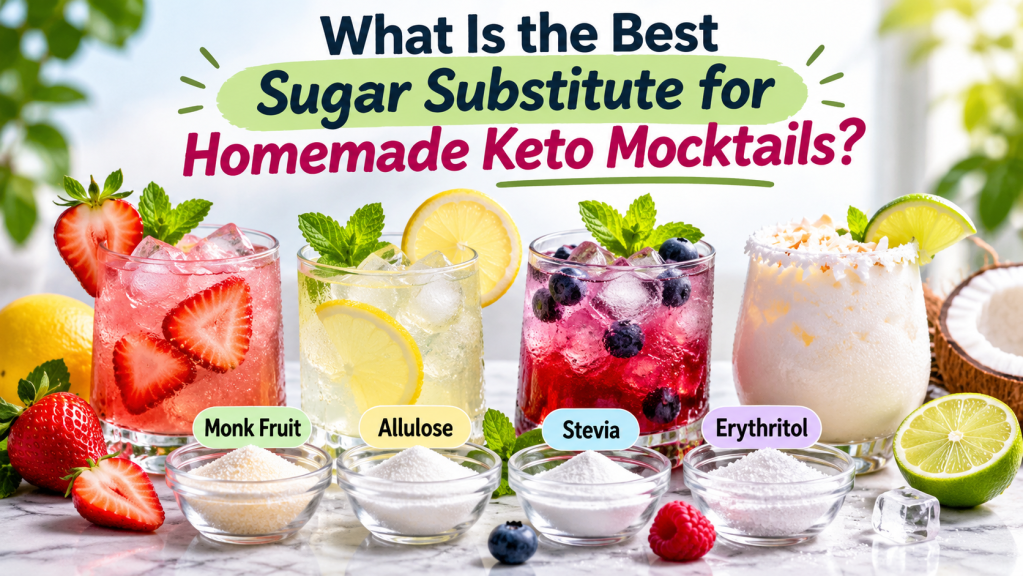
The most popular options include monk fruit, stevia, allulose, and erythritol.
Each has advantages and disadvantages depending on your personal preferences and the recipe you’re preparing.
1. Monk Fruit Sweetener: Best Overall for Keto Mocktails
Monk fruit sweetener is one of the most popular alternatives to sugar for keto-friendly drinks.
It comes from monk fruit, a small fruit native to southern China.
The concentrated sweet compounds in monk fruit, called mogrosides, provide sweetness without the carbohydrates found in regular sugar.
Why monk fruit works well
Monk fruit sweetener offers several benefits:
-
Contains little or no digestible carbohydrate when used in pure form
-
Does not typically raise blood glucose significantly
-
Provides sweetness without regular sugar
-
Works well with citrus and berry flavors
-
Available in convenient liquid drops
-
Requires only small amounts when concentrated
Liquid monk fruit sweetener is particularly useful for cold mocktails because it mixes quickly without leaving undissolved crystals.
Best mocktails for monk fruit
Monk fruit works especially well in:
-
Keto strawberry lemonade
-
Sugar-free raspberry limeade
-
Sparkling blueberry mocktails
-
Keto watermelon coolers
-
Blackberry mint spritzers
-
Coconut lime mocktails
Does monk fruit have an aftertaste?
Some people notice a mild lingering sweetness, particularly when using concentrated products.
However, many find monk fruit smoother than stevia.
For the best flavor, start with a small amount and increase gradually.
Important: Some granulated monk fruit products contain erythritol, dextrose, or other added ingredients. Check the label rather than assuming every monk fruit product is carbohydrate-free.
2. Allulose: Best for a Sugar-Like Taste
Allulose is another excellent sugar substitute for homemade keto mocktails.
It is a rare sugar naturally present in small quantities in certain foods, including figs and raisins.
Although allulose is chemically classified as a sugar, the body metabolizes very little of it for energy.
As a result, it has a minimal effect on blood glucose for most people.
Why allulose is a good choice
Allulose offers several advantages:
-
Tastes remarkably similar to regular sugar
-
Has little bitterness
-
Dissolves well in liquids
-
Works in homemade simple syrup
-
Provides a smooth sweetness
-
Has a minimal impact on blood glucose
Unlike some high-intensity sweeteners, allulose delivers a more traditional sugar-like flavor.
This makes it particularly appealing for people who dislike the taste of stevia or monk fruit.
Best mocktails for allulose
Allulose works beautifully in:
-
Keto lemonade
-
Sugar-free peach mocktails
-
Virgin margaritas
-
Sparkling citrus drinks
-
Keto cranberry spritzers
-
Homemade flavored mocktail syrups
How much allulose should you use?
Allulose is approximately 70% as sweet as regular sugar.
That means you generally need more allulose to achieve the same sweetness.
For example, a recipe requiring one tablespoon of sugar might need approximately 1⅓ to 1½ tablespoons of allulose, depending on the product and personal taste.
Allulose can also cause digestive discomfort when consumed in larger quantities, so moderation is helpful.
3. Liquid Stevia: Best for Low-Carb Drinks With Minimal Sweetener
Stevia is a plant-derived sweetener made from compounds found in the leaves of the stevia plant.
It is significantly sweeter than regular sugar, meaning only a small amount is necessary.
Liquid stevia is particularly convenient for homemade mocktails.
Benefits of liquid stevia
Stevia offers several advantages:
-
Contains virtually no calories in pure form
-
Adds negligible carbohydrates
-
Mixes easily into cold drinks
-
Requires only a few drops
-
Works well with sparkling water
-
Does not generally cause significant blood glucose increases
Because stevia is highly concentrated, measuring carefully is important.
Adding too much can create an unpleasant bitter or licorice-like aftertaste.
Best mocktails for stevia
Liquid stevia works particularly well in:
-
Sparkling lemon water
-
Keto limeade
-
Cucumber mint coolers
-
Sugar-free iced tea mocktails
-
Ginger lime spritzers
-
Herbal citrus drinks
How do you avoid stevia’s bitter aftertaste?
Start with fewer drops than you think you need.
Taste the drink before adding more.
Combining stevia with fresh lemon or lime juice can help balance its flavor.
Some people also prefer stevia blended with monk fruit or allulose because the combination can produce a more rounded sweetness.
4. Erythritol: Best for Homemade Keto Mocktail Syrups
Erythritol is a sugar alcohol commonly used in low-carb and sugar-free recipes.
It contains very few calories and generally has little effect on blood glucose.
Although erythritol can work in mocktails, it behaves differently from regular sugar.
Advantages of erythritol
Erythritol offers several benefits:
-
Provides approximately 60–80% of sugar’s sweetness
-
Has minimal impact on blood glucose
-
Works in some homemade syrups
-
Is widely available in granulated form
-
Can be combined with other sweeteners
What are the disadvantages?
Erythritol sometimes produces a cooling sensation in the mouth.
It also has a tendency to recrystallize when concentrated syrups cool.
This can make it less convenient for refrigerated mocktail syrups.
For that reason, allulose is often a better choice when making a smooth, pourable syrup.
Some observational studies have also raised questions about erythritol and cardiovascular risk. These findings do not establish that consuming erythritol causes cardiovascular events, but they are worth considering if you use it frequently.
Which Keto Sweetener Tastes Most Like Real Sugar?
For many people, allulose provides the closest flavor to traditional sugar.
It offers sweetness without the strong aftertaste associated with some concentrated sweeteners.
However, monk fruit is also an excellent choice, particularly when combined with other ingredients.
Here is how the most common options compare.
| Sweetener | Flavor | Best use |
|---|---|---|
| Liquid monk fruit | Sweet, sometimes lingering | Fruity and citrus mocktails |
| Allulose | Closest to regular sugar | Lemonade and simple syrups |
| Liquid stevia | Very sweet, sometimes bitter | Sparkling and herbal drinks |
| Erythritol | Mild sweetness, cooling sensation | Selected cold drinks and sweetener blends |
For the most natural sugar-like flavor, choose allulose. For convenience in cold mocktails, liquid monk fruit is often the easiest option.
What Is the Best Liquid Sweetener for Cold Keto Mocktails?
Liquid sweeteners are generally more convenient than granulated sweeteners when preparing cold drinks.
Granulated sugar substitutes sometimes dissolve slowly, especially in beverages containing ice.
Liquid monk fruit and liquid stevia eliminate much of that problem.
They can be added directly to a glass or cocktail shaker.
For example, when making keto strawberry lemonade, you can combine fresh strawberries, lemon juice, sparkling water, and liquid monk fruit sweetener without needing to prepare syrup.
This makes liquid sweeteners particularly useful for quick, single-serving mocktails.
If you prefer a sweetener with a sugar-like taste, a prepared allulose syrup is another excellent option.
How Do You Make Keto Simple Syrup Without Sugar?
Traditional simple syrup contains equal parts sugar and water.
It is commonly used in cocktails, mocktails, iced tea, and lemonade.
Fortunately, you can make a keto-friendly version using allulose.
Homemade Keto Simple Syrup Recipe
Preparation time: 2 minutes
Cooking time: 5–7 minutes
Yield: Approximately 1 cup
Ingredients
-
1 cup water
-
1 cup granulated allulose
-
½ teaspoon vanilla extract (optional)
Instructions
-
Pour the water into a small saucepan.
-
Add the granulated allulose.
-
Heat over medium-low heat while stirring.
-
Continue stirring until the allulose dissolves completely.
-
Remove the saucepan from the heat.
-
Add vanilla extract if desired.
-
Allow the syrup to cool.
-
Transfer it to a clean, airtight glass container.
-
Refrigerate until ready to use.
Because allulose is less sweet than sugar, this syrup will be less sweet than traditional equal-parts simple syrup.
You can adjust the concentration or use a little more syrup in your mocktails.
How long does homemade keto syrup last?
Unlike commercial syrups containing preservatives, homemade allulose syrup should be refrigerated.
For best quality, prepare small batches and use them within approximately one week.
Discard the syrup if you notice mold, cloudiness, unusual odors, or other signs of spoilage.
Can You Make Keto Mocktails Without Any Sweetener?
Absolutely.
Not every mocktail needs added sweetness.
Some ingredients naturally provide enough flavor to create a refreshing beverage.
Examples include:
-
Fresh cucumber
-
Lemon juice
-
Lime juice
-
Mint leaves
-
Basil
-
Unsweetened sparkling water
-
Fresh ginger
-
Small amounts of berries
-
Unsweetened herbal tea
For example, a cucumber mint spritzer can be made with muddled cucumber, fresh mint, lime juice, ice, and sparkling water.
The result is a refreshing drink without added sugar or sugar substitutes.
For people who prefer tart or herbal flavors, this may be the simplest approach.
What Sugar Substitute Works Best in Fruity Keto Mocktails?
Fruity mocktails often benefit from a sweetener that balances acidity without overpowering the natural fruit flavor.
Monk fruit and allulose are particularly good choices.
Strawberry mocktails
Liquid monk fruit works well with strawberries because it provides sweetness without requiring traditional simple syrup.
Raspberry mocktails
Allulose can help balance the tartness of fresh raspberries.
Blueberry mocktails
Liquid monk fruit or stevia can enhance blueberry flavor when used sparingly.
Watermelon mocktails
Watermelon naturally contains sugar, so using a small measured portion and adding liquid stevia can provide sweetness without adding more sugar.
Blackberry mocktails
Allulose pairs nicely with the slightly tart, earthy flavor of blackberries.
Remember that fresh fruit still contributes carbohydrates, even when the drink contains a sugar-free sweetener.
For strict keto diets, portion sizes matter.
What Is the Best Sweetener for Keto Lemonade?
Lemonade is one of the easiest beverages to transform into a keto-friendly mocktail.
Traditional lemonade often contains large amounts of sugar.
Replacing that sugar with monk fruit or allulose can significantly reduce the carbohydrate content.
Easy Keto Lemonade Recipe
Preparation time: 5 minutes
Servings: 2
Ingredients
-
2 cups cold water
-
¼ cup freshly squeezed lemon juice
-
Liquid monk fruit sweetener, to taste
-
Ice cubes
-
Fresh lemon slices for garnish
Instructions
-
Pour the cold water into a pitcher.
-
Add the freshly squeezed lemon juice.
-
Add a small amount of liquid monk fruit sweetener.
-
Stir thoroughly.
-
Taste and adjust the sweetness.
-
Fill two glasses with ice.
-
Pour the lemonade over the ice.
-
Garnish with fresh lemon slices.
For a sparkling variation, replace regular water with unsweetened sparkling water.
This simple recipe creates a refreshing lemonade without added sugar.
What Is the Best Sweetener for Creamy Keto Mocktails?
Creamy mocktails often contain coconut milk, almond milk, or heavy cream.
These ingredients create a rich texture that pairs well with certain sugar substitutes.
Allulose and monk fruit are particularly effective.
For example, a creamy keto coconut mocktail can be prepared using unsweetened coconut milk, lime juice, ice, and liquid monk fruit sweetener.
Allulose also works well in creamy beverages because its flavor resembles regular sugar.
Stevia can be used, but its aftertaste may be more noticeable in mildly flavored drinks.
For creamy keto mocktails, always choose unsweetened milk alternatives and check the nutrition labels.
Sweetened coconut milk and flavored almond milk can contain substantial added sugar.
Can You Use Sugar-Free Flavored Syrups in Keto Mocktails?
Yes, but not every sugar-free syrup is necessarily keto-friendly.
Some commercial syrups contain ingredients that may contribute digestible carbohydrates.
Others use sweeteners that can cause digestive discomfort when consumed in larger amounts.
Before purchasing a sugar-free syrup, examine the ingredient list and nutrition facts.
Pay particular attention to:
-
Total carbohydrates
-
Serving size
-
Added sugars
-
Maltitol or other sugar alcohols
-
Dextrose and maltodextrin
-
Artificial flavorings
-
Sweetener blends
A syrup labeled sugar-free may still contain carbohydrates.
Products sweetened with monk fruit, stevia, or allulose can be convenient choices when their full ingredient lists fit your dietary goals.
Are Artificial Sweeteners Good for Keto Mocktails?
Artificial sweeteners such as sucralose and aspartame can also be used in low-carb beverages.
They generally provide sweetness with little or no carbohydrate when used in concentrated forms.
However, they differ in flavor and performance.
Sucralose
Sucralose is highly sweet and commonly used in sugar-free beverages.
Liquid sucralose can work well in cold mocktails.
Some powdered versions contain carbohydrate-based bulking agents, so checking the label is important.
Aspartame
Aspartame is another low-calorie sweetener found in many diet beverages.
It can work in cold drinks but is less useful for recipes requiring prolonged heating.
People with phenylketonuria (PKU) must avoid aspartame because it contains phenylalanine.
Although artificial sweeteners can fit into keto-friendly recipes, many home mocktail makers prefer monk fruit, stevia, or allulose for their particular flavor profiles.
How Much Sugar Substitute Should You Add to a Keto Mocktail?
The correct amount depends on the sweetener’s concentration, the ingredients in your drink, and your personal preference.
Concentrated liquid monk fruit and stevia products vary considerably in sweetness.
Always follow the manufacturer’s conversion guidance rather than assuming that one drop or teaspoon is equivalent across brands.
For the best results:
-
Prepare the mocktail without sweetener.
-
Taste the drink to determine how tart it is.
-
Add a small amount of your chosen sweetener.
-
Stir or shake thoroughly.
-
Taste again.
-
Continue adjusting until the flavor is balanced.
This approach helps prevent overly sweet drinks.
It also allows the natural flavors of fresh fruit, herbs, and citrus to remain noticeable.
What Are the Biggest Mistakes When Sweetening Keto Mocktails?
Even experienced home cooks sometimes make mistakes when working with sugar substitutes.
Adding too much sweetener
Highly concentrated sweeteners can quickly overpower a drink.
Start small and adjust gradually.
Using granulated sweetener in ice-cold drinks
Some granulated sweeteners dissolve poorly in cold liquids.
Choose liquid sweeteners or prepared syrups when possible.
Ignoring carbohydrates from other ingredients
A sugar-free sweetener does not automatically make the entire mocktail keto-friendly.
Fruit juice, coconut products, and flavored mixers may still contain carbohydrates.
Choosing sweeteners without reading labels
Some products marketed as monk fruit or stevia contain additional ingredients.
Check the complete nutrition information.
Forgetting to balance acidity
Sweetness alone does not create a delicious mocktail.
Fresh lemon juice, lime juice, herbs, and sparkling water help build a balanced flavor.
Frequently Asked Questions
Is monk fruit or stevia better for keto mocktails?
Monk fruit is often preferred by people who dislike stevia’s bitter aftertaste. Both can work well in keto mocktails, especially in liquid form.
Is allulose better than erythritol for drinks?
Allulose is generally better for homemade mocktail syrups because it has a sugar-like taste and is less prone to recrystallization.
Can you use Splenda in keto mocktails?
Yes, some Splenda products can fit into keto-friendly drinks. However, formulations vary, and certain powdered versions contain carbohydrate-based fillers. Check the label before using them.
Does monk fruit sweetener break ketosis?
Pure monk fruit sweetener generally does not contribute meaningful digestible carbohydrates and is unlikely to interfere with ketosis. Blended products may contain additional ingredients that affect carbohydrate intake.
What is the healthiest sugar substitute for keto mocktails?
There is no single healthiest option for everyone. Monk fruit, stevia, and allulose can all be reasonable choices. Personal tolerance, overall dietary habits, and the amount consumed matter.
Can you mix two keto sweeteners together?
Yes. Combining sweeteners can improve flavor. For example, small amounts of monk fruit and allulose may create a more balanced sweetness than either one alone.
What is the cheapest sweetener for homemade keto mocktails?
The most economical option depends on local prices, concentration, and how frequently you prepare drinks. Concentrated liquid stevia can be cost-effective because each serving requires very little.
Can keto sweeteners cause stomach problems?
Some can. Allulose and certain sugar alcohols may cause bloating, gas, or diarrhea, especially in larger amounts. Individual tolerance varies.
Do keto mocktails need to taste less sweet than regular mocktails?
No. Keto mocktails can taste just as sweet as traditional mocktails when the correct sweetener and amount are used.
Final Thoughts: What Is the Best Sugar Substitute for Homemade Keto Mocktails?
The best sugar substitute for homemade keto mocktails depends on the type of drink you’re making and the flavor you prefer.
Liquid monk fruit is the best all-around choice for convenience, especially when preparing fruity, citrus, and sparkling mocktails.
Allulose is an excellent alternative when you want a sweetness that closely resembles regular sugar. It is particularly useful for homemade keto simple syrup.
Liquid stevia is another convenient option for refreshing low-carb beverages, although some people find its aftertaste less appealing.
Erythritol can work in certain recipes, but its cooling sensation and tendency to crystallize make it less versatile for mocktails.
Ultimately, the secret to a delicious keto mocktail isn’t simply replacing sugar. It’s creating the right balance of sweetness, acidity, freshness, and flavor.
With the right sugar substitute, you can enjoy homemade strawberry lemonade, sparkling berry spritzers, tropical coconut coolers, and countless other refreshing drinks without relying on traditional added sugar.
Whether you’re following a ketogenic lifestyle, reducing added sugar, or simply experimenting with healthier beverage options, these alternatives make it easier to create flavorful mocktails at home.
Leave a Reply