Category: Grief & Child Loss

  • Grief of the Day: Finding Hope One Day at a Time

    Grief of the Day: Finding Hope One Day at a Time

    Advertisements

    Grief has a way of changing everything.

    It changes how you wake up in the morning. It changes how you see the world. It changes the dreams you once had and the plans you once made. The person you were before loss no longer exists in quite the same way. Whether you have lost a child, a spouse, a parent, a sibling, or a dear friend, grief reshapes your heart in ways that are difficult to explain to someone who has never experienced profound loss.

    One of the hardest parts of grief is believing there can ever be hope again.

    After all, how do you find hope when your world has fallen apart?

    How do you smile when your heart is broken?

    How do you make plans for tomorrow when simply getting through today feels impossible?

    The answer isn’t found in pretending everything is okay.

    It isn’t found in forgetting the one you love.

    It isn’t found in rushing through the grieving process.

    Hope is found in something much simpler.

    It is found one day at a time.

    Grief Makes the Future Feel Overwhelming

    One of grief’s greatest lies is convincing us that today’s pain will last forever.

    When someone we deeply love dies, our minds naturally begin looking ahead.

    You wonder how you’ll survive the holidays.

    You wonder what birthdays will feel like.

    You wonder how anniversaries will ever stop hurting.

    You wonder if you’ll ever laugh without feeling guilty.

    You wonder whether life will ever feel meaningful again.

    These thoughts are understandable because grief wants answers immediately.

    Unfortunately, healing doesn’t work that way.

    None of us are equipped to carry years of pain all at once.

    That’s why Jesus reminds us in Matthew 6:34:

    “Therefore do not worry about tomorrow, for tomorrow will worry about itself. Each day has enough trouble of its own.”

    Even outside the context of grief, these words carry incredible wisdom.

    God invites us to live today.

    Not next month.

    Not next year.

    Today.

    Hope Isn’t a Destination

    Many grieving people think hope is something they’ll suddenly wake up feeling.

    “I’ll know I’ve healed when…”

    “I’ll know I’ve found hope when…”

    But hope rarely arrives as a dramatic emotional breakthrough.

    More often, hope quietly grows beneath the surface.

    It’s waking up and making your bed.

    It’s answering a friend’s phone call.

    It’s cooking dinner after weeks of ordering takeout.

    It’s walking outside for ten minutes.

    It’s praying even when all you can say is, “Lord, help me.”

    Hope grows through ordinary moments.

    Those tiny decisions often become the foundation for extraordinary healing months or even years later.

    Healing Happens in Inches, Not Miles

    Our culture celebrates dramatic transformations.

    Before-and-after stories.

    Instant success.

    Quick recoveries.

    Grief ignores all of those timelines.

    Healing after profound loss is usually measured in inches.

    Perhaps today you cried for thirty minutes instead of three hours.

    Maybe you finally listened to your loved one’s favorite song again.

    Perhaps you visited the cemetery for the first time.

    Maybe you laughed without immediately feeling guilty.

    Those may seem insignificant to someone else.

    To a grieving heart, they are enormous victories.

    Never underestimate small steps.

    Small steps repeated over time create lasting healing.

    The Importance of Being Present

    Many grieving people replay the past over and over.

    “What if I had called?”

    “What if I had stayed?”

    “What if I had noticed something sooner?”

    Others become consumed by the future.

    “How will I survive Christmas?”

    “What happens when everyone stops checking on me?”

    “What will retirement look like without them?”

    Both directions rob us of the present.

    Today is where healing begins.

    Not because today is easy.

    But because today is manageable.

    When today feels overwhelming, reduce your focus even further.

    Focus on the next hour.

    Then the next fifteen minutes.

    Sometimes hope is simply deciding to make it until bedtime.

    And that is enough.

    Finding Hope in Small Blessings

    After loss, life can feel empty.

    Colors seem dull.

    Music loses its beauty.

    Celebrations become reminders of who is missing.

    Yet slowly, almost unexpectedly, tiny moments begin to appear.

    A child smiles at you in the grocery store.

    A sunset captures your attention.

    A stranger holds the door open.

    You hear your loved one’s favorite song and smile before you cry.

    You notice a cardinal perched outside your window.

    These moments are not replacements for the person you lost.

    They are reminders that beauty still exists.

    Grief narrows our vision until all we can see is pain.

    Hope slowly widens that vision again.

    Grief and Gratitude Can Exist Together

    Some people believe gratitude means minimizing loss.

    It doesn’t.

    You can be thankful for twenty-one wonderful years with your son while still wishing you had another twenty-one.

    You can treasure every memory while grieving every future memory that will never happen.

    Gratitude doesn’t erase sorrow.

    It simply reminds us that love existed.

    The depth of your grief reflects the depth of your love.

    That love remains one of life’s greatest gifts.

    There Will Be Setbacks

    Healing is never a straight line.

    You’ll have good days.

    Then unexpectedly, you’ll have terrible ones.

    A smell.

    A photograph.

    A birthday.

    A holiday.

    An empty chair.

    A familiar laugh.

    Something seemingly insignificant can send you right back into deep sorrow.

    This doesn’t mean you’ve failed.

    It doesn’t mean you’re starting over.

    It simply means love still lives in your heart.

    Grief is not a staircase.

    It’s an ocean.

    Some days the waves are calm.

    Other days they crash over you without warning.

    Eventually, however, you become stronger at surviving the waves.

    Hope Through Faith

    For Christians, hope is more than positive thinking.

    Hope is confidence that God is present even when we cannot feel Him.

    Psalm 34:18 reminds us:

    “The LORD is close to the brokenhearted and saves those who are crushed in spirit.”

    Notice that Scripture doesn’t say God avoids broken hearts.

    It says He draws near to them.

    When Jesus stood at Lazarus’ tomb, He already knew resurrection was coming.

    Yet He still wept.

    Those two simple words—”Jesus wept”—remind us that grief is not weakness.

    It is love expressed through tears.

    If the Son of God cried over loss, we should never feel ashamed for crying over ours.

    Living Without Leaving Them Behind

    Many grieving parents wrestle with guilt.

    “If I smile today, am I forgetting them?”

    “If I fall in love again, am I replacing them?”

    “If I chase my dreams, am I dishonoring their memory?”

    The answer is no.

    Love is not limited.

    Our hearts are capable of carrying both grief and joy.

    Your loved one shaped who you are.

    Nothing can erase that.

    Living fully is not abandoning their memory.

    It is carrying their influence into every tomorrow you are blessed to experience.

    Their story continues through your kindness.

    Through your faith.

    Through the lessons they taught you.

    Through every person you encourage because you understand suffering.

    Practical Ways to Find Hope Every Day

    Healing isn’t only emotional or spiritual. It also involves daily habits that gently move you forward.

    Consider incorporating these simple practices into your routine:

    • Begin each morning with a short prayer, even if it’s only one sentence.
    • Read a few verses of Scripture each day.
    • Keep a gratitude journal and write down three blessings, no matter how small.
    • Take a short walk outside and notice God’s creation.
    • Drink enough water and nourish your body with healthy meals.
    • Reach out to one trusted friend or family member each week.
    • Share a favorite memory of your loved one instead of avoiding their name.
    • Volunteer or encourage someone else who is struggling.
    • Allow yourself to cry without apologizing for your emotions.
    • End each day by thanking God for carrying you through another twenty-four hours.

    These habits won’t remove your grief.

    They create space for hope to grow.

    Encouraging Other Grieving Hearts

    One of the surprising gifts that often comes from suffering is compassion.

    People who have experienced deep loss understand pain in a way few others can.

    Your story may someday become someone else’s lifeline.

    The words you speak.

    The hug you offer.

    The prayer you pray.

    The quiet understanding you provide.

    All of these can become evidence that healing is possible.

    Your scars may never disappear.

    But they can become reminders of God’s faithfulness through the darkest seasons of life.

    Final Thoughts

    Finding hope after devastating loss is not about pretending the pain has disappeared.

    It is about believing that love is stronger than death, that God has not abandoned you, and that your story still has purpose.

    Hope is not measured by how often you smile.

    It is measured by your willingness to keep living despite your sorrow.

    Some days hope will look like laughter.

    Other days it will look like tears.

    Sometimes hope simply looks like getting out of bed.

    Every one of those moments matters.

    If today feels overwhelming, remember this:

    You don’t have to heal your entire heart before sunset.

    You don’t have to answer every question about the future.

    You don’t have to stop missing the person you love.

    You only have to take the next step.

    Then tomorrow, take another.

    One prayer.

    One breath.

    One sunrise.

    One act of courage.

    One day at a time.

    And as those days slowly become weeks, months, and years, you may discover something remarkable.

    Not that your grief disappeared.

    But that hope quietly grew beside it.

    Prayer for Today

    Heavenly Father,

    Some days the road through grief feels longer than I can bear. My heart still aches for the one I love, and there are moments when hope seems far away. Yet today I choose to trust that You are walking beside me, even when I cannot see the path ahead. Give me strength for this day alone. Fill my heart with Your peace when sorrow feels overwhelming, and remind me that You are close to the brokenhearted. Help me honor my loved one by living with faith, kindness, and purpose. Open my eyes to the small blessings You place before me each day, and let those moments remind me that Your love never fails. Thank You for carrying me through every tear, every memory, and every step toward healing.

    In Jesus’ name, Amen.

    Bible Verses for Hope During Grief

    • Psalm 34:18 – “The LORD is close to the brokenhearted and saves those who are crushed in spirit.”
    • Isaiah 41:10 – “Fear not, for I am with you…”
    • Romans 15:13 – “May the God of hope fill you with all joy and peace as you trust in Him…”
    • Lamentations 3:22–23 – “His compassions never fail. They are new every morning.”
    • Revelation 21:4 – “He will wipe every tear from their eyes.”

    No matter where you are in your grief journey today, remember this truth:

    Hope doesn’t require giant leaps. It begins with a single step—and by God’s grace, that step is enough for today.

    Read More Of Grief & Child Loss

  • Grief of the Day: Carrying Their Memory Into Tomorrow

    Advertisements

    One of the greatest fears after losing someone we love is the fear that they will be forgotten. Time moves forward. Seasons change. New memories are made. The world continues as though nothing happened, while our own world was forever changed.

    For those of us living with grief, tomorrow is not about leaving our loved one behind. It is about learning how to carry them with us.

    Their physical presence may be gone, but their influence, their love, and the life they shared with us continue to shape who we are. Every tomorrow becomes another opportunity to honor them—not by remaining trapped in yesterday, but by allowing their memory to inspire the way we live today.

    Love Doesn’t Stay in the Past

    Grief often convinces us that moving forward somehow means moving away from the person we lost.

    Nothing could be further from the truth.

    The relationship changes, but it does not end.

    You may no longer hear their voice or see their smile, yet their impact lives on in countless ways:

    • The lessons they taught you.
    • The values they instilled.
    • The traditions you continue.
    • The kindness they inspired.
    • The strength they helped you discover.

    Love was never confined to a single lifetime. It continues through every act of compassion, every story shared, and every life touched because they once existed.

    Tomorrow Doesn’t Mean Forgetting

    Many grieving parents, spouses, siblings, and friends wrestle with guilt whenever they begin to smile again or enjoy life.

    They wonder:

    “Am I leaving them behind?”

    The answer is no.

    Your loved one is part of every tomorrow you experience.

    Living your life does not erase your grief.

    Finding happiness does not diminish your love.

    Healing does not cancel your memories.

    Instead, healing allows those memories to become a source of strength instead of only pain.

    Carry Their Legacy

    Every person leaves something behind.

    Sometimes it is a career.

    Sometimes it is a family.

    Sometimes it is simply the way they loved others.

    Ask yourself:

    • What would they hope I continue?
    • What qualities did they admire?
    • How can I reflect the goodness they brought into this world?

    Perhaps they were generous.

    Become more generous.

    Perhaps they encouraged others.

    Continue encouraging people.

    Perhaps they made others laugh.

    Keep sharing joy.

    When we choose to live out the best parts of those we lost, their legacy continues far beyond their years.

    Some Days Will Still Hurt

    There will always be difficult days.

    Birthdays.

    Anniversaries.

    Holidays.

    Random Tuesday afternoons when a song suddenly plays.

    A familiar scent.

    A photograph.

    A place you once visited together.

    Grief does not follow a calendar.

    It arrives unexpectedly.

    When those moments come, allow yourself to remember without apology.

    Tears are not weakness.

    They are evidence that love still exists.

    The goal is not to stop missing them.

    The goal is to continue loving them while continuing to live.

    Carrying Them Through Your Choices

    One of the most meaningful ways we honor someone is through the choices we make.

    Every time you choose kindness over bitterness…

    Hope over despair…

    Compassion over anger…

    Faith over fear…

    You carry part of them into tomorrow.

    For many grieving parents, that may mean helping another grieving family.

    For others, it may mean volunteering, mentoring, serving their church, or simply loving their family with greater intention.

    Our loved ones continue changing the world through the lives they touched—including ours.

    Their Story Continues Through You

    The people we lose never stop being part of our story.

    We tell their stories.

    We speak their names.

    We laugh about their funny moments.

    We cry over the memories.

    We celebrate who they were.

    As long as someone remembers them, their story continues.

    And every time we choose love over hopelessness, we write another chapter in the legacy they left behind.

    A Gentle Reminder for Today

    If your heart feels heavy today, remember this:

    You are not carrying your grief alone.

    You are carrying a lifetime of love.

    Every tomorrow you face is another opportunity to honor the one you miss—not by pretending the pain is gone, but by allowing their memory to shape the person you are becoming.

    Carry them in your heart.

    Carry them in your words.

    Carry them in your actions.

    Carry them into tomorrow.

    Because love never truly ends.

    It simply learns a new way to stay.


    Reflection of the Day

    The people we love leave fingerprints on our hearts that time can never erase. Every act of kindness, every lesson remembered, every story shared, and every step taken with courage becomes a way of carrying them forward. While grief may walk beside you, so does love—and love is strong enough to reach into every tomorrow.

    “Those we love may leave this world, but they never leave the hearts that continue to love them.”

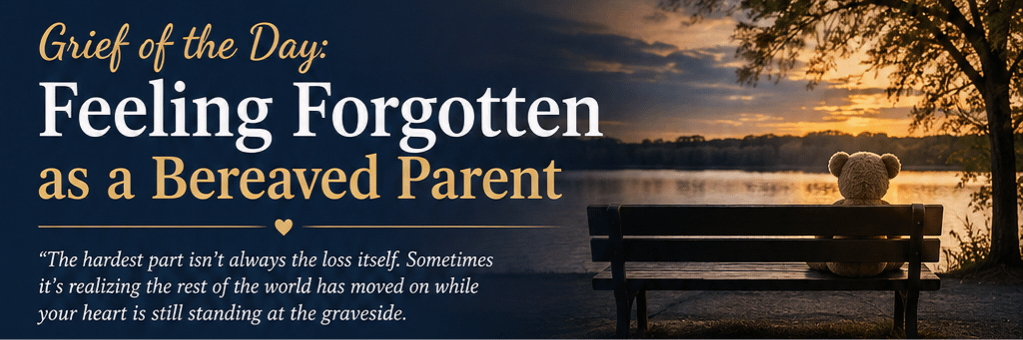
  • Grief of the Day: Feeling Forgotten as a Bereaved Parent

    Advertisements

    “The hardest part isn’t always the loss itself. Sometimes it’s realizing the rest of the world has moved on while your heart is still standing at the graveside.”

    There is a unique loneliness that comes with being a bereaved parent. While the world continues to celebrate birthdays, graduations, weddings, and family milestones, you quietly carry the weight of a child who should still be here. Over time, something else often happens that can be just as painful—you begin to feel forgotten.

    Not because people stopped caring intentionally.

    But because life continued for everyone else.

    For grieving parents, however, life is forever divided into two chapters: before and after.

    The Silence That Grows

    In the weeks following the loss of a child, friends and family often reach out with meals, cards, phone calls, and prayers. Their love is genuine, and their compassion is appreciated.

    Then the weeks become months.

    The months become years.

    The phone rings less often.

    The messages stop.

    Your child’s name is rarely mentioned.

    People may assume you’ve “healed.”

    The truth is, you haven’t forgotten for a single day.

    You never will.

    Every sunrise reminds you they aren’t here to see it.

    Every holiday has an empty chair.

    Every family gathering quietly echoes with someone missing.

    Why People Stop Talking About Your Child

    Many people avoid mentioning your child because they fear bringing up painful memories.

    Ironically, the opposite is true.

    Bereaved parents are already thinking about their child every single day.

    Hearing someone say their name doesn’t create the pain.

    It acknowledges the love.

    One simple sentence can mean everything:

    “I was thinking about Paul today.”

    “I remember his smile.”

    “I still miss him too.”

    Those words remind grieving parents that their child mattered—not just to them, but to others as well.

    Feeling Invisible

    One of the cruelest parts of grief is becoming invisible.

    People ask how your spouse is doing.

    They ask how your other children are doing.

    But no one asks about you.

    As a parent, you’ve spent your life caring for others.

    Now you’re quietly carrying unimaginable pain while trying to function in a world that expects you to return to normal.

    You smile at work.

    You attend family events.

    You laugh when appropriate.

    But inside, there’s a part of you that is still waiting for someone to simply ask,

    “How is your heart today?”

    The World Keeps Moving

    One of grief’s greatest challenges is watching everyone else’s lives continue.

    Children grow older.

    Friends become grandparents.

    Families take vacations.

    Social media fills with celebrations.

    Meanwhile, your child remains forever the same age.

    Time continues.

    Your memories do not.

    The calendar moves forward while your heart often remains anchored to the day everything changed.

    That disconnect can make you feel forgotten by the world around you.

    You Are Still a Parent

    Losing a child does not erase your identity.

    You are still a mother.

    You are still a father.

    Your child may no longer walk beside you, but they will always live within your heart.

    The title of “parent” doesn’t disappear because death entered your story.

    Love doesn’t end at the cemetery.

    Parenthood doesn’t expire.

    You carry it every day.

    It’s Okay to Speak Their Name

    Many grieving parents find themselves protecting other people from their grief.

    They stop mentioning their child because they don’t want to make others uncomfortable.

    But your child’s story deserves to be told.

    Speak their name.

    Share their photographs.

    Tell their funny stories.

    Celebrate their birthday.

    Honor their memory.

    Love spoken aloud keeps memories alive.

    If You Feel Forgotten

    If today you feel invisible…

    If you feel like everyone else has moved on…

    If you wonder whether anyone remembers your child…

    Please know this:

    You are not forgotten.

    Your child is not forgotten.

    Across the world, millions of bereaved parents understand exactly what your heart feels today.

    They know the silence.

    They know the anniversaries.

    They know the tears that arrive unexpectedly in grocery stores, at stoplights, or late at night when everyone else is asleep.

    You are part of a community that no one wanted to join—but one that understands without explanation.

    Ways to Honor Your Child When Others Forget

    When the world grows quiet, you can continue honoring your child’s life in meaningful ways.

    • Light a candle in their memory.
    • Visit a place they loved.
    • Share a favorite story with someone.
    • Donate to a cause in their honor.
    • Write them a letter.
    • Create something beautiful because they lived.
    • Help another grieving parent who feels alone.

    Every act of remembrance declares:

    Their life mattered.

    Final Thoughts

    Feeling forgotten as a bereaved parent is one of grief’s hidden wounds. It can make an already unbearable loss feel even heavier.

    But remember this truth:

    Your love did not end.

    Your child is still part of your story.

    Their life continues to matter because they mattered to you.

    Never let silence convince you that your child has been forgotten.

    Every heartbeat of a grieving parent is proof that love survives loss.

    And every time you speak their name, share their story, or choose to live in a way that honors them, you remind the world that they were here, they were loved, and they will never truly be forgotten.

    Grief of the Day: The world may move on, but a parent’s love never does. If you feel forgotten today, remember that your child changed your life forever—and that love continues to shape who you are. Their memory deserves to be carried with pride, and so do you.

    A Father’s Guide to Surviving the Loss of a Child

  • Grief of the Day: Healing Doesn’t Mean Forgetting

    Advertisements

    One of the greatest fears grieving people carry is not the pain itself—it is the fear of what healing might mean.

    Many people quietly ask themselves questions they are almost afraid to say out loud.

    “If I laugh again, am I forgetting them?”

    “If I start enjoying life, does that mean I didn’t love them enough?”

    “If I stop crying every day, will people think I’ve moved on?”

    These thoughts are incredibly common after losing someone you deeply love. Whether you have lost a child, spouse, parent, sibling, or close friend, grief can convince you that remaining in pain is somehow the price you must continue paying for your love.

    But love has never been measured by suffering.

    Your love was real before the loss, during the loss, and it remains real today. It does not become stronger because you refuse to smile, nor does it become weaker because your heart begins to heal.

    Why Healing Feels So Frightening

    Grief changes every part of your world.

    It changes your routines.

    It changes your priorities.

    It changes your identity.

    The future you once imagined suddenly disappears, leaving you trying to understand a life you never wanted.

    In those early days, pain almost becomes a companion. It reminds you every waking moment that your loved one mattered. Over time, many grieving people become afraid that if the pain fades, so will the memory.

    But memories are not kept alive by suffering.

    They are kept alive by love.

    They live in your stories.

    They live in your traditions.

    They live in the lessons you pass on.

    They live every time you speak their name.

    Love Never Ends

    One of the beautiful truths about love is that death cannot erase it.

    Your loved one may no longer sit beside you at dinner.

    You may never again hear their voice, receive another hug, or celebrate another birthday together.

    But the relationship you shared continues to shape who you are.

    Perhaps you smile because of something they taught you.

    Perhaps you help someone because they showed you compassion.

    Perhaps you choose kindness because that’s how they lived.

    Love leaves fingerprints on the heart that never disappear.

    Healing Is Not Leaving Them Behind

    Many grieving parents tell themselves they have only two choices:

    • Keep hurting forever to prove their love.
    • Heal and somehow leave their child behind.

    The truth is neither choice is real.

    Healing does not mean walking away from your loved one.

    Healing means learning to carry them differently.

    Instead of carrying only the pain, you begin carrying the love.

    Instead of remembering only the day they died, you begin remembering the life they lived.

    Instead of asking why they were taken, you begin asking how their life can continue making a difference through yours.

    That transition doesn’t happen overnight.

    Sometimes it takes years.

    Sometimes it takes decades.

    There is no timetable for grief.

    Guilt Is One of Grief’s Greatest Burdens

    Grief often introduces guilt into nearly every part of life.

    You feel guilty for smiling.

    Guilty for celebrating.

    Guilty for taking a vacation.

    Guilty for enjoying holidays.

    Guilty for laughing at a joke.

    Guilty for making new memories.

    For bereaved parents especially, guilt can become overwhelming because life feels unfair. Your child doesn’t get another birthday, another Christmas, another chance to chase dreams. So how can you possibly enjoy yours?

    Yet love was never intended to become lifelong punishment.

    The person you love would never want your entire life defined only by sadness.

    They would want you to continue living.

    Not because they are forgotten.

    But because they loved you too.

    Healing Happens in Small Moments

    People often imagine healing as one dramatic breakthrough.

    In reality, healing usually arrives quietly.

    It may be the first morning you wake up without crying immediately.

    It may be hearing their favorite song and smiling before the tears come.

    It may be telling a funny story about them instead of avoiding their name.

    It may be planting flowers in their memory.

    It may be helping another grieving parent.

    It may be finding purpose where there once seemed to be none.

    These small moments do not erase grief.

    They simply remind you that grief and hope can exist together.

    Carrying Their Legacy Forward

    One of the most meaningful ways to honor someone is to allow their life to continue influencing others.

    You can carry their legacy by:

    • Showing compassion to someone who is hurting.
    • Sharing stories that keep their memory alive.
    • Supporting causes that mattered to them.
    • Volunteering in your community.
    • Creating scholarships, memorials, or annual traditions.
    • Becoming the kind of person they believed you could be.

    When love changes how you live, the person you lost continues making an impact through your life.

    That is a beautiful legacy.

    When the Hard Days Return

    Healing does not mean grief disappears forever.

    There will still be birthdays that hurt.

    Anniversaries that reopen old wounds.

    Songs that suddenly bring tears.

    Family gatherings with an empty chair.

    Unexpected moments that take your breath away.

    These days are not failures.

    They are reminders of how deeply you loved.

    Even years later, grief may revisit you without warning.

    Welcome those memories with grace.

    Cry if you need to.

    Smile when you can.

    Both responses honor the love you shared.

    Give Yourself Permission to Live

    Today, give yourself permission to take one small step toward healing.

    Go outside and feel the warmth of the sun.

    Call someone who understands your pain.

    Write a letter to your loved one.

    Look through photographs.

    Pray.

    Take a walk.

    Help a stranger.

    Laugh without apologizing.

    Dream about tomorrow.

    None of these things diminish your love.

    They simply remind you that your own life still has purpose.

    Your loved one’s story became part of your story.

    Now allow your story to become one of hope for someone else who is walking through unimaginable loss.

    Final Thoughts

    Healing is one of the greatest acts of courage a grieving heart can choose.

    It is not forgetting.

    It is not replacing.

    It is not moving on as though nothing happened.

    It is moving forward while carrying love, memories, and hope together.

    The pain may always remain somewhere within you, but it no longer has to define every moment of your life.

    You can honor the past while embracing the future.

    You can remember every precious moment while still creating new ones.

    You can miss them every day and still discover reasons to smile.

    That is not betrayal.

    That is love finding a new way to live.

    Grief of the Day

    Healing doesn’t erase the love you carry. It allows that love to become a source of strength, compassion, and hope—for yourself and for everyone whose life you touch.

    A Father’s Guide to Surviving the Loss of a Child

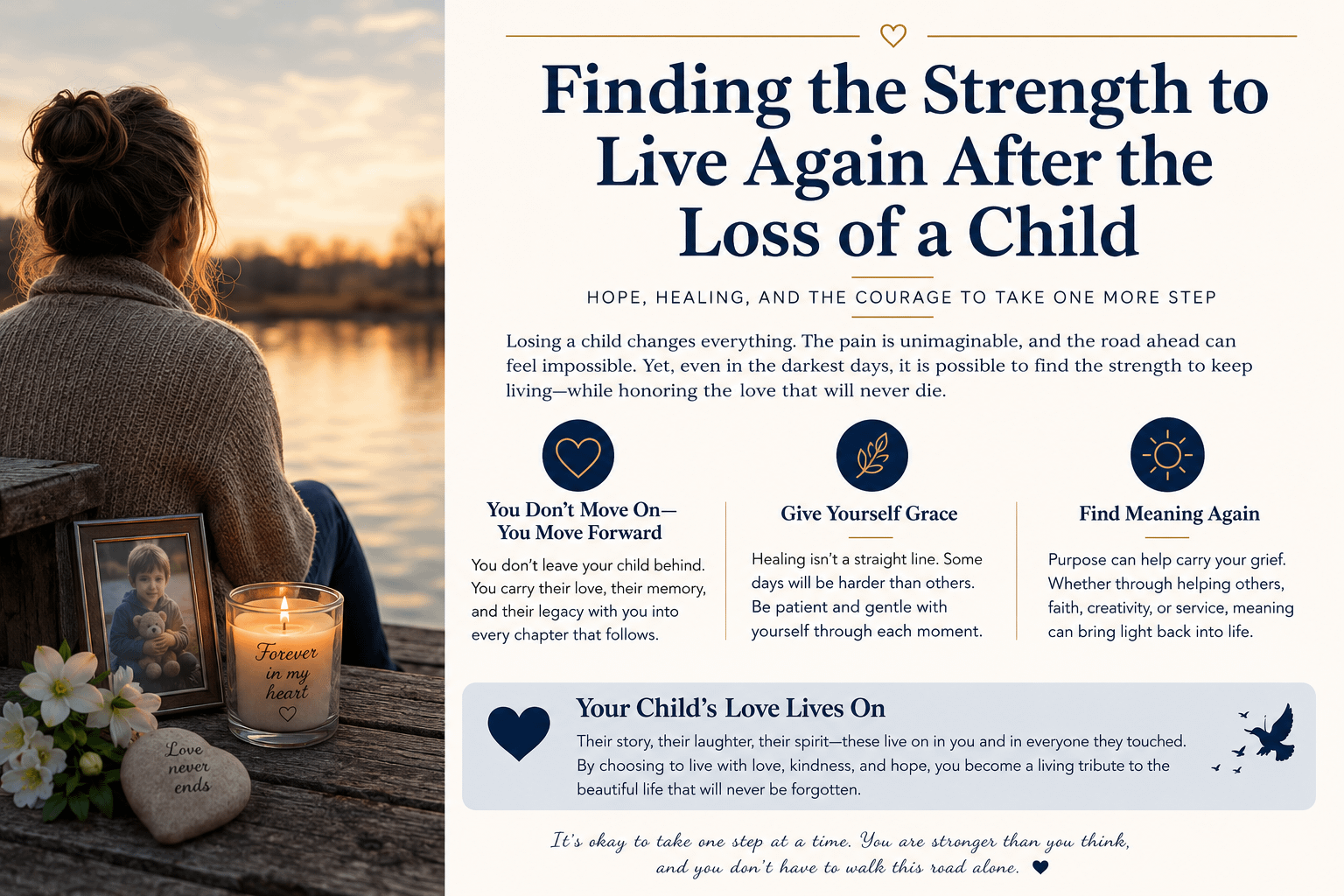
  • Finding the Strength to Live Again After the Loss of a Child

    Advertisements

    Losing a child changes everything.

    There is life before the loss, and there is life after it. The person you were before that heartbreaking day no longer exists in quite the same way. Your priorities change. Your heart changes. Even the simplest parts of daily life can feel unfamiliar.

    As a parent, you never expect to outlive your child. You dream about watching them grow, celebrating their accomplishments, and sharing milestones together. When those dreams are suddenly taken away, it can feel as though your own future disappeared with them.

    If you are reading this after losing your son or daughter, I want you to know something important:

    You are not weak because you’re struggling.

    You are carrying one of the heaviest burdens a human being can endure.

    Finding the courage to move forward isn’t about forgetting your child. It isn’t about pretending everything is okay. It is about learning how to carry unimaginable grief while slowly allowing yourself to live again.


    The Fear of Moving Forward

    Many bereaved parents become trapped by a painful question:

    “If I begin living again, am I leaving my child behind?”

    The answer is no.

    Love does not end because life continues.

    Your child will always be part of your heart, your story, and your identity.

    The fear often comes from guilt.

    You may feel guilty for laughing.

    Guilty for smiling.

    Guilty for taking a vacation.

    Guilty for celebrating a birthday.

    Guilty for enjoying a holiday.

    Sometimes even guilty for waking up.

    Those feelings are common after child loss, but they are not a measure of your love.

    Your love was never dependent upon your suffering.


    Grief Wants to Convince You to Stop Living

    Grief has a way of whispering lies.

    It tells you:

    • You don’t deserve happiness.
    • Nobody understands.
    • Life has no purpose anymore.
    • You’ll never feel joy again.
    • Moving forward means forgetting.

    None of these things are true.

    Grief changes your life, but it does not erase your worth.

    There will always be difficult days. There will always be moments when the pain catches you off guard. Certain songs, birthdays, holidays, or places may bring tears years later.

    That doesn’t mean you are moving backward.

    It means you loved deeply.


    Courage Doesn’t Mean You’re No Longer Afraid

    Many people think courage means feeling strong.

    It doesn’t.

    Courage means taking the next step despite fear.

    Sometimes courage is simply:

    • Getting out of bed.
    • Taking a shower.
    • Going back to work.
    • Answering a friend’s phone call.
    • Walking outside.
    • Going to church.
    • Eating a meal.
    • Talking about your child.

    These ordinary moments become extraordinary victories after devastating loss.

    You don’t have to conquer tomorrow.

    You only have to survive today.


    You Don’t Move On—You Move Forward

    One of the most painful things grieving parents hear is:

    “It’s time to move on.”

    You don’t move on from your child.

    You move forward with them.

    There is a difference.

    Moving on suggests leaving them behind.

    Moving forward means carrying their love into every chapter that follows.

    Your child remains part of every decision you make.

    Every act of kindness.

    Every lesson you share.

    Every life you touch.

    Love doesn’t disappear because someone dies.

    It changes form.

    Many bereaved parents eventually discover that the relationship continues through memory, legacy, and the values their child inspired in them. Healing is not about letting go—it is about learning to carry your child’s love alongside your grief.


    The Weight of Guilt

    Almost every grieving parent asks themselves impossible questions.

    “What if I had done something differently?”

    “Could I have prevented this?”

    “Why wasn’t it me?”

    These thoughts can replay endlessly.

    The truth is that tragedy rarely leaves us with satisfying answers.

    Guilt often becomes grief’s closest companion.

    Learning to release self-blame is not about excusing what happened.

    It is about recognizing that love is not measured by perfect outcomes.

    You loved your child before they died.

    You love them now.

    That has never changed.


    Finding Purpose Again

    Purpose may feel impossible after losing a child.

    For a long time, survival may be enough.

    Eventually, though, many parents begin asking:

    “What do I do with the life I still have?”

    There is no universal answer.

    For some, purpose comes through helping others.

    For others, it comes through volunteering, creating art, strengthening relationships, mentoring, serving their community, or deepening their faith.

    Some parents establish scholarships.

    Some plant memorial gardens.

    Some advocate for safety.

    Some simply become kinder because they understand suffering in ways others cannot.

    Purpose doesn’t erase grief.

    It gives grief somewhere meaningful to go.

    Many bereaved parents find that honoring their child’s memory through service, advocacy, or compassionate living becomes part of rebuilding a meaningful life.


    Give Yourself Permission to Experience Joy

    This is one of the hardest lessons.

    Joy is not betrayal.

    Laughter is not betrayal.

    Peace is not betrayal.

    Hope is not betrayal.

    Your child would never ask you to spend the rest of your life drowning in sorrow.

    They knew your smile.

    They knew your laughter.

    They knew your kindness.

    Continuing to share those gifts with the world honors both your life and theirs.


    Faith in the Darkness

    For many parents, faith is shaken after child loss.

    Questions arise that may never have satisfying answers.

    “Why would God allow this?”

    “Why my child?”

    “Where was He?”

    These questions are not signs of weak faith.

    They are honest expressions of a broken heart.

    God is not afraid of your questions.

    Many of the Psalms are filled with cries of confusion, sorrow, and longing.

    Faith is not pretending you understand.

    Faith is trusting that God remains present even when life makes no sense.

    Sometimes faith is simply whispering:

    “Lord, help me make it through today.”


    The Courage to Love Again

    Some grieving parents close their hearts after loss.

    Not because they no longer want love.

    Because they fear losing again.

    That fear is understandable.

    When you’ve experienced unimaginable heartbreak, vulnerability feels dangerous.

    But love has always involved risk.

    Your child’s life was worth every moment of love you shared, even though the goodbye was heartbreaking.

    Living with an open heart again is not replacing your child.

    It is allowing the love they awakened in you to continue blessing others.


    Healing Happens Slowly

    Healing rarely arrives all at once.

    It comes quietly.

    One conversation.

    One prayer.

    One sunrise.

    One act of kindness.

    One deep breath.

    One step at a time.

    Some days you’ll feel like you’re making progress.

    Other days the grief will feel as fresh as it did years ago.

    That is normal.

    Grief is not a straight line.

    It is a lifelong journey that changes shape over time.

    Research and bereavement experts consistently note that healing after child loss is not about “getting over it,” but about gradually integrating the loss into life while finding ways for love and sorrow to coexist.


    Your Child’s Legacy Lives Through You

    Your child’s story did not end with their last breath.

    Their kindness.

    Their laughter.

    Their dreams.

    Their love.

    The lessons they taught you.

    The memories they created.

    All of these continue through the people whose lives they touched.

    Every time you choose compassion instead of bitterness…

    Every time you help another grieving parent…

    Every time you share their story…

    Their legacy continues.

    Death ends a life.

    It does not end love.


    Final Thoughts

    Finding the courage to move forward after your child passes may be the hardest journey you will ever take.

    Some days you will stumble.

    Some days you will cry without warning.

    Some days simply breathing will feel like an accomplishment.

    That does not mean you are failing.

    It means you are grieving.

    Remember this:

    You do not have to stop loving your child to start living again.

    You do not have to leave them behind to walk toward tomorrow.

    Carry them with you.

    Speak their name.

    Honor their memory.

    Love as deeply as you always have.

    And when you find the strength to take one more step, know that it is not a step away from your child.

    It is a step forward with their love forever woven into your heart.

    Your child will always be part of your story. And by choosing to keep living with courage, compassion, and hope, you become a living testament to the love that can never be taken away.

    A Father’s Guide to Surviving the Loss of a Child

  • Grieving the Life I Thought I Would Have

    Advertisements

    Not all grief comes from death.

    Sometimes the deepest sorrow comes from watching the future you imagined slowly disappear.

    It is grieving the marriage you believed would last forever.

    The retirement you dreamed of.

    The children you expected to watch grow old.

    The vacations you planned.

    The home filled with laughter.

    The holidays that looked so different in your mind.

    The grandkids you pictured running through your yard.

    The quiet evenings beside someone you loved.

    Sometimes grief isn’t about what happened yesterday.

    It’s about realizing tomorrow will never look the way you thought it would.

    That kind of grief is real.

    It deserves to be acknowledged.

    When the Future Dies

    As children, most of us build a picture of our future.

    We imagine careers.

    Families.

    Friendships.

    Love.

    Growing old with someone.

    Watching our children succeed.

    Celebrating anniversaries.

    Holding our grandchildren.

    Those dreams become part of who we are.

    They shape our decisions.

    They influence our hopes.

    They become woven into our identity.

    Then life happens.

    A divorce changes everything.

    A diagnosis changes everything.

    Financial hardship changes everything.

    Betrayal changes everything.

    And for bereaved parents…

    The death of a child changes absolutely everything.

    The future you spent years imagining vanishes in a single moment.

    Not only do you lose the person you love—you lose every future moment that would have included them.

    That is a grief few people truly understand.

    The Hidden Losses

    People often recognize the obvious losses.

    But they rarely see the invisible ones.

    You grieve:

    • The birthdays that will never come.
    • The family photos that will never be taken.
    • The weddings you’ll never attend.
    • The grandchildren you’ll never hold.
    • The traditions that ended before they began.
    • The conversations you’ll never have.
    • The advice you’ll never give.
    • The memories that will never be created.

    Every “what could have been” becomes another small heartbreak.

    Over time those invisible losses can weigh just as heavily as the original tragedy.

    Why This Grief Feels So Complicated

    This kind of grief has no funeral.

    There are no sympathy cards.

    No casseroles.

    No memorial service.

    No one says,

    “I’m sorry you lost the future you imagined.”

    Instead, people expect you to adjust.

    To move on.

    To make new plans.

    To “look on the bright side.”

    But your heart knows something important has died.

    Your expectations.

    Your dreams.

    Your vision of tomorrow.

    That deserves to be mourned.

    Living Between Two Lives

    Many grieving people feel like they live between two worlds.

    There is the life before.

    And the life after.

    You constantly compare them.

    “I should have been celebrating our anniversary.”

    “My son should be here.”

    “We were supposed to travel.”

    “We were supposed to grow old together.”

    “We were supposed to…”

    Those words can become some of the most painful in the English language.

    Because every “supposed to” reminds us of a future that no longer exists.

    Learning to Release the Story You Wrote

    One of the hardest parts of healing is accepting that the story has changed.

    Not because you wanted it to.

    Not because you chose it.

    But because life wrote a chapter you never expected.

    Acceptance doesn’t mean approval.

    It doesn’t mean forgetting.

    It doesn’t mean pretending everything is okay.

    It simply means recognizing that holding onto the old story won’t allow you to begin writing the next one.

    It’s Okay to Miss the Future

    Many people feel guilty for grieving possibilities.

    They think,

    “I should only be grieving what actually happened.”

    But imagined futures carry emotional weight.

    They represent hope.

    Purpose.

    Identity.

    Love.

    When those disappear, your heart naturally mourns them.

    You aren’t weak.

    You’re human.

    Rebuilding Doesn’t Mean Replacing

    One fear many people have is that creating a new life somehow dishonors the old one.

    It doesn’t.

    Nothing replaces what you’ve lost.

    Nothing replaces a child.

    A spouse.

    A dream.

    A family.

    Healing isn’t replacement.

    Healing is learning to carry your love while creating room for new experiences.

    Your heart can hold both grief and hope.

    Both sorrow and joy.

    Both memories and new beginnings.

    Giving Yourself Permission to Dream Again

    This may be the hardest step of all.

    After enough pain, dreaming feels dangerous.

    Hope feels risky.

    Love feels terrifying.

    You tell yourself:

    “If I don’t hope, I can’t be hurt again.”

    But living without hope isn’t living.

    It’s surviving.

    There is courage in allowing yourself to imagine a future again.

    It won’t look like the one you lost.

    It can’t.

    But that doesn’t mean it can’t still hold purpose.

    Peace.

    Friendship.

    Love.

    Meaning.

    Laughter.

    Healing.

    What Helped Me

    There came a time when I realized I wasn’t only grieving the people I had lost.

    I was grieving the man I expected to become.

    The father I thought I would always be.

    The family life I believed would continue.

    The future I spent years building in my mind.

    For a long time, I kept trying to return to a life that no longer existed.

    Eventually I understood something painful but freeing:

    I wasn’t going back.

    I had to decide whether I would spend the rest of my life standing in the ruins of yesterday or begin building something meaningful from what remained.

    That decision didn’t erase my grief.

    It gave my grief somewhere to go.

    Today, I still miss the future I thought I would have.

    I probably always will.

    But I no longer let the future I lost keep me from seeing the possibilities that still exist.

    Faith When the Future Changes

    One of the hardest questions to ask is, “Why would God allow this?”

    While we may never fully understand every loss, Scripture reminds us that God is not absent in our suffering. He walks with us through it.

    Isaiah 43:2 says:

    “When you pass through the waters, I will be with you.”

    Notice it doesn’t say if.

    It says when.

    God never promised a life free from heartbreak.

    He promised His presence in the middle of it.

    When the future you planned falls apart, God is still capable of writing a new story—one marked not by the absence of pain, but by His faithfulness through it.

    Final Thoughts

    Grieving the life you thought you would have is one of the quietest forms of grief.

    Few people see it.

    Even fewer understand it.

    But your pain is real.

    It deserves compassion.

    It deserves patience.

    And it deserves hope.

    The future you imagined may be gone.

    But your story is not over.

    You are still here.

    There are still lives to touch.

    There are still people to love.

    There is still purpose to discover.

    You don’t have to stop missing what might have been.

    But little by little, you can begin making peace with what is—and find the strength to walk toward a future you never planned, yet one that can still be filled with meaning, grace, and hope.

    A Father’s Guide to Surviving the Loss of a Child

  • What Happens When Grief Stops Your Life

    Advertisements

    There are moments when grief doesn’t simply make life difficult—it brings it to a complete stop.

    You wake up, but you don’t want to get out of bed. The goals you once had no longer seem important. Hobbies lose their appeal. Friendships fade into the background. Even simple tasks like cooking dinner, answering a text message, or paying a bill can feel overwhelming.

    If this sounds familiar, you are not alone.

    Grief has the power to pause life in ways few people understand unless they’ve experienced a devastating loss themselves. Whether you’ve lost a child, spouse, parent, sibling, or close friend, grief can leave you feeling frozen while the rest of the world keeps moving.

    The hardest part is that many people expect you to “move on” long before your heart is ready.

    The truth is that grief doesn’t follow a schedule.


    Why Grief Can Stop Your Life

    Grief affects far more than your emotions. It changes how your brain, body, and spirit function.

    When someone you deeply love dies, your mind struggles to accept a reality it never wanted to face. The routines you shared disappear overnight. The future you imagined is suddenly gone.

    Your brain is forced to rebuild its understanding of the world.

    That takes enormous emotional energy.

    This is why grieving people often experience:

    • Mental exhaustion
    • Difficulty concentrating
    • Memory problems
    • Physical fatigue
    • Lack of motivation
    • Social withdrawal
    • Anxiety
    • Depression
    • Trouble making decisions

    You’re not lazy.

    You’re grieving.


    Every Day Can Feel Like Survival

    For many people, grief changes the definition of success.

    Before loss, success may have meant:

    • Building a career
    • Raising a family
    • Traveling
    • Reaching goals
    • Growing financially

    After profound loss, success sometimes becomes:

    • Taking a shower.
    • Eating breakfast.
    • Going outside.
    • Making it through another day.

    That may seem small to others.

    But when grief has stopped your life, these become incredible victories.


    The World Doesn’t Pause With You

    One of the loneliest parts of grief is watching everyone else continue living.

    Birthdays are celebrated.

    Vacations are planned.

    People laugh.

    Children grow.

    Life keeps moving.

    Meanwhile, you feel trapped in the day everything changed.

    It can feel unfair.

    Sometimes it feels like the entire world has forgotten the person you lost while you cannot go five minutes without thinking about them.

    That isolation can make grief even heavier.


    Losing Your Sense of Identity

    Many grieving people don’t just lose someone they love.

    They lose part of who they are.

    A father who loses his son is no longer simply “Dad.”

    A husband who loses his wife may wonder who he is without her.

    A daughter who loses her mother may feel untethered.

    Part of your identity was built around that relationship.

    When the relationship changes through death, it can leave you asking:

    • Who am I now?
    • What is my purpose?
    • Why should I keep going?
    • Will I ever feel like myself again?

    These questions are painful—but they are also common.


    When You Feel Guilty for Living

    Many people experience survivor’s guilt after losing someone they love.

    You may feel guilty for:

    • Smiling
    • Laughing
    • Taking a vacation
    • Starting a new relationship
    • Celebrating holidays
    • Finding happiness again

    It may feel like moving forward means leaving your loved one behind.

    But healing isn’t forgetting.

    Love doesn’t disappear because life continues.

    You carry them with you every day.


    You Don’t Have to “Get Over It”

    One of the biggest misconceptions about grief is that it has an ending.

    People often say things like:

    • “You’ll get over it.”
    • “Everything happens for a reason.”
    • “Time heals all wounds.”

    Those words often hurt more than they help.

    You don’t get over losing someone you deeply love.

    Instead, you slowly learn how to carry the weight.

    Some days it feels lighter.

    Other days it feels almost unbearable again.

    Both are normal.


    Small Steps Matter

    When grief has stopped your life, don’t focus on rebuilding everything overnight.

    Focus on the next small step.

    That might mean:

    • Drinking a glass of water.
    • Walking outside for five minutes.
    • Calling one trusted friend.
    • Reading a favorite Bible verse.
    • Cooking one healthy meal.
    • Writing in a journal.
    • Looking through happy photographs instead of only remembering the final moments.

    Healing is rarely dramatic.

    It’s usually built from hundreds of tiny decisions.


    For Parents Who Have Lost a Child

    The loss of a child changes every part of life.

    Many bereaved parents describe feeling like time stopped on the day their child died.

    The dreams you had disappear.

    Future milestones become painful reminders of what should have been.

    People often ask when you’ll “recover.”

    The honest answer is that many parents don’t recover in the way others expect.

    Instead, they learn to build a different life while carrying an unbreakable love for their child.

    Your child will always matter.

    Their memory deserves to live on.

    Living your life does not erase your love for them.

    In many ways, choosing to keep living becomes one of the greatest ways to honor them.


    Faith During the Darkness

    For people of faith, grief often brings difficult questions.

    Why did God allow this?

    Why wasn’t my loved one healed?

    Why does the pain continue?

    These questions don’t make your faith weak.

    They make it honest.

    Throughout Scripture, we see people crying out to God in confusion, sorrow, and heartbreak. God is not threatened by our tears or our questions.

    Even when you cannot feel His presence, He remains near to those who are brokenhearted.

    Sometimes faith isn’t about having all the answers.

    Sometimes faith is simply taking one more step when your heart is shattered.


    Hope Doesn’t Arrive All at Once

    Healing isn’t a single moment.

    It doesn’t happen because someone gives the perfect advice.

    It doesn’t happen because enough time has passed.

    Hope often returns quietly.

    One smile.

    One peaceful morning.

    One meaningful conversation.

    One memory that brings gratitude instead of only tears.

    Little by little, life begins to move again.

    Not because the loss mattered less.

    But because love continues to shape who you are.


    Final Thoughts

    If grief has stopped your life, know this:

    You are not weak.

    You are not failing.

    You are carrying one of life’s heaviest burdens.

    There is no timeline for healing, and there is no right or wrong way to miss someone you love.

    Take today one breath, one prayer, and one step at a time.

    Your story did not end the day your loved one died.

    Their love became part of your story, and as you continue living, you carry that love forward in the kindness you show, the memories you share, and the hope you slowly reclaim.

    One day, the life that grief paused may begin to move again—not because you’ve forgotten, but because you’ve learned that love and sorrow can exist together, and that even after unimaginable loss, it is still possible to find purpose, peace, and moments of joy.

  • When a Grief Burst Hits You: Understanding the Waves That Come Without Warning

    Advertisements

    When a Grief Burst Hits You

    One moment you’re going about your day.

    You’re making breakfast, driving to work, answering emails, laughing with a friend, or simply sitting quietly enjoying a cup of coffee. For a brief moment, life almost feels normal again.

    Then it happens.

    A song comes on the radio.

    A certain perfume drifts through the air.

    You see someone who looks like your loved one.

    Your phone suggests an old photo.

    Someone casually mentions their name.

    Or perhaps nothing obvious happens at all.

    Without warning, your heart begins to race. Your chest feels heavy. Your eyes fill with tears. The ache you’ve worked so hard to carry suddenly feels as fresh as it did the day everything changed.

    This overwhelming experience is something many grieving people know all too well. It is often called a grief burst—a sudden wave of sorrow that appears without invitation.

    If you’ve experienced one, you’re not alone.

    More importantly, you’re not healing “wrong.”

    Grief bursts are one of the most common—and misunderstood—parts of life after loss.


    What Is a Grief Burst?

    A grief burst is an intense, unexpected surge of grief that interrupts everyday life. Unlike the constant heartbreak that often follows immediately after a death, grief bursts can happen long after the initial shock has faded.

    They arrive suddenly.

    They feel powerful.

    And they often leave us emotionally exhausted.

    These bursts can happen:

    • Days after a loss.
    • Six months later.
    • Five years later.
    • Twenty years later.

    The calendar doesn’t determine when grief appears.

    Love doesn’t operate on a timeline, and neither does the heart.

    Many people are surprised when grief returns after they’ve begun rebuilding their lives. They assume that healing means never crying again.

    But healing isn’t about eliminating grief.

    Healing is learning how to live while carrying it.


    Why Grief Bursts Feel So Intense

    The human brain stores memories in remarkable ways.

    Every experience we share with someone becomes connected to sounds, smells, places, seasons, holidays, and emotions.

    That’s why something as simple as smelling fresh-cut grass may instantly remind you of mowing the lawn with your father.

    A favorite restaurant may remind you of weekly dinners with your spouse.

    A baseball game might remind you of afternoons spent with your son.

    These memories don’t disappear simply because someone has died.

    Instead, they remain quietly stored until something awakens them.

    When that happens, it can feel like time folds in on itself.

    For a brief moment, you’re not remembering the loss.

    You’re reliving the love.

    And because love and grief are inseparable after death, the emotions arrive together.


    Common Triggers

    Grief bursts don’t always have an obvious cause, but many are connected to everyday experiences.

    Some of the most common include:

    • Birthdays
    • Wedding anniversaries
    • Holidays
    • Family gatherings
    • Graduation season
    • Father’s Day or Mother’s Day
    • Songs
    • Movies
    • Favorite foods
    • A familiar laugh
    • A place you once visited together
    • Seeing someone with similar features
    • Social media memories
    • Empty chairs around the dinner table

    Sometimes there isn’t a trigger anyone else can see.

    Your mind may simply be processing emotions beneath the surface until they finally emerge.

    This is completely normal.


    The Fear That You’ve Gone Backward

    One of the cruelest parts of grief is convincing us we’re failing.

    After a grief burst, many people immediately think:

    “I thought I was getting better.”

    “Why is this happening again?”

    “I’ve lost all my progress.”

    “Will this ever end?”

    The answer is no—you haven’t gone backward.

    Imagine climbing a mountain.

    The trail doesn’t go straight upward.

    Sometimes it curves.

    Sometimes it levels out.

    Sometimes you even have to walk downhill before continuing upward.

    Your overall direction hasn’t changed.

    Neither has your healing.

    A difficult day doesn’t erase months of strength.

    One night of tears doesn’t cancel years of courage.

    Healing is measured across seasons—not moments.


    Grief Is Not a Disease to Cure

    Modern culture often treats grief as though it’s a problem to solve.

    People ask:

    “Are you over it yet?”

    “Aren’t you moving on?”

    “Have you found closure?”

    But grief isn’t something we cure.

    It’s something we integrate into our lives.

    The death of someone we love permanently changes us.

    Trying to return to who we were before the loss is impossible because that version of ourselves disappeared the day our loved one did.

    Healing isn’t becoming the old you.

    Healing is becoming someone new while carrying the love that remains.


    The Physical Side of a Grief Burst

    Many people don’t realize grief affects the body just as much as the heart.

    During a grief burst you may experience:

    • Tightness in your chest
    • Difficulty breathing deeply
    • A racing heartbeat
    • Headaches
    • Muscle tension
    • Stomach pain
    • Nausea
    • Extreme fatigue
    • Difficulty concentrating
    • Feeling detached from the world around you

    These physical reactions can be frightening.

    Some even believe they’re having a heart attack or panic attack.

    Grief activates the body’s stress response, releasing hormones that affect nearly every organ.

    This doesn’t mean something is wrong with you.

    It means your body is responding to emotional pain in exactly the way it was designed to.


    When the World Keeps Moving

    One of the hardest parts of a grief burst is that it rarely happens when life conveniently stops.

    It happens:

    While grocery shopping.

    During work meetings.

    At school events.

    In church.

    While driving.

    Standing in line.

    Watching television.

    Everyone else continues their day while your world suddenly pauses.

    That disconnect can make grief feel incredibly lonely.

    People around you may have no idea what you’re carrying in that moment.


    For Fathers Who Grieve

    Many fathers learn very early that society expects them to stay composed.

    We’re often told to:

    “Be strong.”

    “Take care of everyone else.”

    “Don’t fall apart.”

    So when a grief burst comes, many fathers hide it.

    They wait until they’re alone.

    They cry in the shower.

    Inside their truck.

    Late at night after everyone is asleep.

    Behind closed doors.

    But strength isn’t pretending you’re unaffected.

    Strength is allowing yourself to love so deeply that the tears still come years later.

    As a father who lost my son, I’ve experienced grief bursts when I least expected them.

    Sometimes while helping another grieving parent.

    Sometimes while driving.

    Sometimes simply seeing a young man about my son’s age.

    For a few moments, everything becomes quiet.

    The pain returns.

    The memories return.

    The love returns.

    I’ve learned not to fight those moments anymore.

    They’re reminders that my son continues to matter.


    What To Do When a Grief Burst Hits

    There isn’t a perfect response, but there are healthy ways to move through the wave.

    Pause Instead of Fighting

    Trying to force emotions away usually makes them stronger.

    Instead, acknowledge them.

    Tell yourself:

    “I’m grieving because I loved deeply.”

    Breathe Slowly

    Take slow, intentional breaths.

    Allow your body to settle.

    Your emotions deserve space, but your nervous system also needs calm.

    Let the Tears Come

    Tears are not weakness.

    They’re one of the body’s healthiest ways of releasing emotional stress.

    You never have to apologize for crying.

    Pray

    If faith is part of your life, speak honestly with God.

    You don’t need perfect words.

    Sometimes simply saying,

    “Lord, today really hurts.”

    is enough.

    Write the Memory Down

    Many grief bursts are connected to beautiful memories.

    Write them.

    Record them.

    Preserve them.

    Every memory becomes another way of honoring the life that was lived.


    Grief Bursts Can Become Gifts

    This may sound impossible while you’re hurting.

    But over time, some grief bursts become moments of gratitude.

    Not because the pain disappears.

    But because the memories become clearer than the tragedy.

    Eventually, you may find yourself smiling through tears.

    You’ll remember the laughter instead of only the hospital.

    The vacations instead of the funeral.

    The birthday parties instead of the cemetery.

    The conversations instead of the silence.

    Grief slowly teaches us that love leaves behind more than pain.

    It leaves behind a lifetime of moments worth remembering.


    Living Without Forgetting

    One of the greatest fears grieving people have is forgetting.

    Forgetting the voice.

    The laugh.

    The smell.

    The personality.

    The little habits no one else noticed.

    Ironically, grief bursts often remind us that we haven’t forgotten at all.

    Our hearts continue carrying those memories long after everyone else has moved forward.

    And perhaps that’s one of grief’s quiet purposes.

    To remind us that love never truly disappears.


    Give Yourself Grace

    If today became one of those unexpectedly difficult days, please don’t criticize yourself.

    Don’t compare your grief to someone else’s.

    Don’t believe you’ve failed because you cried.

    Don’t measure your healing by how many tears you’ve shed.

    Instead, remind yourself:

    I survived today.

    I honored someone I love.

    I kept going.

    Sometimes that’s enough.


    Final Thoughts

    A grief burst can feel overwhelming, but it is not your enemy.

    It is evidence that love still lives inside you.

    It is proof that someone mattered enough to leave an imprint on your heart that time cannot erase.

    The goal isn’t to stop the waves from coming.

    The goal is to learn that every wave eventually settles.

    Each one reminds us that although death changed our lives forever, it never had the power to erase love.

    So when the next grief burst arrives—and someday it probably will—don’t be ashamed of your tears.

    Let them fall.

    Remember the one you miss.

    Hold onto the love you shared.

    Then, when you’re ready, wipe your eyes, take a deep breath, and keep walking.

    Because healing isn’t about leaving your loved one behind.

    It’s about carrying their memory with you as you continue living a life that honors both your love for them and the precious gift of the days you still have.

    A Father’s Guide to Surviving the Loss of a Child

  • Today I’m Okay… But Tomorrow Might Be a Different Story: The Reality of Living With Grief

    Advertisements

    Some days I wake up and feel like I can breathe again.

    I can smile. I can laugh. I can get through work, answer messages, help someone else, and even enjoy a quiet moment. On those days, people see me and think, “He’s doing better.”

    The truth is… maybe I am.

    But tomorrow might be a completely different story.

    That is what living with grief is really like.

    Grief isn’t something you conquer once and never face again. It doesn’t follow a straight path or a predictable timeline. It comes in waves—sometimes gentle, sometimes powerful enough to knock you to the ground without warning.

    If you’ve never lost someone who was part of your heart, it can be difficult to understand. Healing doesn’t mean the pain disappears. It means you slowly learn how to carry it.

    The Good Days Don’t Erase the Bad Ones

    People often assume healing happens in stages, as though one day you simply arrive at “acceptance” and everything becomes easier.

    Life doesn’t work that way.

    I have had mornings where I felt hopeful, productive, and thankful to be alive. By evening, one memory, one photograph, or one familiar song was enough to bring tears I never expected.

    The good days are real.

    The hard days are just as real.

    Both can exist within the same twenty-four hours.

    Grief Has No Schedule

    There is no calendar that says:

    • Today you’ll smile.
    • Tomorrow you’ll cry.
    • Next Tuesday you’ll finally feel normal again.

    Grief doesn’t care about anniversaries alone.

    Sometimes it’s triggered by seeing a father and son eating breakfast together.

    Sometimes it’s hearing someone laugh exactly like the person you lost.

    Sometimes it’s walking through a grocery store and noticing their favorite snack still sitting on the shelf.

    Sometimes there is no reason at all.

    Your heart simply remembers.

    People Often See the Surface

    One of the hardest parts about grief is that people only see the moments you allow them to see.

    They don’t see the nights when sleep won’t come.

    They don’t hear the conversations you still have in your mind.

    They don’t know how many times you replay memories wishing life had unfolded differently.

    They see you functioning.

    They assume you’re healed.

    But surviving and healing are not always the same thing.

    Many grieving people become experts at looking okay while carrying unimaginable pain inside.

    Losing a Child Changes Every Tomorrow

    When you lose a child, the future you imagined disappears with them.

    You don’t simply mourn the person.

    You mourn every birthday that will never happen.

    Every family gathering that will always feel incomplete.

    Every holiday with one chair left empty.

    Every milestone they should have reached.

    As a father, I don’t only miss my son.

    I miss the life we were supposed to continue building together.

    That kind of grief never fully leaves.

    It simply becomes part of who you are.

    Some Days Strength Looks Different

    People often describe strength as pushing through without breaking.

    I’ve learned strength can look very different.

    Sometimes strength means getting out of bed.

    Sometimes it means asking for help.

    Sometimes it means allowing yourself to cry instead of pretending you’re okay.

    Sometimes strength means canceling plans because today is simply too heavy.

    Healing isn’t measured by how little you cry.

    It’s measured by your willingness to keep living even when your heart still hurts.

    Tomorrow Doesn’t Have to Scare You

    There are days I wonder how tomorrow will feel.

    Will it be peaceful?

    Will grief hit like a tidal wave?

    I’ve learned I don’t need to know.

    I only need to face one day at a time.

    If tomorrow is difficult, I’ll face tomorrow.

    If tomorrow brings peace, I’ll be thankful for it.

    Either way, I’ll keep moving forward.

    Not because grief has ended.

    But because love continues.

    What Grief Has Taught Me

    Living with grief has taught me compassion.

    It has taught me patience with people fighting battles I cannot see.

    It has taught me to appreciate ordinary moments that once seemed insignificant.

    Most importantly, it has reminded me that love never truly ends.

    The pain exists because the love still exists.

    And while I would give anything to have my son back, I choose to honor him by continuing to live a life he would be proud of.

    That doesn’t mean every day is easy.

    It simply means I refuse to let grief have the final word.

    To Anyone Walking This Road

    If today is a good day, embrace it without guilt.

    Smile.

    Laugh.

    Create new memories.

    If tomorrow becomes difficult, don’t believe you’ve failed.

    You haven’t gone backward.

    You’re simply experiencing the reality of loving someone whose absence will always matter.

    Grief isn’t a sign of weakness.

    It’s evidence that someone was deeply loved.

    So whether today is one of your brighter days or one of your darkest, remember this:

    You don’t have to have tomorrow figured out.

    You only have to keep taking the next step.

    One breath.

    One moment.

    One day at a time.

    Because even on the days when grief feels overwhelming, hope is still there—quietly waiting for you to find it again.

    A Father’s Guide to Surviving the Loss of a Child

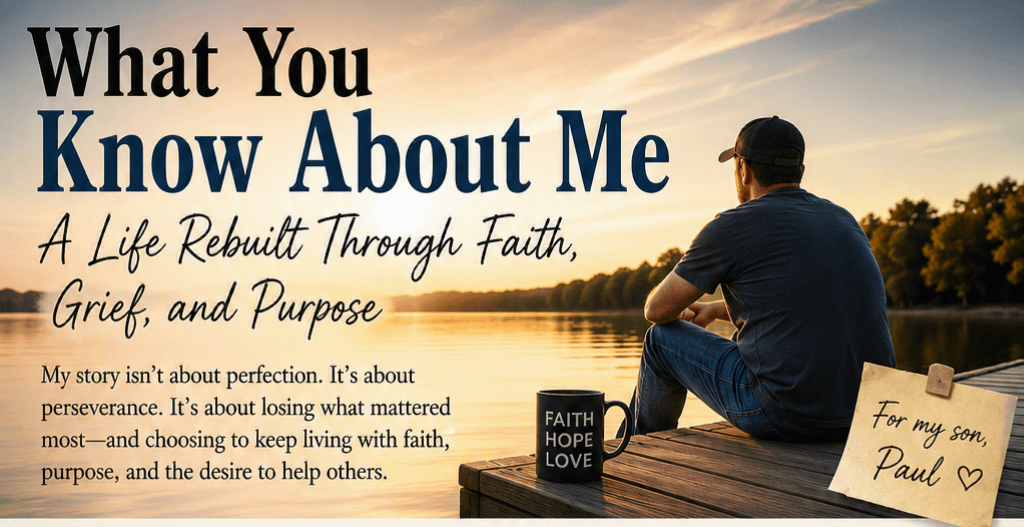
  • What You Know About Me: A Life Rebuilt Through Faith, Grief, and Purpose

    Advertisements

    There are moments in life that divide everything into two chapters: before and after. My life has been defined by one of those moments. While my story includes loss, it is also becoming a story of perseverance, faith, service, and the determination to help others find hope in their darkest hours.

    I Am a Father Before Anything Else

    The most important role I have ever had is being a father.

    My son, Paul, was not only my child—he was my best friend. We shared a bond that few people ever experience. He was compassionate, caring, and someone I admired just as much as he looked up to me. During difficult times in my life, he was there to help me, encourage me, and remind me that family means showing up for one another.

    Losing him changed every part of my life.

    There are no words that fully describe what it feels like for a parent to outlive their child. The pain does not disappear. Birthdays, holidays, anniversaries, and ordinary moments all carry reminders of someone who should still be here.

    Yet even through unimaginable grief, I continue moving forward because I believe honoring my son’s life means choosing to keep living mine.

    My Faith Keeps Me Standing

    Faith has become the foundation that supports me when emotions threaten to overwhelm me.

    I believe that God has remained with me through every difficult day, every sleepless night, every tear, and every question that seemed impossible to answer.

    Prayer is no longer just something I do.

    It is how I survive.

    Each morning is another opportunity to ask God for strength, wisdom, patience, and purpose. Scripture reminds me that even when I cannot understand His plan, I am never walking alone.

    My faith does not erase grief.

    It gives me the strength to carry it.

    Grief Changed Me

    The man I was years ago is different from the man I am today.

    Before tragedy, life felt predictable. I trusted easily. I loved without hesitation. I looked toward the future with excitement.

    Then everything changed.

    Grief taught me that life can change in an instant.

    It also taught me compassion.

    I understand loneliness in ways I never imagined possible. I recognize silent suffering in people who smile on the outside while hurting inside. I know what it feels like when the world moves on while your own heart remains frozen in time.

    These experiences have changed how I treat people.

    Everyone is carrying something.

    My Purpose Is Helping Others

    One of the greatest lessons I’ve learned is that pain can become purpose.

    Rather than allowing grief to consume my life, I have chosen to use my experiences to help others.

    Through writing, I speak directly to grieving parents, especially fathers who often suffer quietly without support. I write about child loss, emotional healing, mental health, faith, resilience, and learning how to live again after unimaginable tragedy.

    Every article I publish has one goal:

    To help someone feel less alone.

    If one grieving parent finds comfort because they realize someone else understands their pain, then every word has been worthwhile.

    I Believe Fathers Need More Support

    One subject that remains especially important to me is the emotional health of fathers.

    Society often expects men to remain strong, stay quiet, and carry their pain without asking for help.

    I know firsthand how dangerous that expectation can become.

    Grieving fathers deserve compassion.

    They deserve understanding.

    They deserve permission to cry, to remember, to talk, and to heal without being judged.

    If my writing helps even one father realize he is not weak for grieving, then I have accomplished something meaningful.

    I Believe Healing Is Not Forgetting

    People sometimes misunderstand healing.

    Healing does not mean forgetting someone you love.

    Healing means learning how to carry their memory while continuing to build a meaningful life.

    I will never stop loving my son.

    I will never stop missing him.

    But I also know he would want me to continue living with purpose, kindness, and faith.

    Honoring someone we love means allowing their influence to continue shaping who we become.

    I Enjoy Creating Content That Helps People

    Writing has become far more than a hobby.

    It has become my ministry.

    I create articles covering grief support, motivation, inspiration, daily prayers, Bible verses, recipes, holidays, historical events, and encouraging messages.

    While these topics may seem different, they all share one purpose:

    Helping someone have a better day.

    Sometimes people need practical advice.

    Sometimes they need encouragement.

    Sometimes they simply need to know someone cares.

    If my content accomplishes any of those things, then it has fulfilled its purpose.

    I Believe Small Acts Matter

    Healing rarely happens through one life-changing moment.

    Instead, it happens through thousands of small decisions.

    Choosing kindness.

    Helping a stranger.

    Encouraging someone who feels hopeless.

    Forgiving.

    Praying.

    Continuing when quitting seems easier.

    Every small act creates another opportunity to make the world a little brighter than it was yesterday.

    I’m Still Learning to Live Again

    One of the hardest parts of grief is allowing yourself to experience happiness again.

    There have been times when I questioned whether I deserved joy after losing someone I loved so deeply.

    Learning to live again has meant facing fears I never expected:

    The fear of loving.

    The fear of trusting.

    The fear of opening my heart.

    The fear that happiness might somehow dishonor the memory of my son.

    Over time, I have come to understand that love is not limited.

    Our hearts do not replace one love with another.

    They grow.

    Continuing to love, laugh, and hope does not diminish the love I have for my son.

    It honors the life he believed I should continue living.

    My Mission

    If someone asked what I hope people remember about me, it would not be accomplishments, titles, or possessions.

    I hope they remember someone who chose compassion over bitterness.

    Someone who kept believing in God during life’s darkest chapters.

    Someone who refused to let tragedy have the final word.

    Someone who used his own brokenness to help others begin healing.

    That is the legacy I want to leave.

    Not because my life has been easy.

    But because even after unimaginable loss, I still believe hope is worth sharing.

    Final Thoughts

    My story is still being written.

    There are difficult days, moments when grief feels overwhelming, and times when memories bring tears without warning. Those moments will probably never disappear completely.

    But neither will faith.

    Neither will hope.

    Neither will purpose.

    Every sunrise is another reminder that while we cannot change yesterday, we can choose how we live today.

    If my journey teaches anything, I hope it reminds others that even the deepest wounds can become a source of compassion, encouragement, and service. Life after loss is not the life I expected, but it is still a life worth living—and one that I hope continues to bring comfort, hope, and healing to everyone who crosses my path.

    A Father’s Guide to Surviving the Loss of a Child

Exit mobile version