
There are some losses that change a person forever.
The death of a child is one of them.
When a father loses his child, he does not simply experience a painful event and eventually return to the person he was before. His world has changed. His identity has been shaken. His dreams for the future have been interrupted, and a relationship that was woven into the center of his life is suddenly no longer physically present.
Yet grieving fathers are often expected to remain strong.
People may ask them how their wife or partner is doing before asking how they are doing. Friends may assume that because a father returned to work, laughed at a joke, attended an event, or seemed composed, he must be handling the loss well.
But appearances can be misleading.
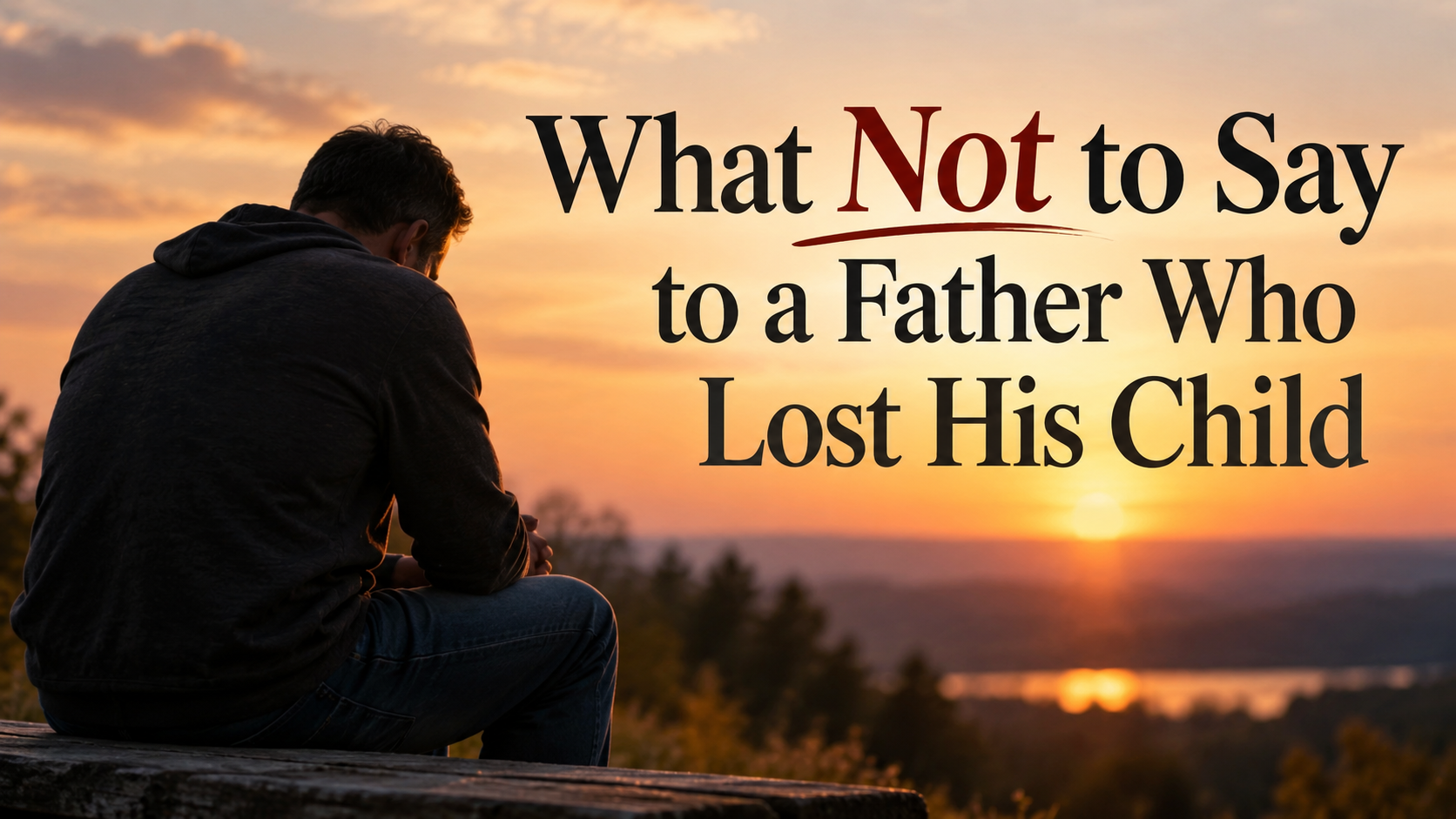
A father can look strong while barely holding himself together inside.
And because people often do not know what to say after the death of a child, they sometimes say things intended to comfort that instead create additional pain.
Most people are not deliberately cruel. They are uncomfortable with grief. They want to say something that will make the grieving father feel better.
The problem is that there are no words capable of fixing the death of a child.
Sometimes the most compassionate thing you can do is stop trying to explain the loss and simply acknowledge it.
Here are some things you should avoid saying to a father who has lost his child—and what you might say instead.
“Everything Happens for a Reason”
This is one of the most common phrases grieving people hear.
It can also be one of the most painful.
When your child has died, hearing that there was somehow a reason for it may feel impossible to accept.
A grieving father may immediately wonder:
What reason could possibly justify losing my child?
Why did my child have to die?
What lesson could possibly be worth this pain?
Even when someone says this from a place of faith or compassion, it can unintentionally minimize the enormity of the loss.
A father does not necessarily need someone to explain why his child died.
He needs someone willing to stand beside him while he learns how to live with the reality that his child is gone.
Instead, consider saying:
“I don’t understand why this happened, but I’m here for you.”
Sometimes admitting that there are no easy answers is far more comforting than trying to provide one.
“You Need to Be Strong”
Many fathers have heard some version of this their entire lives.
Be strong.
Hold it together.
Take care of everyone else.
Don’t cry.
Keep moving.
After the death of a child, these expectations can become overwhelming.
A grieving father may already believe he has to hide his emotions so he does not burden the people around him.
Telling him to “be strong” can reinforce the idea that crying, struggling, needing help, or admitting that he is devastated somehow represents weakness.
It doesn’t.
Grief is not weakness.
Crying is not weakness.
Missing your child is not weakness.
Some days, strength may mean getting out of bed.
Other days, strength may mean admitting:
“I can’t handle today.”
Give fathers permission to grieve instead of demanding that they perform strength for everyone around them.
You might say:
“You don’t have to be strong around me.”
Those words can give a grieving father something he may desperately need: permission to be human.
“At Least You Have Other Children”
Never try to replace one child with another.
Every child is unique.
Every relationship between a father and child is unique.
Having other children does not erase the pain of losing one.
A father can deeply love the children who are still living while simultaneously experiencing overwhelming grief for the child who died.
Both realities can exist at the same time.
Saying “at least you have other children” can make it sound as though children are interchangeable.
They are not.
A better response is simply:
“I know how much you love and miss your child.”
Acknowledge the child who died rather than trying to redirect attention toward what remains.
“At Least You Had 10, 20, or 30 Years Together”
There is no amount of time with your child that ever feels like enough.
A father who loses a baby may grieve all the memories he never had the opportunity to create.
A father who loses a teenager may grieve the milestones his child never reached.
A father who loses an adult son or daughter may grieve decades of memories while also mourning the future they should have shared.
The age of the child does not determine the depth of the grief.
Parents are not supposed to outlive their children.
Whether a child lived for hours or decades, their life mattered.
Instead of focusing on how much time the father had, acknowledge what that relationship meant.
You could say:
“I know those years with your child were precious. I also know you wanted many more.”
“He’s in a Better Place”
For some grieving fathers, faith provides enormous comfort.
For others, even strong faith does not eliminate the pain of separation.
A father can believe his child is in Heaven and still desperately want his child here.
Those beliefs are not contradictory.
Faith and grief can exist together.
A father may trust God while still asking why.
He may believe in eternal life while still crying because he cannot hear his child’s voice.
He may believe he will see his child again while still struggling to survive another birthday, holiday, anniversary, or ordinary Tuesday without them.
If you know the father’s beliefs, faith-based comfort may be appropriate.
But avoid using faith as a way to shut down grief.
Sometimes a better statement is:
“I know how deeply you miss him.”
“God Needed Another Angel”
This phrase is often meant lovingly, but it can be extremely painful for grieving parents.
A father may understandably think:
Why would God need my child more than I do?
Religious explanations can become especially complicated during grief because loss can shake even deeply held beliefs.
A grieving father may be angry with God.
He may question his faith.
He may pray more than ever.
He may stop praying completely for a while.
All of those reactions can be part of grief.
Instead of trying to explain God’s purpose, offer compassion.
“I am praying for you and thinking about your child.”
That allows faith to become a source of support rather than an explanation for tragedy.
“You Have to Move On”
Grieving parents do not simply “move on” from their children.
They learn how to move forward while carrying them.
There is an enormous difference.
Moving on suggests leaving something behind.
Most fathers who have lost a child do not want to leave their child’s memory behind.
They want to continue saying their name.
They want to remember their laugh.
They want to tell stories about them.
They want people to remember birthdays.
They want their child’s life to continue meaning something.
Over time, a father may rebuild parts of his life.
He may laugh again.
Travel again.
Fall in love again.
Celebrate again.
Find purpose again.
None of that means he has moved on from his child.
It means he has slowly learned how to carry love and grief into a life he never expected to live.
“It’s Been Years. Aren’t You Feeling Better?”
Grief does not follow a calendar.
There is no expiration date on loving your child.
Years may pass, but certain moments can make the loss feel incredibly close again.
Birthdays.
The anniversary of the death.
Father’s Day.
Christmas.
A familiar song.
A photograph.
A favorite restaurant.
Driving past somewhere they used to go together.
Seeing someone who resembles the child.
Watching another parent celebrate a milestone your child never reached.
A father can be doing relatively well and suddenly find himself overwhelmed by grief.
That does not mean he is failing.
It means grief can return in waves.
Instead of questioning why he still hurts, recognize the continuing bond.
“I know you still miss him. I’m here whenever you want to talk about him.”
“I Know Exactly How You Feel”
Unless you have experienced the death of a child, you cannot completely know what a grieving parent feels.
Even if you have lost a child yourself, every relationship and every grief experience is different.
Comparing the death of someone’s child to another kind of loss can also hurt.
Losing a parent is devastating.
Losing a spouse is devastating.
Losing a sibling is devastating.
Losing a beloved pet can be heartbreaking.
But grief does not need to become a competition.
You do not have to prove that you understand.
Simply say:
“I can’t fully understand what you’re going through, but I care about you.”
That is enough.
“Everything Will Be Okay”
For a grieving father, everything may never feel “okay” in the way it once did.
Life can become meaningful again.
There can be happiness again.
There can be purpose again.
There can even be moments of genuine joy.
But the absence remains.
The empty chair remains.
The missing phone calls remain.
The future that was supposed to happen remains missing.
Rather than promising that everything will be okay, offer something more immediate and realistic:
“You don’t have to figure out the rest of your life today. I’m here with you.”
Grief is often survived one day at a time—and sometimes one hour at a time.
“You Should Be Grateful for the Memories”
Most grieving fathers are grateful for their memories.
But gratitude does not cancel grief.
In fact, sometimes beautiful memories hurt precisely because they remind a father of what he has lost.
A photograph can make him smile and cry simultaneously.
A video can become priceless because hearing his child’s voice again may feel like receiving something from another lifetime.
Memories matter enormously.
But fathers should not be pressured into using gratitude to suppress sadness.
You can be grateful and devastated at the same time.
“Your Child Wouldn’t Want You to Be Sad”
Perhaps not.
But grief does not work that way.
A father cannot simply stop hurting because his child would want him to be happy.
He may know his child would want him to continue living.
That knowledge can eventually become a powerful motivation.
But sadness is not a betrayal of the child.
The sadness exists because the love exists.
Instead, remind him that continuing to live does not require forgetting.
“You can miss your child and still allow yourself to experience happiness when it comes.”
Don’t Avoid Saying the Child’s Name
Sometimes what people don’t say hurts almost as much as what they do say.
After a child dies, people may become uncomfortable saying the child’s name.
They worry they will remind the father of his loss.
But most grieving fathers do not need to be reminded.
They already remember.
Their child is never far from their thoughts.
Hearing someone else say their child’s name can actually be comforting because it confirms something deeply important:
My child existed.
My child mattered.
My child is remembered.
If you knew his child, share a memory.
Tell him something funny you remember.
Tell him something kind his child once did.
Mention their birthday.
Say their name.
Those moments can become gifts.
Don’t Tell Him How He Should Grieve
There is no single correct way for a father to grieve.
Some fathers cry openly.
Others cry privately.
Some talk constantly about their child.
Others struggle to speak about the loss.
Some throw themselves into work.
Some create foundations, memorials, scholarships, websites, books, or charitable projects.
Some need solitude.
Some need people around them.
Some return to their routines quickly because structure helps them survive.
Others need significant time before ordinary life feels possible again.
None of these reactions automatically tells you how deeply someone loved their child.
Do not measure a father’s love by how visibly he grieves.
What Should You Say Instead?
You do not need perfect words.
Often the simplest words are the most meaningful:
“I’m sorry.”
“I miss him too.”
“I remember him.”
“I’ve been thinking about you.”
“You can talk about your child with me anytime.”
“I don’t know what to say, but I don’t want you to go through this alone.”
“What do you need today?”
Those words do not attempt to repair something that cannot be repaired.
They simply communicate presence.
And presence matters.
Sometimes Actions Matter More Than Words
Supporting a grieving father is not only about knowing what to say.
Sometimes it is about showing up.
Bring dinner.
Send him a message on his child’s birthday.
Remember the anniversary of the death.
Invite him somewhere without pressuring him to attend.
Check on him months after everyone else has returned to normal life.
Sit beside him when he doesn’t feel like talking.
Listen when he tells the same story about his child for the twentieth time.
Let him cry.
Let him laugh without making him feel guilty.
Let him talk about the past.
Let him imagine a future.
And understand that grief can change from one day to the next.
One of the hardest parts of child loss can come after the initial support disappears.
Immediately after a death, there may be phone calls, messages, meals, flowers, cards, and visitors.
Then life continues for everyone else.
For the father, however, the loss remains.
That is when your presence may matter most.
Send the message six months later.
Remember the second anniversary.
Remember the fifth birthday without his child.
Continue saying the child’s name.
A Grieving Father Does Not Need You to Fix Him
There is a powerful lesson anyone supporting a grieving father should understand:
You cannot fix his grief.
And you don’t have to.
You do not need to find the perfect quotation.
You do not need to explain God’s plan.
You do not need to convince him to look at the positive side.
You do not need to make him stop crying.
You do not need to tell him when it is time to move forward.
You simply need to care.
Sometimes support sounds like:
“Tell me about your son.”
Sometimes it sounds like:
“I remember when he…”
And sometimes support is sitting beside someone in silence because there truly are no words.
To the Father Who Has Heard the Wrong Words
If you are the father reading this, you may have heard some of these statements yourself.
Perhaps someone told you to move on.
Perhaps someone wondered why you were still grieving years later.
Perhaps people stopped mentioning your child’s name.
Perhaps you felt as though the world expected you to return to normal when you knew normal no longer existed.
You are allowed to miss your child.
You are allowed to speak their name.
You are allowed to have good days and terrible days.
You are allowed to laugh without feeling guilty.
You are allowed to cry years later.
You are allowed to build a new life without pretending the old one never existed.
Moving forward does not mean leaving your child behind.
Love does not disappear when someone dies.
It changes form.
It becomes memories.
Photographs.
Stories.
Traditions.
Lessons.
Places.
Songs.
Birthdays.
Quiet conversations in your mind.
And sometimes it becomes purpose.
A father may eventually decide to take the pain he never wanted and use it to help another grieving parent survive.
That does not make the loss worth it.
Nothing has to make the loss worth it.
It simply means love continues finding ways to exist.
Final Thoughts
When a father loses his child, there is no sentence capable of removing his pain.
So stop searching for the magical words that will make everything better.
Instead, give him something far more valuable:
Your presence.
Listen without judging.
Remember without being reminded.
Say his child’s name.
Allow him to grieve in his own way.
Be there on the difficult days.
Be there years later.
And never assume that because he looks strong, he no longer hurts.
Behind the strength of many grieving fathers is a heart carrying a love that has nowhere physical to go.
If you know a father who has lost a child, ask yourself one simple question:
When everyone else has stopped checking on him, will I still be there?
Because sometimes the greatest gift you can give a grieving father is not advice.
It is reminding him that he—and the child he loves—have not been forgotten.




Leave a ReplyCancel reply