16 min read
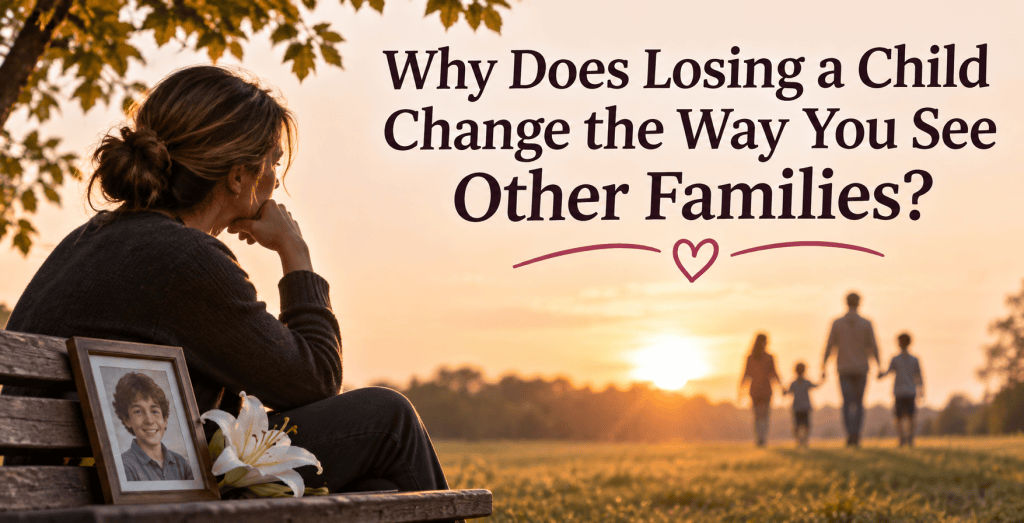
Losing a child changes more than your daily life. It changes the way you see the world, the way you understand love, and sometimes even the way you look at other families.
Before losing a child, seeing parents laughing with their children might have brought a smile to your face. Watching families celebrate birthdays, enjoy holidays, or simply spend time together might have seemed like an ordinary part of life.
After losing a child, those same moments can bring an entirely different set of emotions.
You might feel happiness for another family while simultaneously experiencing an overwhelming sadness for your own. You might find yourself looking away when a father hugs his son or when a mother proudly talks about her daughter’s accomplishments.
Sometimes, the hardest moments are not the obvious reminders of death. They are the everyday reminders of the life you once had and the future you expected to experience.
Losing a child changes the way you see other families because you now recognize something that many parents have never had to imagine: the possibility of living the rest of your life without your child.
That realization changes everything.
Why Does Seeing Other Families Hurt After Losing a Child?
One of the most confusing experiences for grieving parents is discovering that ordinary family interactions can suddenly become painful.
You might be walking through a grocery store when you hear a child call out, “Dad!”
You might see a father teaching his son how to work on a car.
You might watch a family laughing together at a restaurant.
Nothing about these situations is unusual. They happen every day.
But for a parent who has lost a child, these moments can awaken memories, emotions, and longings that are difficult to explain.
It is not necessarily because you resent those families.
It is because you remember what it felt like to have those moments yourself.
You remember the conversations, laughter, disagreements, traditions, and everyday experiences that once filled your life.
You remember having someone who called you Mom or Dad.
And you remember that those experiences ended long before you were ready.
Seeing another family enjoying something you can no longer experience in the same way can make the absence of your child feel especially overwhelming.
Why Do Grieving Parents Compare Their Families to Others?
Before losing a child, you might never have thought much about comparing your family to someone else’s.
Afterward, comparisons can happen almost automatically.
You may notice parents with children around the same age your child would be today.
You may see young adults graduating from college, beginning careers, getting married, or starting families of their own.
And you may find yourself thinking about what your child would be doing if they were still alive.
Would they be married?
Would they have children?
What kind of career would they have chosen?
Would they still call you just to talk?
Would you be sitting together at Thanksgiving dinner?
These questions are not simply about comparing your life to someone else’s.
They are about grieving a future that was taken away.
When a child dies, parents do not only mourn the years they shared. They also mourn the years they expected to have.
Every milestone another family celebrates can become a reminder of a milestone your child will never reach.
That does not mean you cannot celebrate someone else’s happiness.
It means your happiness for them may exist alongside profound sadness for yourself.
Why Can Happy Families Make Grieving Parents Feel Lonely?
There is a particular kind of loneliness that can develop after losing a child.
It is not always about being physically alone.
Sometimes, it comes from feeling separated from a world that continues functioning as though nothing has changed.
Other families continue making plans.
Children grow older.
Parents attend graduations and weddings.
Grandparents welcome new grandchildren.
Family photographs are updated.
Holiday traditions continue.
Meanwhile, a grieving parent may feel as though part of their life stopped on the day their child died.
The world continues moving forward, but the person they most want beside them is missing.
This can create an emotional distance between grieving parents and families who have not experienced child loss.
Even when surrounded by people who care, a bereaved parent may feel profoundly alone.
There may be conversations they no longer know how to participate in.
There may be family gatherings they no longer feel comfortable attending.
And there may be moments when listening to other parents discuss their children becomes emotionally exhausting.
The loneliness is not always about having nobody around. Sometimes, it is about being surrounded by reminders of the one person who is missing.
Why Do Grieving Parents Sometimes Feel Jealous of Other Families?
Jealousy is an emotion many grieving parents struggle to acknowledge.
It can feel uncomfortable or even shameful.
You may genuinely love your friends and relatives while wishing you could still have what they have.
You might see a father celebrating his son’s birthday and wonder why you no longer get to celebrate yours in the same way.
You might hear a parent complaining about their teenager and think about how much you would give to experience another ordinary disagreement with your own child.
You might watch a family taking photographs together and wish desperately for one more photograph with your child.
These feelings do not automatically mean you are bitter or selfish.
They can be expressions of grief, longing, and the painful awareness of what has been lost.
Jealousy in grief is often less about wanting someone else to lose something and more about wishing you could have your own child back.
There is an important difference.
You can be grateful that another parent still has their child while grieving that yours is gone.
Both emotions can exist at the same time.
Why Do Ordinary Complaints About Children Become Difficult to Hear?
One of the changes grieving parents may notice is how differently they respond to everyday complaints about children.
A parent might complain that their son never calls.
Another might become frustrated because their daughter leaves dishes in the sink.
Someone else might complain about having to drive their child to another appointment or activity.
Before experiencing child loss, these conversations might have seemed completely ordinary.
Afterward, they can feel painful.
A grieving parent may think:
“I wish my child could call me again.”
“I would give anything to clean up after my child one more time.”
“I would love to have another ordinary day together.”
These thoughts come from longing, not necessarily judgment.
Parents whose children are alive are still allowed to experience frustration, exhaustion, and disappointment. Raising children has challenges, and grief does not erase those realities.
But losing a child can dramatically change what feels important.
Things that once seemed inconvenient may become the very memories a grieving parent treasures most.
The sound of a child’s voice.
A messy bedroom.
An unexpected phone call.
A familiar laugh coming from another room.
What once felt ordinary can become priceless after it is gone.
Why Do Family Gatherings Feel Different After a Child Dies?
Family gatherings can become some of the most emotionally complicated experiences after losing a child.
Birthdays, Thanksgiving, Christmas, reunions, and other celebrations often emphasize togetherness.
They are occasions when families gather to appreciate the people they love.
But when someone is missing, that togetherness can make their absence even more noticeable.
There may be an empty chair at the dinner table.
A familiar voice may no longer fill the room.
A favorite holiday tradition may feel incomplete.
Other family members may continue celebrating, while a grieving parent struggles to find their place in the gathering.
Sometimes, the difficulty comes from watching other families appear complete while your own feels permanently changed.
Other times, it comes from the silence surrounding your child’s absence.
People may avoid mentioning your child because they are afraid of upsetting you.
Yet that silence can hurt more than hearing your child’s name.
Many grieving parents do not want everyone to pretend their child never existed.
They want their child remembered as someone who belonged to the family and always will.
A child’s death changes the family, but it does not erase the child’s place within it.
Why Does Losing an Only Child Make Seeing Other Families Especially Difficult?
For parents who have lost their only child, the experience can carry additional layers of grief.
When you lose your only child, you may also lose the everyday experience of actively parenting a living child.
There may be no other children coming home.
No other child calling to check in.
No future school events, graduations, or weddings to attend as a parent.
The home that once held conversations, laughter, and shared routines may become painfully quiet.
For a single parent who raised an only child, the loss can feel even more isolating.
The relationship may have been the center of daily life.
You may have spent years building a future around the two of you.
You may have shared traditions, inside jokes, challenges, and dreams that belonged uniquely to your relationship.
Then suddenly, you are left trying to understand who you are without the person who was such a central part of your world.
Seeing other parents with their children can remind you not only of the person you lost but also of the life you shared together.
And although you will always be a parent, the way you experience parenthood has changed.
Your child may no longer be physically present, but your identity as their mother or father does not disappear.
Love does not end because a life ends.
Why Do Grieving Parents Sometimes Avoid Other Families?
Some grieving parents begin avoiding situations where they know families will be gathered.
They may decline invitations to birthday parties.
They may stop attending certain holiday celebrations.
They may avoid parks, restaurants, or other places that remind them of experiences with their child.
They may even withdraw from friends whose children are reaching milestones their own child will never experience.
This withdrawal is not always about disliking people or refusing to participate in life.
Sometimes, it is about emotional survival.
Grief can make ordinary social situations unexpectedly overwhelming.
A parent may feel capable of attending a gathering one day and unable to face the same situation the next.
There is no universal timeline for when these experiences become easier.
However, while taking breaks from painful situations can be helpful, prolonged isolation can sometimes deepen loneliness.
Finding a balance between protecting your emotional well-being and maintaining meaningful connections is important.
That balance may change from week to week.
You do not have to force yourself into every gathering, but you also deserve opportunities to experience companionship, understanding, and connection.
Why Does Losing a Child Change What You Value in Family Relationships?
Child loss can profoundly change a parent’s priorities.
Things that once seemed urgent may no longer carry the same importance.
Arguments over small disagreements may feel less meaningful.
Material possessions may lose some of their significance.
Time, conversations, memories, and relationships may become more valuable.
When you know how suddenly life can change, you may become more aware of how fragile ordinary moments really are.
You may notice the importance of saying “I love you.”
You may place greater value on spending time with people who matter.
You may become less willing to waste energy on unnecessary conflict.
But this change does not mean every grieving parent becomes more patient, peaceful, or appreciative.
Grief can also bring anger, exhaustion, anxiety, and difficulty connecting with others.
Sometimes, the same experience that teaches you the value of relationships also makes those relationships harder to navigate.
Both realities can be true.
Losing a child does not automatically make someone wiser or stronger.
It changes their perspective because they have experienced something that fundamentally alters their understanding of life.
Why Can Watching Fathers and Sons Together Be Especially Painful?
For a father who has lost his son, watching other fathers and sons together can awaken a particularly deep longing.
You might see a father teaching his son to drive.
You might watch them fishing, working on a car, attending a sporting event, or simply talking.
You may notice a father and his adult son laughing together over something that nobody else understands.
These moments can remind you of the relationship you shared with your own son.
They can also remind you of the experiences you expected to share in the future.
Perhaps you imagined watching your son build a career.
Perhaps you hoped to see him become a husband or father.
Perhaps you simply expected to grow older while continuing to be part of each other’s lives.
After losing him, those ordinary expectations become painful reminders of an unfinished future.
And for fathers who feel pressure to remain strong, these emotions may be especially difficult to express openly.
They may smile through conversations while privately struggling with memories.
They may congratulate another father on his son’s accomplishments while silently wishing they could share one more moment with their own.
A father’s grief is not always visible.
Sometimes, it appears in the silence after watching another father walk away with his son.
Why Do Some Grieving Parents Become More Protective of Other Families?
Not every change in perspective involves sadness or withdrawal.
Some grieving parents become more protective, compassionate, or concerned about other families.
After experiencing the death of a child, you may become more aware of dangers that other parents rarely think about.
You may worry when someone mentions their teenager driving late at night.
You may feel anxious when a friend cannot reach their child.
You may find yourself reminding people to appreciate their loved ones.
This heightened awareness can come from understanding how unexpectedly tragedy can occur.
However, it can also become emotionally exhausting.
Living with the knowledge that life is unpredictable does not mean you must constantly anticipate another tragedy.
Other families cannot eliminate every risk, and neither could you.
What happened to your child does not mean every family will experience the same loss.
Learning to live with uncertainty can be one of the difficult parts of grief.
It may help to recognize when concern comes from love and when it is being intensified by fear.
Can You Ever Feel Comfortable Around Happy Families Again?
For many grieving parents, being around other families becomes more manageable over time.
But that does not necessarily mean the sadness disappears.
You may eventually attend birthday parties without feeling overwhelmed.
You may find yourself smiling when you see a father and son laughing together.
You may celebrate a friend’s child’s graduation while remembering the milestones your own child never reached.
There may still be difficult days.
An unexpected photograph, conversation, or familiar laugh may bring tears years after your child’s death.
That does not mean you have failed to heal.
It means your relationship with your child remains meaningful.
Grief often changes over time, but it does not follow a predictable schedule.
Some parents find comfort in spending time with children and families.
Others need more distance.
Some experience both responses depending on the circumstances.
There is no single correct way to navigate these emotions.
The goal is not to stop remembering your child whenever you see another family.
It is to find ways to participate in life while continuing to carry that love.
How Can Grieving Parents Cope With Seeing Other Families?
There are ways to make these experiences more manageable without pretending the pain does not exist.
Allow yourself to feel conflicting emotions.
You can be happy for another family and sad for your own at the same time. You do not need to choose one emotion over the other.
Recognize what triggers your grief.
Certain places, ages, milestones, or family activities may bring stronger emotional reactions. Understanding those triggers can help you prepare for difficult situations.
Give yourself permission to leave when necessary.
If a gathering becomes overwhelming, stepping away does not mean you have failed. Sometimes, a short break is enough.
Stay connected to people who understand.
Other bereaved parents may understand emotions that are difficult to explain to people who have not experienced child loss.
Keep your child’s memory present.
Talking about your child, sharing stories, honoring birthdays, and maintaining meaningful traditions can help you continue expressing your love.
Avoid judging yourself for your reactions.
Grief can bring sadness, jealousy, anger, tenderness, gratitude, and loneliness. Experiencing these emotions does not determine your worth as a parent or person.
Seek additional support when you need it.
A grief support group or mental health professional experienced in child loss can help you navigate difficult emotions, especially when isolation or distress begins interfering with everyday life.
You do not have to pretend that seeing other families is easy.
And you do not have to face every difficult moment alone.
How Can Other Families Support a Parent Who Has Lost a Child?
Families who have not experienced child loss may not fully understand how everyday interactions affect a grieving parent.
But they can still offer meaningful support.
They can continue including bereaved parents in gatherings without pressuring them to attend.
They can understand when invitations are declined.
They can speak openly about the child who died instead of treating their memory as something that must be avoided.
They can listen without trying to fix the grief.
And they can recognize that a parent does not stop being a parent simply because their child has died.
One of the most meaningful things someone can do is acknowledge the child by name.
Ask about their memories.
Remember important dates.
Allow the parent to talk about their son or daughter without immediately changing the subject.
Sometimes, grieving parents do not need advice.
They need reassurance that the world has not forgotten someone who meant everything to them.
Why Does Losing a Child Make You Realize How Precious Ordinary Family Moments Are?
Perhaps one of the most profound changes after losing a child is the way ordinary moments become extraordinary in memory.
The conversations you once had without thinking.
The laughter coming from another room.
The sound of footsteps in the hallway.
The unexpected phone calls.
The simple question, “What are we having for dinner?”
These moments may not have seemed especially important when they were happening.
They were simply part of life.
But after losing a child, you may realize that those ordinary experiences were some of the most meaningful parts of being a parent.
You do not necessarily miss only the birthdays, vacations, and major celebrations.
You miss the everyday presence of your child.
You miss knowing they were somewhere in the world, living their life.
You miss the comfort of believing there would always be another conversation, another visit, another opportunity to say what needed to be said.
And when you see other families experiencing those moments, you recognize their value in a way you never wanted to learn.
That awareness can be painful.
But it can also become part of how you honor your child.
You may encourage others to appreciate the time they have together.
You may become more intentional about expressing love.
You may find meaning in helping other grieving parents feel understood.
Not because your child’s death needed to teach a lesson, but because your love for your child continues shaping the person you are.
Final Thoughts: You See Other Families Differently Because You Know What It Means to Lose Yours
Losing a child changes the way you see other families because it changes the way you experience love, time, and the future.
You notice things you once overlooked.
You recognize moments that other parents may take for granted.
You feel the absence of your child in situations that once brought comfort or happiness.
Sometimes, seeing another family makes you smile.
Sometimes, it makes you cry.
And sometimes, it does both.
There may be moments when you wish you could return to the days when seeing a father and son together did not bring such complicated emotions.
When hearing someone call out “Mom” or “Dad” did not remind you of the voice you long to hear again.
When family celebrations were simply celebrations rather than reminders of an empty place at the table.
But losing a child does not mean you have lost the ability to appreciate other families.
It means you now see those relationships through the experience of a love that continues despite an unimaginable absence.
You understand that no family moment is guaranteed.
You understand that the smallest memories can become the most treasured.
And you understand that a parent can spend the rest of their life missing someone while continuing to love them with everything they have.
Other families may remind you of what you lost, but they can never take away what you had.
Your memories still belong to you.
Your love still belongs to your child.
And no matter how many years pass, you will always be their parent.
Because losing a child changes the way you see other families.
But it never changes the fact that your child will always be part of yours.
Frequently Asked Questions
Why Does Seeing Other Families Hurt After Losing a Child?
One of the most confusing experiences for grieving parents is discovering that ordinary family interactions can suddenly become painful.
Why Do Grieving Parents Compare Their Families to Others?
Before losing a child, you might never have thought much about comparing your family to someone else’s.
Why Can Happy Families Make Grieving Parents Feel Lonely?
There is a particular kind of loneliness that can develop after losing a child.
Why Do Grieving Parents Sometimes Feel Jealous of Other Families?
Jealousy is an emotion many grieving parents struggle to acknowledge.
Why Do Ordinary Complaints About Children Become Difficult to Hear?
One of the changes grieving parents may notice is how differently they respond to everyday complaints about children.
Why Do Family Gatherings Feel Different After a Child Dies?
Family gatherings can become some of the most emotionally complicated experiences after losing a child.
Why Does Losing an Only Child Make Seeing Other Families Especially Difficult?
For parents who have lost their only child, the experience can carry additional layers of grief.
Why Do Grieving Parents Sometimes Avoid Other Families?
Some grieving parents begin avoiding situations where they know families will be gathered.
Leave a Reply