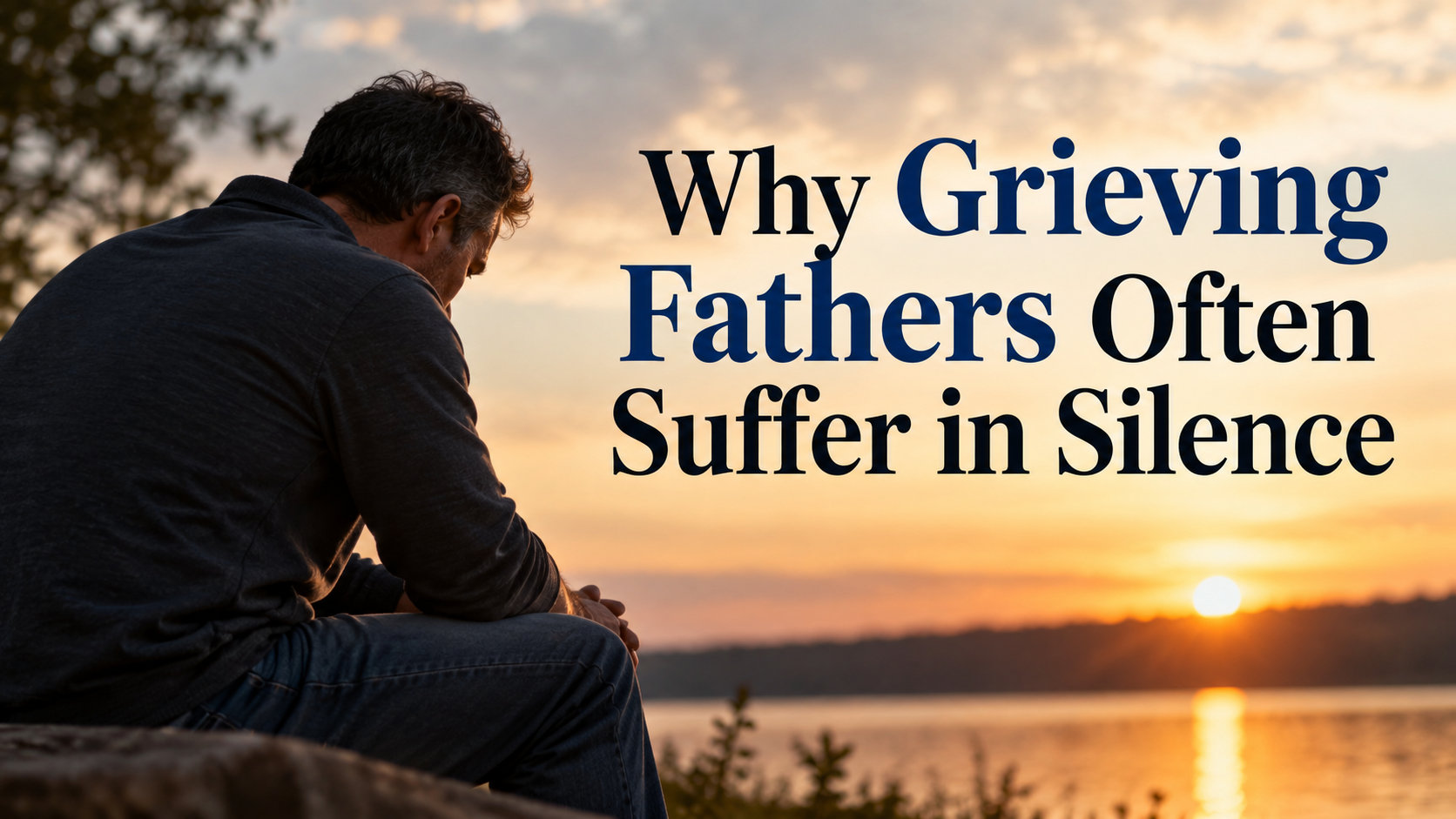
When a child dies, a father’s world changes forever.
There is the life he lived before his child died, and then there is everything that comes afterward.
People often understand that a mother will be devastated by the death of her child. They expect tears. They expect her to talk about her child. They expect grief to remain part of her life for years.
But fathers can experience something different.
A grieving father may be standing in the same room, carrying the same devastating loss, yet people may barely ask how he is doing.
Instead, they ask him how his wife or partner is doing.
They tell him to stay strong.
They expect him to handle the arrangements, answer the phone calls, return to work, pay the bills, comfort everyone else, and somehow continue functioning while his own heart is shattered.
So many fathers learn to grieve quietly.
Not because they loved their children any less.
Not because their grief is smaller.
But because somewhere along the way, many men learned that their pain was something they were supposed to carry privately.
And after losing a child, that silence can become incredibly heavy.
A Father’s Grief Can Be Invisible
One of the most difficult parts of being a grieving father is that your grief may not always look the way other people expect grief to look.
Some fathers cry openly.
Others rarely cry in front of anyone.
Some want to talk constantly about their child.
Others struggle to put what they are feeling into words.
Some become restless and need to stay busy.
Others withdraw.
Some throw themselves into work, projects, exercise, helping others, or anything that gives them something concrete to do.
None of these reactions automatically tells you how deeply a father loved his child.
A man can appear calm while experiencing tremendous pain inside.
He can laugh at a joke and still miss his child every second.
He can return to work while wondering how the rest of the world continues as though nothing happened.
He can tell someone, “I’m okay,” because explaining the truth feels impossible.
That is one of the cruel realities of grief:
A person can look functional while barely holding himself together inside.
Fathers Are Often Expected to Be the Strong Ones
Many men grow up hearing versions of the same message:
Be strong.
Don’t cry.
Handle it.
Protect your family.
Keep going.
Don’t let people see you fall apart.
Those messages can become deeply ingrained.
Then the unimaginable happens.
His child dies.
Suddenly, a father encounters a pain that cannot simply be fixed, solved, repaired, or overcome through determination.
Yet the old expectations remain.
He may feel that everyone needs him to remain strong.
His spouse may be devastated.
His other children may need reassurance.
Relatives may need information.
There may be funeral arrangements, financial responsibilities, paperwork, phone calls, possessions, memorials, and countless decisions.
The father goes into action.
He does what needs to be done.
And people may praise him for his strength.
What they may not realize is that sometimes what looks like strength is survival.
Sometimes a grieving father stays busy because stopping means feeling everything at once.
The Question Fathers Hear Too Often
After the death of a child, a father may repeatedly hear:
“How is your wife doing?”
The question usually comes from a caring place.
But imagine hearing it again and again when you are grieving too.
You may start wondering:
Does anyone realize I lost my child too?
Does anyone see my pain?
Does anyone care how I am surviving this?
A father can become the person everyone expects to support the grieving family without anyone recognizing that he is also a grieving parent.
He did not simply lose someone important to his spouse.
He lost his child.
He lost the person he loved, protected, worried about, laughed with, dreamed about, and expected to watch grow older.
He lost part of his future.
Fathers need support too.
Some Fathers Try to Protect Everyone Else
There is another reason fathers may suffer silently.
They don’t want to add to anyone else’s pain.
A father may see his spouse struggling and think:
She already has enough to deal with. I don’t want her worrying about me.
He may see his other children hurting and decide he needs to remain strong for them.
He may see his parents grieving their grandchild.
He may see friends who do not know what to say.
So he keeps his deepest feelings to himself.
He becomes the protector.
But grief does not disappear simply because you refuse to speak about it.
It waits.
It follows you into quiet rooms.
It appears while driving.
It comes when you hear a song.
It hits when you see someone who reminds you of your child.
It appears during birthdays, holidays, anniversaries, family gatherings, and ordinary Tuesday afternoons.
Eventually, the person protecting everyone else may realize that nobody has been protecting him.
Men Often Grieve Through Action
Not every person processes grief primarily by talking.
Some grieving fathers cope through doing.
They build something.
They create a memorial.
They start a fundraiser.
They work longer hours.
They exercise.
They write.
They advocate for a cause.
They help other grieving parents.
They organize their child’s belongings.
They visit places connected to their child.
They throw themselves into projects.
To an outsider, this can sometimes look like avoidance.
Sometimes it may be.
But sometimes action is simply the language through which a father expresses grief.
Creating something in a child’s memory can be a father’s way of saying:
You mattered. You still matter. I will not let the world forget you.
Helping someone else may become a way to create purpose from unbearable pain.
There is nothing wrong with grieving through action.
The danger comes when staying busy becomes the only way a father allows himself to avoid acknowledging his pain.
Losing a Child Can Change a Father’s Identity
Fatherhood becomes part of who you are.
From the moment your child enters your life, your identity changes.
You are someone’s dad.
You protect.
You provide.
You teach.
You worry.
You celebrate victories.
You help through failures.
You imagine the future.
Even when your child becomes an adult, you are still their father.
Then your child dies.
Suddenly, a father can face questions he never imagined asking.
Who am I now?
What am I supposed to do with all this love?
What happens to the future I imagined?
Am I still a father?
The answer to that last question is important:
Yes.
Death does not erase fatherhood.
Your child will always be your child.
The relationship changes because you can no longer physically see, touch, call, or spend time with them.
But the love does not disappear.
You carry it forward.
That continuing love is one reason grief can remain so powerful years after a child dies.
Silence Can Become Isolation
At first, silence may feel protective.
You don’t have to explain yourself.
You don’t have to answer uncomfortable questions.
You don’t have to watch someone struggle to find the right words.
But over time, silence can become isolation.
Friends may assume you are doing better because you don’t talk about your child.
Coworkers may think you have “moved on.”
Family members may stop checking in.
Invitations may decrease.
People return to their lives.
Meanwhile, the grieving father continues carrying his child with him every day.
This is one of the loneliest parts of long-term grief.
The world gradually stops recognizing the loss even though the father never stops living with it.
“I’m Fine” Can Mean Almost Anything
Ask a grieving father how he is doing and you may hear:
“I’m fine.”
That answer can mean many things.
It might mean:
I don’t know how to explain what I feel.
I don’t want to cry here.
I don’t think you really want the full answer.
I’m exhausted from explaining grief.
I’m trying to survive today.
I don’t want to make you uncomfortable.
I don’t even understand what I’m feeling myself.
Sometimes “I’m fine” simply means:
I don’t have the words.
Grief can contain sadness, anger, guilt, confusion, loneliness, fear, regret, love, gratitude, numbness, exhaustion, and longing simultaneously.
How do you summarize that in a casual conversation?
Sometimes you can’t.
So you say, “I’m fine.”
And continue walking.
The Pressure to “Move On”
One of the most painful things grieving parents encounter is the expectation that eventually grief should end.
People may not say it directly.
Instead, they say things like:
“You have to move forward.”
“Your child wouldn’t want you to be sad.”
“You need to get back to living.”
“It has been several years.”
Usually, people mean well.
But grief does not follow a schedule.
Moving forward does not mean leaving your child behind.
Living again does not mean forgetting.
Laughing again does not mean you have stopped grieving.
Finding happiness does not mean your child matters less.
A father can rebuild parts of his life while continuing to miss his child deeply.
Those realities can exist together.
Grief Does Not Have an Expiration Date
People often provide tremendous support immediately after a death.
They call.
They visit.
They bring food.
They send messages.
They attend the funeral.
Then weeks pass.
Months pass.
Years pass.
Life continues.
But for a parent, grief doesn’t simply disappear because time has passed.
Birthdays still arrive.
The anniversary of the death still arrives.
Holidays still arrive.
Father’s Day still arrives.
Family milestones still happen.
There may be weddings your child should have attended.
Grandchildren your child never got the chance to have.
Trips you expected to take.
Phone calls you still wish you could make.
There are thousands of small reminders of the future that should have existed.
That is why fathers can continue grieving years later.
It isn’t because they are refusing to heal.
It is because they continue loving someone who mattered enormously.
Fathers Need Permission to Talk About Their Children
One of the greatest gifts you can give a grieving father is permission to say his child’s name.
Ask about his child.
Ask what they were like.
Ask about a favorite memory.
Ask what made them laugh.
Ask what he misses most.
You may worry that mentioning the child will remind him that his child died.
You do not need to remind a grieving father.
He remembers.
What may hurt more is feeling as though everyone else has forgotten.
Hearing his child’s name can be painful.
But it can also be comforting.
It acknowledges that his child lived.
That they mattered.
That their story continues to have meaning.
Strength Doesn’t Mean Silence
There is a misconception that strength means carrying everything alone.
It doesn’t.
Sometimes strength is saying:
“I miss my child.”
Sometimes strength is crying.
Sometimes strength is calling someone at midnight because the grief feels unbearable.
Sometimes strength is attending a support group.
Sometimes strength is talking with another bereaved father.
Sometimes strength is writing.
Sometimes strength is praying.
Sometimes strength is admitting:
“Today is hard.”
A grieving father does not become weaker when he speaks about his pain.
He becomes human.
Fathers Need Other Fathers
There are certain experiences that are difficult to understand unless you have lived them.
Child loss is one of them.
Talking with another grieving father can provide something even loving friends and relatives sometimes cannot.
Understanding without explanation.
You don’t have to justify why a birthday still hurts years later.
You don’t have to explain why you keep certain belongings.
You don’t have to explain why you still say your child’s name.
You don’t have to defend the fact that grief still appears unexpectedly.
Another bereaved father may simply understand.
That connection can break through the isolation grief creates.
There Is No Correct Way for a Father to Grieve
Every father is different.
Every child is different.
Every relationship is different.
Every loss is different.
Some fathers need to talk.
Some need quiet.
Some cry often.
Some rarely cry.
Some find comfort in faith.
Some struggle with faith after their child dies.
Some create memorials.
Some avoid reminders until they are ready.
Some become advocates.
Some write.
Some help other grieving parents.
Some simply focus on surviving one day at a time.
Grief is not a competition.
There is no prize for appearing strongest.
There is no deadline for healing.
There is no single correct way to carry the love you still have for your child.
You Don’t Have to Carry It Completely Alone
If you are a grieving father reading this, perhaps you recognize yourself somewhere in these words.
Maybe everyone thinks you’re doing better than you actually are.
Maybe you have become good at hiding the pain.
Maybe people stopped asking about your child years ago.
Maybe you haven’t told anyone how difficult certain days still are.
Maybe there are things you desperately wish you could say but don’t know how.
You don’t have to tell everyone everything.
You don’t have to grieve publicly.
You don’t have to explain yourself to people who refuse to understand.
But finding at least one safe place where you can be truthful about your grief can matter.
A trusted friend.
Another grieving father.
A family member.
A pastor or spiritual leader.
A grief support group.
A counselor.
A journal.
A community of bereaved parents.
Somewhere you don’t have to pretend.
A Father Never Stops Being a Father
Perhaps this is the most important thing grieving fathers need to hear.
Your child’s death did not erase your fatherhood.
You are still their father.
You will always be their father.
You may no longer be able to care for your child in the ways you once did, but you can continue carrying their memory.
You can speak their name.
You can tell their stories.
You can honor their life.
You can help someone because of what your child taught you.
You can create something meaningful in their memory.
You can continue living while carrying them with you.
And when grief returns—even years later—it does not mean you have failed.
It means someone mattered.
The Silent Grief of Fathers Deserves to Be Seen
Grieving fathers often suffer in silence because they have been taught to be strong, because they want to protect their families, because they don’t know how to explain what they are feeling, and because society does not always recognize a father’s grief in the same way.
That needs to change.
Fathers deserve to be asked how they are doing.
Fathers deserve space to cry.
Fathers deserve support.
Fathers deserve to talk about their children.
Fathers deserve to grieve without being rushed.
And fathers deserve to know that asking for help does not make them weak.
Behind the quiet father may be a man carrying a lifetime of love, memories, questions, and heartbreak.
Do not mistake his silence for absence of grief.
Sometimes the people who say the least are carrying the most.
A father may learn how to live again.
He may laugh again.
He may find purpose again.
He may discover reasons to look forward to tomorrow.
But he does not have to leave his child behind to do it.
He carries his child forward in his heart, in his memories, in the person he becomes, and in the love that death could never take away.
If you are a grieving father, what is something you wish other people understood about the way fathers experience the loss of a child?



Leave a Reply