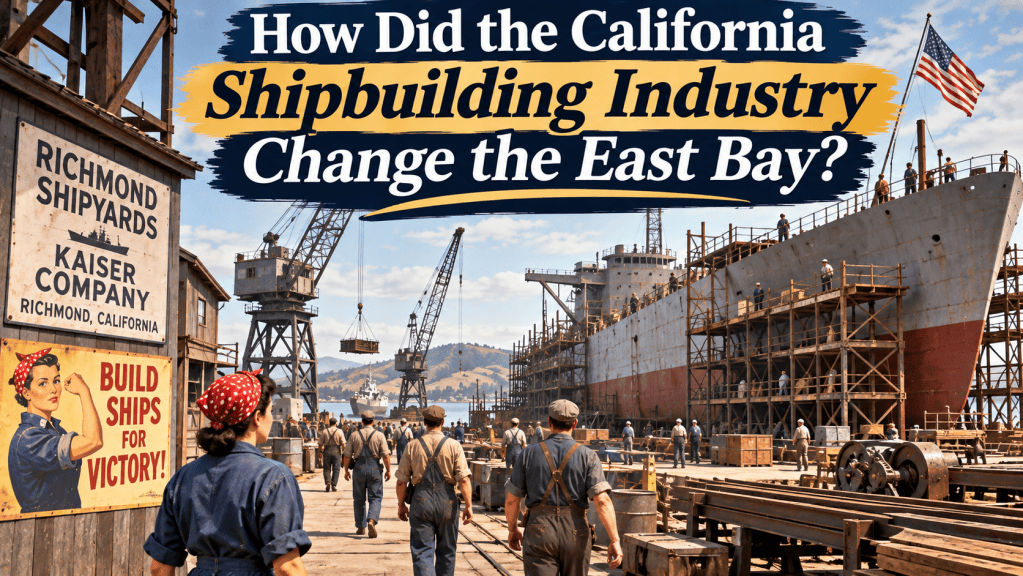
The California shipbuilding industry transformed the East Bay during World War II, turning established industrial communities into major centers of wartime manufacturing. Richmond, Oakland, and Alameda became part of a production network that supplied the Allied war effort while attracting workers from across the United States.
The consequences extended far beyond the waterfront. New employment opportunities, population growth, housing construction, changes in healthcare, and struggles over civil rights helped reshape the region for generations.
What was the East Bay like before World War II?
The East Bay already had an important industrial economy before the United States entered the war. Its location along San Francisco Bay connected manufacturing businesses with ocean shipping and transcontinental railroad transportation.
Oakland had developed as a commercial and transportation center, while Richmond was home to oil refining, automobile assembly, and railroad-related industries. Alameda also had a long association with maritime activity.
Although these communities were accustomed to industrial development, the scale of wartime investment would require changes that few local governments could have anticipated.
Why did California become a shipbuilding center?
California’s Pacific coastline provided access to shipping routes, while the protected waters of San Francisco Bay offered suitable locations for maritime construction.
The expansion of American defense production created demand for cargo vessels, troop transports, and military ships. Existing industrial facilities were expanded, and entirely new shipyards were built.
The National Park Service describes a concentration of twelve shipyards along the East Bay waterfront between Alameda and Richmond. Their operations connected workers, suppliers, engineers, transportation companies, and federal agencies.
The rise of the Kaiser shipyards in Richmond
Industrialist Henry J. Kaiser brought experience from large construction projects to the wartime shipbuilding effort. Beginning in 1941, his Richmond operations expanded rapidly as government contracts called for additional vessels.
Four shipyards ultimately operated on the Richmond waterfront. According to the National Park Service, they completed 747 ships during World War II.
The facilities produced Liberty ships, Victory ships, troop transports, and other vessels. Their work helped sustain overseas supply networks at a time when moving food, fuel, equipment, and personnel across the oceans was essential.
How shipbuilding methods changed
Traditional ship construction depended heavily on experienced tradespeople completing numerous specialized tasks aboard a vessel under construction.
Wartime builders developed systems in which components could be manufactured separately and brought together at the shipyard. Welding, prefabrication, standardized designs, and specialized work assignments helped accelerate construction.
These methods also made it possible to train employees who had never previously worked in maritime manufacturing.
The shipyard became a coordinated industrial workplace in which individual workers might spend their shifts completing a particular task rather than participating in every phase of vessel construction.
The resulting efficiencies were important not only for meeting wartime deadlines but also for demonstrating how large industrial projects could be organized differently.
How shipbuilding transformed Richmond’s population
Richmond experienced particularly dramatic population growth. National Park Service histories indicate that its population rose from fewer than 24,000 residents before the war to roughly 100,000 during the wartime expansion.
People arrived from the South, Midwest, and other parts of the country in search of industrial employment. Some traveled alone and later brought their families. Others relocated together, hoping to establish greater economic security.
The arrival of new residents introduced different regional traditions, religious communities, musical influences, and social networks.
Many families remained in California after the war. Their decisions helped shape the cultural identity of Richmond and neighboring East Bay communities well beyond the years of ship production.
How World War II created new employment opportunities
Women entered industrial occupations
With military service and expanding manufacturing creating labor shortages, employers recruited women for jobs that had traditionally been dominated by men.
Women performed welding, assembly, inspection, administrative work, and many other tasks. The cultural figure known as Rosie the Riveter came to represent their participation in wartime industry.
Their experiences challenged established assumptions about women’s capabilities and employment. However, unequal treatment persisted, and many women faced pressure to leave industrial occupations once the war ended.
African American workers migrated to California
Defense employment encouraged African American migration from Southern states to West Coast cities. For many workers, relocation offered an opportunity to pursue industrial wages and escape aspects of Southern segregation.
Yet the East Bay was not free from racial discrimination. Employment restrictions, unequal treatment, and segregated housing limited opportunities.
These tensions helped stimulate local organizing and demands for greater civil rights. The wartime experience demonstrated both the possibilities of industrial employment and the barriers that remained.
The housing crisis caused by rapid industrial growth
New workers needed places to live, but residential construction and public services could not immediately keep up with demand.
Some families shared crowded accommodations or relied on temporary shelters while searching for permanent homes. Federal wartime housing programs brought new residential developments to Richmond, including Atchison Village and Nystrom Village.
Access to housing was unequal, and discriminatory policies influenced where residents could settle. Neighborhood development during the wartime years therefore reflected economic expansion alongside racial exclusion.
The housing emergency also demonstrated the importance of coordinating industrial development with schools, utilities, healthcare, and transportation. Creating thousands of jobs without providing corresponding community services placed considerable pressure on existing infrastructure.
How shipbuilding influenced healthcare and childcare
Large industrial workforces required reliable access to medical services. Kaiser-associated medical programs offered prepaid healthcare arrangements for workers, helping establish the foundations of what became Kaiser Permanente.
This model connected healthcare financing with organized medical services and became an influential part of the postwar American healthcare landscape.
Childcare was another pressing concern. Parents working demanding industrial shifts needed dependable arrangements for their children.
Wartime childcare facilities demonstrated how community services could support working families. They also drew attention to the relationship between employment opportunities and access to practical family assistance.
How Oakland and Alameda participated in the shipbuilding boom
Although Richmond’s Kaiser yards became especially famous, Oakland and Alameda were important parts of the wider East Bay maritime economy.
Ship construction, repair, naval operations, freight handling, and industrial supply businesses formed an interconnected regional system. Activities at one waterfront facility could generate additional work for manufacturers and transportation businesses elsewhere.
Oakland’s established railroad connections and port infrastructure supported the movement of materials and finished goods. Alameda’s maritime facilities and naval activities added to the region’s defense-related employment.
This industrial network illustrates why the consequences of wartime shipbuilding cannot be understood by examining Richmond alone.
What happened to the shipbuilding industry after World War II?
When the war ended in 1945, the emergency demand for vessels declined. Facilities closed or reduced operations, and many workers had to seek new employment.
The transition was difficult because local businesses and households had become accustomed to the wartime economy. Some residents moved away, while others remained and pursued work in transportation, manufacturing, construction, and service industries.
The waterfront gradually took on different functions. Industrial properties were adapted for new uses, although redevelopment also brought questions about environmental conditions, public access, and the preservation of historic structures.
The social transformations created during the war did not simply disappear when production ended. Families, neighborhoods, institutions, and community organizations carried those experiences into the following decades.
Preserving the East Bay’s shipbuilding history
The Rosie the Riveter/World War II Home Front National Historical Park preserves and interprets Richmond’s wartime history. Its exhibits and historic sites help explain industrial innovation, the experiences of workers, and changes in American society.
The SS Red Oak Victory is another surviving connection to the era. The vessel was constructed in Richmond and serves as a museum ship associated with the city’s maritime heritage.
These resources encourage visitors to consider the people behind industrial achievements, including workers who endured dangerous conditions, families who relocated across the country, and communities that faced discrimination while contributing to the war effort.
Frequently asked questions
How many ships were built in Richmond during World War II?
The four Kaiser shipyards in Richmond produced 747 vessels, according to National Park Service historical records.
Why did so many people move to the East Bay during the war?
Expanding defense industries offered employment opportunities. Workers and their families relocated from across the country, contributing to rapid population growth.
Did women work in California shipyards?
Yes. Women entered numerous industrial and administrative occupations, including welding and assembly, during the wartime labor expansion.
How did shipbuilding contribute to Kaiser Permanente?
Medical programs developed to serve industrial workers helped lay the groundwork for the healthcare organization that later became Kaiser Permanente.
The lasting legacy of East Bay shipbuilding
California’s wartime shipbuilding industry changed the East Bay by connecting industrial growth with profound social and demographic transformations. Its legacy survives in local neighborhoods, healthcare institutions, maritime facilities, and the family histories of people who came to California seeking new opportunities.
The ships were built for an immediate national emergency, but the communities that built them continued evolving long after the war ended.
Leave a Reply