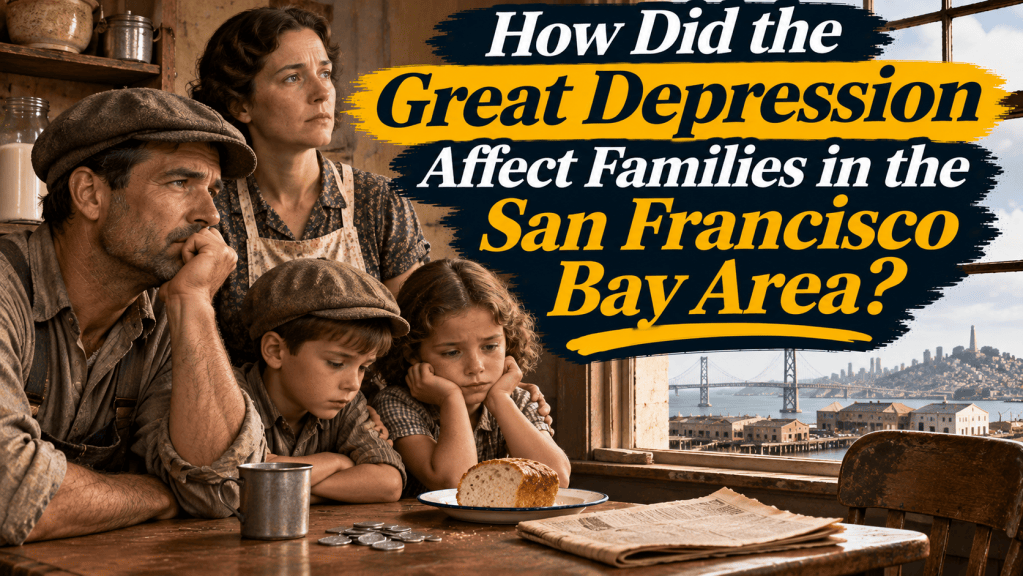
During the Great Depression, families throughout the San Francisco Bay Area faced unemployment, reduced wages, housing insecurity, and the challenge of putting enough food on the table. Communities that had experienced considerable growth during the 1920s suddenly found themselves navigating an economic crisis that affected nearly every aspect of everyday life.
The Depression also helped transform the region. Public construction projects created employment, labor organizing changed working conditions, and government relief programs introduced new forms of assistance. The Bay Area that emerged from the 1930s was shaped by both the hardships families endured and the changes they worked to achieve.
What was the Great Depression?
The Great Depression was a prolonged economic crisis that began in 1929 and continued through much of the 1930s. The stock market crash was one prominent event in a broader collapse involving declining production, bank failures, unemployment, and reduced consumer spending.
Although the crisis affected the entire United States, its consequences varied by region. The Bay Area had a diverse economy that included shipping, manufacturing, retail, agriculture, construction, and transportation. Each sector experienced the downturn differently.
For families, national economic statistics translated into immediate concerns about rent, groceries, clothing, and whether another paycheck would arrive.
How unemployment changed family life
Losing a job during the Depression could mean losing a household’s primary source of income. Even workers who retained their positions sometimes faced shorter hours, lower wages, or irregular employment.
The effects extended beyond factory gates and waterfront terminals. When customers had less money to spend, neighborhood stores, restaurants, and service businesses also encountered difficulties.
Adults who had previously worked steadily could find themselves searching for employment alongside hundreds of other applicants. Households with multiple potential wage earners might depend on the combined earnings of several family members.
The experience of unemployment was not merely financial. Uncertainty about the future could affect a person’s identity, confidence, and relationships. Parents often had to make difficult decisions about how to provide for their children with limited resources.
How families managed food shortages and household expenses
Families adapted their household routines according to what they could afford. They might repair worn clothing, reuse household materials, postpone purchases, or prepare meals using inexpensive staples.
Beans, potatoes, rice, bread, and seasonal vegetables could help stretch a limited food budget. Households with access to suitable land could grow some of their own produce, while families living in densely populated neighborhoods had fewer opportunities to do so.
Relatives sometimes shared housing or pooled their resources. Neighbors could exchange childcare, food, or practical assistance. These arrangements depended on the circumstances of each household and did not eliminate the difficulties of prolonged unemployment.
It is important not to romanticize these survival strategies. Thrift and resourcefulness were valuable, but many families experienced hunger and deprivation that could not be overcome through careful budgeting alone.
Breadlines and emergency relief in San Francisco
The waterfront was particularly visible as a place where unemployed workers sought assistance. One well-known relief effort was the White Angel Jungle, an outdoor soup kitchen organized by Lois Jordan near San Francisco’s Embarcadero.
Such efforts helped people who were struggling to afford food, including workers whose employment depended on waterfront commerce.
Photographer Dorothea Lange documented hardship in San Francisco during the early years of the Depression. Her photograph White Angel Breadline, made in 1933, became an enduring visual record of unemployment and hunger.
Lange later documented migrant agricultural workers in California. The Library of Congress preserves photographs from her work, providing insight into the living conditions of people whose livelihoods were disrupted by the economic crisis.
Private charitable organizations, religious communities, and public agencies played important roles in providing assistance. As the crisis continued, local resources were strained and federal relief became increasingly significant.
What was family life like in Oakland during the Depression?
Oakland had grown into an important industrial and transportation center before the economic downturn. Its manufacturing businesses, commercial districts, railroad connections, and port facilities supported many households.
Declining economic activity placed pressure on workers and businesses throughout the city. A surviving letter in the Oakland Public Library’s archival collections describes a Berkeley resident’s observations of unemployed men in downtown Oakland during the Depression, alongside accounts of ordinary family affairs.
That combination helps illustrate how hardship and everyday life existed together. Families continued celebrating birthdays, attending school, listening to the radio, and maintaining friendships even when their economic circumstances were uncertain.
Oakland’s neighborhoods did not all experience the crisis in identical ways. Employment opportunities, housing conditions, discrimination, and access to family support influenced what resources were available to individual households.
How the Depression affected Richmond and nearby East Bay communities
Richmond’s industrial economy differentiated it from some other California communities. Its refinery, transportation facilities, and manufacturing businesses provided a foundation that helped portions of the local economy withstand the downturn.
The City of Richmond’s historical account describes commercial development in its downtown during the 1920s and 1930s, along with investment in port facilities. This continued activity should not be interpreted as evidence that every household was financially secure.
Some families in North Richmond maintained gardens or raised food on residential properties. The California Italian American Project documents the importance of such practices among Italian immigrant families who settled in the area before World War II.
Nearby communities such as San Pablo, Pinole, Hercules, and Crockett had their own combinations of industrial employment, small businesses, and agricultural traditions. Their economic experiences depended partly on the fortunes of local employers and the resources available to residents.
How the Depression affected women and children
Women’s paid employment, household labor, and management of limited resources played major roles in many families’ survival.
Some women sought additional work or became primary wage earners when another household member lost a job. Others took on more unpaid responsibilities, including preparing meals from inexpensive ingredients, mending clothing, and caring for relatives.
Children could also become aware of financial worries at an early age. Some families had difficulty affording school supplies or appropriate clothing. Older children might seek part-time employment where opportunities existed.
Economic hardship was also shaped by existing inequalities. Racial discrimination, unequal wages, and restrictions on employment and housing could make it especially difficult for some households to obtain work or assistance.
These experiences are an important reminder that the Depression was not a uniform event. Families faced different obstacles even when they lived in the same city.
The 1934 waterfront strike and the struggle for better working conditions
The economic crisis contributed to tensions surrounding wages, job security, and working conditions on the Pacific Coast waterfront.
In May 1934, longshore workers began a major strike that affected ports along the West Coast. In San Francisco, violent confrontations on July 5 became known as Bloody Thursday. A general strike followed later that month.
The strike was a significant chapter in the development of organized labor. For workers and their families, participation could involve lost wages, uncertainty, and concern about safety. At the same time, organizing offered a way to pursue more predictable employment arrangements and a stronger voice in workplace decisions.
The University of Washington’s Great Depression Project documents the strike’s broader importance to the West Coast labor movement.
How major construction projects provided employment
The San Francisco-Oakland Bay Bridge
Construction of the Bay Bridge began in 1933, and the bridge opened in November 1936. Its construction provided employment during a period when reliable jobs were especially valuable.
The crossing also created lasting transportation connections between San Francisco and the East Bay. Although it could not solve the economic problems of the entire region, it represented substantial investment during the Depression.
The Golden Gate Bridge
Work on the Golden Gate Bridge began in January 1933. The Golden Gate Bridge District’s historical exhibits describe how the project relied heavily on local workers.
The bridge opened in May 1937. For families supported by construction earnings, the project offered employment, although bridge building involved serious hazards.
Its creation demonstrates how infrastructure investment could bring immediate economic activity while establishing a resource that would benefit future generations.
New Deal work programs
Federal New Deal programs supported employment through projects involving construction, maintenance, recreation, and the arts. San Francisco’s Aquatic Park is one example of a Depression-era public works project.
Public art also created paid opportunities for artists. The National Park Service documents the federal arts initiatives associated with the murals at Coit Tower and Aquatic Park.
These programs did not provide employment to everyone who needed it, but they expanded the range of public responses to economic hardship.
How World War II changed the Bay Area’s economic prospects
The expansion of national defense production near the end of the 1930s and during the early 1940s transformed employment opportunities across the region.
Richmond became a major wartime shipbuilding center. Oakland and other Bay Area communities also experienced increased industrial and transportation activity.
The new jobs attracted workers from across the country. The resulting population growth created additional challenges involving housing, schools, transportation, and other public services.
For many households, wartime employment offered an opportunity to improve financial circumstances after years of economic uncertainty. However, discrimination and unequal access to opportunities continued, and the consequences of the Depression did not disappear overnight.
Frequently asked questions
Was the San Francisco Bay Area badly affected by the Great Depression?
Yes. Unemployment, reduced purchasing power, and financial insecurity affected families across the region, although the severity varied according to local industries and household circumstances.
Did people lose their homes during the Depression?
Housing insecurity was a serious concern. Families who could not meet rent or mortgage payments sometimes had to relocate, share accommodations, or seek assistance.
Were the Bay Bridge and Golden Gate Bridge built during the Great Depression?
Yes. Both major bridge projects began construction in 1933. The Bay Bridge opened in 1936, followed by the Golden Gate Bridge in 1937.
Where can you learn more about Bay Area life in the 1930s?
The Oakland History Center, San Francisco Public Library’s historical collections, local historical societies, the Library of Congress, and regional museums preserve photographs, documents, and accounts of the period.
Remembering the families who lived through the Great Depression
The history of the Great Depression in the Bay Area is not only a story of economic statistics, political decisions, and impressive construction projects. It is also the story of parents trying to feed their children, workers looking for dependable employment, and communities confronting extraordinary uncertainty.
The bridges, public spaces, and labor institutions that developed during the period remain visible parts of regional history. Equally important are the personal experiences preserved in letters, photographs, oral histories, and family memories.
Understanding those experiences helps us appreciate the generations who lived through the economic crisis and the lasting ways their struggles shaped the San Francisco Bay Area.
Leave a Reply