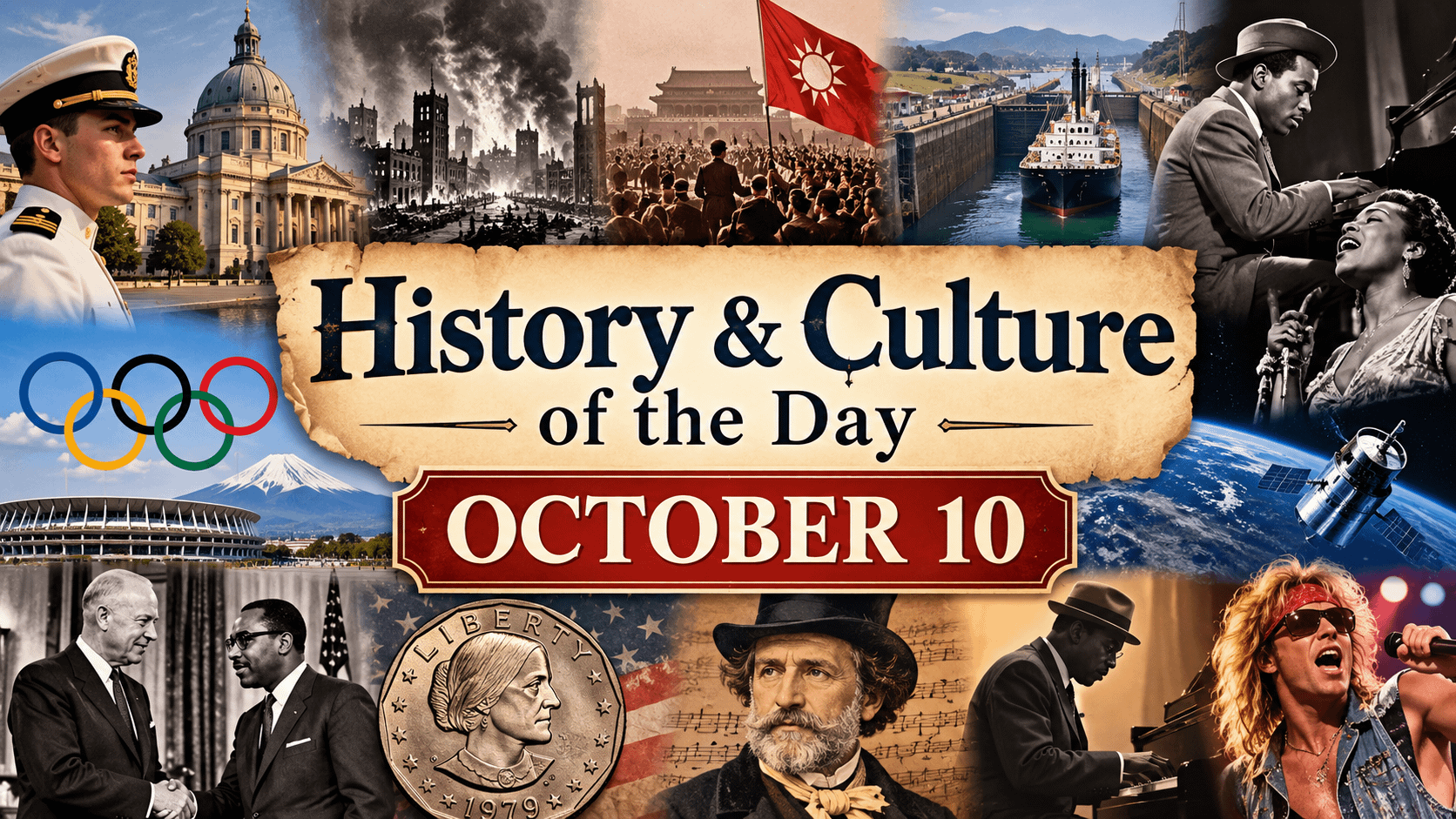
October 10 is a date filled with fascinating moments in history, cultural milestones, scientific achievements, political developments, and events that helped shape the world we know today.
From the opening of an important engineering achievement in the United States to developments in music, exploration, entertainment, and international history, October 10 gives us another opportunity to look into the past and understand how yesterday continues to influence today.
A Day to Look Back at History
History is more than a collection of names and dates. It is the story of people making decisions, taking risks, creating new ideas, overcoming challenges, and sometimes changing the direction of society.
Some historical moments receive worldwide attention. Others seem relatively small when they happen but become much more significant with time.
October 10 has seen plenty of both.
Let’s explore some of the notable history and culture connected with this date.
1845 – The United States Naval Academy Begins Classes
On October 10, 1845, the institution that would become the United States Naval Academy opened in Annapolis, Maryland.
It began as the Naval School under Secretary of the Navy George Bancroft. The goal was to provide a more organized system of education for future naval officers.
Before institutions like the Naval Academy were established, much of a young naval officer’s education happened aboard ships.
The school eventually developed into one of America’s best-known military academies.
Its establishment reflected a broader change occurring during the 19th century. Military service was becoming increasingly professionalized, and technical education was becoming more important as ships, navigation, engineering, and weaponry became more sophisticated.
Today, the Naval Academy continues to educate future officers for service in the United States Navy and Marine Corps.
1871 – The Great Chicago Fire Comes Under Control
One of the most famous disasters in American history was finally brought under control around October 10, 1871.
The Great Chicago Fire began on the evening of October 8 and burned through much of the city.
Thousands of buildings were destroyed, hundreds of people died, and roughly 100,000 residents were left without homes.
The destruction was enormous.
But the story of the Great Chicago Fire is also connected with rebuilding.
Chicago rapidly reconstructed itself in the years that followed. The disaster encouraged changes in construction practices and helped influence the city’s future architectural development.
Chicago would eventually become famous for innovative architecture and some of the earliest skyscrapers.
The fire therefore became both a devastating chapter in the city’s history and the beginning of a remarkable period of rebuilding.
1911 – The Wuchang Uprising Begins
October 10, 1911, became an extremely important date in Chinese history when the Wuchang Uprising began.
The uprising helped trigger the Xinhai Revolution, which ultimately brought an end to the Qing dynasty.
The revolution resulted in the establishment of the Republic of China.
The date became so historically significant that October 10 is commonly associated with the anniversary of the revolution and is known as “Double Ten Day.”
It remains an important date in the history of modern China and Taiwan.
The events demonstrate how quickly political unrest can grow into a movement capable of changing a country’s system of government.
1913 – The Panama Canal’s Gamboa Dike Is Blown Up
October 10, 1913, marked an important moment during construction of the Panama Canal.
The Gamboa Dike was destroyed, allowing water from Gatun Lake to flow into the Culebra Cut.
Although additional work was still required before the canal officially opened, the event represented another major step toward completing one of the greatest engineering projects of its era.
The Panama Canal would officially open to commercial traffic in 1914.
Its impact on global transportation was enormous.
Ships traveling between the Atlantic and Pacific Oceans no longer had to make the long and dangerous journey around the southern tip of South America.
The canal dramatically shortened many shipping routes and became one of the world’s most strategically important waterways.
1935 – George Gershwin’s Porgy and Bess Opens on Broadway
American music and theater history reached an important milestone on October 10, 1935, when George Gershwin’s Porgy and Bess opened on Broadway.
The work combined elements of opera, jazz, blues, spirituals, and American popular music.
Songs associated with the production, including “Summertime,” became widely recognized beyond the stage.
The production’s history has also generated discussion about race, representation, stereotypes, and the portrayal of Black American life.
Over the decades, Porgy and Bess has been revived and reinterpreted numerous times.
Its complicated cultural history makes it an important work not only in American music but also in discussions about how American culture and identity have been portrayed onstage.
1957 – President Eisenhower Apologizes to Ghana’s Finance Minister
October 10 is also connected to an important moment in the history of the American civil rights era.
In 1957, Komla Agbeli Gbedemah, the finance minister of the newly independent nation of Ghana, was refused service at a Howard Johnson’s restaurant in Dover, Delaware.
The incident attracted international attention.
President Dwight D. Eisenhower subsequently apologized to Gbedemah and invited him to the White House.
The incident illustrated an uncomfortable contradiction facing the United States during the Cold War.
America was attempting to present itself internationally as a defender of democracy and freedom while racial segregation and discrimination remained widespread at home.
Events such as this helped demonstrate that the American civil rights struggle had international consequences as well as domestic ones.
1964 – The Tokyo Summer Olympics Open
On October 10, 1964, the Summer Olympic Games officially opened in Tokyo, Japan.
The Tokyo Olympics carried enormous cultural significance.
Japan had undergone extraordinary reconstruction following the devastation of World War II, and hosting the Olympics provided an opportunity to present a modernized Japan to an international audience.
Major infrastructure projects accompanied preparations for the Games.
One of the most famous was the Tokaido Shinkansen, or bullet train, which began service shortly before the Olympics.
The Games became associated with Japan’s postwar economic development, technological progress, and reemergence on the international stage.
Tokyo would later host the Summer Olympics again in 2021 after the 2020 Games were postponed because of the COVID-19 pandemic.
1967 – The Outer Space Treaty Enters Into Force
The exploration of space was rapidly becoming one of humanity’s greatest technological adventures during the 1960s.
On October 10, 1967, the Outer Space Treaty entered into force.
The agreement established important principles regarding the exploration and use of outer space.
Among its provisions, the treaty prohibited placing nuclear weapons or other weapons of mass destruction in orbit or stationing them on celestial bodies.
It also established the principle that outer space should be used for peaceful purposes and that celestial bodies such as the Moon are not subject to national appropriation.
Decades later, the treaty remains a foundation of international space law.
Its importance may continue to grow as governments and private companies expand their activities beyond Earth.
1973 – Spiro Agnew Resigns as Vice President
On October 10, 1973, Spiro Agnew resigned as vice president of the United States.
Agnew entered a plea of no contest to a federal charge of income tax evasion as part of an agreement with prosecutors.
His resignation occurred during an already turbulent period in American political history.
The Watergate scandal involving President Richard Nixon was intensifying at approximately the same time.
Gerald Ford was subsequently nominated and confirmed to replace Agnew as vice president.
Less than a year later, Nixon resigned the presidency, and Ford became president.
The unusual chain of events meant Ford became both vice president and president without having been elected to either office.
1978 – The Susan B. Anthony Dollar Is Authorized
On October 10, 1978, President Jimmy Carter signed legislation authorizing the Susan B. Anthony dollar coin.
Anthony was one of the most prominent figures in the American women’s suffrage movement.
The coin entered circulation the following year.
It represented an important cultural milestone because Anthony became the first historical woman portrayed on a circulating United States coin.
The coin itself never became particularly popular in everyday commerce, partly because its size and appearance made it easy to confuse with the quarter.
Nevertheless, its historical symbolism remains significant.
October 10 and World Mental Health Day
October 10 has another important modern cultural connection: World Mental Health Day.
The observance was first organized by the World Federation for Mental Health in 1992.
Its purpose is to encourage awareness, education, and discussion surrounding mental health around the world.
Over the years, public conversations surrounding mental health have changed considerably.
Topics that were once rarely discussed publicly—including depression, anxiety, trauma, grief, addiction, and emotional well-being—have increasingly become part of mainstream conversations.
World Mental Health Day serves as a reminder that mental health is an important part of overall health and that conversations about emotional struggles can help reduce stigma.
Born on October 10
October 10 is also the birthday of several notable people from history and popular culture.
Giuseppe Verdi – Born in 1813
Italian composer Giuseppe Verdi became one of the most influential opera composers of the 19th century.
His famous works include Rigoletto, La Traviata, Aida, and Otello.
His music remains regularly performed around the world.
Helen Hayes – Born in 1900
Helen Hayes became one of America’s most celebrated actresses.
Her career extended across stage, film, and television for decades, earning her the nickname “First Lady of American Theatre.”
Thelonious Monk – Born in 1917
Jazz pianist and composer Thelonious Monk became one of the most distinctive and influential musicians in jazz history.
His unconventional melodies, rhythms, harmonies, and improvisational style helped shape modern jazz.
Compositions such as “Round Midnight” became jazz standards.
James Clavell – Born in 1921
Writer and filmmaker James Clavell became especially well known for historical novels dealing with encounters between Asian and Western cultures.
His novel Shōgun became one of his most famous works and inspired major television adaptations.
David Lee Roth – Born in 1954
David Lee Roth became famous as the energetic lead singer of the rock band Van Halen.
His distinctive personality and stage presence helped make the band one of the most recognizable rock acts of the late 1970s and 1980s.
Why October 10 Matters
What makes October 10 interesting isn’t one single event.
It is the variety of history connected to the date.
Military education, urban disaster and rebuilding, revolution, international engineering, Broadway, civil rights, the Olympics, space exploration, American politics, women’s history, jazz, opera, rock music, and mental health awareness all appear somewhere in the story of October 10.
That variety is exactly what makes studying history so fascinating.
The world we experience today wasn’t created through one major event. It developed through millions of individual decisions, discoveries, conflicts, inventions, tragedies, achievements, and cultural changes.
Some happened centuries ago.
Others happened within living memory.
History Gives Us Perspective
Looking backward can help us better understand the present.
The Great Chicago Fire demonstrates the enormous challenge of rebuilding after disaster.
The Panama Canal represents what engineering and human determination can accomplish.
The 1964 Tokyo Olympics show how an international sporting event can become part of a country’s larger cultural transformation.
The Outer Space Treaty reminds us that even as humanity began reaching beyond Earth, nations recognized the need to establish rules governing that new frontier.
World Mental Health Day shows how cultural conversations can change over time.
Each story is different, but together they demonstrate something important:
History never truly disappears.
Its consequences remain around us—in our cities, laws, traditions, technology, music, institutions, and culture.
Final Thoughts
October 10 has witnessed revolutions, political change, groundbreaking engineering projects, cultural achievements, sporting history, and milestones that continue to influence the modern world.
Some of these events transformed nations. Others changed music, technology, transportation, or culture.
And some remind us how much society itself can change from one generation to another.
Taking a few minutes each day to explore history gives us a chance to discover not only what happened but why those events still matter.
Which October 10 event do you think had the greatest lasting impact on the world?