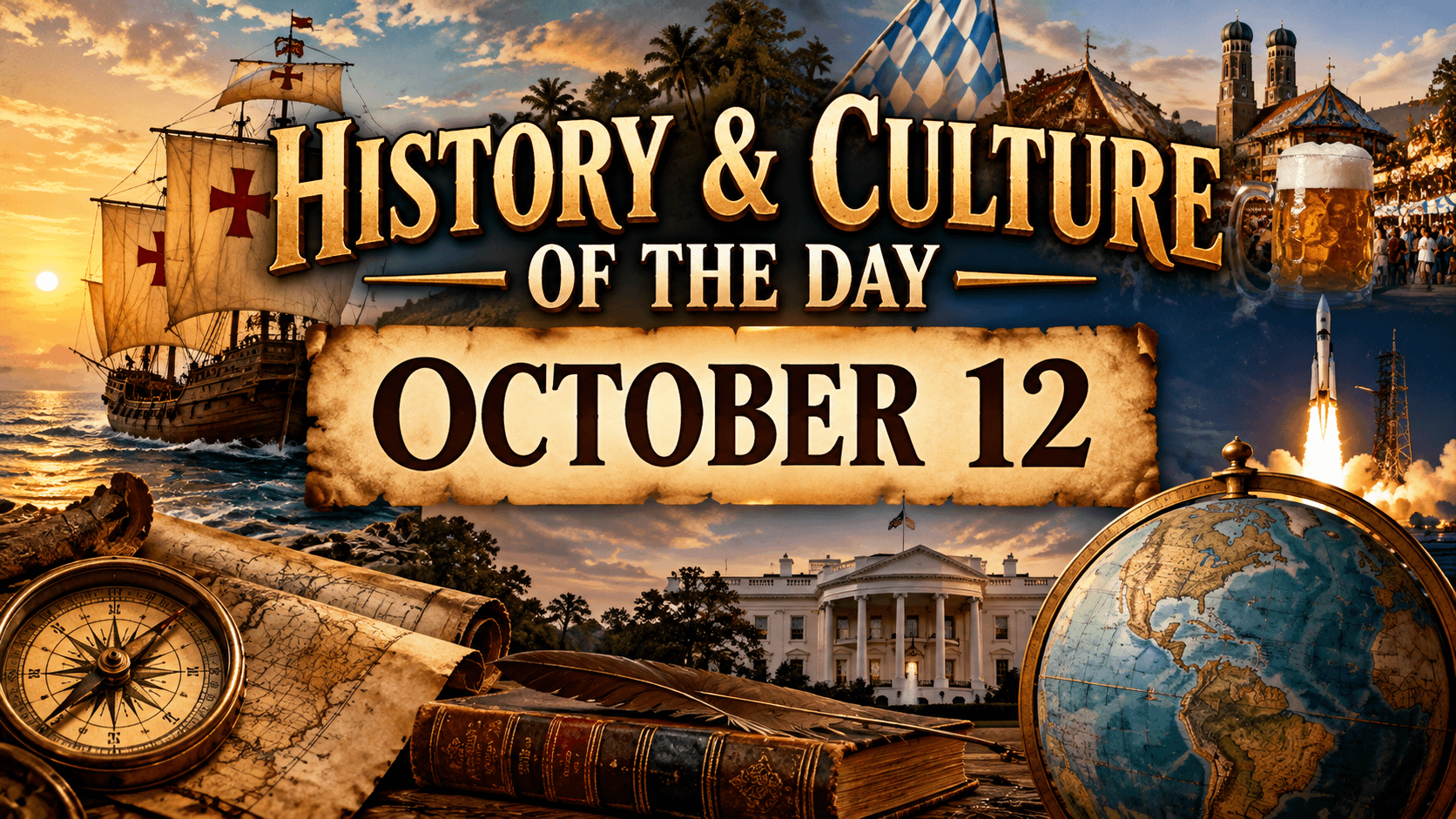
October 12 is a date filled with exploration, cultural change, historic turning points, scientific discoveries, and events that continue to shape how we understand the world today.
Perhaps no event associated with October 12 is more widely known—or more debated—than Christopher Columbus reaching the Caribbean in 1492. But the history of October 12 extends far beyond that single voyage. The date has also witnessed the creation of one of the world’s most famous celebrations, important moments in American history, technological achievements, and cultural milestones.
Here is a look back at some of the history and culture connected to October 12.
1492 – Christopher Columbus Reaches the Caribbean
On October 12, 1492, Christopher Columbus and his expedition reached an island in the Caribbean after sailing west across the Atlantic Ocean under the sponsorship of Spain’s Catholic monarchs.
Columbus believed he had reached islands near Asia. Instead, his voyage became part of a much larger period of sustained European exploration, colonization, migration, and conquest in the Americas.
For generations, American history lessons often presented Columbus’s arrival primarily as the “discovery of America.” Today, historians generally provide a much broader perspective.
Indigenous peoples had lived throughout the Americas for thousands of years before Columbus arrived. Nor was Columbus the first European known to have reached North America; Norse explorers had established a settlement at L’Anse aux Meadows in Newfoundland centuries earlier.
Columbus’s voyages nevertheless became historically significant because they helped initiate sustained contact between Europe and the Americas.
That contact dramatically transformed both sides of the Atlantic.
Plants, animals, foods, technologies, diseases, and populations moved between continents in what historians commonly call the Columbian Exchange. Foods originating in the Americas—including potatoes, tomatoes, corn, cacao, and peppers—eventually transformed cuisines around the world.
At the same time, European colonization brought devastating consequences for Indigenous populations, including warfare, forced labor, displacement, enslavement, and epidemics.
Because of this complicated legacy, October 12 and related observances remain subjects of historical discussion and cultural debate.
Columbus Day and Indigenous Peoples’ Day
In the United States, Columbus Day became a federal holiday in 1937 and is observed on the second Monday of October rather than permanently on October 12.
Over time, many communities began observing Indigenous Peoples’ Day on the same Monday.
Indigenous Peoples’ Day recognizes the histories, cultures, contributions, and resilience of Indigenous peoples while encouraging greater awareness of the consequences of European colonization.
The evolution of these observances demonstrates something important about history: societies continually reconsider how the past should be remembered.
Historical events do not change, but our understanding of their meaning can deepen as additional perspectives and evidence receive attention.
1773 – America’s First Public Museum Opens
October 12 also holds an interesting place in American cultural history.
On October 12, 1773, the Charleston Library Society announced the opening of a museum in Charleston, South Carolina. It is frequently described as America’s first public museum.
Early museums were quite different from the enormous institutions we know today. Collections often contained natural specimens, artifacts, scientific curiosities, and unusual objects gathered from around the world.
These early collections reflected the growing interest in science, exploration, natural history, and education during the eighteenth century.
Museums eventually became some of the most important institutions for preserving cultural artifacts and helping generations learn about history, science, art, and civilization.
1810 – The First Oktoberfest Celebration
One of the world’s most famous festivals traces its beginnings to October 12.
On October 12, 1810, Crown Prince Ludwig of Bavaria married Princess Therese of Saxe-Hildburghausen.
Citizens of Munich were invited to festivities celebrating the royal wedding. Horse races were held several days later on fields outside the city gates.
The celebration proved so popular that it was repeated.
Over time, the event evolved into Oktoberfest.
Today, Munich’s Oktoberfest is famous around the world for Bavarian traditions, enormous festival tents, music, food, traditional clothing, carnival attractions, and, of course, beer.
Despite its name, most of modern Oktoberfest takes place during September, usually ending in early October.
What began as a royal wedding celebration more than two centuries ago became an international symbol of Bavarian culture.
1892 – The Pledge of Allegiance Is Recited in Schools
October 12, 1892, was connected to a major national celebration marking the 400th anniversary of Columbus’s voyage.
As part of nationwide school ceremonies surrounding the anniversary, millions of American students participated in patriotic exercises.
The original Pledge of Allegiance had recently been written by Francis Bellamy and published in The Youth’s Companion.
Bellamy’s original wording was much shorter than the pledge familiar to Americans today.
The words “under God,” for example, were not added until 1954.
The pledge became increasingly common in American schools during the decades that followed and eventually became one of the country’s most recognizable civic traditions.
1901 – The White House Officially Gets Its Name
The home of the president of the United States has been known by several names throughout American history, including the President’s House, President’s Palace, and Executive Mansion.
On October 12, 1901, President Theodore Roosevelt’s administration officially began using “White House” on presidential stationery.
The name had already been commonly used for years, but Roosevelt’s action helped formalize it.
Today, “the White House” can mean both the physical presidential residence at 1600 Pennsylvania Avenue and, more broadly, the presidential administration itself.
1935 – Luciano Pavarotti Is Born
October 12, 1935, marked the birth of Luciano Pavarotti in Modena, Italy.
Pavarotti became one of the world’s most recognizable opera singers.
Known for his powerful tenor voice and charismatic performances, he helped introduce opera to audiences who might otherwise never have attended a traditional opera performance.
His appearances as part of the Three Tenors alongside Plácido Domingo and José Carreras became enormously popular internationally.
Pavarotti’s career demonstrated how classical music could reach mass audiences through television, recordings, concerts, and collaborations with popular musicians.
He died in 2007, but recordings of his performances continue to introduce new generations to opera.
1960 – Nikita Khrushchev’s Famous United Nations Protest
October 12, 1960, is remembered for one of the strangest episodes in United Nations history.
During a heated meeting of the UN General Assembly, Soviet leader Nikita Khrushchev angrily protested remarks being made during the session.
The incident became famous because Khrushchev was widely reported to have brandished or banged a shoe during the confrontation.
Exactly what happened has been debated for decades, with eyewitness accounts differing over whether Khrushchev actually struck the desk with the shoe.
Regardless, the episode became an enduring image of Cold War tensions between the Soviet Union, the United States, and their respective allies.
1964 – The Soviet Union Launches Voskhod 1
The Space Race produced another historic October 12 milestone.
On October 12, 1964, the Soviet Union launched Voskhod 1.
The spacecraft carried three cosmonauts: Vladimir Komarov, Konstantin Feoktistov, and Boris Yegorov.
It became the first spaceflight to carry more than one person into orbit.
The mission demonstrated how quickly human spaceflight was advancing. Only a few years earlier, sending even one person into orbit had represented an extraordinary technological achievement.
By the middle of the decade, both the United States and Soviet Union were developing increasingly ambitious missions as they competed for leadership in space exploration.
That competition would eventually culminate in humans walking on the Moon in 1969.
1999 – The World’s Population Reaches Six Billion
October 12, 1999, was symbolically designated by the United Nations as the “Day of Six Billion.”
The date represented the estimated moment when the world’s population reached approximately six billion people.
It was not possible to identify the exact individual who represented the six-billionth person, but the milestone drew attention to enormous changes in global population.
Human population growth accelerated dramatically during the twentieth century because of improvements in medicine, sanitation, agriculture, nutrition, and public health.
The world’s population later passed seven billion and then eight billion, creating continuing discussions about resources, cities, food production, environmental pressures, aging populations, and economic development.
October 12 and the Changing Meaning of History
Few dates demonstrate the complexity of historical memory quite like October 12.
The date can represent exploration and cultural exchange while also reminding us of conquest, colonization, and the devastating experiences of Indigenous peoples.
It can represent an old Bavarian royal wedding that unexpectedly became one of the world’s largest festivals.
It can remind us of America’s evolving civic traditions, Cold War confrontations, breakthroughs in space exploration, and dramatic changes in global population.
History becomes more meaningful when we look beyond a single headline.
Every date contains countless human stories.
Some involve celebration.
Others involve tragedy.
Some changed nations, while others changed culture in quieter ways.
Together, they help explain how today’s world came to be.
Why October 12 Still Matters
Studying October 12 reminds us that history is rarely simple.
Christopher Columbus’s arrival in the Caribbean transformed world history, but understanding that event requires acknowledging both the enormous global changes that followed and the experiences of Indigenous peoples who were already living in the Americas.
Oktoberfest shows how a single celebration can evolve into a tradition lasting more than two centuries.
Voskhod 1 reminds us how quickly technology can push humanity beyond boundaries that once seemed impossible.
And the Day of Six Billion demonstrates just how dramatically the human population has changed within only a few generations.
History isn’t simply a collection of dates to memorize.
It is the story of people, choices, discoveries, conflicts, traditions, achievements, mistakes, and consequences.
October 12 gives us another opportunity to look backward—not simply to celebrate or condemn the past, but to understand it.
Which event from October 12 do you think had the greatest impact on the world we live in today?