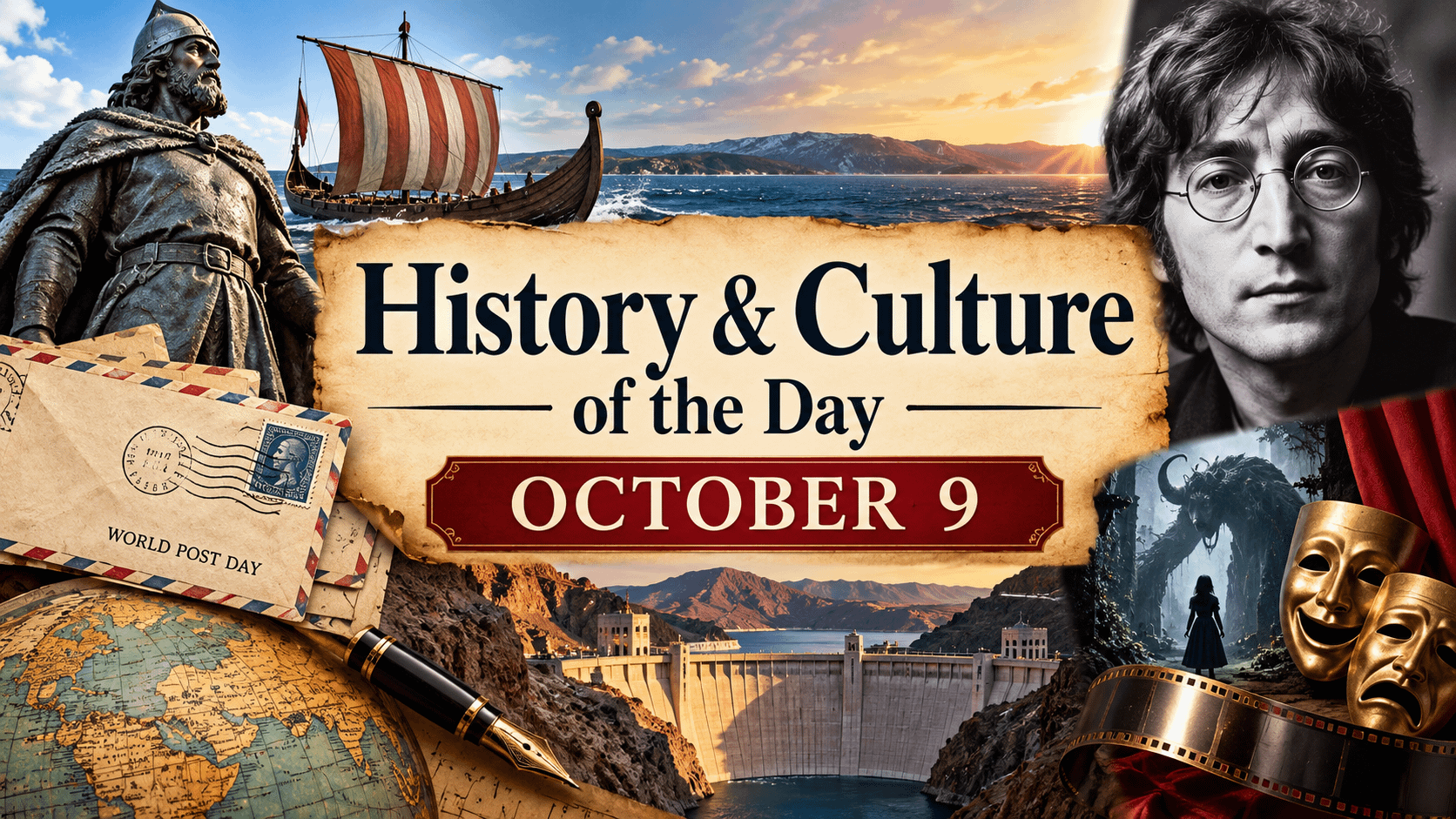
October 9 is a date filled with stories of exploration, communication, music, political change, engineering achievement, tragedy, and cultural transformation.
From the creation of an international postal system that helped connect the world to the celebration of Viking explorer Leif Erikson, October 9 reminds us how human beings have continually tried to cross boundaries—whether those boundaries were oceans, national borders, technological limitations, or cultural expectations.
It is also the birthday of one of the most influential musicians of the twentieth century, John Lennon, and a date associated with events that changed communities and nations.
Here is a closer look at the history and culture of October 9.
🌎 1874 — The Universal Postal Union Is Created
Long before email, text messages, social media, and smartphones allowed people to communicate instantly, sending a letter internationally could be surprisingly complicated.
Different countries operated under different postal rules, rates, and agreements.
That began to change dramatically on October 9, 1874, when representatives signed the Treaty of Bern in Switzerland, establishing what was originally called the General Postal Union. Representatives of 22 nations participated in the conference that led to the agreement. The organization was renamed the Universal Postal Union (UPU) in 1878.
The agreement helped establish a more unified international system for exchanging letters.
It might seem ordinary today to put an address on an envelope, pay the required postage, and trust that the letter can travel thousands of miles through multiple countries.
In the nineteenth century, creating a system capable of doing that reliably was a major achievement.
The postal network didn’t merely deliver correspondence.
Letters connected families separated by migration. Businesses communicated with customers and suppliers. Governments sent documents. Soldiers wrote home. Friends maintained relationships across continents.
For generations, a letter arriving in the mailbox could bring some of the most important news of a person’s life.
📬 World Post Day
Because of the importance of the October 9, 1874 agreement, October 9 is now celebrated internationally as World Post Day.
The Universal Postal Congress officially established the observance in 1969, marking the anniversary of the UPU’s founding.
World Post Day recognizes the role postal services play in connecting individuals, businesses, and communities.
Even in an era dominated by digital communication, postal networks remain important.
Packages ordered online travel through massive delivery networks. Important documents still move through the mail. Postal systems serve remote communities where other services may be limited.
The technology has changed dramatically, but the fundamental goal remains familiar:
Connecting one person with another.
⚔️ Leif Erikson Day
October 9 is also recognized in the United States as Leif Erikson Day, honoring the Norse explorer associated with the first known European expedition to reach North America centuries before Christopher Columbus.
Norse explorers established a settlement at what is now L’Anse aux Meadows in Newfoundland, Canada, around the year 1000. Archaeological discoveries there provided physical evidence of a Norse presence in North America.
Leif Erikson’s story became especially important among Scandinavian-American communities.
Congressional action connected October 9 with the commemoration of Leif Erikson as early as 1935, and later federal action established the modern annual observance.
Interestingly, October 9 is not believed to be Leif Erikson’s birthday or the exact date he reached North America.
Instead, the date became connected with Scandinavian-American heritage and immigration history.
Today, Leif Erikson Day provides an opportunity to remember both Viking exploration and the contributions of Nordic immigrants to American culture.
🧭 The Viking Presence in North America
For centuries, stories of Viking voyages westward were preserved primarily through Norse sagas.
Eventually archaeology provided remarkable evidence supporting parts of those traditions.
In 1960, explorer Helge Ingstad identified remains at L’Anse aux Meadows. Archaeological excavations involving his wife, archaeologist Anne Stine Ingstad, uncovered Norse artifacts dating to around A.D. 1000.
The discovery transformed our understanding of early European exploration of North America.
It demonstrated that Norse sailors had crossed the Atlantic roughly five centuries before Columbus’s famous 1492 voyage.
Their journey also reveals the extraordinary maritime abilities of Viking-age sailors.
Without modern navigation systems, engines, satellite maps, or weather forecasts, these explorers crossed some of the most dangerous waters in the world.
Their voyages remain an extraordinary chapter in the history of human exploration.
🏛️ 1635 — Roger Williams Is Banished From Massachusetts
October 9 also played an important role in the history of religious freedom in colonial America.
On October 9, 1635, religious dissident Roger Williams was banished from the Massachusetts Bay Colony.
Williams challenged several ideas held by colonial authorities. Among other things, he argued for greater religious liberty and questioned the government’s authority over matters of individual conscience.
After leaving Massachusetts, Williams eventually helped establish a settlement that became part of Rhode Island.
Rhode Island became famous for its unusually broad commitment to religious tolerance.
The principles Williams advocated would eventually become central to American discussions about the separation of church and state and freedom of religion.
Ideas considered radical in one generation sometimes become foundational principles in another.
⚡ 1936 — Hoover Dam Sends Electricity to Los Angeles
On October 9, 1936, electricity generated at Hoover Dam began traveling across approximately 266 miles of transmission lines to Los Angeles.
Hoover Dam had already become one of America’s greatest engineering projects.
Built during the Great Depression, the enormous structure harnessed the Colorado River and provided hydroelectric power while helping manage water resources throughout the Southwest.
The arrival of Hoover Dam electricity in Los Angeles represented more than an engineering accomplishment.
Reliable electrical power helped support the rapid growth of Southern California.
Homes gained electricity.
Businesses expanded.
Factories increased production.
Cities grew.
The project demonstrated how infrastructure can reshape entire regions.
Nearly a century later, Hoover Dam remains one of the most recognizable engineering landmarks in the United States.
🎭 1946 — The Iceman Cometh Opens on Broadway
American theater experienced an important moment on October 9, 1946, when Eugene O’Neill’s The Iceman Cometh opened at the Martin Beck Theatre on Broadway.
O’Neill was one of America’s most influential playwrights.
His plays frequently explored difficult subjects including addiction, regret, broken families, loneliness, dreams, disappointment, and the ways people cope with painful realities.
The Iceman Cometh examines people clinging to illusions about themselves and their futures.
Rather than providing simple entertainment, the play forces audiences to confront uncomfortable questions:
How much of our identity depends on the stories we tell ourselves?
Can people survive without hope?
And is an uncomfortable truth always better than a comforting illusion?
Those questions helped the play become an enduring work of American drama.
🎸 1940 — John Lennon Is Born
One of the most culturally significant birthdays associated with October 9 occurred in 1940, when John Lennon was born in Liverpool, England.
Lennon would eventually become a founding member of The Beatles, one of the most influential musical groups in history.
Alongside Paul McCartney, George Harrison, and Ringo Starr, Lennon helped transform popular music during the 1960s.
The Beatles did more than produce hit songs.
Their music evolved rapidly, incorporating new recording techniques, instruments, lyrical themes, and influences from cultures around the world.
Their hairstyles, clothing, humor, personalities, and attitudes also influenced youth culture internationally.
After the Beatles separated, Lennon continued his solo career and became associated with songs and activism centered on peace.
His life ended tragically when he was murdered in New York City in 1980.
Yet decades later, his music continues to be discovered by new generations.
🎬 1964 — Guillermo del Toro Is Born
October 9 is also the birthday of acclaimed Mexican filmmaker Guillermo del Toro, born in 1964.
Del Toro became known for films blending fantasy, horror, folklore, history, and deeply human stories.
His work often presents monsters differently than traditional horror films.
Sometimes the frightening-looking creature isn’t the true monster at all.
Instead, human cruelty, intolerance, greed, or authoritarianism may represent the greater danger.
Films such as Pan’s Labyrinth and The Shape of Water helped establish del Toro as one of modern cinema’s distinctive visual storytellers.
His career demonstrates how fantasy can be used not simply as escapism but as a way to examine real human emotions and social issues.
🇮🇹 1963 — The Vajont Dam Disaster
October 9 also carries the memory of tragedy.
On October 9, 1963, a massive landslide occurred near the Vajont Dam in northern Italy.
An enormous amount of rock crashed into the reservoir, displacing water and creating a devastating wave that overwhelmed communities below.
More than 2,000 people were killed.
The dam itself largely remained standing.
The disaster demonstrated that engineering safety involves far more than the structural strength of a dam.
Geology, environmental conditions, surrounding mountains, water levels, and risk assessments can be equally important.
The Vajont disaster remains one of the twentieth century’s most devastating dam-related catastrophes.
🇧🇴 1967 — Che Guevara Is Executed
Another major historical event connected with October 9 occurred in 1967.
Revolutionary Ernesto “Che” Guevara was executed in Bolivia after being captured by Bolivian forces.
Guevara had become internationally famous through his involvement in the Cuban Revolution and his association with Fidel Castro.
His legacy remains intensely debated.
Supporters have portrayed him as a revolutionary symbol of resistance to imperialism and economic inequality, while critics emphasize political repression and executions associated with the revolutionary government and Guevara’s own actions.
Regardless of those competing interpretations, Guevara’s image became one of the most recognizable political symbols of the twentieth century.
His famous portrait has appeared on posters, shirts, flags, artwork, and protest materials throughout the world.
October 9, 1967 marked the end of his life but the beginning of an even larger cultural mythology surrounding his image.
🇦🇫 2004 — Afghanistan Holds Its First Direct Presidential Election
On October 9, 2004, Afghanistan held its first direct presidential election.
More than 10 million people participated, according to contemporary historical accounts, with women representing approximately 41 percent of voters.
The election took place only a few years after the fall of the Taliban government following the U.S.-led intervention in 2001.
The event was widely presented at the time as an important milestone in Afghanistan’s attempt to establish democratic political institutions.
Afghanistan’s subsequent political history became far more complicated, including continuing conflict and the Taliban’s return to national power in 2021.
The 2004 election nevertheless remains an important moment in the country’s modern history.
🎂 Famous People Born on October 9
October 9 has produced an interesting collection of artists, musicians, filmmakers, athletes, and public figures.
Among them are:
John Lennon — 1940
Musician, songwriter, peace activist, and member of The Beatles.
Jackson Browne — 1948
American singer-songwriter known for influential songs spanning decades of rock music.
Tony Shalhoub — 1953
Award-winning actor known for roles including Adrian Monk in Monk.
Scott Bakula — 1954
American actor known for Quantum Leap and Star Trek: Enterprise.
Guillermo del Toro — 1964
Mexican filmmaker celebrated for visually imaginative fantasy and horror films.
PJ Harvey — 1969
Influential English singer-songwriter and musician known for constantly evolving musical styles.
These birthdays show just how strongly October 9 is connected with creativity and popular culture.
📮 The Cultural Importance of the Letter
Perhaps the most fitting cultural theme for October 9 is something most of us rarely think about anymore:
the handwritten letter.
For centuries, letters were among humanity’s most important forms of communication.
Love letters crossed oceans.
Parents wrote children who had moved away.
Soldiers wrote home from battlefields.
Immigrants described their new lives to relatives thousands of miles away.
Friends maintained lifelong relationships through correspondence.
Historical letters now provide historians with intimate glimpses into the past that official documents often cannot provide.
A government record might tell us that a war happened.
A soldier’s letter can tell us what that war felt like.
A census can tell us where someone lived.
A love letter can tell us whom that person loved.
That’s the difference between recording history and understanding the people who lived through it.
📱 From Letters to Instant Messages
Communication has changed dramatically since the Universal Postal Union was established in 1874.
A message that once took weeks to cross an ocean can now travel around the planet in seconds.
Letters became telegrams.
Telegrams gave way to telephone calls.
Telephone calls were joined by email.
Email was joined by text messaging.
Then came social media, video calls, messaging apps, and smartphones.
Yet something interesting happened along the way.
Communication became faster, but handwritten communication became more meaningful precisely because it became less common.
Receiving a handwritten birthday card or letter today can feel unusually personal.
Someone had to sit down.
Think about what they wanted to say.
Write it.
Address it.
And send it.
Sometimes slowing communication down makes the words feel more important.
🌍 What October 9 Teaches Us
The history of October 9 contains a surprising common thread.
Connection.
Leif Erikson crossed an ocean and connected distant parts of the world.
The Universal Postal Union created a system allowing people in different countries to communicate more easily.
Hoover Dam’s transmission lines connected electrical power with a rapidly growing city.
John Lennon used music to connect with millions of people across cultures and generations.
Guillermo del Toro uses storytelling to connect fantasy with deeply human experiences.
Even difficult moments in October 9 history remind us how interconnected our lives can become.
History is rarely made by isolated individuals.
Explorers need crews.
Artists need audiences.
Cities need infrastructure.
Communication requires someone willing to send a message—and someone willing to receive it.
Final Thoughts
October 9 reminds us that humanity has always searched for ways to cross the distance between us.
Sometimes we crossed oceans in wooden ships.
Sometimes we carried handwritten letters thousands of miles.
Sometimes we built transmission lines through deserts and mountains.
Today we send messages instantly through devices sitting in our pockets.
The technology changes.
The human desire behind it doesn’t.
We want to explore.
We want to create.
We want to communicate.
We want to leave something behind that tells future generations:
We were here. We experienced this. We created something. We loved someone. And our story mattered.
That may ultimately be one of history’s greatest purposes—not simply remembering dates, wars, inventions, and famous people, but remembering the human lives behind them.
If you could send one handwritten letter to any person from history, who would you write to—and what would you want to tell them?