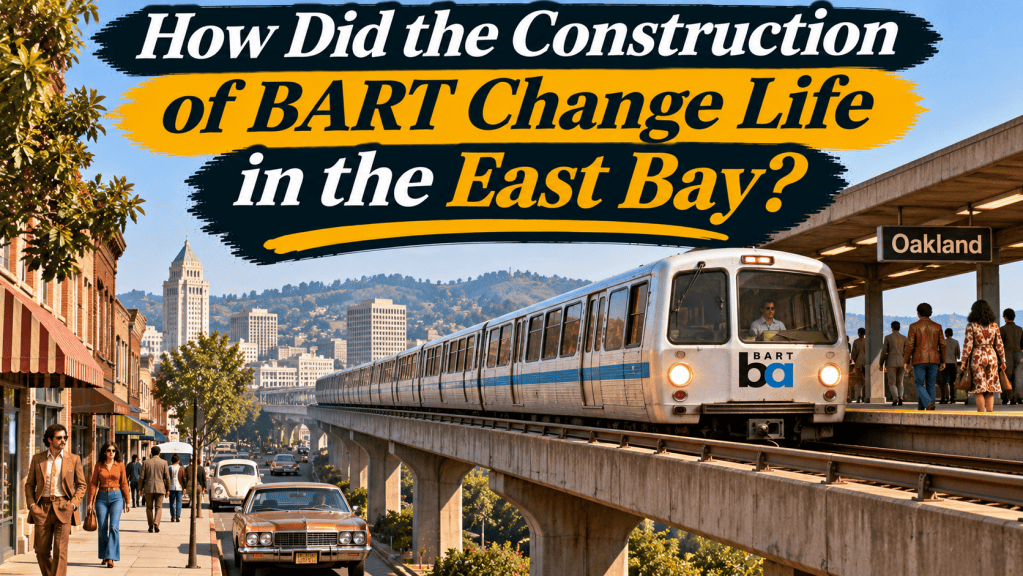
The construction of Bay Area Rapid Transit, better known as BART, transformed the way people lived, worked, and traveled throughout the East Bay. Beginning in the 1960s, the construction of elevated tracks, underground stations, tunnels, and a rail crossing beneath San Francisco Bay created a transportation network that would connect communities in Alameda and Contra Costa counties with San Francisco.
BART gave many East Bay residents an alternative to driving, expanded access to employment and educational opportunities, and influenced development around railway stations. However, construction also displaced households and disrupted established neighborhoods, particularly in parts of Oakland.
Understanding the history of BART means examining both its transportation achievements and the experiences of the communities affected by its development.
What was transportation like before BART?
Before BART opened, East Bay residents relied on automobiles, buses, ferries, and earlier railway services to reach their destinations. The Key System had previously operated electric trains connecting East Bay communities with San Francisco, including service across the San Francisco-Oakland Bay Bridge.
The last Key System trains stopped running in 1958. Bus transportation continued, but the region’s growing population and increasing dependence on automobiles created concerns about future congestion.
For people traveling between the East Bay and San Francisco, the Bay Bridge was a particularly important connection. Regional leaders recognized that continued population growth would create demand for additional transportation capacity.
A rapid transit system offered the possibility of moving large numbers of passengers without requiring each traveler to drive a separate automobile.
Why was BART built?
Plans for a new regional rail system developed over several decades. A transportation study in 1947 identified the need for another connection between San Francisco and Oakland. During the 1950s, regional planning efforts examined how rapid transit might accommodate future development.
California established the Bay Area Rapid Transit District in 1957. Although the proposed system initially involved more counties, its original construction ultimately centered on Alameda, Contra Costa, and San Francisco counties.
In 1962, voters approved a major bond measure to help finance the system.
BART was intended to address regional transportation needs rather than simply provide local railway service within individual cities. The planned routes would connect urban centers with growing suburban communities and create a new way to travel beneath the bay.
When did BART construction begin in the East Bay?
The official groundbreaking took place on June 19, 1964, near Concord. President Lyndon B. Johnson participated in the ceremony marking the beginning of work on an experimental track in Contra Costa County.
Construction subsequently expanded throughout the East Bay. Work on the Oakland subway started in 1966, requiring extensive excavation in busy urban areas.
Engineers faced different challenges depending on the landscape. Some sections of railway were built at ground level, others required elevated structures, and still others involved underground tunnels.
Projects of this scale affected the streets, businesses, and residential properties surrounding construction sites. For several years, residents experienced the inconvenience of building a transportation system that many hoped would eventually improve their daily lives.
When did BART open for passengers?
BART began carrying paying passengers on September 11, 1972. Its first operating section connected MacArthur Station in Oakland with Fremont.
Additional East Bay routes opened in stages. Service between Oakland and Richmond began in January 1973, followed by the route toward Concord in May of that year.
The connection under San Francisco Bay opened to passengers on September 16, 1974. At that point, the system could offer rail journeys between the East Bay and San Francisco through the Transbay Tube.
These milestones established the foundation of the regional network that subsequent generations of residents would use.
How the Transbay Tube changed commuting
The Transbay Tube was one of the most ambitious features of the new railway. Construction involved fabricating large tunnel sections, transporting them into position, and installing them beneath the bay.
Once passenger service began in 1974, East Bay commuters gained another way to reach San Francisco without crossing the Bay Bridge by road.
Someone living in Oakland or Berkeley could travel into San Francisco for work without having to drive and find parking downtown. Residents of communities farther east or south could also make journeys using the regional railway, depending on their proximity to a station.
The new system did not eliminate traffic congestion or replace every automobile journey. It did provide an additional transportation option that became an important part of the Bay Area’s transportation network.
How BART changed everyday life in East Bay communities
Greater access to employment
BART expanded the geographic area in which some residents could reasonably look for work. A person living near a station could consider employment in another city connected by rail.
This was especially valuable for jobs near downtown stations and other major employment centers. For households without reliable access to a car, the railway could make certain opportunities more accessible.
The practical advantages depended on fares, service schedules, station accessibility, and the availability of transportation between stations and workplaces.
New ways to reach schools and cultural destinations
The railway also supported travel beyond the daily commute. Students could use trains to reach educational institutions, while families could travel to museums, sporting events, restaurants, and community celebrations.
Downtown Berkeley, for example, gained a regional rail connection close to the University of California and the surrounding commercial district.
BART made some of these trips easier to organize, although many destinations still required a walk, bus ride, or another connection.
Changes to household transportation choices
For some residents, living near a station made it possible to rely less heavily on a private automobile. Others continued driving to nearby stations and completing the remainder of their journeys by train.
Station parking, bus connections, walking routes, and bicycle facilities became important considerations in determining how easily people could use the railway.
These connections help explain why transportation planning involves more than building tracks. A station is most useful when people can reach it conveniently and safely.
How construction affected Oakland neighborhoods
While BART brought important transportation benefits, building the system also required land. In some neighborhoods, homes and businesses were acquired and removed to make room for stations and railway infrastructure.
West Oakland experienced substantial disruption from several major development projects during the twentieth century, including freeway construction, redevelopment, and BART.
KQED’s historical reporting documents the experiences of families whose properties were acquired through eminent domain during BART construction. Community members also raised concerns about compensation, relocation assistance, and fair access to construction jobs.
The elevated BART line along West Oakland’s Seventh Street affected a historic area associated with Black-owned businesses and a thriving cultural community. The decline of the district cannot be attributed to BART alone, but railway construction formed part of the broader changes affecting the neighborhood.
The experiences of these residents illustrate an important lesson in regional planning: a project can provide widely shared transportation benefits while imposing significant costs on particular communities.
Why Berkeley chose underground BART tracks
The original planning process included a combination of elevated and underground railway infrastructure in Berkeley.
Residents and local officials challenged the proposed elevated sections, seeking to protect the character of affected neighborhoods. Berkeley ultimately obtained an underground route through the city, a decision that increased construction costs and changed the project’s timeline.
The debate demonstrated that decisions about railway design were not exclusively engineering matters. Community preferences, political influence, funding, and concerns about the built environment also shaped the final system.
The contrast between Berkeley’s underground tracks and elevated structures elsewhere provides an opportunity to examine how different communities experienced the same regional transportation project.
How BART influenced housing and business development
BART stations created locations where residents could access regional rail service. Over time, these locations became important considerations in local land-use planning.
Homes and businesses situated near stations could appeal to people seeking convenient transportation. Municipalities and developers increasingly explored ways to combine housing, commercial space, and public transportation within the same area.
This approach is commonly called transit-oriented development.
Fruitvale Transit Village in Oakland provides a notable example. Its first phase was completed in 2004 through a partnership involving BART, the Unity Council, and other participants. The project illustrates an effort to create housing and commercial activity alongside an existing transit station.
Station-area development can improve access to services and provide new housing opportunities. However, rising property costs and displacement remain concerns when neighborhoods become more desirable. The benefits depend partly on affordability, local planning decisions, and the participation of existing residents.
How BART changed Richmond and Contra Costa County
The opening of the Richmond route in 1973 connected Richmond, El Cerrito, and Berkeley with the developing regional rail network.
For residents of West Contra Costa County, stations in Richmond and El Cerrito provided access to destinations farther south and, after the Transbay Tube opened, across the bay.
Communities that did not receive stations, including Pinole and Hercules, could still benefit from connections to the railway through buses, automobiles, and other transportation arrangements.
The line toward Concord also introduced regional rail service to communities beyond the Berkeley Hills. As the network expanded over subsequent decades, additional areas gained access to rail transportation.
These changes helped make regional commuting a more prominent part of suburban East Bay life, although access to stations and housing costs continued to influence who could benefit.
Frequently asked questions
When did BART first open in the East Bay?
Passenger service began on September 11, 1972, between MacArthur Station in Oakland and Fremont.
When did BART begin serving Richmond?
The Oakland-to-Richmond section opened on January 29, 1973.
When did BART first travel beneath San Francisco Bay?
Passenger service through the Transbay Tube began on September 16, 1974.
Did BART construction displace East Bay residents?
Yes. Property acquisition and construction displaced some households and businesses. West Oakland was among the neighborhoods affected by BART and other major infrastructure projects.
Did BART replace the Bay Bridge?
No. BART provided an additional crossing beneath San Francisco Bay, while the Bay Bridge continued serving road traffic.
A transportation system that reshaped the East Bay
The construction of BART represented a major turning point in the history of the East Bay. It connected communities across city boundaries, expanded transportation options, and influenced decisions about where people lived, worked, and established businesses.
Its history also reminds us that transportation infrastructure has human consequences. The neighborhoods disrupted during construction are as much a part of BART’s story as the engineering achievements that made the railway possible.
Decades after its first trains entered service, BART remains a defining feature of the East Bay’s transportation landscape. Its history offers valuable lessons about the relationship between mobility, economic opportunity, community preservation, and responsible regional development.
Leave a Reply