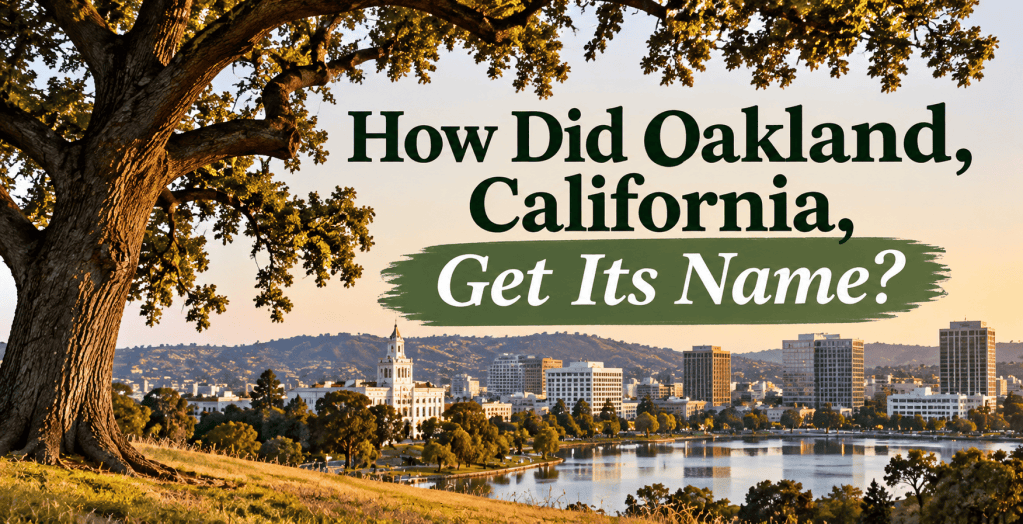
Oakland, California, is one of the most historically significant cities in the San Francisco Bay Area. Known today for its diverse neighborhoods, bustling waterfront, cultural movements, and deep connections to California history, Oakland has a name that reflects what the land looked like long before it became a major American city.
But how did Oakland get its name, and who decided to call it Oakland?
The answer goes back to the early 1850s, when a small settlement along the eastern shore of San Francisco Bay began transforming into a growing town. Before skyscrapers, shipping terminals, and busy freeways, the area was known for its beautiful groves of native oak trees.
Oakland received its name because of the oak trees that once covered portions of the land where the city was established. The name was adopted during the community’s early development and became official when Oakland was incorporated as a town in 1852.
However, the story behind Oakland’s name involves much more than trees. It includes the Indigenous people who lived on the land for thousands of years, Spanish and Mexican California, early American settlers, land disputes, and the rapid growth that followed the California Gold Rush.
Understanding how Oakland got its name provides a fascinating look at how one of California’s most recognizable cities began.
What Does the Name Oakland Mean?
The name Oakland literally means land associated with oak trees.
During the early nineteenth century, the eastern shoreline of San Francisco Bay contained extensive grasslands, wetlands, and wooded areas. Oak trees were particularly noticeable in portions of what would eventually become downtown Oakland and the surrounding neighborhoods.
These trees were an important part of the natural landscape.
California’s native oaks provided shade, supported wildlife, and produced acorns that were an essential food source for Indigenous communities.
The abundance of these trees made the name Oakland a natural choice for the growing settlement.
Unlike some California cities that received Spanish names honoring saints or religious figures, Oakland received an English name describing its physical surroundings.
That distinction reflects the period when the settlement developed under American rule following California’s transition from Mexican to United States territory.
What Was Oakland Called Before It Became Oakland?
Before Oakland existed as an incorporated community, the land was home to Indigenous peoples for thousands of years.
The area was part of the ancestral homeland of the Ohlone peoples, including Chochenyo-speaking communities whose history remains deeply connected to the East Bay.
These communities lived throughout the region long before European colonization.
They established settlements near creeks, marshlands, and other areas that provided access to freshwater, fish, shellfish, plants, and wildlife.
The landscape that eventually became Oakland supported a rich natural environment.
Native oak trees played an important role in everyday life because their acorns could be processed into nutritious food.
The land also contained grasslands, streams, and wetlands that supported a wide variety of animals and plants.
There was no single English-language city name for the entire area before Oakland was established. Indigenous communities had their own place names and geographic relationships that existed long before modern municipal boundaries.
Later, Spanish colonization and Mexican land grants introduced additional names and systems of land ownership.
One of the most important was Rancho San Antonio.
How Did Rancho San Antonio Influence Oakland’s History?
Before Oakland became an American town, much of the surrounding land belonged to a large Mexican-era land grant known as Rancho San Antonio.
In 1820, Luis María Peralta received a grant of land along the eastern shore of San Francisco Bay from Spanish authorities.
The grant covered approximately 44,800 acres and included land that would eventually become Oakland, Berkeley, Alameda, and several neighboring communities.
Peralta had served in the Spanish military, and the grant reflected the landholding system established during Spanish rule.
After Mexico gained independence from Spain in 1821, the region became part of Mexican California.
The Peralta family continued to play a significant role in the area’s development.
Luis María Peralta eventually divided portions of Rancho San Antonio among his sons.
The land that included much of present-day Oakland became associated with Antonio María Peralta and Vicente Peralta.
During this period, the landscape remained largely agricultural, with ranching activities and scattered settlements.
Oak trees continued to grow across portions of the property.
The transformation from ranch land into an American town began after the United States acquired California in 1848.
The discovery of gold that same year would dramatically accelerate the region’s growth.
How Did the California Gold Rush Lead to Oakland’s Founding?
The California Gold Rush changed the future of the entire San Francisco Bay Area.
After gold was discovered in 1848, thousands of people traveled to Northern California hoping to make their fortunes.
San Francisco quickly became an important commercial center, but the growing population created demand for housing, transportation, lumber, and other supplies.
The eastern shoreline of San Francisco Bay offered opportunities for new settlements.
Its location across the water from San Francisco made it attractive to entrepreneurs and land developers.
By 1850, American settlers and businessmen had begun establishing communities on former Rancho San Antonio lands.
Among the most influential figures were Edson Adams, Andrew Moon, and Horace W. Carpentier.
These men recognized the commercial potential of the waterfront and began developing a settlement near what is now downtown Oakland.
However, the land was not unclaimed.
It was associated with the Peralta family’s property, and the newcomers’ occupation and sale of lots created legal disputes that continued for years.
Despite these controversies, the settlement expanded.
Its proximity to San Francisco, access to the bay, and potential for commercial development helped establish the foundation for Oakland’s future.
Who Chose the Name Oakland?
Horace W. Carpentier is closely associated with Oakland’s early development and naming.
Alongside Edson Adams and Andrew Moon, Carpentier helped establish the town that became Oakland in the early 1850s.
The name reflected the oak groves covering the surrounding landscape.
The area had previously been associated with the Spanish name Encinal de Temescal, referring to an oak grove near Temescal.
The English name Oakland preserved the landscape-based meaning.
Although Carpentier played an important role in the town’s incorporation, historical records do not conclusively identify one individual as the first person to propose the English name.
What is clear is that Oakland was the established name when the California Legislature incorporated the community in 1852.
Carpentier subsequently became Oakland’s first mayor when the town was incorporated as a city in 1854.
His involvement in early land development, transportation, and local government made him one of the most influential figures in Oakland’s founding years.
However, his legacy also includes controversy over land ownership and waterfront control.
The city’s origins were shaped by both ambitious development and disputes over property rights.
When Was Oakland Officially Founded?
Oakland was officially incorporated as a town on May 4, 1852.
At that time, it was a relatively small settlement with fewer than 100 residents.
The original community occupied an area near the waterfront, including portions of what are now downtown Oakland and West Oakland.
Its boundaries were much smaller than those of the modern city.
The early settlement developed around the foot of Broadway, which became an important commercial street.
Oakland was incorporated as a city on March 25, 1854.
These two dates represent important milestones in Oakland’s history.
-
1852: Oakland was incorporated as a town.
-
1854: Oakland became an incorporated city.
-
1860s: Railroad expansion helped transform Oakland into a major transportation center.
-
Late 1800s: The city expanded through industrial development, population growth, and the annexation of neighboring communities.
The name Oakland remained unchanged as the settlement grew into one of Northern California’s most important cities.
What Did Oakland Look Like Before It Became a City?
It is difficult to imagine modern downtown Oakland as a landscape of open grasslands, oak trees, and natural waterways.
Yet that was the environment encountered by early settlers.
Before extensive urban development, the area contained rolling hills, creeks, wetlands, and large stands of native trees.
The shoreline looked considerably different from the waterfront seen today.
Much of the land around the bay consisted of tidal marshes and shallow waterways.
Oak trees grew across portions of the flatter terrain, while redwoods and other native vegetation occupied parts of the surrounding hills.
The region supported deer, birds, fish, and numerous other wildlife species.
Creeks flowing from the Oakland Hills provided freshwater and helped sustain the natural environment.
The oak groves were especially memorable.
Early descriptions of the area emphasized the beauty of the trees, which helped distinguish the settlement from other developing communities around San Francisco Bay.
As streets, houses, businesses, and transportation infrastructure expanded, many of the original trees disappeared.
Nevertheless, Oakland’s name preserved the memory of the landscape that existed before urbanization.
What Kind of Oak Trees Originally Grew in Oakland?
The most closely associated species was the coast live oak, scientifically known as Quercus agrifolia.
Coast live oaks are native to California and are particularly well adapted to the state’s Mediterranean climate.
These evergreen trees have dense canopies, dark green leaves, and strong branches that often spread outward.
They can survive long, dry summers and relatively mild, wet winters.
Historically, coast live oaks provided important habitat for birds, mammals, and insects.
Their acorns were also an important food source for Indigenous communities, who developed methods of gathering, processing, and preparing them.
The trees could grow for generations, becoming recognizable landmarks in the surrounding landscape.
In early Oakland, groves of these trees were prominent enough to influence the community’s identity.
The city’s name therefore represents a particular part of California’s natural history.
It is not simply a decorative reference to trees.
It describes a real ecological feature that once helped define the region.
What Does Encinal de Temescal Mean?
One of the most interesting details about Oakland’s name is its connection to Spanish-language place names.
The phrase Encinal de Temescal refers to an oak grove associated with the Temescal area.
The Spanish word encinal means an oak grove or an area where oak trees grow.
Temescal is connected to the Nahuatl word temazcalli, referring to a sweat bath or sweat lodge.
The name reflected the geography and cultural history of the region before Oakland became an American municipality.
Spanish explorers had also described the landscape in terms of its oak trees.
During an expedition in 1772, Father Juan Crespí described the area as a plain of oaks.
This early description demonstrates that the trees were a recognizable feature long before the city was founded.
When American developers established Oakland, the English name continued that association with oak-covered land.
The transition from Encinal to Oakland reflects the broader political and cultural changes occurring in California during the nineteenth century.
Spanish and Mexican place names remained important throughout the region, even as new American settlements adopted English names.
How Did Oakland Grow Beyond Its Original Boundaries?
The Oakland incorporated in 1852 was much smaller than the city that exists today.
Its early development centered on the waterfront and nearby commercial streets.
Over time, surrounding communities were incorporated into the expanding city.
Areas such as Brooklyn, Clinton, San Antonio, and Fruitvale had their own histories before becoming part of modern Oakland.
Transportation improvements played a major role in this expansion.
Ferry connections made travel between Oakland and San Francisco easier.
Railroad development during the nineteenth century transformed Oakland into an important transportation hub.
The completion of the transcontinental railroad system helped strengthen the city’s economic position.
Oakland became associated with rail yards, shipping facilities, manufacturing, and regional commerce.
Its waterfront eventually developed into one of the West Coast’s major ports.
Population growth also changed the city.
New residents arrived from different parts of the United States and from countries around the world.
Each wave of migration contributed to Oakland’s neighborhoods, businesses, cultural traditions, and community institutions.
By the twentieth century, Oakland had become a major industrial and residential center.
The small oak-covered settlement had transformed into a large city, but its original name remained.
Are Any of Oakland’s Original Oak Trees Still Standing?
Oak trees remain an important part of Oakland’s landscape, although the extensive groves that inspired the city’s name have been greatly reduced.
Urban development removed many trees as roads, homes, businesses, and industrial facilities expanded.
Other trees disappeared because of changes in land use, soil conditions, and natural aging.
Today, coast live oaks can still be found in parks, open spaces, and some residential neighborhoods throughout Oakland.
The Oakland Hills and surrounding East Bay landscapes contain native oak woodland habitats that provide a connection to the region’s earlier environment.
Preserving these trees is important for several reasons.
Oak trees provide shade, help support wildlife, improve habitat diversity, and contribute to the character of local neighborhoods.
They also represent a living connection to Oakland’s history.
Although not every oak tree standing today dates back to the city’s founding, the continued presence of native oaks helps preserve the natural heritage reflected in Oakland’s name.
Why Was Oakland Named After Trees Instead of a Spanish Saint?
Many California cities have names connected to Spanish missions, Catholic saints, or the Spanish colonial period.
San Francisco, San Jose, and Santa Clara are familiar examples.
Oakland followed a different naming tradition.
The settlement developed during the early years of American control, when English-speaking settlers were establishing new towns and commercial centers.
Rather than choosing a religious name, Oakland’s developers adopted a name describing the surrounding landscape.
The choice was practical, memorable, and geographically meaningful.
It also maintained a connection to the earlier Spanish description of the oak-covered area.
This makes Oakland an interesting example of how California place names reflect different historical periods.
Its name combines a landscape recognized during Spanish and Mexican rule with the English-language naming practices of American settlers.
How Did Oakland’s Name Become Part of Its Identity?
As Oakland grew, its name became more than a description of the trees that once covered the land.
It became associated with the city’s neighborhoods, waterfront, transportation networks, and cultural history.
During the twentieth century, Oakland developed a reputation for industrial innovation, labor activism, music, sports, and political organizing.
The city played important roles in the growth of West Coast shipping, the wartime economy, and the civil rights movement.
Oakland was also the birthplace of the Black Panther Party in 1966, an organization that became internationally recognized for its political activism and community programs.
Its cultural influence extended into jazz, blues, funk, hip-hop, literature, and visual arts.
These developments transformed Oakland’s identity far beyond its original geographic meaning.
Yet the name continued to connect the modern city to its nineteenth-century beginnings.
The oak tree remains an appropriate symbol of endurance, history, and the natural environment.
Interesting Facts About Oakland’s Name and Early History
Several historical details help explain how Oakland developed its identity.
Oakland’s name comes from a real oak woodland. The city was named for the extensive oak groves that once occupied the original settlement.
The area was associated with the name Encinal de Temescal. This earlier name referred to the oak-covered landscape near Temescal.
Oakland began on former Rancho San Antonio land. The Peralta family’s land grant included much of the territory that later became Oakland and neighboring East Bay cities.
Oakland was incorporated as a town in 1852. The community was still small, with fewer than 100 residents.
Oakland became a city in 1854. Horace W. Carpentier served as its first mayor.
The original Oakland was much smaller than today’s city. Neighboring settlements were gradually incorporated as the city expanded.
Coast live oaks remain part of the local environment. These native California trees continue to grow in portions of Oakland and the surrounding East Bay.
The name reflects multiple periods of California history. Oakland’s English name preserved the meaning of earlier Spanish descriptions of the landscape.
Frequently Asked Questions About Oakland’s Name
Why is Oakland called Oakland?
Oakland is named after the oak trees that once grew abundantly throughout the area where the city was established. The name reflects the landscape’s historic oak groves.
Who originally named Oakland, California?
Oakland’s early developers included Edson Adams, Andrew Moon, and Horace W. Carpentier. Carpentier was especially influential in the city’s incorporation, although the exact individual who first proposed the English name is not conclusively documented.
What was Oakland called before 1852?
The area was associated with the Spanish name Encinal de Temescal and was part of Rancho San Antonio. Indigenous communities had lived in the region long before those names were introduced.
When did Oakland become a city?
Oakland was incorporated as a town on May 4, 1852, and became an incorporated city on March 25, 1854.
What does Encinal mean in English?
Encinal is a Spanish word meaning oak grove or an area containing oak trees.
Was Oakland originally part of Mexico?
Yes. The area was part of Mexican California after Mexico gained independence from Spain in 1821. It became United States territory following the Mexican-American War and the Treaty of Guadalupe Hidalgo in 1848.
What trees is Oakland named after?
Oakland is primarily associated with native coast live oak trees, which once grew extensively throughout portions of the original settlement.
Is Oakland named after a person?
No. Oakland was not named after an individual. Its name comes from the oak-covered landscape that characterized the area before the city developed.
Conclusion: Oakland’s Name Preserves a Piece of California History
Oakland, California, received its name from the beautiful oak groves that once covered the land along the eastern shore of San Francisco Bay.
Before the city became a major transportation center, industrial hub, and culturally influential community, the area was home to Indigenous peoples and later became part of the Peralta family’s Rancho San Antonio.
The oak-covered landscape was associated with the Spanish name Encinal de Temescal, a name whose meaning survived when American settlers established Oakland in the early 1850s.
When the town was incorporated in 1852, its name reflected one of the most recognizable features of the surrounding environment.
More than 170 years later, Oakland has changed dramatically.
Its original groves have largely given way to neighborhoods, commercial districts, roads, and waterfront facilities. Yet native oak trees still grow throughout portions of the city and surrounding hills.
The name Oakland serves as a reminder that before the buildings, railroads, ports, and bustling streets, this part of the East Bay was known for its oak-covered landscape.
Oakland’s name is more than a geographic label. It is a lasting connection between the city’s natural environment, its early history, and the generations of people who have called the East Bay home.
Leave a Reply