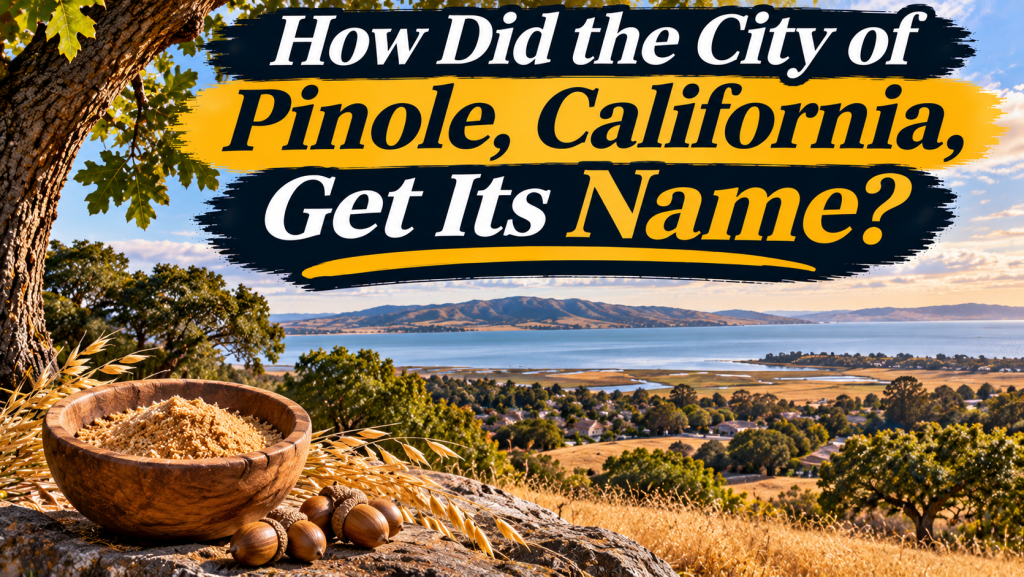
The name Pinole traces its origins to a food made from ground and toasted seeds or grain. According to a longstanding local account, members of a Spanish expedition traveling through what is now western Contra Costa County received food from Indigenous residents and began referring to their campsite as El Pinole.
The name survived the Spanish colonial period, the era of Mexican land grants, and the establishment of an incorporated California city. Today, it connects a modern East Bay community with a much older history of Indigenous food traditions, exploration, and regional development.
What does the name Pinole mean?
The Spanish word pinole comes from the Nahuatl word pinolli, which refers to ground, roasted grain, particularly maize. Nahuatl is an Indigenous language originating in Mexico.
Different preparations of pinole have been made using locally available ingredients. In the traditional account of the California city’s name, the food offered to the travelers consisted of a ground mixture of seeds, acorns, and wild grain.
It is important to distinguish the linguistic origin of the word from the cultural identity of the people who lived in the East Bay. The name came into Spanish through Nahuatl, but the Indigenous inhabitants of the Pinole area were not Nahuatl-speaking Aztecs.
This distinction illustrates how words traveled through the Americas during the colonial period and were sometimes applied to foods and places far from their original linguistic home.
Who lived in Pinole before the Spanish arrived?
The history of human settlement around San Pablo Bay extends back thousands of years. The region’s creeks, oak woodlands, grasslands, and tidal marshes provided resources that supported Indigenous communities long before the arrival of European expeditions.
The City of Pinole’s account of its municipal seal identifies the area’s original inhabitants as members of the Lisjan Ohlone nation and recognizes its connections to Huchiun and Carquin territories.
Native communities developed knowledge of local plants, seasonal food sources, waterways, and wildlife. Gathering and preparing seeds, nuts, and other foods required skill and familiarity with the landscape. These activities formed part of a broader cultural and economic life that included relationships among neighboring communities.
Although the modern city’s name is associated with a Spanish expedition, the history of the place itself did not begin with that encounter. Indigenous peoples had already established their own relationships with the land, and their descendants continue to preserve and renew cultural traditions.
The expedition of Pedro Fages and Juan Crespí
In 1772, Spanish military officer Pedro Fages and Franciscan priest Juan Crespí traveled through the East Bay as part of an expedition from Monterey. Their journey was connected to Spain’s efforts to learn more about and extend its colonial presence in Alta California.
Crespí recorded observations of the expedition in his diary. These accounts later became important historical resources, although they reflect the perspective of the colonial travelers rather than a complete understanding of Indigenous experiences.
The Pinole Historical Society associates the city’s naming tradition with this expedition. According to the story, the travelers were short of food when they encountered Indigenous residents who shared a ground meal with them.
The Spaniards reportedly applied the familiar word pinole to the food and used El Pinole as the name of their camp.
The exact details of the encounter have been passed down through local historical accounts. It is therefore appropriate to describe the naming story as a historical tradition rather than assume every detail has been independently established.
Why was ground seed meal important?
Grinding seeds and other plant foods was an important food preparation technique in many Indigenous societies. The specific ingredients and methods varied according to local resources and cultural knowledge.
Dry ingredients could be processed into meal, making them useful in preparations that were easier to transport or combine with other foods. Acorns, when used for food, generally required careful processing to remove bitter tannins.
The meal associated with Pinole’s naming story reflects the knowledge of people who understood how to gather and prepare foods from their surroundings. The reported act of sharing food also offers a reminder that the expedition depended in part on assistance from communities already living in the region.
Modern Mexican pinole, often made with toasted maize and sometimes sweetened or combined with spices, is related to the origin of the Spanish word. It should not be treated as necessarily identical to the food prepared by Indigenous residents of the East Bay in the eighteenth century.
How El Pinole became a permanent place name
A temporary campsite designation could easily have disappeared as travelers continued their journey. Instead, El Pinole became associated with the surrounding area.
One of the clearest examples of the name’s persistence came during the Mexican period, following Mexico’s independence from Spain in 1821.
In 1823, Ygnacio Martínez obtained the Rancho El Pinole land grant from the Mexican government. The name was therefore already established enough to identify an extensive property in what is now western Contra Costa County.
Martínez established a residence in Pinole Valley. The modern Pinole Valley Park area is associated with that early rancho history.
The land grant belongs to a period when California’s political and economic organization was changing. Large ranchos became important centers of agricultural activity and livestock production. These developments also followed colonial disruption and dispossession of Indigenous communities.
The survival of the El Pinole name across different political systems helped establish it as a lasting geographic identity.
How did Pinole develop into a town?
The middle of the nineteenth century brought further changes to California. The Gold Rush, increased migration, commercial expansion, and new transportation connections created opportunities for settlements near the bay.
Bernardo Fernandez established a waterfront trading operation during the 1850s. The Fernandez family became associated with the developing community, and the historic Fernandez House remains a link to that era.
For a settlement near navigable water, access to shipping could influence where businesses were established and how local agricultural products reached wider markets. Stores and services developed to meet the needs of residents, workers, and travelers.
As the regional economy grew, railroad connections and industrial employment further influenced development in western Contra Costa County. The powder manufacturing operations in neighboring Hercules became part of that shared economic history.
Although the landscape and local economy changed considerably, the name Pinole continued to identify the community.
When did Pinole officially become a city?
Pinole incorporated in 1903. By that time, it had developed into an established community rather than a temporary encampment or an agricultural estate.
Incorporation enabled local government to address municipal responsibilities and provide services as the community grew. During the twentieth century, expanded automobile travel and the construction of regional highways changed how residents traveled and where development occurred.
The name retained by the incorporated city was a remarkable connection to the earlier geographic designation. More than a century separated the traditional naming encounter from the establishment of local municipal government.
Where can you see Pinole’s history today?
The historic Old Town area helps illustrate how Pinole developed before modern suburban expansion. Older commercial buildings, residences, and streets preserve elements of the community’s former appearance.
The Pinole Historical Society’s historical walking tour identifies buildings and sites associated with the city’s development, including the Fernandez House on Tennent Avenue.
The city seal also reflects historical themes. The municipality’s account describes the Indigenous heritage that informed its design, including references to the observations recorded by Crespí.
These features encourage residents to explore the layers of history behind familiar places. A street name, architectural detail, or community park can provide an opportunity to learn how earlier generations experienced the area.
Frequently asked questions
Is Pinole a Spanish or Native American word?
Pinole is a Spanish word borrowed from Nahuatl, an Indigenous language of Mexico. Its use as a California place name developed through Spanish colonial contact with Indigenous communities in the East Bay.
Was the city named after an individual?
No. The accepted local naming account associates Pinole with a ground food rather than a person’s surname.
When did Spanish explorers reach the Pinole area?
The traditional naming account relates to the Fages-Crespí expedition of 1772.
What was Rancho El Pinole?
It was a Mexican-era land grant awarded to Ygnacio Martínez in 1823. Its name preserved the existing geographic designation.
When was the City of Pinole incorporated?
Pinole became an incorporated municipality in 1903.
A name that carries centuries of East Bay history
Pinole’s name offers a connection between language, food, Indigenous history, and the development of California. The traditional account of travelers receiving food near San Pablo Bay is one chapter in a much longer story.
Through the Mexican rancho era, commercial development, industrial growth, and the creation of a modern city, the name endured.
Learning its origins also provides an opportunity to recognize the Indigenous communities whose knowledge and history preceded the arrival of colonial expeditions. The name Pinole is not merely a label on a highway sign. It is a reminder of the many histories that shaped the place residents call home.
Leave a Reply