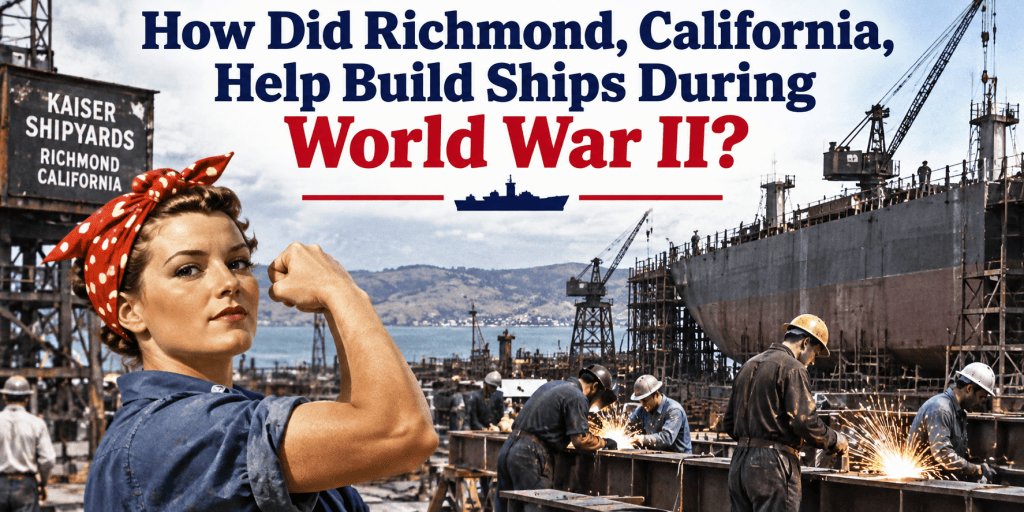
During World War II, Richmond, California, became one of the most important shipbuilding centers in American history. What had once been a relatively small industrial city along the eastern shore of San Francisco Bay transformed into a massive wartime production center, where thousands of workers built ships that transported soldiers, military equipment, food, fuel, and essential supplies across the world’s oceans.
Between 1941 and 1945, Richmond’s four Kaiser shipyards produced an astonishing 747 ships, more than any other shipyard complex in the United States during the war.
The achievement was about more than constructing vessels. Richmond helped revolutionize American manufacturing, created employment opportunities for women and minorities, introduced new approaches to industrial health care and childcare, and demonstrated how ordinary Americans could make extraordinary contributions during a national emergency.
Today, Richmond’s shipbuilding history remains one of the most remarkable chapters in California’s contribution to World War II.
Why Was Richmond, California, Important During World War II?
Before World War II, Richmond was a growing but relatively small industrial community in Contra Costa County.
The city already had several important industrial operations, including the Standard Oil refinery, a Ford Motor Company assembly plant, railroad facilities, and businesses connected to maritime transportation.
Richmond also possessed something particularly valuable for wartime shipbuilding: access to the deep waters of San Francisco Bay.
Its waterfront offered enough space to construct large shipyards, while nearby railroads and industrial facilities could deliver the enormous quantities of steel, machinery, equipment, and supplies needed to build ocean-going vessels.
When the United States and its allies needed to dramatically increase ship production, Richmond became an ideal location.
The city’s transformation began even before the United States officially entered World War II in December 1941.
American industrial leaders were already preparing to support Britain and other Allied nations fighting against Nazi Germany.
Among those leaders was Henry J. Kaiser, an ambitious industrialist whose experience in major construction projects would help transform American shipbuilding.
Who Was Henry J. Kaiser, and Why Did He Build Ships in Richmond?
Henry J. Kaiser was an American industrialist best known before World War II for his involvement in massive construction projects, including the Hoover Dam and Grand Coulee Dam.
Although Kaiser had little experience building ships before the war, he understood how to organize large industrial operations, coordinate workers, and complete complicated projects under demanding deadlines.
When the federal government needed new shipyards capable of producing hundreds of vessels, Kaiser recognized an opportunity to apply large-scale construction techniques to shipbuilding.
Richmond offered the waterfront space, transportation connections, and industrial resources needed to make his vision possible.
Beginning in 1941, Kaiser and his business partners established a series of shipyards along Richmond’s shoreline.
Eventually, four major Kaiser shipyards operated in the city.
Together, they became the largest shipbuilding operation on the Pacific Coast.
Their success helped establish Kaiser as one of the most influential industrial figures of World War II.
How Many Ships Were Built in Richmond During World War II?
Richmond’s four Kaiser shipyards constructed 747 vessels during World War II.
This extraordinary total included several different types of ships designed to meet the military and logistical needs of the Allied war effort.
The most important categories included Liberty ships, Victory ships, troop transports, landing ships, and naval support vessels.
Liberty Ships
Liberty ships were among the most important cargo vessels of World War II.
These ships transported enormous quantities of military supplies, including ammunition, vehicles, food, fuel, aircraft components, and other equipment.
Richmond’s shipyards produced 519 Liberty ships.
These relatively simple but durable vessels were designed for rapid construction and dependable transportation rather than speed or luxury.
Without cargo ships such as these, American and Allied forces would have struggled to maintain military operations overseas.
Victory Ships
Victory ships represented an improvement over the earlier Liberty ship design.
They were generally faster and incorporated more advanced machinery and stronger hull designs.
Richmond constructed 142 Victory ships during the war.
Their increased speed made them particularly valuable for transporting supplies through dangerous waters where enemy submarines threatened Allied shipping.
Troop Transports and Other Vessels
Richmond’s shipyards also produced troop transports and other specialized vessels.
Troop transports carried military personnel to overseas destinations, while landing ships supported amphibious military operations.
Some Richmond-built vessels were designed for specific naval assignments rather than general cargo transportation.
This variety demonstrated the flexibility of Richmond’s shipbuilding operations and the ability of American manufacturers to respond to changing wartime requirements.
How Did Richmond Build Ships So Quickly?
One of Richmond’s greatest contributions to World War II was the development and refinement of faster shipbuilding techniques.
Before the war, constructing a large ocean-going ship could require many months of specialized labor.
Traditional shipbuilding depended heavily on skilled craftsmen who assembled vessels through complicated, time-consuming processes.
Kaiser’s engineers approached the problem differently.
Instead of treating each ship as an individually constructed project, they adapted principles associated with mass production.
Prefabricated Ship Sections
Workers manufactured large sections of ships separately before bringing them together for final assembly.
These sections could include parts of the hull, deckhouses, machinery spaces, and other major components.
Huge cranes lifted the prefabricated sections into position, where workers joined them together.
This system allowed different teams to complete multiple parts of a vessel simultaneously.
It also reduced the amount of work that had to be performed directly on the ship during final construction.
Welding Instead of Traditional Riveting
Another major innovation involved the extensive use of welding.
Traditional shipbuilding relied heavily on rivets to fasten steel plates together.
Welding allowed workers to join metal components more efficiently and made it easier to incorporate prefabricated sections.
Although welding required proper training and careful quality control, it helped dramatically accelerate production.
Specialized Assembly-Line Labor
Workers were trained to perform specific tasks repeatedly.
Instead of requiring every employee to master numerous shipbuilding skills, the shipyards divided production into smaller assignments.
This approach allowed inexperienced workers to become productive relatively quickly.
The combination of prefabrication, welding, specialized labor, and careful scheduling helped Richmond construct ships at an unprecedented pace.
What Was the Fastest Ship Built in Richmond During World War II?
One of the most famous achievements in Richmond’s shipbuilding history involved the Liberty ship SS Robert E. Peary.
In November 1942, workers at Richmond’s Kaiser Shipyard No. 2 assembled the vessel in approximately four days, fifteen hours, and twenty-nine minutes.
This remarkable achievement became a symbol of American industrial productivity.
The record-setting construction was a specially organized effort involving extensive preparation and prefabricated components.
It did not mean that every Richmond ship could be completed in fewer than five days.
Nevertheless, the achievement demonstrated how dramatically modern production methods could reduce the time required to assemble a large cargo vessel.
By 1944, ordinary Liberty ship assembly at Richmond had become so efficient that ships could be assembled in a little more than two weeks.
For Americans following the war effort, these accomplishments represented the nation’s growing ability to outproduce its enemies.
How Did Women Help Build Ships in Richmond?
Women played an essential role in Richmond’s wartime shipbuilding success.
Before World War II, many industrial jobs were traditionally reserved for men.
However, as millions of American men entered military service, factories and shipyards needed additional workers.
Women answered that call.
Thousands entered Richmond’s shipyards, performing physically demanding and technically important jobs.
They worked as welders, burners, electricians, machinists, crane operators, inspectors, and production workers.
Women also filled important administrative, engineering-support, and transportation positions.
Rosie the Riveter and Richmond’s Shipyards
The famous image of Rosie the Riveter became a national symbol of women’s contributions to wartime manufacturing.
Although Rosie represented women working in defense industries across the United States, Richmond became particularly associated with this history.
Women working in the Kaiser shipyards helped prove that industrial skills were not limited by gender.
Their contributions challenged long-standing assumptions about women’s abilities in manufacturing and heavy industry.
The experience also helped influence changing expectations about women’s employment after the war.
However, many women faced pressure to leave industrial jobs when returning servicemen reentered the workforce.
Despite these setbacks, their wartime achievements remained an important milestone in American labor history.
How Did African American Workers Contribute to Richmond’s Shipbuilding Industry?
World War II also brought major demographic changes to Richmond.
Thousands of African Americans migrated from the South and other parts of the country in search of better-paying industrial employment.
This movement formed part of the broader Great Migration, which transformed communities throughout the United States.
Richmond’s shipyards offered opportunities that had previously been difficult or impossible for many African American workers to obtain.
Men and women worked in welding, manufacturing, transportation, maintenance, and other essential positions.
Their labor helped keep ship production operating around the clock.
However, wartime employment did not eliminate racial discrimination.
African American workers frequently encountered unequal treatment, restricted housing opportunities, workplace prejudice, and barriers to advancement.
Segregation and discrimination affected daily life even as the federal government depended on workers of different backgrounds to support the war effort.
Despite these challenges, African American workers made indispensable contributions to Richmond’s industrial success.
Their experiences also became part of the broader struggle for civil rights and workplace equality in California.
How Did World War II Change Richmond’s Population?
Richmond experienced one of the most dramatic population increases of any California community during World War II.
In 1940, the city had fewer than 24,000 residents.
By 1943, its population had grown to nearly 100,000.
Workers arrived from across the United States, drawn by the promise of employment in shipbuilding and other defense industries.
The sudden population increase created enormous challenges.
Housing became scarce, roads grew crowded, schools needed additional space, and existing public services struggled to meet demand.
Many workers initially lived in temporary accommodations, overcrowded homes, or hastily constructed housing developments.
The federal government eventually supported extensive wartime housing projects to accommodate the growing workforce.
Entire neighborhoods developed around the needs of shipyard employees and their families.
Richmond’s rapid transformation changed the city’s social and cultural identity.
People from different states, racial backgrounds, and economic circumstances found themselves working and living in the same rapidly expanding industrial community.
These changes shaped Richmond long after World War II ended.
How Did Richmond Support Shipyard Workers and Their Families?
Building hundreds of ships required more than industrial equipment and skilled labor.
Workers also needed housing, medical care, transportation, food, and childcare.
Richmond became an important example of how communities could organize social services around wartime industrial production.
Kaiser Permanente and Wartime Health Care
One of the most lasting developments associated with Richmond’s shipyards was the expansion of prepaid medical care.
Henry J. Kaiser’s industrial operations helped develop a health care system designed to provide medical services for workers and their families.
The Kaiser Permanente medical system grew from these wartime and earlier construction-industry health care programs.
The Richmond shipyards became an important part of this development.
The approach demonstrated how organized medical coverage could support large industrial workforces while helping workers receive treatment when needed.
Childcare for Working Families
Because many women worked long shifts in the shipyards, childcare became an essential service.
Richmond developed childcare centers designed to accommodate the demanding schedules of wartime workers.
Some facilities operated around the clock, allowing parents to work during different shifts.
These programs represented important advances in publicly supported childcare.
They also demonstrated how childcare could make a major difference in workforce participation.
Housing and Transportation
Government agencies and local organizations worked to provide housing and transportation for thousands of incoming workers.
New residential developments helped accommodate families, while expanded transportation services connected neighborhoods with industrial employment centers.
These improvements were necessary to keep Richmond’s shipyards functioning efficiently.
However, rapid development did not eliminate overcrowding or unequal access to services.
The city continued to experience significant social and economic pressures throughout the war.
What Were Working Conditions Like in Richmond’s Shipyards?
Shipyard employment offered relatively good wages for many workers, but the work was often difficult and dangerous.
Employees worked around heavy machinery, enormous steel components, powerful cranes, and welding equipment.
The constant noise of industrial production filled the shipyards.
Workers faced hazards involving falling objects, burns, electrical equipment, fumes, and other industrial dangers.
Long shifts were common because the shipyards operated continuously to meet wartime production demands.
Many employees worked nights, weekends, and overtime.
The pressure to complete ships quickly created additional physical and emotional demands.
Nevertheless, workers understood that their efforts were directly connected to the survival and success of American and Allied forces overseas.
For many employees, shipbuilding was more than a paycheck.
It was a contribution to a national cause.
How Did Richmond’s Ships Help the United States Win World War II?
Military victories depended on more than soldiers, tanks, and aircraft.
Armies fighting overseas required a continuous supply of food, ammunition, fuel, vehicles, medical equipment, and replacement personnel.
Ships made this global transportation system possible.
Richmond-built cargo vessels carried essential supplies across the Atlantic and Pacific Oceans.
These ships supported American military operations and helped sustain Allied forces fighting in Europe and the Pacific.
Supporting the War in Europe
Allied forces fighting Nazi Germany depended on enormous quantities of supplies transported across the Atlantic Ocean.
German submarines attacked merchant shipping in an attempt to disrupt these supply routes.
American shipyards responded by producing replacement vessels and expanding the Allied merchant fleet.
Richmond’s Liberty ships helped maintain the flow of equipment and materials necessary for military operations.
Supporting the Pacific War
The Pacific theater presented enormous logistical challenges because military operations took place across vast ocean distances.
American forces needed ships to transport supplies between ports, island bases, and combat zones.
Richmond’s shipyards helped provide vessels capable of supporting these operations.
Replacing Ships Lost to Enemy Attacks
Enemy submarines, aircraft, mines, and surface vessels destroyed or damaged Allied ships throughout the war.
American shipyards had to replace losses while also expanding the total number of available vessels.
Richmond’s ability to produce ships rapidly helped strengthen the Allied transportation network.
The city’s contribution demonstrated a fundamental principle of modern warfare: industrial production and reliable supply lines could be just as important as battlefield strength.
What Happened to Richmond After World War II Ended?
When World War II ended in 1945, the demand for emergency shipbuilding declined sharply.
Government contracts were reduced or canceled, and Richmond’s shipyards began closing.
Thousands of workers lost their wartime jobs or moved into different industries.
The city’s economy faced a difficult transition.
Businesses that had depended on shipyard employment experienced declining demand, while many temporary wartime facilities were no longer needed.
Some workers left Richmond in search of employment elsewhere.
Others remained, establishing permanent roots in the community.
The city retained much of the cultural diversity and industrial infrastructure developed during the war.
However, the sudden disappearance of shipbuilding employment created long-term economic challenges.
Richmond’s experience reflected a broader national problem faced by communities that had expanded rapidly during wartime production.
The same industrial mobilization that created unprecedented opportunities also left difficult questions about economic stability after the war.
Can You Still See Richmond’s World War II Shipbuilding History Today?
Yes. Richmond preserves several important locations connected to its wartime shipbuilding history.
One of the most significant is the Rosie the Riveter/World War II Home Front National Historical Park.
Established in 2000, the park preserves and interprets the experiences of workers, families, and communities involved in the American home front.
Rather than focusing exclusively on military battles, the park highlights the contributions of civilians who supported the war through industrial labor and community service.
Visitors can learn about women working in shipyards, African American migration, wartime housing, medical care, and the transformation of Richmond.
The SS Red Oak Victory
One of Richmond’s most important surviving wartime landmarks is the SS Red Oak Victory.
Built at Richmond’s Kaiser Shipyard No. 1 and launched in 1944, the vessel is a surviving example of the ships produced during World War II.
Today, the ship serves as a museum vessel at Richmond’s historic waterfront.
It offers a tangible connection to the industrial achievements of the men and women who built America’s wartime fleet.
Historic Shipyard No. 3
Richmond’s Shipyard No. 3 also preserves significant remnants of the city’s wartime industrial landscape.
Historic buildings and structures help illustrate the enormous scale of shipbuilding operations.
These surviving resources provide an opportunity to understand how ships were assembled and how thousands of employees worked together to meet production goals.
Together, Richmond’s historic sites ensure that future generations can learn about the city’s remarkable contributions.
Why Is Richmond’s World War II Shipbuilding History Still Important?
Richmond’s wartime achievements remain important for several reasons.
First, the city demonstrated the extraordinary productive capacity of American industry.
Constructing 747 ships in just a few years required innovation, organization, investment, and cooperation on an enormous scale.
Second, Richmond helped transform the American workforce.
Women and minority workers entered industrial positions that had previously been restricted or difficult to obtain.
Their contributions challenged established workplace expectations and helped lay the groundwork for later social changes.
Third, Richmond became an important testing ground for industrial health care, childcare, and large-scale worker housing.
Many of these developments influenced discussions about employment benefits and public services after the war.
Finally, Richmond’s history reminds us that victory in World War II depended on millions of people who never fought on a battlefield.
Welders, electricians, machinists, crane operators, engineers, nurses, childcare workers, and countless others contributed to the war effort through their daily labor.
Their work helped make military success possible.
Frequently Asked Questions About Richmond’s World War II Shipyards
How many shipyards did Richmond have during World War II?
Richmond had four major Kaiser shipyards operating during World War II. Together, they formed one of the country’s most productive shipbuilding complexes.
How many ships did Richmond build during World War II?
Richmond’s Kaiser shipyards built 747 ships, including 519 Liberty ships and 142 Victory ships, along with other military and transport vessels.
Who owned the Richmond shipyards during World War II?
The shipyards were operated by companies associated with industrialist Henry J. Kaiser, working under government and Allied shipbuilding contracts.
How many people worked at Richmond’s shipyards?
Approximately 90,000 people worked in Richmond’s Kaiser shipyards at the height of wartime employment. Workers came from across the country to participate in the massive industrial effort.
What was the fastest ship built in Richmond?
The SS Robert E. Peary was assembled in approximately four days, fifteen hours, and twenty-nine minutes in November 1942, setting a remarkable shipbuilding record.
Did women build ships in Richmond during World War II?
Yes. Thousands of women worked in Richmond’s shipyards as welders, machinists, electricians, inspectors, and other industrial employees. Their contributions became closely associated with the Rosie the Riveter movement.
Why were Liberty ships important during World War II?
Liberty ships transported essential military supplies, equipment, and materials across the world’s oceans. Their rapid production helped the Allies maintain supply routes despite enemy attacks on merchant shipping.
Where can people learn about Richmond’s World War II history?
The Rosie the Riveter/World War II Home Front National Historical Park, the historic Richmond shipyards, and the SS Red Oak Victory preserve important parts of the city’s wartime history.
Final Thoughts: How Richmond, California, Helped Change the Course of World War II
Richmond, California, played a remarkable role in helping the United States and its allies achieve victory during World War II.
Through its four Kaiser shipyards, the city produced 747 vessels that helped transport the people, equipment, and supplies needed to sustain military operations around the world.
But Richmond’s contribution extended far beyond the number of ships it built.
The city helped pioneer faster manufacturing methods, expanded opportunities for women and minority workers, and developed innovative approaches to supporting industrial employees and their families.
Its population grew dramatically, its neighborhoods changed, and its waterfront became one of the busiest centers of wartime production in America.
The legacy of those years can still be seen in Richmond’s historic shipyards, preserved vessels, and the stories of the people who worked there.
Richmond’s World War II history is ultimately a story of ordinary people accomplishing extraordinary things.
Every ship launched into San Francisco Bay represented thousands of hours of labor, countless individual sacrifices, and a shared determination to support a nation at war.
The workers who built those vessels may not have stood on the front lines of battle, but their contributions helped make victory possible.
And more than eight decades later, Richmond’s place in American history remains a powerful reminder that some of the most important victories are made possible by the people working tirelessly behind the scenes.
Leave a Reply