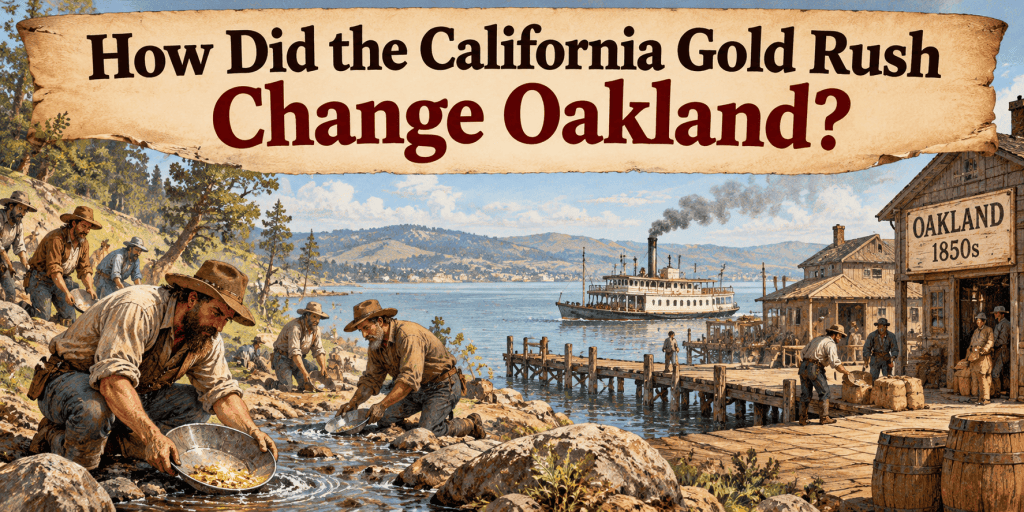
The California Gold Rush of 1848 transformed the San Francisco Bay Area almost overnight, bringing thousands of people seeking wealth, opportunity, and a new beginning. While San Francisco became the most famous destination for arriving gold seekers, the land across the bay experienced a transformation of its own.
Oakland, which had not yet been incorporated as a city when gold was discovered, quickly developed from a landscape of oak-covered hills, ranchlands, and scattered settlements into an important transportation, commercial, and residential center.
The California Gold Rush helped create the conditions that turned Oakland into a city. It attracted settlers, increased demand for transportation, encouraged land development, and connected the East Bay to California’s rapidly expanding economy.
Understanding how the Gold Rush changed Oakland reveals why the city grew so quickly during the 1850s and how its early development shaped the Oakland we know today.
What Was Oakland Like Before the California Gold Rush?
Before the discovery of gold in 1848, the area that would become Oakland looked dramatically different from the modern city.
For thousands of years, the region had been home to Indigenous communities, particularly the Ohlone peoples, whose villages and cultural traditions were deeply connected to the East Bay’s waterways, grasslands, and oak forests.
The area offered abundant natural resources, including freshwater streams, fish, shellfish, wildlife, and acorns gathered from its many oak trees.
During the Spanish and Mexican periods, the region underwent major changes as missions, ranching, and colonial settlement disrupted Indigenous communities.
Much of present-day Oakland became part of Rancho San Antonio, a large Mexican land grant associated with the Peralta family.
The Peraltas operated an extensive cattle ranch covering territory that would eventually include Oakland, Berkeley, Alameda, and surrounding communities.
The landscape consisted primarily of ranchlands, oak groves, marshes, and open countryside.
There were no major commercial districts, industrial waterfronts, or extensive residential neighborhoods.
That would begin changing rapidly after 1848.
How Did the Discovery of Gold Affect the East Bay?
On January 24, 1848, James W. Marshall discovered gold at Sutter’s Mill in Coloma, California.
News of the discovery spread throughout California and eventually across the United States and around the world.
By 1849, enormous numbers of people were traveling to California hoping to find gold.
Many arrived by ship through San Francisco Bay before continuing toward the goldfields of the Sierra Nevada foothills.
Although Oakland was not a major gold-mining location, its position across the bay from San Francisco gave it an important geographic advantage.
As San Francisco expanded, the surrounding East Bay became increasingly attractive for settlement, transportation, agriculture, and commercial development.
The Gold Rush created demand for land, housing, food, lumber, transportation services, and other supplies.
Communities around the bay began growing to meet those needs.
Oakland was one of the places that benefited from this economic expansion.
Why Did People Begin Settling in Oakland During the Gold Rush?
One of the most important effects of the Gold Rush was the dramatic increase in California’s population.
Gold seekers were not the only people arriving.
Merchants, farmers, carpenters, blacksmiths, sailors, laborers, and entrepreneurs also traveled west.
Many realized that providing goods and services to miners could be more dependable than searching for gold themselves.
As San Francisco became increasingly crowded and expensive, land across the bay offered opportunities for settlement and development.
Oakland’s relatively flat terrain, access to the waterfront, and proximity to San Francisco made it appealing.
Settlers could establish homes, open businesses, develop transportation services, and participate in the expanding regional economy.
The East Bay also offered agricultural land that could help supply food to the growing population.
What had previously been largely ranchland began attracting people interested in building a permanent community.
This migration helped establish the population base that Oakland needed to become a city.
How Did the Gold Rush Lead to Oakland’s Founding?
Oakland’s formal development began during the early years of the Gold Rush.
In 1850, California entered the United States as the 31st state.
Around the same period, American settlers and land developers began establishing themselves on the eastern shore of San Francisco Bay.
Among the most prominent early figures were Horace Carpentier, Edson Adams, and Andrew Moon.
These men became associated with the development of the town that would become Oakland.
They recognized the commercial potential of the waterfront and the surrounding land.
However, the process was controversial.
The land was connected to the Peralta family’s Rancho San Antonio, and disputes over ownership, occupation, and development became part of Oakland’s early history.
The Gold Rush intensified pressure on Mexican-era land grants throughout California, contributing to complicated legal battles and changes in landownership.
Oakland was officially incorporated as a town on May 4, 1852.
Just two years later, on May 25, 1854, it was incorporated as a city.
This rapid transition demonstrates how quickly the Gold Rush-era economy encouraged settlement and urban development.
Without the population growth and economic opportunities created by the Gold Rush, Oakland’s emergence as an incorporated city might have happened much more slowly.
How Did the Gold Rush Improve Transportation Between Oakland and San Francisco?
Transportation was one of the most important factors in Oakland’s early development.
San Francisco Bay separated Oakland from the region’s principal port and commercial center.
During the Gold Rush, the increasing movement of people, merchandise, and supplies created a strong demand for dependable transportation across the water.
Ferry connections became essential.
Early ferry services helped connect Oakland’s waterfront with San Francisco, allowing passengers and goods to move between the two communities.
These connections made Oakland more accessible to merchants, workers, and settlers.
They also encouraged businesses to develop near the waterfront.
The growing transportation network helped establish Oakland as more than a rural settlement.
It became part of a connected regional economy.
Over time, these early ferry connections contributed to the city’s development as a major transportation center.
Later railroad expansion would strengthen that role considerably.
Why Did Oakland’s Waterfront Become So Important?
Oakland’s waterfront was one of its greatest economic advantages.
The city occupied a strategic location along the eastern shore of San Francisco Bay, where vessels could connect local communities with the region’s growing commercial network.
During the Gold Rush, shipping and transportation activity increased throughout the bay.
San Francisco handled enormous quantities of imported goods and passengers.
The East Bay offered additional waterfront locations for transporting agricultural products, construction materials, and other merchandise.
Oakland’s shoreline became increasingly valuable as the surrounding population grew.
Developers recognized that controlling access to the waterfront could provide significant commercial opportunities.
Horace Carpentier became particularly associated with early waterfront rights and disputes.
These controversies influenced Oakland’s political and economic development for decades.
The waterfront’s growing importance also encouraged improvements in docks, transportation connections, and commercial infrastructure.
Although Oakland’s modern port emerged much later, the city’s early waterfront development established a foundation for its future maritime economy.
How Did the Gold Rush Change Oakland’s Economy?
Before the Gold Rush, the local economy centered largely on ranching, agriculture, and the use of natural resources.
The arrival of settlers and the rapid expansion of nearby San Francisco introduced new economic opportunities.
Oakland began developing a more diverse commercial economy.
Agriculture and food production
The growing population of Northern California needed reliable food supplies.
East Bay farms and ranches could produce vegetables, fruit, grain, dairy products, and livestock for local and regional markets.
Agriculture remained important even as Oakland became more urbanized.
Construction and lumber
New residents needed houses, stores, warehouses, roads, and docks.
This created demand for timber and building materials.
Oakland’s nearby redwood forests, particularly in the hills, became valuable sources of lumber.
Logging and timber-related activity contributed to the development of the surrounding region.
Retail businesses and services
As Oakland’s population increased, businesses opened to serve residents and travelers.
General stores, boardinghouses, workshops, and transportation-related enterprises became increasingly important.
These businesses helped turn Oakland into a functioning commercial community.
Real estate development
Land became one of the most valuable opportunities created by the Gold Rush.
Developers divided property into lots, established streets, and promoted settlement.
The resulting land speculation accelerated Oakland’s growth but also contributed to disputes over ownership and property rights.
Together, these economic activities helped Oakland move beyond its ranching origins.
What Happened to the Peralta Family’s Land During the Gold Rush?
The Gold Rush brought major changes to landownership throughout California.
Before American statehood, large portions of the East Bay belonged to Mexican-era ranchos.
Rancho San Antonio, associated with Luis María Peralta and his family, covered a substantial part of the region.
Following the Mexican-American War and the Treaty of Guadalupe Hidalgo in 1848, California became part of the United States.
The treaty provided protections for Mexican property rights, but the transition to American legal and political institutions created considerable uncertainty.
The California Land Act of 1851 required many holders of Spanish and Mexican land grants to establish their claims through a federal review process.
Legal proceedings could be lengthy and expensive.
At the same time, squatters and developers occupied or claimed portions of valuable land.
In Oakland, conflicts involving the Peralta lands became central to the city’s early history.
The rapid growth of settlement increased pressure to subdivide and develop property.
Over time, land that had supported the Peralta ranching operation became part of Oakland’s expanding street grid and residential neighborhoods.
This transformation was not simply a story of economic growth.
It also involved contested property rights, legal disputes, and the displacement of earlier landholding arrangements.
How Did the Gold Rush Affect Oakland’s Indigenous Communities?
The changes associated with the Gold Rush cannot be fully understood without considering their impact on Indigenous peoples.
The Ohlone communities of the East Bay had already experienced severe disruption during the Spanish mission period and subsequent Mexican rule.
The Gold Rush brought additional population growth, land seizures, environmental changes, and intensified pressure on Native communities.
Across California, Indigenous peoples faced violence, forced labor, displacement, and devastating population losses during the Gold Rush era.
In the Oakland area, expanding settlements and private land development further transformed places that had long supported Indigenous communities.
Wetlands, forests, waterways, and traditional gathering areas were increasingly incorporated into farms, transportation corridors, and urban development.
The Gold Rush therefore had very different consequences for different populations.
For many newcomers, it represented economic opportunity.
For Indigenous communities, it intensified an already destructive period of dispossession and cultural disruption.
Recognizing both experiences provides a more complete understanding of Oakland’s history.
Did Oakland Become a Mining Town During the Gold Rush?
No. Oakland did not develop as a major gold-mining town.
The principal goldfields were located farther inland, especially in the Sierra Nevada foothills.
Communities such as Coloma, Auburn, Nevada City, and Grass Valley became closely associated with mining activity.
Oakland developed a different economic role.
Rather than relying on extracting gold, the city benefited from supporting the broader economy created by the Gold Rush.
Its advantages included access to San Francisco Bay, relatively developable land, agricultural resources, and opportunities for transportation and trade.
This distinction helped shape Oakland’s future.
Mining towns often experienced dramatic population fluctuations as nearby gold deposits were exhausted or mining conditions changed.
Oakland’s economy became connected to longer-lasting activities such as commerce, transportation, housing, and regional services.
Those economic foundations allowed the city to continue growing after the initial Gold Rush excitement faded.
How Did the Gold Rush Help Oakland Become a Railroad City?
One of the most significant long-term consequences of the Gold Rush was the development of California’s transportation infrastructure.
The rapid increase in population and commercial activity created demand for better connections between coastal cities, inland settlements, and the rest of the United States.
During the 1850s and 1860s, railroad development became increasingly important.
Oakland’s location along San Francisco Bay made it an attractive western transportation terminal.
In 1869, Oakland became the western terminus of the first transcontinental railroad connection, with passengers and freight using ferry services to reach San Francisco.
This occurred more than two decades after the discovery of gold.
Nevertheless, the railroad’s development was closely connected to the population growth, commercial expansion, and transportation demands that the Gold Rush had helped create.
The arrival of the transcontinental railroad transformed Oakland’s economy.
Rail yards, warehouses, shipping facilities, hotels, and businesses expanded around the transportation network.
Oakland became an important gateway between the Pacific Coast and the rest of the country.
The railroad era represented a new stage of growth built partly upon foundations established during the Gold Rush.
How Did the Gold Rush Influence Oakland’s Neighborhoods?
Oakland’s earliest urban development concentrated around the waterfront and the area that became downtown.
As settlement increased, streets were established and land was divided for residential and commercial purposes.
The original townsite developed around the western shoreline of Lake Merritt and the waterfront to its southwest.
Early transportation routes connected residential areas with commercial activity near the bay.
As Oakland grew, additional neighborhoods emerged beyond the original settlement.
The Gold Rush did not directly create every modern Oakland neighborhood.
Many familiar districts developed decades later as railroad expansion, streetcars, industry, and population growth reshaped the city.
However, the initial Gold Rush-era settlement established the urban center from which Oakland expanded.
The placement of early streets, waterfront facilities, and commercial districts influenced the city’s later development.
How Did the Gold Rush Change Oakland’s Population?
The Gold Rush brought people to California from many different regions of the United States and around the world.
Migrants arrived from Latin America, Europe, Asia, Australia, and other locations.
This movement contributed to the development of California’s increasingly diverse population.
Oakland’s early residents included people involved in shipping, agriculture, construction, retail trade, and transportation.
As the city developed, its population became more varied in occupation, national origin, and cultural background.
However, opportunities were not equal.
Racial discrimination, restrictive laws, violence, and unequal access to property and employment affected many communities throughout Gold Rush-era California.
Chinese immigrants, for example, played important roles in California’s developing economy while facing discrimination and exclusion.
African Americans also participated in Gold Rush-era migration and helped establish communities and institutions in Northern California.
Oakland’s later multicultural identity developed through many additional waves of migration, but the Gold Rush helped begin the demographic transformation of the region.
What Were the Negative Effects of the Gold Rush on Oakland?
Although the Gold Rush encouraged economic development, it also created significant problems.
Rapid settlement brought pressure on land, natural resources, and public infrastructure.
Property disputes became especially important as developers attempted to acquire and control valuable waterfront and ranchland.
The expansion of logging reduced portions of the East Bay’s original redwood forests.
Urban development gradually transformed natural habitats, wetlands, and waterways.
The growing population also increased the need for roads, sanitation, public services, and local government.
Oakland’s early civic institutions had to develop while the community was changing rapidly.
Land speculation created opportunities for some individuals but contributed to uncertainty and conflict for others.
Indigenous displacement and discrimination against minority communities were also part of the broader consequences of Gold Rush-era settlement.
These challenges demonstrate that Oakland’s growth came with substantial social and environmental costs.
What Happened to Oakland After the Gold Rush Ended?
The initial Gold Rush peaked during the early 1850s, although gold mining continued in California for many years.
By that time, Oakland had already established itself as an incorporated community.
Unlike settlements that depended almost entirely on mining, Oakland had developed economic activities capable of supporting continued growth.
Transportation, trade, agriculture, real estate, and regional commerce remained important.
The city also benefited from its proximity to San Francisco.
During the second half of the nineteenth century, railroad expansion accelerated Oakland’s development.
In 1869, the transcontinental railroad connection strengthened the city’s position as a transportation hub.
Oakland continued expanding during the following decades as businesses, industries, and residential communities grew.
The city also became the Alameda County seat in 1873, reflecting its increasing civic importance.
By the end of the nineteenth century, Oakland had become a major urban center in the East Bay.
The Gold Rush had helped initiate a transformation that continued long after the earliest miners arrived in California.
Can You Still See Evidence of the Gold Rush in Oakland Today?
Although most of Oakland’s original Gold Rush-era structures have disappeared or been substantially altered, traces of the period remain visible in the city’s historical geography and landmarks.
Old Oakland
The Old Oakland district preserves part of the historic downtown street pattern and contains nineteenth-century commercial architecture. Most of its surviving historic buildings date from after the initial Gold Rush, but the district reflects the commercial center that developed from Oakland’s early settlement.
Oakland’s waterfront
The waterfront remains a reminder of the city’s longstanding relationship with transportation, shipping, and trade.
Modern port facilities are far removed from the early ferry landings, but both reflect the importance of Oakland’s location on San Francisco Bay.
Peralta Hacienda Historical Park
Peralta Hacienda Historical Park preserves and interprets the history of Rancho San Antonio, the Peralta family, and the communities connected to the land before and after Oakland’s founding.
The site provides important historical context for understanding the transition from Mexican-era ranching to American urban development.
Oakland’s original downtown
The streets and commercial areas near the original townsite reflect the city’s early development during the 1850s.
Although the buildings and businesses have changed, the basic location of Oakland’s historic center remains connected to its Gold Rush-era origins.
These places help illustrate how a settlement created during a period of extraordinary migration evolved into a major California city.
Why Was the Gold Rush So Important to Oakland’s Future?
The California Gold Rush was important to Oakland because it created the population growth, economic demand, and investment that encouraged the city’s establishment.
Several long-term developments emerged from this period.
First, the Gold Rush attracted settlers who helped establish a permanent community.
Second, the rapid expansion of San Francisco created opportunities for housing, agriculture, commerce, and transportation across the bay.
Third, Oakland’s waterfront became increasingly valuable as a location for moving people and goods.
Fourth, land development transformed former ranchlands into streets, neighborhoods, and commercial districts.
Finally, the transportation needs of a growing California helped prepare the way for the railroad expansion that would later make Oakland a major regional hub.
These developments were interconnected.
The Gold Rush did not create modern Oakland overnight, but it set in motion economic and demographic changes that shaped the city’s future.
Frequently Asked Questions About the California Gold Rush and Oakland
Was Oakland founded because of the California Gold Rush?
The Gold Rush was a major factor in Oakland’s founding. The population boom and expanding economy created demand for settlement and transportation across San Francisco Bay. Oakland was incorporated as a town in 1852 and as a city in 1854.
Was gold ever discovered in Oakland?
Oakland was not a significant Gold Rush mining location. Its economic importance came primarily from transportation, trade, agriculture, settlement, and commercial development rather than gold extraction.
Who founded Oakland during the Gold Rush?
Horace Carpentier, Edson Adams, and Andrew Moon are among the early settlers and developers associated with Oakland’s founding. Their activities took place amid disputes involving land connected to the Peralta family’s Rancho San Antonio.
Why did Oakland grow so quickly in the 1850s?
Oakland grew because of migration to California, demand for land and housing, expanding trade, ferry transportation, and economic activity associated with nearby San Francisco.
How did the Gold Rush affect Oakland’s waterfront?
The Gold Rush increased transportation and commercial demand throughout San Francisco Bay. Oakland’s waterfront became an important location for ferry services, shipping connections, and later commercial development.
Did the California Gold Rush lead to Oakland’s railroad development?
The Gold Rush helped establish the population and commercial demand that encouraged transportation investment. Oakland later became a major railroad terminal, including its role in the transcontinental railroad connection in 1869.
What was Oakland called before the Gold Rush?
Before Oakland developed as a town, much of the area formed part of Rancho San Antonio, associated with the Peralta family. The region was also the ancestral homeland of Ohlone peoples long before Spanish and Mexican colonization.
Conclusion: How the Gold Rush Helped Build Oakland
The California Gold Rush changed Oakland by transforming the economic and social conditions of the East Bay.
Before 1848, the area consisted largely of ranchlands, oak forests, wetlands, and scattered settlements shaped by centuries of Indigenous history and later Spanish and Mexican colonization.
Within a few years of the discovery of gold, newcomers were establishing businesses, building homes, developing transportation connections, and creating the foundations of a new city.
Oakland’s incorporation in 1852 as a town and 1854 as a city reflected the speed of this transformation.
Although Oakland never became a major gold-mining center, it benefited from the enormous economic activity surrounding the Gold Rush.
Its waterfront, proximity to San Francisco, and opportunities for commerce helped it develop into an important East Bay community.
The changes also brought conflict, displacement, environmental damage, and unequal opportunities, making the Gold Rush a complicated chapter in the city’s history.
Ultimately, the California Gold Rush did more than bring people to Northern California. It helped turn Oakland from a largely rural landscape into a growing city and laid the groundwork for its future as one of the Bay Area’s most important centers of transportation, commerce, and culture.
Leave a Reply