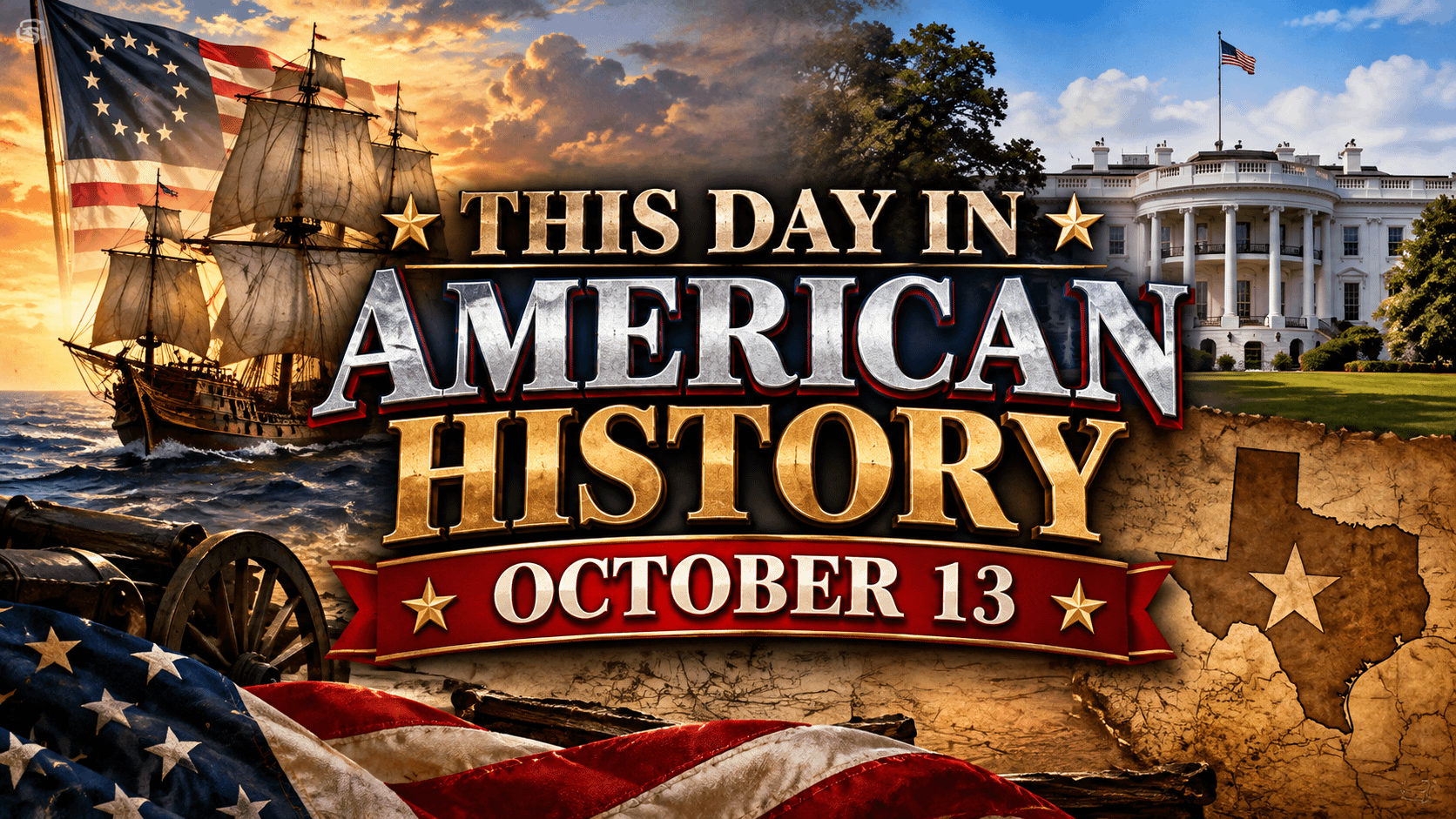
October 13 has played a surprisingly important role in the American story. From the birth of the United States Navy during the Revolutionary War to the beginning of construction on the White House and a decisive vote on the annexation of Texas, this date connects several chapters of the nation’s political, military, and cultural development.
Here is a look back at some of the most significant moments associated with October 13 in American history.
1775 – The Continental Congress Takes a Historic Step Toward Creating an American Navy
One of the most important events associated with October 13 occurred before the United States had even declared its independence.
On October 13, 1775, the Continental Congress authorized the fitting out of two armed vessels to intercept British ships carrying military supplies during the American Revolution. The decision is recognized as a foundational moment in the creation of the Continental Navy and is commemorated today as the birthday of the United States Navy.
At the time, creating a naval force was an ambitious undertaking.
Great Britain possessed one of the world’s most powerful navies, while the American colonies lacked anything resembling a comparable national fleet. Some members of Congress questioned whether the colonies could afford or effectively operate such a force.
But the Revolutionary War was creating an urgent problem. British ships transported weapons, ammunition, troops, and supplies along the Atlantic coast. American leaders recognized that challenging those supply lines could help the revolutionary cause.
Congress therefore approved plans to outfit two vessels for military service.
It was a modest beginning, but it represented something much larger: the colonies were beginning to build the institutions necessary to fight as a united nation.
October 13 Becomes the Navy’s Birthday
The naval force authorized during the Revolution was the Continental Navy rather than the permanent U.S. Navy that exists today. After independence, American naval organization went through significant changes before Congress established the Department of the Navy in 1798.
Nevertheless, October 13, 1775 became the date traditionally associated with the Navy’s birth.
In 1972, Chief of Naval Operations Admiral Elmo R. Zumwalt Jr. formally authorized recognition of October 13 as the Navy’s birthday.
On October 13, 2026, the Navy will commemorate its 251st birthday.
From two armed vessels authorized during the Revolution, the American naval service would eventually grow into a force operating around the world.
1792 – Construction of the White House Begins
Seventeen years after the Continental Congress took its historic naval action, another defining American institution reached an important milestone on October 13.
On October 13, 1792, the cornerstone of what was then called the President’s House was laid in the developing federal capital.
That residence would eventually become known around the world as the White House.
President George Washington had announced the location of the permanent federal capital in 1791. A competition was later held to select the design for the president’s residence.
Irish-born architect James Hoban submitted the winning design.
The cornerstone ceremony on October 13, 1792 included local officials, commissioners, Freemasons, and other participants. Contrary to some later accounts, George Washington himself apparently remained in Philadelphia and did not attend the ceremony.
Construction would continue for years.
The White House Becomes a Symbol of the Presidency
President John Adams and First Lady Abigail Adams became the first presidential family to occupy the unfinished residence in November 1800.
Since then, the building has witnessed more than two centuries of American history.
Presidents have made decisions involving war and peace within its walls. Foreign leaders have visited it. Families have lived there. Protesters have gathered outside its gates. The building has survived destruction, reconstruction, renovation, and enormous changes to the country surrounding it.
Yet its story as a presidential residence traces back to that cornerstone ceremony on October 13, 1792.
1845 – Texas Voters Approve Annexation
Another major moment came on October 13, 1845.
Texas had declared independence from Mexico in 1836 and existed for nearly a decade as the independent Republic of Texas.
The question of whether Texas should become part of the United States was politically controversial. The debate involved territorial expansion, relations with Mexico, constitutional questions, and the expansion of slavery.
After years of negotiations and political disputes, the United States offered terms for annexation in 1845.
A Texas convention accepted the proposal and prepared a state constitution.
The issue then went before Texas voters.
On October 13, 1845, voters overwhelmingly approved annexation and the proposed state constitution. Historical records compiled by the Texas State Library show the final annexation tally as 7,664 votes in favor and 430 against.
The vote cleared another major hurdle toward statehood.
Texas Becomes the 28th State
The October vote did not immediately make Texas a state.
Additional action by the United States government was required.
Congress subsequently approved Texas for admission, and President James K. Polk signed the measure on December 29, 1845.
Texas officially became the 28th state of the United States.
The annexation also intensified tensions between the United States and Mexico and was among the major developments preceding the Mexican-American War.
Texas annexation therefore became part of the much larger story of American territorial expansion during the nineteenth century.
Three Events That Helped Shape America
What makes October 13 especially interesting is how three major events on this date represent different parts of the American experience.
October 13, 1775 — Naval power
The Continental Congress took a crucial step toward establishing an American naval force.
October 13, 1792 — National government
The cornerstone of the future White House was laid in Washington.
October 13, 1845 — Territorial expansion
Texas voters overwhelmingly approved annexation to the United States.
Each event happened in a different generation, yet all three contributed to the development of the nation.
From Revolution to a Growing Republic
The events of October 13 also show how dramatically the United States changed in just seventy years.
In 1775, there was no independent United States. The colonies were fighting the British Empire and attempting to assemble the military forces necessary to survive a revolution.
By 1792, independence had been won, the Constitution had taken effect, George Washington was president, and the young nation was constructing a permanent capital.
By 1845, the United States had expanded far beyond its original boundaries and was debating how much farther the nation should grow.
October 13 therefore offers a snapshot of three distinct stages of American development: revolution, nation-building, and expansion.
Why October 13 Matters
History is often remembered through famous dates such as July 4, 1776, or December 7, 1941. But countless other dates contain events that helped determine the country’s direction.
October 13 is one of them.
A congressional decision during the Revolution helped establish America’s naval tradition.
A cornerstone placed in a developing federal city began the physical construction of what would become one of the world’s most recognizable government buildings.
And a vote in Texas helped redraw the map of the United States.
These events remind us that nations are rarely shaped by one defining moment. They are built through thousands of decisions, debates, risks, victories, mistakes, and turning points spread across generations.
This Day in American History
On October 13, we remember the birth of America’s naval tradition, the beginning of construction on the White House, and an important step toward Texas statehood.
From the Revolutionary generation of 1775 to the expanding republic of 1845, October 13 has left its mark on the American story.
History isn’t simply about remembering what happened.
It’s about understanding how the choices made by previous generations helped create the country we know today.
Which October 13 event do you think had the greatest long-term impact on American history?