American history is not shaped only by wars, elections, presidents, and laws. It is also shaped by inventions, books, protests, ships, architecture, art, and the decisions ordinary people make during extraordinary moments.
October 21 offers a fascinating example.
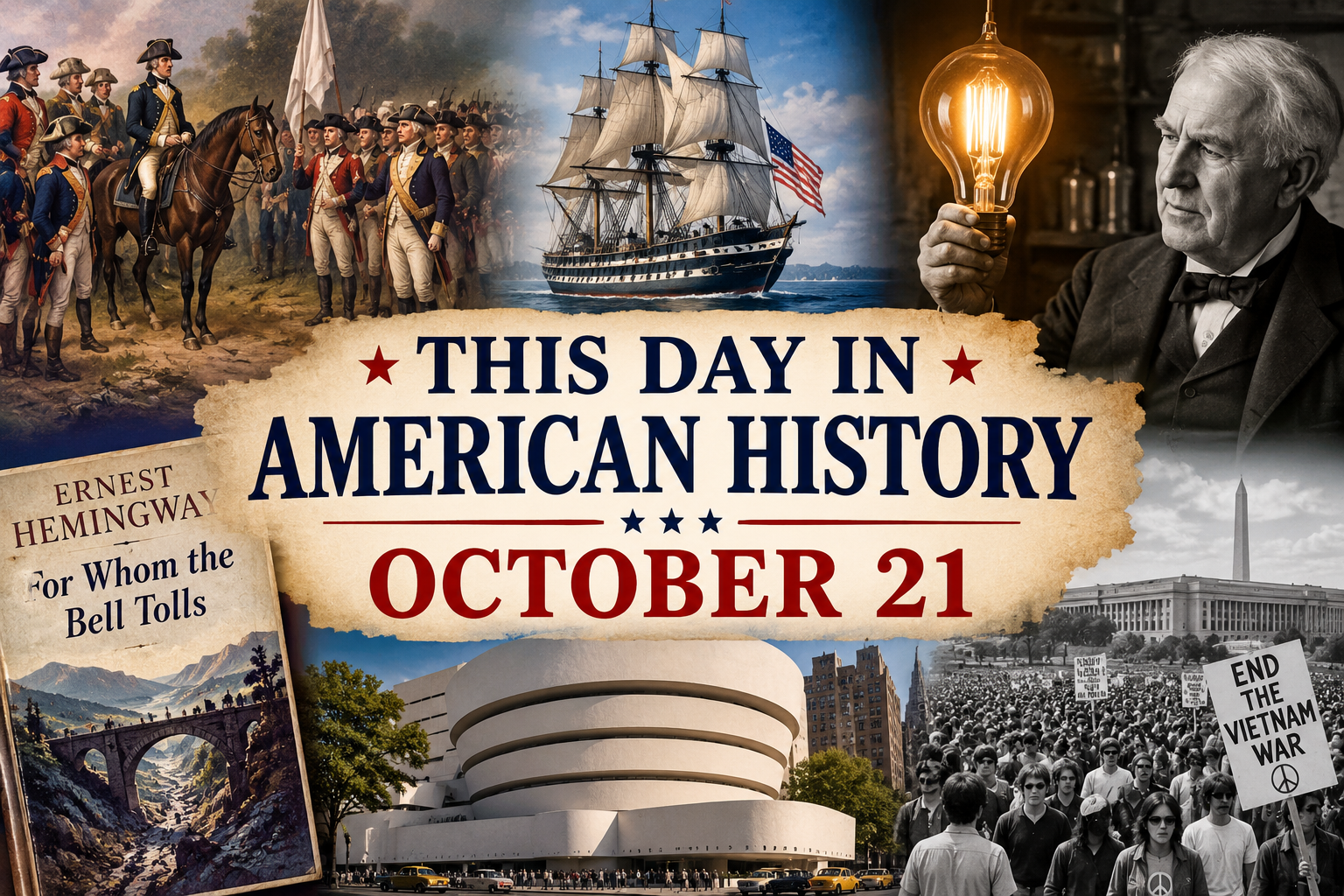
On this date, the United States witnessed events connected to the aftermath of the American Revolution, the birth of the early U.S. Navy, Thomas Edison’s experiments with electric lighting, one of Ernest Hemingway’s most famous novels, the opening of an architectural landmark in New York City, and a massive demonstration against the Vietnam War.
Each event happened in a different era, but together they tell part of the larger American story—a story of independence, innovation, creativity, disagreement, and change.
Here is a look back at October 21 in American history.
1781 — The Aftermath of the American Victory at Yorktown
Just two days before October 21, 1781, one of the most important events of the American Revolution had taken place.
British General Charles Cornwallis surrendered his army at Yorktown, Virginia, on October 19.
The surrender did not immediately end the Revolutionary War, but it effectively destroyed Britain’s ability to continue major offensive operations against the Americans.
On October 21, 1781, British and German prisoners began their journey away from Yorktown toward prison camps in places including Winchester, Virginia; Frederick, Maryland; and Lancaster, Pennsylvania.
It must have been an extraordinary sight.
Only a few years earlier, the idea that Britain’s colonies could defeat one of the world’s most powerful military empires would have seemed almost impossible. Now thousands of British and allied soldiers were leaving the battlefield as prisoners.
For George Washington and the Continental Army, Yorktown represented the culmination of years of sacrifice.
The Americans had endured defeats, shortages, disease, bitter winters, desertions, and enormous uncertainty.
Yet they continued fighting.
French military and naval assistance also proved crucial at Yorktown. The combined American and French effort trapped Cornwallis and prevented the British from escaping or receiving sufficient reinforcements.
The consequences extended far beyond Virginia.
News of the defeat eventually reached Britain and strengthened arguments that continuing the war was becoming too costly. Negotiations followed, and the Treaty of Paris of 1783 formally recognized American independence.
October 21 therefore represents one of those quieter dates following a famous historical event.
The surrender occurred on October 19.
But history continued afterward.
Armies had to move. Prisoners had to be transported. Political leaders had to determine what came next.
The United States had won an extraordinary military victory, but the much larger challenge of building a functioning independent nation was only beginning.
1797 — USS Constitution Is Launched
Sixteen years later, another major symbol of the young United States entered the water.
On October 21, 1797, the USS Constitution was successfully launched in Boston.
The ship was one of six frigates authorized by Congress under the Naval Act of 1794 as the United States attempted to establish a naval force capable of protecting American commerce.
According to the Naval History and Heritage Command, Constitution was launched from Edmund Hartt’s shipyard in Boston and remains the sole survivor of the original six frigates built for the early U.S. Navy.
The launch itself did not go smoothly at first.
There had already been two unsuccessful attempts to launch the massive ship in September. Workers eventually adjusted the launching ways, and at high tide on October 21, Constitution finally slid into Boston Harbor.
The ship would eventually become one of the most famous vessels in American history.
During the War of 1812, Constitution fought the British Royal Navy and achieved several celebrated victories.
During one battle against HMS Guerriere, British cannon fire appeared to bounce off the American ship’s thick wooden hull.
That helped inspire the nickname that remains associated with the vessel:
“Old Ironsides.”
The ship was not actually made of iron. Its hull was constructed from extremely strong timber, including live oak.
Nevertheless, the nickname became legendary.
USS Constitution eventually became much more than a military vessel. It became a physical connection between modern America and the earliest years of the United States.
More than two centuries after its launch, Constitution remains a commissioned U.S. Navy warship.
Few objects from America’s founding era remain active symbols of the country in quite the same way.
1879 — Thomas Edison and the Search for Practical Electric Light
October 21 is also closely associated with one of America’s most famous inventors.
In 1879, Thomas Edison and his researchers at Menlo Park, New Jersey, were working intensely to develop a practical incandescent electric lamp.
The story is sometimes simplified into the claim that Edison simply “invented the light bulb” on October 21.
The actual history is more complicated.
Electric lighting existed before Edison, and numerous inventors had experimented with incandescent lamps. Edison’s challenge was to develop a system that could be practical, durable, and commercially useful.
Researchers at the Smithsonian’s National Museum of American History note that later mythology often identified October 21 as the single dramatic moment when Edison invented the incandescent lamp. Laboratory records instead reveal a continuing series of experiments around October 21 and 22.
Those experiments included carbonized cotton thread placed inside an evacuated glass bulb.
The Thomas Edison Papers at Rutgers University describes the experiments of October 21–22, 1879, as the first successful tests by Edison and his staff using a carbonized cotton-thread filament in a vacuum.
That distinction matters.
Innovation rarely happens in a single magical moment.
It usually comes through repeated experiments, failures, modifications, and improvements.
Edison’s work on electric lighting is an excellent example.
His larger vision extended beyond creating a glowing bulb. A practical electric-lighting system required generators, wiring, switches, sockets, meters, and an electrical distribution network.
In other words, the bulb was only part of the challenge.
Eventually, electric lighting transformed American life.
Factories could operate differently.
Businesses could remain open after sunset.
City streets could be illuminated more effectively.
Homes gradually became electrified.
The rhythms of everyday life changed.
October 21 therefore represents something larger than a single invention. It represents the experimental process behind one of the technological transformations that helped create modern America.
1940 — Ernest Hemingway’s For Whom the Bell Tolls
American history is also written through literature.
In October 1940, Ernest Hemingway published one of his most important novels, For Whom the Bell Tolls.
The novel was inspired by Hemingway’s experiences connected to the Spanish Civil War.
Rather than presenting war simply as heroic adventure, the book explored violence, sacrifice, political conflict, loyalty, love, death, and the human consequences of war.
The Library of Congress includes For Whom the Bell Tolls among its “Books That Shaped America,” noting that Hemingway drew upon his experiences as a reporter during the Spanish Civil War and that the novel became a major literary success.
The book follows American Robert Jordan, who joins anti-fascist guerrilla fighters in Spain and is given the dangerous assignment of destroying a bridge.
But the novel is about much more than a military mission.
It asks difficult questions about duty and sacrifice.
How much should someone be willing to risk for a cause?
What happens when personal relationships collide with larger political struggles?
How do people maintain their humanity while surrounded by violence?
Those questions helped make the novel endure long after the conflict that inspired it.
Hemingway would later receive the 1954 Nobel Prize in Literature, further cementing his place among the most influential American writers of the twentieth century.
October 21’s connection to his work reminds us that history is not preserved only through official documents and battlefields.
Novelists, poets, journalists, musicians, filmmakers, and artists also shape how generations understand the world that came before them.
1959 — The Guggenheim Museum Opens in New York City
On October 21, 1959, thousands of people gathered in New York City for the opening of a building unlike almost anything they had seen before.
The Solomon R. Guggenheim Museum opened to the public on Fifth Avenue.
The building had been designed by legendary American architect Frank Lloyd Wright.
Its appearance immediately stood apart from the traditional rectangular buildings surrounding it.
Instead of conventional floors and galleries, Wright created a sweeping spiral structure centered around a massive open rotunda.
Visitors could experience art while moving along a continuous ramp.
The building itself became part of the artistic experience.
The Guggenheim Foundation confirms that the museum opened on October 21, 1959, sixteen years after Wright received the commission to design it.
Thousands of visitors came for opening day, with lines forming along Fifth Avenue.
Interestingly, Wright did not live to see the completed museum open.
He died earlier in 1959.
Yet the building became one of the most recognizable works of his career.
The Guggenheim demonstrates how architecture can become part of a country’s cultural identity.
People do not visit simply to see the artwork inside.
They visit to experience the building itself.
More than six decades later, its curved exterior remains one of the most distinctive architectural sights in New York City.
1967 — The March on the Pentagon
Eight years after the Guggenheim opened, October 21 became associated with a very different chapter of American history.
By 1967, the Vietnam War had become increasingly controversial inside the United States.
American troop levels had grown dramatically, casualty numbers were rising, and opposition to the war was becoming more organized.
On October 21, 1967, tens of thousands of demonstrators gathered in Washington, D.C., for a major antiwar protest.
The demonstration began with a rally near the Lincoln Memorial before thousands of protesters marched toward the Pentagon.
The U.S. Marshals Service describes the October 21 protest as a major national demonstration against the Vietnam War. Federal authorities prepared extensively for the gathering, with military personnel and deputy U.S. marshals positioned around the Pentagon.
The day eventually produced confrontations between demonstrators and authorities.
Hundreds of people were arrested.
The protest also produced some of the most memorable photographs of the Vietnam era, including images of demonstrators confronting lines of armed troops.
The event demonstrated something important about the direction of American society during the late 1960s.
The Vietnam War was no longer simply a foreign-policy issue debated by politicians.
It had become a major domestic issue dividing families, universities, communities, political movements, and generations.
Some Americans believed the war was necessary to resist communist expansion.
Others believed American involvement was misguided, destructive, or immoral.
Those disagreements became increasingly visible through marches, demonstrations, political campaigns, and public debate.
The March on the Pentagon became one of the defining demonstrations of that period.
What October 21 Tells Us About America
When these events are viewed together, October 21 becomes a fascinating snapshot of the American experience.
In 1781, the country was emerging from its struggle for independence.
In 1797, the young republic was building a navy capable of defending itself and its commerce.
In 1879, American inventors were helping usher society into the electrical age.
By 1940, American literature was examining the terrible human cost of modern warfare.
In 1959, American architecture was challenging traditional ideas about what a museum could look like.
And in 1967, Americans were taking to the streets to argue over their country’s involvement in Vietnam.
The events have little in common on the surface.
A wooden warship.
An experimental electric lamp.
A novel.
A museum.
A protest.
Yet all represent different parts of the American story.
America has continually been shaped by people willing to build something new, challenge accepted ideas, defend their beliefs, experiment with technology, create art, and debate the direction of the country.
History is rarely a straight line.
Progress often comes with disagreement.
Victories create new challenges.
New technologies create new possibilities.
Wars produce both patriotism and protest.
Art forces people to see familiar things differently.
And sometimes something that appears ordinary at the time becomes historically significant only after generations have passed.
Remembering October 21
“This Day in American History” is about more than memorizing dates.
It is about understanding the people, decisions, struggles, and ideas behind those dates.
October 21 reminds us that America’s history has unfolded in laboratories, shipyards, museums, battlefields, city streets, and the pages of books.
The USS Constitution still connects Americans with the earliest days of the U.S. Navy.
Electric lighting became so common that most people rarely think about the decades of experimentation that made it practical.
The Guggenheim remains an architectural landmark.
Hemingway’s writing continues to be read and debated.
The demonstrations of the Vietnam era remain important to understanding the political and cultural conflicts of the 1960s.
And the aftermath of Yorktown reminds us how difficult and uncertain the creation of the United States actually was.
Every generation inherits history.
Then it adds another chapter.
That is what makes looking back at dates such as October 21 worthwhile. Behind every date are stories of people facing uncertainty without knowing how history would ultimately remember them.
Today, we can look backward and see the larger picture.
They could not.
They simply lived through the moment.
And through their actions, inventions, sacrifices, creativity, successes, failures, and disagreements, they helped shape the America that came afterward.
That is the history of October 21—and another chapter in the continuing American story.


Leave a Reply