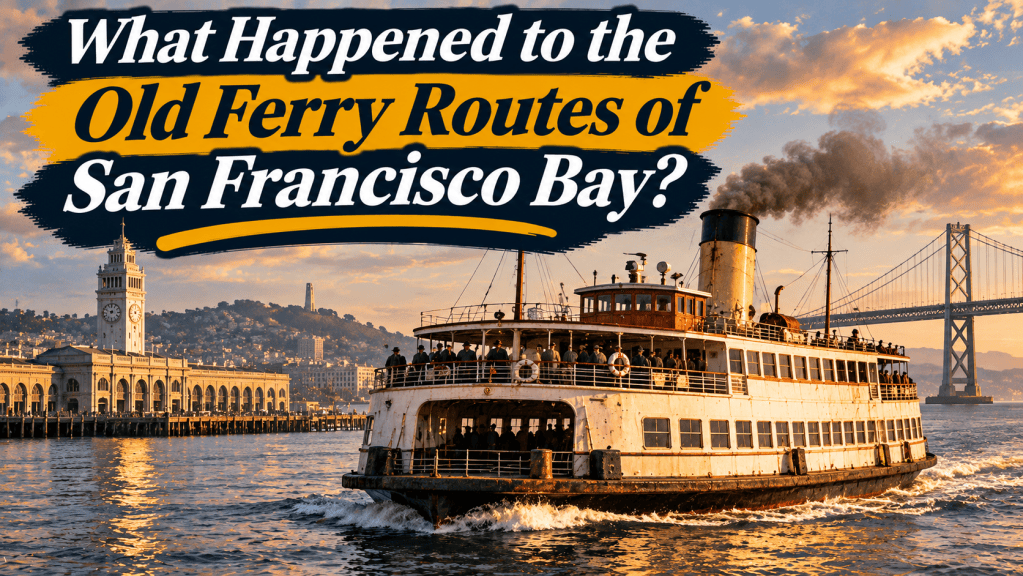
Long before commuters crossed the San Francisco-Oakland Bay Bridge or traveled beneath the water aboard BART, ferryboats carried people between communities throughout San Francisco Bay. The waterfront was an essential meeting point for passengers arriving by train, workers traveling to their jobs, and families visiting neighboring cities.
Most of the old ferry routes disappeared because the construction of bridges made road and rail crossings more convenient. The Bay Bridge opened in 1936, the Golden Gate Bridge in 1937, and the Richmond-San Rafael Bridge in 1956. By 1958, the last Southern Pacific passenger ferry between Oakland and San Francisco had completed its run.
However, ferry transportation did not disappear permanently. Later generations rediscovered the value of traveling by water, particularly when congestion and emergencies demonstrated the importance of having more than one way to cross the bay.
How ferry transportation began on San Francisco Bay
The geography of the Bay Area helped make ferry service a natural part of its development. Communities grew along opposite shores, separated by miles of water. Traveling around the shoreline could require a lengthy journey, particularly before modern roads existed.
The California Gold Rush brought a dramatic increase in population and commerce. An account of ferry history preserved in the U.S. Department of Transportation’s National Transportation Library identifies an early regular service established in 1850 between San Francisco and the Oakland Estuary.
As the region developed, ferry operators expanded their services. Their vessels provided links between towns, railway stations, commercial districts, and industrial waterfronts.
The introduction of railroad connections made ferries even more important. Passengers who arrived in the East Bay from distant destinations could board a boat for the final portion of their journey to San Francisco.
For many people, the ferry was not a separate excursion. It was an essential part of a much longer transportation system.
The Ferry Building became the gateway to San Francisco
The historic Ferry Building opened on July 13, 1898, at the foot of Market Street. Its clock tower became a familiar sight for arriving passengers.
People stepping off ferryboats could continue into the city on streetcars and other forms of transportation. The location made the building an important connection between residential communities across the bay and employment in San Francisco.
At the height of ferry travel, the terminal was a busy place filled with arriving and departing passengers. The activity extended to surrounding streets, where businesses could serve travelers and waterfront workers.
The building’s continued existence offers a reminder of an era when arriving in San Francisco by water was an ordinary part of everyday life rather than primarily a sightseeing experience.
What were the major historic ferry routes?
Oakland and San Francisco
Oakland was one of the most important connections in the historic network. Southern Pacific operated ferries that linked railway facilities on the Oakland waterfront with San Francisco.
The Oakland Mole was a long structure extending into the bay, allowing trains to meet ferryboats beyond the shoreline. Passengers could transfer between rail and water transportation without needing to make a separate journey across the city.
The Key System also provided coordinated train and ferry transportation. Its network connected East Bay neighborhoods with a ferry terminal of its own, making commuting possible for residents who lived some distance from the waterfront.
These services helped make it practical to live in one city and work in another.
Alameda and San Francisco
Alameda also developed important ferry connections. Its waterfront terminals provided links to San Francisco for residents traveling to work, shopping districts, and other destinations.
Like Oakland, Alameda benefited from local transportation services that connected neighborhoods to ferry departure points.
When direct railway and automobile crossings became available over the Bay Bridge, the older Alameda ferry services lost much of their importance.
Sausalito and San Francisco
Ferryboats linking Marin County with San Francisco were especially valuable before the construction of the Golden Gate Bridge.
The Northwestern Pacific Railroad operated services that connected passengers with rail transportation farther north. Travelers arriving in Sausalito could board a ferry for the remaining crossing to San Francisco.
The ferryboat Eureka, preserved as part of the San Francisco Maritime National Historical Park collection, is one of the most recognizable surviving vessels associated with this period.
The original railroad-operated Sausalito passenger ferry service ended in 1941. Modern passenger ferry operations between the two communities would emerge decades later.
Richmond and San Rafael
One of the most important historic crossings for residents of western Contra Costa County connected Richmond with Marin County.
Automobile ferries traveled between the Richmond shoreline and Point San Quentin near San Rafael. These services allowed motorists to cross the northern portion of the bay without making a lengthy journey around it.
As automobile ownership grew, ferry capacity and reliability became increasingly important. Regional transportation historians note that lengthy ferry labor disputes in 1947 and 1949 strengthened interest in constructing a permanent bridge.
Caltrans identifies the Richmond-San Rafael Bridge as the replacement for this ferry connection. The bridge opened in 1956, bringing the old crossing to an end.
Vallejo, Benicia, and Martinez
Ferry travel also extended into the northern and northeastern portions of the bay and its adjoining waterways.
Vallejo had a history of connections with San Francisco. Other services carried passengers, automobiles, or railroad equipment across the Carquinez Strait.
A particularly unusual example was the large railroad ferry Solano, which carried trains between Benicia and Port Costa. According to the California State Railroad Museum, its service ended in 1930.
The replacement of railway ferries by fixed crossings demonstrated how changes in transportation infrastructure could affect routes far beyond downtown San Francisco.
Why did the bridges replace so many ferryboats?
Ferries required passengers and vehicles to arrive at a terminal, wait for a boat, board, cross the water, and disembark. Although this process was efficient for many railway passengers, it could create delays for growing numbers of automobile travelers.
Bridges offered a more continuous crossing. Drivers could travel between communities without organizing their journeys around individual ferry departures.
The Bay Bridge also supported interurban electric trains beginning in 1939. For East Bay passengers, this provided a direct rail alternative to the older train-and-ferry arrangement.
The Golden Gate Bridge transformed connections between San Francisco and Marin County. Nearly two decades later, the Richmond-San Rafael Bridge produced a similar change for motorists traveling between Marin and Contra Costa counties.
The bridges did not eliminate every ferry immediately. Some services continued because they fulfilled specialized transportation needs. Nevertheless, the economic foundation of the large commuter ferry network gradually disappeared.
The end of the old Southern Pacific ferry era
Southern Pacific continued transporting passengers between Oakland and San Francisco after the busiest commuter ferry routes stopped operating. These later sailings served people connecting with long-distance trains.
The final Southern Pacific Oakland-to-San Francisco passenger ferry service ended in July 1958.
This marked the conclusion of a transportation tradition that had connected the two cities since the nineteenth century. The region’s emphasis had shifted toward highways, automobiles, buses, and eventually a new rapid transit railway beneath the bay.
Some former terminals and waterfront structures were demolished or repurposed. Other reminders survived in photographs, historic vessels, museum collections, and the memories of people who had traveled aboard the ferries.
How modern ferry service returned
The revival of North Bay passenger ferries
Growing traffic on the Golden Gate Bridge helped renew interest in water transportation. The Golden Gate Bridge, Highway and Transportation District introduced its Sausalito passenger service on August 15, 1970.
The Larkspur route followed in December 1976. Unlike the older railroad ferry arrangements, these modern services were designed primarily to carry passengers rather than automobiles or entire railway cars.
The new ferries offered a practical alternative for commuters and helped reestablish the waterfront as a transportation destination.
The 1989 Loma Prieta earthquake
On October 17, 1989, the Loma Prieta earthquake damaged the Bay Bridge and disrupted transportation between San Francisco and the East Bay.
Emergency ferry services helped carry passengers during the bridge closure. Research published through the Transportation Research Board records how the emergency response led to a pilot service connecting Oakland and Alameda with San Francisco.
The earthquake demonstrated that water transportation could provide valuable backup capacity when roads or other transportation infrastructure became unavailable.
Ferries subsequently became a more established part of regional public transportation planning.
Richmond’s new ferry connection
On January 10, 2019, passenger ferry service between Richmond and downtown San Francisco launched at the new Richmond Ferry Terminal.
The Metropolitan Transportation Commission documented the opening as a partnership involving regional transportation agencies and the City of Richmond.
This route is different from the old Richmond-to-San Rafael automobile ferry. Rather than restoring the exact historic crossing, it brought a new passenger transportation option to Richmond’s waterfront.
What happened to the historic ferryboats?
Not every old ferry survived the disappearance of its route. Some were dismantled, while others found new purposes as restaurants, offices, museum exhibits, or floating facilities.
The Eureka illustrates how a historic vessel can tell the story of an earlier transportation system. Built in 1890 under the name Ukiah, it was later rebuilt and operated under its better-known name. Its history includes railroad transportation, commuter service, and wartime duties.
Historic photographs, timetables, postcards, and newspaper accounts also preserve evidence of what ferry travel was like. They reveal crowded passenger decks, waterfront terminals, railway tracks, and vessels built for purposes that differ significantly from those of modern commuter boats.
Frequently asked questions
Did people use ferries before the Bay Bridge?
Yes. Ferries were a major means of transportation between San Francisco and East Bay communities long before the Bay Bridge opened in 1936.
When did the old Oakland ferry service end?
The final Southern Pacific passenger ferry connection between Oakland and San Francisco ended in July 1958. Modern passenger services on the Oakland and Alameda corridor developed later.
Why did the Richmond-San Rafael ferry stop running?
The opening of the Richmond-San Rafael Bridge in 1956 replaced the automobile ferry connection between Contra Costa and Marin counties.
Did the Loma Prieta earthquake bring back ferry service?
It helped accelerate the expansion of ferry transportation in the East Bay. Emergency crossings provided relief when the Bay Bridge was damaged, demonstrating the usefulness of an alternative transportation network.
Are any of the original ferry routes still operating?
Modern passenger ferries serve several of the same communities that historically relied on boats. However, many terminals, vessels, operators, and service arrangements have changed. Modern routes should not be mistaken for uninterrupted operation of the original services.
The lasting legacy of San Francisco Bay’s ferry system
The old ferry routes were more than a collection of boat crossings. They shaped commuting patterns, linked distant railway destinations, supported regional commerce, and influenced the development of waterfront communities.
Bridges and rail tunnels eventually transformed transportation, but the bay itself remained an important potential travel corridor.
The return of passenger ferries illustrates how an older transportation idea can find a new purpose. Modern boats may look very different from the steam-powered vessels that once crowded the waterfront, yet they continue a tradition of connecting communities across the water.
Every ferry crossing offers a reminder that San Francisco Bay has never been merely a barrier between cities. It has also been one of the region’s most important transportation resources.
Leave a Reply