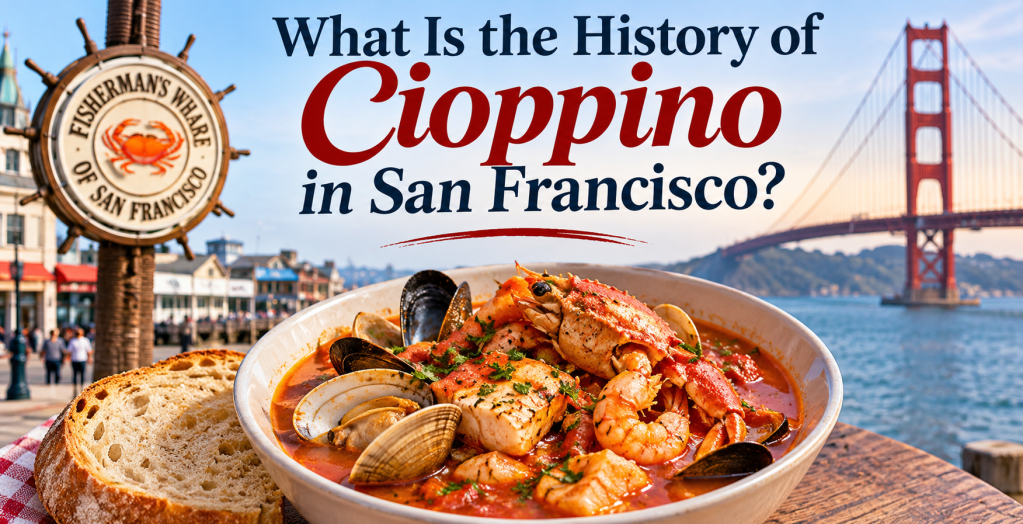
San Francisco is famous for its Golden Gate Bridge, historic cable cars, sourdough bread, and incredible seafood. However, one of the city’s most beloved culinary traditions began long before modern restaurants and tourist attractions transformed its waterfront.
That dish is cioppino, a rich, tomato-based seafood stew that reflects San Francisco’s fishing heritage, Italian immigrant communities, and connection to the Pacific Ocean.
Although cioppino has strong Italian roots, the dish as Americans know it today was developed in San Francisco. Its story begins with hardworking immigrant fishermen who combined fresh seafood, tomatoes, garlic, wine, and simple seasonings to create a satisfying meal.
Over generations, this humble fishermen’s stew became one of the most recognizable dishes in Northern California.
Understanding the history of cioppino reveals more than the origins of a famous recipe. It tells the story of immigration, community, resourcefulness, and the development of San Francisco’s distinctive food culture.
Where Did Cioppino Originally Come From?
Cioppino originated in San Francisco during the nineteenth century, most likely among Italian immigrant fishermen working along the city’s waterfront.
Many of these fishermen came from Genoa and other coastal communities in the Liguria region of northwestern Italy.
In their homeland, seafood soups and stews were already part of everyday cooking. Fishermen regularly prepared meals using smaller fish, inexpensive ingredients, and whatever seafood was available.
When these immigrants arrived in California, they brought their culinary knowledge and traditions with them.
However, the seafood available in San Francisco differed from what they had known in the Mediterranean.
The Pacific Ocean and nearby coastal waters offered an abundance of fish, shellfish, and especially Dungeness crab.
Rather than simply recreating their traditional Italian recipes, immigrant fishermen adapted their cooking to the ingredients available in Northern California.
The result was a distinctly San Francisco seafood stew that combined Italian cooking traditions with the region’s fresh seafood.
Although its exact invention date remains uncertain, cioppino was established in San Francisco by the beginning of the twentieth century.
How Did Italian Fishermen Create Cioppino?
The earliest versions of cioppino were practical meals rather than elaborate restaurant dishes.
Fishing was physically demanding work, and fishermen needed affordable, filling food after spending long hours on the water.
According to traditional accounts, fishermen used portions of their daily catch that had not been sold.
These might include smaller fish, pieces of crab, clams, or other seafood.
The seafood was combined with familiar Italian ingredients such as:
-
Tomatoes
-
Garlic
-
Onions
-
Olive oil
-
White wine
-
Fresh herbs
-
Chili peppers
Everything was simmered together to create a flavorful seafood stew.
The exact ingredients depended on the day’s catch, which meant no two pots were necessarily identical.
One day, a stew might contain mostly fish and crab. Another day, it might include clams, shrimp, and other shellfish.
This flexibility became one of cioppino’s defining characteristics.
Unlike dishes that require specific ingredients and precise measurements, cioppino developed as a practical way to make the most of available seafood.
That tradition continues today, with different families and restaurants preparing their own versions.
Why Is Cioppino Associated With Fisherman’s Wharf?
San Francisco’s Fisherman’s Wharf played a central role in the development and popularity of cioppino.
During the nineteenth century, the city’s waterfront supported a thriving commercial fishing industry.
Italian immigrants became an important part of this industry, operating fishing boats and establishing communities near the waterfront.
Many lived in North Beach, a neighborhood that developed into the center of San Francisco’s Italian-American culture.
The nearby wharves provided access to fishing boats, seafood markets, and commercial customers.
For these fishermen, preparing seafood stew was a natural extension of their daily work.
The ingredients were readily available, and the cooking methods were familiar.
As San Francisco expanded, its fishing industry became increasingly connected to restaurants, markets, and visitors.
Cioppino gradually moved beyond fishermen’s homes and waterfront meals.
It became a dish served in restaurants around Fisherman’s Wharf and North Beach, helping establish its reputation as a San Francisco specialty.
Today, Fisherman’s Wharf remains closely associated with cioppino, even though the dish is served throughout the Bay Area and beyond.
Where Did the Name Cioppino Come From?
One of the most interesting parts of cioppino’s history is the debate surrounding its name.
There are two commonly discussed explanations.
The Italian Linguistic Origin
The explanation supported by linguistic evidence connects cioppino to the Ligurian word ciuppin.
Ciuppin refers to a traditional fish soup associated with the coastal region around Genoa.
The soup was generally prepared using fish, vegetables, and other inexpensive ingredients.
When Ligurian immigrants settled in San Francisco, they brought their seafood cooking traditions with them.
Over time, the name appears to have evolved into the Italian-American word cioppino.
This explanation reflects the dish’s connection to the food traditions of northern Italy.
The Famous “Chip In” Story
Another popular explanation comes from San Francisco waterfront folklore.
According to this story, fishermen would contribute portions of their catches to a shared pot of seafood stew.
Someone would supposedly walk among the fishing boats asking others to “chip in” whatever seafood they could spare.
The phrase eventually became associated with the dish’s name.
It is an appealing story because it emphasizes cooperation and community among fishermen.
However, historians have questioned whether the phrase actually produced the name.
The connection to the Ligurian word ciuppin is considered more convincing.
The “chip in” story remains an important part of San Francisco’s culinary folklore, even though it should not be treated as a proven historical fact.
When Did Cioppino First Appear in Historical Records?
Although cioppino likely developed during the second half of the nineteenth century, written evidence helps establish when it became part of San Francisco’s food culture.
One particularly interesting reference appeared in the San Francisco Call in 1901.
A newspaper account described a seafood dish prepared aboard a fishing boat.
The dish, recorded under a spelling resembling “chespini,” included olive oil, garlic, tomatoes, chili peppers, white wine, and fresh fish.
These ingredients closely resemble the foundation of modern cioppino.
The account demonstrates that fishermen were preparing this style of seafood stew by the beginning of the twentieth century.
Another important historical reference comes from The Refugees’ Cook Book, published in 1906 following the devastating San Francisco earthquake and fire.
The cookbook included a cioppino recipe, providing further evidence that the dish had already become established in local cooking.
These records are important because they help separate documented history from the legends that developed around cioppino.
They also demonstrate that the dish existed before it became a famous restaurant specialty.
How Did the 1906 San Francisco Earthquake Affect Cioppino’s History?
The 1906 earthquake and fire dramatically changed San Francisco.
Entire neighborhoods were destroyed, businesses disappeared, and thousands of residents were forced to rebuild their lives.
The disaster also affected the city’s waterfront and Italian immigrant communities.
Meiggs’ Wharf, an important nineteenth-century waterfront structure associated with San Francisco’s fishing industry, was destroyed.
Despite the destruction, the city’s culinary traditions survived.
Families continued preparing familiar meals, including seafood stews rooted in their Italian heritage.
The appearance of cioppino in a cookbook published after the earthquake provides a particularly meaningful historical connection.
It shows that the dish was already part of San Francisco’s food culture during a period of enormous upheaval.
As the city rebuilt, its restaurants, fishing businesses, and immigrant neighborhoods continued to evolve.
Cioppino remained connected to the waterfront and eventually became a recognizable symbol of San Francisco’s culinary identity.
Why Did Dungeness Crab Become an Important Ingredient?
One of the biggest differences between San Francisco cioppino and traditional Mediterranean seafood stews is the use of Dungeness crab.
Dungeness crab is native to the Pacific Coast and has long been an important part of Northern California’s seafood industry.
Its sweet, delicate meat and distinctive flavor make it especially well suited to tomato-based seafood dishes.
Italian fishermen arriving in San Francisco discovered that Dungeness crab could be incorporated into the seafood stews they already knew how to prepare.
Over time, crab became one of cioppino’s signature ingredients.
Traditional San Francisco versions frequently include crab sections with the shells still attached.
The shells contribute flavor to the broth, while the crab meat provides sweetness that balances the tomatoes, garlic, and wine.
The result is a rich seafood stew that reflects the ingredients available along California’s coast.
Although cioppino can be prepared without Dungeness crab, the ingredient remains closely associated with classic San Francisco versions.
How Did Cioppino Become Popular in San Francisco Restaurants?
Cioppino began as a practical meal associated with fishermen and their families.
Its transformation into a restaurant specialty happened gradually as San Francisco’s dining culture expanded.
Italian restaurants became increasingly prominent in North Beach and around Fisherman’s Wharf during the late nineteenth and early twentieth centuries.
These establishments introduced customers to dishes influenced by Italian immigrant cooking.
Seafood was especially popular because of the city’s location and active fishing industry.
Cioppino offered restaurants a flavorful dish that highlighted local ingredients while reflecting the area’s Italian heritage.
By the early twentieth century, it was becoming an established part of waterfront dining.
Restaurants such as Alioto’s, which began as a seafood stand in 1925, helped popularize cioppino among customers visiting Fisherman’s Wharf.
As tourism increased, the dish reached an even larger audience.
Visitors looking for authentic San Francisco food discovered a hearty seafood stew unlike the dishes commonly served in other American cities.
Eventually, cioppino became a signature menu item at seafood restaurants throughout the city.
What Makes Traditional San Francisco Cioppino Different?
Traditional San Francisco cioppino has several characteristics that distinguish it from other seafood soups.
The most important is its tomato-based broth.
Unlike creamy seafood chowders, cioppino relies on tomatoes, garlic, olive oil, wine, and seasonings to create a flavorful cooking liquid.
The broth should complement the seafood rather than overwhelm it.
Another defining feature is the combination of different seafood varieties.
A classic preparation may include Dungeness crab, shrimp, clams, mussels, squid, and firm white fish.
The ingredients are generally added according to their cooking times to prevent delicate seafood from becoming tough.
Cioppino is also traditionally served as a substantial meal.
Rather than a small bowl of soup, it often arrives as a generous portion filled with seafood.
Crab shells, clam shells, and mussel shells may remain in the bowl, making the meal a hands-on experience.
Bread is another important part of the tradition.
San Francisco sourdough is especially popular because its chewy texture and tangy flavor complement the rich broth.
Together, the seafood stew and sourdough bread represent two of the city’s most recognizable culinary traditions.
Is Cioppino an Italian Dish or an American Dish?
Cioppino is best described as an Italian-American dish created in San Francisco.
Its cooking techniques and culinary inspiration came from Italian immigrants, particularly those from Liguria.
However, the specific combination of ingredients and the dish’s development occurred in California.
Traditional Italian seafood soups provided the foundation.
San Francisco’s seafood industry supplied the ingredients that helped transform those traditions into something new.
Dungeness crab became especially important, while tomatoes, garlic, wine, and seasonings created the familiar broth.
This combination makes cioppino an excellent example of immigrant food traditions evolving in the United States.
It is not simply an Italian recipe transported unchanged to America.
It is a regional American dish shaped by Italian heritage.
How Is Cioppino Different From Other Famous Seafood Stews?
Cioppino belongs to a larger family of seafood soups and stews found throughout coastal regions.
However, several differences make it distinctive.
Cioppino vs. Italian Ciuppin
Ciuppin is a traditional Ligurian fish soup associated with the Genoa region.
It commonly uses smaller fish and vegetables, and some versions have a smoother or more broken-down texture.
San Francisco cioppino generally features larger pieces of seafood in a tomato-based broth.
Crab, clams, mussels, and shrimp are often served whole or in substantial portions.
Cioppino vs. French Bouillabaisse
Bouillabaisse originated in Marseille, France.
It traditionally emphasizes Mediterranean fish and often uses saffron and other characteristic Provençal seasonings.
Cioppino generally relies more heavily on tomatoes and frequently includes Pacific Coast seafood.
Both dishes developed from practical fishermen’s cooking traditions.
Cioppino vs. Seafood Chowder
Seafood chowders are often thickened with cream, milk, or potatoes.
Cioppino is typically lighter in texture, with a broth built from tomatoes, wine, and seafood juices.
Although it can be rich and hearty, it does not depend on dairy for its characteristic flavor.
These differences help explain why cioppino developed its own identity rather than becoming simply another variation of seafood soup.
Why Is Cioppino Often Served With San Francisco Sourdough?
Cioppino and San Francisco sourdough bread are a natural combination.
The stew produces a deeply flavored broth containing tomatoes, garlic, wine, herbs, and seafood juices.
Sourdough bread provides a convenient way to enjoy every bit of that broth.
Its firm crust holds up well when dipped into the stew, while its slightly sour flavor balances the richness of the seafood.
Both foods also have deep connections to San Francisco’s nineteenth-century history.
Sourdough became associated with the city during the California Gold Rush era.
Cioppino developed through the traditions of Italian immigrant fishermen.
Serving them together brings two important parts of San Francisco’s culinary heritage onto one table.
Today, many restaurants serve cioppino with sourdough bread, garlic bread, or toasted slices intended for dipping.
How Has Cioppino Changed Over the Years?
Cioppino has evolved considerably since its early days as a fishermen’s meal.
Originally, the stew was shaped by necessity.
Fishermen used the seafood available to them, often choosing inexpensive ingredients or portions of the catch that were not sold.
Modern restaurant versions may include premium seafood such as scallops, large shrimp, and generous portions of crab.
Some preparations use carefully developed seafood stock, additional herbs, or richer tomato sauces.
Other versions include pasta or variations in seasoning.
Home cooks have also adapted cioppino to different budgets and seafood availability.
Frozen seafood, canned tomatoes, and prepared seafood stock make it possible to prepare the dish without living near the Pacific Ocean.
Despite these changes, the central idea remains remarkably consistent.
Cioppino is still a seafood stew built around tomatoes, aromatic ingredients, wine, and a mixture of seafood.
The flexibility that made it practical for fishermen continues to make it appealing to modern cooks.
Why Is Cioppino Important to San Francisco’s Cultural History?
Cioppino represents much more than a popular seafood recipe.
It reflects the influence of immigration on American food culture.
Italian immigrants arriving in San Francisco brought their cooking traditions, work ethic, and knowledge of the fishing industry.
They established communities, opened businesses, and helped shape neighborhoods such as North Beach.
Their food traditions gradually became part of the city’s broader identity.
Cioppino also reflects the relationship between San Francisco and its natural surroundings.
The Pacific Ocean provided the seafood that made the dish possible.
The city’s waterfront provided the setting where immigrant cooking traditions could evolve.
Restaurants eventually introduced those traditions to generations of residents and visitors.
In this way, cioppino tells a story of adaptation.
People arrived in a new country, worked with unfamiliar ingredients, and created something that became a lasting part of their adopted home.
That is one reason cioppino remains such an important symbol of San Francisco.
Is Cioppino Still Popular in San Francisco Today?
Cioppino remains one of San Francisco’s most recognizable traditional dishes.
It continues to appear on menus at seafood restaurants, Italian restaurants, and waterfront dining establishments.
Fisherman’s Wharf and North Beach are especially associated with the dish.
For visitors, ordering cioppino offers an opportunity to experience a meal connected to the city’s history.
For longtime Bay Area residents, the stew may carry memories of family gatherings, holiday meals, and special occasions.
It is particularly appealing during cooler weather, when a steaming bowl of seafood stew makes a comforting dinner.
Dungeness crab season also contributes to its seasonal popularity.
Although restaurant preparations have changed over time, cioppino remains rooted in the same basic ingredients and traditions that made it famous.
Frequently Asked Questions About the History of Cioppino
Who invented cioppino in San Francisco?
Cioppino is generally credited to Italian immigrant fishermen, especially those from Genoa, who worked along San Francisco’s waterfront during the nineteenth century. No single inventor has been conclusively identified.
When was cioppino invented?
Cioppino most likely developed during the second half of the nineteenth century. Historical newspaper evidence confirms that a closely related seafood stew was being prepared by San Francisco fishermen by 1901.
Was cioppino invented at Fisherman’s Wharf?
Cioppino is strongly associated with the fishing communities around San Francisco’s historic waterfront, including the area that became known as Fisherman’s Wharf.
What does cioppino mean in Italian?
The name is generally traced to the Ligurian word ciuppin, referring to a fish soup. The popular story that the name came from fishermen saying “chip in” is considered folklore rather than an established linguistic explanation.
Why is Dungeness crab used in cioppino?
Dungeness crab is native to the Pacific Coast and became an important ingredient because it was available to San Francisco fishermen. Its sweet meat also complements the tomato-based broth.
Is cioppino traditionally served with pasta?
Traditional San Francisco cioppino is generally served as a seafood stew with bread. Some restaurants and home cooks add pasta, but pasta is not essential to the classic dish.
What is the difference between cioppino and fish stew?
Cioppino is a particular style of seafood stew associated with San Francisco. It typically combines multiple types of fish and shellfish in a tomato, garlic, and wine-based broth.
Why is cioppino famous in San Francisco?
Cioppino became famous because of its connection to Italian immigrant fishermen, the city’s seafood industry, and the restaurants around Fisherman’s Wharf. It is now considered one of San Francisco’s signature dishes.
Final Thoughts: Cioppino Is a Taste of San Francisco History
The history of cioppino is a reminder that some of America’s most memorable foods began with ordinary people making the most of what they had.
Italian immigrant fishermen did not set out to create one of San Francisco’s most famous dishes.
They were preparing meals using familiar cooking methods and the seafood available along California’s coast.
Over time, their tomato-based seafood stew became part of the city’s identity.
From the fishing boats of the nineteenth century to the seafood restaurants of modern Fisherman’s Wharf, cioppino has remained connected to San Francisco’s waterfront, immigrant heritage, and culinary traditions.
Its ingredients have changed, and every family or restaurant may prepare it differently, but its history remains rooted in resourcefulness and adaptation.
Cioppino is more than a bowl of seafood stew. It is a piece of San Francisco history, served one delicious spoonful at a time.
Leave a Reply