Oakland, California, is known today for its busy waterfront, diverse neighborhoods, historic architecture, cultural influence, and important role in the San Francisco Bay Area. However, long before Oakland became a major California city, the land looked dramatically different.
Before the streets, skyscrapers, shipping terminals, and residential neighborhoods, the area was home to Indigenous communities, oak-covered landscapes, freshwater creeks, wetlands, and abundant wildlife. Later, Spanish colonization, Mexican ranching, and the California Gold Rush transformed the region into a rapidly developing settlement.
Oakland officially incorporated as a town in 1852 and became a city in 1854. But its history stretches back thousands of years.
Understanding what Oakland was like before it became a city reveals a fascinating story about the East Bay’s original inhabitants, natural environment, early ranches, and the events that shaped one of Northern California’s most recognizable communities.
What Did Oakland Look Like Before European Settlement?
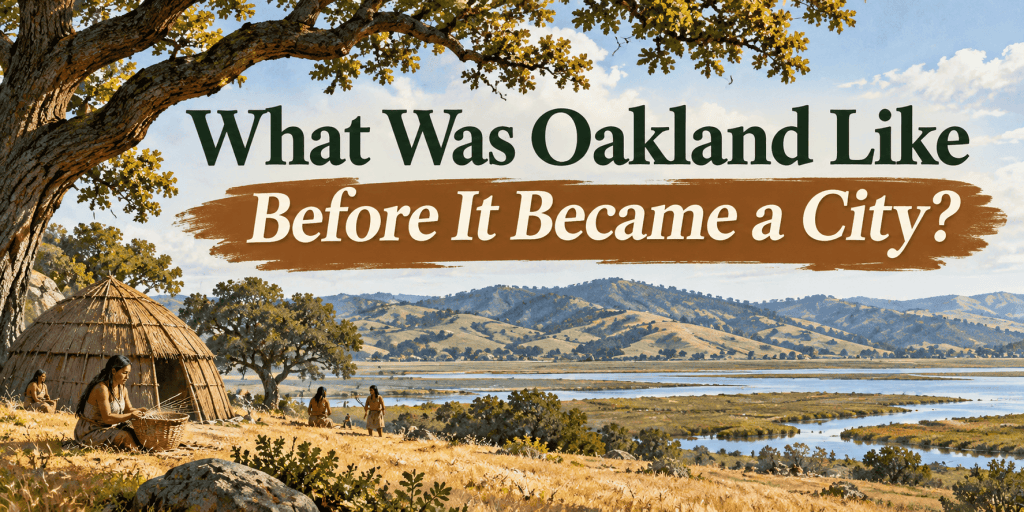
Before European settlers arrived, the land that would eventually become Oakland was a mixture of rolling hills, oak woodlands, grasslands, creeks, marshes, and coastal environments.
The landscape was considerably different from the developed city residents recognize today.
Large oak trees grew throughout portions of the region, particularly across the flatter areas between the hills and the shoreline. These trees would eventually inspire Oakland’s name.
The natural environment included several distinctive features.
Oak Woodlands and Open Grasslands
Oakland’s landscape once supported extensive oak woodlands, including coast live oaks and other native oak species.
The trees provided food and shelter for wildlife and were an important resource for Indigenous communities.
Between wooded areas, grasslands supported deer, smaller mammals, birds, and numerous native plants.
The Oakland Hills contained additional woodland habitats, while the flatter areas closer to the bay offered a combination of open terrain and tree cover.
Freshwater Creeks
Numerous creeks flowed from the Oakland Hills toward San Francisco Bay.
These waterways provided freshwater, supported wildlife, and created important natural corridors through the landscape.
Some of the area’s historic waterways included:
-
Temescal Creek
-
Sausal Creek
-
Glen Echo Creek
-
Peralta Creek
-
Arroyo Viejo
Many of these creeks still exist, although portions have been redirected, placed underground, or surrounded by urban development.
Before Oakland became a city, these waterways were important to the people, plants, and animals living throughout the region.
Wetlands Along San Francisco Bay
Oakland’s original shoreline looked very different from its modern waterfront.
Tidal marshes, mudflats, and shallow coastal waters occupied areas that would later be filled or developed for industrial and commercial purposes.
These wetlands supported fish, shellfish, waterfowl, and other wildlife.
They also provided valuable food resources for Indigenous communities.
The modern Port of Oakland and surrounding waterfront facilities occupy a landscape that has been substantially altered through dredging, filling, and construction.
Who Lived in Oakland Before It Became a City?
Long before Oakland was established, the region was inhabited by Indigenous peoples whose communities had lived around the East Bay for thousands of years.
The original inhabitants of the Oakland area included Ohlone peoples, particularly Chochenyo-speaking communities.
These communities developed deep relationships with the land, waterways, plants, and animals.
Their societies existed long before Spanish explorers, Mexican ranchers, or American settlers arrived.
The Ohlone People of the East Bay
The Ohlone were not a single centralized tribe. Instead, they consisted of numerous distinct communities connected through related languages, cultural practices, trade, and regional relationships.
The East Bay was home to several Indigenous communities with established territories and settlements.
The Huchiun, a Chochenyo-speaking Ohlone people, are especially associated with the Oakland area.
Their ancestral territory included portions of what is now Oakland and nearby East Bay communities.
These communities maintained villages, seasonal gathering areas, and networks of relationships with neighboring peoples.
What Was Daily Life Like?
Daily life involved fishing, hunting, gathering, food preparation, basket weaving, toolmaking, trade, and community ceremonies.
Acorns collected from oak trees were an important food source.
Preparing acorns required considerable knowledge and skill. They were shelled, ground into meal, and processed with water to remove bitter tannins before cooking.
Other foods included fish, shellfish, seeds, berries, roots, and game animals.
Indigenous people used natural materials to create baskets, tools, shelters, and other necessities.
Basket weaving was particularly important because baskets served many purposes, including collecting, storing, preparing, and transporting food.
The region’s natural abundance supported established communities with sophisticated ecological knowledge.
Indigenous Land Management
The landscape was not simply untouched wilderness.
Indigenous communities actively managed their surroundings through gathering practices, selective harvesting, and the use of fire.
Cultural burning helped maintain certain habitats, encourage useful plants, and influence vegetation patterns.
These practices contributed to the ecological character of the East Bay before European colonization.
Recognizing this history is important because Oakland’s early landscape was shaped by generations of Indigenous stewardship.
What Happened When Spanish Explorers Arrived?
European exploration of the San Francisco Bay region expanded during the late eighteenth century.
In 1772, an expedition led by Pedro Fages traveled through portions of the East Bay.
Spanish colonial expansion introduced major changes to Indigenous communities and the surrounding environment.
Mission settlements, livestock, European diseases, and colonial policies disrupted established ways of life.
The Spanish Mission Period
Mission San José was established in 1797 near present-day Fremont.
The mission became part of Spain’s broader effort to establish religious and political control over California.
Indigenous people from different East Bay communities were brought into the mission system.
Many experienced forced changes to their traditional lives, restricted freedom, disease, and severe population losses.
The mission system also altered land use throughout the region.
Cattle and other livestock were introduced on a large scale, affecting native grasslands and vegetation.
By the early nineteenth century, the East Bay was undergoing significant social and environmental changes.
What Was Oakland Like During the Mexican Rancho Period?
After Mexico gained independence from Spain in 1821, California became part of Mexico.
During this period, large land grants helped establish the ranching economy that shaped much of the East Bay.
One of the most important developments in Oakland’s early history was the creation of Rancho San Antonio.
The Rancho San Antonio Land Grant
In 1820, while California was still under Spanish rule, Luis María Peralta received a large land grant from the Spanish colonial government.
The grant covered approximately 44,800 acres in what is now the East Bay.
The property included land that would eventually become parts of Oakland, Berkeley, Alameda, Albany, Emeryville, Piedmont, and surrounding communities.
The grant became known as Rancho San Antonio.
Peralta was a former Spanish soldier whose family became closely associated with the region’s early ranching history.
The property was later divided among his four sons.
What Did Rancho San Antonio Look Like?
During the rancho period, much of the land consisted of open grazing areas, oak trees, rolling hills, and waterways.
Cattle and horses were central to the ranching economy.
Instead of modern streets and subdivisions, the landscape contained ranch buildings, trails, grazing lands, and agricultural activities.
Cattle ranching was particularly important because hides and tallow were valuable products in California’s early economy.
The ranching system depended on the labor of Indigenous people and other workers, often within unequal social and economic relationships.
Although the region remained largely rural, its ownership and land-use patterns had changed substantially from the earlier Indigenous landscape.
Who Were the Peralta Brothers?
Luis María Peralta divided Rancho San Antonio among his four sons in the 1840s.
The brothers were:
-
Domingo Peralta
-
Vicente Peralta
-
Antonio María Peralta
-
Ignacio Peralta
Their properties covered different sections of the original grant.
Vicente Peralta received land that included much of what would become Oakland.
The Peralta family played an important role in the transition from ranching territory to the communities that later developed throughout the East Bay.
The Peralta Hacienda
One of Oakland’s most important surviving connections to this period is the Peralta Hacienda Historical Park.
Located in the Fruitvale area, the site preserves the history of the Peralta family and the broader communities associated with the land.
The surviving Peralta house dates to 1870, after Oakland had already become a city, so it should not be mistaken for a building from Oakland’s earliest settlement period.
Nevertheless, the property helps tell the story of the region’s transformation from Indigenous homeland to Spanish and Mexican colonial landholding and eventually an American city.
What Was Oakland Called Before It Was Oakland?
Before Oakland received its modern name, different communities knew the land through their own geographic and cultural traditions.
Indigenous people had names for their territories, villages, waterways, and significant places.
During the Spanish and Mexican periods, much of the area became associated with Rancho San Antonio.
The name Oakland emerged during the early American settlement period.
It referred to the oak trees that were once prominent across the landscape.
Why Was the Name Oakland Chosen?
Oakland’s name reflects the area’s historic oak woodlands.
Early settlers recognized the abundance of oak trees and adopted a name that described the landscape.
The settlement developed during a period when California was experiencing rapid population growth following the discovery of gold.
As land was surveyed, divided, and sold, Oakland became the established name of the developing town.
Today, the city’s name remains a reminder of the natural environment that existed before extensive urban development.
How Did the California Gold Rush Change Oakland?
The California Gold Rush was one of the most important events in Oakland’s transformation.
Gold was discovered at Sutter’s Mill in 1848, triggering an enormous migration to California.
Thousands of people arrived seeking wealth, employment, land, and new opportunities.
San Francisco quickly became a major center of commerce and transportation.
Across the bay, the future Oakland offered something valuable: land with access to San Francisco Bay and routes leading toward the interior of California.
Oakland’s Strategic Location
Oakland’s location made it attractive for settlement and transportation.
The area offered access to the bay, relatively flat land near the shoreline, and routes connecting the waterfront with inland communities.
As San Francisco grew, opportunities expanded on the eastern side of the bay.
Entrepreneurs and settlers recognized the potential for a town that could serve travelers, businesses, and the growing regional economy.
The Arrival of American Settlers
During the early 1850s, American settlers began establishing a more permanent commercial settlement in the Oakland area.
Among the best-known early town developers were Horace Carpentier, Edson Adams, and Andrew Moon.
Their activities contributed to the surveying, subdivision, and development of the new town.
However, the process was controversial.
Land ownership disputes, competing claims, and conflicts involving the Peralta family’s property complicated Oakland’s early development.
The transition from rancho land to an American town was not simply an orderly sale of vacant property.
It involved contested ownership, legal disputes, speculation, and the displacement of earlier communities.
What Did Oakland Look Like in the Early 1850s?
Imagine standing near Oakland’s waterfront around 1851 or 1852.
Instead of the modern skyline, highways, and port cranes, you would have seen a small developing settlement surrounded by a largely rural landscape.
Oak trees still stood across portions of the area.
Creeks flowed toward the bay.
Open land extended toward the hills.
Near the waterfront, new buildings, roads, and commercial activities were beginning to appear.
Small Wooden Buildings
Early Oakland contained modest wooden structures rather than the large brick and concrete buildings that would later define its downtown.
Homes, stores, lodging establishments, and other businesses gradually appeared as the settlement grew.
Construction was relatively simple, reflecting the limited infrastructure and rapidly changing population.
Dirt Roads and Trails
Oakland did not yet have its modern network of paved streets.
Travel took place along trails, wagon routes, and newly established roads.
During wet weather, unpaved routes could become muddy and difficult to navigate.
Transportation depended on walking, horses, wagons, and boats.
A Developing Waterfront
The waterfront was one of Oakland’s most important early assets.
Small-scale shipping and ferry activity helped connect the settlement with San Francisco and other locations around the bay.
The shoreline had not yet been transformed into the extensive industrial port that exists today.
Nevertheless, its commercial potential was already becoming clear.
A Mixture of Rural and Commercial Life
Early Oakland combined ranching traditions with new commercial development.
Cattle grazing and agricultural activities continued in surrounding areas while businesses began operating near the growing town center.
This combination of rural land and emerging commerce defined Oakland during its transition into an incorporated community.
When Did Oakland Officially Become a Town?
Oakland was incorporated as a town on May 4, 1852.
This marked a major turning point in its history.
The settlement now had formal municipal recognition, although its institutions and infrastructure were still developing.
The town occupied only a portion of the territory that would eventually become modern Oakland.
Surrounding areas remained separate communities, agricultural properties, or undeveloped land.
Oakland’s incorporation reflected the rapid changes occurring throughout California after statehood in 1850.
The growing settlement needed systems for local government, property administration, roads, and public services.
These needs became more important as the population and economy expanded.
When Did Oakland Become a City?
Oakland officially became a city on May 17, 1854.
The change occurred just two years after its incorporation as a town.
This rapid transition demonstrated how quickly the settlement was developing.
Horace Carpentier became Oakland’s first mayor.
The new city still looked nothing like the large urban center it would eventually become.
Its population was relatively small, much of the surrounding land remained rural, and major transportation and industrial developments were still decades away.
However, Oakland had established the municipal foundation for future expansion.
How Was Early Oakland Different From Modern Oakland?
The contrast between Oakland before incorporation and Oakland today is remarkable.
| Feature | Before Oakland Became a City | Modern Oakland |
|---|---|---|
| Landscape | Oak woodlands, grasslands, creeks, wetlands | Dense neighborhoods, parks, commercial districts |
| Population | Indigenous communities, later ranching families and settlers | Large, culturally diverse urban population |
| Transportation | Trails, horses, wagons, boats | Roads, highways, BART, buses, rail and ferries |
| Economy | Indigenous food systems, ranching, agriculture, early trade | Healthcare, education, technology, logistics, retail and services |
| Waterfront | Natural marshes, mudflats, small landing areas | Major seaport and developed shoreline |
| Buildings | Indigenous structures, ranch buildings, early wooden settlements | Historic buildings, apartments, offices and high-rises |
| Government | Indigenous governance, followed by colonial and territorial authorities | Incorporated municipal government |
These differences reveal just how dramatically Oakland has changed over the past two centuries.
What Happened to Oakland’s Original Oak Trees?
Oakland’s historic oak trees were gradually removed as the city expanded.
Road construction, residential development, commercial buildings, and other projects transformed the original landscape.
Many oak woodlands disappeared from the flatter portions of the city.
However, oak trees remain part of Oakland’s natural identity.
They can still be found in parks, neighborhoods, and hillside areas.
Places such as Joaquin Miller Park and other East Bay open spaces preserve examples of the region’s woodland environments.
The remaining trees provide a connection to the landscape that inspired Oakland’s name.
They also remind residents that the city developed within an existing ecosystem rather than on empty land.
What Happened to Oakland’s Indigenous Communities?
The development of Oakland occurred alongside profound losses for Indigenous communities.
Spanish colonization, the mission system, introduced diseases, dispossession, and later American settlement disrupted Indigenous societies throughout California.
The nineteenth century brought additional violence, discrimination, and displacement.
Many Indigenous people lost access to ancestral lands and traditional resources.
However, it is important not to describe Oakland’s original inhabitants only in the past tense.
Ohlone descendants and communities remain active today.
Organizations and tribal communities continue working to preserve languages, protect cultural sites, maintain traditions, and seek recognition of ancestral relationships to the land.
Oakland’s Indigenous history is therefore not simply a chapter that ended when the city was established.
It remains part of the region’s living cultural identity.
Are There Places in Oakland Where You Can Still See Its Early History?
Although Oakland has changed dramatically, several locations preserve connections to its earlier landscape and history.
Peralta Hacienda Historical Park
This historic site in the Fruitvale neighborhood explores the Peralta family, Rancho San Antonio, and the broader history of the people who lived and worked on the land.
It provides an important connection to Oakland’s Mexican rancho period.
Oakland Museum of California
The Oakland Museum of California explores the state’s history, art, and natural environment.
Its exhibits and collections help visitors understand Indigenous California, settlement, environmental change, and the development of communities such as Oakland.
Lake Merritt
Lake Merritt is one of Oakland’s most recognizable landmarks.
Before the surrounding area was extensively developed, it was part of a tidal estuary connected to San Francisco Bay.
Its history offers an example of how Oakland’s natural waterways were transformed as the city expanded.
Lake Merritt became a designated wildlife refuge in 1870, reflecting an early effort to protect birdlife within an increasingly developed environment.
Oakland’s Creeks and Hills
Natural areas along Sausal Creek, Temescal Creek, and the Oakland Hills provide additional glimpses of the region’s older geography.
Although these landscapes have also changed, they preserve elements of the environment that existed long before incorporation.
Why Did Oakland Grow So Quickly?
Several factors helped Oakland develop from a small settlement into an important East Bay city.
Its location across the bay from San Francisco created commercial opportunities.
The California Gold Rush brought population growth and economic activity to Northern California.
Access to the waterfront supported transportation and trade.
The region’s relatively accessible land encouraged settlement and construction.
Later developments, particularly the arrival of the transcontinental railroad’s western terminus in Oakland in 1869, accelerated the city’s importance.
Industrial growth, shipping, manufacturing, and transportation eventually transformed Oakland into a major economic center.
But these later achievements were built upon the geographic advantages and historical changes that had already shaped the area before 1854.
Frequently Asked Questions About Oakland Before It Became a City
Was Oakland originally a forest?
Oakland was not entirely covered by dense forest. Its original landscape included oak woodlands, grasslands, wetlands, creeks, and hills. Oak trees were particularly prominent in areas that later became part of the city.
Who were the first people to live in Oakland?
The original inhabitants included Indigenous Ohlone communities, particularly the Chochenyo-speaking Huchiun people. Their ancestors lived in the East Bay for thousands of years before European colonization.
Was Oakland once part of Mexico?
Yes. The land became part of independent Mexico after 1821. Before that, it was under Spanish colonial rule. Rancho San Antonio was established through a Spanish land grant in 1820 and continued through the Mexican period.
Who owned Oakland before it became a city?
The land was originally the homeland of Indigenous communities. Under Spanish colonial authority, Luis María Peralta received the Rancho San Antonio grant in 1820. His family later controlled large portions of the land, although ownership became heavily disputed during American settlement.
Why is Oakland named Oakland?
Oakland was named for the oak trees that once grew abundantly across portions of the area.
What year was Oakland founded?
Oakland was incorporated as a town in 1852 and as a city in 1854. Its history as an inhabited place extends thousands of years earlier.
What was Oakland’s economy like before 1854?
Before incorporation, the area’s economy changed over time from Indigenous food gathering, fishing, hunting, trade, and land management to colonial ranching and agriculture. During the early 1850s, commerce, transportation, property development, and waterfront activities became increasingly important.
Did Oakland exist during the Gold Rush?
The land and its communities existed long before the Gold Rush, but Oakland’s development as an American town accelerated during the early 1850s, following the 1848 discovery of gold.
Final Thoughts: Oakland Before the Modern City
Before Oakland became a city, it was a place of oak-covered landscapes, flowing creeks, tidal wetlands, Indigenous villages, and abundant natural resources.
For thousands of years, Ohlone communities lived throughout the region, developing traditions and relationships with the land that remain important today.
Spanish colonization brought missions, livestock, and dramatic changes to Indigenous life.
The Mexican period introduced Rancho San Antonio and the Peralta family’s extensive landholdings.
Then the California Gold Rush helped transform the East Bay into a growing center of settlement, transportation, and commerce.
By the time Oakland officially became a city in 1854, its landscape and communities had already experienced generations of transformation.
The Oakland we know today did not emerge overnight. It developed through centuries of Indigenous history, colonial expansion, ranching, migration, land disputes, and economic opportunity.
Understanding what Oakland was like before it became a city helps us appreciate not only how much the East Bay has changed, but also the people, landscapes, and histories that existed long before the modern streets and skyline appeared.
Leave a Reply