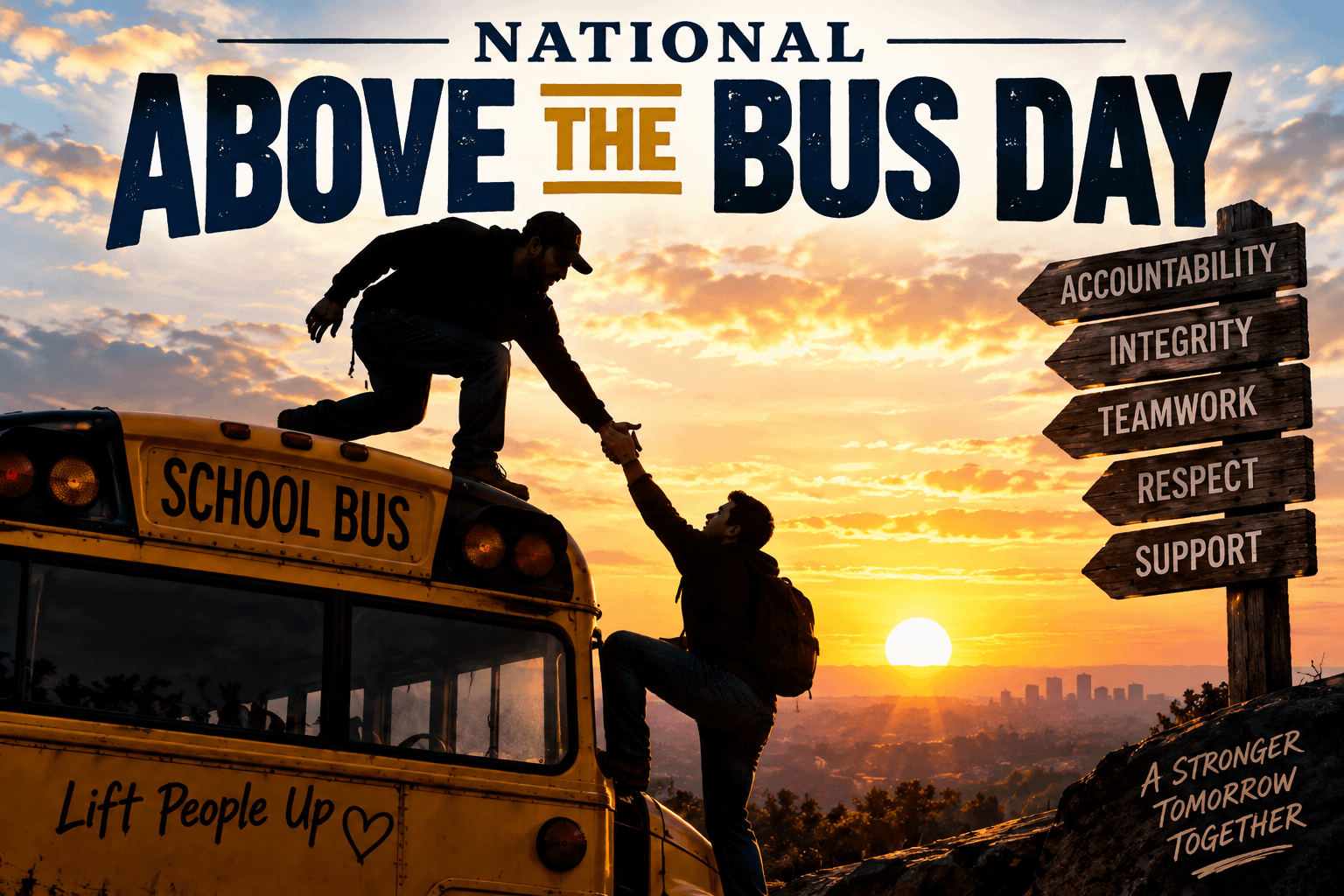
Every workplace, organization, team, and community has moments when something goes wrong. Deadlines are missed. Plans fail. Mistakes happen. When they do, people have a choice: accept responsibility or look for someone else to blame.
National Above the Bus Day turns the familiar expression “throw someone under the bus” upside down. Instead of sacrificing another person to protect ourselves, the day encourages us to rise above blame, recognize the contributions of others, and take responsibility for our own actions.
Being “above the bus” means choosing accountability over excuses, appreciation over self-promotion, and teamwork over blame.
It is a simple idea, but practicing it can completely change the culture of a workplace, family, friendship, or organization.
What Does “Throw Someone Under the Bus” Mean?
Most of us have heard someone say that another person was “thrown under the bus.”
The expression generally describes a situation where someone is blamed, sacrificed, criticized, or exposed so another person can protect themselves or gain an advantage.
Imagine a team working on a major project. The project misses its deadline, and a manager immediately tells senior leadership:
“It wasn’t my fault. My team didn’t get their work done.”
Even if the manager shares some responsibility for the failure, shifting all the blame downward protects the manager at the expense of everyone else.
That is throwing someone under the bus.
National Above the Bus Day promotes the opposite attitude.
Instead of asking:
“Who can I blame?”
Ask:
“What responsibility can I take?”
Instead of wondering:
“How do I make myself look good?”
Ask:
“Who deserves recognition for helping us succeed?”
Those small changes can have a tremendous impact.
What Does It Mean to Be “Above the Bus”?
Being above the bus doesn’t mean ignoring mistakes.
Accountability still matters.
People should be able to talk honestly about what went wrong, what needs to change, and who was responsible for different decisions. But accountability and humiliation are not the same thing.
You can address a mistake without destroying someone’s reputation.
You can correct someone without embarrassing them.
You can acknowledge another person’s failure while also acknowledging your own role.
Being above the bus means handling difficult situations with integrity.
It means refusing to climb higher by pushing someone else lower.
Give Credit Where Credit Is Due
One of the easiest ways to practice the spirit of National Above the Bus Day is to recognize the people who helped you succeed.
Success is rarely accomplished completely alone.
Maybe a coworker stayed late to help finish a project.
Maybe an employee solved a problem before anyone else even noticed it.
Maybe someone introduced you to an opportunity.
Maybe a friend encouraged you when you were ready to quit.
Maybe a family member quietly supported you while you pursued a goal.
Give them credit.
Say their name.
Tell people what they contributed.
One of the strongest signs of leadership is being secure enough to celebrate someone else’s contribution without worrying that their success somehow diminishes yours.
There is plenty of room for more than one person to receive recognition.
Take Responsibility When Things Go Wrong
Giving credit is easy when everything goes well.
Character becomes more visible when something goes wrong.
When we make mistakes, our natural instinct can be to defend ourselves.
We explain.
We justify.
We point toward circumstances.
Sometimes those explanations are legitimate. Not every problem is entirely our responsibility.
But before pointing outward, it is worth looking inward.
Ask yourself:
What part of this belonged to me?
Maybe you didn’t communicate clearly.
Maybe you waited too long to make a decision.
Maybe you assumed someone understood instructions that were never fully explained.
Maybe you ignored a warning sign.
Maybe you simply made the wrong call.
Saying, “That part was my responsibility, and I should have handled it differently,” can be difficult.
It can also earn enormous respect.
People don’t expect perfection.
They do remember honesty.
Strong Leaders Protect Their People
Leadership isn’t simply having authority.
Leadership is what you do with that authority.
Weak leadership often pushes responsibility downward and pulls recognition upward.
When something succeeds:
“Look what I accomplished.”
When something fails:
“Look what they did.”
Strong leadership reverses that pattern.
A good leader shares recognition generously while accepting responsibility when leadership decisions contribute to a problem.
That doesn’t mean leaders should accept blame for absolutely everything their employees do. People remain responsible for their own choices.
It means leaders don’t use the people beneath them as shields.
When a problem happens, good leaders ask what they could have done differently.
Were expectations clear?
Was adequate training provided?
Did employees have the resources they needed?
Were warning signs ignored?
Was communication effective?
Those questions create improvement instead of fear.
Why Blame Can Destroy a Team
When people constantly worry about being blamed, behavior changes.
Employees stop taking risks.
People hide mistakes.
Coworkers protect themselves instead of helping each other.
Communication becomes guarded.
Everyone begins documenting conversations simply so they can prove something wasn’t their fault.
Eventually, the workplace becomes less about accomplishing the mission and more about surviving the politics.
That is exhausting.
Trust disappears quickly when people believe their coworkers or leaders will sacrifice them whenever something goes wrong.
Once trust is gone, rebuilding it can take a long time.
Accountability Creates Better Results
Some people mistakenly believe that avoiding blame means avoiding accountability.
It doesn’t.
Healthy accountability is essential.
Suppose someone makes a significant mistake. Pretending nothing happened doesn’t help that person, the team, or the organization.
The better approach is to focus on three questions:
What happened?
Why did it happen?
How do we prevent it from happening again?
That creates a completely different conversation from:
“Whose fault is this?”
Sometimes responsibility still needs to be clearly identified. But the ultimate goal should be improvement.
If people know they can admit mistakes without immediately being humiliated, they are more likely to speak up early.
That gives everyone a chance to fix problems before they become disasters.
Being Above the Bus Outside of Work
The lesson isn’t limited to offices and businesses.
We can throw people under the bus in our personal lives too.
A couple gets into an argument and one person tells friends a version of the story that makes the other person look completely responsible.
A sibling blames another sibling to avoid getting in trouble.
A friend shares someone’s private mistake because it makes them look better.
A teammate publicly criticizes another player after losing a game.
A group member takes credit for an idea someone else originally suggested.
Different situations, same behavior.
National Above the Bus Day challenges us to do better.
Protect people’s dignity whenever possible.
Speak truthfully.
Take responsibility for your actions.
Give people credit.
And don’t sacrifice someone’s reputation simply to protect your own.
Praise Publicly, Correct Thoughtfully
One valuable principle is:
Praise publicly and correct thoughtfully.
When someone does something great, don’t keep it secret.
Tell them.
Tell the team.
Tell their supervisor.
Recognition can mean more than we realize.
Correction, however, usually deserves more discretion.
There are exceptions, especially when something must be addressed publicly, but many problems can be handled through a private conversation.
Imagine making a mistake and having your boss announce it in front of everyone.
Now imagine the boss pulling you aside and saying:
“We need to talk about what happened. Here’s the problem, and here’s what we need to do differently next time.”
The mistake is still addressed.
The standard remains.
But dignity remains too.
That is leadership.
Don’t Steal Someone Else’s Credit
Throwing someone under the bus isn’t always about blame.
Sometimes it happens through stolen recognition.
Someone suggests an idea during a meeting. Nobody responds.
A week later, another person presents essentially the same idea and receives praise.
If you know where the idea originated, speak up.
Say:
“That builds on the idea Sarah mentioned last week.”
Those few words matter.
Recognition costs you almost nothing, but it can mean everything to the person who deserves it.
Five Ways to Observe National Above the Bus Day
You don’t need a major event to participate. Practice the principle through everyday choices.
1. Thank someone publicly. Recognize a coworker, employee, friend, volunteer, or family member who has helped you.
2. Own one mistake. Think about something that recently went wrong and honestly consider your responsibility.
3. Give someone credit. If someone contributed to your success, make sure others know.
4. Defend someone who is being unfairly blamed. If you know the full story, don’t stay silent simply because speaking up is inconvenient.
5. Change the conversation. When everyone starts looking for someone to blame, ask what can be learned and how the problem can be prevented next time.
The People Around You Remember How You Treat Them
Titles change.
Jobs change.
Companies change.
Teams change.
But people remember how you made them feel when things became difficult.
They remember the boss who defended them.
They remember the coworker who gave them credit.
They remember the friend who didn’t expose their mistakes.
They remember the person who stood beside them when everyone else was pointing fingers.
They also remember the opposite.
Your reputation isn’t built only during your greatest successes.
It is built during uncomfortable moments when blaming someone else would be easier.
Rise Above the Bus
National Above the Bus Day carries a message that can be practiced every day.
Don’t build yourself up by tearing someone else down.
Don’t take credit that belongs to someone else.
Don’t hide behind another person when you make a mistake.
Instead, be someone people can trust.
Give credit generously.
Accept responsibility honestly.
Correct mistakes respectfully.
Protect people’s dignity.
Celebrate the people who helped you succeed.
There will always be opportunities to throw someone under the bus.
The greater challenge is choosing to stand beside them—or helping pull them back up.
When something goes wrong, are you looking for someone to blame, or are you looking for a way to make things better?
Leave a Reply