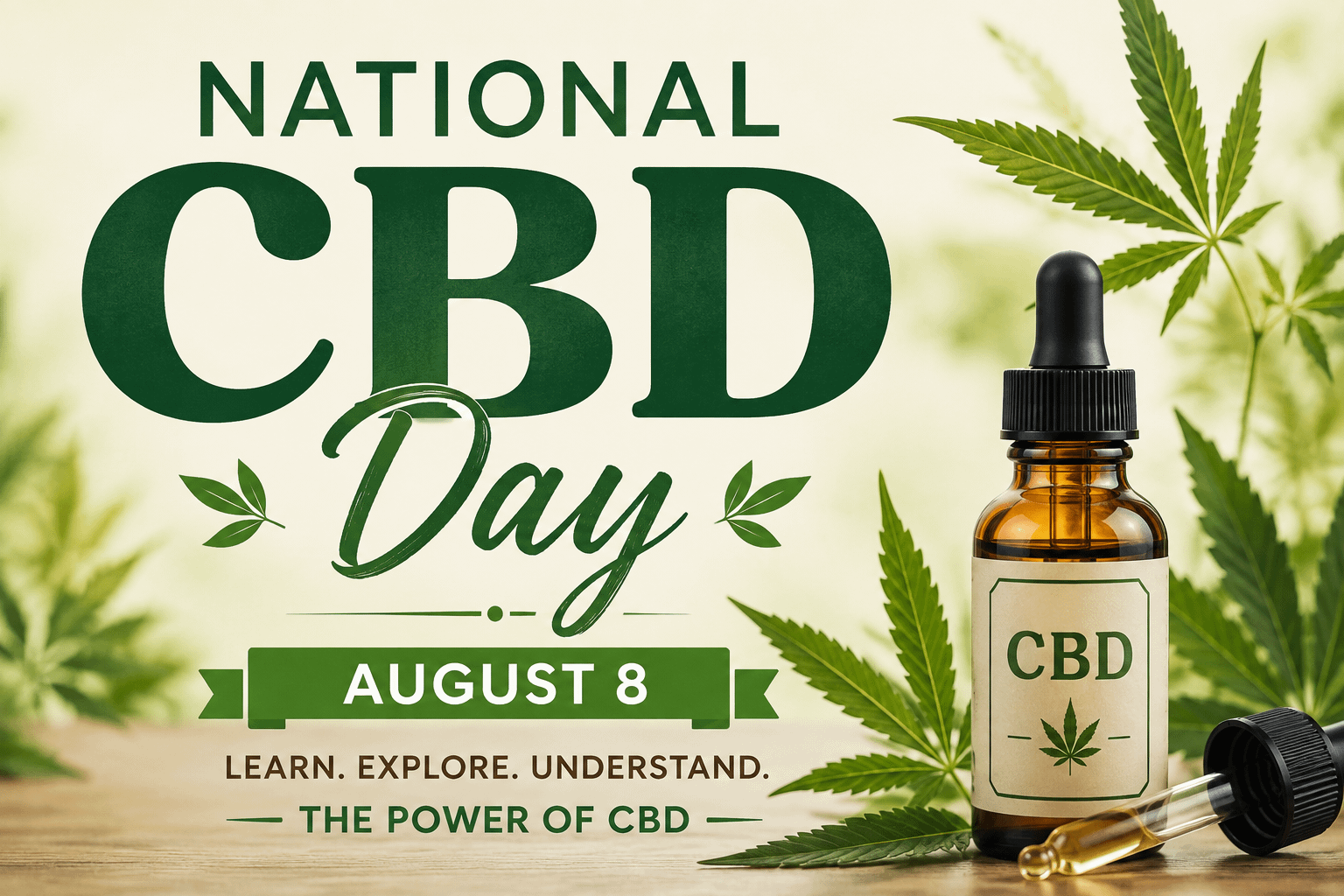
Every year on August 8, National CBD Day recognizes cannabidiol—better known as CBD—and encourages conversation about hemp, cannabis research, consumer products, wellness, and the evolving understanding of cannabinoids.
CBD has experienced a remarkable transformation in public awareness. Not long ago, most people outside the cannabis industry or scientific community had probably never heard the word cannabidiol. Today, CBD appears on store shelves, online marketplaces, wellness discussions, skincare labels, and conversations about alternative approaches to health and relaxation.
CBD products can come in many forms, including oils, tinctures, capsules, gummies, creams, balms, lotions, and other formulations.
But CBD’s growing popularity has also created confusion.
Is CBD marijuana?
Does CBD make you high?
Is hemp the same thing as cannabis?
Are CBD products legal?
Can CBD actually help with pain, anxiety, or sleep?
Can CBD interact with prescription medications?
Will using CBD cause someone to fail a drug test?
These are important questions because the CBD marketplace has expanded faster than many consumers’ understanding of the products being sold.
National CBD Day provides an opportunity to look beyond advertisements and trends and explore what CBD actually is, where it comes from, why people use it, and why responsible consumer education matters.
When Is National CBD Day?
National CBD Day is observed annually on August 8.
The observance is relatively modern compared with traditional holidays and historical commemorations. It developed during the rapid expansion of public interest in hemp-derived cannabidiol products in the United States.
Today, August 8 provides an opportunity to discuss CBD education, cannabinoid research, hemp agriculture, consumer safety, regulations, and the changing cultural conversation surrounding cannabis.
You don’t have to consume CBD to participate in National CBD Day.
Learning something new about cannabinoids, researching hemp history, reading scientific information, or simply understanding the difference between CBD and THC are all meaningful ways to recognize the day.
What Exactly Is CBD?
CBD stands for cannabidiol.
It is one of many naturally occurring chemical compounds called cannabinoids found in plants belonging to the Cannabis genus.
Two of the most widely recognized cannabinoids are:
CBD — cannabidiol
and
THC — tetrahydrocannabinol
Although both compounds originate from cannabis plants, they interact with the body differently.
THC is primarily known for producing the intoxicating effects associated with marijuana.
CBD does not generally produce the same intoxicating “high.”
That difference is one of the major reasons CBD became attractive to consumers interested in cannabis-derived products without seeking the traditional psychoactive effects associated with THC.
Cannabis, Hemp, and Marijuana: What’s the Difference?
The terminology surrounding cannabis can be confusing.
Cannabis refers broadly to plants within the Cannabis genus.
“Hemp” is a legal and agricultural classification used for cannabis that meets specific limits for delta-9 THC concentration under federal law.
“Marijuana” has historically been used to describe cannabis containing higher concentrations of THC, although terminology continues to evolve within medical, legal, and scientific discussions.
CBD can occur in different cannabis plants, but much of the commercially available CBD in the United States is derived from hemp.
Understanding these distinctions helps explain why CBD products can be treated differently from marijuana products under various laws.
CBD Does Not Automatically Mean THC-Free
One important misconception is that all CBD products contain absolutely no THC.
That isn’t necessarily true.
Some CBD products may contain small amounts of THC depending on the source material, extraction method, formulation, manufacturing process, and product category.
This distinction can matter for people who:
- Undergo workplace drug testing
- Work in safety-sensitive occupations
- Drive commercial vehicles
- Serve in certain government positions
- Participate in professional or competitive sports
- Want to avoid THC completely
- Are particularly sensitive to cannabinoids
Consumers should carefully examine product labels and independent laboratory reports rather than assuming every CBD product is THC-free.
A Brief History of Cannabis and Hemp
Cannabis has a history stretching back thousands of years.
Different civilizations used cannabis plants for fiber, textiles, rope, food, traditional preparations, and other purposes.
Hemp became particularly valuable because its strong fibers could be used for practical materials.
Long before CBD became a wellness trend, hemp was primarily known as an agricultural crop.
Over time, cannabis became increasingly controversial because of its association with psychoactive marijuana.
Legal restrictions expanded throughout the 20th century in the United States and elsewhere.
However, scientific interest in the chemical compounds contained within cannabis continued.
The Discovery and Study of CBD
Scientists began isolating and studying cannabinoids during the 20th century.
As research progressed, scientists developed a better understanding of compounds including CBD and THC.
Eventually, researchers discovered that the human body has its own complex signaling network influenced by cannabinoids.
This became known as the endocannabinoid system.
The discovery helped researchers better understand why cannabis compounds can have biological effects.
Today, scientists continue investigating cannabinoids and their potential roles in medicine, neurology, inflammation, pain, sleep, mood, and numerous other areas.
However, research quality and evidence vary significantly depending on the condition being studied.
What Is the Endocannabinoid System?
The endocannabinoid system, often abbreviated ECS, is a biological signaling system found throughout the human body.
It includes naturally produced compounds known as endocannabinoids, receptors, and enzymes involved in producing and breaking down those compounds.
Researchers have studied the ECS in relation to several physiological processes.
The system appears to participate in areas including mood, appetite, sleep, pain perception, immune responses, and other functions.
CBD’s interactions with the body are complex and are not simply a matter of activating one receptor.
Scientists continue investigating exactly how CBD influences different biological pathways.
This is one reason CBD research remains such an active scientific field.
Why Did CBD Become So Popular?
Several factors contributed to CBD’s rapid rise.
Growing public acceptance of cannabis played an important role.
So did interest in natural wellness products.
Social media, celebrity endorsements, online marketing, wellness influencers, and changing cannabis laws all helped introduce CBD to millions of consumers.
Another major factor was the perception that CBD could offer some cannabis-related effects without intoxication.
As a result, CBD began appearing in an enormous variety of products.
The marketplace quickly expanded beyond traditional CBD oils.
CBD eventually appeared in skincare products, beverages, lotions, balms, gummies, capsules, bath products, and many other consumer goods.
The 2018 Farm Bill and the CBD Boom
One of the most significant moments in the modern hemp industry occurred with passage of the Agriculture Improvement Act of 2018, commonly known as the 2018 Farm Bill.
The legislation changed federal treatment of hemp by removing qualifying hemp from the federal definition of marijuana under the Controlled Substances Act.
That change dramatically expanded opportunities for hemp cultivation and hemp-derived products.
However, the Farm Bill did not create a completely unrestricted CBD marketplace.
The U.S. Food and Drug Administration retained regulatory authority over products within its jurisdiction.
State laws can also vary considerably.
As a result, consumers and businesses need to understand that hemp-derived does not automatically mean that every product or use is permitted everywhere.
CBD Oil vs. Hemp Seed Oil
Another common source of confusion involves CBD oil and hemp seed oil.
They are not necessarily the same thing.
Hemp seed oil is generally produced by pressing hemp seeds.
It can be used in foods, cosmetics, and other products and contains nutrients and fatty acids.
However, hemp seeds naturally contain little to no CBD.
CBD products, on the other hand, are produced using cannabinoid-containing parts of the hemp plant and extraction processes designed to obtain cannabidiol.
A product advertised simply as “hemp oil” may therefore not contain meaningful amounts of CBD.
Consumers should read ingredient labels carefully.
What Is Full-Spectrum CBD?
Consumers shopping for CBD frequently encounter three major categories.
Full-Spectrum CBD
Full-spectrum products generally contain CBD along with various other naturally occurring cannabis compounds.
Depending on the product and applicable laws, this can include small amounts of THC.
Supporters sometimes discuss an “entourage effect,” a theory that multiple cannabis compounds may work together differently than isolated compounds.
Research into this concept continues.
Broad-Spectrum CBD
Broad-spectrum products typically contain CBD and several other cannabis compounds but are processed to remove or substantially reduce THC.
However, consumers should still verify laboratory testing if avoiding THC is important.
CBD Isolate
CBD isolate generally refers to highly purified cannabidiol that has been separated from most other cannabis compounds.
The final product is designed to contain primarily CBD.
Even when a product is labeled isolate, independent testing remains valuable.
Common Types of CBD Products
The CBD marketplace includes numerous formulations.
CBD Oils and Tinctures
These products usually contain CBD extract combined with a carrier oil.
CBD Capsules and Softgels
Capsules offer a premeasured serving and are often marketed similarly to dietary supplements.
CBD Gummies
Gummies became particularly popular because they resemble traditional candy or vitamin gummies.
They should always be stored securely away from children.
CBD Topicals
Creams, lotions, balms, and salves are applied directly to the skin.
They are frequently marketed toward people interested in massage, skincare, or exercise recovery.
CBD Beauty Products
CBD has also appeared in serums, moisturizers, soaps, bath products, and other cosmetics.
Why Do People Use CBD?
Consumers report using CBD for many reasons.
Some people are interested in relaxation.
Others explore CBD products in connection with sleep, physical discomfort, recovery after exercise, stress, or general wellness.
However, there is an important distinction between why consumers use a product and what science has conclusively demonstrated that product can treat.
Testimonials aren’t the same thing as controlled scientific research.
A person saying CBD helped them doesn’t automatically establish that CBD will have the same effect on another person.
CBD Has a Legitimate Prescription Medical Application
The strongest example of an established medical application for CBD involves a prescription medication called Epidiolex.
The U.S. Food and Drug Administration approved Epidiolex, which contains purified cannabidiol, for seizures associated with certain serious seizure disorders.
This approval was an important milestone in cannabinoid medicine.
However, it does not mean commercially available CBD gummies, oils, or lotions are equivalent to prescription cannabidiol.
Pharmaceutical products undergo extensive manufacturing controls, clinical evaluation, standardized dosing, and regulatory oversight.
Consumers should therefore be cautious when companies imply that an ordinary CBD product can treat serious diseases simply because a CBD-containing prescription medication exists.
CBD and Pain
Pain management is one of the most frequently discussed reasons people become interested in cannabinoids.
Researchers have investigated cannabis and cannabinoids in relation to different types of pain.
However, pain is extremely complex.
Arthritis pain, nerve pain, muscle soreness, migraine pain, surgical pain, and chronic pain can have completely different causes and treatment requirements.
Research involving cannabis products also doesn’t automatically demonstrate that CBD alone is responsible for an observed effect.
People experiencing persistent or severe pain should seek appropriate medical evaluation rather than relying exclusively on an over-the-counter CBD product.
CBD and Anxiety
CBD is frequently marketed for relaxation and stress.
Researchers have explored its potential relationship with anxiety, but the evidence is still developing.
Anxiety disorders are medical conditions that can significantly affect someone’s quality of life.
CBD should not automatically be considered a replacement for professional mental health treatment, prescribed medication, counseling, or other evidence-based approaches.
Anyone struggling with persistent anxiety should consider discussing treatment options with a qualified healthcare professional.
CBD and Sleep
Sleep is another major reason consumers purchase CBD.
Some people report feeling more relaxed after using CBD products.
But sleep problems can have many underlying causes, including stress, medication effects, sleep disorders, pain, lifestyle habits, medical conditions, caffeine, alcohol, or irregular schedules.
Research has not established every commercially available CBD product as a proven treatment for insomnia.
Persistent sleep difficulties deserve proper evaluation.
CBD and Exercise Recovery
CBD creams, balms, and oils are often marketed toward athletes and physically active adults.
These products may be promoted for post-workout recovery or muscle discomfort.
Marketing language, however, should not be confused with established medical evidence.
Athletes should also pay close attention to competition rules and product purity because contamination with THC or other prohibited substances can create problems with drug testing.
CBD and Skincare
CBD has also entered the beauty industry.
Consumers can now find CBD-containing moisturizers, lotions, facial serums, balms, and other skincare products.
Researchers continue investigating cannabinoids in dermatology, but consumers should remain skeptical of dramatic claims.
Terms such as “natural,” “plant-based,” and “CBD-infused” don’t automatically mean a skincare product is more effective or safer than conventional alternatives.
CBD for Pets
The CBD industry has also expanded into products marketed for dogs, cats, and other animals.
Pet owners may encounter products promoted for mobility, calmness, aging, or general wellness.
Animals don’t necessarily respond to substances in the same way humans do.
Additionally, ingredients that are safe for humans can sometimes be dangerous for pets.
Never assume a human CBD product is appropriate for an animal.
Pet owners interested in CBD should consult a veterinarian who can discuss the available evidence and potential risks.
Does CBD Have Side Effects?
CBD is often promoted as “natural,” but natural substances can still produce side effects.
Potential effects can include:
- Drowsiness or changes in alertness
- Gastrointestinal discomfort
- Diarrhea
- Appetite changes
- Changes in how certain medications are metabolized
- Other individual reactions
Responses can vary depending on the individual, dose, product, and other substances being taken.
CBD Can Interact With Medications
Medication interactions are one of the most important safety issues surrounding CBD.
CBD can influence enzymes involved in processing certain medications.
That means it may potentially alter the amount of another medication in the bloodstream.
This can be particularly important for people taking prescription medicines.
Anyone taking regular medications should consider talking with their doctor or pharmacist before using CBD.
Never discontinue prescribed medication in favor of CBD without appropriate medical guidance.
CBD and Alcohol
Combining CBD with alcohol or other substances that cause sedation may increase drowsiness or impairment for some individuals.
People should be cautious when combining substances, especially when they do not know how they personally respond.
If you feel impaired, don’t drive.
Can CBD Make You High?
CBD itself does not generally produce the classic intoxicating high associated with THC.
However, a CBD product may contain THC.
The amount can vary based on the formulation and manufacturing process.
Poorly labeled or contaminated products can further complicate the situation.
This is another reason reputable manufacturing and independent laboratory testing matter.
Could CBD Make You Fail a Drug Test?
Potentially.
Many workplace drug tests look for THC metabolites rather than CBD.
If a CBD product contains enough THC, regular use could potentially lead to a positive result.
Consumers who undergo drug testing should understand this risk.
Even products marketed as THC-free should be approached cautiously because labeling or manufacturing errors can occur.
What Is a Certificate of Analysis?
One of the most useful tools available to CBD consumers is a Certificate of Analysis, commonly called a COA.
A COA is a laboratory report describing test results for a particular product or batch.
Depending on the laboratory and testing performed, it may show levels of:
- CBD
- THC
- Other cannabinoids
- Heavy metals
- Pesticides
- Residual solvents
- Microbial contaminants
Consumers can compare the laboratory results with the product label.
If a company refuses to provide meaningful testing information, consumers may want to consider another product.
What to Look for When Shopping for CBD
Consumers should avoid choosing a CBD product solely because it has attractive packaging or impressive marketing.
Instead, consider several factors.
Look for clearly stated CBD amounts.
Check whether THC is present.
Review the ingredient list.
Look for a batch or lot number.
Check for independent laboratory testing.
Research the manufacturer.
Be skeptical of miracle claims.
Understand how the product is intended to be used.
And remember that the most expensive product isn’t necessarily the best product.
Beware of CBD Health Scams
The enormous popularity of CBD has unfortunately created opportunities for questionable marketing.
Be especially cautious of products claiming to:
“Cure” serious diseases.
Replace necessary medications.
Work instantly for everyone.
Guarantee dramatic weight loss.
Completely eliminate chronic illnesses.
Treat numerous unrelated medical conditions simultaneously.
Health products should not need exaggerated promises to attract customers.
Scientific evidence should guide health decisions—not testimonials, celebrity endorsements, or social-media hype.
CBD and Children
CBD products should be stored securely away from children.
Gummies can be particularly concerning because they may look similar to ordinary candy.
Children may not understand the difference.
Parents should also avoid giving CBD products to children for medical purposes without appropriate professional guidance.
Prescription cannabidiol used for specific seizure disorders is very different from purchasing an unregulated consumer CBD product.
CBD During Pregnancy and Breastfeeding
People who are pregnant or breastfeeding should be especially cautious about cannabinoid products.
Because developing babies and infants may be vulnerable to substances consumed by the mother, professional medical guidance is important.
The absence of obvious immediate effects doesn’t establish that a product is safe during pregnancy or breastfeeding.
Responsible Storage Matters
CBD products should be treated like other wellness products, medications, or supplements.
Keep them:
- Away from children
- Away from pets
- In their original packaging
- Clearly labeled
- Stored according to manufacturer instructions
- Separate from ordinary candy or snacks
Edible products deserve particular attention because their appearance may be attractive to children.
The Environmental Side of Hemp
CBD isn’t the only reason people are interested in hemp.
Hemp has historically been used to produce fiber and other materials.
Modern researchers and manufacturers have explored hemp for textiles, building materials, paper, bioplastics, food ingredients, and other industrial uses.
As with any crop, environmental benefits depend on farming methods, processing, transportation, water use, and numerous other factors.
Still, hemp’s versatility continues to generate interest well beyond CBD.
CBD and American Agriculture
The expansion of legal hemp cultivation created new opportunities for American farmers.
Some agricultural producers saw hemp as a potential alternative crop.
However, hemp farming has also presented challenges.
Market demand can fluctuate.
Processing infrastructure can be limited.
Regulations can be complicated.
And cannabinoid concentrations must be carefully monitored to ensure crops meet applicable legal requirements.
The CBD boom therefore represents not only a wellness story but also an agricultural and economic story.
CBD and the Changing Cannabis Conversation
Perhaps one of CBD’s most significant cultural effects has been its role in changing how people discuss cannabis.
For decades, cannabis conversations were often dominated by recreational marijuana and criminal law.
CBD introduced many people to a broader discussion involving cannabinoids, plant science, agriculture, medicine, wellness, and consumer regulation.
People who might never have considered using marijuana began encountering hemp-derived CBD products at mainstream retailers.
That shift helped bring cannabinoid terminology into everyday conversation.
Common CBD Myths
National CBD Day is a great opportunity to clear up several misconceptions.
Myth: CBD Gets Everyone High
CBD doesn’t generally cause the intoxicating effects associated with THC.
Myth: All CBD Products Are THC-Free
Some products can contain THC.
Myth: Natural Means Completely Safe
Natural substances can still produce side effects and medication interactions.
Myth: Every CBD Product Has Been FDA Approved
It hasn’t.
Prescription cannabidiol and ordinary consumer CBD products should not be treated as equivalent.
Myth: CBD Works the Same for Everyone
Individual responses can differ dramatically.
Myth: More CBD Is Always Better
More isn’t automatically more effective or safer.
Questions to Ask Before Trying CBD
Before purchasing a CBD product, consider asking:
Why am I interested in using it?
What evidence supports its use for that purpose?
Does the product contain THC?
Has it been independently tested?
What other ingredients does it contain?
Could it interact with medications I take?
Could it affect my employment or drug-testing requirements?
Am I relying on legitimate information or marketing promises?
Would discussing this with my healthcare provider be appropriate?
These simple questions can lead to much more informed decisions.
How to Observe National CBD Day Responsibly
National CBD Day doesn’t have to be about buying something.
You can recognize August 8 by learning.
Read about CBD and THC.
Explore the history of hemp.
Learn about the endocannabinoid system.
Research current cannabinoid studies.
Check the laws in your state.
Learn how laboratory testing works.
Examine the label of a CBD product.
Discuss CBD with a healthcare professional.
Learn about hemp agriculture.
Talk with others about responsible cannabis education.
The goal should be knowledge rather than hype.
The Future of CBD Research
The future of CBD will likely be shaped by science.
Researchers continue investigating cannabidiol and other cannabinoids to determine where they may have genuine therapeutic value.
Future studies may provide clearer answers regarding dosage, long-term effects, interactions, safety, and effectiveness for different conditions.
Research may also identify situations where CBD provides little or no meaningful benefit.
Both outcomes are valuable.
Good science isn’t about proving that CBD is good or bad.
It is about discovering what it actually does.
Why National CBD Day Matters
National CBD Day represents much more than a trending wellness product.
CBD sits at the intersection of several major subjects:
Science.
Medicine.
Agriculture.
Business.
Consumer protection.
Cannabis policy.
Public health.
American culture.
The rapid rise of CBD demonstrates how quickly consumer markets can change.
It also shows why education needs to keep pace with innovation.
When consumers understand what they are purchasing, they are better equipped to make decisions based on evidence instead of advertising.
A Day for Curiosity, Education, and Responsible Choices
National CBD Day can be celebrated without treating CBD as either a miracle product or something that should automatically be dismissed.
There is legitimate scientific interest in cannabidiol.
There is an established prescription use of purified CBD.
There is also an enormous commercial marketplace filled with products whose quality, formulation, and marketing can vary.
All three realities can exist at the same time.
Responsible CBD conversations should acknowledge what science has established, what remains uncertain, and what consumers need to know to protect themselves.
Final Thoughts: Celebrating National CBD Day on August 8
National CBD Day on August 8 reflects the dramatic transformation of cannabidiol from a relatively obscure cannabis compound into one of the most recognizable ingredients in the modern wellness marketplace.
CBD has influenced agriculture, retail, medicine, research, skincare, sports recovery, wellness culture, and the broader conversation surrounding cannabis.
But popularity should always be accompanied by education.
CBD does not automatically make someone high.
CBD is not necessarily THC-free.
Natural does not automatically mean risk-free.
A consumer CBD product isn’t the same thing as an FDA-approved prescription medicine.
And impressive marketing doesn’t replace scientific evidence.
National CBD Day is therefore an excellent opportunity to become a more informed consumer.
Learn where CBD comes from.
Understand the differences between CBD and THC.
Research the company behind a product.
Read the label.
Check independent laboratory testing.
Understand potential medication interactions.
Know the laws where you live.
And seek professional medical guidance when considering CBD for a health-related concern.
The science surrounding cannabidiol will continue to develop, and our understanding will evolve along with it.
That’s what makes National CBD Day particularly interesting.
It isn’t simply a celebration of a product.
It’s an opportunity to explore the intersection of an ancient plant, modern science, changing laws, American agriculture, consumer wellness, and a rapidly evolving cultural conversation.
On August 8, National CBD Day invites us to learn more, question exaggerated claims, follow the science, and make informed choices about one of the most talked-about plant-derived compounds of the modern era.
Read More Holidays & National Days