There are certain meals that seem to bring comfort before you even take the first bite. The aroma fills the kitchen, vegetables simmer slowly in a rich sauce, and everyone begins wondering when dinner will finally be ready.
Chicken cacciatore is one of those meals.
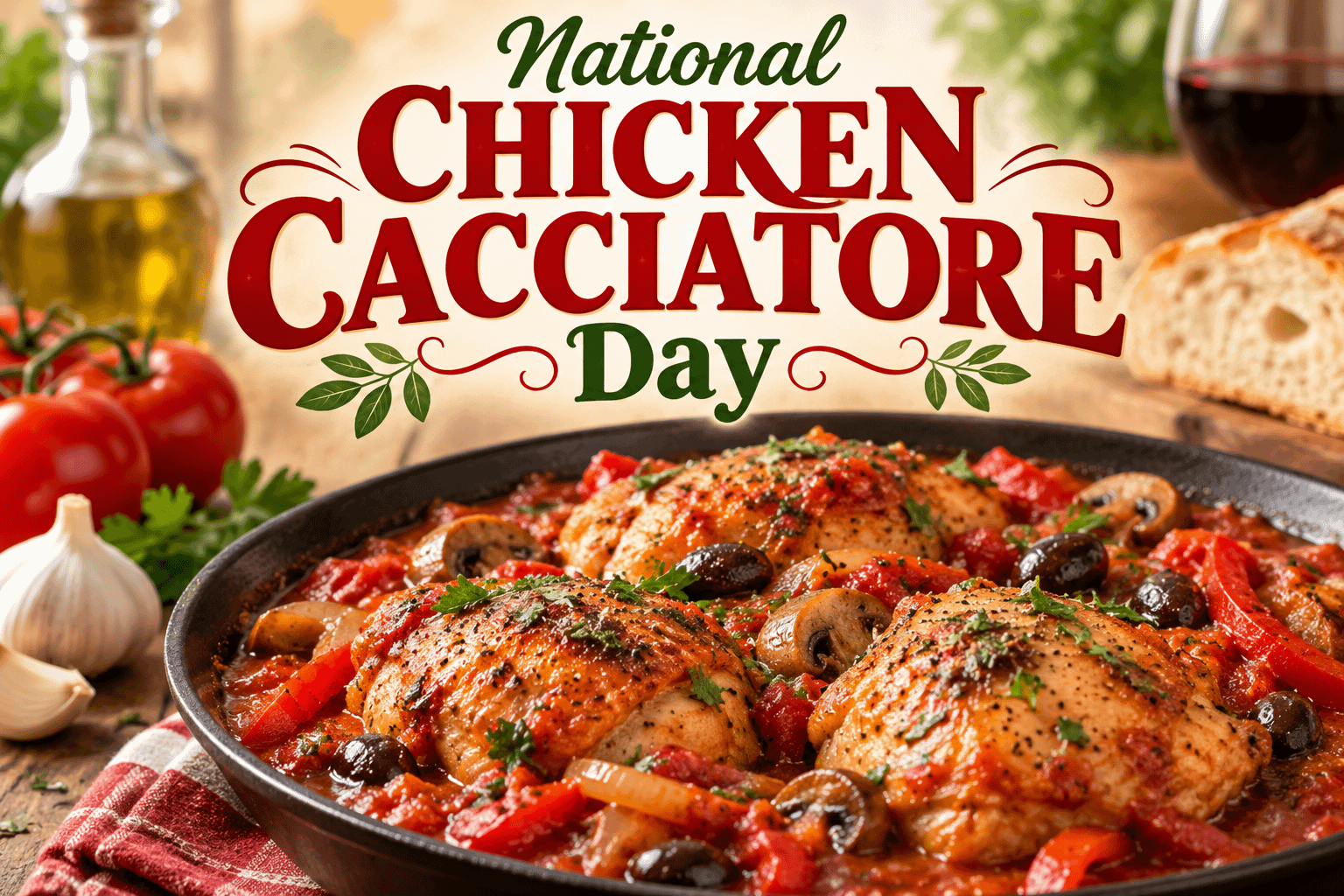
National Chicken Cacciatore Day is an opportunity to celebrate this hearty Italian-inspired dish and the tradition of gathering around the table for a satisfying home-cooked meal.
Chicken cacciatore combines tender chicken with tomatoes, onions, peppers, herbs, garlic, and other simple ingredients to create something much greater than the individual parts. Depending on the recipe and family tradition, you may also find mushrooms, olives, wine, or additional vegetables simmering alongside the chicken.
It isn’t necessarily a fancy meal.
That’s part of its appeal.
Chicken cacciatore represents rustic cooking—the kind of food designed to be filling, flavorful, practical, and shared.
What Is Chicken Cacciatore?
Chicken cacciatore is generally prepared by browning pieces of chicken and then slowly cooking them in a tomato-based sauce with vegetables and herbs.
The word cacciatore means “hunter” in Italian, while alla cacciatora roughly refers to something prepared “hunter-style.”
Like many traditional dishes, there isn’t one universally accepted recipe.
One cook might use chicken thighs and mushrooms. Another might prepare an entire cut-up chicken with onions and peppers. Some recipes include red wine, while others use white wine or no wine at all.
Herbs such as oregano, rosemary, parsley, thyme, or basil can be incorporated depending on the recipe.
That flexibility is part of what has allowed chicken cacciatore to remain such a beloved dish.
You don’t necessarily need expensive ingredients or complicated techniques.
You need good ingredients, patience, and enough time to allow everything to cook together.
A Dish Built Around Simple Ingredients
Some of the best comfort foods begin with ingredients that aren’t particularly exciting by themselves.
Consider a typical chicken cacciatore:
Chicken.
Tomatoes.
Garlic.
Onions.
Bell peppers.
Mushrooms.
Herbs.
Olive oil.
Seasonings.
Put those ingredients on the counter separately and they might not look extraordinary.
Cook them together slowly, however, and something completely different happens.
The chicken releases flavor into the sauce. The vegetables soften. Garlic and herbs provide aroma. Tomatoes create the foundation, while everything gradually becomes part of one rich dish.
That’s one of the great lessons of rustic cooking.
Great food doesn’t always require complicated ingredients.
Sometimes it simply requires giving ordinary ingredients enough time to become extraordinary together.
Why Chicken Cacciatore Is Perfect Comfort Food
Comfort food means something different to everyone.
For some people, it’s macaroni and cheese.
For others, it’s meatloaf, chicken soup, mashed potatoes, chili, lasagna, or a casserole that reminds them of childhood.
Chicken cacciatore belongs comfortably within that tradition.
There is something satisfying about placing a large pot or skillet in the middle of the dinner table and allowing everyone to serve themselves.
It feels like a meal.
Not something grabbed quickly from a drive-through.
Not something eaten while rushing out the door.
A real sit-down dinner.
And sometimes we need those meals.
Life moves quickly. Work, family responsibilities, phones, social media, errands, appointments, and everything else compete for our attention.
Cooking something slowly forces us to do something increasingly uncommon:
Wait.
The sauce needs time.
The chicken needs time.
The vegetables need time.
You can’t always rush good food.
How to Make Classic Chicken Cacciatore
There are countless variations, but this version provides an approachable starting point for celebrating National Chicken Cacciatore Day.
Ingredients
- 6 bone-in chicken thighs
- 2 tablespoons olive oil
- 1 medium onion, sliced
- 1 red bell pepper, sliced
- 1 green or yellow bell pepper, sliced
- 8 ounces mushrooms, sliced
- 3 to 4 cloves garlic, minced
- 1 can (28 ounces) crushed tomatoes
- 1 can (14.5 ounces) diced tomatoes
- 1/2 cup chicken broth
- 1/2 cup dry red wine, optional
- 1 teaspoon dried oregano
- 1 teaspoon dried basil
- 1/2 teaspoon dried thyme
- 1/2 teaspoon red pepper flakes, optional
- Salt and black pepper to taste
- 1 bay leaf
- 1/3 cup sliced black or Kalamata olives, optional
- Fresh parsley or basil for garnish
Directions
Pat the chicken dry and season both sides generously with salt and black pepper.
Heat the olive oil in a large Dutch oven or deep skillet over medium-high heat.
Add the chicken, skin-side down if using skin-on thighs, and brown it for several minutes. Flip and brown the opposite side.
You aren’t trying to completely cook the chicken at this point. Browning develops additional flavor that will eventually become part of the sauce.
Remove the chicken and place it on a plate.
Add the onions and peppers to the same pan. Cook until they begin to soften.
Add the mushrooms and continue cooking for several minutes.
Stir in the garlic and cook briefly until fragrant.
If you’re using wine, add it now and scrape the bottom of the pan with a wooden spoon to loosen the browned bits.
Those browned pieces contain plenty of flavor, so you want them incorporated into your sauce rather than left behind.
Add the crushed tomatoes, diced tomatoes, chicken broth, oregano, basil, thyme, red pepper flakes, and bay leaf.
Stir everything together.
Return the browned chicken to the pan and spoon some of the sauce over the top.
Reduce the heat, cover, and allow the chicken to simmer gently until thoroughly cooked and tender. Chicken should reach a safe internal temperature of 165°F (74°C).
Add olives near the end of cooking if desired.
Taste the sauce and adjust the salt, pepper, and seasonings.
Remove the bay leaf, garnish with fresh parsley or basil, and serve.
What Should You Serve With Chicken Cacciatore?
One of the advantages of chicken cacciatore is how easily it works with different side dishes.
Pasta is an obvious choice.
Place your favorite pasta on the plate and spoon the chicken and tomato sauce over it.
But pasta isn’t your only option.
Chicken cacciatore is also excellent served with creamy polenta, mashed potatoes, roasted potatoes, rice, or crusty Italian bread.
Bread deserves special mention because you probably won’t want that sauce left on the plate.
A warm piece of crusty bread gives you something to soak up every last spoonful.
Add a simple salad or roasted vegetables, and you’ve got a complete dinner.
Make Chicken Cacciatore Your Own
Traditional dishes survive because people adapt them.
Your chicken cacciatore doesn’t have to look exactly like somebody else’s.
Prefer additional mushrooms?
Add them.
Love bell peppers?
Use several colors.
Don’t like olives?
Leave them out.
Want a little heat?
Increase the crushed red pepper.
Prefer boneless chicken?
Use it, but adjust the cooking time accordingly so the chicken doesn’t become dry.
You can even make chicken cacciatore in a slow cooker.
Brown the chicken first for additional flavor, sauté the vegetables if you have time, and then allow everything to slowly cook together.
That’s particularly useful when you want a comforting dinner waiting after a busy day.
Chicken Thighs or Chicken Breasts?
Both can work, although they produce somewhat different results.
Chicken thighs are especially well suited for longer cooking because their higher fat content helps them remain moist and flavorful.
Chicken breasts are leaner and can become dry if overcooked.
If using breasts, pay closer attention to temperature and cooking time.
An entire cut-up chicken is another option and creates a beautiful family-style presentation.
The important thing is ensuring every piece reaches a safe internal temperature without unnecessarily overcooking it.
The Magic of Cooking Something Slowly
There is something almost therapeutic about a meal simmering on the stove.
You don’t have to constantly interfere with it.
You prepare the ingredients.
You build the sauce.
Then you give everything time.
Eventually, the kitchen begins smelling incredible.
Someone walks through the room and asks:
“What are you cooking?”
That’s when you know dinner is heading in the right direction.
Cooking can sometimes feel like another chore on an already long list of responsibilities, but meals like chicken cacciatore remind us that cooking can also be an experience.
It can be creative.
It can be relaxing.
It can bring people together.
And it can create memories.
Food Has a Way of Connecting Generations
Recipes often travel through families in ways we don’t fully appreciate.
Maybe your grandmother made chicken cacciatore.
Maybe your father cooked it.
Maybe you discovered the dish at an Italian restaurant.
Maybe you’ve never eaten it before and National Chicken Cacciatore Day becomes your reason to finally try it.
Every recipe has the possibility of becoming part of someone’s story.
Imagine making chicken cacciatore tonight and discovering your children love it.
You make it again several months later.
Then again.
Eventually, it becomes something your family expects.
Years from now, someone might smell tomatoes, garlic, and herbs simmering and immediately remember dinners around your table.
That’s one of the beautiful things about food.
Memories don’t always arrive through major events.
Sometimes they arrive through smells and flavors.
A certain sauce.
A particular dessert.
Sunday dinner.
A recipe somebody always made when the weather became colder.
Food can transport us back to people, places, and moments we thought we had forgotten.
Turn Dinner Into Family Time
National Chicken Cacciatore Day doesn’t have to be only about the chicken.
Use the occasion to have dinner together.
Put the phones away for a while.
Sit around the table.
Talk.
Laugh.
Ask how everyone’s day went.
Let dinner take longer than usual.
Those ordinary moments can eventually become some of the memories we treasure most.
We sometimes spend so much time waiting for big moments that we overlook the importance of everyday ones.
Family dinners may seem ordinary while they’re happening.
Years later, they might not feel ordinary at all.
Ways to Celebrate National Chicken Cacciatore Day
The obvious celebration is making chicken cacciatore for dinner, but you can make the day a little more interesting.
Try a family recipe if you have one. If someone in your family traditionally made cacciatore, ask them how they prepared it.
Experiment with a new variation by trying different herbs, vegetables, or serving styles.
Invite someone to dinner. Food usually tastes better when shared.
Visit a local Italian restaurant and see whether chicken cacciatore appears on the menu.
Teach someone else how to make it.
Write down your favorite recipe instead of assuming you’ll always remember it.
Recipe cards, notebooks, and family cookbooks can become meaningful keepsakes.
And don’t forget to make enough for leftovers.
Leftovers Might Be Even Better
Some dishes are simply built for the next day.
Chicken cacciatore is one of them.
As the sauce sits overnight in the refrigerator, the flavors continue mingling. Reheated the following day, the dish can taste even richer.
Store leftovers promptly in an airtight container in the refrigerator and reheat them thoroughly before serving.
You can serve the leftovers exactly as you did the first night or change things around.
If you originally served the chicken with pasta, try leftovers over polenta or rice.
Grab some crusty bread and turn it into an easy lunch.
A good meal shouldn’t have to disappear after one dinner.
Celebrate the Food That Brings People Together
National food days can sometimes seem silly.
Do we really need a special day dedicated to chicken cacciatore?
Maybe not.
But perhaps that’s missing the point.
A food celebration gives us an excuse to try something different, learn about a dish, cook at home, invite someone over, or rediscover something we haven’t eaten in years.
National Chicken Cacciatore Day celebrates more than chicken simmered in tomato sauce.
It celebrates rustic cooking.
It celebrates patience.
It celebrates recipes passed between generations.
It celebrates kitchens filled with wonderful smells and tables surrounded by people we care about.
Because some of life’s best moments don’t happen during elaborate celebrations.
Sometimes they’re much simpler.
A large pot is simmering on the stove.
Bread is sitting on the table.
Everyone has finally sat down.
Someone reaches for another helping.
And for a little while, nobody needs to be anywhere else.
That’s a pretty good reason to celebrate.
Have you ever made chicken cacciatore at home, and what ingredient would you add to make the recipe your own?