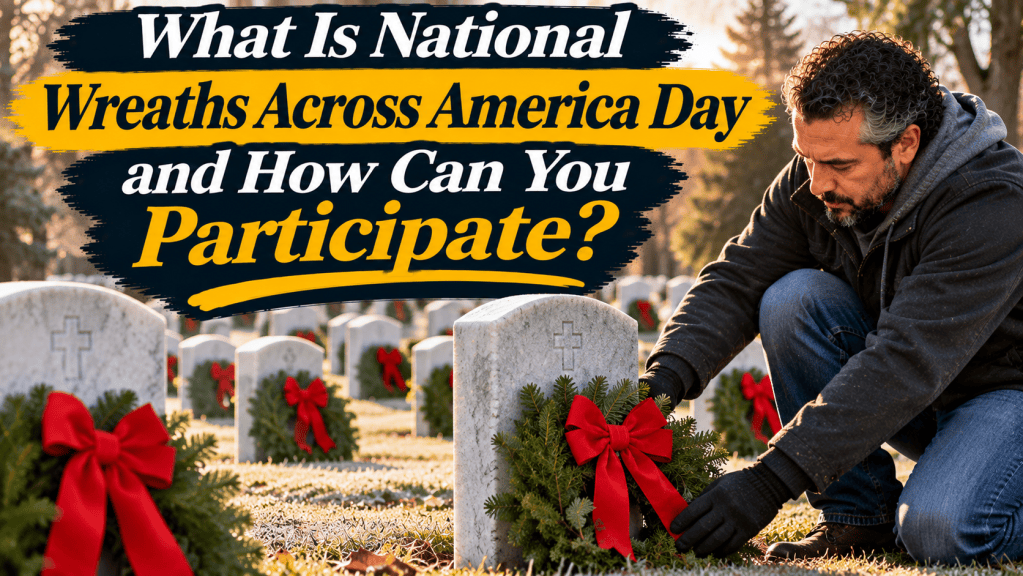
Every December, volunteers gather at veterans’ cemeteries and memorial sites to honor the men and women who served in the United States Armed Forces. They place evergreen wreaths beside grave markers, pause to remember the individuals buried there, and recognize the service of generations of Americans.
National Wreaths Across America Day is an annual remembrance observance organized by the nonprofit Wreaths Across America. Its purpose is to honor deceased veterans, recognize military service, and help younger generations understand the significance of freedom and sacrifice.
You can participate by volunteering at a wreath-laying ceremony, sponsoring a remembrance wreath, helping a local organizing group, or learning and sharing the stories of veterans in your community. You do not need to have served in the military or have a family member buried at a participating cemetery to take part.
When is National Wreaths Across America Day?
In 2026, National Wreaths Across America Day takes place on Saturday, December 19, according to the organizing nonprofit.
The observance occurs on a Saturday in December rather than on a fixed calendar date. Since 2008, Congress has annually proclaimed a Saturday in December for the occasion, according to Wreaths Across America.
The national date provides a common opportunity for remembrance, but individual locations may have different arrival times, ceremony arrangements, and volunteer requirements. Check the details of your chosen location before making travel plans.
How did Wreaths Across America begin?
The tradition began in 1992 when Maine wreath maker Morrill Worcester provided wreaths for placement at Arlington National Cemetery in Virginia. What began as an act of gratitude developed into a recurring tradition.
In 2007, Wreaths Across America was established as a nonprofit organization to continue and broaden that effort.
Over the years, participation expanded beyond Arlington. Communities organized their own ceremonies, and local volunteers developed relationships with cemeteries, businesses, veterans’ organizations, and other supporters.
Today, the observance connects people across the country through a shared act of remembrance. The organization’s official history explains how an individual gesture grew into a national effort that continues throughout the year.
What is the meaning behind the remembrance wreaths?
Evergreen wreaths have long been used in commemorative traditions. Their green branches can symbolize enduring memory, while the circular shape can suggest continuity. The act of placing a wreath provides a visible way of acknowledging an individual whose service deserves recognition.
Many participants find the personal nature of the ceremony particularly meaningful. A grave marker represents a person who had a life beyond the dates and military information engraved upon it. That person may have been a parent, child, sibling, spouse, friend, neighbor, or colleague.
Volunteers are encouraged to speak the veteran’s name while placing a wreath. Saying a name serves as a reminder that remembrance is about individual lives, not simply the number of people who served.
Understanding the purpose of Wreaths Across America
Remembering those who have died
The observance provides an opportunity to recognize deceased veterans, including people whose service occurred many decades ago. Some may have relatives who visit regularly, while others may no longer have family members living nearby.
A wreath cannot tell the complete story of a person’s life, but it can communicate that their service has not been forgotten.
Honoring those who serve
Remembrance also offers an opportunity to acknowledge the commitment of people in uniform, veterans living in our communities, and the families whose lives are affected by military service.
This recognition can extend beyond an annual ceremony. Listening to a veteran’s experiences, assisting a military family through an established community program, or volunteering with an appropriate organization are meaningful ways to demonstrate ongoing appreciation.
Teaching younger generations
Children and young adults may learn about military history through textbooks and classroom discussions. A remembrance ceremony can provide another perspective by connecting historical events with individual lives.
Parents and teachers can use the occasion to discuss public service, citizenship, the consequences of war, and the importance of treating people with dignity. These conversations can be adapted to the age and interests of the children involved.
How can you participate in National Wreaths Across America Day?
1. Find a participating cemetery or memorial
Begin by using the location search on the official Wreaths Across America website. Search by your city, state, or ZIP code to identify participating sites.
Review the individual location’s event information. Some sites have designated parking arrangements, specific entrances, or instructions for people who need accessible transportation.
A nearby cemetery may not participate in the program, so confirm its involvement before arriving with the expectation of volunteering.
2. Register to volunteer
Follow the registration instructions provided by the participating location or its coordinator. Registration can help organizers estimate attendance and prepare enough assignments for volunteers.
You may be asked to assist with distributing wreaths, placing them in designated sections, or supporting other aspects of the ceremony.
Even if you have never participated before, you can learn the placement procedure from experienced volunteers. You do not need specialized knowledge to offer your time.
3. Sponsor a remembrance wreath
People who cannot attend in person may choose to sponsor a wreath through the official organization or an authorized participating group.
Some locations offer options for requesting placement at a particular veteran’s grave, subject to local procedures and availability. Verify the cemetery, the veteran’s information, and any relevant deadlines before submitting a request.
Sponsorship terms and costs may change. Review the current information provided by the organization rather than relying on prices from previous years.
4. Participate with your family or community group
Families, schools, civic organizations, and workplace volunteer groups can participate together when the selected site permits group attendance.
Consider explaining the purpose of the event to younger participants beforehand. Encourage them to approach the ceremony quietly, follow instructions, and recognize that each marker represents a real person’s life.
If someone in your group has limited mobility, contact the organizer about suitable ways to assist or observe the proceedings.
5. Help with wreath removal or other preparations
A successful ceremony involves more than the volunteers who place wreaths. Organizers may need assistance with setup, directions, unloading supplies, and cleanup.
Many locations arrange a later date to remove wreaths after the holiday season. Contact the local coordinator to learn whether additional volunteers are needed for these activities.
Helping before or after the main observance can be an especially useful option if you have another commitment on the national date.
What happens during a wreath-laying ceremony?
The format varies by location. Some ceremonies include remarks from organizers or veterans, a moment of silence, music, or recognition of the different military branches. Others may be smaller gatherings with a brief explanation of the day’s purpose.
Participants should listen to instructions before beginning the placement of wreaths. Organizers may assign specific sections of a cemetery or establish a particular order for distribution.
Take your time when placing a wreath. Read the marker if you are able, acknowledge the person’s name, and handle the wreath and surrounding area carefully.
This is an opportunity for remembrance rather than a competition to place the greatest number of wreaths. Every participant should have the opportunity to contribute respectfully.
How to prepare for a December ceremony
Because the observance takes place during winter, weather conditions may be cold, wet, or unpredictable.
- Check the location’s announcements and weather forecast before leaving.
- Wear appropriate layers and shoes suitable for uneven or slippery ground.
- Allow additional time for parking, walking, and any entry requirements.
- Bring water and necessary personal items.
- Follow cemetery rules and volunteer instructions.
- Ask before photographing other participants or grieving families.
Do not assume that a cemetery permits visitors to add personal decorations or move existing flowers. Follow the local rules, respect graves and religious traditions, and leave the area as directed.
How is Wreaths Across America Day different from Veterans Day and Memorial Day?
Although all three observances recognize military service, they have different purposes and traditions.
Veterans Day, observed on November 11, honors military veterans, with particular emphasis on recognizing living veterans. Memorial Day, observed on the last Monday in May, commemorates members of the U.S. military who died while serving.
National Wreaths Across America Day specifically centers on an organized tradition of laying remembrance wreaths for deceased veterans in December. It is not a federal public holiday.
The observances complement one another by offering different opportunities to learn about military service and acknowledge its personal significance.
Frequently asked questions
Do you have to pay to volunteer?
No. The national organization describes the wreath-laying event as free and open to the public. Sponsoring wreaths is a separate, voluntary way to support the program.
Can children participate?
Yes, children are welcome at many participating locations. Check local rules and supervise them appropriately, particularly around traffic, equipment, and uneven cemetery grounds.
Can I bring my own wreath?
Contact the cemetery and local event coordinator before bringing personal decorations. Cemeteries may have specific requirements concerning the type and placement of wreaths.
Do I need to travel to Arlington National Cemetery?
No. Participating locations exist throughout the United States and beyond. Search for a site near you and check its individual ceremony details.
Can I honor a veteran if I cannot attend the ceremony?
Yes. You can explore wreath sponsorship, preserve a veteran’s story, speak with family members about their memories, or support an appropriate local veterans’ organization.
Keeping the memory of our veterans alive
National Wreaths Across America Day reminds us that military service is part of the story of countless individuals, families, and communities. Each grave marker represents a life with its own experiences, relationships, hopes, and contributions.
Whether you place a wreath, sponsor one, assist with a local ceremony, or share a veteran’s story with a younger generation, your participation can help preserve that person’s memory.
Remembrance does not have to end when the wreaths are removed. It can continue through the respect we show, the stories we preserve, and the gratitude we express throughout the year.
Leave a Reply