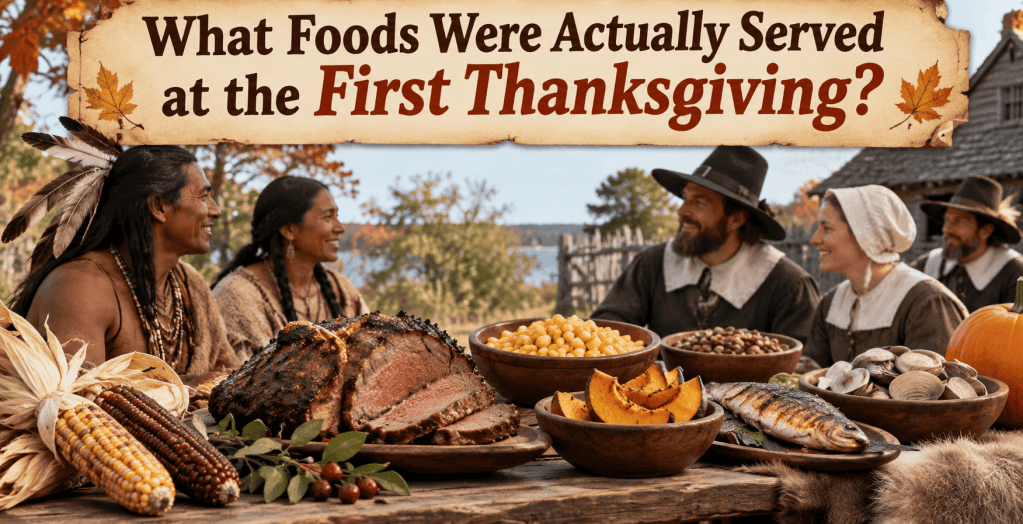
When Americans think about Thanksgiving dinner, they usually picture a golden roasted turkey surrounded by mashed potatoes, stuffing, cranberry sauce, sweet potato casserole, green bean casserole, and pumpkin pie. These dishes have become such an important part of the holiday that it is difficult to imagine Thanksgiving without them.
However, the foods served at the first Thanksgiving in 1621 were very different from what Americans enjoy today.
The original harvest celebration in Plymouth, Massachusetts, brought together English colonists, commonly known as the Pilgrims, and members of the Wampanoag people. Their meal reflected the ingredients available in coastal New England during the early 17th century.
Instead of modern holiday favorites, the celebration likely featured wild game, waterfowl, corn, seafood, vegetables, and other seasonal foods.
So, what foods were actually served at the first Thanksgiving? Which traditional Thanksgiving dishes existed in 1621, and which ones were added centuries later?
Understanding the history of this famous meal reveals how much Thanksgiving food has changed over the past 400 years.
When Was the First Thanksgiving Celebrated?
The event commonly remembered as the first Thanksgiving took place in the fall of 1621 in Plymouth Colony, located in present-day Massachusetts.
After surviving a devastating first winter, the English colonists celebrated a successful harvest.
The gathering lasted approximately three days and included around 50 English colonists and about 90 Wampanoag men, including their leader, Ousamequin, also known as Massasoit.
The Wampanoag had lived in the region for thousands of years before the English arrived. Their agricultural knowledge, fishing practices, and understanding of local resources were essential to the colonists’ survival.
The gathering was not called Thanksgiving in the modern holiday sense. It was primarily a harvest celebration involving food, recreation, and interaction between the two communities.
Importantly, the 1621 event was not the first occasion on which people in North America gave thanks or celebrated a harvest. Indigenous peoples had longstanding traditions of thanksgiving and seasonal celebrations.
Much of what historians know about the Plymouth gathering comes from two early accounts written by English colonists, Edward Winslow and William Bradford.
These records provide clues about the foods available, although they do not include a complete menu.
1. Venison Was Definitely Served at the First Thanksgiving
One of the few foods historians can confidently identify at the 1621 celebration is venison.
Venison is meat from deer, and it was an important food source for the Wampanoag people.
According to Edward Winslow’s account, Wampanoag participants went hunting and brought five deer to the gathering.
The deer were presented to the English colonists and their leaders.
This makes venison one of the best-documented foods served during the celebration.
How Was Venison Prepared?
The exact cooking methods used during the gathering were not recorded.
However, venison could have been prepared using common 17th-century techniques, including:
-
Roasting meat over an open fire.
-
Cooking pieces of meat in a pot.
-
Simmering meat with available vegetables.
-
Smoking or drying meat for preservation.
Venison would have provided a substantial amount of protein for the large gathering.
Unlike modern Thanksgiving dinners, where turkey is usually the centerpiece, deer meat was an important part of the original feast.
2. Wild Birds Were Probably on the Menu
Another food mentioned in historical accounts is wild fowl.
Edward Winslow described English colonists going hunting for birds before the celebration.
However, his account does not identify the exact species they brought back.
Did the First Thanksgiving Include Turkey?
Wild turkeys lived in the Plymouth region during the 1600s.
William Bradford also mentioned wild turkeys when describing food resources available to the colonists during that period.
For this reason, turkey may have been served at the 1621 celebration.
However, there is no surviving record explicitly confirming that turkey was eaten during the gathering itself.
Other birds that may have appeared on the menu include ducks, geese, and other waterfowl.
These birds were common in the region and could be hunted in nearby wetlands and coastal areas.
How Were Wild Birds Cooked?
Wild birds could have been roasted over an open fire or cooked in a pot.
The colonists did not have modern ovens, roasting bags, or temperature-controlled cooking equipment.
Preparing large quantities of meat required open fires, cooking vessels, and considerable time.
The birds would also have tasted different from modern domesticated turkeys because wild birds are generally leaner and have a stronger flavor.
3. Corn Was One of the Most Important Foods
Corn played an essential role in the survival of the Plymouth colonists.
The Wampanoag had cultivated corn long before the English arrived, and their knowledge of local agriculture helped the newcomers establish crops.
By the fall of 1621, the colonists had harvested their first successful corn crop.
However, the corn eaten during the first Thanksgiving was not necessarily the sweet yellow corn commonly served today.
Much of the corn grown in the region was flint corn, which could be dried, stored, and ground into meal.
How Was Corn Prepared?
Corn could have been used in several ways:
-
Ground into cornmeal.
-
Boiled into a thick porridge.
-
Cooked with water to make a simple dish.
-
Added to soups and stews.
-
Dried and stored for winter.
One possible dish was a cornmeal porridge similar to what later became known in New England as samp.
Although historians cannot confirm exactly how corn was served during the gathering, it was an important food source for both communities.
Modern Thanksgiving cornbread and corn casseroles developed from culinary traditions that evolved over time.
4. Seafood May Have Been Part of the Celebration
Plymouth Colony was located near the Atlantic Ocean, where fish and shellfish were abundant.
The Wampanoag had extensive experience fishing and harvesting seafood from coastal waters.
The English colonists also relied on local marine resources.
Possible seafood dishes at the 1621 celebration included fish, clams, mussels, and other shellfish.
What Types of Fish Were Available?
The waters around Plymouth contained several fish species, including cod, bass, and other coastal fish.
These could have been prepared by roasting, boiling, or drying.
Shellfish were another accessible food source.
Clams and mussels could be collected along the shoreline and cooked over a fire.
However, no surviving account specifically confirms that seafood was served during the three-day celebration.
Its presence is historically plausible because of the location and available food resources, but it should not be treated as a documented menu item.
5. Pumpkins and Squash Were Available
Pumpkins and other squash varieties were familiar foods in northeastern North America long before European settlement.
Indigenous communities cultivated different varieties of squash as part of their agricultural traditions.
Squash could be stored for extended periods, making it especially valuable during the colder months.
How Did People Cook Squash in 1621?
Squash could have been prepared by:
-
Roasting pieces near hot coals.
-
Boiling squash in water.
-
Cooking it in soups or stews.
-
Drying pieces for later use.
Pumpkins and squash may have been eaten at the harvest celebration because they were available in the region.
However, their presence on the specific 1621 menu is not confirmed.
One thing historians can say with much greater confidence is that the gathering did not feature pumpkin pie as Americans know it today.
Modern pumpkin pie depends on ingredients and preparation methods that were not readily available to the Plymouth colonists.
6. Beans and Other Vegetables May Have Been Served
Beans were another important crop cultivated by Indigenous communities in northeastern North America.
Corn, beans, and squash are often associated with the agricultural system known as the Three Sisters.
These crops could complement one another when grown together.
Corn provided support for climbing beans, beans contributed nitrogen to the soil through their relationship with soil bacteria, and squash leaves helped cover the ground.
The Wampanoag possessed extensive agricultural knowledge, although specific cultivation practices varied across communities and locations.
What Vegetables Were Available?
Depending on the season and local harvest, available foods could have included:
-
Beans.
-
Squash.
-
Onions and other alliums.
-
Leafy greens.
-
Edible roots.
-
Native herbs.
Some of these foods may have been included in soups, stews, or other dishes.
However, historians cannot confirm a specific vegetable menu for the 1621 gathering.
The important distinction is between foods known to have existed in the region and foods documented as part of the celebration.
7. Fruits and Nuts Were Available in New England
Wild fruits and nuts were valuable seasonal foods for Indigenous communities and European settlers.
The forests and coastal areas of New England provided a variety of edible plants.
Possible foods included grapes, plums, berries, walnuts, chestnuts, and other locally available nuts.
These foods could be eaten fresh, dried, or incorporated into other dishes.
Were Cranberries Served at the First Thanksgiving?
Cranberries grew naturally in the region and were familiar to the Wampanoag.
However, there is no direct historical evidence that cranberry sauce was served at the 1621 celebration.
The sweet cranberry sauce associated with modern Thanksgiving would have required a substantial amount of sugar.
Sugar was expensive and not readily available to the Plymouth colonists.
Although cranberries themselves could have been eaten, the familiar sweetened holiday sauce developed later.
8. There Were Probably No Modern Thanksgiving Desserts
One of the biggest differences between the original harvest celebration and modern Thanksgiving is the dessert table.
Today, Thanksgiving desserts often include pumpkin pie, pecan pie, apple pie, sweet potato pie, and various cakes.
These desserts were not part of the documented 1621 menu.
The colonists had limited access to refined sugar, butter, wheat flour, and other ingredients needed for familiar baked desserts.
They also lacked the kinds of baking equipment commonly used in modern kitchens.
This does not mean the participants had no naturally sweet foods available.
Fruits and other seasonal ingredients could provide sweetness without refined sugar.
However, there is no surviving evidence describing a special dessert course during the gathering.
What Foods Were Not Served at the First Thanksgiving?
Many foods Americans associate with Thanksgiving were either unavailable in Plymouth in 1621 or had not yet developed into their modern forms.
Here is how several familiar Thanksgiving dishes compare with the historical evidence.
| Modern Thanksgiving food | First Thanksgiving in 1621 |
|---|---|
| Roast turkey | Possible, but not confirmed |
| Venison | Confirmed |
| Mashed potatoes | Not served in the familiar modern form |
| Sweet potato casserole | Not part of the historical menu |
| Bread stuffing | No direct evidence |
| Cranberry sauce | No direct evidence of sweetened sauce |
| Pumpkin pie | Not part of the documented feast |
| Green bean casserole | Modern invention |
| Cornbread | Corn was available, but modern cornbread is unconfirmed |
| Macaroni and cheese | Not part of the feast |
| Pecan pie | Not part of the feast |
| Seafood | Possible, but not confirmed |
Why Weren’t Mashed Potatoes Served?
Potatoes originated in South America and had reached Europe by the late 1500s.
However, they were not an established crop in Plymouth Colony at the time of the 1621 celebration.
The creamy mashed potatoes Americans enjoy today became part of later culinary traditions.
Why Wasn’t Sweet Potato Casserole Served?
Sweet potatoes originated in the Americas, but they were not a typical crop in early colonial New England.
The sweet potato casseroles topped with marshmallows or brown sugar are much later American creations.
Why Wasn’t Green Bean Casserole Served?
Green bean casserole was created in 1955 by Dorcas Reilly while working for the Campbell Soup Company.
It became a popular Thanksgiving side dish during the 20th century.
It has no connection to the actual menu of the 1621 gathering.
What Did the First Thanksgiving Meal Probably Look Like?
Although the complete menu is unknown, historians can reconstruct a reasonable picture of the gathering based on contemporary accounts and regional food traditions.
The meal likely looked very different from a modern Thanksgiving dinner.
Rather than a carefully arranged table featuring individual place settings and numerous side dishes, food would have been prepared using the cooking equipment and methods available at the time.
Large quantities of meat may have been roasted or cooked in pots.
Corn and other plant foods could have been prepared as porridges, stews, or simple cooked dishes.
The gathering lasted three days, so food may have been prepared and eaten throughout the celebration rather than served as one formal dinner.
The participants also came from two distinct cultures with different food traditions.
The Wampanoag brought knowledge of local agriculture, hunting, fishing, and food preparation, while the English colonists brought their own cooking practices.
The resulting meals may have reflected a combination of these traditions.
However, historians should avoid presenting a reconstructed menu as a confirmed historical fact.
Did the Pilgrims and Wampanoag Eat Together?
Historical records indicate that English colonists and Wampanoag participants were present at the 1621 gathering and shared in the celebration.
However, the familiar image of everyone seated around one long table is largely a later artistic interpretation.
The event involved approximately 140 people over three days.
There is no detailed surviving description of seating arrangements or exactly how food was distributed.
The gathering also occurred within a complicated historical relationship.
The Wampanoag were not simply guests at an English celebration. They were members of an established Indigenous society with their own leadership, territory, food systems, and political interests.
The alliance between Ousamequin and the Plymouth colonists reflected circumstances affecting both communities.
Later colonial expansion brought dispossession, violence, and profound suffering to Indigenous peoples.
Understanding this broader history provides a more accurate perspective than the simplified Thanksgiving story often taught to children.
How Did the Traditional Thanksgiving Menu Develop?
The foods associated with Thanksgiving changed gradually over several centuries.
The modern holiday menu did not emerge directly from the 1621 celebration.
Instead, it developed through regional cooking traditions, agricultural changes, immigration, and the growing popularity of Thanksgiving as an American holiday.
Thanksgiving in the 1700s
By the 18th century, Thanksgiving celebrations were common in parts of New England.
Roasted poultry, pies, seasonal vegetables, and other harvest foods appeared in regional holiday meals.
Different communities developed their own traditions.
Thanksgiving in the 1800s
During the 19th century, Thanksgiving became increasingly associated with family gatherings and elaborate meals.
Sarah Josepha Hale, a writer and editor, played an important role in promoting Thanksgiving as a national holiday.
Her descriptions of holiday dinners helped popularize foods such as roasted turkey, stuffing, and pumpkin pie.
In 1863, President Abraham Lincoln proclaimed a national day of Thanksgiving during the Civil War.
The holiday continued to develop into a major American family tradition.
Thanksgiving in the 1900s
During the 20th century, convenience foods and changing cooking habits introduced additional Thanksgiving favorites.
Green bean casserole, marshmallow-topped sweet potatoes, packaged stuffing, and canned cranberry sauce became familiar additions to holiday tables.
These dishes helped create the Thanksgiving menu many Americans recognize today.
Why Did Turkey Become the Main Thanksgiving Dish?
Turkey became the centerpiece of Thanksgiving for several reasons.
Wild turkeys were native to North America, and domesticated turkeys eventually became widely available.
A large turkey could feed an entire family, making it practical for holiday gatherings.
Turkey also became strongly associated with Thanksgiving through 19th-century literature, recipes, and popular traditions.
As the holiday became more standardized, roasted turkey emerged as its most recognizable main dish.
The bird’s connection to early American history helped reinforce its symbolic importance.
However, the popularity of turkey today should not be mistaken for proof that it was the main dish in 1621.
Venison is much more clearly documented at the original gathering.
Can You Recreate an Authentic First Thanksgiving Meal Today?
It is possible to prepare a historically inspired meal using ingredients available in 17th-century New England.
However, no one can reproduce the exact 1621 menu because a complete record does not exist.
A historically inspired Thanksgiving dinner might include roasted venison, wild turkey or duck, cornmeal porridge, roasted squash, cooked beans, fish, and seasonal nuts or fruit.
Cooking methods could include roasting over a fire, simmering food in pots, and using simple seasonings.
For greater historical accuracy, modern dishes such as marshmallow sweet potatoes, creamy mashed potatoes, canned cranberry sauce, and pumpkin pie would be omitted.
Even then, the result would be an interpretation rather than a confirmed recreation.
Frequently Asked Questions About the First Thanksgiving Food
What Was the Main Meat Served at the First Thanksgiving?
Venison is one of the only meats specifically confirmed by a firsthand account of the 1621 celebration. Wampanoag participants brought five deer. Wild birds were also obtained, although their exact species were not recorded.
Did the Pilgrims Eat Turkey at the First Thanksgiving?
Possibly. Wild turkeys lived in the Plymouth area, and William Bradford mentioned their availability. However, no surviving account specifically confirms that turkey was eaten at the 1621 gathering.
Did the First Thanksgiving Have Mashed Potatoes?
There is no evidence that mashed potatoes were served. Potatoes were not an established crop in Plymouth Colony in 1621, and modern mashed potatoes developed through later culinary traditions.
Did They Eat Pumpkin Pie at the First Thanksgiving?
No historical record identifies pumpkin pie as part of the feast. Pumpkins and squash were available in the region, but the colonists lacked ready access to several ingredients used in modern pumpkin pie.
Was Cranberry Sauce Served at the First Thanksgiving?
There is no direct evidence that cranberry sauce was served. Cranberries grew in New England, but the sweetened sauce familiar today was not a documented part of the 1621 celebration.
What Did the Wampanoag Bring to the First Thanksgiving?
According to Edward Winslow’s account, Wampanoag participants hunted and brought five deer. Their broader knowledge of local food resources and agriculture also played an important role in the colonists’ survival.
How Long Did the First Thanksgiving Feast Last?
The 1621 harvest celebration lasted approximately three days. It included food and recreation rather than a single formal dinner resembling modern Thanksgiving.
What Is the Biggest Difference Between the First Thanksgiving and Thanksgiving Today?
The biggest culinary difference is the menu itself. The 1621 gathering relied on locally available foods such as venison, wild birds, and corn, while modern Thanksgiving includes many dishes that became popular centuries later.
Final Thoughts: The First Thanksgiving Was Very Different From Today’s Holiday
The first Thanksgiving was not the elaborate turkey dinner Americans recognize today.
The 1621 gathering in Plymouth was a harvest celebration involving English colonists and Wampanoag people who lived in the region long before European settlement.
Historical accounts confirm that venison was provided and wild birds were hunted. Corn was an important local crop, while seafood, squash, beans, fruits, and nuts were among the foods available in the region.
However, the complete menu remains unknown.
Modern favorites such as mashed potatoes, sweet potato casserole, cranberry sauce, pumpkin pie, and green bean casserole became associated with Thanksgiving through centuries of changing American food traditions.
Learning what people actually ate in 1621 helps separate historical evidence from popular mythology.
It also provides an opportunity to recognize the Wampanoag people’s agricultural knowledge, cultural traditions, and central place in the history of Plymouth.
Ultimately, the history of the first Thanksgiving is about more than what was served on the table. It is also about the people, cultures, and circumstances that shaped one of America’s most recognizable holiday traditions.
Leave a Reply