Life does not always give us a warning.
Sometimes everything seems normal one moment, and the next moment, your entire world has changed.
A phone call comes.
A relationship ends.
You lose someone you love.
You lose your job.
A financial crisis hits.
Your home is damaged.
Your health changes.
Someone you trusted betrays you.
A dream you spent years building suddenly falls apart.
Whatever form disaster takes, there are moments in life when you are left standing in the middle of something you never expected, wondering how you are supposed to keep going.
Those are the moments when strength matters most.
Not the strength that pretends everything is okay.
Not the strength that hides every emotion.
Not the strength that refuses to ask for help.
Real strength is looking at the disaster in front of you and saying:
“I don’t know how I am going to get through this, but I am going to keep going.”
Strength Does Not Mean You Don’t Hurt
One of the biggest misunderstandings about being strong is believing that strong people do not break down.
They do.
Strong people cry.
Strong people become exhausted.
Strong people get scared.
Strong people have moments when they wonder how much more they can handle.
Strength is not the absence of pain.
Strength is continuing despite the pain.
You can be devastated and still be strong.
You can be grieving and still be strong.
You can be afraid and still be strong.
You can admit that you don’t have all the answers and still be strong.
Sometimes the strongest thing you can say is:
“This hurts.”
Because once you acknowledge what you are going through, you can begin figuring out what comes next.
Disaster Can Change Everything
Some events divide your life into two parts:
Before it happened.
And:
After it happened.
You remember what life was like before everything changed.
You remember the plans you had.
You remember the person you used to be.
Then disaster came along and changed the direction of your life.
It can be incredibly difficult to accept.
You may spend days, months, or even years wishing you could return to the life you had before.
But sometimes there is no going backward.
There is only forward.
And moving forward does not mean forgetting what happened.
It means learning how to carry it.
You Don’t Have to Solve Everything Today
When disaster strikes, your mind may immediately start racing.
What am I going to do?
How will I fix this?
How will I survive this?
What happens tomorrow?
What happens next month?
What happens next year?
Those questions can become overwhelming very quickly.
Instead of trying to solve your entire future at once, concentrate on what is directly in front of you.
Sometimes your goal isn’t rebuilding your entire life.
Sometimes your goal is simply getting through today.
Get out of bed.
Take care of what absolutely needs to be done.
Eat something.
Drink some water.
Make the phone call.
Ask someone for help.
Take the next necessary step.
Then take another.
Small steps still move you forward.
Focus on What You Can Control
Disasters remind us how much of life is outside our control.
You cannot control every accident.
You cannot control every person’s actions.
You cannot control everything that happens to the people you love.
You cannot control the past.
But even when much of your situation is beyond your control, there are usually still things that belong to you.
Your response.
Your decisions.
Your effort.
Your attitude.
Your willingness to ask for help.
Your willingness to get back up.
Your decision to keep going.
Don’t waste all of your energy fighting things you cannot change.
Put that energy into the things you still can.
Surviving Is Sometimes the Victory
We celebrate accomplishments.
Promotions.
Graduations.
New businesses.
Weight-loss milestones.
Financial achievements.
Relationships.
Homes.
Awards.
But there are victories that nobody else sees.
Getting through a terrible night is a victory.
Getting out of bed when you wanted to hide from the world is a victory.
Going to work while carrying tremendous pain is a victory.
Laughing again after believing you never would is a victory.
Trying again after failure is a victory.
Allowing yourself to hope again is a victory.
There are seasons of life when simply refusing to give up is an incredible accomplishment.
Never underestimate the strength required to survive something that changed you.
You May Not Be the Same Person Afterward
People often talk about “getting back to normal” after tragedy or disaster.
But sometimes normal doesn’t exist anymore.
Something significant happened.
It affected you.
It changed the way you see life.
Instead of trying desperately to become exactly who you were before, you may have to discover who you are becoming now.
You might become more compassionate.
More patient.
More appreciative.
More protective of your time.
More aware of what truly matters.
You might stop worrying about things that once seemed important.
You might value relationships differently.
You might discover strength inside yourself that you never knew existed.
You didn’t ask for the disaster.
You didn’t choose the pain.
But you can choose what you do with the life that remains in front of you.
Let People Help You
Strength does not require doing everything alone.
Sometimes we convince ourselves that asking for help means we are weak.
It doesn’t.
When disaster hits, allow good people to stand beside you.
Let someone bring you dinner.
Let someone listen.
Let someone make a phone call.
Let someone sit quietly beside you.
Let someone help you figure out the next step.
There are burdens in life that become a little easier to carry when someone else grabs the other side.
You can be strong and still need people.
Both things can be true.
Your Worst Day Doesn’t Have to Be Your Last Chapter
When you’re standing in the middle of disaster, it can feel like the pain will last forever.
Your mind looks at the destruction around you and struggles to imagine anything different.
But life can change again.
There can be good days after terrible ones.
There can be laughter after tears.
There can be opportunities after failures.
There can be love after heartbreak.
There can be purpose after loss.
There can be rebuilding after destruction.
The fact that you cannot see the road ahead does not mean there isn’t one.
Sometimes you only see the next few feet.
Walk those few feet.
Then keep going.
Give Yourself Permission to Have Bad Days
Being strong doesn’t mean waking up every morning ready to conquer the world.
Some days you will feel motivated.
Other days you won’t.
Some days you may feel like you’re making progress.
Other days something will remind you of what happened, and suddenly it feels like you’re back at the beginning.
That does not erase your progress.
Healing and rebuilding are rarely straight lines.
Give yourself permission to struggle without convincing yourself that struggling means you’ve failed.
Rest when you need to.
Cry when you need to.
Talk when you need to.
Then, when you’re ready, stand back up.
Remember What You Have Already Survived
When you start believing you aren’t strong enough for what you’re facing, look backward for a moment.
Think about everything you’ve already survived.
Think about the days you once thought you would never get through.
You got through them.
Maybe not perfectly.
Maybe you still carry scars from them.
But you’re here.
That matters.
Your scars aren’t evidence that life defeated you.
They are evidence that something hurt you deeply and you continued living.
Rebuild One Piece at a Time
After disaster, you may look at everything that has been damaged and wonder where to begin.
Start somewhere.
Anywhere.
You don’t have to rebuild everything today.
Put one piece back together.
Then another.
Then another.
Eventually, those small pieces become something bigger.
Maybe your new life won’t look exactly like the one you imagined.
That doesn’t mean it cannot still contain meaning, purpose, love, happiness, and beautiful moments.
Sometimes rebuilding creates something different.
Different doesn’t automatically mean worse.
It simply means life has changed.
Keep Your Faith When You Don’t Understand
For those who believe in God, disaster can challenge faith in ways that ordinary days never do.
You may ask:
Why did this happen?
Why was this allowed?
Why didn’t God stop it?
Why do I have to carry this?
There may not be an answer that makes the pain disappear.
Faith does not always mean understanding why something happened.
Sometimes faith means continuing to believe even when you don’t understand.
Sometimes the prayer isn’t complicated.
“God, I don’t know how to do this. Please help me through today.”
That can be enough.
Tomorrow you can pray again.
Being Strong Means Choosing Tomorrow
There may come a moment when you have absolutely no idea what tomorrow will look like.
Choose it anyway.
Choose another sunrise.
Choose another opportunity.
Choose another conversation.
Choose another attempt.
Choose another chance to rebuild.
You don’t need to know exactly where your life is going.
You just need enough courage to take the next step.
And sometimes courage doesn’t roar.
Sometimes courage whispers:
“I’ll try again tomorrow.”
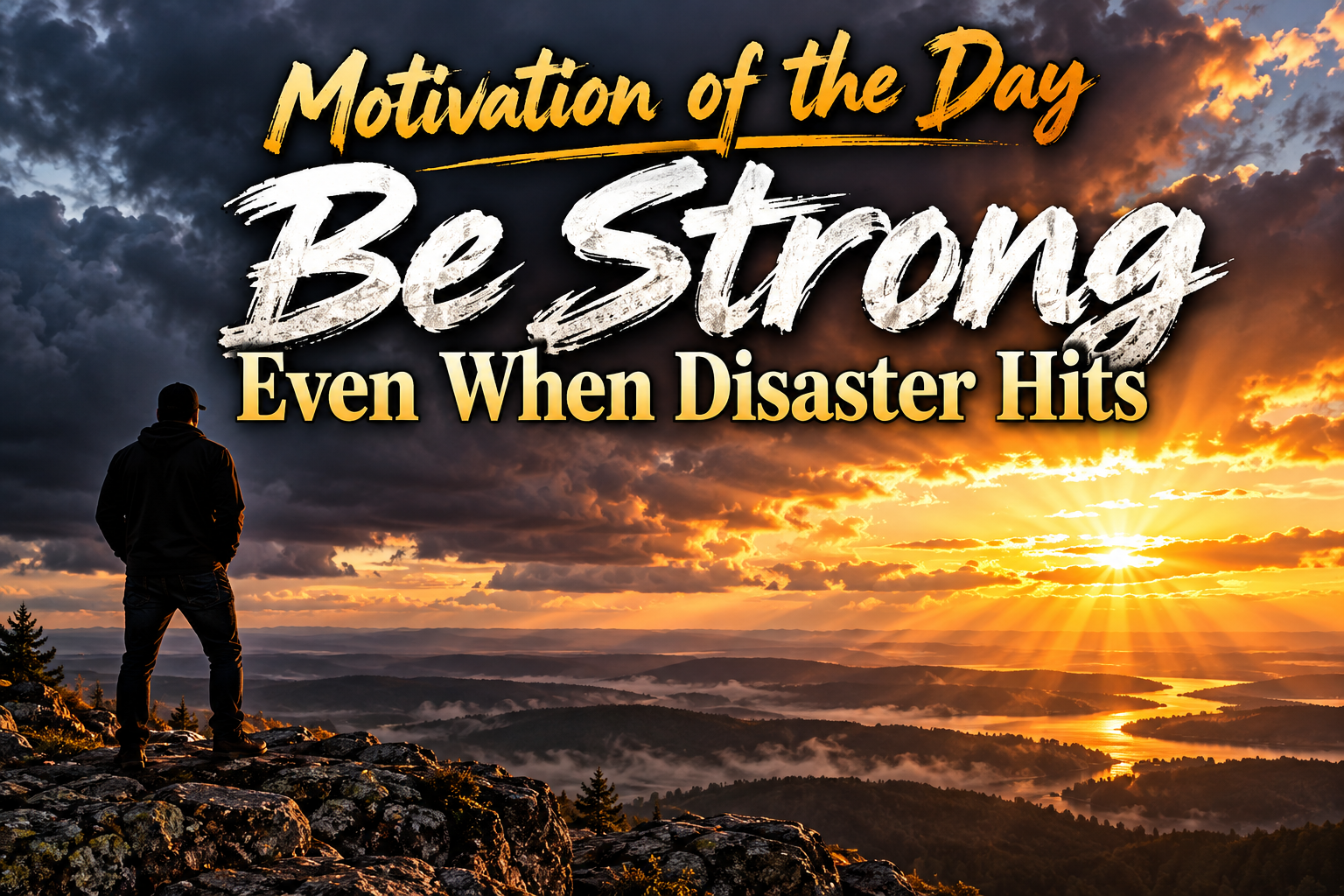
Motivation of the Day
When disaster hits, you don’t have to pretend it didn’t hurt.
You don’t have to hide your tears.
You don’t have to have every answer.
You don’t have to rebuild your entire life overnight.
You simply have to keep going.
Be strong when everything feels uncertain.
Be strong when you’re scared.
Be strong when plans fall apart.
Be strong when you’re exhausted.
Be strong enough to ask for help.
Be strong enough to rest.
Be strong enough to cry.
Be strong enough to stand back up.
The disaster may become part of your story.
But it does not have to become the end of your story.
There are still pages ahead of you.
There are still people to love.
There are still experiences waiting for you.
There are still opportunities you cannot see yet.
There are still reasons to wake up tomorrow.
You may have been knocked down by something you never saw coming.
But you’re still here.
And as long as you’re still here, there is still another step you can take.
When disaster hits, don’t measure your strength by whether you fell. Measure it by your willingness to rise again.
What is one difficult situation you survived that showed you just how strong you really are?



Leave a Reply