Blog

  • The Quiet Damage of False Hope

    The Quiet Damage of False Hope

    Advertisements

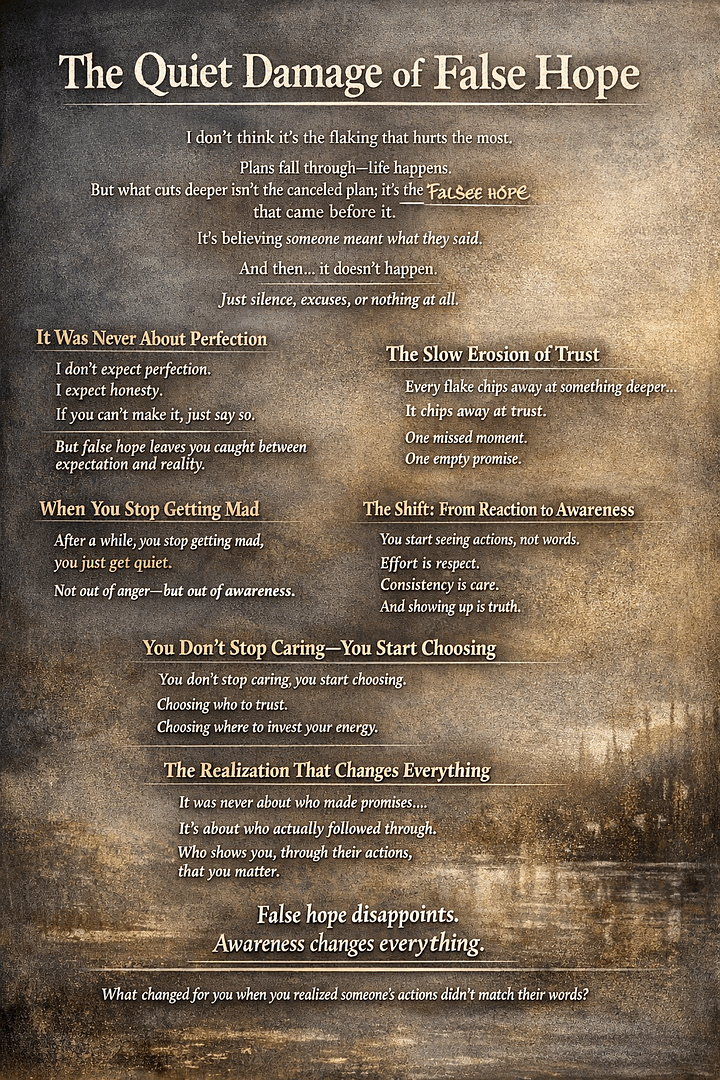
    I don’t think it’s the flaking that hurts the most.

    Plans fall through—life happens, people get overwhelmed, things don’t always go the way we expect. That’s part of life, and most of us understand that. We make room for it. We give grace. We try to be patient.

    But what cuts deeper isn’t the canceled plan or the missed moment.

    It’s the false hope that came before it.

    It’s believing someone meant what they said.

    It’s that moment when they look you in the eye—or send that message—and say, “Yeah, I’ll be there,” or “Let’s do this.” And you take them at their word. Not because you’re naïve, but because you choose to believe in people. You choose to trust.

    So you start to look forward to it.

    You rearrange your schedule. You turn down other plans. You mentally prepare. Maybe you even feel a little excitement building—because connection matters to you. Showing up matters to you.

    And then… it doesn’t happen.

    No real explanation.
    No accountability.
    No honesty.

    Just silence, last-minute excuses, or worse—nothing at all.

    That’s the part that lingers.

    Because it’s not just about the plan that fell through. It’s about the emotional investment that came with it. It’s about realizing that while you were being intentional, someone else was being careless.

    And that realization doesn’t just sting—it settles.

    It Was Never About Perfection

    Most people aren’t expecting perfection.

    We don’t expect people to always get it right. We don’t expect life to run on schedule or everything to go smoothly. What we do expect—what we need in order to feel respected—is honesty.

    Simple, direct honesty.

    If you can’t make it, say that.
    If you’re not sure, say that.
    If you don’t want to show up, just be real about it.

    Because there’s something grounding about truth—even when it disappoints you. Truth gives you clarity. It allows you to adjust, to move forward without confusion.

    But false hope?

    That leaves you hanging in a space between expectation and reality. And that space is where doubt begins to grow.

    The Slow Erosion of Trust

    Every time someone flakes, it might seem small on the surface.

    “It’s just one time.”
    “It’s not a big deal.”
    “They probably didn’t mean anything by it.”

    But over time, those moments add up.

    And what they begin to chip away at isn’t your schedule—it’s your trust.

    Trust doesn’t break loudly most of the time. It doesn’t always come with a confrontation or a clear ending. More often, it fades quietly.

    One missed moment.
    One empty promise.
    One unanswered message.

    Until eventually, something inside you shifts.

    You stop expecting consistency from certain people.
    You stop believing their words carry weight.
    You stop giving them the same access to your time and energy.

    Not out of anger—but out of awareness.

    When You Stop Getting Mad

    At first, it frustrates you.

    You question it. You replay conversations. You try to understand why someone would say something they didn’t intend to follow through on. You might even blame yourself—wondering if you expected too much.

    But then something changes.

    You stop reacting the way you used to.

    You don’t argue.
    You don’t chase explanations.
    You don’t keep asking, “Are you still coming?”

    Instead…

    you get quiet.

    And that silence isn’t weakness.

    It’s recognition.

    It’s the moment you begin to understand that not everyone values your time the way you do. Not everyone communicates with the same level of intention. Not everyone shows up—not just physically, but emotionally.

    And once you see that clearly, it becomes harder to ignore.

    The Shift: From Reaction to Awareness

    That quiet phase is where growth happens.

    Because instead of reacting emotionally, you start observing patterns. You begin to separate words from actions. You stop holding onto potential and start paying attention to consistency.

    You learn that:

    Effort is a form of respect
    Consistency is a form of care
    Showing up is a form of truth

    And when those things are missing, no amount of excuses can replace them.

    So you adjust.

    You don’t give the same energy to everyone.
    You don’t overextend yourself for people who underdeliver.
    You don’t build expectations on words alone anymore.

    You start protecting your time like it matters—because it does.

    You start protecting your peace like it matters—because it does.

    You Don’t Stop Caring—You Start Choosing

    One of the biggest misconceptions is that when someone gets quiet, it means they’ve stopped caring.

    But that’s not always true.

    Sometimes, it means they’ve started choosing.

    Choosing where to invest their energy.
    Choosing who to trust.
    Choosing what they allow into their space.

    You don’t stop valuing connection—you just become more intentional about it.

    You don’t shut people out—you just stop chasing people who aren’t meeting you halfway.

    Because you’ve learned something important:

    Not everyone who says they’ll be there actually will be.
    But the ones who truly care? They won’t have to convince you.

    The Realization That Changes Everything

    At some point, it clicks.

    You realize it was never about how many people made promises.

    It was about who actually followed through.

    Who checked in.
    Who showed up.
    Who made the effort without needing reminders or pressure.

    And once you see that clearly, everything shifts.

    You stop holding onto false hope.
    You stop waiting on people who don’t value your time.
    You stop confusing words with commitment.

    And instead…

    you start building your life around the people who show you—consistently—that you matter.

    Final Thought

    False hope doesn’t just disappoint—it reshapes how you trust.

    But awareness?

    That reshapes how you choose.

    And in the end, that quiet understanding—the one that comes after all the frustration fades—is what protects your heart moving forward.

    Because now you know:

    It’s not about who says they care.

    It’s about who proves it—without you having to question it.
    Read More Health & Wellness

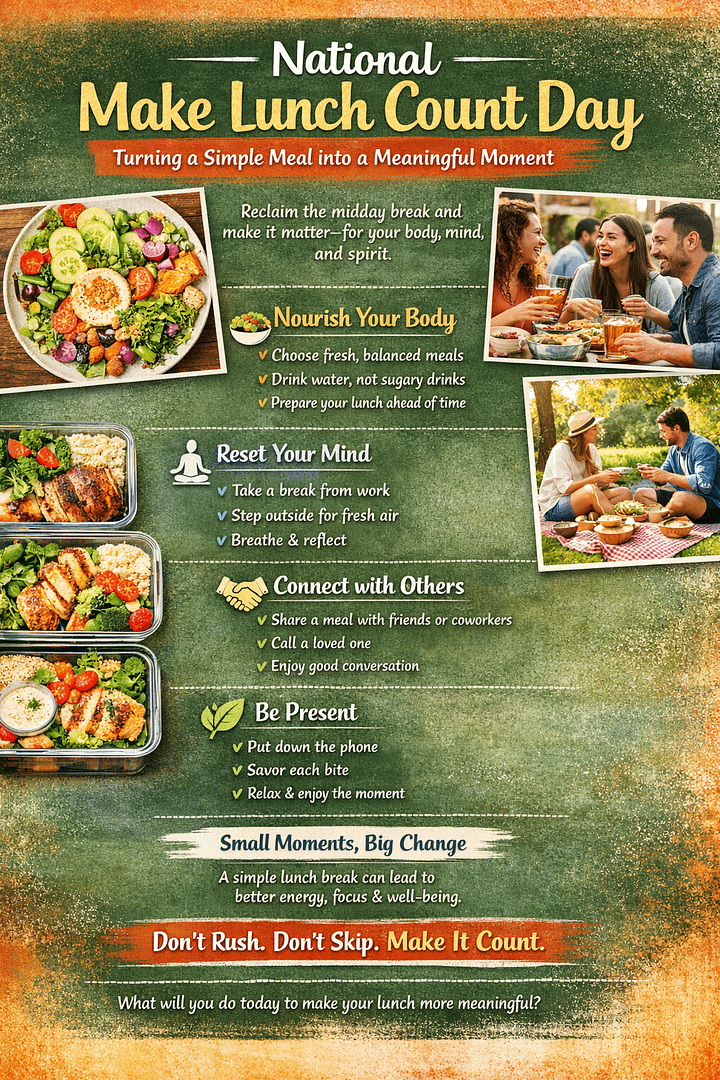
  • 🥪 National Make Lunch Count Day: Turning a Simple Meal into a Meaningful Moment

    Advertisements

    In a world that constantly demands more of our time, energy, and attention, lunch often becomes one of the first things we sacrifice. We eat quickly, eat poorly, or sometimes don’t eat at all. But National Make Lunch Count Day challenges that habit. It calls us to pause, to be intentional, and to recognize that even something as simple as lunch can shape the entire course of our day—and our well-being.

    This isn’t just about food.
    It’s about how you treat yourself in the middle of life’s demands.

    🍽️ The Forgotten Break in a Busy World

    Think about your typical day. Mornings are rushed. Evenings are full. And right in the middle sits lunch—a moment that could restore you, yet is often ignored.

    Too many people:

    Eat at their desk without looking up
    Grab fast food out of convenience, not nourishment
    Skip meals entirely due to stress or workload

    Over time, these habits take a toll—not just physically, but emotionally and mentally. When you neglect your midday break, you’re telling yourself that everything else matters more than your own care.

    National Make Lunch Count Day is about changing that mindset.
    It’s about reclaiming that moment and using it with purpose.

    🥗 Nourish Your Body with Intention

    Food is fuel—but it’s also medicine. The choices you make at lunch can either carry you through the rest of the day with steady energy or leave you feeling sluggish and drained.

    Making lunch count doesn’t mean perfection. It means awareness.

    Consider:

    Choosing whole, fresh ingredients over processed options
    Including a balance of protein, healthy fats, and fiber
    Avoiding heavy, sugar-loaded meals that lead to crashes

    Even small changes matter:

    Adding a handful of greens
    Swapping soda for water
    Preparing your lunch ahead of time instead of relying on convenience

    These simple decisions add up. Over time, they become habits—and those habits become a healthier, stronger version of you.

    🧠 A Reset for Your Mind and Spirit

    Your mind needs rest just as much as your body needs food.

    Lunch is more than a physical break—it’s a mental reset. Stepping away, even for 20–30 minutes, can improve your focus, reduce stress, and help you return to your day with clarity.

    Instead of multitasking during lunch, try:

    Sitting somewhere quiet
    Taking a short walk outdoors
    Practicing gratitude or reflection
    Simply breathing and being still

    In a world that glorifies constant productivity, choosing to pause is powerful. It’s not laziness—it’s wisdom.

    🤝 The Power of Connection

    Some of life’s best conversations happen over a meal.

    Lunch can be a time to reconnect—with coworkers, friends, or family. It can be a moment to laugh, share stories, and strengthen relationships that often get lost in the busyness of life.

    Even a simple message or phone call during lunch can remind someone they matter—and remind you that you’re not alone.

    And if you’re eating by yourself, that doesn’t mean you’re disconnected. It can be a time to reconnect with yourself—to check in emotionally, mentally, and spiritually.

    🌿 Presence Over Pressure

    One of the biggest reasons lunch loses its value is distraction. Phones, emails, notifications—they all pull you away from the moment.

    Making lunch count means choosing presence over pressure.

    Slow down.
    Taste your food.
    Notice your surroundings.

    When you’re present, even a simple sandwich becomes more than just a meal—it becomes a moment of peace in a busy world.

    ⏳ Small Moments Create Big Change

    It’s easy to think that meaningful change requires big actions. But often, it’s the small, consistent moments that shape our lives.

    Lunch is one of those moments.

    A better lunch today leads to:

    Better energy this afternoon
    Better focus on your goals
    Better habits over time

    And eventually, a better quality of life.

    💬 Final Thoughts

    National Make Lunch Count Day is more than a reminder—it’s an invitation.

    An invitation to slow down.
    An invitation to take care of yourself.
    An invitation to be intentional in the middle of your day.

    Because your life isn’t just made up of big milestones—
    it’s made up of small, everyday moments like this one.

    So today, don’t rush through lunch.
    Don’t ignore it.
    Don’t treat it as unimportant.

    Sit down.
    Take a breath.
    And make it count.

    Read More Holidays & National Days

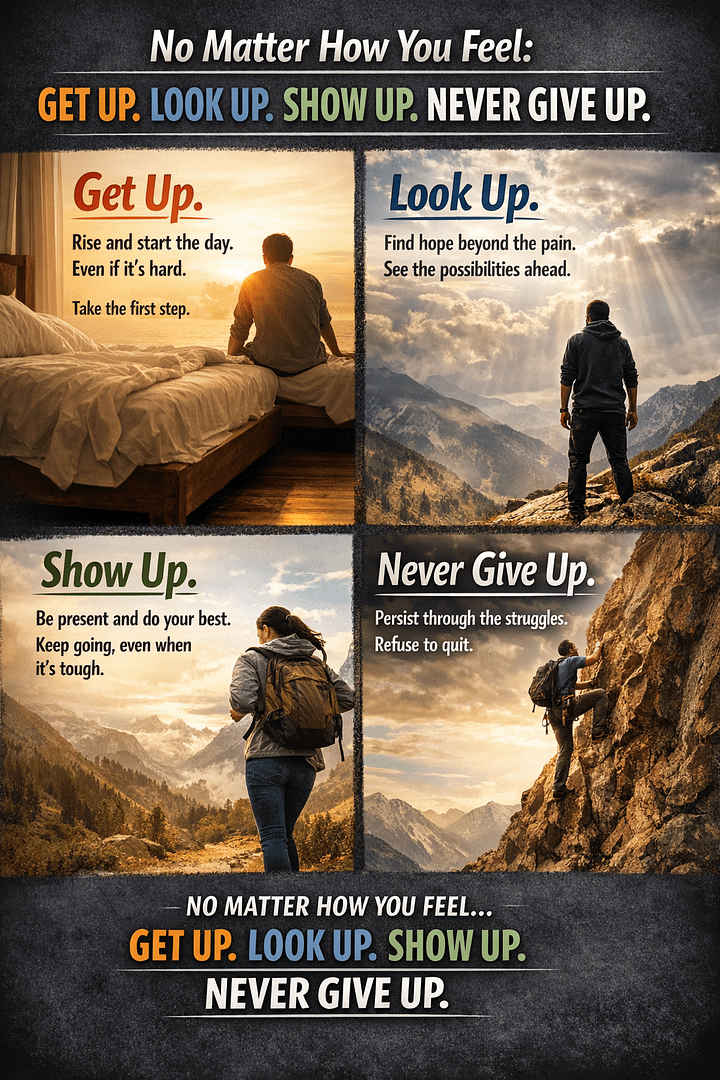
  • No Matter How You Feel: Get Up. Look Up. Show Up. Never Give Up.

    Advertisements

    There are moments in life when everything inside you says stop.
    Stop trying. Stop caring. Stop pushing forward.

    It’s in those quiet, heavy moments—when the world keeps moving but your heart feels stuck—that this message matters most:

    Get up.
    Look up.
    Show up.
    Never give up.

    These words are simple, but they carry a kind of strength that doesn’t shout—it endures. They are not about perfection. They are about persistence. Not about feeling strong, but choosing to keep going even when you feel anything but.

    Get Up: The First Victory of the Day

    Getting up is often the hardest part.

    Not physically—but emotionally.

    It’s waking up to another day when your heart still aches. It’s facing responsibilities when your mind is tired. It’s stepping into a world that doesn’t pause for your pain.

    But getting up is powerful.

    It is the first decision that shifts everything.
    It is the moment you refuse to let your circumstances define your entire day.

    Some days, getting up will feel like a small act. But in reality, it’s a declaration:

    I’m not done.

    Even if all you do is take one step forward, that step matters. Because momentum doesn’t begin with leaps—it begins with movement.

    Look Up: Changing Your Perspective

    When life gets heavy, your vision narrows. You begin to see only what’s wrong, what’s missing, what hurts.

    Looking up is about breaking that pattern.

    It’s about lifting your eyes—whether toward faith, hope, purpose, or simply the possibility that things can change. It’s choosing not to stay locked into the weight of the present moment.

    Looking up doesn’t erase your struggles.
    It gives you the strength to rise above them.

    It reminds you that:

    This moment is not your entire story
    Pain is real, but it is not permanent
    There is still something ahead worth moving toward

    Sometimes, looking up is a prayer.
    Sometimes, it’s a quiet belief.
    Sometimes, it’s just refusing to give in to despair.

    But every time you do it, you create space for hope.

    Show Up: The Power of Presence

    You don’t need to have it all figured out to show up.

    You don’t need to feel ready, confident, or strong.

    You just need to be there.

    Showing up is one of the most underrated forms of strength. It’s easy to disappear when life gets hard—to withdraw, to shut down, to isolate. But choosing to show up—especially when you don’t feel like it—is what builds resilience.

    Show up for:

    Your responsibilities
    Your purpose
    Your family and those who care about you
    And most importantly, yourself

    Some days, showing up means giving your best effort.
    Other days, it simply means not giving up.

    And that’s enough.

    Because consistency—not perfection—is what creates change over time.

    Never Give Up: The Decision That Changes Everything

    There will be moments when quitting feels easier.

    When the road feels too long.
    When the pain feels too deep.
    When the progress feels invisible.

    But what you don’t see in those moments is how close you might be to a breakthrough.

    Giving up ends the story.
    Continuing gives it a chance to change.

    Never giving up doesn’t mean you never struggle. It doesn’t mean you don’t feel weak, tired, or discouraged.

    It means that despite all of that—you keep going.

    It means:

    You keep trying, even when it’s hard
    You keep believing, even when doubt creeps in
    You keep moving, even when progress feels slow

    Because strength is not about never falling—it’s about refusing to stay down.

    When Feelings Try to Take Control

    Feelings are powerful.

    They can convince you that you’re not strong enough. That things won’t get better. That it’s not worth the effort.

    But feelings are not facts.

    They change. They shift. They rise and fall like waves.

    If you build your life based only on how you feel in a moment, you’ll always be at the mercy of those waves.

    But when you choose discipline over emotion—when you decide to act regardless of how you feel—you take back control.

    You remind yourself:

    I may feel weak, but I am not defeated.
    I may feel tired, but I can still move forward.
    I may feel lost, but I am not without direction.

    The Quiet Strength of Endurance

    Not all strength is loud.

    Sometimes strength looks like:

    Getting through the day without giving up
    Holding yourself together when everything feels like it’s falling apart
    Continuing to try when no one else sees your effort

    Endurance is not glamorous—but it is powerful.

    It builds character.
    It shapes resilience.
    It creates a foundation that cannot be easily broken.

    And over time, that quiet strength becomes unshakable.

    The Ripple Effect of Showing Up

    When you live by this mindset, something incredible happens.

    Your actions begin to influence more than just your own life.

    You inspire others—often without even realizing it.

    Someone sees you keep going when it’s hard, and it gives them the courage to do the same. Someone watches your persistence and begins to believe that maybe they can push through too.

    Your decision to not give up becomes a light for someone else.

    Final Reflection

    No matter how you feel today—whether you’re full of energy or barely holding on—these four steps remain the same:

    Get up.
    Look up.
    Show up.
    Never give up.

    You don’t have to conquer everything at once.
    You don’t need all the answers.
    You don’t have to feel strong.

    You just have to take the next step.

    Because every step forward—no matter how small—is proof that you are still fighting, still believing, and still moving toward something better.

    And that… is more powerful than you realize.

    Read More Of Inspiration & Motivation

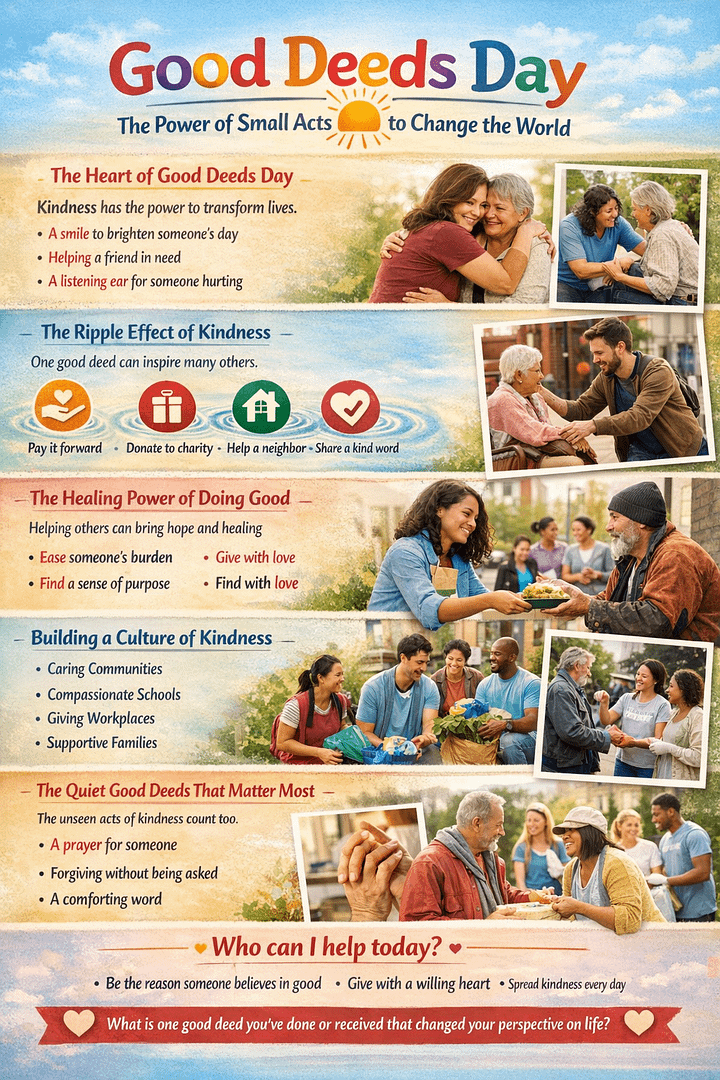
  • Good Deeds Day: The Power of Small Acts to Change the World

    Advertisements

    Good Deeds Day is more than just a date on the calendar—it is a global movement built on the belief that kindness has the power to transform lives. Celebrated by millions of people across the world, this day serves as a reminder that no act of goodness is ever too small to matter.

    In a world that often feels fast-paced and disconnected, Good Deeds Day invites us to slow down, look around, and choose compassion. It reminds us that behind every face is a story, and sometimes all it takes is one kind gesture to change the direction of someone’s day—or even their life.

    The Heart Behind Good Deeds Day

    At its core, Good Deeds Day is about intention. It’s about making a conscious decision to bring light into someone else’s world. It’s not about recognition, applause, or reward—it’s about giving from a place of sincerity.

    A good deed doesn’t have to be grand or expensive. Often, the most meaningful acts are the simplest:

    A smile offered to someone who feels invisible
    A listening ear for someone who needs to be heard
    A message that says, “I’m thinking of you”
    Helping someone carry a burden—physically or emotionally

    These moments, though brief, have a lasting impact. They remind people that they are seen, valued, and not alone.

    The Ripple Effect of Kindness

    Kindness doesn’t stop with one person—it spreads.

    When someone experiences a good deed, it often inspires them to pass that kindness on to someone else. This creates a ripple effect that can travel far beyond the original act. One moment of compassion can turn into dozens, even hundreds, of acts of goodness.

    Think of it like a stone dropped into still water. The ripples move outward, touching everything in their path. That’s what kindness does—it reaches places we may never see, impacting lives we may never know.

    Good Deeds in Everyday Life

    You don’t have to wait for Good Deeds Day to make a difference. Opportunities for kindness are everywhere, woven into the fabric of everyday life.

    You can:

    Pay for someone’s coffee without telling them
    Leave a generous tip for a hardworking server
    Volunteer your time at a local shelter
    Donate clothes or food to those in need
    Offer encouragement to someone going through a difficult time
    Forgive someone who has hurt you
    Simply be patient when it would be easier not to be

    Even in moments when life feels heavy, choosing kindness can be a powerful act—not just for others, but for yourself.

    The Healing Power of Doing Good

    There is something deeply healing about helping others.

    For those carrying grief, pain, or loss, doing a good deed can bring a sense of purpose and connection. It doesn’t erase the pain, but it can soften it. It can remind you that even in brokenness, there is still something beautiful you can give.

    Sometimes, the act of helping someone else becomes a quiet way of honoring someone you’ve lost. A way of continuing love in a world that still needs it.

    Kindness becomes a bridge—connecting what was, what is, and what still can be.

    When Kindness Feels Hard

    There are days when being kind feels difficult—when you’re tired, hurt, or disappointed by others. Days when the world feels cold, and your instinct is to pull back.

    But those are often the moments when kindness matters most.

    Choosing to do good, even when you don’t feel like it, is a powerful act of strength. It says that you will not let negativity define you. It says that your heart, no matter what it has been through, still chooses love.

    That doesn’t mean allowing yourself to be mistreated. It means setting boundaries when needed, while still holding onto your humanity.

    Building a Culture of Good Deeds

    Imagine if kindness became contagious in every community:

    Workplaces where people uplift instead of compete
    Neighborhoods where people look out for one another
    Schools where compassion is taught as strongly as academics
    Families where love is expressed openly and often

    This kind of world doesn’t start with large systems—it starts with individuals making small choices every day.

    When enough people choose kindness, culture begins to shift.

    The Quiet Good Deeds That Matter Most

    Some of the most powerful good deeds are the ones no one ever sees.

    The prayer you say for someone in silence
    The forgiveness you offer without being asked
    The decision to speak kindly instead of reacting in anger
    The strength it takes to show up for someone when you’re struggling yourself

    These quiet acts shape character. They define who you are when no one is watching.

    And often, they are the ones that carry the deepest meaning.

    A Legacy of Kindness

    At the end of life, people rarely remember the material things. They remember how someone made them feel. They remember the kindness, the compassion, the moments when someone showed up for them.

    Every good deed you do becomes part of your legacy.

    It becomes part of the story people tell about you.
    It becomes part of the difference you made in the world.

    You may never fully see the impact of your kindness—but that doesn’t mean it isn’t there.

    Final Thoughts

    Good Deeds Day is not just a celebration—it’s an invitation.

    An invitation to be more aware.
    An invitation to be more compassionate.
    An invitation to live with intention.

    Today, and every day, ask yourself:

    Who can I help?
    Who needs encouragement?
    Where can I bring a little more light?

    Because in the end, it’s not about how much you give—it’s about the heart behind it.

    And sometimes, the smallest act of kindness can become the biggest blessing in someone’s life.

    Read More Holidays & National Days

  • 🧀 National Grilled Cheese Sandwich Day: A Comfort Food Classic Worth Celebrating

    Advertisements

    Every year on April 12, kitchens across America fill with the unmistakable aroma of butter sizzling in a pan and bread turning golden brown. National Grilled Cheese Sandwich Day isn’t just about food—it’s about comfort, tradition, and the simple joy of something made with love.

    This humble sandwich has stood the test of time, proving that sometimes the most basic ingredients can create the most unforgettable experiences.

    🥪 A Humble Beginning with Lasting Impact

    The grilled cheese sandwich didn’t start as the two-slice classic we know today. In the early 20th century, when sliced bread and processed cheese became widely available, people began making open-faced melted cheese sandwiches. These were affordable, filling, and easy to prepare—perfect for families during difficult economic times.

    During World War II, the sandwich gained even more popularity. U.S. Navy cooks served what they called “American cheese filling sandwiches,” providing soldiers with a warm, satisfying meal that required minimal ingredients. It wasn’t long before the second slice of bread was added, transforming it into the grilled cheese sandwich we recognize today.

    🧈 The Magic Behind the Flavor

    What makes grilled cheese so special isn’t just the ingredients—it’s the transformation that happens when heat meets simplicity.

    Butter melts into the bread, creating a crispy, golden crust. Inside, the cheese softens, stretches, and melts into a creamy center. That contrast—crunchy on the outside, gooey on the inside—is what makes every bite unforgettable.

    But beyond texture and taste, there’s something deeper at play. Grilled cheese taps into comfort and memory. It’s the sandwich many of us grew up with—served on rainy afternoons, after long school days, or alongside a warm bowl of soup when we weren’t feeling our best.

    🧀 Endless Ways to Make It Your Own

    One of the greatest things about grilled cheese is how easily it can be personalized. While the classic version—white bread and American cheese—remains a favorite, today’s kitchens have turned grilled cheese into a canvas for creativity.

    You can keep it simple, or take it to a whole new level:

    Classic Comfort: White bread, butter, and American cheese
    Sharp & Bold: Cheddar with sourdough bread
    Creamy & Stretchy: Mozzarella with a hint of garlic butter
    Savory Upgrade: Add bacon, ham, or turkey
    Fresh Twist: Tomato slices, spinach, or avocado
    Gourmet Style: Brie with apple slices or gouda with caramelized onions

    There’s no wrong way to make a grilled cheese—only your way.

    🍅 The Perfect Pairing

    For many, grilled cheese isn’t complete without its longtime companion: tomato soup. The rich, tangy flavor of the soup perfectly balances the buttery, cheesy sandwich.

    Dipping a crispy corner into warm soup isn’t just a habit—it’s a tradition. Together, they create a combination that has comforted generations and continues to bring people back to simpler times.

    ❤️ More Than Food—It’s a Feeling

    Grilled cheese is more than just something you eat. It’s something you feel.

    It represents:

    Home
    Warmth
    Care
    Simplicity in a complicated world

    In a time when life can feel overwhelming, there’s something grounding about making a grilled cheese sandwich. It doesn’t require perfection. It doesn’t demand fancy ingredients. It just asks you to slow down, even for a few minutes, and enjoy something real.

    🔥 A Day to Slow Down and Savor

    National Grilled Cheese Sandwich Day is a reminder that not everything needs to be elaborate to be meaningful. Sometimes, the smallest things—like a sandwich made in a skillet—can bring the greatest comfort.

    So today, take a moment. Heat up a pan. Butter the bread. Watch the cheese melt. And enjoy not just the sandwich, but the pause it brings with it.

    Because in that moment, you’re not just making food—you’re creating a little piece of happiness.

    Read More Holidays & National Days

  • When You Want to Open Up but Know Not To

    Advertisements

    There’s a quiet war that happens inside you—one that no one else sees.

    It begins in a moment. A pause in conversation. A simple question someone asks. A memory that rises to the surface without warning. Your heart leans forward, ready to speak, ready to release what it’s been holding for far too long. You want to open up. You want to be understood. You want someone to see past the surface and recognize what you’ve been carrying in silence.

    But then something stops you.

    It’s not hesitation without reason. It’s not weakness. It’s not fear for no cause.
    It’s experience.

    It’s the memory of the last time you let someone in and walked away feeling exposed instead of supported. The time your vulnerability was misunderstood, dismissed, or quietly judged. It’s the realization that when you gave someone access to your truth, they didn’t know how to hold it—or worse, they didn’t try.

    So now, every time that moment comes again, something inside you pulls back.

    You sit there, caught between two opposing forces. One side of you is reaching out, desperate to speak, to release, to finally not feel so alone in your own mind. The other side is protective, guarded, reminding you of everything it cost you the last time you tried.

    And more often than not, the protective side wins.

    You change the subject. You laugh it off. You say, “I’m good,” even when you’re not.
    And just like that, the moment passes.

    But the weight stays.

    Because the truth is, not opening up doesn’t mean you don’t need to. It just means you’ve learned the hard way that not everyone deserves access to your deeper self.

    And over time, that lesson doesn’t just affect your words—it starts to shape your entire life.

    You begin to feel like you can’t make real friends, because friendships require openness, and openness feels unsafe. You keep people at a distance—not because you don’t care, but because you care too much to risk being hurt again.

    You start to believe you shouldn’t date, because how can someone love you if they don’t truly know you—and how can you let them know you without exposing the parts of yourself you’ve learned to protect? So you hold back. You avoid. You tell yourself it’s easier that way.

    And somewhere along the line, a heavier thought settles in:

    Maybe I’m not good for anyone.

    Not because you don’t have a good heart—but because you feel like what you carry is too much. Too heavy. Too complicated. You begin to think that letting someone into your world would only burden them, confuse them, or eventually push them away.

    So you isolate—not always physically, but emotionally.

    You show up, you smile, you play your part. But the real you—the one that feels deeply, that struggles, that wants to be understood—stays hidden.

    And that kind of silence can be exhausting.

    Because you’re not closed off by nature—you’ve just been taught to be.

    You’ve learned that vulnerability without safety leads to pain. That opening up to the wrong people can leave deeper wounds than staying quiet ever could. So you adapt. You protect. You build walls not because you want to shut people out, but because you’re trying to survive what you’ve already been through.

    But here’s the truth that quietly sits beneath all of that:

    Just because you’ve been hurt doesn’t mean you are unworthy of connection.
    Just because people mishandled your vulnerability doesn’t mean you are too much.
    And just because you feel like you’re not good for anyone doesn’t make it true.

    It only means you haven’t been met with the kind of understanding you needed.

    There is a difference between being incapable of connection and being cautious about where you place your trust. What you’re feeling isn’t a failure—it’s self-protection that has gone on for so long it’s started to feel like identity.

    But it’s not who you are at your core.

    At your core, you’re someone who wants to connect. Someone who wants to share, to be known, to be accepted without fear of being misunderstood. Someone who still, despite everything, has the ability to care deeply.

    And that is not something broken.
    That is something rare.

    The challenge is not that you can’t have friendships, or love, or be good for someone. The challenge is finding people who are capable of meeting you with the same depth and care that you offer.

    Not everyone will.

    But some people will.

    There are people who listen without trying to fix you. Who don’t get overwhelmed by your honesty. Who don’t run when things get real. People who understand that being let into someone’s world is not a burden—it’s a privilege.

    Those are the people worth waiting for.

    Until then, it’s okay to protect your heart. It’s okay to take your time. It’s okay to not open up in every moment where you feel the urge.

    But don’t let your past convince you that you are meant to live unseen, unheard, and disconnected forever.

    Because you’re not.

    You’re not “too much.”
    You’re not “not good for anyone.”
    You’re someone who has been hurt and learned to be careful.

    And one day, when the right person sits across from you—not just hearing you, but truly listening—you won’t feel that internal war the same way.

    You won’t feel the need to hold everything back.

    You’ll feel safe enough to speak.

    And in that moment, you’ll realize something you may have forgotten:

    You were never the problem.
    You were just protecting yourself from the wrong people.

    Read More Of Love & Relationships

  • National Ranch Water Day: Celebrating the Spirit of the West in a Glass

    Advertisements

    National Ranch Water Day is more than a celebration of a drink—it’s a tribute to a lifestyle rooted in simplicity, resilience, and the wide-open beauty of the American West. With its crisp taste and no-nonsense ingredients, Ranch Water has grown from a regional favorite into a nationwide sensation, capturing hearts with every refreshing sip.

    But beyond the bubbles and citrus lies a deeper story—one of heritage, culture, and the enduring appeal of slowing down and savoring life.

    The Origins: Born Under the Texas Sun

    Ranch Water traces its roots back to the rugged landscapes of West Texas, where life moves to the rhythm of the land. Out there, under blazing sun and endless skies, ranchers needed something that could cool them down without weighing them down.

    Legend has it that Ranch Water was first poured in small desert towns like Marathon, where locals mixed tequila with lime and sparkling mineral water straight from the bottle. There were no cocktail shakers, no elaborate garnishes—just what was available and what worked.

    And it worked beautifully.

    The drink quickly became a staple among ranch hands and locals alike. It wasn’t just refreshing—it was practical, easy to make, and perfectly suited to the environment. Over time, it became a quiet tradition, passed from one gathering to the next.

    The Simplicity That Made It Legendary

    In a world where cocktails can sometimes feel overly complicated, Ranch Water stands apart. It proves that you don’t need a long list of ingredients to create something memorable.

    At its heart, Ranch Water is made with just three essentials:

    Tequila (preferably blanco) – clean, bright, and slightly earthy
    Fresh lime juice – for a natural citrus punch
    Sparkling mineral water – most famously Topo Chico, known for its bold carbonation

    That’s it.

    No syrups. No artificial flavors. No unnecessary extras.

    This simplicity is what gives Ranch Water its charm. It’s approachable, authentic, and honest—much like the people and places it comes from.

    From Ranch to Mainstream

    What began as a regional refreshment has evolved into a national trend. Over the past decade, Ranch Water has made its way from Texas ranches to urban cocktail menus, backyard barbecues, and even canned beverage aisles.

    Bars across the country now feature their own takes on Ranch Water, some adding creative twists like:

    Jalapeño slices for a spicy kick
    Grapefruit juice for a tangy variation
    Agave nectar for a touch of sweetness
    Flavored sparkling waters for a modern spin

    Despite these innovations, the essence of Ranch Water remains unchanged. It’s still about balance, refreshment, and ease.

    Even as it gains popularity, it hasn’t lost its soul.

    Why Ranch Water Resonates Today

    There’s a reason Ranch Water feels especially relevant right now. In a fast-paced, always-connected world, people are craving simplicity. They’re looking for ways to slow down, unplug, and reconnect—with nature, with others, and with themselves.

    Ranch Water fits perfectly into that mindset.

    It’s:

    Light and refreshing – ideal for warm afternoons and relaxed evenings
    Lower in sugar – a cleaner alternative to many cocktails
    Easy to make – no bartending skills required
    Social – meant to be shared with friends and family

    It’s not just a drink—it’s an experience.

    How to Make the Perfect Ranch Water

    If you want to celebrate National Ranch Water Day the right way, start with the classic recipe:

    Ingredients:

    2 oz blanco tequila
    Juice of half a fresh lime
    Topo Chico (or your favorite sparkling mineral water)
    Ice

    Instructions:

    Fill a tall glass with ice
    Pour in the tequila
    Squeeze in fresh lime juice
    Top with sparkling water
    Stir gently
    Garnish with a lime wedge if desired

    Pro Tip: Some traditionalists skip the glass altogether and drink straight from the Topo Chico bottle—taking a sip first to make room, then adding tequila and lime. It doesn’t get more authentic than that.

    A Drink That Captures a Way of Life

    Ranch Water isn’t about excess—it’s about presence.

    It’s about sitting on a porch as the sun dips below the horizon.
    It’s about laughter shared after a long day’s work.
    It’s about quiet moments where the world feels still and simple.

    In many ways, Ranch Water reflects the values of the West:

    Hard work balanced with well-earned rest
    Connection to the land and to each other
    Appreciation for life’s simple pleasures

    When you raise a glass of Ranch Water, you’re not just enjoying a drink—you’re embracing a mindset.

    Celebrating National Ranch Water Day

    Whether you’re on a ranch, in the suburbs, or in the heart of the city, National Ranch Water Day is an invitation to pause and enjoy.

    Celebrate by:

    Mixing up a batch for friends and family
    Hosting a backyard gathering or barbecue
    Watching the sunset with a cold drink in hand
    Trying your own twist on the classic recipe
    Sharing the experience with others

    There’s no right or wrong way to celebrate—just keep it simple and meaningful.

    Final Thoughts: A Toast to Simplicity

    In a world full of noise and complexity, Ranch Water is a breath of fresh air. It reminds us that we don’t need much to enjoy life—just good company, a beautiful view, and something refreshing in our glass.

    So this National Ranch Water Day, take a moment to slow down.
    Feel the breeze. Watch the sky. Savor the sip.

    Because sometimes, the simplest things are the ones we remember most.

    Cheers to National Ranch Water Day—where every sip tells a story of freedom, tradition, and the spirit of the West.

    Read More Holidays & National Days

  • 🧀 National Cheese Fondue Day: A Celebration of Warmth, Flavor, and Togetherness

    Advertisements

    Every year on April 11th, food lovers across the country gather—whether physically or in spirit—to celebrate National Cheese Fondue Day. It’s more than just a food holiday; it’s a reminder of the beauty found in slowing down, sharing a meal, and connecting with the people around us.

    In a world where meals are often rushed and eaten alone, cheese fondue invites us back to the table—to linger, to laugh, and to savor not only the flavors but the moments.

    🫕 The Humble Origins of a Beloved Dish

    Cheese fondue began as a necessity in the rugged mountains of Switzerland. Long winters and limited access to fresh food meant families had to rely on what they could preserve—aged cheese, bread, and wine. Instead of letting stale bread go to waste, they softened it by dipping it into melted cheese, creating a dish that was both practical and deeply satisfying.

    Over time, this simple survival meal transformed into a cherished tradition. By the 18th century, fondue had become a staple in Swiss households. Eventually, it crossed borders and oceans, gaining popularity worldwide—especially during the 1960s and 1970s in the United States, when fondue parties became a cultural phenomenon.

    But despite its evolution, fondue has never lost its roots: simplicity, resourcefulness, and togetherness.

    🧀 The Art of Perfect Cheese Fondue

    Making the perfect cheese fondue is both a science and an art. At its core, it’s about balance—flavor, texture, and temperature all working together in harmony.

    Key Ingredients:
    Cheese: Traditionally a blend of Gruyère and Emmental for a nutty, creamy profile
    Liquid: Dry white wine helps create a smooth consistency and enhances flavor
    Aromatics: Garlic is often rubbed inside the pot for subtle depth
    Thickener: A small amount of flour or cornstarch prevents separation
    Optional Touches: A splash of kirsch (cherry brandy) or a pinch of nutmeg

    The secret lies in melting the cheese slowly and stirring consistently to achieve that silky, luxurious texture that coats every bite perfectly.

    🍞 Dippers: Where Creativity Meets Flavor

    While bread may be the traditional choice, today’s fondue experience is as creative as you want it to be.

    Classic Dippers:
    Crusty bread cubes
    Steamed vegetables like broccoli and cauliflower
    Boiled baby potatoes
    Apple slices for a sweet contrast
    Bold & Unique Options:
    Grilled sausage or steak bites
    Pretzels or tortilla chips
    Roasted mushrooms
    Even pickles for a tangy twist

    Each dipper brings its own personality to the table, turning every bite into a new experience.

    🫶 Fondue Etiquette and Traditions

    Part of what makes fondue so special is the set of traditions and unwritten rules that come with it—adding a playful and communal spirit to the meal.

    Double-dipping? Traditionally frowned upon—but often laughed about
    Dropping your bread? In some cultures, it comes with a fun “penalty” like telling a story or buying the next round
    Sharing is essential—fondue is meant to be enjoyed together, not alone

    These small traditions turn dinner into an experience, full of laughter and connection.

    🍷 Pairing the Perfect Drink

    No fondue experience is complete without the right beverage. Traditionally, it’s paired with:

    Dry white wines like Sauvignon Blanc or Chardonnay
    Warm tea, believed to aid digestion
    Light beers for a refreshing contrast

    Interestingly, in Swiss tradition, cold drinks are often avoided during fondue, as they’re thought to make the cheese harder to digest—another example of how culture shapes cuisine.

    🏡 How to Celebrate National Cheese Fondue Day

    Celebrating this delicious holiday doesn’t require a special occasion—just a little intention and a love for good food.

    Host a fondue gathering with friends or family
    Create a themed dinner night with Swiss-inspired décor
    Try making fondue from scratch for a more authentic experience
    Experiment with new flavors like spicy cheese blends or smoked varieties
    Keep it cozy—dim the lights, light candles, and enjoy the moment

    Even a simple fondue night at home can feel special when you embrace the spirit of the day.

    💛 More Than Food: A Symbol of Connection

    At its heart, cheese fondue represents something deeper than melted cheese—it represents unity.

    Everyone gathers around the same pot. Everyone shares the same experience. There’s no rush, no distractions—just conversation, laughter, and presence.

    In many ways, fondue is a reminder of what truly matters:
    time spent together, memories created, and the warmth of connection.

    🧀 A Tradition That Lives On

    National Cheese Fondue Day isn’t just about celebrating a dish—it’s about honoring a tradition that has stood the test of time. From the snowy Alps to modern dining rooms, fondue continues to bring people together in the most meaningful way.

    So whether you’re dipping bread, veggies, or something uniquely your own, take a moment to slow down and enjoy it.

    Because sometimes, the simplest meals create the richest memories.

    Read More Holidays & National Days

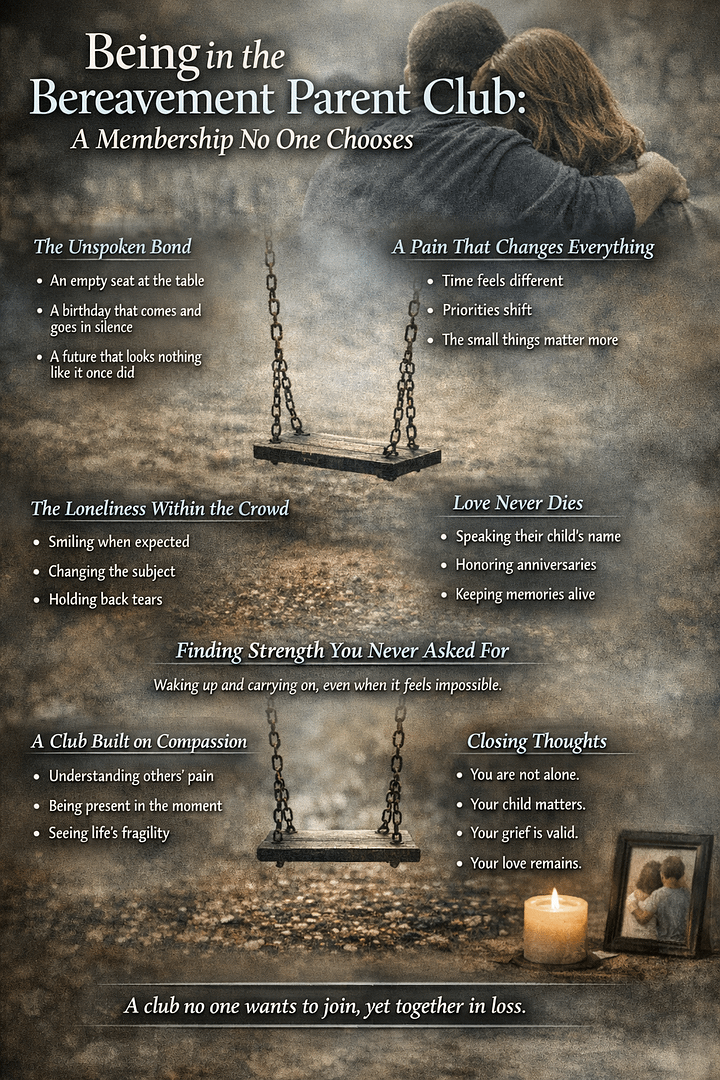
  • Being in the Bereavement Parent Club: A Membership No One Chooses

    Advertisements

    There are no invitations.
    No sign-up sheets.
    No orientation.

    Yet somehow, without warning or consent, some parents find themselves part of a club they never knew existed—the bereavement parent club. And it is a club that no one, not a single soul, ever wants to belong to.

    The Unspoken Bond

    Those who are part of this club recognize each other without words. There’s a quiet understanding, a shared language of loss that doesn’t need explanation. It lives in the eyes, in the pauses between sentences, in the way a name is spoken—or sometimes avoided.

    This bond is not one formed out of joy or shared interests. It is forged in heartbreak. It is built on memories that should still be in the making, on dreams that were never given the chance to unfold.

    And yet, within this unchosen community, there is a deep and powerful connection. Because only another bereaved parent truly understands the weight of:

    An empty seat at the table
    A birthday that comes and goes in silence
    A future that looks nothing like it once did
    A Pain That Changes Everything

    Losing a child is not something you “get over.” It is something that becomes a part of you—woven into your identity, reshaping your world forever.

    Grief, in this form, is not linear. It doesn’t follow rules or timelines. One moment you may find yourself functioning, even smiling… and the next, you are pulled under by a wave of sorrow so strong it takes your breath away.

    It changes how you see everything:

    Time feels different
    Priorities shift
    The small things matter more, yet the big things sometimes feel meaningless

    You learn quickly that life continues around you—but it never continues the same within you.

    The Loneliness Within the Crowd

    One of the hardest parts of this journey is the isolation. Even when surrounded by people who care, there can be a deep sense of being alone.

    Friends and family may not know what to say. Some may try to offer comfort but unintentionally say the wrong things. Others may drift away, unsure of how to handle such profound grief.

    And so, many bereaved parents carry their pain quietly.

    They learn to:

    Smile when expected
    Change the subject when it gets too heavy
    Hold back tears in public spaces

    But inside, the grief remains—constant, present, and deeply personal.

    Love Never Dies

    What makes this kind of grief so powerful is love. The love for a child does not end when their life does. It continues—fierce, unbreakable, and eternal.

    That love shows up in different ways:

    Speaking their child’s name
    Honoring anniversaries and birthdays
    Keeping traditions alive
    Finding small ways to carry their memory forward

    Grief is not just sorrow—it is love with nowhere to go. And so, it finds its way into everything.

    Finding Strength You Never Asked For

    There is a quiet strength in bereaved parents. Not the kind that boasts or shines loudly—but the kind that endures.

    They wake up each day and keep going, even when it feels impossible.
    They carry both love and loss in the same heart.
    They learn to live in a world that no longer feels whole.

    And in time—though the pain never disappears—they find ways to breathe again. To live again. Not in the same way as before, but in a way that honors both their child and their journey.

    A Club Built on Compassion

    If there is anything this unwanted club offers, it is compassion.

    Bereaved parents often become:

    More understanding of others’ pain
    More present in moments that matter
    More aware of how fragile and precious life truly is

    They become a source of comfort for others walking similar paths—offering a kind of support that can only come from someone who truly knows.

    Closing Thoughts

    No one chooses this path. No one signs up for this kind of heartbreak.

    But for those who find themselves here, know this:

    You are not alone.
    Your child matters.
    Your grief is valid.
    And your love—your endless, unwavering love—will always be a part of your story.

    Even in the deepest pain, that love remains.

    A Father’s Guide to Surviving the Loss of a Child

    Grief & Child Loss


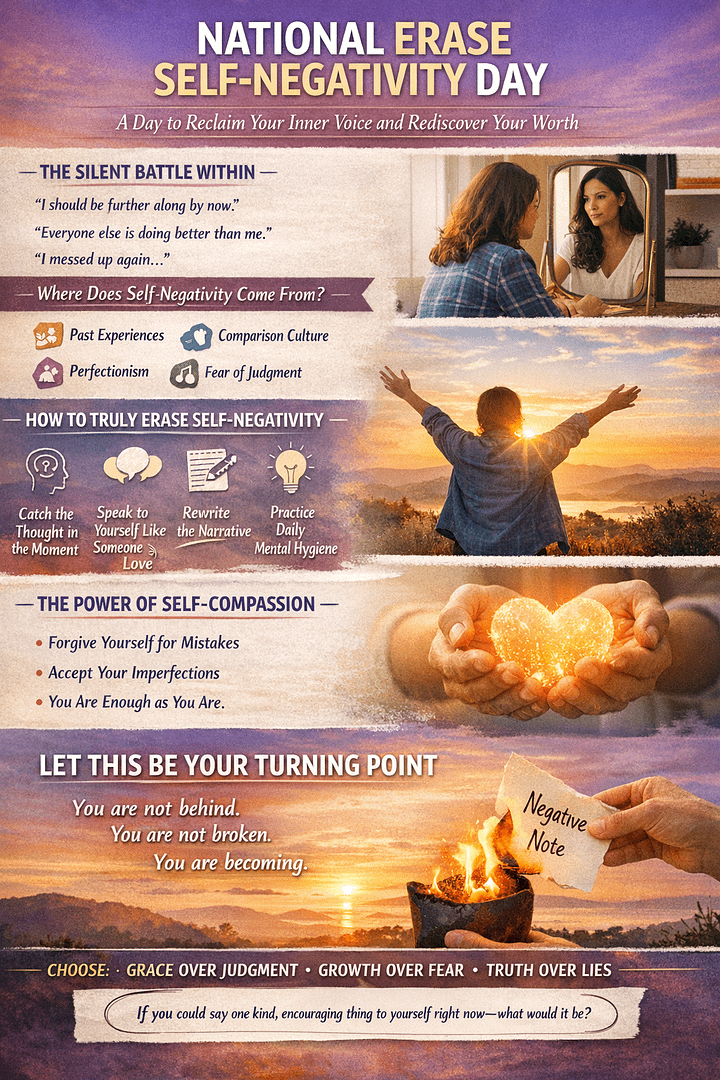
  • National Erase Self-Negativity Day – A Day to Reclaim Your Inner Voice and Rediscover Your Worth

    Advertisements

    Every year, on the second Thursday of April, National Erase Self-Negativity Day offers something many of us don’t even realize we need—a chance to pause, reset, and examine the way we speak to ourselves.

    Not out loud… but internally.

    Because for many, the harshest words they hear don’t come from others—they come from within.

    This day is a reminder that while the world can be demanding and unforgiving, we don’t have to be that way with ourselves.

    The Silent Battle Within

    Self-negativity doesn’t always show itself in obvious ways. It’s often subtle, woven into daily thoughts:

    “I should be further along by now.”
    “Everyone else is doing better than me.”
    “I messed up again… what’s wrong with me?”

    These thoughts may seem small, but repeated over time, they become beliefs. And beliefs shape identity.

    You begin to:

    Doubt your abilities
    Question your worth
    Hold back from opportunities
    Settle for less than you deserve

    The truth is, self-negativity doesn’t just affect how you feel—it affects how you live.

    Where Does Self-Negativity Come From?

    Understanding the root of self-negativity is a powerful step toward erasing it. It often stems from:

    1. Past Experiences

    Failures, rejection, or painful moments can leave lasting impressions. If you were once told you weren’t good enough, you may have carried that belief forward—even if it was never true.

    2. Comparison Culture

    In today’s world, it’s easy to measure your life against carefully curated versions of others. Social media highlights victories but hides struggles, creating unrealistic standards.

    3. Perfectionism

    The belief that you must be flawless can lead to constant disappointment. When perfection becomes the goal, anything less feels like failure.

    4. Fear of Judgment

    Worrying about what others think can cause you to silence your true self and replace it with self-criticism.

    The Cost of Negative Self-Talk

    Self-negativity is not harmless. Over time, it can:

    Lower self-esteem
    Increase anxiety and stress
    Create feelings of hopelessness
    Prevent personal and professional growth
    Damage relationships (including the one you have with yourself)

    It becomes a cycle: negative thoughts → negative feelings → limited actions → reinforced beliefs.

    Breaking that cycle starts with awareness—and intention.

    How to Truly Erase Self-Negativity

    Erasing self-negativity is not about ignoring your struggles. It’s about changing your relationship with your thoughts.

    1. Catch the Thought in the Moment

    The next time a negative thought appears, pause. Don’t let it pass unnoticed. Awareness is the first step toward change.

    Ask yourself:

    “Is this thought true?”
    “Is this thought helpful?”
    2. Speak to Yourself Like Someone You Love

    Imagine a friend came to you with the same thoughts you have about yourself. Would you criticize them—or encourage them?

    Offer yourself that same kindness.

    3. Rewrite the Narrative

    Replace harsh thoughts with balanced, truthful ones:

    “I failed” → “I learned something valuable.”
    “I’m not good enough” → “I am growing and improving.”
    “I’ll never succeed” → “My journey is still unfolding.”

    This isn’t denial—it’s perspective.

    4. Practice Daily Mental Hygiene

    Just as you take care of your body, your mind needs daily care:

    Journaling your thoughts
    Practicing gratitude
    Limiting negative influences
    Feeding your mind with uplifting content
    5. Give Yourself Permission to Heal

    Some self-negativity runs deep. It may be tied to grief, loss, or past trauma. Healing takes time—and that’s okay.

    You are allowed to grow at your own pace.

    A Personal Commitment

    National Erase Self-Negativity Day is not just about one day—it’s about making a commitment to yourself.

    A commitment to:

    Stop tearing yourself down
    Start recognizing your value
    Speak words of life over your mind and heart

    You don’t have to become a completely different person overnight. You simply have to start treating yourself differently—one thought at a time.

    The Power of Self-Compassion

    Self-compassion is not weakness. It is strength.

    It means:

    Forgiving yourself for mistakes
    Accepting your imperfections
    Recognizing that you are human

    When you begin to show yourself compassion, something shifts. The pressure eases. The weight lifts. And in its place, something powerful grows:

    Confidence. Peace. Freedom.

    Let This Be Your Turning Point

    Today can be the day you choose differently.

    The day you stop believing every negative thought.
    The day you begin to rewrite your inner dialogue.
    The day you realize that your worth has never been in question.

    You are not behind.
    You are not broken.
    You are not unworthy.

    You are becoming.

    Final Reflection

    Erasing self-negativity doesn’t mean you’ll never struggle again. It means you no longer let your struggles define your identity.

    It means choosing:

    Grace over judgment
    Growth over fear
    Truth over lies

    And most importantly—it means choosing yourself.

    Read More Holidays & National Days

Exit mobile version