Blog

  • The Origin and History of the Murphy Name

    The Origin and History of the Murphy Name

    Advertisements

    Few surnames carry the depth of history, cultural pride, and global recognition that the name Murphy does. Today, Murphy is one of the most common Irish surnames in the world, found throughout Ireland, the United States, Canada, Australia, and many other countries. Yet behind this familiar name lies a story that stretches back over a thousand years to ancient Gaelic Ireland, a time of clans, warriors, kings, and a deep connection to land and sea.

    The history of the Murphy name is not just the story of a surname—it is a reflection of Irish heritage, resilience, and the journey of generations who carried their identity across continents.

    Gaelic Origins: Ó Murchadha

    The surname Murphy originates from the ancient Irish Gaelic name Ó Murchadha. In traditional Gaelic naming systems, surnames often described lineage. The prefix “Ó” means “descendant of,” indicating that those who carried the name were descendants of a man named Murchadh.

    The personal name Murchadh is itself rich in meaning. It comes from two Gaelic elements:

    “Muir” – meaning sea

    “Cath” – meaning battle

    Combined, the name can be interpreted as “sea warrior,” “warrior of the sea,” or “sea battler.” These meanings suggest strength, courage, and a powerful connection to Ireland’s coastal life, where the sea was both a resource and a force that shaped communities.

    In ancient Ireland, names often reflected qualities admired in society—bravery, leadership, and connection to nature. The name Murchadh likely belonged to respected leaders or warriors whose descendants proudly carried the family identity forward.

    Murphy Clans Across Ireland

    Unlike some surnames that come from a single family line, the Murphy name developed among multiple independent Gaelic clans across Ireland. Over centuries, different branches of the Murphy family emerged in various regions, each with its own local influence and history.

    Two of the most prominent Murphy lineages developed in:

    County Wexford
    The Murphy clan in Wexford was closely associated with the powerful Uí Ceinnselaig dynasty, a ruling family in southeastern Ireland. Members of this lineage were often local chiefs and landholders, playing important roles in regional politics and society.

    County Cork
    Another major Murphy clan grew in County Cork, particularly in the southern province of Munster. This branch became extremely widespread, and many Murphys in Ireland today trace their ancestry to this region.

    Because the surname developed in different parts of the country, not all Murphys share a single ancestor. Instead, the name represents several families who independently adopted the Ó Murchadha lineage, all tied to the same Gaelic root.

    Life in Medieval Ireland

    During the medieval period, Irish society was organized around clans and kinship groups. A clan leader or chief represented the family, and loyalty to one’s extended kin was a central part of life.

    Murphy families would have lived in small rural communities where agriculture, livestock, and fishing were essential to survival. Coastal regions in particular depended heavily on the sea, which may explain why the name connected to “sea warriors” held cultural significance.

    Clan members protected their territories, maintained alliances, and sometimes fought rival groups. The identity tied to a surname like Ó Murchadha would have been deeply meaningful—it represented ancestry, loyalty, and belonging.

    Anglicization of Irish Names

    The transformation from Ó Murchadha to Murphy occurred during centuries of English rule in Ireland.

    Beginning in the 16th century and continuing through the 17th and 18th centuries, English administrators and record keepers often altered Irish names to fit English spelling and pronunciation. Gaelic prefixes such as Ó and Mac were frequently dropped, simplified, or changed.

    As a result:

    Ó Murchadha → Murchadha → Murphy

    This anglicized version became standardized in official records, including land ownership documents, church registries, and census lists.

    Although the spelling changed, the cultural identity tied to the name remained strong among Irish families.

    The Great Irish Famine and Global Migration

    One of the most significant turning points in the history of the Murphy name came during the Great Irish Famine of the mid-19th century.

    Between 1845 and 1852, a devastating potato blight destroyed crops across Ireland. Because so many people relied on potatoes as their primary food source, the famine led to widespread hunger, disease, and economic collapse.

    During this period:

    Over one million people died

    More than two million emigrated

    Many Murphys were among those forced to leave their homeland in search of survival and opportunity.

    Irish immigrants traveled to:

    The United States

    Canada

    Australia

    England

    New Zealand

    Ships carrying Irish emigrants were sometimes called “coffin ships” because of the dangerous conditions onboard. Despite these hardships, many immigrants eventually established thriving communities abroad.

    In the United States especially, the Murphy name became widespread. Today, it remains one of the most common Irish surnames among Americans of Irish descent.

    Murphy Around the World

    As Irish immigrants settled in new countries, they brought their traditions, culture, and surnames with them. Over generations, Murphy families became part of the social and cultural fabric of many nations.

    Today the Murphy name appears in countless professions and fields, including:

    Politics and public service

    Literature and journalism

    Film, television, and entertainment

    Sports and athletics

    Education and science

    Though separated by geography, many Murphy families maintain pride in their Irish ancestry and heritage.

    Cultural Identity and Irish Pride

    For many people, the surname Murphy represents more than genealogy—it symbolizes Irish resilience and identity.

    Irish culture places strong value on storytelling, family lineage, and remembrance of ancestors. A surname often serves as a link to those who came before.

    In the case of Murphy, that link reaches back through centuries of Irish history—from ancient Gaelic clans to immigrant families who built new lives across the world.

    A Name That Endures Through Generations

    Today, the Murphy name continues to thrive across the globe. It carries echoes of ancient Gaelic warriors, medieval clan leaders, famine survivors, and immigrants who sought better futures for their families.

    Every Murphy family has its own story, but all share a connection to a name that has traveled through history and across oceans.

    From its roots as Ó Murchadha, meaning “descendant of the sea warrior,” the Murphy name stands as a lasting symbol of heritage, strength, and the enduring spirit of Ireland.

    Read More History & Culture

  • National Get Over It Day

    Advertisements

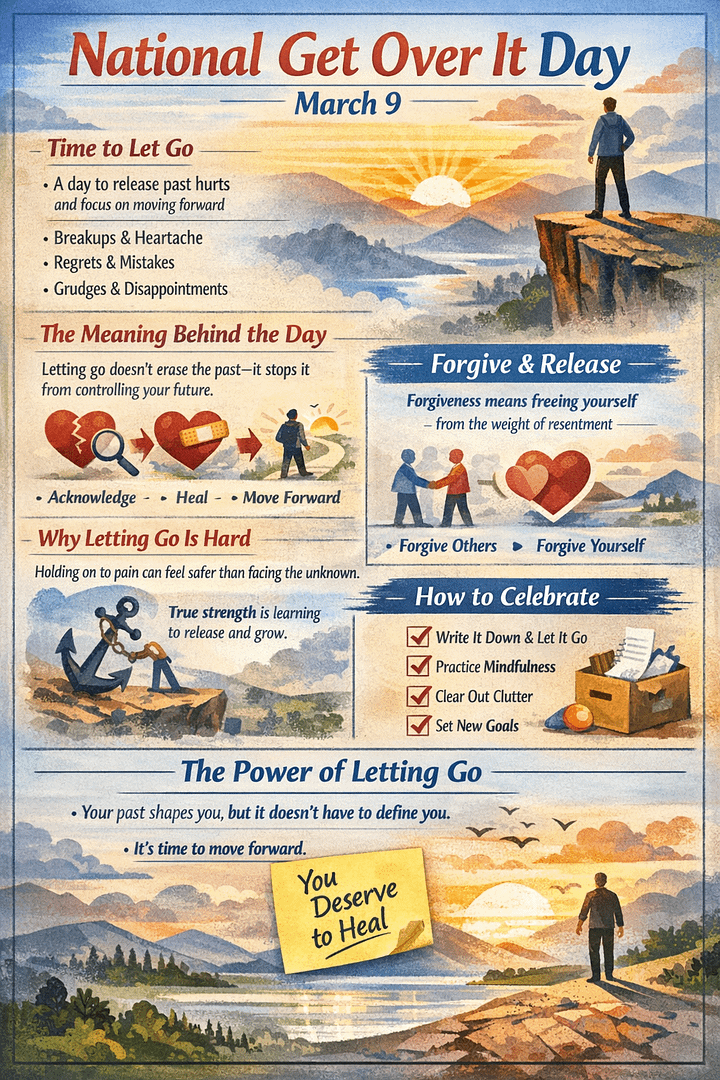
    Every year on March 9, people observe National Get Over It Day, a day that encourages individuals to release the emotional weight of the past and focus on moving forward. At first glance, the phrase “get over it” can sound blunt or even insensitive. However, the spirit of this observance is not about dismissing feelings or rushing through pain. Instead, it is about recognizing when it is time to stop letting past hurt, regret, or disappointment control our present.

    Life is filled with moments that leave lasting impressions on our hearts and minds. Some of those moments bring joy, while others leave wounds that take time to heal. National Get Over It Day offers a reminder that while we cannot change what has happened, we can choose how much power it continues to have over our lives.

    It is a day about healing, self-awareness, forgiveness, and the courage to move beyond what once held us back.

    The Deeper Meaning Behind the Day

    Everyone carries emotional baggage in some form. It might be a failed relationship that left unanswered questions, a mistake that continues to haunt our thoughts, or resentment toward someone who caused pain. These experiences can linger in our minds long after the moment itself has passed.

    The idea behind National Get Over It Day is not to deny those feelings, but to encourage reflection on whether continuing to hold onto them is helping or harming us. Emotional wounds deserve acknowledgment and time to heal, but sometimes people become trapped in cycles of replaying painful memories over and over.

    This day reminds us that healing often involves a decision—a conscious moment when we choose to release the grip of the past and begin focusing on what lies ahead.

    Letting go does not mean the experience never mattered. It simply means we refuse to let it define the rest of our lives.

    Why Holding On Can Be So Powerful

    Human beings are naturally wired to remember emotional experiences, particularly painful ones. Our minds often replay difficult moments as a way of trying to understand them or prevent similar situations in the future. Unfortunately, this mental loop can keep people stuck in the past.

    Sometimes people hold onto pain because it feels safer than moving forward. Letting go can feel like stepping into the unknown. In other cases, people fear that releasing anger or sadness may somehow invalidate their experience.

    But holding onto emotional pain for too long can quietly shape how we see the world. It can create barriers to trust, prevent new relationships from forming, and drain emotional energy that could otherwise be used for growth and happiness.

    National Get Over It Day invites people to consider a different path: learning from the past without being trapped by it.

    Learning the Difference Between Healing and Suppression

    An important message behind this observance is that “getting over it” does not mean ignoring emotions or pretending everything is fine. True healing involves acknowledging pain, processing it, and allowing time for recovery.

    Suppressing emotions can actually make them stronger over time. The goal of National Get Over It Day is not emotional avoidance—it is emotional release.

    That process might involve talking with trusted friends, journaling about past experiences, seeking therapy, or simply giving oneself permission to forgive and move forward. Each person’s path to healing is unique.

    For some, moving on may happen quickly. For others, it may take months or even years. What matters is the willingness to eventually move toward a healthier place.

    The Role of Forgiveness

    One of the most powerful ways people “get over” painful experiences is through forgiveness. Forgiveness does not mean excusing harmful behavior or pretending something did not hurt. Instead, it means choosing to release the emotional grip that resentment can have on our lives.

    Sometimes forgiveness is directed toward another person who caused pain. Other times, it must be directed inward. Many people struggle with regret over past mistakes, holding themselves to impossible standards of perfection.

    National Get Over It Day can be an opportunity to practice self-forgiveness. Recognizing that everyone makes mistakes—and that growth often comes from those mistakes—can be incredibly freeing.

    Letting go of guilt and resentment can open the door to peace and emotional clarity.

    Turning Pain Into Growth

    One of the most empowering perspectives behind National Get Over It Day is the idea that difficult experiences can become powerful teachers. Many people discover that their greatest challenges eventually lead to personal growth, resilience, and deeper empathy for others.

    Heartbreak can teach us about what we truly value in relationships.
    Failure can teach us perseverance and determination.
    Regret can teach us wisdom and humility.

    When we allow painful experiences to transform into lessons rather than lifelong burdens, they begin to serve a positive role in our lives.

    In this way, “getting over it” does not erase the past—it reframes it as part of a larger journey of growth.

    Simple Ways People Observe the Day

    People celebrate National Get Over It Day in many personal and meaningful ways. Some activities are symbolic, while others involve real steps toward emotional healing.

    Common ways people observe the day include:

    Writing down something they are ready to release and discarding the paper

    Reflecting on lessons learned from past experiences

    Practicing meditation or mindfulness

    Reconnecting with supportive friends or family

    Letting go of physical reminders tied to painful memories

    Starting a new hobby, project, or personal goal

    Even small gestures can represent a powerful emotional shift. Sometimes the act of acknowledging that you are ready to move forward is the most meaningful step of all.

    A Cultural Reminder to Focus on the Future

    In today’s fast-paced world, people often carry emotional stress without taking the time to process it. National Get Over It Day acts as a cultural reminder to pause and reflect on what we are holding onto.

    The day encourages individuals to look toward the future rather than constantly revisiting the past. It reminds us that every new day brings opportunities for change, renewal, and growth.

    No matter what someone has been through—heartbreak, disappointment, mistakes, or loss—the future is still unwritten.

    Choosing to move forward can be one of the most empowering decisions a person can make.

    The Power of Letting Go

    Letting go is rarely easy, but it is often necessary. Carrying unresolved pain can weigh heavily on the heart, while releasing it can create room for peace, joy, and new experiences.

    National Get Over It Day reminds us that our past may shape us, but it does not have to define us. We are not limited by our worst moments or the things that once hurt us.

    Each person has the ability to decide when they are ready to take the next step forward.

    Sometimes healing begins with a simple thought:
    I deserve to move on.

    And sometimes, that single decision can change everything.

    Read More Holidays & National Days

  • National Retro Video Game Day: Celebrating the Games That Started It All

    Advertisements

    Every year on March 8, gamers around the world celebrate National Retro Video Game Day, a tribute to the classic games, consoles, and arcade machines that laid the groundwork for today’s massive gaming industry. Before photorealistic graphics, online multiplayer servers, and massive open-world adventures, there were simple pixels, blinking screens, and games that relied on creativity and skill rather than advanced technology.

    Retro video games may seem primitive by modern standards, but they represent something deeply meaningful to millions of players: the roots of gaming culture. They remind us of a time when gaming was new, exciting, and full of possibilities. These early titles introduced unforgettable characters, imaginative worlds, and challenges that kept players coming back for “just one more try.”

    National Retro Video Game Day isn’t just about nostalgia—it’s about recognizing the games that shaped an entire industry and inspired generations of players and developers.

    The Birth of the Video Game Era

    The roots of retro gaming go back to the 1970s, when video games began appearing in arcades and early home consoles. One of the earliest breakout hits was Pong, a simple tennis-style game that captured the public’s imagination and demonstrated that interactive entertainment could be incredibly engaging.

    Arcades quickly became social hubs. Rows of machines filled with flashing lights and electronic sounds invited players to test their reflexes and compete for high scores. Titles like Pac-Man, Donkey Kong, Galaga, and Space Invaders became global sensations.

    Around the same time, companies began bringing gaming into living rooms. Systems like the Atari 2600 allowed players to switch cartridges and experience different games at home—something revolutionary at the time.

    These early developments transformed gaming from a novelty into a cultural movement.

    The Golden Age of Home Consoles

    The mid-1980s and early 1990s are often considered the golden age of retro gaming, when home consoles truly exploded in popularity.

    The Nintendo Entertainment System (NES) revitalized the gaming industry after the video game crash of 1983. With memorable titles like Super Mario Bros., The Legend of Zelda, and Metroid, Nintendo introduced players to expansive adventures and iconic characters.

    Soon after, competition heated up with the arrival of the Sega Genesis, which marketed itself with speed, attitude, and bold graphics. The rivalry between Nintendo and Sega became legendary among gamers and helped push innovation forward.

    The Super Nintendo Entertainment System (SNES) built on Nintendo’s earlier success with richer colors, improved sound, and deeper gameplay experiences. Games became more cinematic, storytelling improved, and players began to feel truly immersed in digital worlds.

    These consoles weren’t just entertainment devices—they became centerpieces of childhood memories for millions of people.

    Iconic Characters Born in the Retro Era

    The retro gaming era gave birth to characters who remain legendary decades later. These early heroes and mascots helped define gaming identity and continue to influence pop culture.

    Some of the most recognizable figures include:

    Mario, the mustached plumber who became Nintendo’s global mascot

    Link, the heroic adventurer exploring the magical land of Hyrule

    Sonic the Hedgehog, Sega’s fast-running blue rival to Mario

    Pac-Man, the arcade icon who turned simple maze gameplay into a worldwide phenomenon

    What made these characters special wasn’t just their appearance—it was the memorable gameplay experiences tied to them. Their adventures introduced puzzle solving, exploration, speed challenges, and storytelling that players still enjoy today.

    The Unique Charm of Retro Games

    Even with the rise of high-definition graphics and massive open-world games, retro titles still hold a special charm. Their simplicity often hides incredibly clever design.

    Because early hardware had strict limitations, developers had to rely on ingenuity rather than technology. This led to gameplay that was tightly balanced, challenging, and endlessly replayable.

    Retro games often share several characteristics that modern players still appreciate:

    Simple but addictive gameplay
    Many retro games could be learned in minutes but mastered only after hours of practice.

    Creative design within limitations
    Limited memory and graphics forced developers to focus on gameplay mechanics and level design.

    Memorable music and sound effects
    8-bit and 16-bit soundtracks remain iconic and instantly recognizable.

    High challenge levels
    Many classic games required patience, timing, and skill—qualities that made victory feel incredibly rewarding.

    These elements give retro games a timeless appeal that continues to attract both longtime fans and new players.

    The Rise of Retro Gaming Culture

    Retro gaming isn’t just about revisiting old games—it has grown into a thriving community. Collectors search for rare cartridges, enthusiasts restore vintage consoles, and gaming conventions celebrate classic titles.

    Online communities share speedruns, gameplay tips, and nostalgic memories of growing up with early gaming systems. Streaming platforms even feature retro game tournaments and challenges, proving that these classics remain exciting to watch and play.

    Many modern developers also draw inspiration from retro design, creating “retro-style” indie games that replicate pixel art graphics and classic gameplay mechanics while introducing modern twists.

    In many ways, retro gaming has become both a hobby and a cultural preservation effort.

    How to Celebrate National Retro Video Game Day

    There are many ways gamers can celebrate this nostalgic holiday:

    🎮 Replay a classic game from your childhood
    🕹 Visit a retro arcade and chase high scores
    📺 Hook up an old console and relive the original experience
    👾 Try a retro collection available on modern consoles
    📚 Learn about gaming history and the pioneers who created these early titles
    🏆 Challenge friends or family to a retro gaming tournament

    For many people, the joy of retro gaming isn’t just about the games themselves—it’s about reconnecting with memories, friendships, and the excitement of discovery.

    A Legacy Built One Pixel at a Time

    National Retro Video Game Day reminds us that the gaming industry didn’t begin with powerful graphics cards and online worlds. It started with simple ideas, passionate developers, and players willing to explore new forms of entertainment.

    Those early pixels became the foundation for a global industry worth billions today. Yet despite all the technological progress, the spirit of those early games still lives on every time someone picks up a controller and presses Start.

    Retro games prove that sometimes the simplest experiences can leave the most lasting impact.

    Read More Holidays & National Days

  • The Quiet Weight of Feeling Unwanted

    Advertisements

    There are some emotions that people talk about openly—stress, heartbreak, disappointment. But there are other feelings that live quietly beneath the surface, rarely spoken aloud. One of the heaviest of these is the anxiety of believing you are unwanted.

    It is not just the fear of being single or alone for a period of time. It is something deeper and more personal. It is the haunting thought that maybe people simply do not choose you. That maybe, no matter how much you care or how much love you are willing to give, you will somehow always be the one left behind.

    This kind of anxiety can shape the way a person sees themselves and the world around them. Over time, it can quietly rewrite a person’s inner story—turning moments of disappointment into proof that something must be wrong with them.

    And once that belief takes root, it can be incredibly difficult to let go.

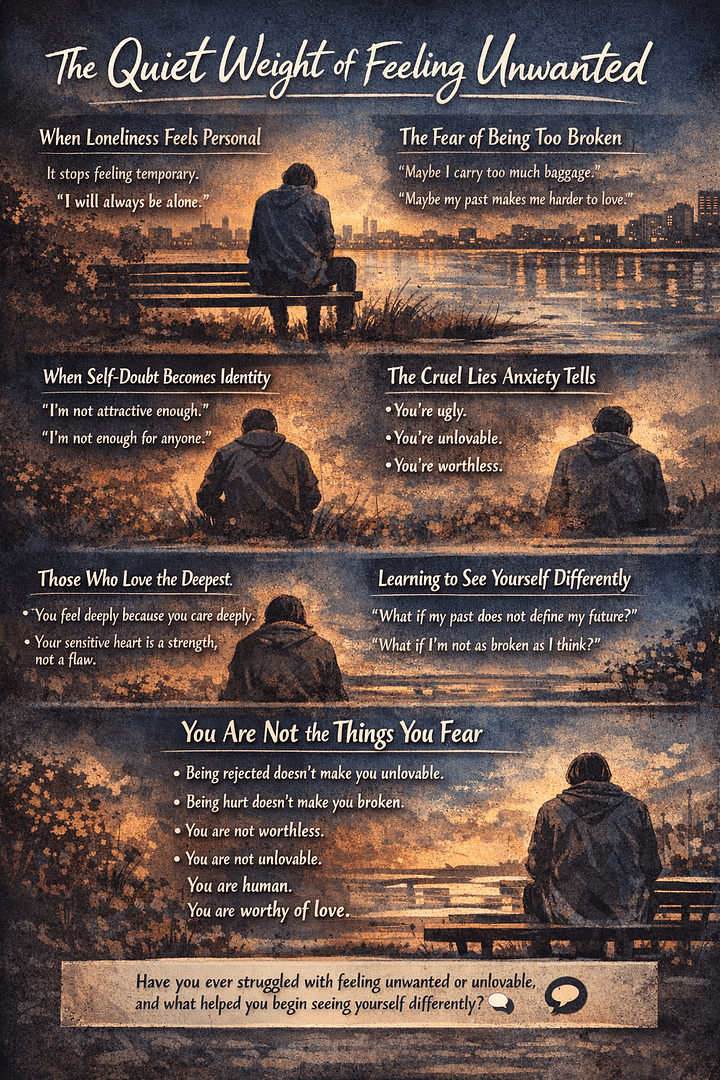
    When Loneliness Feels Personal

    Loneliness is a universal human experience. Everyone feels it at times. But when someone struggles with the anxiety of being unwanted, loneliness becomes something much more painful.

    It stops feeling temporary.

    Instead of thinking, I’m alone right now, the thought becomes, I will always be alone.

    Simple moments can trigger this feeling. A message that goes unanswered. Being the one who always reaches out first. Watching others find love and connection while you stand quietly on the outside.

    These moments might seem small to others, but to someone already battling these fears, they reinforce a painful belief: that they are somehow not enough.

    It can feel like standing in a crowded room yet still feeling invisible.

    The Fear of Being Too Broken

    Many people who struggle with these thoughts begin to see themselves as damaged or broken. They look at their past—the heartbreaks, the rejections, the moments where they opened their heart and were hurt—and they begin to believe those experiences have permanently changed them.

    They wonder if others can somehow see the cracks.

    They may think:

    Maybe I carry too much baggage.
    Maybe my past makes me harder to love.
    Maybe people can tell I’m broken.

    This belief can create a painful cycle. Because someone who feels broken may start to pull away from opportunities for connection. They may avoid expressing their feelings. They may hide parts of themselves to avoid rejection.

    In trying to protect their heart, they sometimes build walls around it.

    But those walls can also keep love from reaching them.

    When Self-Doubt Becomes Identity

    Anxiety has a powerful way of repeating certain thoughts until they begin to feel like facts. Over time, these thoughts stop sounding like fears and start sounding like truth.

    A person might begin telling themselves things like:

    I’m not attractive enough.
    I’m not interesting enough.
    I’m too much for people.
    I’m not enough for anyone.

    Eventually, those thoughts form a painful identity. A person no longer just feels unworthy—they begin to believe that they are unworthy.

    This can affect every part of life. Compliments are brushed off. Kindness feels suspicious. When someone shows interest, it can feel confusing or even unbelievable.

    Deep down, the mind is waiting for the moment when the person leaves, because that is what it has come to expect.

    The Invisible Battle

    One of the most difficult parts of this kind of anxiety is that it is often invisible to others. On the outside, someone might appear strong, kind, even confident.

    They may laugh with friends, go to work, and carry on with daily life.

    But inside, there is a quiet battle happening every day.

    They may constantly question themselves:

    Did I say something wrong?
    Do they actually want me around?
    Am I just tolerated instead of loved?

    It is exhausting to live with a mind that constantly doubts your own worth.

    The Cruel Lies Anxiety Tells

    Anxiety has a way of turning past pain into present fear. It takes a few moments of rejection and stretches them into a permanent story about who you are.

    But the things anxiety tells you are often deeply unfair.

    It may say you are ugly when beauty is subjective and far more complex than appearance.

    It may say you are unlovable when the truth is that love often depends on timing, compatibility, and circumstances far beyond your control.

    It may say you are worthless when your value as a human being has nothing to do with how others treat you.

    The mind can be incredibly convincing—but it is not always accurate.

    The People Who Feel the Most Are Often the Ones Who Love the Deepest

    There is a quiet irony in this struggle.

    Many people who feel unlovable are the ones capable of loving the most deeply.

    They notice the small details about others. They care about people’s feelings. They remember things that matter. They invest emotionally in ways that others sometimes overlook.

    Their sensitivity, which sometimes feels like a flaw, is actually one of their greatest strengths.

    They feel deeply because they care deeply.

    And in a world that often rushes past emotional connection, that kind of heart is rare.

    Learning to See Yourself Differently

    Healing from these beliefs does not happen quickly. When someone has spent years questioning their worth, it takes time to rewrite that inner narrative.

    But change begins with small moments of self-awareness.

    It begins with asking difficult but important questions:

    What if the things I believe about myself are not actually true?
    What if I have been measuring my worth by the wrong standards?
    What if my past does not define my future?

    Sometimes the first step is simply recognizing that the harsh voice in your head is not an objective judge of your value.

    It is a voice shaped by hurt.

    And hurt can be healed.

    You Are Not the Things You Fear

    Being rejected does not make you unlovable.

    Being hurt does not make you broken.

    Feeling alone does not mean you will always be alone.

    The truth is that every person carries invisible struggles. Many people who appear confident or loved have battled the same doubts in quiet moments.

    Human beings are far more fragile—and far more resilient—than we often realize.

    Your story is not finished. Your worth is not determined by the people who failed to see it.

    You are not ugly because someone did not choose you.

    You are not worthless because someone walked away.

    And you are not unlovable simply because you have not yet found the person who sees you clearly.

    Sometimes the hardest thing to believe is also the most important truth:

    You are not broken.

    You are human.

    And that alone makes you worthy of love, connection, and belonging.

    Read More Health & Wellness

  • 🥣 National Cereal Day: Celebrating the Breakfast Classic

    Advertisements

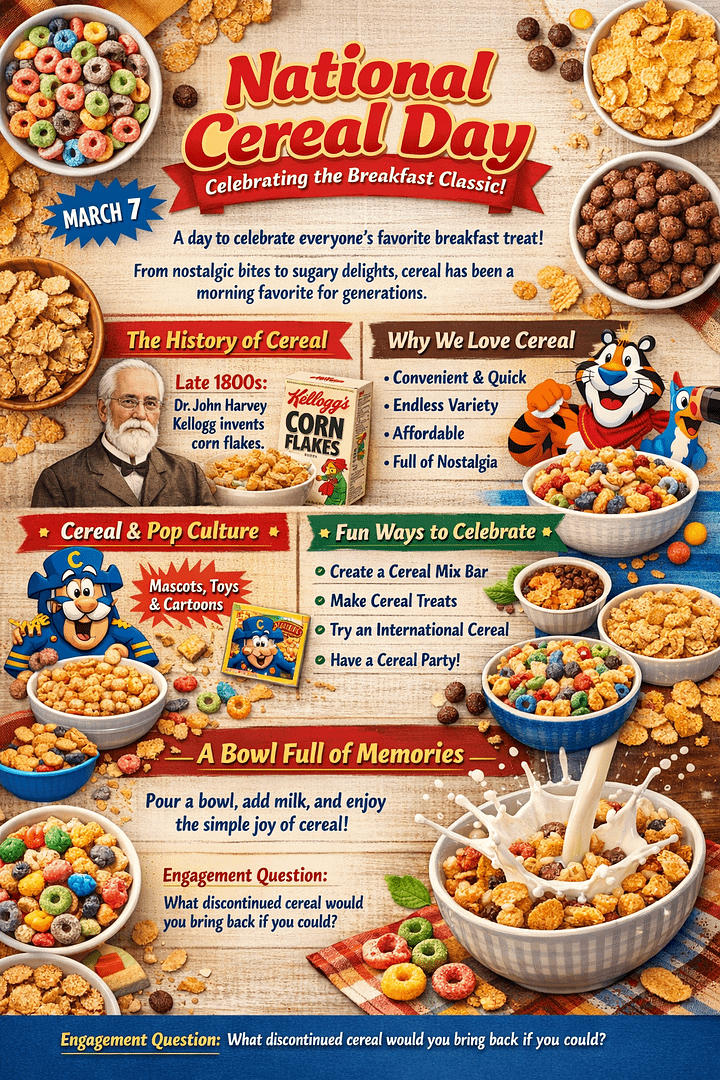
    Every year on March 7, people across the United States celebrate National Cereal Day, a day dedicated to one of the most recognizable and beloved breakfast foods ever created. From crunchy corn flakes to chocolatey puffs and fruity loops, cereal has been part of morning routines for generations.

    For many, cereal represents more than just a quick meal—it symbolizes childhood mornings, family kitchens, and the comforting simplicity of a bowl filled with crunchy goodness and cold milk. Whether eaten before school, during a late-night snack session, or even straight from the box, cereal has remained a dependable favorite in homes for over a century.

    National Cereal Day is the perfect excuse to revisit those memories and enjoy the timeless comfort of this classic breakfast staple.

    The Surprising History of Breakfast Cereal

    The story of cereal begins in the late 1800s, during a time when many health reformers believed that heavy breakfasts—often consisting of meat, fried foods, and bread—were unhealthy. Doctors and nutrition advocates began searching for lighter, plant-based alternatives.

    One of the most important figures in cereal history was John Harvey Kellogg, a physician and health reformer who worked at the Battle Creek Sanitarium in Michigan. Along with his brother Will Keith Kellogg, he experimented with grain-based foods that were easier to digest.

    In 1894, the Kellogg brothers accidentally created corn flakes while attempting to cook wheat into a digestible form. The flakes quickly became popular among patients at the sanitarium. Eventually, Will Keith Kellogg recognized the commercial potential and founded the Kellogg Company, bringing cereal to households across the country.

    Battle Creek, Michigan, soon became known as the “Cereal Capital of the World.”

    Soon after, other companies entered the cereal market, including General Mills and Post Consumer Brands, helping expand cereal varieties and making breakfast cereal a nationwide phenomenon.

    The Rise of Colorful Cereals and Mascots

    By the mid-20th century, cereal was no longer just about health—it had become entertainment. Companies began marketing cereals directly to children through television commercials, bright packaging, and lovable mascots.

    Characters like Tony the Tiger, Toucan Sam, and Cap’n Crunch became cultural icons. These mascots helped transform cereal from a simple breakfast food into a fun and exciting part of childhood.

    Many cereal boxes also included prize toys, games, puzzles, or collectible items. Kids eagerly poured through their cereal each morning hoping to find the surprise waiting inside.

    Saturday mornings became especially associated with cereal. Children across the country would sit down with a bowl of their favorite cereal while watching cartoons—a tradition that became deeply embedded in American culture.

    Why Cereal Remains So Popular

    Despite changing food trends, cereal continues to be a staple in many homes for several reasons.

    Convenience

    Few foods are as quick and easy as cereal. With no cooking required, it provides an instant meal that fits perfectly into busy mornings.

    Endless Variety

    There are hundreds of cereal types available today, including:

    Whole-grain cereals

    Granola and muesli

    High-protein cereals

    Gluten-free varieties

    Classic sweet cereals

    Organic and natural options

    This wide selection ensures that there’s something for everyone.

    Affordability

    Cereal remains an economical option for families. A single box can provide multiple servings, making it a cost-effective breakfast solution.

    Comfort and Nostalgia

    Many adults still enjoy the same cereals they loved as children. The taste, smell, and crunch can instantly bring back memories of simpler times.

    Cereal Beyond Breakfast

    While cereal is traditionally a breakfast food, people enjoy it in many different ways today.

    Some eat cereal as a late-night snack, while others use it creatively in recipes.

    Popular cereal-based treats include:

    Cereal snack bars

    Marshmallow cereal treats

    Cereal-crusted desserts

    Ice cream toppings

    Yogurt parfait layers

    Cereal has even inspired gourmet desserts in bakeries and restaurants.

    For many people, cereal is also a comfort food—something simple and satisfying when they want something quick and familiar.

    Fun Ways to Celebrate National Cereal Day

    Celebrating National Cereal Day can be as simple or creative as you want. Here are some fun ideas:

    🥣 Revisit Your Childhood Favorite
    Buy a box of the cereal you loved most growing up.

    🥣 Create a Cereal Mix Bar
    Set up bowls with different cereals and toppings like fruit, nuts, or chocolate chips.

    🥣 Try an International Cereal
    Different countries offer unique cereal flavors worth exploring.

    🥣 Make Homemade Granola
    Try baking your own cereal with oats, honey, nuts, and dried fruit.

    🥣 Host a Cereal-Themed Breakfast
    Invite friends or family and let everyone bring a different cereal to share.

    🥣 Eat Cereal for Dinner
    Sometimes the best way to celebrate is by breaking the rules and enjoying cereal at night.

    A Bowl Full of Simple Joy

    In a world where meals often become complicated or rushed, cereal remains wonderfully simple. Pour, add milk, and enjoy.

    National Cereal Day celebrates not only a popular breakfast food but also the memories and moments attached to it—childhood mornings before school, lazy weekends watching cartoons, and the comfort of a late-night snack when nothing else sounds quite right.

    For something so simple, cereal has created countless small moments of happiness in kitchens everywhere.

    So today, grab a bowl, pour your favorite cereal, add a splash of milk, and celebrate a tradition that has been brightening mornings for generations.

    Read More Holidays & National Days

  • Why Subscribing Matters: Join Me on Pickax

    Advertisements

    In today’s digital world, meaningful content can sometimes get lost in the noise of endless scrolling, algorithms, and distractions. Many creators spend hours writing, sharing stories, and opening their hearts, only to find that their work never reaches the people who would appreciate it the most. That is one reason platforms like Pickax are beginning to stand out—they give creators and readers a more direct way to connect.

    If you have enjoyed my articles, reflections, and personal pieces, I want to invite you to take the next step and subscribe to my page on Pickax:

    https://pickax.com/BrettMurphy

    Subscribing isn’t just about following another page. It’s about becoming part of a community that values thoughtful writing, honest emotion, and real human connection.

    A Place for Real Stories and Honest Conversations

    The articles I share are often inspired by real experiences and real emotions. Many of them explore themes that people carry quietly—love that isn’t returned, the courage it takes to open your heart, grief, hope, and the complicated beauty of human relationships.

    Sometimes the most powerful stories are the ones that make us pause and say, “I’ve felt that too.”

    On my Pickax page, you’ll find writing that focuses on:

    Reflections about love, longing, and emotional vulnerability

    Personal growth and the courage to be honest about our feelings

    Observations about life that many people experience but rarely talk about

    Articles inspired by moments that remind us we’re all more alike than we think

    Writing has always been a way to connect with others on a deeper level. When someone reads a piece and feels understood, a quiet bond is formed between writer and reader.

    That connection is what this space is all about.

    Why Subscribe Instead of Just Following?

    Subscribing ensures you won’t miss the content you care about. Instead of hoping you see a post, subscribing means you are intentionally choosing the voices and creators that matter to you.

    It also helps support creators who invest time and emotion into their work.

    Every article represents thought, reflection, and often personal vulnerability. When readers subscribe, it sends a powerful message: that meaningful writing still matters in a world dominated by quick headlines and short attention spans.

    Subscriptions help me continue sharing stories, perspectives, and experiences that might otherwise go unheard.

    Building a Community, Not Just an Audience

    One of the things I value most about writing is the conversations that happen afterward. Often, readers share their own stories, their own feelings, or moments in their lives that echo what they just read.

    That exchange turns writing into something much bigger than a single article—it becomes a shared experience.

    My goal with Pickax is not simply to post content, but to build a community where people feel comfortable reflecting, responding, and connecting.

    If something I write has ever resonated with you, then you’re already part of that community.

    Subscribing simply strengthens that connection.

    Join Me on Pickax

    If you’d like to continue reading my work and supporting the stories I share, I would truly appreciate your subscription.

    You can subscribe here:
    https://pickax.com/BrettMurphy

    And if you’re new to Pickax, it’s also available to download from the Apple App Store and Google Play Store, making it easy to stay connected and discover new creators who value thoughtful content.

    Writing has always been about reaching people—sometimes strangers—who happen to feel the same things we do. When those connections happen, even through a screen, they remind us that we are never as alone as we sometimes think.

    Thank you to everyone who reads, shares, and supports the words I put into the world.

    I look forward to seeing you on Pickax.

    👉 https://pickax.com/BrettMurphy

    Read More Opportunities & Growth


  • Day of the Dude: Celebrating the Chill Philosophy of The Big Lebowski

    Advertisements

    Every year on March 6, fans of laid-back living, cult cinema, and unconventional wisdom celebrate Day of the Dude. Inspired by the unforgettable character known simply as The Dude, the holiday honors a philosophy that has resonated with millions: life doesn’t always have to be rushed, complicated, or stressful.

    The Dude, portrayed by Jeff Bridges in the 1998 cult classic The Big Lebowski, has become more than just a movie character. Over the years, he has evolved into a cultural icon representing calm acceptance, humor in the face of chaos, and the simple joy of taking life one day at a time.

    For many fans, Day of the Dude is not just about celebrating a movie—it’s about embracing a mindset.

    The Cult Classic That Started It All

    When The Big Lebowski was released in 1998, it didn’t immediately achieve blockbuster success. Directed by filmmaking brothers Joel Coen and Ethan Coen, collectively known as the Coen Brothers, the film featured a strange mix of crime mystery, absurd humor, and eccentric characters.

    The plot follows Jeffrey Lebowski—nicknamed The Dude—a laid-back Los Angeles slacker who becomes entangled in a complicated kidnapping scheme after being mistaken for a wealthy man with the same name. All The Dude really wants is compensation for a rug that “really tied the room together,” but the situation spirals into a bizarre journey involving nihilists, eccentric millionaires, performance artists, and bowling tournaments.

    What initially puzzled some audiences eventually became part of the film’s charm. Over time, fans discovered layers of humor, philosophy, and quotable dialogue that made the movie endlessly rewatchable.

    Today, The Big Lebowski is widely regarded as one of the greatest cult films ever made.

    The Dude: An Unlikely Cultural Hero

    Most cinematic heroes are defined by bravery, ambition, or extraordinary talent. The Dude is none of those things—and that is precisely what makes him special.

    The Dude lives a remarkably simple life. He wears comfortable clothes—often a bathrobe and sandals—drinks White Russians, listens to music, and spends most of his time bowling with his friends Walter and Donny.

    Despite the chaos that unfolds around him, The Dude rarely loses his cool. While other characters shout, threaten, and panic, he remains calm, often responding with confusion or humor rather than anger.

    His famous line, “The Dude abides,” perfectly captures his worldview. To abide means to endure, to persist, and to accept life as it comes. Instead of fighting every obstacle with stress or aggression, The Dude simply moves through life with patience and resilience.

    In a world where people are constantly pressured to hustle, compete, and achieve more, The Dude’s relaxed outlook feels almost revolutionary.

    From Movie Character to Philosophy

    The influence of The Dude extended beyond cinema and into an unexpected place: real-world philosophy.

    Inspired by the character’s relaxed attitude toward life, a movement called Dudeism was founded by Oliver Benjamin. While it has a humorous tone, Dudeism contains surprisingly meaningful ideas about how to live a balanced life.

    The philosophy encourages followers—often called “Dudeists”—to embrace principles such as:

    Taking it easy in a stressful world

    Practicing patience and tolerance

    Avoiding unnecessary conflict

    Finding joy in everyday moments

    Maintaining humor during difficult times

    Dudeism often draws comparisons to ancient philosophies like Taoism and Buddhism, which also emphasize harmony, simplicity, and acceptance.

    While not everyone takes Dudeism literally as a religion, many people appreciate the reminder that life doesn’t always need to be taken so seriously.

    How Day of the Dude Is Celebrated

    True to its relaxed spirit, Day of the Dude isn’t about elaborate events or strict traditions. Instead, people celebrate in ways that reflect The Dude’s easygoing lifestyle.

    Some popular ways fans mark the occasion include:

    Watching The Big Lebowski
    Many fans celebrate with a movie night dedicated to the film that started it all. Reciting favorite lines has become part of the fun.

    Bowling with Friends
    Bowling is central to the movie’s setting, making it a natural way to celebrate. Some bowling alleys even host themed nights dedicated to the film.

    Enjoying The Dude’s Favorite Drink
    The White Russian—made with vodka, coffee liqueur, and cream—has become synonymous with the character.

    Dressing Like The Dude
    Fans sometimes celebrate by wearing bathrobes, sandals, or sunglasses, channeling The Dude’s famously casual style.

    Taking Time to Relax
    Perhaps the most authentic way to honor the day is simply to slow down. Turn off the noise, take a break from stress, and enjoy the moment.

    The Enduring Appeal of The Dude

    More than two decades after its release, The Big Lebowski continues to inspire fan gatherings, festivals, and endless online discussions. The film’s humor, memorable characters, and quirky storytelling keep attracting new audiences each year.

    But the lasting popularity of The Dude goes deeper than nostalgia.

    His character speaks to something universal: the desire to navigate life without being overwhelmed by it.

    In modern society, people are constantly surrounded by deadlines, expectations, and pressures. The Dude offers a refreshing alternative—a reminder that peace of mind can come from letting go of things we cannot control.

    Sometimes, the most powerful response to chaos is simply to remain calm and keep going.

    Why We Still Need the Dude Today

    In many ways, Day of the Dude feels more relevant now than ever. The world moves faster than it did when The Big Lebowski was released in 1998. Technology keeps us constantly connected, and the pressure to always be productive can feel overwhelming.

    The Dude’s philosophy encourages something many people forget to do: pause.

    Taking a break, enjoying time with friends, laughing at life’s absurdities, and letting go of unnecessary stress are small but meaningful ways to improve our well-being.

    As simple as it sounds, learning to “abide” can be a powerful life skill.

    Final Thoughts

    Day of the Dude may have started as a playful tribute to a beloved movie character, but it has grown into something more meaningful. It celebrates not only a cult classic film but also a philosophy centered on patience, kindness, and balance.

    Whether you spend the day bowling with friends, watching The Big Lebowski, or simply relaxing with your favorite drink, the spirit of the holiday remains the same:

    Slow down. Laugh a little more. Worry a little less.

    And remember—no matter how strange life gets—

    The Dude abides.

    Read More Holidays & National Days

  • The Truth That Comes Out When the Walls Come Down

    Advertisements

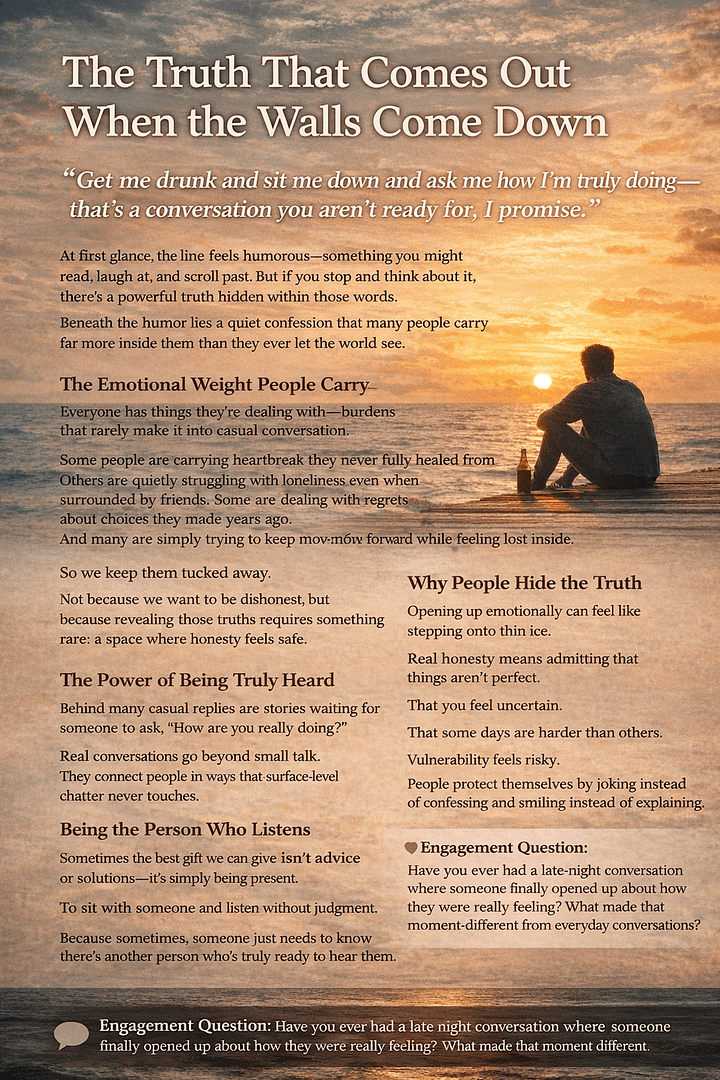
    “Get me drunk and sit me down and ask me how I’m truly doing—that’s a conversation you aren’t ready for, I promise.”

    At first glance, the line feels humorous—something you might read, laugh at, and scroll past. But if you stop and think about it, there’s a powerful truth hidden within those words. Beneath the humor lies a quiet confession that many people carry far more inside them than they ever let the world see.

    Most of us have become masters of the polite response. When someone asks, “How are you?” the answer almost always comes automatically.

    “I’m good.”
    “Doing fine.”
    “Can’t complain.”

    These phrases have become social shorthand—quick, simple replies designed to keep conversations moving and emotions neatly tucked away. They allow us to navigate daily interactions without revealing the deeper layers of what we’re actually feeling.

    But the truth is, those answers are rarely the full story.

    The Emotional Weight People Carry

    Everyone has things they’re dealing with—burdens that rarely make it into casual conversation.

    Some people are carrying heartbreak they never fully healed from.
    Others are quietly struggling with loneliness even when surrounded by friends.
    Some are dealing with regrets about choices they made years ago.
    And many are simply trying to keep moving forward while feeling lost inside.

    Life has a way of layering experiences on top of each other. Over time, those layers become stories we carry within us—stories that are often too complex, too vulnerable, or too painful to casually share.

    So we keep them tucked away.

    Not because we want to be dishonest, but because revealing those truths requires something rare: a space where honesty feels safe.

    Why People Hide the Truth

    Opening up emotionally can feel like stepping onto thin ice. When someone asks how you’re really doing, answering honestly means exposing parts of yourself that you usually keep guarded.

    It means admitting that things aren’t perfect.
    That you feel uncertain.
    That some days are harder than others.

    For many people, vulnerability feels dangerous because they’ve learned—through experience—that not everyone is prepared for it. Sometimes when people open up, the response they receive is awkward silence, quick advice, or someone trying to change the subject.

    So over time, people learn to protect themselves by keeping things light.

    They joke instead of confessing.
    They smile instead of explaining.
    They say they’re fine even when they’re anything but.

    The Role of Lowered Defenses

    That’s where the quote’s reference to alcohol comes in—not as encouragement, but as symbolism.

    When people relax or let their guard down, the walls they’ve carefully built around their emotions can begin to soften. The things they normally keep hidden suddenly feel easier to say.

    Late-night conversations often have this effect. The world quiets down, distractions fade, and people begin speaking more honestly than they would during the day.

    In those moments, you sometimes hear the real answers:

    “I’m actually struggling more than people realize.”
    “I miss someone I can’t talk to anymore.”
    “I’m not sure where my life is going.”

    These are the truths that rarely appear in casual daytime conversation.

    The Power of Being Truly Heard

    At its core, the quote reveals something deeply human: many people are waiting for someone who genuinely wants to hear the truth.

    Not someone who asks out of politeness.
    Not someone looking for a quick answer.

    But someone willing to sit through the real conversation.

    Real conversations can be messy. They might involve sadness, frustration, confusion, or unresolved emotions. But they also create something incredibly valuable: connection.

    When someone finally speaks honestly about what they’re carrying, they’re not just sharing their struggles—they’re sharing trust.

    And being heard without judgment can be one of the most healing experiences a person can have.

    Why Deep Conversations Matter

    In a world filled with constant noise, real conversations have become rare. Social media highlights the best moments of people’s lives, while everyday interactions often stay at surface level.

    But beneath those surfaces, people are craving authenticity.

    They want conversations that go deeper than small talk.
    They want moments where they can put down the emotional armor they wear every day.

    Those moments remind us that we’re not alone in our struggles. They remind us that everyone is navigating their own complicated story.

    And sometimes, simply knowing someone is willing to listen can lighten a burden that’s been carried for far too long.

    Learning to Ask the Right Question

    The deeper message behind the quote isn’t really about alcohol or dramatic confessions. It’s about the courage required to ask—and answer—a simple question honestly.

    “How are you really doing?”

    It’s a question that invites truth instead of routine. But asking it means being prepared for the possibility that the answer might be complicated.

    It might take time.
    It might involve emotions.
    It might reveal things you didn’t expect.

    But those are often the conversations that matter the most.

    Being the Person Who Listens

    Sometimes the greatest gift we can give someone isn’t advice, solutions, or perfectly chosen words. Sometimes it’s simply our presence.

    To sit with someone.
    To listen without rushing them.
    To let them say what they’ve been holding inside.

    Because behind many quiet smiles and casual replies are stories waiting to be told.

    And every once in a while, someone just needs another person who’s truly ready to hear them.

    Read More Health & Wellness

  • When You Feel Like Nobody’s First Choice

    Advertisements

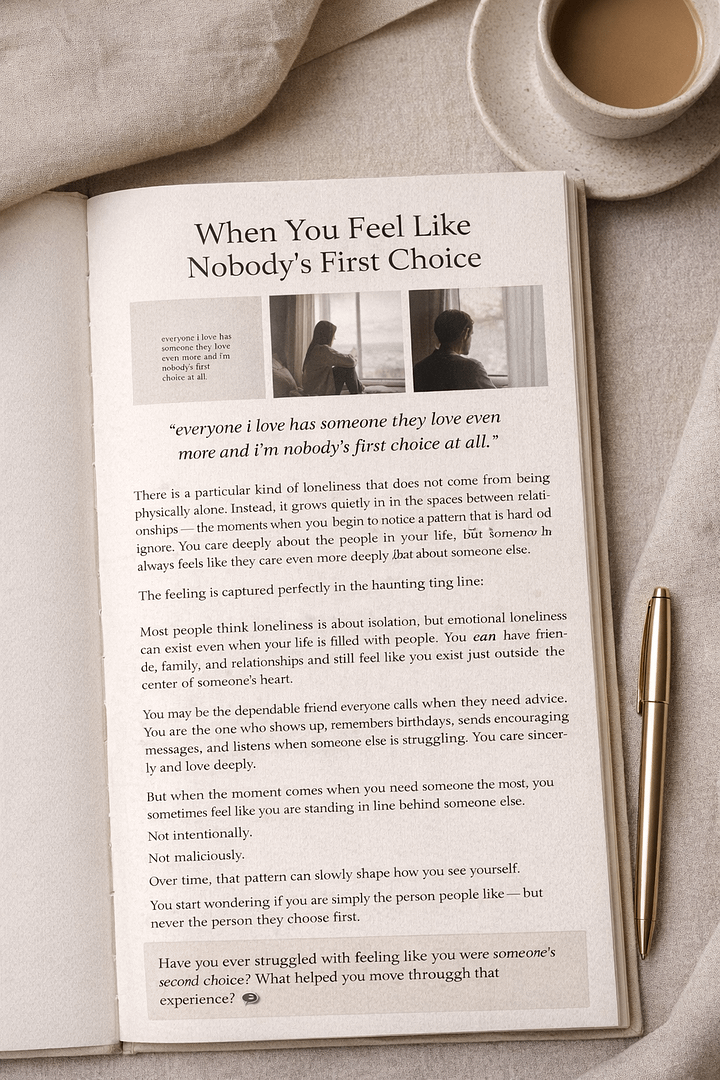
    There is a particular kind of loneliness that does not come from being physically alone. Instead, it grows quietly in the spaces between relationships—the moments when you begin to notice a pattern that is hard to ignore. You care deeply about the people in your life, but somehow it always feels like they care even more deeply about someone else.

    The feeling is captured perfectly in the haunting line:

    “everyone i love has someone they love even more and i’m nobody’s first choice at all.”

    It is a thought that many people carry privately, often afraid to admit it out loud. Because once you say it, you are acknowledging a fear that touches something very vulnerable: the fear of not being chosen.

    The Quiet Weight of Emotional Second Place

    Most people think loneliness is about isolation, but emotional loneliness can exist even when your life is filled with people. You can have friends, family, and relationships and still feel like you exist just outside the center of someone’s heart.

    You may be the dependable friend everyone calls when they need advice. You are the one who shows up, remembers birthdays, sends encouraging messages, and listens when someone else is struggling. You care sincerely and love deeply.

    But when the moment comes when you need someone the most, you sometimes feel like you are standing in line behind someone else.

    Not intentionally.
    Not maliciously.
    But consistently.

    Over time, that pattern can slowly shape how you see yourself.

    You start wondering if you are simply the person people like—but never the person they choose first.

    Loving Deeply in a World of Hesitation

    People who experience this feeling are often the same people who love the hardest. They are emotionally attentive and deeply empathetic. They notice small changes in someone’s voice, the slight shift in someone’s mood, or the unspoken sadness behind a smile.

    They give their energy generously because caring comes naturally to them.

    However, this emotional openness can also make them vulnerable. When you invest your heart so fully in others, every imbalance becomes more noticeable. Every time someone chooses someone else first, it feels like confirmation of a painful narrative forming inside your mind.

    You begin asking quiet questions:

    What am I missing?
    Why am I never the one people choose first?
    Is there something wrong with me?

    These questions can linger for years, even when there are no simple answers.

    When Comparison Becomes a Silent Enemy

    Social media and modern communication can amplify these feelings. Every photo, every public declaration of love, every visible friendship dynamic can create the illusion that everyone else is someone’s priority.

    Meanwhile, you may feel like you are always supporting roles in other people’s stories.

    The danger of this mindset is that it often leads to comparison. You begin measuring your worth against the relationships of others. You look at couples, close friendships, or tight family bonds and assume that you somehow fall short.

    But relationships are complex. What we see on the surface rarely tells the full story.

    Still, the emotional impact of comparison can be powerful. It can convince someone that they are destined to always be “almost enough” but never truly chosen.

    The Emotional Cost of Always Being Strong

    Another hidden aspect of this experience is the role you may have unintentionally taken on: the strong one.

    People who appear emotionally resilient often become the support systems for everyone around them. Because they seem capable, others lean on them during difficult times. Because they seem stable, others assume they do not need the same level of care.

    But strength can sometimes become a mask.

    Behind that dependable presence may be someone who quietly longs for a moment when someone else says, “You matter to me most.”

    Not as an afterthought.
    Not as a backup.
    But as a priority.

    The Truth About Being Chosen

    The painful belief that you are nobody’s first choice often has less to do with your worth and more to do with timing, circumstance, and emotional compatibility.

    People enter our lives at different stages of their own emotional journeys. Some are not ready for deep connection. Some are healing from past wounds. Others may already be attached to relationships that shape their priorities.

    This does not diminish the value of the love you offer.

    In fact, the ability to love deeply is one of the rarest and most meaningful qualities a person can have.

    The challenge is learning to give that love without losing yourself in the process.

    Becoming Your Own First Choice

    One of the most transformative shifts someone can make is learning to choose themselves first.

    This does not mean becoming selfish or closing yourself off emotionally. Instead, it means recognizing that your value should not be determined by who prioritizes you.

    When you begin to respect your own worth, several things start to change.

    You stop chasing validation from people who cannot give it.

    You stop investing emotional energy in relationships that consistently place you second.

    And most importantly, you begin creating space in your life for the people who will truly see you.

    The Love That Feels Different

    When the right connection enters your life, it does not feel like competition. It does not require constant questioning or quiet insecurity.

    It feels steady.

    You do not have to wonder where you stand because the other person makes it clear. They include you in their life without hesitation. They choose you not because you asked for it, but because their heart naturally gravitates toward you.

    In those moments, the old fear begins to fade.

    You realize that you were never unworthy of being someone’s first choice.

    You were simply waiting for someone who recognized your value.

    A Different Ending to the Story

    The feeling that “everyone you love loves someone else more” can be incredibly painful. But it does not define your future or the relationships you will eventually experience.

    Sometimes the people who feel overlooked are the very people who will one day be cherished the most. Their empathy, loyalty, and emotional depth become the foundation of powerful connections when they finally meet someone capable of appreciating them fully.

    The truth is simple, even if it takes time to believe:

    You are not meant to be everyone’s first choice.

    You are meant to be the right person’s first choice.

    And when that happens, it will not feel like you are competing for someone’s heart.

    It will feel like you finally came home.

    Read More Of Love & Relationships

  • 🍪 Chocolate Chip Cookie Week: Celebrating America’s Favorite Sweet Treat

    Advertisements

    Few desserts bring the same feeling of comfort and nostalgia as a warm chocolate chip cookie. Soft in the middle, slightly crisp on the edges, and filled with rich chocolate pieces, this beloved treat has become a staple in kitchens across the world. Chocolate Chip Cookie Week is the perfect time to celebrate this iconic dessert and the happiness it has delivered for generations.

    From family kitchens to professional bakeries, chocolate chip cookies have earned a special place in our hearts. The smell alone—warm butter, vanilla, sugar, and melting chocolate—can instantly transport people back to childhood memories of baking with parents or grandparents. This simple dessert carries with it a sense of comfort that few foods can match.

    The Sweet History Behind the Cookie

    The story of the chocolate chip cookie begins in the late 1930s with Ruth Wakefield, owner of the Toll House Inn in Whitman, Massachusetts. While preparing a batch of butter cookies for guests, Wakefield added chopped pieces of semi-sweet chocolate into the dough, expecting them to melt throughout the batter.

    Instead, the chocolate softened but held its shape, creating small pockets of chocolate inside each cookie. The result was a delicious surprise that quickly became popular with guests at the inn.

    Soon, the recipe was published in newspapers and cookbooks across the country. The cookie became so popular that the chocolate company Nestlé struck a deal with Wakefield to print the recipe on its chocolate bar packaging. In return, she received a lifetime supply of chocolate.

    From that moment forward, chocolate chip cookies became an American baking tradition.

    Why Chocolate Chip Cookies Became So Popular

    Chocolate chip cookies stand out because they are incredibly simple to make, yet endlessly satisfying. The basic recipe contains only a handful of ingredients: butter, sugar, eggs, flour, vanilla, baking soda, and chocolate chips.

    Despite this simplicity, small changes can create completely different cookie experiences.

    Some bakers prefer soft and chewy cookies with a slightly underbaked center. Others love thin, crispy cookies with golden edges and a caramelized flavor. There are also thick bakery-style cookies loaded with chocolate chunks that have become popular in modern bakeries.

    Chocolate chip cookies are also incredibly adaptable. Bakers often add ingredients like:

    Chopped walnuts or pecans

    Dark chocolate or white chocolate chips

    Sea salt sprinkled on top

    Peanut butter or caramel swirls

    Oats or coconut flakes

    Each variation offers a new twist on the classic recipe, proving that chocolate chip cookies can evolve while still keeping their timeless charm.

    The Science of the Perfect Cookie

    Part of the magic of baking cookies lies in the science behind them. Small adjustments in ingredients and baking techniques can dramatically change the texture and flavor.

    For example:

    Butter temperature matters.
    Melted butter tends to produce denser cookies, while softened butter helps create lighter, fluffier dough.

    Brown sugar vs. white sugar.
    Brown sugar contains molasses, which adds moisture and chewiness to cookies.

    Chilling the dough.
    Many bakers chill their cookie dough before baking, allowing flavors to develop and preventing cookies from spreading too thin.

    Baking time.
    A difference of just one or two minutes in the oven can determine whether a cookie is soft and gooey or crisp and crunchy.

    These little details allow bakers to create cookies exactly the way they like them.

    Fun Ways to Celebrate Chocolate Chip Cookie Week

    Chocolate Chip Cookie Week is the perfect excuse to enjoy this classic treat and share it with others. Whether you are an experienced baker or someone who simply loves cookies, there are plenty of fun ways to celebrate.

    Bake a classic batch
    Sometimes the best way to celebrate is the simplest—bake a traditional chocolate chip cookie recipe and enjoy them fresh from the oven.

    Try a new recipe
    Experiment with gourmet ingredients like dark chocolate chunks, sea salt, espresso powder, or even stuffed cookie centers.

    Host a cookie swap
    Invite friends or coworkers to bake their favorite cookie recipes and exchange them with one another. Everyone gets to try something new.

    Visit local bakeries
    Many bakeries create specialty chocolate chip cookies, from oversized bakery-style treats to stuffed cookies filled with marshmallow or Nutella.

    Bake with family
    Chocolate chip cookies are one of the easiest recipes for children to help with, making them perfect for family baking days.

    A Cookie That Connects Generations

    Chocolate chip cookies have a special way of bringing people together. They appear at birthday parties, school bake sales, holiday gatherings, and quiet nights at home. For many families, baking cookies is a tradition passed down from one generation to the next.

    Grandparents share recipes with grandchildren. Parents teach kids how to measure flour and stir dough. Friends bond over late-night baking sessions and trays of cookies fresh from the oven.

    These moments turn a simple dessert into something meaningful.

    The Timeless Joy of Chocolate Chip Cookies

    In a world that often moves too fast, chocolate chip cookies remind us to slow down and enjoy simple pleasures. A glass of milk, a warm cookie, and a few minutes to savor the moment can make an ordinary day feel special.

    Chocolate Chip Cookie Week celebrates more than just a dessert—it celebrates comfort, tradition, creativity, and the small moments that bring joy into everyday life.

    So whether you bake your own batch, buy one from your favorite bakery, or share cookies with friends and family, take a moment this week to enjoy one of the sweetest traditions ever created.

    Because sometimes happiness really is as simple as a warm chocolate chip cookie.

    Read More Holidays & National Days

Exit mobile version