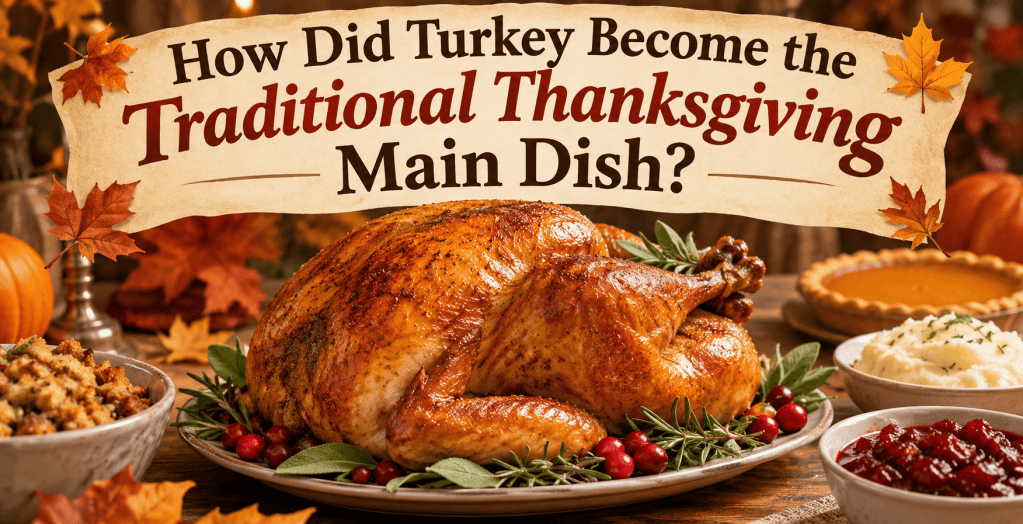
Thanksgiving is one of America’s most recognizable holidays, bringing families and friends together around tables filled with traditional foods. From mashed potatoes and stuffing to cranberry sauce and pumpkin pie, certain dishes have become inseparable from the celebration. However, no food represents Thanksgiving quite like the roasted turkey.
Every November, millions of Americans prepare turkey as the centerpiece of their Thanksgiving dinner. Whether roasted, smoked, deep-fried, or grilled, turkey has become so closely associated with the holiday that Thanksgiving is often called “Turkey Day.”
But how did turkey become the traditional Thanksgiving main dish? Was turkey served at the first Thanksgiving in 1621? And why did Americans choose turkey over chicken, beef, pork, or other meats?
The answer involves early American history, colonial farming practices, nineteenth-century traditions, influential writers, and the gradual development of Thanksgiving into a national holiday.
Understanding how turkey earned its place at the Thanksgiving table reveals how American food traditions develop and change over generations.
Was Turkey Served at the First Thanksgiving in 1621?
One of the most common beliefs about Thanksgiving is that the Pilgrims and Native Americans gathered around a table featuring a large roasted turkey.
However, historical evidence does not confirm that turkey was served at the famous 1621 harvest celebration in Plymouth, Massachusetts.
The gathering involved English colonists and members of the Wampanoag people, who shared a harvest celebration lasting approximately three days.
Only a limited number of firsthand accounts describe the event, and neither provides a complete menu.
Edward Winslow, an English colonist who participated in the celebration, described the colonists hunting wildfowl and the Wampanoag bringing five deer.
Wildfowl could have included several types of birds, such as ducks, geese, and possibly wild turkeys.
However, Winslow did not specifically identify turkey as one of the birds served.
This means turkey may have appeared at the first Thanksgiving, but historians cannot say for certain.
What historians do know is that venison and wildfowl were important parts of the celebration.
The familiar image of a perfectly roasted turkey surrounded by stuffing, cranberry sauce, and mashed potatoes developed much later.
Why Were Wild Turkeys Common in Early America?
Wild turkeys were native to North America long before European colonists arrived.
These large birds lived in forests and woodlands throughout much of the eastern United States and other parts of the continent.
Indigenous peoples had hunted and eaten wild turkeys for centuries. Turkeys were also domesticated in parts of the Americas long before European settlement.
When European settlers arrived, they encountered a bird that was already an established food source.
Wild turkeys offered several advantages.
They were relatively large, provided substantial amounts of meat, and could feed multiple people.
Unlike smaller birds that might serve only a few individuals, one turkey could provide enough food for a family gathering.
Turkeys were also familiar to settlers, who began raising domesticated birds alongside chickens, ducks, and geese.
Over time, turkey became an increasingly practical choice for large meals and special occasions.
Its availability and size helped establish the foundation for its future association with Thanksgiving.
Why Did Early Americans Choose Turkey for Holiday Meals?
Before Thanksgiving became a nationally recognized holiday, American families celebrated harvests and special occasions with various meats.
Depending on the region and household, holiday dinners might feature chicken, goose, duck, pork, beef, venison, or turkey.
Turkey gradually became especially popular because of several practical advantages.
1. Turkey Could Feed a Large Family
One of the biggest reasons turkey became associated with Thanksgiving was its size.
A large turkey could provide enough meat for an extended family gathering.
This made it particularly useful for celebrations involving relatives, neighbors, and guests.
Instead of preparing several smaller birds, a household could roast one large turkey and serve it with vegetables, bread, and other dishes.
2. Turkeys Were Raised on American Farms
By the eighteenth and nineteenth centuries, domesticated turkeys were familiar farm animals in many American communities.
Farmers could raise them for meat, and households could purchase birds from local markets.
Although availability varied by region and income, turkeys became an established part of American agriculture.
Their presence on farms made them a natural candidate for seasonal celebrations.
3. Turkey Was Suitable for Special Occasions
Turkey was not necessarily an everyday meal for many American families.
Preparing a large bird required time, fuel, and effort.
Because of this, turkey could be reserved for important occasions when families wanted something more elaborate than their usual meals.
Thanksgiving provided the perfect opportunity.
A large roasted turkey symbolized hospitality, abundance, and the importance of sharing food with others.
4. Turkey Fit the Harvest Season
Thanksgiving developed from traditions of giving thanks for successful harvests and other blessings.
Autumn was an important time for farmers preparing for winter.
Turkeys raised during the warmer months could be ready for slaughter in the fall.
This seasonal connection made turkey a practical addition to autumn celebrations.
When Did Turkey Become a Thanksgiving Tradition?
Turkey did not become America’s Thanksgiving centerpiece overnight.
The tradition developed gradually, particularly in New England, where annual thanksgiving celebrations became increasingly established.
During the eighteenth century, roasted turkey appeared among the foods served at special dinners.
By the early nineteenth century, descriptions of New England Thanksgiving meals frequently included turkey.
Cookbooks, newspaper articles, and family traditions helped reinforce its popularity.
As Thanksgiving celebrations spread beyond New England, the foods associated with the holiday traveled with them.
Turkey became more than simply another meat served at dinner.
It increasingly represented the Thanksgiving celebration itself.
However, one influential American writer played an especially important role in popularizing the holiday and its traditional foods.
How Did Sarah Josepha Hale Help Make Turkey a Thanksgiving Tradition?
Sarah Josepha Hale was one of the most influential figures in the development of modern American Thanksgiving.
Hale was an author, editor, and longtime advocate for establishing Thanksgiving as a national holiday.
She is also remembered as the author of the nursery rhyme “Mary Had a Little Lamb.”
During the nineteenth century, Hale promoted Thanksgiving through her writing and editorial work.
She believed the holiday could encourage family unity, gratitude, and a shared national identity.
In her 1827 novel Northwood, Hale described a New England Thanksgiving dinner featuring roasted turkey.
Her descriptions helped popularize an idealized version of Thanksgiving centered around family gatherings and abundant food.
Later, as editor of Godey’s Lady’s Book, she continued advocating for Thanksgiving celebrations.
The magazine reached a large audience of American women and helped spread ideas about holiday meals, household traditions, and family celebrations.
Hale’s influence helped strengthen the association between Thanksgiving and foods such as roasted turkey, stuffing, and pumpkin pie.
She did not invent the tradition of eating turkey at Thanksgiving, but she helped popularize it nationally.
Her decades-long campaign also contributed to Thanksgiving becoming an officially recognized national observance.
What Did Abraham Lincoln Have to Do With Thanksgiving Turkey?
In 1863, President Abraham Lincoln issued a proclamation calling for a national day of Thanksgiving.
The proclamation came during the American Civil War, when the country was deeply divided.
Lincoln encouraged Americans to observe Thanksgiving on the last Thursday of November.
The proclamation helped establish a more unified national Thanksgiving tradition, although the holiday’s observance and official date continued to evolve.
Importantly, Lincoln did not declare turkey the official Thanksgiving food.
The association between turkey and Thanksgiving already existed, particularly in New England.
However, as the national observance became more widespread, the holiday customs promoted in newspapers, magazines, and cookbooks gained popularity.
Roasted turkey was among the most recognizable of these customs.
Lincoln’s proclamation therefore helped create the conditions for turkey to become a nationwide Thanksgiving tradition.
Why Did Turkey Become More Popular Than Goose or Chicken?
Turkey was not the only bird Americans enjoyed during holiday celebrations.
Goose, duck, and chicken were also common choices.
In some households, these birds were easier to obtain or better suited to smaller families.
Nevertheless, turkey offered several advantages that helped it become the dominant Thanksgiving centerpiece.
| Meat | Why it was served | Thanksgiving advantage or limitation |
|---|---|---|
| Turkey | Large bird raised for meat | Could feed many guests |
| Goose | Traditional festive poultry | Rich flavor but often fattier |
| Chicken | Common household poultry | Smaller birds might be needed for large groups |
| Duck | Popular in some regions | Smaller size and richer meat |
| Beef | Common celebratory meat | Less closely associated with New England Thanksgiving imagery |
| Pork | Widely available farm meat | Remained popular but did not become the national holiday symbol |
Turkey was especially well suited to the image of a large family gathered around one impressive main dish.
As illustrated holiday meals became popular in magazines and advertisements, the appearance of a whole roasted turkey helped reinforce its symbolic role.
A large golden-brown bird placed in the center of the table became a recognizable image of Thanksgiving abundance.
How Did Thanksgiving Turkey Become Popular Across America?
During the nineteenth and early twentieth centuries, Thanksgiving traditions spread throughout the United States.
Several developments contributed to turkey becoming the standard main dish.
Cookbooks Standardized Thanksgiving Recipes
American cookbooks increasingly featured recipes for roasting turkey, preparing stuffing, and making gravy.
These recipes helped families reproduce traditional holiday meals.
As cooking instructions became more accessible, preparing a Thanksgiving turkey became an established household practice.
Newspapers Promoted Traditional Thanksgiving Menus
Newspapers published Thanksgiving menus, cooking advice, and advertisements for holiday ingredients.
Roasted turkey frequently appeared as the centerpiece of these suggested meals.
Repeated exposure helped strengthen the expectation that Thanksgiving dinner should include turkey.
Grocery Stores Made Turkey More Accessible
As food distribution systems improved, more Americans gained access to commercially raised turkeys.
Refrigeration, transportation, and modern food retailing made it easier to purchase poultry beyond local farms.
Families who did not raise their own animals could increasingly buy a turkey for their holiday meal.
Poultry Farming Expanded
During the twentieth century, commercial turkey production grew significantly.
Selective breeding and changes in farming practices increased the availability of larger, meatier birds.
This made turkey more practical for mass-market holiday consumption.
As production expanded, turkey became firmly established as the traditional American Thanksgiving main dish.
When Did Thanksgiving Become Known as Turkey Day?
The nickname “Turkey Day” developed because turkey became so closely associated with Thanksgiving.
The expression appeared in American usage by the nineteenth century and became increasingly familiar over time.
As turkey dinners became a defining feature of the holiday, the nickname offered a playful way to refer to Thanksgiving.
Today, “Turkey Day” appears in advertising, television programs, social media posts, and everyday conversations.
The nickname demonstrates how completely turkey has become connected to the holiday.
Although Thanksgiving is about gratitude, family, community, and tradition, the food most Americans immediately associate with the celebration is turkey.
How Did the Presidential Turkey Pardon Tradition Begin?
Another famous Thanksgiving turkey tradition involves the president of the United States.
Each year, a turkey is ceremonially spared from becoming Thanksgiving dinner.
However, the history of the presidential turkey pardon is more complicated than many people realize.
Presidents received turkeys as gifts long before the modern ceremony developed.
During the twentieth century, poultry organizations began presenting Thanksgiving turkeys to presidents in increasingly publicized events.
In 1963, President John F. Kennedy declined to eat a turkey presented to him, saying that the bird would be allowed to live.
However, this was not yet an established annual presidential pardon ceremony.
President Ronald Reagan jokingly referred to pardoning a turkey in 1987.
In 1989, President George H. W. Bush formally used the language of a presidential pardon for a Thanksgiving turkey.
That event helped establish the modern annual tradition.
Today, the presidential turkey pardon has become a lighthearted part of America’s Thanksgiving celebrations.
It also reflects the turkey’s unique status as a national holiday symbol.
Why Is Roasted Turkey Still the Most Traditional Thanksgiving Main Dish?
Even though Americans now have access to countless food choices, roasted turkey remains strongly associated with Thanksgiving.
One reason is tradition.
Families often prepare the same holiday foods year after year because those dishes connect generations.
A Thanksgiving turkey may remind someone of childhood dinners, grandparents, family recipes, or gatherings with loved ones.
Preparing turkey can become a ritual that carries emotional meaning beyond the meal itself.
Another reason is presentation.
A whole roasted turkey creates a natural centerpiece for a holiday table.
Carving the turkey and serving it to guests can become an important part of the celebration.
Turkey also pairs well with traditional Thanksgiving side dishes.
Stuffing, mashed potatoes, gravy, cranberry sauce, sweet potatoes, and roasted vegetables complement its mild flavor.
These foods have become so closely connected that many Americans consider them parts of one traditional Thanksgiving meal.
How Has Thanksgiving Turkey Changed Over the Years?
Although turkey remains the centerpiece of many Thanksgiving dinners, preparation methods have changed considerably.
Early American households often roasted birds over open fires or cooked them using fireplaces and other traditional cooking equipment.
Modern kitchens offer many additional methods.
Some families continue preparing classic oven-roasted turkey with herbs, butter, and stuffing served alongside it.
Others prefer different approaches.
Popular Thanksgiving turkey preparations now include:
-
Traditional roasted turkey: Seasoned and cooked in the oven until tender and golden brown.
-
Smoked turkey: Slowly cooked with smoke for a distinctive flavor.
-
Deep-fried turkey: Cooked in hot oil to create crispy skin and juicy meat, requiring careful outdoor safety precautions.
-
Grilled turkey: Prepared over indirect heat for a smoky, roasted flavor.
-
Spatchcocked turkey: Flattened by removing the backbone, allowing faster and more even cooking.
-
Turkey breast: A smaller option for households that do not need an entire bird.
These variations show how Americans continue adapting Thanksgiving traditions to their preferences.
The preparation may change, but turkey remains an important part of the celebration.
Do All Americans Eat Turkey on Thanksgiving?
Although turkey is the traditional Thanksgiving main dish, not every American family serves it.
Food traditions vary according to culture, region, personal preference, household size, and dietary needs.
Some families prepare ham, roast beef, chicken, seafood, or vegetarian dishes instead.
Others combine traditional Thanksgiving foods with recipes reflecting their cultural heritage.
For example, Thanksgiving tables may feature tamales, lasagna, macaroni and cheese, barbecue, or regional specialties alongside traditional side dishes.
Vegetarian and vegan households may serve stuffed squash, lentil loaf, or plant-based alternatives.
These variations demonstrate that Thanksgiving has never had one universal menu.
Turkey may be the most recognizable symbol of the meal, but the holiday’s meaning does not depend on serving a particular food.
Frequently Asked Questions About Thanksgiving Turkey History
Did the Pilgrims Eat Turkey at the First Thanksgiving?
Possibly, but there is no definitive historical evidence confirming that turkey was served at the 1621 Plymouth harvest celebration.
Historical accounts mention wildfowl and venison, but they do not specifically identify turkey.
Who Started the Tradition of Eating Turkey on Thanksgiving?
No single person invented the tradition.
Turkey gradually became associated with Thanksgiving through New England harvest celebrations, colonial food practices, nineteenth-century cookbooks, and changing American holiday customs.
Sarah Josepha Hale helped popularize the image of turkey as the centerpiece of Thanksgiving dinner.
Why Is Turkey Eaten on Thanksgiving Instead of Chicken?
Turkey is larger than chicken and can feed more people, making it well suited to large holiday gatherings.
Its association with New England Thanksgiving traditions also helped establish it as the preferred holiday bird.
Did Abraham Lincoln Make Turkey a Thanksgiving Tradition?
No. Abraham Lincoln helped establish a national Thanksgiving observance in 1863, but turkey was already associated with the holiday.
His proclamation helped spread Thanksgiving customs that included roasted turkey.
What Meat Was Originally Served at Thanksgiving?
At the 1621 Plymouth harvest celebration, historical accounts confirm that the Wampanoag brought deer and that the English colonists obtained wildfowl.
Other foods may have been served, but the complete menu is unknown.
Why Is Thanksgiving Called Turkey Day?
Thanksgiving is nicknamed Turkey Day because turkey became the holiday’s most recognizable traditional main dish.
The nickname reflects the strong cultural connection between Thanksgiving and roasted turkey.
Is Turkey the Official National Food of Thanksgiving?
No. The United States has not designated turkey as the official national food of Thanksgiving.
Its status comes from longstanding cultural traditions rather than federal law.
When Did Americans Start Eating Turkey for Thanksgiving?
Turkey appeared at American harvest and holiday meals during the colonial period and became especially associated with New England Thanksgiving celebrations.
By the nineteenth century, roasted turkey was widely recognized as a traditional Thanksgiving dish.
Final Thoughts: How Turkey Became an American Thanksgiving Tradition
Turkey became the traditional Thanksgiving main dish through centuries of changing food customs, agricultural practices, family celebrations, and cultural influences.
The tradition did not begin with a single meal or presidential declaration.
Instead, it developed gradually as Americans adopted turkey for its availability, size, suitability for large gatherings, and connection to autumn harvest celebrations.
New England Thanksgiving customs helped establish the association, while influential writers such as Sarah Josepha Hale promoted the image of a family holiday centered around roasted turkey.
Abraham Lincoln’s 1863 Thanksgiving proclamation helped strengthen the holiday’s national importance, and the growth of commercial poultry farming made turkey increasingly accessible to American households.
Over time, turkey became more than a practical choice for feeding a crowd.
It became a symbol of family gatherings, gratitude, hospitality, and shared traditions.
The reason turkey remains the traditional Thanksgiving main dish is not simply that Americans enjoy eating it. It is that generations of families have made it part of how they celebrate and remember the holiday.
Whether Thanksgiving dinner features a whole roasted turkey, a smaller turkey breast, or an entirely different main course, the deeper meaning of the holiday remains the same: gathering with others, appreciating what matters, and sharing a meal in a spirit of gratitude.
Leave a Reply