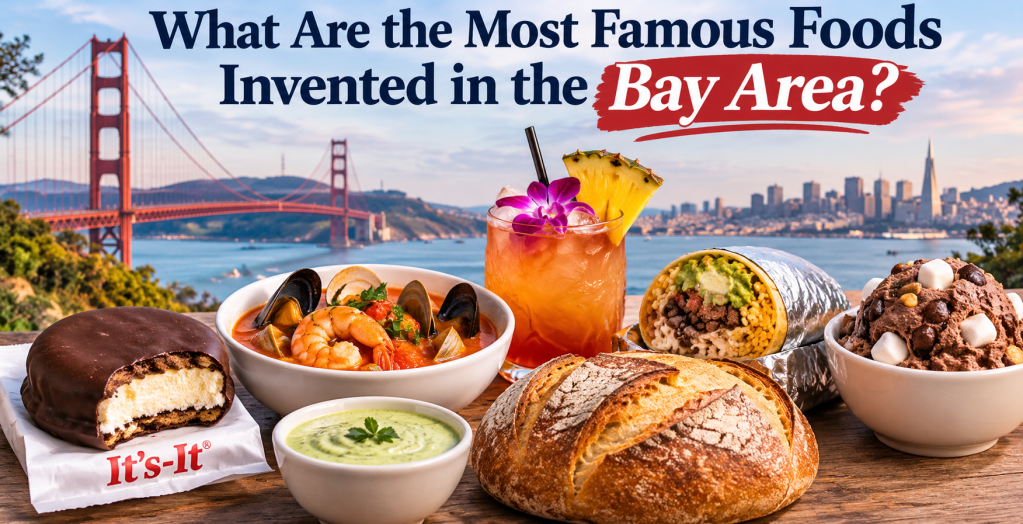
The San Francisco Bay Area is famous for its beautiful coastline, cultural diversity, innovative spirit, and extraordinary food scene. From San Francisco’s historic waterfront to Oakland’s diverse neighborhoods and the agricultural communities surrounding the region, the Bay Area has helped shape American food culture for generations.
While many people associate the region with sourdough bread, seafood, and California cuisine, some of its most recognizable foods were actually created or popularized right here in Northern California.
The Bay Area has introduced distinctive desserts, creative seafood dishes, famous chocolate treats, and restaurant specialties that eventually became popular throughout the United States.
But what foods were actually invented in the San Francisco Bay Area?
Some have well-documented origins, while others have competing historical claims. Understanding the difference between foods invented locally and foods made famous by Bay Area restaurants reveals just how influential the region has been.
Here are some of the most famous foods invented, developed, or popularized in the San Francisco Bay Area.
1. It’s-It Ice Cream Sandwich
One of the most recognizable desserts invented in the Bay Area is the It’s-It ice cream sandwich.
This frozen treat originated in San Francisco in 1928 when George Whitney created it at Playland-at-the-Beach, a popular amusement park near Ocean Beach.
The original dessert featured vanilla ice cream sandwiched between two oatmeal cookies and dipped in dark chocolate.
The combination was simple but irresistible.
Unlike traditional ice cream sandwiches made with soft chocolate wafers, It’s-It offered a chewy oatmeal cookie texture surrounded by a crisp chocolate coating.
The dessert quickly became a favorite among visitors to Playland.
Even after the amusement park closed in 1972, the ice cream sandwich continued to grow in popularity.
Today, It’s-It remains one of Northern California’s most beloved frozen desserts.
Why it’s famous: It’s-It represents a genuine San Francisco food invention that developed into a recognizable regional brand.
2. Cioppino
Cioppino is one of the most famous dishes associated with San Francisco.
This hearty seafood stew developed among Italian immigrant fishermen working along the city’s waterfront during the late nineteenth century.
Many of these fishermen came from the Liguria region of Italy, particularly around Genoa.
They brought traditions of preparing seafood stews using whatever fresh fish and shellfish were available.
In San Francisco, those traditions evolved into cioppino.
The dish typically combines:
-
Dungeness crab
-
Clams
-
Mussels
-
Shrimp
-
White fish
-
Tomatoes
-
Garlic
-
Onions
-
Wine
-
Herbs
The seafood simmers in a flavorful tomato-based broth and is commonly served with crusty bread.
Cioppino reflects the Bay Area’s fishing heritage and Italian American culinary traditions.
Although it was influenced by older Mediterranean seafood stews, the San Francisco version became a distinctive regional creation.
Why it’s famous: Cioppino is one of the clearest examples of a dish developed in San Francisco that became an American seafood classic.
3. The Mai Tai Cocktail
Although many people associate the Mai Tai with Hawaii, one of its most widely recognized origin stories places its invention in Oakland, California.
In 1944, Victor Bergeron, better known as Trader Vic, reportedly created the cocktail at his Oakland restaurant.
The original Mai Tai combined aged rum, lime juice, orange curaçao, orgeat syrup, and rock candy syrup.
According to Trader Vic’s account, the drink received its name after a Tahitian guest exclaimed that it was excellent.
The cocktail eventually became a symbol of American tiki culture.
However, its history is disputed.
Donn Beach, another influential tiki bartender, also claimed connections to an earlier drink that may have influenced the Mai Tai.
Despite the competing claims, Oakland remains central to the cocktail’s history.
Why it’s famous: The Mai Tai helped establish the Bay Area as an important birthplace of American tiki cocktail culture.
4. Rocky Road Ice Cream
Rocky Road is one of America’s most popular ice cream flavors, and its history has strong connections to Oakland.
The flavor became famous in 1929 through Oakland-based ice cream makers.
William Dreyer of Dreyer’s Grand Ice Cream is frequently credited with creating a version containing chocolate ice cream, marshmallows, and nuts.
However, Fentons Creamery and other individuals associated with Oakland’s ice cream industry also have historical claims involving the flavor’s development.
The precise inventor remains disputed.
What is clear is that Oakland played an important role in making Rocky Road a nationally recognized ice cream flavor.
The name is often associated with the difficult economic conditions surrounding the beginning of the Great Depression.
Rocky Road helped demonstrate that ice cream could include multiple textures and mix-ins rather than simply relying on flavoring.
Why it’s famous: Oakland helped turn chocolate ice cream with marshmallows and nuts into an enduring American favorite.
5. The Hangtown Fry
Hangtown Fry is a historic California dish with connections to the Gold Rush.
It combines eggs, oysters, and bacon into a rich breakfast or brunch dish.
The recipe is traditionally associated with Placerville, formerly known as Hangtown, in the Sierra Nevada foothills.
According to popular accounts, the dish emerged during the Gold Rush when a newly wealthy miner ordered an expensive meal featuring ingredients considered luxurious at the time.
Although Hangtown Fry was not invented in the Bay Area itself, San Francisco restaurants helped preserve and popularize it.
The dish became associated with historic establishments such as Tadich Grill.
Its combination of oysters, eggs, and bacon reflects the wealth and unusual culinary traditions of nineteenth-century California.
Why it’s famous: Hangtown Fry became part of San Francisco’s historic restaurant culture, even though its commonly accepted birthplace lies outside the Bay Area.
6. Green Goddess Dressing
Green Goddess dressing is one of San Francisco’s most famous culinary creations.
The creamy green dressing was developed at the Palace Hotel in San Francisco during the 1920s.
It is commonly credited to chef Philip Roemer, who created it in connection with actor George Arliss and his play The Green Goddess.
The dressing traditionally contains ingredients such as mayonnaise, herbs, anchovies, lemon juice, and vinegar.
Its fresh green appearance comes from ingredients including parsley, chives, and tarragon.
Green Goddess dressing became popular as a salad dressing and later as a dip and sauce.
Today, variations appear in grocery stores, restaurants, and homemade recipes throughout the country.
Some modern versions use Greek yogurt, avocado, or other ingredients to create a lighter texture.
Why it’s famous: Green Goddess dressing is a well-established San Francisco invention that became a lasting part of American salad culture.
7. The Irish Coffee at Buena Vista Cafe
Irish coffee was not originally invented in San Francisco.
The drink originated in Ireland, where chef Joe Sheridan is widely credited with developing it during the 1940s.
However, San Francisco played a major role in introducing the drink to American audiences.
In 1952, the Buena Vista Cafe began serving its famous version after owner Jack Koeppler and travel writer Stanton Delaplane worked to recreate the Irish drink.
The classic recipe combines hot coffee, Irish whiskey, sugar, and lightly whipped cream.
The Buena Vista became internationally known for serving Irish coffee.
Its presentation, with a floating layer of cream above the hot coffee, became part of the restaurant’s identity.
Why it’s famous: San Francisco did not invent Irish coffee, but the Buena Vista helped make it an American restaurant classic.
8. The Fortune Cookie
Fortune cookies are strongly associated with Chinese American restaurants, but their American history has important connections to San Francisco.
The cookies resemble Japanese fortune crackers that existed before the American version became popular.
One prominent origin account credits Makoto Hagiwara, who was associated with the Japanese Tea Garden in San Francisco’s Golden Gate Park.
According to this account, fortune cookies were served at the tea garden during the early twentieth century.
Another claim connects the American fortune cookie to Los Angeles.
Because of these competing histories, the exact American birthplace remains uncertain.
Nevertheless, San Francisco played a significant role in the development and popularity of fortune cookies.
The city’s Chinatown also became an important center for fortune cookie production.
Why it’s famous: Fortune cookies demonstrate how Japanese and Chinese American food traditions evolved into something widely recognized across the United States.
9. The Mission-Style Burrito
The Mission-style burrito is one of the Bay Area’s most influential contributions to American Mexican food.
This oversized burrito developed in San Francisco’s Mission District during the twentieth century.
Unlike smaller traditional burritos, the Mission-style version is known for its substantial size and generous fillings.
Common ingredients include rice, beans, meat, salsa, cheese, sour cream, and guacamole.
The ingredients are wrapped tightly inside a large flour tortilla, often with aluminum foil to help hold everything together.
Restaurants such as El Faro and La Cumbre are frequently mentioned in discussions about the burrito’s early history.
El Faro claims to have introduced the super burrito in 1961, while La Cumbre has its own longstanding place in Mission burrito history.
The exact evolution involved multiple restaurants and changing customer preferences.
Today, the Mission-style burrito has influenced taquerias throughout California and beyond.
Why it’s famous: San Francisco helped transform the burrito into the large, fully loaded meal familiar to millions of Americans.
10. Ghirardelli Chocolate Squares
San Francisco has a long chocolate-making history, and Ghirardelli is one of its most recognizable names.
Domenico Ghirardelli established his chocolate business in San Francisco in 1852.
The company became an important part of the city’s manufacturing and culinary history.
Although chocolate squares were not invented in San Francisco, Ghirardelli’s individually wrapped chocolate squares became a signature product associated with the brand.
Popular varieties include dark chocolate, milk chocolate, caramel-filled chocolate, and other specialty flavors.
Ghirardelli Square, located near Fisherman’s Wharf, remains a well-known San Francisco destination.
The historic site celebrates the company’s long connection to the city.
Why it’s famous: Ghirardelli helped establish San Francisco as a major American chocolate-making center, even though chocolate squares themselves were not a Bay Area invention.
11. San Francisco-Style Sourdough Bread
Sourdough bread existed thousands of years before San Francisco was established.
However, the city developed a distinctive sourdough tradition during the California Gold Rush.
Bakers used naturally fermented starters to produce bread with a chewy texture, crisp crust, and characteristic tangy flavor.
San Francisco’s sourdough became closely associated with the city’s bakery culture.
Boudin Bakery, established in 1849, became one of the best-known names connected to this tradition.
The bakery’s sourdough bread eventually became a signature San Francisco food.
Sourdough also became a popular accompaniment to seafood dishes, particularly clam chowder.
Today, sourdough bread bowls are among the most recognizable foods sold around Fisherman’s Wharf.
Why it’s famous: San Francisco did not invent sourdough, but it developed one of America’s most famous regional sourdough traditions.
12. The Martini and Its Bay Area Origins
The martini is one of the most recognizable cocktails in the world, and Northern California has an important place in its disputed history.
One popular origin story connects the cocktail to Martinez, California.
According to local tradition, a bartender created an early version of the drink for a customer during the nineteenth century.
Another explanation connects the martini to cocktails called the Martinez, which appeared in nineteenth-century bartending literature.
However, historians have not established that the modern martini was definitively invented in Martinez.
The cocktail evolved over time, and its precise birthplace remains uncertain.
Early versions often contained gin, sweet vermouth, bitters, and sometimes maraschino liqueur.
Modern martinis generally use gin or vodka with dry vermouth.
Why it’s famous: Martinez remains part of the historical conversation surrounding one of the world’s most famous cocktails, even though its invention claim is unproven.
13. The California Cuisine Movement
California cuisine is not a single dish, but the Bay Area played a major role in developing the cooking philosophy that eventually influenced restaurants nationwide.
During the 1970s, chefs increasingly emphasized fresh, seasonal ingredients and relationships with local farms.
Berkeley’s Chez Panisse, founded by Alice Waters in 1971, became particularly influential.
The restaurant helped popularize a style of cooking built around high-quality ingredients, seasonal produce, and relatively simple preparation.
This approach encouraged chefs to focus on freshness rather than elaborate techniques alone.
California cuisine eventually influenced restaurant menus across the United States.
Its emphasis on local sourcing and seasonal cooking remains an important part of modern American food culture.
Why it’s famous: The Bay Area helped transform how American restaurants think about ingredients, farmers, and seasonal menus.
14. The Original Popsicle and Its Oakland Connection
One of the most recognizable frozen treats in America has roots in the Bay Area.
The Popsicle is associated with Frank Epperson, who reportedly discovered the concept as a child in the San Francisco Bay Area in 1905.
According to the familiar story, Epperson accidentally left a flavored drink mixture outside overnight with a stirring stick inside.
The mixture froze, creating an early version of a frozen treat on a stick.
Years later, he developed and commercialized the idea.
Epperson received a patent in 1924 for a frozen confection.
The product eventually became known as the Popsicle.
Although the details of the childhood discovery story are difficult to verify independently, Epperson’s role in commercializing the frozen treat is well documented.
Why it’s famous: The Popsicle became one of America’s most familiar frozen desserts, with its origin story closely tied to the Bay Area.
15. The Crab Louie Salad
Crab Louie is a classic American seafood salad strongly associated with the West Coast.
The dish became popular during the early twentieth century and appeared in restaurants in San Francisco and other Pacific Coast cities.
Traditional versions feature fresh crab meat served over lettuce with ingredients such as hard-boiled eggs, tomatoes, asparagus, and a creamy dressing.
The dressing commonly contains mayonnaise, chili sauce, and seasonings.
Crab Louie became particularly popular in regions where Dungeness crab was readily available.
San Francisco restaurants helped establish the salad as an elegant seafood dish.
However, the exact birthplace remains disputed, with historical claims involving multiple West Coast cities.
Why it’s famous: Crab Louie became a signature West Coast seafood salad, and San Francisco played an important role in its popularity.
16. The San Francisco Joe’s Special
Joe’s Special is a classic San Francisco restaurant dish made with ground beef, spinach, eggs, onions, and seasonings.
The ingredients are cooked together in a skillet, creating a hearty meal that can be served for breakfast, lunch, or dinner.
The dish is strongly associated with San Francisco’s Italian American restaurant culture.
Original Joe’s, established in 1937, is among the restaurants most closely connected to its history.
The exact circumstances surrounding the recipe’s invention are not completely documented, but the dish became a recognized San Francisco specialty.
Its appeal comes from using familiar ingredients to create a filling, flavorful meal.
Many home cooks have adapted the recipe over the years.
Why it’s famous: Joe’s Special represents the practical, hearty cooking traditions that helped define San Francisco’s neighborhood restaurants.
17. The Celery Victor Salad
Celery Victor is another historic dish associated with San Francisco’s Palace Hotel.
It is generally credited to chef Victor Hirtzler during the early twentieth century.
The dish traditionally features celery that has been cooked in a seasoned broth, chilled, and served with a dressing.
Some versions include anchovies or other savory garnishes.
Although celery might seem like an unusual centerpiece for a salad today, the dish reflected an era when elaborate vegetable preparations were popular in fine dining.
Celery Victor appeared on restaurant menus and in American cookbooks.
It remains an interesting example of San Francisco’s early culinary creativity.
Why it’s famous: Celery Victor is a historically documented San Francisco specialty that reflects the city’s influential hotel dining scene.
18. The Berkeley-Style Gourmet Pizza
Pizza was certainly not invented in the Bay Area, but Berkeley helped develop a distinctive approach to gourmet pizza.
During the late twentieth century, restaurants began experimenting with unconventional toppings, seasonal vegetables, and fresh local ingredients.
Chez Panisse Café became especially influential in popularizing California-style pizza in the early 1980s.
Instead of relying exclusively on traditional toppings, chefs used ingredients such as goat cheese, fresh herbs, roasted vegetables, and seasonal produce.
These pizzas reflected the broader California cuisine movement.
The approach eventually influenced restaurants across the country.
Why it’s famous: Berkeley helped introduce a fresh, ingredient-driven style of pizza that became a major part of American restaurant culture.
19. The Bay Area’s Specialty Coffee Culture
Coffee was not invented in the Bay Area, but the region helped reshape modern American coffee culture.
Peet’s Coffee opened its first store in Berkeley in 1966.
Founder Alfred Peet emphasized freshly roasted beans, carefully sourced coffee, and darker roasting styles.
His approach influenced generations of coffee entrepreneurs.
The Bay Area later became an important center for specialty coffee companies and independent cafés.
San Francisco’s coffee scene continued evolving through businesses emphasizing small-batch roasting, single-origin beans, and careful brewing methods.
This movement helped change how Americans purchase, prepare, and appreciate coffee.
Why it’s famous: Berkeley and San Francisco played important roles in the growth of America’s specialty coffee industry.
20. The Bay Area’s Modern Food Innovations
The Bay Area continues to influence food trends through restaurants, bakeries, food technology companies, and creative chefs.
Modern culinary innovations have included new approaches to plant-based foods, artisan bread, specialty chocolate, and globally influenced restaurant menus.
The region’s diverse communities have also contributed to innovative combinations of culinary traditions.
Korean, Mexican, Chinese, Filipino, Japanese, Indian, Vietnamese, and many other food cultures have helped shape the area’s restaurant scene.
Some of these combinations become regional favorites, while others eventually spread throughout the country.
The Bay Area’s ongoing influence comes from its willingness to experiment while drawing inspiration from established culinary traditions.
Why it’s famous: The region remains an important center for food experimentation and the development of new American dining trends.
Which Famous Foods Were Actually Invented in the Bay Area?
Not every food associated with San Francisco or Oakland originated there.
Some have clear local histories, while others were imported, adapted, or popularized by Bay Area restaurants.
The following table separates several of the best-known examples.
| Food | Bay Area connection | Historical status |
|---|---|---|
| It’s-It ice cream sandwich | San Francisco, 1928 | Documented local invention |
| Cioppino | San Francisco waterfront | Developed locally from Italian traditions |
| Green Goddess dressing | San Francisco Palace Hotel | Widely credited local invention |
| Mission-style burrito | San Francisco Mission District | Locally developed style |
| Joe’s Special | San Francisco | Local restaurant specialty |
| Celery Victor | San Francisco Palace Hotel | Widely credited local invention |
| Mai Tai | Oakland | Disputed invention claim |
| Rocky Road ice cream | Oakland | Disputed inventor, strong Oakland connection |
| Popsicle | Bay Area | Epperson’s documented commercialization and local origin story |
| Fortune cookie | San Francisco | Disputed American origin |
| Martini | Martinez | Disputed origin |
| Irish coffee | San Francisco | Popularized locally, invented in Ireland |
| Sourdough bread | San Francisco | Famous regional style, not original invention |
| Hangtown Fry | Placerville | Invented outside the Bay Area |
This distinction is important because culinary history often involves more than one person, restaurant, or community.
A food can become famous in a particular city without having been invented there.
Why Has the Bay Area Invented So Many Famous Foods?
Several factors have contributed to the Bay Area’s culinary influence.
Cultural diversity
The region has welcomed immigrants from around the world for generations.
These communities brought traditional recipes, cooking methods, and ingredients that influenced local cuisine.
Italian immigrants contributed to San Francisco’s seafood traditions, while Mexican American communities helped develop the Mission-style burrito.
Asian American communities also shaped the region’s food culture through restaurants, bakeries, and food manufacturing.
Access to fresh ingredients
Northern California benefits from nearby agricultural regions, fisheries, and food producers.
Fresh seafood, vegetables, fruit, dairy products, and other ingredients have long influenced Bay Area cooking.
This access encouraged restaurants to experiment with seasonal dishes and regional specialties.
Historic restaurants and hotels
San Francisco’s early hotels and restaurants employed chefs who developed recipes for wealthy travelers, businesspeople, and local residents.
Establishments such as the Palace Hotel became important centers for culinary innovation.
Other restaurants helped preserve regional dishes and introduce them to wider audiences.
A willingness to experiment
The Bay Area has a longstanding reputation for creativity.
That attitude extends to food.
From frozen desserts and specialty cocktails to gourmet pizza and modern plant-based products, local entrepreneurs have repeatedly experimented with new ideas.
Strong neighborhood food traditions
Some of the Bay Area’s most famous dishes emerged from neighborhood restaurants rather than luxury dining establishments.
The Mission-style burrito is a perfect example.
Its popularity developed through everyday restaurant culture before influencing food businesses throughout the country.
What Is the Most Famous Food Invented in San Francisco?
Cioppino, Green Goddess dressing, and the It’s-It ice cream sandwich are among the strongest candidates.
Each represents a different part of San Francisco’s culinary identity.
Cioppino reflects the city’s fishing industry and Italian immigrant history.
Green Goddess dressing represents the influence of historic hotel restaurants.
It’s-It demonstrates how a simple amusement park dessert could become a lasting regional favorite.
The Mission-style burrito is another major contender because of its widespread influence on American Mexican food.
There is no objective way to identify one single winner, but all four have strong historical connections to San Francisco.
What Famous Food Was Invented in Oakland?
Oakland has particularly strong connections to Rocky Road ice cream and the Mai Tai cocktail.
Rocky Road became famous through Oakland’s ice cream industry, although competing invention claims make it difficult to identify one definitive creator.
The Mai Tai is closely associated with Trader Vic’s Oakland restaurant, where Victor Bergeron claimed to have created it in 1944.
Both became recognizable far beyond the Bay Area.
Oakland’s food history also reflects the city’s diverse communities and its important place in Northern California’s restaurant culture.
What Foods Did the Bay Area Make Famous Without Inventing Them?
Several foods became closely associated with the Bay Area even though they originated elsewhere.
San Francisco sourdough is one example. Sourdough fermentation existed long before the California Gold Rush, but local bakeries developed a famous regional tradition.
Irish coffee is another example. The drink originated in Ireland, but the Buena Vista Cafe helped introduce it to a broad American audience.
Ghirardelli chocolate also represents an important distinction. The company helped establish San Francisco’s chocolate-making reputation without inventing chocolate itself.
Similarly, Berkeley’s gourmet pizza movement transformed how American restaurants approached pizza without inventing the original dish.
These examples show that a region can influence food history through adaptation and popularization as well as invention.
How Did Bay Area Foods Become Popular Across America?
Many Bay Area foods began as local specialties before spreading through restaurants, commercial food production, and changing consumer preferences.
The It’s-It ice cream sandwich expanded beyond its original amusement park setting.
Rocky Road became a familiar flavor sold by ice cream manufacturers.
Green Goddess dressing appeared in grocery stores and home kitchens.
Mission-style burritos influenced Mexican American restaurants throughout the country.
California-style pizza inspired restaurants to experiment with fresh and unconventional toppings.
These foods spread because they offered something memorable, whether it was a new combination of ingredients, an appealing presentation, or a distinctive eating experience.
The Bay Area’s influence grew as visitors, restaurant owners, and food businesses introduced these ideas to other communities.
Frequently Asked Questions
Was cioppino invented in San Francisco?
Yes. Cioppino developed among Italian immigrant fishing communities in San Francisco during the late nineteenth century. It was influenced by traditional Italian seafood stews but evolved into a distinctive local dish.
Was Rocky Road ice cream invented in Oakland?
Rocky Road has strong historical connections to Oakland, particularly during the late 1920s. However, competing claims involving different ice cream makers mean the exact inventor remains disputed.
Was the Mai Tai invented in Oakland?
Trader Vic claimed to have invented the Mai Tai at his Oakland restaurant in 1944. Another tiki bartender, Donn Beach, has been connected to competing origin claims, so the history remains debated.
Did San Francisco invent sourdough bread?
No. Sourdough bread existed for thousands of years before San Francisco became a city. However, San Francisco developed a famous sourdough tradition during the Gold Rush.
Where was Green Goddess dressing invented?
Green Goddess dressing is widely credited to chef Philip Roemer at San Francisco’s Palace Hotel during the 1920s.
Was the Mission burrito invented in San Francisco?
The large, generously filled Mission-style burrito developed in San Francisco’s Mission District. Multiple restaurants contributed to its history, and its exact evolution is not attributable with certainty to one establishment.
Was the Popsicle invented in the Bay Area?
The Popsicle is associated with Frank Epperson, whose famous childhood discovery story takes place in the Bay Area. Epperson later patented and commercialized the frozen treat.
What dessert was definitely invented in San Francisco?
The It’s-It ice cream sandwich is one of the clearest examples. George Whitney created it at Playland-at-the-Beach in 1928 using ice cream, oatmeal cookies, and a chocolate coating.
Final Thoughts: The Bay Area’s Lasting Influence on American Food
The San Francisco Bay Area has contributed far more to American food culture than many people realize.
From the seafood traditions of San Francisco’s waterfront to the ice cream innovations of Oakland and the creative restaurants of Berkeley, the region has repeatedly helped shape what Americans eat and drink.
Some foods, including It’s-It ice cream sandwiches, Green Goddess dressing, and Mission-style burritos, have particularly strong claims as Bay Area creations.
Others, such as Rocky Road ice cream, the Mai Tai, and fortune cookies, have fascinating but disputed histories.
And foods such as sourdough bread and Irish coffee demonstrate how the Bay Area can make an existing tradition famous without inventing it.
What makes the region special is not simply the number of foods associated with it.
It is the combination of immigrant traditions, local ingredients, independent restaurants, culinary experimentation, and generations of people willing to create something new.
The Bay Area’s greatest contribution to American food may be its ability to take different culinary traditions, bring them together, and turn them into something unforgettable.
Leave a Reply