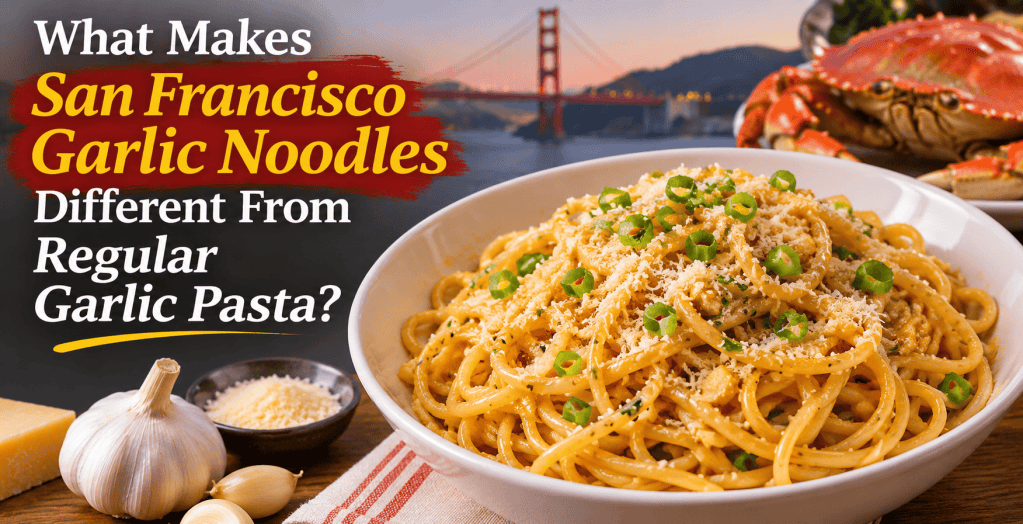
Garlic noodles may sound like a simple pasta dish, but anyone who has tasted San Francisco-style garlic noodles knows there is something special about them. Rich, buttery, savory, slightly sweet, and packed with garlic flavor, these noodles offer a completely different experience from traditional garlic pasta.
While regular garlic pasta often relies on olive oil, garlic, and a handful of Italian seasonings, San Francisco garlic noodles combine familiar pasta ingredients with Asian-inspired sauces to create a distinctive flavor.
This combination has become one of the Bay Area’s most recognizable fusion dishes, particularly in San Francisco’s Vietnamese-American food scene.
But what exactly makes San Francisco garlic noodles different from regular garlic pasta? The answer comes down to their history, ingredients, cooking techniques, and signature umami-rich flavor.
What Are San Francisco Garlic Noodles?
San Francisco garlic noodles are a Vietnamese-American fusion dish made with noodles, butter, fresh garlic, and a combination of savory Asian sauces.
Unlike traditional Italian pasta dishes, which generally emphasize olive oil, herbs, cheese, or tomatoes, San Francisco garlic noodles focus on creating a rich, deeply savory sauce that coats every strand.
The dish is especially associated with Thanh Long, a Vietnamese restaurant in San Francisco’s Outer Sunset neighborhood, and the An family’s restaurant legacy.
Thanh Long became famous for serving garlic noodles alongside roasted Dungeness crab, creating a pairing that remains closely associated with San Francisco dining.
Over time, garlic noodles became popular throughout the Bay Area, appearing in Vietnamese restaurants, Asian fusion kitchens, seafood restaurants, and home kitchens.
Today, the dish represents the cultural influences that have shaped Northern California’s food scene.
What Is the Biggest Difference Between San Francisco Garlic Noodles and Regular Garlic Pasta?
The biggest difference is the sauce.
Traditional garlic pasta generally uses a relatively simple combination of garlic, olive oil or butter, pasta water, and sometimes Parmesan cheese.
San Francisco garlic noodles typically incorporate additional ingredients that create a more complex flavor.
These commonly include:
-
Butter
-
Fresh garlic
-
Oyster sauce
-
Soy sauce
-
Fish sauce
-
Parmesan cheese
-
A small amount of sugar
Not every recipe includes all these ingredients, but the combination of garlic, butter, and savory sauces is what gives San Francisco garlic noodles their distinctive character.
The result is a dish that tastes richer, slightly sweeter, and more intensely savory than most traditional garlic pasta recipes.
Where Did San Francisco Garlic Noodles Originate?
San Francisco garlic noodles are closely connected to the city’s Vietnamese-American culinary history.
The dish is widely credited to the An family, whose restaurant Thanh Long helped popularize garlic noodles in San Francisco.
The restaurant opened in the early 1970s and became known for its combination of Vietnamese-inspired cooking and Western ingredients.
Helene An, an influential figure in the family’s restaurant business, helped develop the cuisine that made the family’s restaurants famous.
Garlic noodles became one of their signature dishes, especially when paired with roasted crab.
The original restaurant recipe is proprietary, which means most homemade versions are interpretations rather than exact reproductions.
Nevertheless, the general combination of butter, garlic, noodles, and Asian seasonings has become a defining feature of the dish.
This history makes San Francisco garlic noodles more than another pasta recipe.
They are an example of how immigrant communities helped shape the food culture of California.
How Are San Francisco Garlic Noodles Different From Italian Garlic Pasta?
Although both dishes use garlic and noodles, their ingredients and flavor profiles are noticeably different.
| Feature | San Francisco Garlic Noodles | Traditional Italian Garlic Pasta |
|---|---|---|
| Main fat | Butter | Olive oil or butter |
| Garlic flavor | Rich and concentrated | Often lighter and more aromatic |
| Seasonings | Oyster sauce, soy sauce, sometimes fish sauce | Salt, pepper, herbs, chili |
| Cheese | Often Parmesan | Parmesan or Pecorino in some recipes |
| Flavor | Buttery, savory, umami-rich, slightly sweet | Garlicky, often lighter and more olive-oil-forward |
| Common pairings | Dungeness crab, shrimp, chicken | Vegetables, seafood, or served alone |
| Culinary influence | Vietnamese-American fusion | Italian |
One important distinction is that traditional Italian garlic pasta is not always a single standardized dish.
For example, spaghetti aglio e olio typically uses garlic, olive oil, chili flakes, and pasta water without relying on butter or Asian sauces.
San Francisco garlic noodles take a different approach by layering several savory ingredients into the sauce.
Why Do San Francisco Garlic Noodles Have So Much Umami Flavor?
One of the defining characteristics of San Francisco garlic noodles is their strong umami flavor.
Umami is often described as a deep, savory taste that makes food feel especially rich and satisfying.
Several ingredients contribute to this flavor.
Oyster Sauce
Oyster sauce provides concentrated savory flavor with a touch of sweetness.
It also helps give the noodles a glossy coating.
Soy Sauce
Soy sauce contributes saltiness and additional umami.
It balances the richness of the butter and enhances the garlic flavor.
Fish Sauce
Some versions include fish sauce for another layer of savory depth.
Only a small amount is needed because fish sauce has a concentrated flavor.
Parmesan Cheese
Parmesan adds nuttiness, saltiness, and natural umami compounds.
Although cheese may seem unusual alongside Asian sauces, it works surprisingly well in this dish.
Butter
Butter creates the rich foundation that brings everything together.
When combined with garlic and the savory seasonings, it produces the distinctive flavor associated with San Francisco garlic noodles.
Why Is Butter So Important in San Francisco Garlic Noodles?
Butter plays a central role in creating the dish’s signature texture and flavor.
While many Italian garlic pasta recipes rely on olive oil, San Francisco garlic noodles commonly use generous amounts of butter.
Butter contributes three important qualities.
First, it creates richness that complements the savory sauces.
Second, it helps coat the noodles evenly, giving them a smooth, glossy appearance.
Third, it softens the sharpness of fresh garlic, allowing its flavor to blend into the sauce.
The goal is not simply to make buttery pasta.
The goal is to create a balanced sauce where butter, garlic, and umami ingredients work together.
Using unsalted butter is particularly helpful because oyster sauce, soy sauce, and fish sauce already contain significant amounts of sodium.
What Type of Noodles Are Used in San Francisco Garlic Noodles?
One interesting feature of San Francisco garlic noodles is that they often use traditional wheat pasta rather than rice noodles.
Spaghetti is one of the most common choices.
Other options include:
-
Thin spaghetti
-
Linguine
-
Egg noodles
-
Fresh wheat noodles
Spaghetti works particularly well because its long strands hold the butter and garlic sauce.
Linguine provides a slightly wider surface, allowing more sauce to cling to each noodle.
Egg noodles can produce a softer, richer texture.
Although rice noodles can be used for variations, wheat noodles are generally closer to the familiar San Francisco restaurant style.
The important factor is choosing noodles that can hold the sauce without becoming overly soft.
Why Do San Francisco Garlic Noodles Taste Slightly Sweet?
Many San Francisco garlic noodle recipes include a small amount of sugar.
This sweetness is usually subtle rather than obvious.
Sugar helps balance the salty and savory ingredients, particularly oyster sauce, soy sauce, and fish sauce.
Oyster sauce itself often contains some sweetness, so additional sugar may not always be necessary.
The ideal flavor should be predominantly garlicky, buttery, and savory.
If the noodles taste noticeably sugary, the balance may need adjustment.
The slight sweetness is another characteristic that separates San Francisco garlic noodles from many traditional Italian garlic pasta dishes.
How Do You Make San Francisco-Style Garlic Noodles at Home?
Making San Francisco-style garlic noodles at home is surprisingly simple.
Although the restaurant versions may have their own closely guarded techniques, a homemade interpretation can deliver similar buttery, savory flavors.
Ingredients
Servings: 4 | Prep time: 10 minutes | Cook time: 15 minutes | Total time: 25 minutes
-
12 ounces spaghetti or linguine
-
5 tablespoons unsalted butter
-
8 cloves garlic, finely minced
-
2 tablespoons oyster sauce
-
1 tablespoon soy sauce
-
1 teaspoon fish sauce
-
1 teaspoon sugar, optional
-
¼ cup freshly grated Parmesan cheese
-
¼ cup reserved pasta water, as needed
-
2 tablespoons chopped green onions, optional
-
Black pepper, to taste
Step 1: Cook the Pasta
Bring a large pot of water to a boil.
Add the spaghetti and cook according to the package directions until al dente.
Before draining, reserve approximately half a cup of the pasta cooking water.
Drain the noodles and set them aside.
Step 2: Prepare the Sauce
In a small bowl, combine the oyster sauce, soy sauce, fish sauce, and optional sugar.
Stir until the sugar dissolves.
Preparing the sauce ahead of time makes it easier to add everything quickly without overcooking the garlic.
Step 3: Cook the Garlic
Melt the butter in a large skillet over medium-low heat.
Add the minced garlic and cook for approximately one to two minutes, stirring frequently.
The garlic should become fragrant and softened without turning dark brown.
Burned garlic can create bitterness that overwhelms the entire dish.
Step 4: Add the Savory Sauce
Pour the prepared sauce mixture into the skillet.
Stir gently for approximately 30 seconds to combine the ingredients with the garlic butter.
Keep the heat relatively low to prevent the sauce from scorching.
Step 5: Toss the Noodles
Add the cooked spaghetti to the skillet.
Toss thoroughly until the noodles are evenly coated.
If the sauce seems too thick, add a tablespoon or two of reserved pasta water.
Continue tossing until the noodles become glossy.
Step 6: Add Parmesan Cheese
Turn off the heat.
Sprinkle the freshly grated Parmesan cheese over the noodles and toss again.
The residual heat will help the cheese blend into the sauce.
Step 7: Serve
Transfer the noodles to serving bowls.
Garnish with chopped green onions and black pepper if desired.
Serve immediately while the noodles are warm and buttery.
This recipe is a home-style interpretation of San Francisco garlic noodles, not the original proprietary Thanh Long recipe.
Why Are San Francisco Garlic Noodles Often Served With Dungeness Crab?
One of the most famous combinations in San Francisco dining is garlic noodles with roasted Dungeness crab.
Dungeness crab has long been an important part of Northern California’s seafood culture.
Its naturally sweet, delicate meat pairs especially well with rich garlic butter.
The noodles complement the crab without requiring an entirely separate flavor profile.
Both dishes emphasize garlic, butter, and savory seasonings.
The combination became particularly well known through Thanh Long and the An family’s restaurants.
Today, roasted crab and garlic noodles remain a recognizable Bay Area restaurant pairing.
For home cooks, garlic noodles also work well with crab legs, sautéed shrimp, or other seafood.
Can You Make San Francisco Garlic Noodles Without Oyster Sauce?
Yes. Although oyster sauce is a common ingredient, you can make a flavorful version without it.
Oyster sauce contributes savory depth and slight sweetness, so a substitute should provide similar qualities.
Possible alternatives include mushroom-based vegetarian oyster sauce or a combination of soy sauce and a small amount of sugar.
Mushroom sauce is especially useful because it provides a rich umami flavor without shellfish ingredients.
For a vegetarian version, use mushroom-based sauce and omit fish sauce.
For a vegan version, also replace the butter with plant-based butter and use a dairy-free Parmesan alternative or omit the cheese.
The final flavor will be somewhat different, but the noodles can still be rich and satisfying.
Are San Francisco Garlic Noodles Spicy?
Traditional San Francisco-style garlic noodles are not necessarily spicy.
Their primary flavors come from garlic, butter, and savory seasonings rather than chili peppers.
However, many restaurants and home cooks create spicy variations.
Common additions include chili crisp, red pepper flakes, sambal oelek, or fresh sliced chilies.
Chili crisp is particularly popular because it adds heat along with crunchy texture and savory flavor.
If you prefer mild noodles, the basic recipe works perfectly without any spicy ingredients.
What Proteins Go Best With San Francisco Garlic Noodles?
Garlic noodles are versatile enough to accompany many different proteins.
Dungeness Crab
The classic San Francisco pairing combines sweet crab meat with buttery garlic noodles.
Garlic Shrimp
Shrimp cooks quickly and complements the sauce without overpowering it.
Grilled Chicken
Chicken provides a mild, satisfying protein that works well with the noodles’ rich flavor.
Grilled Steak
Thinly sliced steak adds a hearty element and pairs well with the umami-rich sauce.
Crispy Tofu
Tofu absorbs the savory flavors and offers a meatless alternative.
Roasted Salmon
Salmon’s natural richness works well with garlic butter, especially when balanced with a squeeze of lemon.
These additions can turn garlic noodles from a side dish into a complete meal.
What Are the Most Common Mistakes When Making San Francisco Garlic Noodles?
Even though the recipe is simple, several mistakes can affect the finished dish.
Burning the Garlic
Garlic cooks quickly and becomes bitter when burned.
Use medium-low heat and stir frequently.
Adding Too Much Soy Sauce
Soy sauce adds flavor, but excessive amounts can make the noodles overly salty.
Start with the recommended amount and adjust only after tasting.
Overcooking the Noodles
Soft, overcooked noodles can become sticky when tossed with butter and sauce.
Cooking pasta until al dente helps preserve its texture.
Using Too Little Garlic
Garlic is the main attraction.
Using only one or two cloves will not produce the bold flavor associated with the dish.
Overheating the Parmesan
Adding Parmesan over high heat can cause it to clump.
Turn off the heat before mixing in the cheese.
Skipping the Pasta Water
A little starchy pasta water helps the sauce coat the noodles more evenly.
It can also prevent the dish from feeling overly greasy.
Are San Francisco Garlic Noodles Healthier Than Regular Garlic Pasta?
Neither dish is automatically healthier than the other.
The nutritional differences depend on the ingredients and portion sizes.
Traditional spaghetti aglio e olio typically contains olive oil, garlic, pasta, and sometimes chili flakes.
San Francisco garlic noodles commonly contain butter, oyster sauce, soy sauce, and Parmesan cheese.
Because of these ingredients, San Francisco garlic noodles may contain more saturated fat and sodium than some olive-oil-based pasta dishes.
However, recipes vary considerably.
You can make a lighter version by reducing the butter, using lower-sodium soy sauce, increasing the amount of vegetables, and serving smaller portions.
Adding broccoli, mushrooms, spinach, or snap peas can also increase the meal’s fiber and nutrient content.
The most important consideration is the overall recipe rather than assuming one style is always healthier.
Why Are San Francisco Garlic Noodles So Popular in the Bay Area?
San Francisco garlic noodles reflect the Bay Area’s diverse culinary identity.
The region has a long history of food traditions shaped by immigrant communities, local seafood, and creative restaurant cooking.
Vietnamese-American cuisine has played an important role in that history.
Garlic noodles combine familiar Western ingredients, including pasta, butter, and Parmesan, with Asian seasonings that create a distinctive flavor.
They are also approachable.
Someone unfamiliar with Vietnamese-American cuisine may recognize spaghetti and garlic butter, while the oyster sauce and other seasonings introduce a different savory dimension.
The dish is flavorful without requiring complicated preparation.
It works equally well as a restaurant specialty, family dinner, or side dish for seafood.
These qualities have helped garlic noodles remain popular across generations of Bay Area diners.
Frequently Asked Questions About San Francisco Garlic Noodles
What makes San Francisco garlic noodles unique?
Their combination of butter, garlic, oyster sauce, soy sauce, and often Parmesan creates a rich Vietnamese-American fusion dish with more layered umami flavor than typical garlic pasta.
Are San Francisco garlic noodles Vietnamese or Italian?
They are best described as Vietnamese-American fusion cuisine. The dish uses Italian-style wheat pasta and Western ingredients alongside Asian-inspired seasonings.
Do authentic San Francisco garlic noodles contain Parmesan cheese?
Many popular restaurant-inspired recipes include Parmesan. However, the original Thanh Long recipe is proprietary, so the exact ingredients and proportions are not publicly confirmed.
Can you use regular spaghetti for San Francisco garlic noodles?
Yes. Regular spaghetti is one of the most commonly used noodle options and works well with the buttery garlic sauce.
Why do garlic noodles taste different from spaghetti aglio e olio?
Spaghetti aglio e olio emphasizes garlic and olive oil, while San Francisco garlic noodles typically use butter and savory sauces that create a richer, slightly sweeter flavor.
Can San Francisco garlic noodles be made ahead of time?
Yes, although they taste best freshly prepared. Refrigerate leftovers promptly in an airtight container and use within three to four days. Reheat gently with a splash of water to loosen the sauce.
Are garlic noodles a main dish or a side dish?
They can be either. Garlic noodles are often served alongside roasted crab or other proteins, but they can also become a complete meal with chicken, shrimp, tofu, or vegetables.
Final Thoughts: What Makes San Francisco Garlic Noodles Special?
San Francisco garlic noodles stand apart from regular garlic pasta because of their distinctive combination of culinary influences.
Traditional garlic pasta often emphasizes the simplicity of garlic, olive oil, and pasta.
San Francisco garlic noodles take those familiar ingredients in a different direction by adding butter, savory Asian sauces, and sometimes Parmesan cheese to create a rich, deeply satisfying dish.
Their popularity also reflects something important about Bay Area food culture: some of the region’s most memorable dishes come from combining traditions rather than following just one.
From their association with Thanh Long and roasted Dungeness crab to the countless homemade variations enjoyed today, San Francisco garlic noodles have become an enduring part of Northern California’s culinary identity.
Whether served with fresh seafood, grilled chicken, or enjoyed on their own, these buttery, garlicky noodles offer a flavor that ordinary garlic pasta simply does not replicate.
And that unique combination of garlic, butter, umami, and San Francisco food history is exactly what makes them special.
Leave a Reply