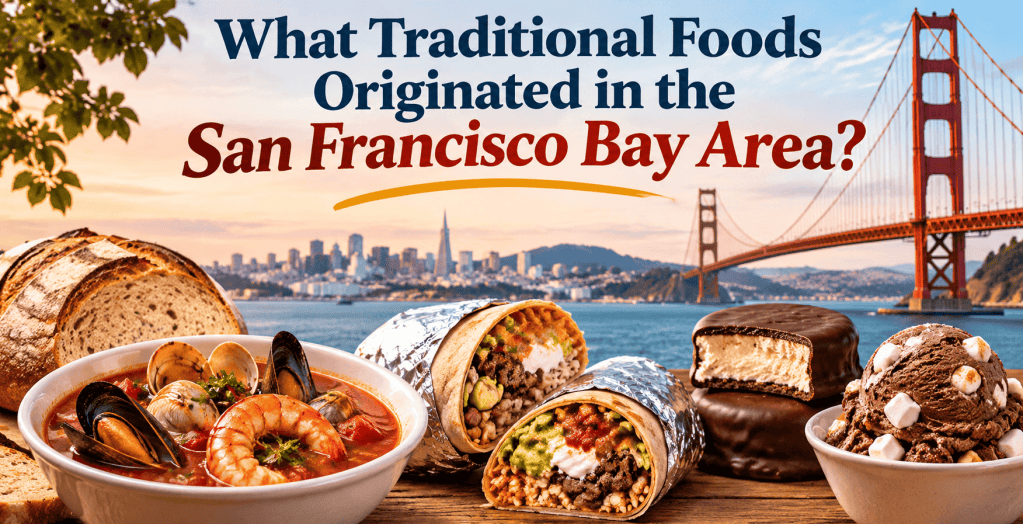
The San Francisco Bay Area is famous for its beautiful waterfront, diverse communities, historic neighborhoods, and innovative food culture. However, some of the region’s greatest contributions to American culture can be found on the dinner table.
From San Francisco sourdough bread and seafood-filled cioppino to the legendary Mission-style burrito, the Bay Area has created and popularized foods that have become recognizable throughout the United States.
What makes Bay Area cuisine especially interesting is its history. Many traditional dishes developed through the influence of Italian immigrants, Chinese communities, Mexican American families, Gold Rush settlers, and generations of local fishermen.
Some foods were invented in the Bay Area, while others were adapted from older traditions and transformed into something uniquely Northern Californian.
Understanding where these foods originated reveals how the Bay Area became one of America’s most influential culinary regions.
What Traditional Foods Were Invented in the San Francisco Bay Area?
Several famous foods have documented connections to San Francisco and its surrounding communities.
Among the best-known examples are:
-
San Francisco sourdough bread
-
Cioppino seafood stew
-
Mission-style burritos
-
Hangtown fry
-
Joe’s Special
-
Green Goddess dressing
-
Crab Louie salad
-
Fortune cookies
-
Rocky Road ice cream
-
It’s-It ice cream sandwiches
-
Irish coffee at the Buena Vista
-
Celery Victor
-
Chicken Tetrazzini
-
San Francisco-style garlic noodles
-
The Martini, according to one disputed origin story
Not every food on this list was invented entirely from scratch in the Bay Area. Some have disputed origins, while others represent local adaptations of dishes brought to California by immigrants.
Nevertheless, each has an important connection to the region’s culinary history.
1. San Francisco Sourdough Bread
Few foods represent San Francisco more strongly than sourdough bread.
Although sourdough fermentation existed thousands of years before San Francisco was founded, the city’s distinctive sourdough tradition became famous during the California Gold Rush.
In 1849, French immigrant Isidore Boudin established the bakery that would eventually become one of San Francisco’s most recognizable food institutions.
The city’s sourdough became known for its chewy texture, crisp crust, and characteristic tangy flavor.
What Makes San Francisco Sourdough Different?
Traditional sourdough relies on a naturally fermented starter containing wild yeast and lactic acid bacteria.
Instead of relying exclusively on commercial baker’s yeast, bakers maintain a living culture that helps the dough rise and develop flavor.
San Francisco sourdough is particularly associated with:
-
A tangy, slightly acidic taste
-
A thick, golden crust
-
A chewy interior
-
Long fermentation
-
Traditional round and oval loaves
Today, sourdough remains a major part of San Francisco’s food identity.
It is commonly served with butter, used for sandwiches, or hollowed into bread bowls filled with clam chowder.
Did sourdough originate in San Francisco?
No. Sourdough bread is ancient, but San Francisco developed a famous regional style that became closely associated with the city.
2. Cioppino: San Francisco’s Famous Seafood Stew
Cioppino is one of the strongest examples of a traditional dish that originated in San Francisco.
The hearty seafood stew developed among Italian immigrant fishing communities, particularly those associated with the city’s North Beach neighborhood and waterfront.
During the late nineteenth century, fishermen combined available seafood with tomatoes, wine, garlic, onions, and herbs to create a filling meal.
The result became known as cioppino.
What Is Traditionally in Cioppino?
Ingredients vary depending on the catch, but traditional versions often include:
-
Dungeness crab
-
Clams
-
Mussels
-
Shrimp
-
White fish
-
Squid
-
Tomatoes
-
Garlic
-
Onions
-
White wine
-
Olive oil
The seafood simmers in a rich tomato-based broth, creating a dish that reflects both Italian cooking traditions and Northern California’s fishing industry.
Cioppino is commonly served with crusty sourdough bread for soaking up the broth.
Unlike many Italian seafood soups, cioppino developed in the United States and is generally recognized as a San Francisco creation.
3. The Mission-Style Burrito
The Mission-style burrito is one of the Bay Area’s most influential contributions to modern Mexican American cuisine.
Developed and popularized in San Francisco’s Mission District during the twentieth century, this oversized burrito became famous for its generous fillings and distinctive preparation.
Restaurants such as El Faro and La Cumbre are frequently associated with the early development of the Mission burrito, although accounts differ about who introduced particular features first.
What Makes a Mission Burrito Different?
Unlike smaller traditional burritos, the Mission-style version typically includes several ingredients wrapped inside a large flour tortilla.
Common fillings include:
-
Carne asada, carnitas, or grilled chicken
-
Mexican-style rice
-
Beans
-
Salsa
-
Sour cream
-
Cheese
-
Guacamole
The burrito is often wrapped tightly in aluminum foil, making it easier to carry and eat.
Its popularity eventually spread beyond San Francisco, influencing burrito restaurants throughout California and across the country.
Did burritos originate in San Francisco?
No. Burritos have older Mexican roots. The oversized, heavily filled Mission-style burrito, however, is a distinctly San Francisco development.
4. Hangtown Fry
Hangtown fry is a historic California dish associated with the Gold Rush.
It is traditionally made with eggs, oysters, and bacon.
The dish is most closely connected to Placerville, formerly known as Hangtown, in California’s Sierra Nevada foothills.
According to popular stories, a newly wealthy gold miner ordered an expensive meal featuring ingredients considered luxurious at the time.
Oysters were particularly costly because transporting them inland required considerable effort.
What Goes Into Hangtown Fry?
Traditional ingredients include eggs, bacon, and oysters, which may be breaded and fried before being combined into an omelet or scramble.
Hangtown fry became part of San Francisco’s historic restaurant culture, although its commonly cited birthplace lies outside the Bay Area.
It remains an important example of Gold Rush-era Northern California cooking.
5. Joe’s Special
Joe’s Special is a classic San Francisco diner dish that combines ground beef, spinach, onions, and scrambled eggs.
Its exact origin is debated, but the dish became strongly associated with San Francisco’s Italian American restaurant culture.
It is frequently connected to the city’s historic Joe’s restaurants.
What Is in Joe’s Special?
A traditional version generally includes:
-
Ground beef
-
Fresh spinach
-
Eggs
-
Chopped onions
-
Garlic
-
Olive oil or butter
-
Salt and black pepper
The beef and onions are cooked before the spinach and eggs are added.
Everything is combined into a hearty skillet meal.
Joe’s Special is often served with sourdough toast, potatoes, or another simple side dish.
Its straightforward ingredients helped make it a lasting favorite in San Francisco diners.
6. Green Goddess Dressing
Green Goddess dressing has one of the clearest documented San Francisco origin stories.
The dressing was created at the Palace Hotel in San Francisco during the 1920s.
It is commonly credited to chef Philip Roemer, who prepared it in honor of actor George Arliss and his connection to the play The Green Goddess.
The dressing quickly became popular because of its creamy texture and distinctive herbal flavor.
What Is Green Goddess Dressing Made From?
Traditional recipes commonly feature:
-
Mayonnaise
-
Anchovies
-
Parsley
-
Chives
-
Tarragon
-
Lemon juice or vinegar
-
Seasonings
Some modern versions include sour cream, yogurt, avocado, or additional herbs.
Green Goddess dressing can be served with salads, vegetables, seafood, or grilled chicken.
Although the recipe has changed over time, its origins remain closely tied to San Francisco’s historic hotel dining scene.
7. Crab Louie Salad
Crab Louie, sometimes called Crab Louis, is a classic West Coast seafood salad.
It became popular during the early twentieth century, when Dungeness crab was a prized ingredient along the Pacific Coast.
San Francisco is one of several cities associated with its early history, although the precise birthplace remains disputed.
What Is in a Traditional Crab Louie?
Common ingredients include:
-
Fresh Dungeness crab
-
Lettuce
-
Hard-boiled eggs
-
Tomatoes
-
Asparagus
-
Cucumber
-
Louie dressing
The dressing is generally creamy and tangy, often featuring mayonnaise, chili sauce, lemon juice, and seasonings.
Crab Louie became particularly popular in hotel dining rooms and seafood restaurants.
It remains closely associated with the Bay Area’s historic Dungeness crab industry.
8. Fortune Cookies
Fortune cookies are widely associated with Chinese restaurants, but their American history has strong connections to California.
San Francisco played an important role in popularizing the modern fortune cookie.
Japanese American confectionery traditions are central to its history, and the Japanese Tea Garden in Golden Gate Park is frequently mentioned in accounts of its early development.
Los Angeles also has a competing origin claim.
Why Are Fortune Cookies Associated With San Francisco?
During the early twentieth century, fortune cookies became increasingly popular in California.
Over time, Chinese American restaurants adopted them as a familiar after-dinner treat.
San Francisco businesses also helped develop the commercial production of fortune cookies.
Today, fortune cookies are a recognizable part of American restaurant culture, even though they are not a traditional Chinese dessert.
Their history demonstrates how California’s immigrant communities influenced American food traditions.
9. Rocky Road Ice Cream
Rocky Road ice cream has important roots in Oakland.
The flavor is commonly associated with Oakland-based ice cream maker William Dreyer, who helped popularize it in 1929.
Another Oakland business, Fentons Creamery, also has a longstanding claim involving the flavor’s development.
Because of these competing accounts, the precise details of its invention remain debated.
What Is Rocky Road Ice Cream?
The classic flavor combines chocolate ice cream with marshmallows and nuts, traditionally walnuts or almonds depending on the recipe.
The combination creates contrasting textures, with smooth ice cream, soft marshmallow pieces, and crunchy nuts.
The name is often connected to the difficult economic conditions surrounding the beginning of the Great Depression.
Rocky Road eventually became one of America’s most recognizable ice cream flavors.
Its Oakland connections make it an important part of East Bay culinary history.
10. The It’s-It Ice Cream Sandwich
The It’s-It ice cream sandwich is a genuine San Francisco original.
It was introduced in 1928 by George Whitney at Playland-at-the-Beach, the amusement park that once operated near Ocean Beach.
The dessert became a favorite among visitors to the park.
What Makes an It’s-It Different?
The original treat features vanilla ice cream sandwiched between two oatmeal cookies and coated in dark chocolate.
Unlike an ordinary ice cream sandwich, the combination of oatmeal cookies and chocolate coating gives it a distinctive flavor and texture.
After Playland closed, the dessert continued to be produced and sold.
Today, It’s-It remains a nostalgic Northern California favorite.
11. Irish Coffee at the Buena Vista
Irish coffee was not invented in San Francisco.
The drink originated in Ireland, where chef Joe Sheridan is widely credited with creating it during the 1940s.
However, San Francisco played an important role in introducing and popularizing Irish coffee in the United States.
In 1952, the Buena Vista Cafe began serving its famous version after efforts by owner Jack Koeppler and travel writer Stanton Delaplane to recreate the drink.
What Is in Traditional Irish Coffee?
The classic preparation includes hot coffee, Irish whiskey, sugar, and lightly whipped cream.
The cream floats on top rather than being stirred completely into the coffee.
The Buena Vista’s version became an important San Francisco tradition.
Although the drink originated elsewhere, its American popularity is closely connected to the city’s waterfront restaurant culture.
12. Celery Victor
Celery Victor is a historic San Francisco salad that developed during the early twentieth century.
The dish is generally credited to chef Victor Hirtzler of the St. Francis Hotel.
It reflects an era when elegant hotel restaurants played an important role in American fine dining.
What Is Celery Victor?
The traditional dish features celery hearts simmered in seasoned stock, chilled, and served with a tangy dressing.
Anchovies are sometimes included.
Unlike raw celery salads, Celery Victor uses cooked celery to create a tender texture.
Although less common on modern menus, the dish remains an example of San Francisco’s early culinary creativity.
13. Chicken Tetrazzini
Chicken Tetrazzini is a creamy baked pasta dish named after Italian opera singer Luisa Tetrazzini.
The dish is often associated with San Francisco, where the singer performed and enjoyed considerable popularity.
However, its precise invention is disputed, with competing claims involving restaurants and hotels in different American cities.
What Is Chicken Tetrazzini?
Common ingredients include chicken, spaghetti or another pasta, mushrooms, butter, cream or a creamy sauce, Parmesan cheese, and seasonings.
The ingredients are combined and baked until hot and lightly browned.
Turkey Tetrazzini is a popular variation, particularly after Thanksgiving.
Even though its exact birthplace is uncertain, Chicken Tetrazzini remains part of San Francisco’s broader culinary history.
14. San Francisco-Style Garlic Noodles
Garlic noodles are a more modern Bay Area food tradition.
The dish became particularly famous through San Francisco’s Vietnamese American restaurant scene, especially Thanh Long in the Outer Sunset neighborhood.
Its rich, buttery flavor reflects the blending of Asian and Western cooking traditions.
What Makes San Francisco Garlic Noodles Unique?
Recipes vary, but popular versions feature:
-
Wheat noodles
-
Butter
-
Fresh garlic
-
Soy sauce or other savory seasonings
-
Parmesan cheese
-
Oyster sauce in some variations
The noodles are tossed in a deeply flavored garlic butter sauce.
They are frequently served alongside roasted crab, another specialty associated with San Francisco’s Vietnamese American restaurants.
This combination has become one of the city’s recognizable modern seafood meals.
15. The Martini and the Bay Area Connection
The Martini is one of the world’s most famous cocktails, and its origin has been debated for generations.
One popular California legend connects the drink to Martinez, a city northeast of San Francisco.
According to the story, a bartender created a drink known as the Martinez during the nineteenth-century Gold Rush era.
The Martinez cocktail is often discussed as a possible predecessor of the modern Martini.
However, historians have not established that the Martini was invented in Martinez.
Other origin theories involve San Francisco, New York, and the evolution of nineteenth-century gin-and-vermouth cocktails.
The Martinez connection remains a memorable part of Bay Area cocktail folklore rather than a proven origin story.
Why Did So Many Famous Foods Develop in the Bay Area?
The Bay Area’s food history was shaped by several major influences.
The California Gold Rush
The Gold Rush brought people from across the United States and around the world to Northern California.
Restaurants, bakeries, and markets developed to feed a rapidly growing population.
Sourdough bread and hearty meals became especially important during this period.
Immigration and Cultural Diversity
Italian, Chinese, Japanese, Mexican, Vietnamese, and many other communities contributed ingredients, techniques, and traditions to Bay Area cooking.
These influences helped produce foods such as cioppino, Mission burritos, fortune cookies, and garlic noodles.
Access to Fresh Seafood
San Francisco’s waterfront provided access to Dungeness crab, oysters, fish, and other seafood.
These ingredients helped shape dishes such as cioppino and Crab Louie.
Restaurants and Hotels
Historic establishments such as the Palace Hotel and St. Francis Hotel helped introduce dishes that eventually became nationally recognized.
Their chefs developed recipes that influenced American restaurant dining.
Culinary Experimentation
The Bay Area has long been associated with experimentation and cultural exchange.
Its food traditions reflect a willingness to combine familiar ingredients in new ways.
That approach continues to influence Northern California cuisine today.
Which Traditional Bay Area Foods Are Still Popular Today?
Many historic Bay Area creations remain popular, although some are easier to find than others.
| Food | Bay Area connection |
| Sourdough bread | San Francisco baking tradition |
| Cioppino | San Francisco waterfront |
| Mission burrito | Mission District |
| Rocky Road ice cream | Oakland |
| It’s-It sandwich | San Francisco’s Playland |
| Green Goddess dressing | Palace Hotel |
| Garlic noodles | San Francisco Vietnamese American cuisine |
| Joe’s Special | San Francisco diners |
Sourdough, Mission burritos, and garlic noodles are especially recognizable in contemporary Bay Area dining.
Older dishes such as Celery Victor and Hangtown fry are less common but remain historically significant.
Frequently Asked Questions About Traditional Bay Area Foods
What food was actually invented in San Francisco?
Cioppino, Green Goddess dressing, the It’s-It ice cream sandwich, and the Mission-style burrito are among the strongest examples of foods developed in San Francisco. Other dishes, such as Joe’s Special and Celery Victor, also have important local origin stories.
What famous dessert originated in the Bay Area?
Rocky Road ice cream has strong historical connections to Oakland, while the It’s-It ice cream sandwich originated in San Francisco in 1928.
Did San Francisco invent sourdough bread?
No. Sourdough is an ancient method of breadmaking. San Francisco became famous for its particular sourdough tradition during and after the California Gold Rush.
What seafood dish originated in San Francisco?
Cioppino is one of the city’s best-known original seafood dishes. It developed among Italian immigrant fishing communities and typically combines several kinds of seafood in a tomato-based broth.
What Mexican food originated in San Francisco?
The Mission-style burrito developed in San Francisco’s Mission District. It is known for its large flour tortilla, generous fillings, and tightly wrapped preparation.
What famous food originated in Oakland?
Rocky Road ice cream is one of Oakland’s most famous culinary contributions, although competing accounts exist concerning who first developed the flavor.
Are fortune cookies originally from San Francisco?
San Francisco played an important role in the American development and popularization of fortune cookies, but their exact origin is disputed. Japanese confectionery traditions and competing California origin claims are part of their history.
Final Thoughts: The Bay Area’s Lasting Influence on American Food
The San Francisco Bay Area has contributed far more to American cuisine than many people realize.
Its food history includes Gold Rush baking traditions, Italian American seafood stews, Mexican American burritos, historic hotel recipes, and desserts that became national favorites.
Some foods, including cioppino and Green Goddess dressing, have particularly strong San Francisco origin stories. Others, such as Rocky Road ice cream and the Mission burrito, demonstrate the culinary influence of Oakland and San Francisco’s diverse neighborhoods.
Equally important are foods that were not invented in the region but became uniquely associated with it, including sourdough bread and Irish coffee.
Together, these dishes reveal a larger story about immigration, community, innovation, and the way local traditions can influence an entire country.
The Bay Area’s greatest culinary legacy is not a single recipe. It is the remarkable combination of cultures and traditions that turned Northern California into one of America’s most distinctive food regions.
Leave a Reply