
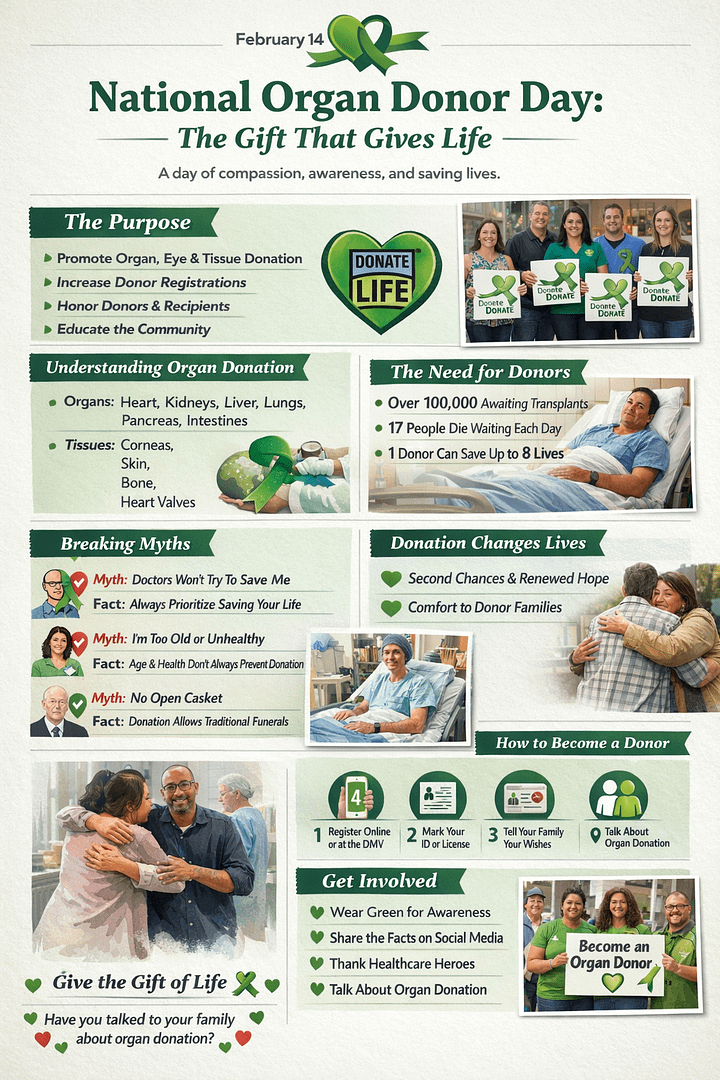
National Organ Donor Day, observed annually on February 14, stands as one of the most meaningful observances of the year — a day devoted to compassion, generosity, and the extraordinary power of human connection. While Valentine’s Day celebrates love between partners, friends, and families, National Organ Donor Day reminds us that love can also be expressed through a selfless decision that saves lives long after we are gone.
This day raises awareness about organ, eye, and tissue donation while honoring donors, supporting recipients, and encouraging conversations that can ultimately transform tragedy into hope.
🌱 The Purpose Behind National Organ Donor Day
National Organ Donor Day was created to educate the public about the urgent need for registered donors and to dispel myths surrounding organ donation. It also serves as a tribute to those who have given the ultimate gift — the gift of life.
Organizations like Donate Life America and the United Network for Organ Sharing coordinate national awareness campaigns, manage transplant systems, and work to ensure organs are matched fairly and ethically with patients in need.
The day focuses on four key goals:
Increasing donor registrations
Honoring donors and donor families
Celebrating transplant recipients
Educating communities about donation facts
❤️ Understanding Organ Donation
Organ donation occurs when a person allows healthy organs or tissues to be transplanted into someone whose organs have failed due to illness, injury, or genetic conditions.
Organs That Can Be Donated
Heart
Kidneys
Liver
Lungs
Pancreas
Intestines
Tissues and Other Donations
Corneas (restore vision)
Skin (helps burn victims heal)
Bone and tendons (restore mobility)
Heart valves
A single donor can save up to eight lives through organ donation and improve dozens more through tissue donation.
📊 The Growing Need for Donors
Every day, thousands of individuals wait anxiously for a transplant that could give them more time with loved ones. For many patients, organ failure limits everyday life — simple tasks like walking, working, or even breathing become difficult.
Key realities include:
New patients are added to transplant waiting lists daily.
Many people wait years for a compatible organ.
Some patients never receive the transplant they need in time.
The shortage of registered donors remains the greatest challenge in transplantation medicine.
🧠 Breaking Common Myths About Organ Donation
Misunderstandings often prevent people from registering. National Organ Donor Day works to replace fear with facts.
Myth: Doctors won’t try as hard to save registered donors.
Fact: Medical teams treating patients are completely separate from transplant teams. Saving your life is always the first priority.
Myth: I’m too old or unhealthy to donate.
Fact: Medical professionals evaluate donation eligibility at the time of death — many people qualify regardless of age or health history.
Myth: Organ donation conflicts with religion.
Fact: Most major religions support organ donation as an act of compassion and charity.
Myth: Donation prevents traditional funeral arrangements.
Fact: Open-casket funerals are still possible in most cases.
🌍 The Emotional Impact of Donation
Organ donation is not only a medical procedure — it is a deeply human experience that connects strangers through shared humanity.
For Recipients
Receiving a transplant often means:
Freedom from life-support treatments like dialysis
Renewed energy and independence
The chance to celebrate milestones once thought impossible
Many recipients describe their transplant anniversary as a “second birthday.”
For Donor Families
Though donation often follows profound loss, families frequently find comfort knowing their loved one’s legacy continues through others. Acts of remembrance, letters of gratitude, and awareness events help keep that legacy alive.
🏥 The Science and Coordination Behind Transplants
Organ transplantation requires extraordinary coordination among hospitals, surgeons, transportation teams, and national registries.
When a donor is identified:
Medical professionals evaluate organ viability.
Matching systems compare donors with recipients based on compatibility, urgency, and location.
Surgical teams work quickly — some organs must be transplanted within hours.
Recipients undergo life-changing surgery followed by careful recovery and lifelong monitoring.
The process represents one of modern medicine’s most remarkable achievements, blending technology, compassion, and teamwork.
✅ How to Become an Organ Donor
Registering as an organ donor is simple but powerful:
Sign up through your state donor registry or at the DMV.
Mark donor status on your driver’s license or ID card.
Inform family members of your decision.
Family awareness is essential because loved ones are often involved in confirming donation wishes.
💚 Ways to Participate in National Organ Donor Day
You can honor the day in meaningful ways:
Wear green to promote awareness
Share educational posts online
Thank transplant healthcare workers
Attend local awareness events or donor drives
Start conversations about donation with friends and family
Even one conversation can inspire someone to register — potentially saving multiple lives.
🌟 A Legacy That Lives On
National Organ Donor Day reminds us that humanity is connected in profound ways. A single decision made today can become tomorrow’s miracle for someone else — a heartbeat restored, eyesight regained, or years of life returned.
Organ donation transforms loss into hope and grief into generosity. It represents love in its purest form: giving without expecting anything in return.
Choosing to register as an organ donor is not just a personal decision — it is a promise that life can continue, hope can endure, and compassion can outlive us all.
Read More Holidays & National Days
Leave a ReplyCancel reply