Author: Brett Murphy

  • ☕ Celebrating National Tea Day: A Timeless Tradition in Every Cup

    ☕ Celebrating National Tea Day: A Timeless Tradition in Every Cup

    Advertisements

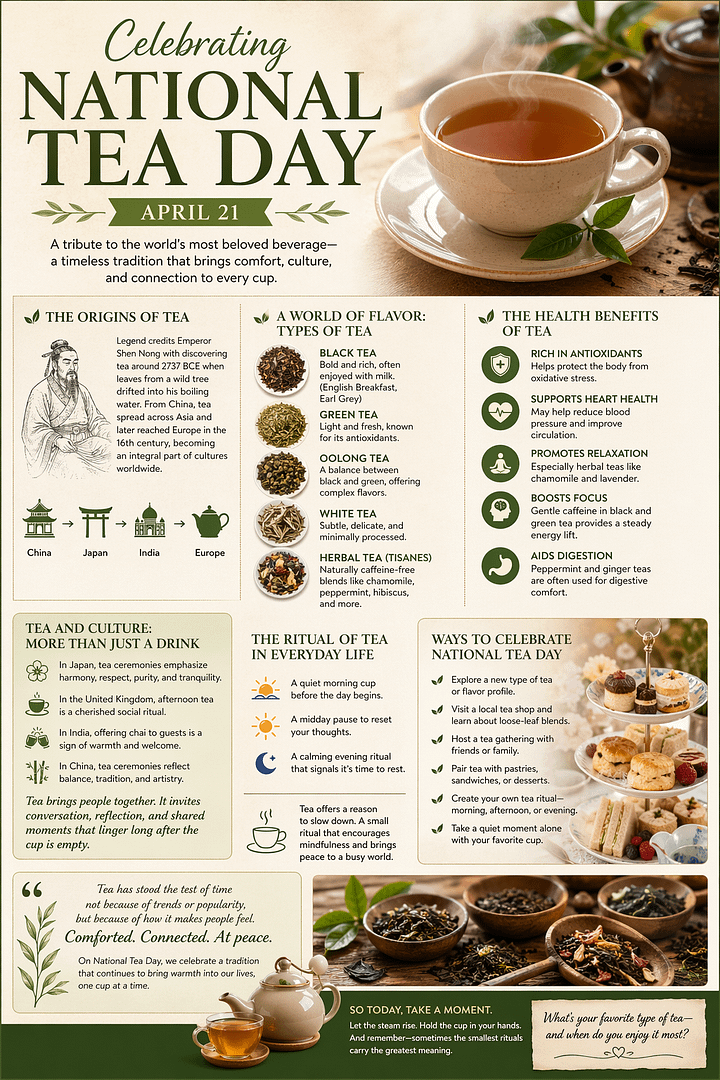
    National Tea Day, celebrated each year on April 21, is more than just a nod to a popular beverage—it’s a tribute to a centuries-old tradition that has brought comfort, culture, and connection to people across the globe. From quiet mornings to meaningful conversations, tea has a unique way of weaving itself into the rhythm of everyday life.

    On this day, tea lovers pause to appreciate not only the drink itself, but the rituals, memories, and sense of peace that come with every cup.

    🍃 The Origins of Tea: From Legend to Legacy

    The story of tea begins in ancient China, where legend tells of Emperor Shen Nong discovering tea around 2737 BCE when leaves drifted into his boiling water. Whether myth or history, one thing is certain—tea quickly became valued for both its flavor and its medicinal properties.

    From China, tea spread to neighboring regions like Japan and India, each developing its own unique traditions. In Japan, tea ceremonies became an art form rooted in mindfulness and respect. In India, spiced chai became a daily staple, blending tea with bold flavors like cardamom, cinnamon, and ginger.

    By the 16th and 17th centuries, tea reached Europe, eventually becoming deeply embedded in British culture. The tradition of afternoon tea—complete with delicate cups, pastries, and conversation—became a symbol of elegance and social connection.

    🍵 A World of Flavor: Understanding Different Teas

    One of the most remarkable things about tea is its diversity. All traditional teas come from the same plant—Camellia sinensis—yet differences in processing create entirely different flavors and experiences.

    Black Tea

    Bold, full-bodied, and often enjoyed with milk or sugar, black tea is a favorite in Western cultures. Popular varieties include English Breakfast and Earl Grey.

    Green Tea

    Light, fresh, and slightly grassy, green tea is known for its clean taste and high antioxidant content. It’s widely enjoyed in East Asia and often associated with wellness.

    Oolong Tea

    Sitting between black and green tea, oolong offers a complex flavor profile that can range from floral to roasted, depending on how it’s processed.

    White Tea

    Delicate and minimally processed, white tea has a subtle sweetness and is often considered one of the most refined tea varieties.

    Herbal Tea (Tisanes)

    Technically not “tea” since it doesn’t come from the tea plant, herbal infusions like chamomile, peppermint, and hibiscus are beloved for their calming and caffeine-free qualities.

    🌿 The Health Benefits of Tea

    Tea has long been associated with wellness, and modern research continues to support many of its benefits. While each type of tea offers something unique, many share common advantages:

    Rich in Antioxidants: Helps protect the body from oxidative stress
    Supports Heart Health: May help reduce blood pressure and improve circulation
    Promotes Relaxation: Especially herbal teas like chamomile and lavender
    Boosts Focus: Gentle caffeine in black and green tea provides a steady energy lift
    Aids Digestion: Peppermint and ginger teas are often used for digestive comfort

    Beyond the physical benefits, tea also supports mental well-being. The simple act of preparing and drinking tea can be grounding—a small ritual that encourages mindfulness in a busy world.

    🫖 Tea and Culture: More Than Just a Drink

    Tea is deeply tied to culture and tradition. Around the world, it represents hospitality, respect, and connection.

    In Japan, tea ceremonies emphasize harmony, respect, purity, and tranquility
    In the United Kingdom, afternoon tea is a cherished social ritual
    In India, offering chai to guests is a sign of warmth and welcome
    In China, tea ceremonies reflect balance, tradition, and artistry

    No matter where you are, tea often brings people together. It invites conversation, reflection, and shared moments that linger long after the cup is empty.

    ☀️ The Ritual of Tea in Everyday Life

    In today’s fast-paced world, tea offers something rare—a reason to slow down.

    It might be the quiet comfort of a morning cup before the day begins…
    A midday pause to reset your thoughts…
    Or a calming evening ritual that signals it’s time to rest.

    Tea doesn’t demand attention. It simply offers presence.

    For many, it becomes a personal ritual—a moment carved out just for themselves, where the noise fades and peace settles in.

    🎉 Ways to Celebrate National Tea Day

    Whether you’re a lifelong tea lover or just beginning to explore, National Tea Day is the perfect opportunity to try something new or deepen your appreciation:

    Explore a new type of tea or flavor profile
    Visit a local tea shop and learn about loose-leaf blends
    Host a tea gathering with friends or family
    Pair tea with pastries, sandwiches, or desserts
    Create your own tea ritual—morning, afternoon, or evening
    Take a quiet moment alone with your favorite cup

    You don’t need a grand celebration. Sometimes, the simplest cup is the most meaningful.

    🌅 A Tradition That Endures

    Tea has stood the test of time—not because of trends or popularity, but because of how it makes people feel.

    Comforted.
    Connected.
    At peace.

    On National Tea Day, we celebrate more than a drink—we celebrate a tradition that continues to bring warmth into our lives, one cup at a time.

    So wherever you are today, take a moment.
    Let the steam rise.
    Hold the cup in your hands.

    And remember—sometimes the smallest rituals carry the greatest meaning.

    Read More Holidays & National Days

  • 🧀 National Cheddar Fries Day: A Celebration of Crispy, Cheesy Perfection

    Advertisements

    Every year on April 20, food lovers across the country get a delicious excuse to indulge in one of the ultimate comfort foods—cheddar fries. National Cheddar Fries Day isn’t just about satisfying a craving; it’s about celebrating a dish that has become a staple in diners, ballparks, restaurants, and homes everywhere.

    Golden, crispy fries layered with rich, melted cheddar cheese create a flavor combination that feels both nostalgic and indulgent. Whether you enjoy them plain or piled high with toppings, cheddar fries have a way of bringing people together around something simple—and incredibly satisfying.

    🍟 A Comfort Food Classic with a Story

    While fries themselves trace back to European origins, cheddar fries are a distinctly modern comfort food evolution. As casual dining and fast-food culture grew in the United States, so did the desire to elevate simple sides into crave-worthy dishes.

    Enter cheddar cheese—a bold, sharp, and perfectly meltable cheese that pairs effortlessly with hot fries. Over time, what began as a quick add-on became a menu favorite in its own right. Today, cheddar fries are not just a side dish—they’re often the main attraction.

    From sports stadium concessions to late-night diners, they’ve earned their place as a go-to indulgence for people of all ages.

    🧀 Why Cheddar Makes All the Difference

    Not all cheeses are created equal when it comes to fries, and cheddar stands above the rest for good reason.

    Flavor Depth: Cheddar ranges from mild and creamy to sharp and tangy, giving you options depending on your preference
    Perfect Melt: It melts smoothly, coating fries evenly without becoming overly greasy
    Versatility: Works as shredded cheese, melted slices, or a rich cheese sauce

    The beauty of cheddar is how it enhances the fries without overpowering them. Instead, it creates a balanced bite—crispy, creamy, salty, and deeply satisfying.

    🔥 From Simple to Fully Loaded

    Cheddar fries are endlessly customizable, making them one of the most versatile comfort foods out there.

    Classic Style:

    Fresh-cut fries
    Melted cheddar cheese
    A pinch of salt

    Loaded Favorites:

    Crispy bacon bits
    Sour cream
    Chopped green onions
    Jalapeños for heat
    Pulled pork or grilled chicken
    Chili for a hearty twist

    Gourmet Takes:

    Truffle oil drizzle
    Artisan aged cheddar blends
    Caramelized onions
    Garlic aioli or specialty sauces

    Whether you prefer them simple or stacked with bold toppings, cheddar fries can be tailored to fit any mood or appetite.

    🍔 Cheddar Fries in Food Culture

    Cheddar fries have become more than just a menu item—they’re part of modern food culture. They show up at:

    Game days and tailgates as the ultimate shareable snack
    Family gatherings as a crowd-pleasing side
    Late-night cravings when only comfort food will do
    Social media feeds, where loaded fries have become a viral favorite

    Restaurants and food trucks continue to reinvent cheddar fries, pushing the boundaries with creative toppings and presentation styles. What was once simple has become a canvas for culinary creativity.

    🧑‍🍳 Make Restaurant-Style Cheddar Fries at Home

    Bringing the magic home is easier than you might think—and often even more rewarding.

    Ingredients:
    Frozen or fresh-cut fries
    Shredded cheddar cheese (sharp or mild)
    Butter and milk (for cheese sauce, optional)
    Salt and seasonings
    Optional toppings of your choice
    Steps:
    Cook fries until golden and crispy
    Melt cheddar directly over the fries or prepare a smooth cheese sauce
    Layer fries and cheese for maximum coverage
    Add toppings while everything is hot
    Serve immediately

    Pro Tip: For the ultimate experience, use a mix of sharp and mild cheddar to create a richer, more complex flavor.

    🎉 Why This Day Matters

    National Cheddar Fries Day is a reminder that food doesn’t have to be complicated to be meaningful. Sometimes, the most memorable meals come from the simplest ingredients done right.

    It’s about:

    Sharing food with friends and family
    Treating yourself without guilt
    Enjoying flavors that bring comfort and joy
    Slowing down and savoring the moment

    In a fast-paced world, something as simple as cheddar fries can create a moment of happiness worth celebrating.

    🧡 A Bite of Pure Comfort

    There’s something timeless about the combination of crispy fries and melted cheddar. It’s warm, familiar, and satisfying in a way that few foods can match.

    So whether you’re grabbing a basket at your favorite local spot or making your own at home, take a moment on April 20 to enjoy every cheesy, crispy bite.

    Because sometimes, comfort really is as simple as fries and cheese.

    Read More Holidays & National Days
  • 🍍 National Pineapple Upside-Down Cake Day

    Advertisements

    National Pineapple Upside-Down Cake Day, celebrated each year on April 20, honors a dessert that has stood the test of time—both for its flavor and its charm. With its glossy, caramelized topping of pineapple rings and cherries resting atop a soft, buttery cake, this iconic treat is more than just a dessert. It’s a piece of culinary history, a symbol of creativity in the kitchen, and a reminder that sometimes the best things in life come from turning tradition upside down.

    A Deeper Look Into Its Origins

    Long before modern baking pans and electric ovens, cooks relied on cast-iron skillets and open fires to prepare meals. The concept of “upside-down” cakes dates back to these early cooking methods, where fruit and sugar were placed at the bottom of a pan, topped with batter, and cooked slowly. Once finished, the cake would be flipped over, revealing a beautifully glazed fruit topping created naturally during the cooking process.

    The pineapple variation didn’t emerge until the early 20th century, when canned pineapple became widely accessible. Thanks to Dole Food Company and its innovative canning process, pineapple transformed from a rare tropical luxury into an everyday ingredient in American households.

    In 1925, Dole launched a now-famous recipe contest to promote canned pineapple. Out of more than 60,000 entries, a significant portion featured pineapple upside-down cake, cementing its place in American dessert culture. From there, it quickly became a staple in homes across the country, especially during the 1930s through the 1950s.

    The Magic Behind the Cake

    What makes pineapple upside-down cake so special isn’t just its appearance—it’s the science and simplicity behind it.

    As the cake bakes, butter and brown sugar melt together, creating a rich caramel sauce. The pineapple slices release their juices, blending with the sugar to form a glossy, golden topping. When the cake is flipped, gravity does the rest—revealing a perfectly arranged, glistening surface that looks as good as it tastes.

    The flavor profile is a balance of:

    Sweetness from the caramelized sugar
    Tanginess from the pineapple
    Richness from the buttery cake

    This harmony is what keeps people coming back for slice after slice.

    A Dessert Rooted in Nostalgia

    For many, pineapple upside-down cake is deeply tied to memories of home. It’s the dessert that showed up at family dinners, church potlucks, and holiday gatherings. It’s the cake your grandmother may have made in a well-worn skillet, using a recipe she knew by heart.

    In an age where desserts are often elaborate and visually complex, this cake stands out for its simplicity and authenticity. It doesn’t rely on heavy frosting or intricate decoration—its beauty is baked right in.

    There’s also something comforting about the act of flipping the cake. It’s a small moment of anticipation and surprise, where the final reveal feels almost magical every time.

    Creative Twists and Modern Takes

    While the traditional version remains beloved, today’s bakers are reimagining pineapple upside-down cake in exciting ways:

    Tropical variations: Adding shredded coconut or a splash of rum for a richer island-inspired flavor
    Mini cakes: Baking individual portions in muffin tins for easy serving
    Grilled pineapple: Using caramelized fresh pineapple slices for a deeper, smoky sweetness
    Health-conscious versions: Substituting ingredients like almond flour, coconut sugar, or plant-based butter
    Alternative fruits: Swapping pineapple for peaches, apples, pears, or even berries

    These modern interpretations show just how versatile the upside-down technique can be while still honoring the original concept.

    Tips for Baking the Perfect Cake

    If you’re planning to celebrate by baking one yourself, here are a few tips to make it just right:

    Use a well-greased pan to prevent sticking
    Don’t rush the flip—let the cake cool slightly so it holds together
    Arrange fruit carefully for a visually pleasing final look
    Balance the sugar to avoid an overly sweet topping
    Serve warm for the best flavor and texture

    A cast-iron skillet is often the preferred choice, as it distributes heat evenly and enhances the caramelization process.

    Why This Day Still Matters

    In a fast-paced world filled with trendy desserts and viral recipes, National Pineapple Upside-Down Cake Day reminds us to slow down and appreciate the classics. It celebrates a time when baking was about bringing people together, using simple ingredients, and creating something meaningful from scratch.

    This day isn’t just about cake—it’s about tradition, creativity, and connection. It’s about remembering that even the simplest recipes can leave the strongest impressions.

    Celebrate in Your Own Way

    Whether you bake from scratch, follow a family recipe, or pick one up from your favorite bakery, take a moment to enjoy this timeless dessert. Share it with loved ones, snap a photo of that perfect flip, or even try your hand at creating your own variation.

    However you choose to celebrate, let it be a reminder that some of the sweetest moments in life come from the simplest traditions.

    Read More Holidays & National Days
  • Stay Humble and Kind: The Timeless Code of Character

    Advertisements

    In a world driven by speed, recognition, and constant comparison, the quiet instruction to “stay humble and kind” feels almost revolutionary. It cuts through the noise with a steady, grounding truth: who you are will always matter more than what you achieve. Long after titles fade and accomplishments are forgotten, character remains.

    These words aren’t complicated. In fact, they’re beautifully simple—hold the door, say “please,” say “thank you,” don’t steal, don’t cheat, don’t lie. Yet within that simplicity lies a code for living that has stood the test of time. It’s a blueprint not just for success, but for a life that holds meaning, respect, and lasting impact.

    The Strength Found in Humility

    Humility is often misunderstood. Some mistake it for weakness or a lack of confidence, but true humility is anything but that. It’s strength wrapped in quiet assurance. It’s knowing your value without needing to broadcast it. A humble person doesn’t walk into a room demanding attention—they earn it through presence, respect, and authenticity.

    There is a certain peace that comes with humility. When you’re not constantly trying to prove yourself, you free your mind from comparison and competition. You begin to see others not as rivals, but as fellow travelers on their own journeys. You listen more. You learn more. And over time, that openness becomes one of your greatest strengths.

    Humility also keeps you grounded when life begins to elevate you. Success has a way of testing people. It can inflate egos, distort priorities, and create distance between you and the values that once defined you. But humility acts as an anchor. It reminds you where you came from, who stood beside you when the road was uncertain, and why you started in the first place.

    Kindness: The Language Everyone Understands

    Kindness is the natural extension of humility. It’s not loud or flashy—it doesn’t need to be. It shows up in everyday moments, often unnoticed, yet deeply felt. A kind word to someone who is struggling. A moment of patience when frustration would be easier. A gesture of generosity without expecting anything in return.

    What makes kindness so powerful is its ripple effect. One small act can travel far beyond the moment it was given. You never truly know what someone else is carrying—what battles they’re fighting quietly. A simple act of kindness can become a turning point in someone’s day, or even their life.

    In a culture that often celebrates toughness and self-interest, kindness can feel countercultural. But make no mistake—kindness is not weakness. It requires emotional strength, awareness, and the willingness to choose compassion over indifference. It is a deliberate act, one that reflects the depth of a person’s character.

    Integrity: The Foundation You Stand On

    “Don’t steal, don’t cheat, don’t lie.” These aren’t just rules—they are the pillars of integrity. They define how you operate when no one is watching. Integrity is the quiet agreement you make with yourself to live honestly, even when dishonesty might offer an easier path.

    Trust is built on integrity. Every honest action strengthens it; every dishonest one weakens it. And trust, once broken, is incredibly difficult to repair. That’s why living with integrity is not just about avoiding wrongdoing—it’s about actively choosing what is right.

    There will be moments in life when shortcuts seem tempting. Opportunities to cut corners, to gain advantage, to bend the truth just enough to benefit. But those moments are tests. They ask you one question: Who are you when it matters most?

    Choosing integrity may cost you something in the short term. But in the long run, it builds something far more valuable—self-respect, credibility, and a reputation that cannot be bought or faked.

    Climbing Your Mountains

    Life guarantees one thing: you will face mountains. Some will be visible—career challenges, financial struggles, personal setbacks. Others will be internal—grief, doubt, fear, and the quiet battles no one else can see.

    Climbing those mountains is part of the human experience. Growth rarely happens in comfort. It happens in effort, in persistence, in choosing to keep going even when the path is steep and uncertain.

    But how you climb matters just as much as reaching the summit.

    It’s easy to lose sight of your values when you’re focused on getting ahead. Pressure can push people to compromise, to forget the importance of humility and kindness in the pursuit of success. But the truth is, success achieved at the cost of your character is not success at all—it’s a hollow victory.

    Climb with integrity. Climb with respect for others. Climb without stepping on those around you. Because when you reach the top, the view means very little if you’ve lost yourself along the way.

    The Power of Staying Grounded

    There’s something deeply admirable about people who remain grounded regardless of their circumstances. Whether they have little or a lot, whether they’re recognized or unknown, they carry themselves with the same steady presence.

    These are the people who remember names. Who show appreciation. Who treat everyone—from strangers to close friends—with equal respect. They don’t let status define how they behave.

    Staying grounded requires intentionality. It means regularly checking in with yourself—asking whether your actions still align with your values. It means being willing to correct course when you drift. And most importantly, it means understanding that your worth is not tied to your achievements, but to who you are at your core.

    Legacy: What Really Lasts

    At the end of the day, life isn’t measured solely by what you accomplish. It’s measured by the lives you touch and the impact you leave behind.

    People may admire your success, but they remember your character.

    They remember the way you treated them when you had nothing to gain. They remember your honesty when it would have been easier to lie. They remember your kindness when they needed it most.

    Legacy is built in those moments—not in grand gestures, but in consistent, everyday choices.

    A Code Worth Living By

    The message to stay humble and kind isn’t complicated—but living it requires commitment. It asks you to slow down in a fast world, to choose integrity in a world of shortcuts, and to show compassion in a world that can feel indifferent.

    It asks you to:

    Speak with respect
    Act with honesty
    Treat others with dignity
    Stay grounded in success
    Remain hopeful in hardship

    It asks you to live in a way that reflects not just who you are, but who you aspire to be.

    Final Reflection

    Life will test you. It will challenge your patience, your values, and your sense of self. There will be moments when it feels easier to compromise, to harden your heart, or to let pride take control.

    But those are the moments that define you.

    So hold the door. Say “please.” Say “thank you.”
    Choose honesty. Choose kindness. Choose humility.

    Climb your mountains—but never lose sight of the ground beneath your feet.

    Because in the end, the greatest measure of a life well lived isn’t how high you climbed…

    …it’s how you treated people along the way.

  • 🌤️ National Hanging Out Day: A Celebration of Simplicity, Sustainability, and Sunshine

    Advertisements

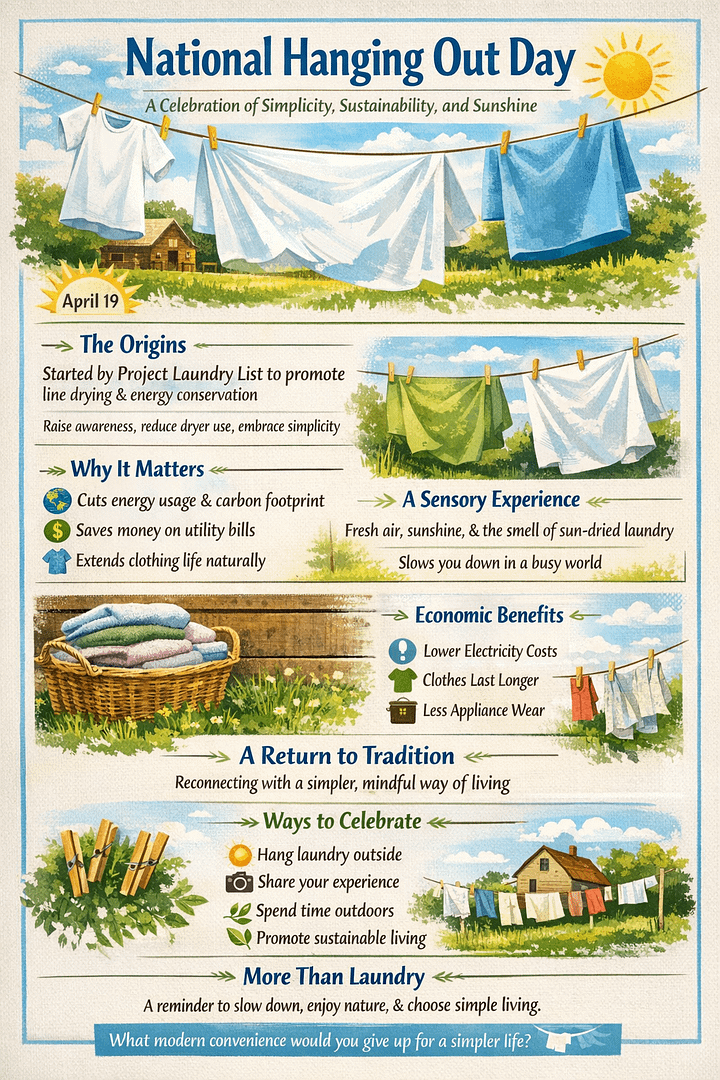
    Every year on April 19, people across the United States and beyond take part in a refreshingly simple tradition—National Hanging Out Day. While it may sound like a casual excuse to relax outdoors, the day actually carries a meaningful message rooted in sustainability, mindful living, and reconnecting with everyday practices that once defined daily life.

    At its heart, National Hanging Out Day encourages people to skip the dryer, step outside, and hang their laundry in the open air. It’s a small act—but one that symbolizes a much larger shift toward conscious living.

    🌿 The Origins of National Hanging Out Day

    National Hanging Out Day was founded by Project Laundry List, a nonprofit organization dedicated to helping people reduce their environmental impact by rethinking how they do laundry.

    The organization recognized that something as routine as drying clothes had become heavily dependent on energy-consuming machines. Electric dryers, while convenient, are among the top energy users in many households. By promoting line drying—even occasionally—Project Laundry List aimed to inspire a simple yet powerful habit change.

    But beyond energy savings, the movement also advocates for something deeper:
    the right to choose a more natural, sustainable lifestyle.

    In some communities, restrictions once existed against outdoor clotheslines due to aesthetic concerns. National Hanging Out Day also became a quiet protest against those limitations, encouraging people to embrace practicality over appearance and to reclaim a traditional, eco-friendly practice.

    ☀️ The Environmental Impact: Why It Matters

    Dryers account for a significant portion of household energy use. According to energy studies, the average dryer can consume as much energy as a refrigerator, washing machine, and dishwasher combined over time.

    By contrast, line drying uses:

    Zero electricity
    No added heat or emissions
    Minimal environmental impact

    Choosing to hang your laundry outside, even just once a week, can:

    Reduce your carbon footprint
    Lower greenhouse gas emissions
    Decrease strain on power grids
    Conserve valuable natural resources

    It’s a reminder that sustainability doesn’t always require big, dramatic changes. Sometimes, it starts with something as simple as a clothesline.

    🌼 A Sensory Experience We’ve Forgotten

    There’s something deeply nostalgic—and surprisingly therapeutic—about hanging clothes outside.

    The warmth of the sun on your skin.
    The gentle rhythm of fabric swaying in the breeze.
    The quiet satisfaction of completing a task without rushing.

    Unlike the hum of a dryer, line drying invites you to slow down and engage with your surroundings. It turns a routine chore into a mindful moment—one where you can breathe, reflect, and appreciate the simplicity of the present.

    And then there’s the scent—sun-dried laundry carries a crisp, natural freshness that no artificial fragrance can truly replicate.

    🌎 Economic Benefits: Saving More Than Energy

    While the environmental advantages are compelling, the financial benefits are just as meaningful.

    Dryers are not only energy-intensive—they also contribute to higher utility bills. Over time, frequent dryer use adds up, especially in larger households.

    Line drying helps:

    Reduce electricity costs
    Extend the life of clothing (less heat damage, fading, and shrinkage)
    Lower maintenance expenses (less wear on appliances)

    Clothing lasts longer when it isn’t exposed to high heat. Fabrics maintain their strength, colors stay vibrant, and delicate items remain intact.

    In a time when many are looking for ways to cut costs, National Hanging Out Day offers a simple, practical solution that benefits both your wallet and the planet.

    🌅 A Return to Tradition in a Modern World

    Before dryers became household staples, line drying was simply a part of life. It was routine, expected, and even social—neighbors would chat while hanging clothes, and yards filled with fluttering fabrics became a familiar sight.

    Today, that image feels almost nostalgic.

    National Hanging Out Day invites us to revisit that tradition—not out of necessity, but by choice. It challenges the idea that convenience should always come first and reminds us that older ways often hold lasting value.

    It’s not about rejecting modern technology—it’s about finding balance.

    🌱 Mindfulness and Mental Well-Being

    Beyond sustainability and savings, there’s an emotional and mental benefit to slowing down and engaging in simple tasks.

    Hanging laundry can become a form of quiet reflection:

    A moment to step away from screens
    A chance to breathe in fresh air
    An opportunity to reset your thoughts

    In a world filled with constant notifications, deadlines, and digital noise, these small pauses matter more than we often realize.

    Sometimes, peace isn’t found in doing more—but in doing less, with intention.

    💡 Creative Ways to Celebrate National Hanging Out Day

    Whether you have a backyard, a balcony, or even an indoor drying rack, there are plenty of ways to participate:

    Hang a full load of laundry outside and enjoy the process
    Try drying delicate clothing naturally instead of using the dryer
    Spend extra time outdoors while your laundry dries—read, pray, or simply relax
    Share photos or thoughts about your experience
    Encourage friends and family to give it a try
    Reflect on other small lifestyle changes that could reduce your environmental impact

    Even if you can’t fully switch to line drying, participating for just one day can spark new habits.

    🌞 More Than a Chore—A Lifestyle Choice

    National Hanging Out Day isn’t really about laundry—it’s about awareness.

    It’s about recognizing how small, everyday choices shape the world around us. It’s about slowing down long enough to appreciate the natural resources we often take for granted—sunlight, wind, and time.

    And maybe, just maybe, it’s about rediscovering a sense of peace in the ordinary.

    Because sometimes the most meaningful changes don’t come from big, dramatic actions…
    they come from simple decisions made with purpose.

    Read More Holidays & National Days

  • 🧄 National Garlic Day: Celebrating the Flavor That Changed the World

    Advertisements

    Every year on April 19, food lovers come together to celebrate National Garlic Day, honoring a humble ingredient that has shaped cuisines, cultures, and traditions across the globe. Garlic may be small in size, but its impact is anything but—bringing bold flavor, rich aroma, and centuries of history into kitchens everywhere.

    From sizzling skillets to slow-roasted masterpieces, garlic is more than just an ingredient—it’s a foundation. It’s the quiet beginning of countless recipes, the unmistakable scent that fills a home, and the secret behind dishes that keep people coming back for more.

    🌍 A Deep-Rooted History of Power and Purpose

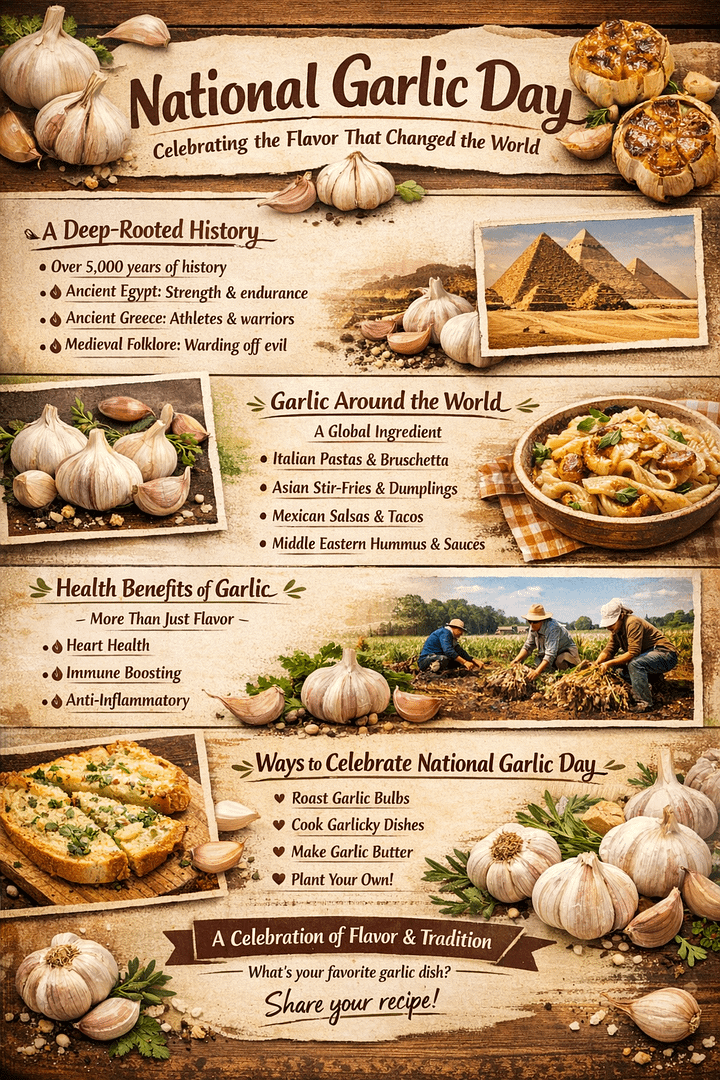
    Garlic’s story begins over 5,000 years ago, making it one of the oldest cultivated plants in the world. Ancient civilizations didn’t just use garlic for cooking—they revered it.

    In ancient Egypt, garlic was so highly valued that it was placed in tombs and even used as a form of currency. Laborers building the pyramids consumed garlic daily, believing it increased strength and endurance. In ancient Greece, athletes ate garlic before Olympic competitions, while soldiers relied on it for stamina and courage in battle.

    The Romans spread garlic throughout Europe, where it became a staple among the working class. During the Middle Ages, it was believed to protect against disease and even the plague. Garlic’s reputation as a protective force also made its way into folklore—famously used to ward off evil spirits and vampires.

    Across continents and centuries, garlic has remained a symbol of strength, protection, and vitality.

    🍳 The Soul of Global Cuisine

    Garlic is one of the few ingredients that transcends borders. No matter where you go in the world, you’ll find it at the heart of traditional cooking.

    Italian kitchens rely on garlic for sauces, pastas, and classic dishes like bruschetta
    French cuisine elevates garlic in dishes like garlic butter escargot and rich stews
    Asian cultures use garlic in stir-fries, dumplings, soups, and marinades
    Mexican and Latin American dishes depend on garlic for bold, layered flavors
    Middle Eastern cooking features garlic in dips like hummus and sauces like toum

    Garlic has the unique ability to adapt—sharp and pungent when raw, mellow and sweet when roasted, and deeply savory when sautéed. It builds flavor from the ground up, turning simple ingredients into something extraordinary.

    Even the act of cooking garlic—hearing it sizzle in oil, watching it turn golden—signals that something good is about to happen.

    🔬 The Science and Health Behind Garlic

    Beyond its culinary appeal, garlic has long been associated with powerful health benefits. While many of these claims come from traditional medicine, modern science has begun to explore and support some of them.

    Garlic contains a compound called allicin, which is released when garlic is crushed or chopped. This compound is believed to contribute to garlic’s:

    Antibacterial and antiviral properties
    Ability to support heart health by lowering blood pressure
    Potential to improve cholesterol levels
    Anti-inflammatory effects
    Immune system support

    Garlic has been used in natural remedies for centuries, from fighting colds to promoting overall wellness. While it’s not a cure-all, it’s clear that garlic offers more than just flavor—it contributes to a healthier lifestyle.

    🌱 From Farm to Table

    Garlic’s journey begins in the soil. It’s typically planted in the fall and harvested in the summer, requiring patience and care. Farmers cultivate different varieties, each with its own flavor profile, size, and intensity.

    Hardneck garlic offers bold flavor and produces garlic scapes
    Softneck garlic is milder and commonly found in grocery stores
    Specialty varieties can range from spicy to slightly sweet

    Once harvested, garlic is cured and stored, ready to make its way into kitchens around the world. Whether grown on a large farm or in a backyard garden, garlic connects people to the land and the seasons.

    🎉 Ways to Celebrate National Garlic Day

    There’s no shortage of ways to honor garlic—just follow your taste buds:

    Roast whole garlic bulbs until soft and spreadable
    Make homemade garlic butter for bread, steak, or vegetables
    Try a bold dish like garlic shrimp, roasted chicken, or garlic pasta
    Experiment with new recipes from different cultures
    Visit a local restaurant and order something garlic-rich
    Plant garlic in your garden for next season’s harvest

    For the true garlic lover, today is the perfect excuse to go all in—extra cloves, extra flavor, no regrets.

    🧄 Garlic in Everyday Life

    Garlic is one of those rare ingredients that feels both simple and essential. It’s there in quick weeknight dinners and elaborate holiday meals. It’s passed down in family recipes and discovered in new culinary adventures.

    It brings comfort. It brings flavor. And in many ways, it brings people together.

    There’s something timeless about the smell of garlic cooking—a reminder of home, tradition, and shared experiences. It’s a scent that tells a story before the first bite is even taken.

    ❤️ A Celebration of Flavor, Tradition, and Connection

    National Garlic Day isn’t just about celebrating a food—it’s about celebrating everything that food represents. Culture, history, health, and the joy of gathering around a table.

    Garlic has earned its place as one of the most beloved ingredients in the world. It has stood the test of time, crossed every border, and found its way into the hearts (and kitchens) of millions.

    So today, embrace the flavor. Cook boldly. Share a meal. And don’t be afraid to add one more clove.

    Read More Holidays & National Days
  • 🎉 National Piñata Day: A Celebration of Color, Culture, and Joy

    Advertisements

    Every year on April 18, bursts of color, laughter, and anticipation fill the air as families and communities celebrate National Piñata Day. What may seem like a simple party activity is, in truth, a tradition layered with history, symbolism, and cultural pride. From its roots in ancient customs to its place in modern celebrations, the piñata continues to bring people together in a uniquely joyful way.

    🪅 What Is a Piñata?

    At its core, a piñata is a decorated container—often crafted from papier-mâché, clay, or cardboard—filled with candy, toys, or festive treats. Suspended from above, it becomes the centerpiece of a game where participants, usually blindfolded, take turns trying to break it open with a stick.

    But what makes the piñata special isn’t just what’s inside—it’s the experience. The laughter from missed swings, the cheers from onlookers, and the excitement leading up to that final, candy-filled burst create a moment that’s shared and remembered long after the party ends.

    🌎 A Rich and Meaningful History

    The story of the piñata stretches across continents and centuries. While it is most closely associated with Mexico, its origins are believed to date back to ancient China, where decorated containers filled with seeds were broken during celebrations for good fortune.

    The tradition later traveled to Europe, particularly Italy and Spain, before arriving in Mexico during the colonial period. It was there that the piñata took on deeper spiritual meaning.

    The traditional seven-pointed star piñata became a powerful symbol:

    Each point represented one of the seven deadly sins
    The blindfold symbolized faith
    The stick represented virtue or the will to overcome temptation
    The treats inside symbolized the rewards of faith and perseverance

    Over time, these religious meanings blended with local customs, transforming the piñata into both a spiritual symbol and a joyful celebration.

    🎊 The Evolution Into Modern Celebrations

    Today, piñatas are a staple at birthday parties, holidays, and community events—not only in Mexico but across the United States and around the world. While the symbolic meaning may not always be at the forefront, the spirit of unity and celebration remains strong.

    Modern piñatas have expanded far beyond the traditional star shape. You’ll find:

    Cartoon characters
    Animals
    Sports themes
    Custom designs for weddings, graduations, and corporate events

    They’ve become more than just decorations—they’re expressions of creativity and personality.

    🎨 The Art of Making a Piñata

    Creating a piñata is an art form that blends patience, creativity, and tradition. While store-bought versions are widely available, many people still enjoy making their own.

    The process often includes:

    Building the base – Using balloons or molds
    Layering papier-mâché – Applying strips of paper with glue or paste
    Drying and shaping – Allowing the structure to harden
    Decorating – Adding colorful tissue paper, fringe, and designs
    Filling – Placing candy, toys, or surprises inside

    For many families, making a piñata together is just as meaningful as breaking it—turning the celebration into a shared creative experience.

    🎈 How National Piñata Day Is Celebrated

    On April 18, people celebrate in ways that highlight both tradition and fun:

    Hosting themed parties centered around piñatas
    Teaching children about cultural history
    Sharing homemade treats and festive meals
    Playing music and dancing
    Posting photos and videos of piñata moments

    In schools and community centers, the day can also serve as a way to introduce cultural appreciation and storytelling.

    ❤️ Why the Piñata Still Matters

    In a fast-paced, digital world, the piñata remains a refreshingly simple source of joy. It encourages:

    Connection – Bringing people together in shared laughter
    Patience – Waiting your turn and enjoying the moment
    Excitement – The thrill of not knowing when it will break
    Generosity – Sharing the rewards once it does

    There’s something timeless about the moment a piñata bursts open—when anticipation turns into celebration, and everyone rushes forward with smiles and laughter.

    🌟 A Symbol of Joy Across Generations

    For children, it’s a game filled with excitement. For adults, it’s often a nostalgic reminder of childhood celebrations. Across generations, the piñata bridges age, culture, and experience.

    It doesn’t matter where you come from or how you celebrate—when a piñata is involved, the result is almost always the same: joy, laughter, and unforgettable memories.

    🎉 Final Thoughts

    National Piñata Day is more than just a fun excuse to swing at a colorful creation—it’s a celebration of culture, creativity, and connection. It reminds us that some of life’s best moments come from shared experiences and simple joys.

    So whether you’re crafting one by hand, hanging one at a party, or just enjoying the excitement from the sidelines, take a moment to appreciate what the piñata represents.

    Because sometimes, the sweetest rewards in life come after a few missed swings—and a lot of laughter.

    Read More Holidays & National Days

  • Celebrating National Animal Cracker Day: A Bite-Sized Tradition Full of Nostalgia

    Advertisements

    Every year on April 18, families, snack lovers, and the young at heart come together to celebrate National Animal Cracker Day—a simple yet meaningful tribute to a treat that has stood the test of time. At first glance, animal crackers may seem like just another snack, but for many, they carry something deeper: memories of childhood, moments of comfort, and a sense of playful imagination that never quite fades.

    🏛️ A Snack with a Rich and Whimsical History

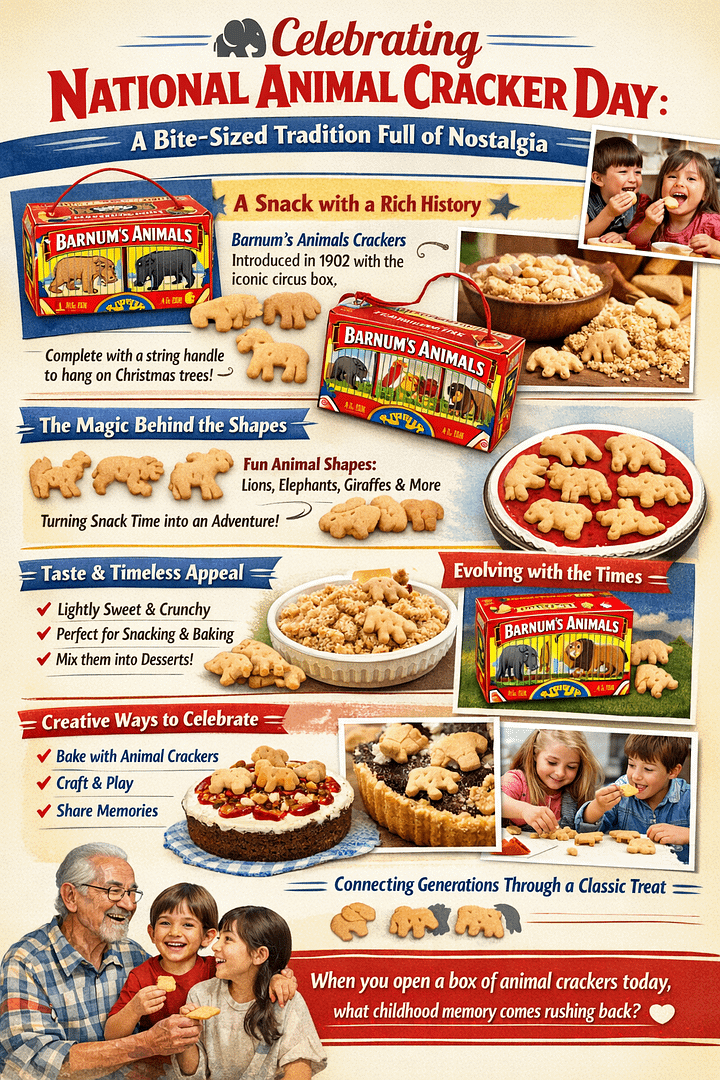
    Animal-shaped biscuits date back to 19th-century England, where they were known simply as “animal biscuits.” These early versions inspired American bakers, but it wasn’t until the arrival of Barnum’s Animals Crackers that the snack truly found its identity in the United States.

    Produced by the National Biscuit Company—which later became Nabisco—these crackers were introduced in 1902 and quickly became a national favorite. The packaging played a huge role in their success. Designed as a colorful circus train car, the box featured lions, elephants, tigers, and bears, sparking curiosity and excitement before the box was even opened.

    One of the most iconic details? The small string attached to the box, originally intended to hang it on Christmas trees as a holiday treat. This clever design transformed a simple snack into a seasonal tradition and a cherished keepsake.

    🦁 The Magic Behind the Shapes

    Part of what makes animal crackers so beloved is the experience they create. Each cracker is shaped like an animal—lions, camels, giraffes, monkeys, and more—turning snack time into a playful adventure.

    For children, it becomes a game:

    “Which animal did I get?”
    “Can I name them all?”
    “Should I eat the tail first or save the head for last?”

    For adults, those same shapes bring back memories of sitting at the kitchen table, sharing snacks with siblings, or enjoying a quiet moment with something simple and sweet. There’s a kind of emotional connection built into these tiny crackers—one that goes far beyond flavor.

    🍪 Taste, Texture, and Timeless Appeal

    Unlike overly sweet cookies or heavily processed snacks, animal crackers strike a balance. They are lightly sweet, slightly crisp, and easy to enjoy in just about any setting. Their mild flavor makes them incredibly versatile:

    Paired with peanut butter or frosting for a fun treat
    Crushed into pie crusts or dessert toppings
    Mixed into trail mix for a playful twist
    Enjoyed straight from the box—no extras needed

    Their simplicity is their strength. In a world filled with bold flavors and complicated recipes, animal crackers remind us that sometimes less truly is more.

    🎪 A Cultural Icon That Evolved with Time

    Animal crackers didn’t just remain a snack—they became a cultural symbol. Over the decades, they’ve appeared in lunchboxes, classrooms, road trips, and even holiday traditions.

    Teachers have used them to help children learn counting, sorting, and storytelling. Parents have used them as rewards, distractions, and bonding moments. And for many, they’ve become tied to emotional milestones—small comforts during big days.

    In recent years, even the packaging has evolved. The once-caged circus animals were redesigned to show the animals roaming freely, reflecting changing values and a growing awareness of animal welfare. It’s a small change, but a meaningful one—showing that even the most nostalgic traditions can grow with the times.

    👨‍👩‍👧‍👦 Generations Connected by a Simple Snack

    What makes National Animal Cracker Day truly special is how it connects generations. Grandparents, parents, and children can all share the same experience, even decades apart.

    A parent might open a box and say,
    “I used to eat these when I was your age,”
    and suddenly, a simple snack becomes a bridge between past and present.

    In a fast-moving world where trends come and go, animal crackers remain a constant—a reminder that not everything needs to change to stay meaningful.

    🎉 Creative Ways to Celebrate National Animal Cracker Day

    If you’re looking to make the most of this fun and nostalgic day, here are a few ideas:

    Host a themed snack time with kids and let them name each animal
    Bake with them—use crushed animal crackers in cheesecakes or pie crusts
    Create art or crafts using the animal shapes as inspiration
    Share memories—post a childhood story or photo involving animal crackers
    Start a tradition by enjoying them every year on April 18

    You can even turn it into a storytelling game—build a “zoo adventure” using the crackers and let kids create their own imaginative tales.

    ❤️ More Than Just a Cracker

    At its core, National Animal Cracker Day is about more than food. It’s about slowing down, enjoying something simple, and reconnecting with the joy we often overlook in everyday life.

    Animal crackers remind us that happiness doesn’t always come from something big or complicated. Sometimes, it comes from a small box, a familiar shape, and a memory that makes you smile.

    Read More Holidays & National Days

  • There’s No Way Around It: Walking Through Grief and Loss

    Advertisements

    There’s a quiet truth about grief that most people don’t want to hear—because it asks something of us we don’t feel ready to give.

    There’s no way around it.

    No shortcut. No detour. No way to outrun something that lives in your heart.

    You can dodge it for a while. You can stay busy, fill your days, keep the noise going so there’s no room for silence. You can tell yourself you’re fine, convince others you’re strong, and maybe even believe it for a moment. But grief doesn’t operate on denial. It doesn’t fade just because we refuse to look at it.

    It waits.

    Patiently. Quietly. Faithfully.

    And sooner or later, it asks you to come back and face it.

    The World That Changed Overnight

    Grief begins the moment something—or someone—you love is taken from your world.

    And in that instant, everything shifts.

    The world keeps moving. People keep talking. Life goes on like nothing happened. But for you, everything has changed. The familiar becomes unfamiliar. The normal becomes distant. Even the smallest routines can feel unbearable, because they remind you of what used to be.

    You don’t just lose a person—you lose the version of life that existed with them in it.

    You lose conversations that will never happen.
    Moments that will never be shared.
    A future that will never unfold the way you imagined.

    And there’s no preparing for that.

    No manual on how to carry something so heavy and invisible at the same time.

    The Illusion of Avoidance

    In the early days—or even months or years—many people try to avoid grief.

    It’s not weakness. It’s survival.

    You do what you have to do to get through the day. You put one foot in front of the other. You show up where you’re needed. You learn how to function, even when everything inside you feels broken.

    Some people bury themselves in work.
    Some isolate themselves from the world.
    Some try to stay strong for everyone else.
    Some numb the pain in ways that only delay it.

    And for a while, it might seem like it’s working.

    But grief is not something you can outwork, outthink, or outlast.

    Because grief is tied to love.

    And love doesn’t disappear just because we’re not ready to feel it.

    Going Into It

    There comes a moment—different for everyone—when the distractions stop working.

    It might be triggered by something small. A song. A smell. A memory. A random Tuesday that feels heavier than it should. Or it might come crashing in all at once, without warning, without mercy.

    That’s when you realize:

    You can’t go around this.

    You have to go through it.

    Going through grief doesn’t mean you understand it. It doesn’t mean you accept it. It doesn’t even mean you’re ready.

    It simply means you allow yourself to feel it.

    The sadness.
    The anger.
    The confusion.
    The guilt.
    The longing.

    All of it.

    It means sitting in the quiet when the world gets too loud. It means letting tears fall without trying to stop them. It means acknowledging the depth of your loss instead of minimizing it.

    And that’s not easy.

    Because going into grief feels like stepping into something endless.

    Like you might never find your way back out.

    The Weight of Love

    One of the hardest realizations in grief is this:

    The pain you feel is a reflection of how deeply you loved.

    Grief is not a sign of weakness.

    It’s proof of connection.

    It’s what remains when love has nowhere to go.

    And that’s why it hurts so much.

    Because the love is still there.

    Still present.
    Still alive.
    Still searching for a place to land.

    You don’t stop loving someone just because they’re gone.

    And so, you carry it.

    In your memories.
    In your thoughts.
    In the quiet moments no one else sees.

    Learning to Carry It

    As time passes, something begins to shift—not in a way that erases the pain, but in a way that changes your relationship with it.

    You start to learn how to carry your grief.

    Not perfectly. Not consistently. But gradually.

    At first, it feels like it’s carrying you.

    Every step is heavy. Every day feels like a mountain. The weight of it presses down on everything—your thoughts, your energy, your ability to move forward.

    But slowly, you find small ways to hold it.

    You learn what helps, even just a little.
    You learn when to rest.
    You learn when to let yourself feel and when to step back.

    And over time, the grief that once consumed every part of you begins to settle into something you carry alongside you.

    It’s still there.

    But it doesn’t define every moment.

    The Days That Still Break You

    Even as you begin to move forward, grief doesn’t follow a straight line.

    There will be days that feel okay.

    And then there will be days that feel like the beginning all over again.

    Anniversaries.
    Birthdays.
    Holidays.

    Or sometimes nothing at all—just a random moment that hits you out of nowhere.

    A memory surfaces.
    A feeling returns.
    A wave of emotion you didn’t expect crashes in.

    And suddenly, you’re right back in it.

    That doesn’t mean you’re not healing.

    It means you’re human.

    Grief doesn’t disappear—it evolves.

    The Other Side of Grief

    When people talk about “coming out the other side,” it can sound misleading.

    Because there’s no finish line.

    No moment where grief is completely gone.

    But there is a shift.

    A quiet transformation.

    One day, you notice that the pain doesn’t feel as sharp.
    That your breathing feels a little easier.
    That you can remember without completely falling apart.

    You begin to experience moments of peace.

    Moments of gratitude.
    Moments of connection.
    Moments where you feel something other than loss.

    And those moments matter.

    Because they remind you that life still exists—even after everything you’ve been through.

    A Different World

    When you come through grief, you don’t return to the same world you left.

    That world is gone.

    And so is the version of you that lived in it.

    But what emerges is someone who has walked through something deep and life-changing.

    Someone who understands the fragility of life.
    The value of time.
    The importance of presence.

    You may find yourself softer.

    More compassionate.
    More aware of others who are hurting.

    And at the same time, stronger.

    More grounded.
    More resilient.
    More capable than you ever thought possible.

    Still Capable of Love

    One of the greatest fears in grief is the idea that you’ll never feel whole again.

    That the loss has taken something from you that can never be replaced.

    And in some ways, that’s true.

    There are parts of your life that will never be the same.

    But grief doesn’t take away your ability to love.

    If anything, it deepens it.

    It reminds you how precious it is.

    How important it is to show up, to speak, to hold on to the moments you have.

    You don’t stop loving.

    You learn to love differently.

    With more intention.
    More awareness.
    More heart.

    Step by Step

    If you’re in the middle of grief right now, standing at the edge of something you don’t want to face, hear this:

    You don’t have to do it all at once.

    You don’t have to be strong every day.

    You don’t have to have the answers.

    All you have to do is take the next step.

    And then the next.

    Some days that step might be getting out of bed.
    Some days it might be letting yourself cry.
    Some days it might be finding a moment of peace in the middle of the chaos.

    Every step counts.

    Every breath matters.

    The Quiet Strength of Survival

    There’s a kind of strength that only comes from walking through grief.

    It’s not loud.
    It’s not obvious.
    It doesn’t look like what people usually think strength looks like.

    It’s quiet.

    It’s the strength to keep going when everything in you wants to stop.
    The strength to feel when it would be easier to shut down.
    The strength to carry love and loss at the same time.

    And if you’re here—if you’re still moving, still breathing, still trying—then you already have it.

    Because the truth is this:

    There’s no way around grief and loss.

    But there is a way through.

    And while the world you find on the other side will never be the same as the one you left…

    You will still be here.

    Stronger than you know.

    Still standing.

    Still loving.

    Still becoming someone who carries both the weight of loss and the beauty of what remains.

    A Father’s Guide to Surviving the Loss of a Child

    Grief & Child Loss


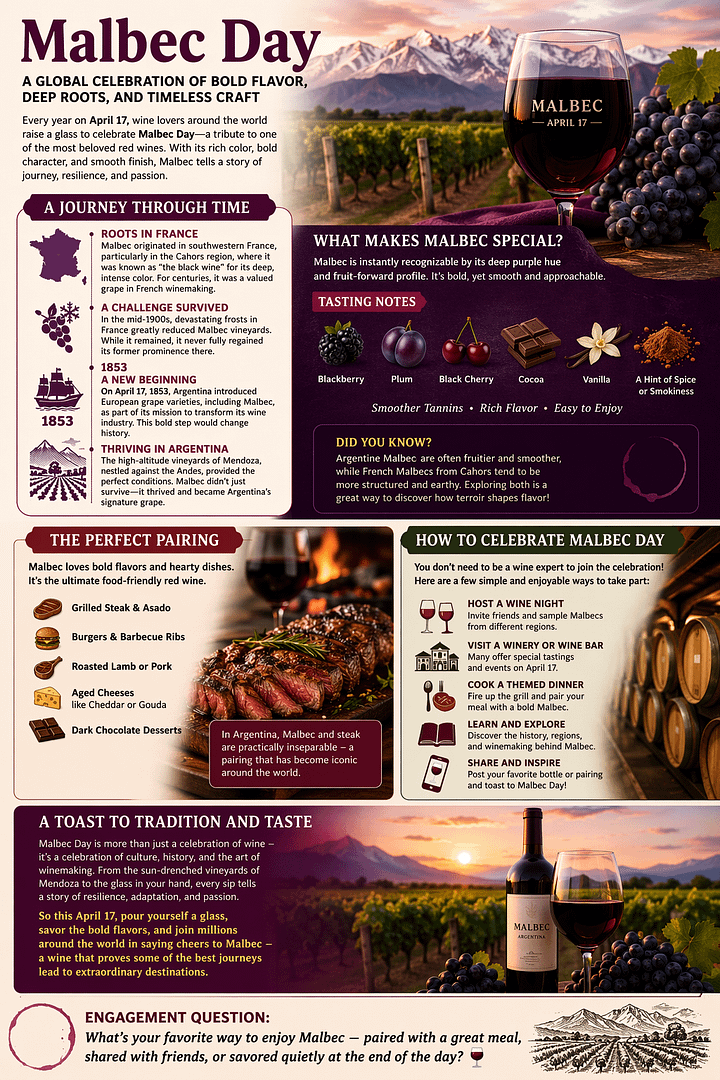
  • Malbec Day: A Global Celebration of Bold Flavor, Deep Roots, and Timeless Craft

    Advertisements

    Every year on April 17, wine lovers across the globe come together to celebrate Malbec Day—a tribute to a wine that has journeyed across continents, survived challenges, and emerged as one of the most cherished red varietals in the world. With its rich color, bold character, and smooth finish, Malbec isn’t just a drink—it’s an experience rooted in history, culture, and craftsmanship.

    Whether you’re sipping your first glass or you’ve long appreciated its depth, Malbec Day is a reminder of how a single grape can tell a powerful story.

    From France to Argentina: A Story of Reinvention

    Malbec’s origins trace back to southwestern France, particularly the Cahors region, where it was once known as “the black wine” due to its dark, intense color. For centuries, it played a key role in French winemaking, often blended with other grapes.

    However, Malbec’s journey wasn’t without hardship. In the mid-20th century, devastating frosts in France nearly wiped out large portions of Malbec vineyards. While the grape still exists in France today, it never fully regained its former prominence there.

    But halfway across the world, something extraordinary was happening.

    In 1853, Argentina took a bold step toward transforming its wine industry by introducing European grape varieties—Malbec among them. What began as an experiment soon became a revolution. The high-altitude vineyards of Mendoza, nestled against the Andes Mountains, provided the perfect conditions: abundant sunlight, cool nights, and mineral-rich soil.

    Here, Malbec didn’t just survive—it thrived.

    Over time, Argentina embraced Malbec as its signature grape, crafting wines that are now recognized globally for their richness, balance, and accessibility. Today, when most people think of Malbec, they think of Argentina first.

    The Signature of Malbec: What Sets It Apart

    One look at a glass of Malbec tells you you’re in for something special. Its deep, inky purple color hints at the bold flavors waiting inside.

    Malbec is known for being fruit-forward yet balanced, offering a richness that doesn’t overwhelm the palate. Common tasting notes include:

    Ripe blackberry and plum
    Juicy black cherry
    Subtle cocoa and chocolate undertones
    Vanilla and sweet spice (from oak aging)
    A gentle smokiness or earthy finish

    Compared to many other red wines, Malbec tends to have softer tannins, making it smoother and more approachable. This is one reason it appeals to both seasoned wine drinkers and newcomers alike.

    The climate where it’s grown also plays a major role:

    Argentine Malbec: Fruity, smooth, and full-bodied
    French Malbec (Cahors): More structured, earthy, and tannic

    This contrast makes Malbec a fascinating wine to explore across regions.

    The Art Behind the Bottle

    Winemaking is both science and art, and Malbec showcases this beautifully. From vineyard to glass, every step shapes the final product.

    High-altitude growing (especially in Argentina) intensifies sunlight exposure, which helps develop deeper color and richer flavors.
    Cool nighttime temperatures preserve acidity, keeping the wine balanced.
    Oak aging adds complexity—introducing notes of vanilla, spice, and toast.

    Many winemakers experiment with different aging techniques, blending methods, and terroirs to create unique expressions of Malbec. No two bottles are exactly the same, and that’s part of the magic.

    Perfect Pairings: Why Malbec Loves the Grill

    Malbec’s bold yet smooth profile makes it one of the most food-friendly red wines available. It shines brightest when paired with rich, savory dishes.

    Classic pairings include:

    Grilled steak (especially Argentine-style asado)
    Barbecue ribs and burgers
    Roasted lamb or pork
    Aged cheeses like cheddar or gouda
    Dark chocolate desserts

    The wine’s fruitiness balances smoky, charred flavors, while its body stands up to hearty meals. It’s no surprise that Malbec has become the go-to wine for grill lovers.

    How the World Celebrates Malbec Day

    Malbec Day has grown into a global event, celebrated in wine bars, restaurants, vineyards, and homes around the world.

    Here are a few meaningful ways to join in:

    Host a tasting night: Compare Malbecs from Argentina, France, and even California
    Visit a winery or wine bar: Many offer special flights or discounts
    Cook a themed dinner: Fire up the grill and build a meal around your wine
    Learn something new: Dive into the history, regions, or production methods
    Share the moment: Post your favorite bottle or pairing and invite others to join the celebration

    Even a quiet evening with a single glass can be a perfect way to honor the day.

    More Than a Wine—A Story in Every Glass

    Malbec Day isn’t just about enjoying a good bottle—it’s about appreciating the journey behind it. From its origins in France to its transformation in Argentina, Malbec represents resilience, adaptation, and the power of finding the right place to grow.

    It’s a reminder that sometimes the best things in life come from unexpected paths—and that with the right conditions, something ordinary can become extraordinary.

    So this April 17, pour a glass, take a moment, and savor not just the flavor—but the story.

    Final Toast

    Raise your glass to Malbec—a wine that brings people together, complements life’s best meals, and continues to evolve with every harvest.

    Cheers to bold flavor, rich tradition, and the simple joy of a well-earned glass of wine.

    Read More Holidays & National Days
Exit mobile version