Author: Brett Murphy

  • It’s Been a Week Since Deleting My Son’s Number and Last Text Message

    It’s Been a Week Since Deleting My Son’s Number and Last Text Message

    Advertisements

    It’s been seven days.

    Seven days since I did something I never thought I would have the strength—or the heartbreak—to do. I deleted my son’s phone number. I erased the last text message he ever sent me.

    And somehow, the world kept turning.

    But inside… something shifted.

    For a long time, I held onto that number like it was still a lifeline. Like somehow, if I just didn’t let go, there would still be a connection. His name sitting there in my contacts felt like proof that he existed—not just in memory, but in something tangible. Something I could see, scroll to, and almost… reach.

    And that last text message.

    I read it more times than I could count.

    Sometimes I’d open it just to feel close to him again. Other times, I’d stare at it, wishing I had answered differently… said more… said better. You don’t realize how much weight a few simple words can carry until they’re all you have left.

    Deleting it wasn’t just pressing a button.

    It felt like standing at the edge of something permanent.

    My finger hovered longer than I’d like to admit. Because deep down, I knew this wasn’t really about clearing space on a phone. This was about facing a truth I’ve been trying to live with every single day…

    He’s not coming back.

    People might not understand that.

    They might think, “It’s just a number. Just a message.”

    But it wasn’t.

    It was the last place where our conversations still existed in real time. The last thread where it felt like he could text me again… even though I knew he wouldn’t.

    Letting that go felt like closing a door I never wanted to shut.

    This past week has been quiet in a different way.

    There’s no more scrolling back. No more rereading those words. No more holding onto that digital piece of him like it could somehow bring comfort.

    And I’ll be honest…

    It hurt.

    It still hurts.

    Because grief doesn’t get smaller when you let go of things. It just changes shape.

    But something else happened too.

    In the silence, I started realizing something I hadn’t fully allowed myself to see before…

    He was never in that phone.

    Not really.

    He’s in the memories that play without warning.
    He’s in the lessons he left behind.
    He’s in the way I try to live now… trying to honor him in the smallest, everyday moments.

    Deleting his number didn’t erase him.

    It just forced me to find him somewhere deeper.

    There’s a different kind of connection now.

    Not one I can hold in my hand.

    But one I carry in my heart… every second of every day.

    And maybe that’s the hardest part of grief—learning to let go of what you can touch, while holding on to what you can’t.

    It’s been a week.

    Some moments feel heavier than others. Some days, I still reach for my phone without thinking. Muscle memory doesn’t disappear overnight.

    But I’m still here.

    Still breathing.
    Still remembering.
    Still loving him in a way that doesn’t need a contact name or a message thread.

    If you’re walking this road too—holding onto the last pieces, the last words, the last connection—you’re not alone.

    There’s no right time to let go.

    And there’s no right way to grieve.

    All we can do is take it one step at a time… carrying them with us, not in our phones—but in the way we live, the way we love, and the way we refuse to forget.

    Because love like that doesn’t disappear.
    It just finds a new place to live.

    A Father’s Guide to Surviving the Loss of a Child

    Grief & Child Loss


  • National Eggs Benedict Day: Celebrating a Brunch Classic

    Advertisements

    Every year on April 16, brunch lovers come together to celebrate National Eggs Benedict Day, honoring a dish that has become synonymous with comfort, indulgence, and timeless culinary tradition. Whether enjoyed at a cozy café, a high-end restaurant, or made from scratch in your own kitchen, Eggs Benedict represents more than just a meal—it’s a moment of pause, a reward, and a reminder that simple ingredients can create something extraordinary.

    The Anatomy of a Classic

    Eggs Benedict may look refined, but its brilliance lies in its simplicity. Each layer plays a critical role:

    English Muffin – toasted to provide a crisp, sturdy base
    Canadian Bacon or Ham – savory and slightly salty, adding depth
    Poached Eggs – delicate, with a soft yolk that becomes part of the sauce
    Hollandaise Sauce – rich, buttery, and slightly tangy, tying everything together

    When done right, it’s a perfect balance. The crunch of the muffin, the tenderness of the egg, and the velvety hollandaise create a harmony that has made this dish a brunch icon for generations.

    A Dish Born from Curiosity

    The origin of Eggs Benedict is one of culinary folklore. The most widely told story places its creation in late 19th-century New York City. A man named Lemuel Benedict, seeking relief from a long night, walked into the Waldorf Hotel and requested something simple yet satisfying: toast, poached eggs, bacon, and hollandaise sauce.

    The chef, intrigued, refined the idea—swapping toast for an English muffin and bacon for Canadian bacon—and a legend was born.

    Another story suggests the dish was created for a wealthy family named Benedict, who requested something new and unique. While historians may debate the details, the outcome remains the same: a dish that has stood strong for over a century.

    The Art (and Challenge) of Hollandaise

    If Eggs Benedict has a heart, it’s the hollandaise sauce. This classic French sauce is made from egg yolks, butter, and lemon juice, and while the ingredient list is short, the technique requires patience and care.

    Too much heat, and the eggs scramble. Too little, and the sauce won’t thicken. When mastered, however, hollandaise becomes silky, smooth, and rich—elevating the entire dish.

    For many home cooks, learning to make hollandaise is a rite of passage. It turns a simple breakfast into something restaurant-worthy and deeply satisfying.

    Why Eggs Benedict Endures

    There’s a reason Eggs Benedict has remained popular for generations:

    1. It Feels Special
    This isn’t an everyday breakfast. It’s a treat—something you order when you want to slow down and enjoy the moment.

    2. It Engages the Senses
    From the visual appeal of the golden sauce to the satisfying break of the yolk, it’s as much about experience as it is flavor.

    3. It’s Comfort Food with Elegance
    Few dishes manage to feel both indulgent and refined at the same time.

    4. It Brings People Together
    Eggs Benedict is often enjoyed during brunch—a meal that’s more about connection than routine. It’s about sitting longer, talking more, and appreciating the company around you.

    Creative Twists on a Classic

    As beloved as the classic is, Eggs Benedict has inspired countless variations:

    Eggs Florentine – replaces meat with sautéed spinach for a lighter option
    Eggs Royale – uses smoked salmon for a rich, slightly briny flavor
    Southern Benedict – swaps the muffin for a biscuit and adds sausage gravy
    Avocado Benedict – a fresh, modern twist with creamy avocado
    Crab Cake Benedict – combines seafood richness with brunch tradition

    These variations show just how versatile the dish can be while still honoring its roots.

    Making It at Home

    While Eggs Benedict might seem intimidating, it’s absolutely achievable at home with a little patience:

    Use fresh eggs for easier poaching
    Add a splash of vinegar to the water to help the egg whites set
    Toast your muffin well—it needs to hold up under the sauce
    Don’t rush the hollandaise; low and steady heat is key

    The reward? A homemade brunch that feels like something out of a high-end restaurant.

    How to Celebrate National Eggs Benedict Day

    Celebrating is simple—and delicious:

    Visit a local brunch spot and enjoy a professionally made version
    Cook it yourself and take pride in mastering a classic
    Try a new variation you’ve never had before
    Share the experience with family or friends over a relaxed meal

    This day isn’t just about eating—it’s about appreciating the craft, the flavor, and the tradition behind the dish.

    A Moment Worth Slowing Down For

    In a world that moves fast, Eggs Benedict invites you to slow down. It’s not a grab-and-go breakfast. It’s meant to be savored—bite by bite, conversation by conversation.

    National Eggs Benedict Day reminds us that food can be more than fuel. It can be comfort. It can be connection. It can be a small but meaningful celebration of life’s simple pleasures.

    Read More Holidays & National Days

  • National Anime Day: Celebrating the Art, Stories, and Global Impact of Anime

    Advertisements

    National Anime Day, celebrated each year on April 15, is more than just a day on the calendar—it’s a celebration of imagination, emotion, and storytelling that has touched millions of lives across the globe. What began as a uniquely Japanese art form has grown into a worldwide cultural movement, shaping how stories are told and how audiences connect with them.

    What Makes Anime Different?

    Anime stands apart from other forms of animation because it doesn’t limit itself. It refuses to be boxed into a single audience or style. While Western animation has often been associated with children’s entertainment, anime boldly explores every stage of life and every corner of the human experience.

    From fast-paced action and supernatural adventures to deeply emotional dramas and quiet, reflective slice-of-life stories, anime offers something for everyone. It doesn’t shy away from reality—it embraces it, even when it’s uncomfortable.

    Anime characters are rarely perfect. They struggle, fail, grow, and carry emotional weight that feels real. That authenticity is one of the reasons anime resonates so deeply with its audience.

    The Evolution of an Art Form

    The journey of anime is one of constant growth and innovation. Early works laid the foundation, but it was visionaries like Osamu Tezuka who helped define its storytelling style and visual language.

    As technology advanced, so did anime. Studios began pushing artistic boundaries—blending hand-drawn animation with digital techniques, experimenting with color, motion, and cinematic storytelling.

    Today, anime ranges from beautifully minimalist designs to incredibly detailed worlds that feel almost lifelike. Every frame can feel like a piece of art.

    Storytelling That Stays With You

    What truly sets anime apart is its ability to tell stories that stay with you long after the screen goes dark.

    Anime often explores themes that hit close to home:

    The pain of losing someone you love
    The struggle to find your purpose
    The weight of regret and the hope for redemption
    The quiet strength it takes to keep going

    These aren’t just fictional ideas—they mirror real-life emotions. That’s why so many people turn to anime during difficult times. It gives language to feelings that are often hard to express.

    For some, a single anime scene can leave a lifelong impact.

    A Global Cultural Movement

    Anime is no longer confined to Japan—it has become a global language of storytelling.

    Streaming platforms have made anime more accessible than ever, allowing fans from all over the world to discover new series instantly. What was once considered niche is now mainstream, influencing:

    Hollywood films and storytelling techniques
    Fashion trends inspired by characters
    Music and visual art styles
    Video games and digital media

    Anime has reshaped entertainment, proving that powerful stories can cross any cultural boundary.

    The Power of the Anime Community

    Anime isn’t just something people watch—it’s something they live and share.

    Fans form deep connections through:

    Cosplay, bringing characters to life with incredible creativity
    Fan art and storytelling, expanding on the worlds they love
    Online communities, where discussions go far beyond surface-level entertainment
    Conventions, where thousands gather to celebrate a shared passion

    There’s a sense of belonging in the anime community. People from completely different backgrounds come together through a shared love of storytelling.

    Anime and Emotional Healing

    For many, anime becomes something deeply personal. It can be a source of comfort during grief, loneliness, or uncertainty.

    There are stories that help people process loss…
    Stories that remind them they’re not alone…
    Stories that show that even in darkness, there’s still light ahead.

    Anime has a unique ability to sit with you in your pain without trying to rush you past it. It allows you to feel, reflect, and slowly heal.

    Why National Anime Day Matters

    National Anime Day is more than a celebration of entertainment—it’s a recognition of the impact anime has had on people’s lives.

    It’s a day to:

    Appreciate the artists and creators behind the scenes
    Reflect on the stories that have shaped you
    Share your favorite series with someone new
    Revisit the moments that meant something to you

    Whether you’ve been watching anime for years or you’re just starting, this day is about honoring the connection between story and viewer.

    How to Celebrate National Anime Day

    There’s no right or wrong way to celebrate—but here are a few ideas:

    Rewatch a series that left a lasting impact
    Start something new you’ve been meaning to watch
    Share your favorite anime with friends or online
    Support creators by purchasing official content or merchandise
    Create something inspired by anime—art, writing, or even a post

    Or simply sit back, press play, and let yourself get lost in another world.

    Final Thoughts

    Anime is more than animation—it’s emotion in motion, storytelling without limits, and a bridge between cultures, experiences, and people.

    On National Anime Day, take a moment to appreciate the stories that made you feel something real.

    Because anime isn’t just about what you see…

    …it’s about what stays with you long after it’s over.

    Read More Holidays & National Days

  • 🍌 National Banana Day: Celebrating One of the World’s Favorite Fruits

    Advertisements

    National Banana Day, celebrated each year on the third Wednesday of April, is more than just a lighthearted food holiday—it’s a celebration of one of the most essential, accessible, and beloved fruits on the planet. From early morning breakfasts to late-night snacks, bananas have quietly become a part of daily life for millions of people.

    But behind that simple yellow peel is a story of global impact, nutrition, culture, and comfort.

    🌍 A Global Staple With Deep Roots

    Bananas are grown in over 100 countries and are a staple food for millions, particularly in parts of Africa, Latin America, and Southeast Asia. Unlike many fruits that are considered treats or seasonal luxuries, bananas are often a daily necessity—providing affordable nutrition to families around the world.

    They grow in warm, tropical climates and are harvested year-round, which is why you can find them in grocery stores no matter the season. This consistency has made bananas one of the most reliable and widely distributed fruits in human history.

    Interestingly, bananas aren’t technically trees—they grow on large herbaceous plants. And what we commonly eat today is the Cavendish banana, a variety chosen for its durability and sweetness.

    💪 The Power of a Simple Fruit

    Bananas may seem ordinary, but nutritionally, they punch far above their weight.

    They are packed with:

    Potassium, which helps regulate blood pressure and supports heart health
    Vitamin B6, essential for brain health and mood regulation
    Vitamin C, which strengthens your immune system
    Dietary fiber, aiding digestion and promoting gut health

    Bananas also contain natural sugars like glucose, fructose, and sucrose—making them a perfect quick energy source. That’s why athletes often reach for a banana before or after workouts.

    And unlike processed snacks, bananas come with no additives, no preservatives, and no packaging—just pure, natural fuel.

    🍽️ From Simple Snack to Culinary Star

    One of the reasons bananas are so popular is their versatility. They can be enjoyed at every stage of ripeness, each offering a different taste and use:

    Green bananas – Less sweet, often used in cooking or frying
    Yellow bananas – Perfectly balanced sweetness, ideal for snacking
    Spotted bananas – Extra sweet, great for baking

    Bananas shine in countless recipes:

    Fluffy banana pancakes to start your morning
    Creamy smoothies for a healthy boost
    Homemade banana bread that fills the house with warmth
    Frozen banana “nice cream” for a guilt-free dessert
    Peanut butter and banana sandwiches for a quick, satisfying meal

    They can be healthy, indulgent, or somewhere in between—depending on how you use them.

    🎉 Celebrating National Banana Day

    National Banana Day is all about enjoying the fruit in your own way, but it can also be a chance to slow down and appreciate the simple things.

    Here are some meaningful and fun ways to celebrate:

    Try something new – Make a banana recipe you’ve never tried before
    Share the joy – Bring banana treats to work or family gatherings
    Go healthy for the day – Swap processed snacks for bananas
    Teach kids about nutrition – Show them how simple foods can be powerful
    Support local stores – Pick up fresh produce and get creative in the kitchen

    Even something as small as starting your day with a banana can feel like a quiet celebration.

    🌱 The Bigger Picture: Sustainability and Challenges

    While bananas are incredibly popular, their production comes with challenges. The global banana industry faces threats like plant diseases, climate change, and supply chain issues.

    Because most exported bananas come from a single variety (Cavendish), they are vulnerable to disease. Scientists and farmers are working hard to protect banana crops and develop more resilient varieties.

    So when you pick up a banana, you’re not just grabbing a snack—you’re participating in a global system that supports farmers, economies, and communities.

    🍌 A Fruit That Feels Like Comfort

    There’s something comforting about bananas. Maybe it’s their familiar taste, their simplicity, or the way they’ve been a part of our lives since childhood.

    They don’t require preparation. They don’t demand attention. They’re just… there when you need them.

    In a fast-paced, complicated world, that kind of simplicity matters.

    🌟 Final Thoughts

    National Banana Day isn’t just about celebrating a fruit—it’s about recognizing how something so simple can have such a meaningful impact on our lives.

    Bananas remind us that not everything has to be complicated to be good. Sometimes, the best things are the ones that are easy, natural, and always there when we need them.

    So on April 20, take a moment to enjoy a banana—not just for the taste, but for everything it represents: nourishment, energy, comfort, and the beauty of simplicity.

    Read More Holidays & National Days

  • National Reach As High As You Can Day – Dream Bigger. Push Further. Rise Higher.

    Advertisements

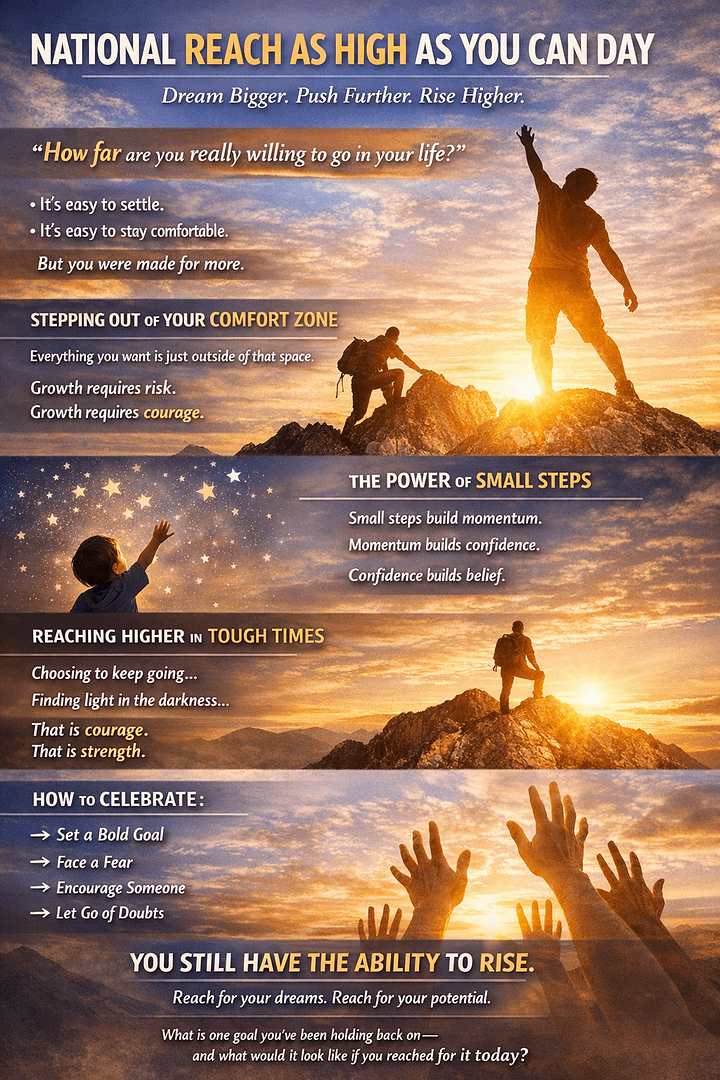
    Every year, National Reach As High As You Can Day arrives as more than just a moment on the calendar—it shows up as a quiet challenge to every one of us:

    How far are you really willing to go in your life?

    It’s easy to exist.
    It’s easy to settle.
    It’s easy to convince yourself that “this is enough.”

    But this day pushes back against that mindset. It reminds us that inside every person is something greater waiting to be unlocked—dreams that haven’t been chased, goals that haven’t been pursued, and a version of ourselves we haven’t fully stepped into yet.

    This isn’t about perfection.
    This is about effort, courage, and movement forward.

    The Meaning Behind Reaching Higher

    To “reach as high as you can” doesn’t mean comparing yourself to others. It doesn’t mean measuring your worth based on someone else’s success.

    It means asking yourself:

    Am I living up to what I’m capable of?
    Am I allowing fear to decide my limits?
    Am I growing—or just staying comfortable?

    Reaching higher is personal. For one person, it might mean building a business or chasing a dream career. For another, it might mean healing from something deeply painful or learning to trust again.

    Growth looks different for everyone—but it always requires movement.

    The Comfort Zone Trap

    There’s a place many people live in without even realizing it: the comfort zone.

    It feels safe there. Predictable. Controlled.

    But the truth is, nothing grows there.

    The comfort zone whispers:

    “Don’t take the risk.”
    “What if you fail?”
    “You’re fine where you are.”

    And slowly, over time, those whispers become beliefs.

    But here’s the reality:

    Everything you want is just outside of that space.

    Reaching higher means stepping out of what’s familiar and stepping into what’s possible.

    It means being willing to look foolish.
    It means being willing to fail.
    It means being willing to try again anyway.

    The Power of Small Steps

    There’s a misconception that reaching high requires massive, life-changing action.

    It doesn’t.

    It requires consistency.

    It’s waking up and choosing to try—again.
    It’s making one better decision today than you did yesterday.
    It’s doing the hard thing, even when no one is watching.

    Small steps build momentum.
    Momentum builds confidence.
    Confidence builds belief.

    And belief? That’s what carries you further than anything else.

    Reaching Higher When Life Feels Heavy

    Not everyone is starting from the same place.

    For some, life has dealt challenges that make even the idea of “reaching higher” feel exhausting.

    Grief.
    Loss.
    Disappointment.
    Loneliness.

    These things weigh on a person in ways that aren’t always visible.

    If you’re carrying something heavy, understand this:

    Reaching higher doesn’t always mean doing more—it sometimes means not giving up.

    Getting through the day is reaching higher
    Choosing to keep going is reaching higher
    Finding even a small moment of peace is reaching higher

    Especially for those who are grieving or struggling, progress doesn’t look like leaps—it looks like endurance.

    And that kind of strength deserves to be recognized.

    Breaking Through Fear and Doubt

    Fear is one of the biggest barriers between where you are and where you want to be.

    It shows up in different ways:

    Overthinking
    Procrastination
    Self-doubt
    Talking yourself out of opportunities

    Fear tries to protect you—but it also limits you.

    The only way through it is to face it.

    Not all at once. Not perfectly. But intentionally.

    Courage isn’t the absence of fear—it’s moving forward despite it.

    Every time you take a step forward, even while afraid, you weaken the hold fear has on you.

    The Importance of Believing in Yourself

    Before anyone else believes in you… you have to believe in yourself.

    And that’s not always easy.

    Life has a way of shaking confidence. People let you down. Plans don’t work out. Doubt creeps in.

    But belief isn’t something you wait to feel—it’s something you build.

    You build it by:

    Keeping promises to yourself
    Showing up even when it’s hard
    Choosing growth over excuses
    Reminding yourself that your story isn’t over

    You don’t need to have everything figured out.

    You just need to decide that you’re not done trying.

    How to Truly Celebrate This Day

    Celebrating National Reach As High As You Can Day isn’t about posting a quote and moving on.

    It’s about action.

    Here are meaningful ways to honor the day:

    1. Do the Thing You’ve Been Avoiding

    There’s something you’ve been putting off. You know it.
    Take one step toward it today.

    2. Set a Bold Goal

    Not a “safe” goal—a real one.
    Something that excites you and scares you at the same time.

    3. Speak Life Into Someone Else

    Encourage someone who might be doubting themselves.
    Your words could be the push they need.

    4. Reflect on How Far You’ve Come

    Sometimes reaching higher starts with recognizing how much you’ve already overcome.

    5. Let Go of What’s Holding You Back

    Whether it’s fear, doubt, or even people who don’t support your growth—release it.

    A Message for Those Who Feel Stuck

    If you feel like you’re not where you thought you’d be…
    If you feel like life hasn’t gone the way you planned…

    You’re not alone.

    And more importantly—you’re not finished.

    There is still time to grow.
    Still time to change direction.
    Still time to become who you were meant to be.

    Your current situation is not your final destination.

    Final Reflection

    National Reach As High As You Can Day is not about pressure—it’s about possibility.

    It’s about remembering that no matter your past, your pain, or your present circumstances…

    You still have the ability to rise.

    So reach.

    Reach for healing.
    Reach for purpose.
    Reach for peace.
    Reach for the life you know deep down you’re capable of living.

    And don’t stop—
    not when it’s hard,
    not when it’s uncomfortable,
    not when doubt creeps in.

    Because the moment you stop reaching… is the moment you stop growing.

    And you were never meant to stay where you are.

    Read More Holidays & National Days

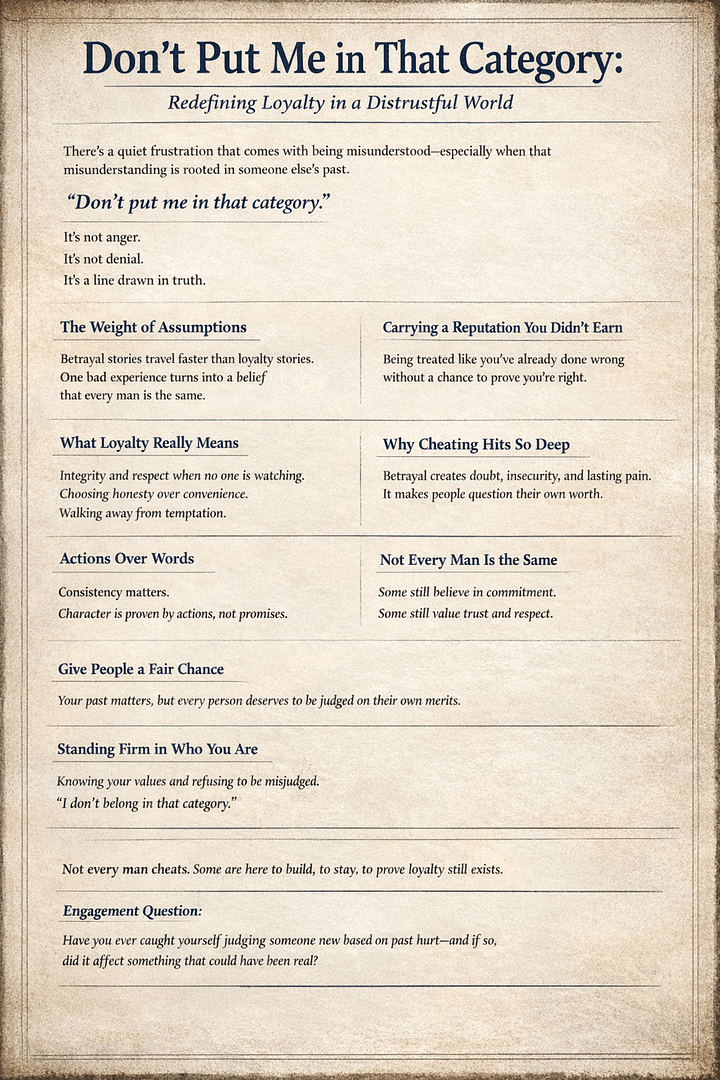
  • Don’t Put Me in That Category: Redefining Loyalty in a Distrustful World

    Advertisements

    There’s a quiet frustration that comes with being misunderstood—especially when that misunderstanding is rooted in someone else’s past. It’s the feeling of being judged before you’ve even had the chance to show who you are. And for many men today, that judgment comes in the form of a label they never earned: being grouped in with men who cheat.

    “Don’t put me in that category.”

    It’s not anger. It’s not denial.
    It’s a line drawn in truth.

    The Weight of Assumptions

    We live in a time where betrayal stories travel faster than loyalty stories. Pain gets shared more than peace. And while those stories are valid—because people really have been hurt—they’ve also created a culture of assumption.

    One bad experience turns into guarded behavior.
    Multiple bad experiences turn into belief.
    And eventually, that belief becomes a filter through which every new person is judged.

    So when a man steps in with honest intentions, he’s not just trying to build something new—he’s also trying to break through walls he didn’t build.

    That’s the part people don’t always see.

    Carrying a Reputation You Didn’t Earn

    There’s something heavy about being treated like you’ve already done wrong before you’ve even had the chance to prove yourself right.

    It shows up in the questions.
    In the doubt behind simple situations.
    In the hesitation to trust even the smallest things.

    And while understanding someone’s past is important, there’s a difference between being aware and being unfair.

    Because when someone is constantly expected to fail, it creates distance—even if they’re doing everything right.

    No one thrives in a space where they’re always being compared to someone else’s worst memory.

    What Loyalty Really Means

    Loyalty isn’t just about not cheating—it’s about integrity when there’s opportunity to do wrong.

    It’s about:

    Choosing the person you’re with, even when no one is watching
    Being honest instead of convenient
    Walking away from temptation instead of entertaining it
    Respecting your partner even in their absence

    A loyal man doesn’t need to prove himself through constant reassurance—his consistency speaks for him.

    He’s not perfect. He’ll make mistakes, like anyone else. But betrayal isn’t one of them.

    Because loyalty, to him, isn’t a rule—it’s part of who he is.

    Why Cheating Hits So Deep

    Cheating isn’t just physical—it’s emotional disruption at its core.

    It creates questions like:
    Was I not enough?
    Was any of it real?
    How did I miss the signs?

    It doesn’t just break trust in one person—it can break trust in yourself.

    That’s why people become guarded. That’s why they hesitate. That’s why they question everything.

    And that’s also why it matters when someone comes along who genuinely doesn’t operate that way.

    Because they’re not just offering love—they’re offering safety.

    The Difference Between Guarded and Closed Off

    There’s nothing wrong with protecting your heart. In fact, it’s necessary after you’ve been hurt.

    But there’s a line between being cautious and being closed off.

    Being cautious says: I’m paying attention.
    Being closed off says: I’ve already decided who you are.

    And when someone has already decided you’re just like the last person, it doesn’t matter how differently you show up—you’re fighting a battle you can’t win.

    Healthy relationships require awareness, not assumptions.

    Actions Over Words

    Anyone can say they’re loyal. Anyone can promise they’ll be different.

    But real character shows up in patterns, not promises.

    It’s in:

    Showing up when they say they will
    Communicating even when it’s uncomfortable
    Being transparent without being asked
    Respecting boundaries naturally, not reluctantly

    A man who values loyalty doesn’t perform it—he lives it.

    Over time, consistency becomes undeniable.

    Not Every Man Is the Same

    This truth often gets lost in the noise: not every man cheats.

    There are men who:

    Believe in commitment
    Value emotional connection over attention
    Take pride in being dependable
    Understand the responsibility that comes with someone trusting them

    They may not always be the loudest or the most flashy—but they’re there.

    And they’re often overlooked because they don’t fit the narrative people have grown used to expecting.

    Give People a Fair Chance

    No one is asking you to ignore your past. Your experiences matter. They shaped you.

    But they shouldn’t control every future connection.

    Every person deserves to be evaluated on their own actions—not someone else’s behavior.

    Trust doesn’t have to be given all at once.
    It can be built slowly, through observation and time.

    But it has to be possible.

    Because without that possibility, nothing real can grow.

    Standing Firm in Who You Are

    Saying “Don’t put me in that category” is about more than defending yourself—it’s about knowing your values and refusing to be misrepresented.

    It’s about saying:

    I don’t move like that
    I don’t treat people like that
    I don’t build connections just to break them

    It’s quiet confidence. Not arrogance.
    It’s self-awareness. Not defensiveness.

    And it comes from living in alignment with your principles—even when no one is watching.

    Final Thoughts

    We all carry something from the past—lessons, scars, memories.

    But if we let those things define every new person we meet, we risk missing out on something real.

    Not everyone is here to hurt you.
    Not everyone is here to leave.
    And not every man belongs in the category of those who cheat.

    Some are here to build.
    Some are here to stay.
    Some are here to prove that loyalty still exists.

    And if you meet one of those men—
    don’t make him pay for what someone else did.

    Read More Of Love & Relationships

  • The Quiet Damage of False Hope

    Advertisements

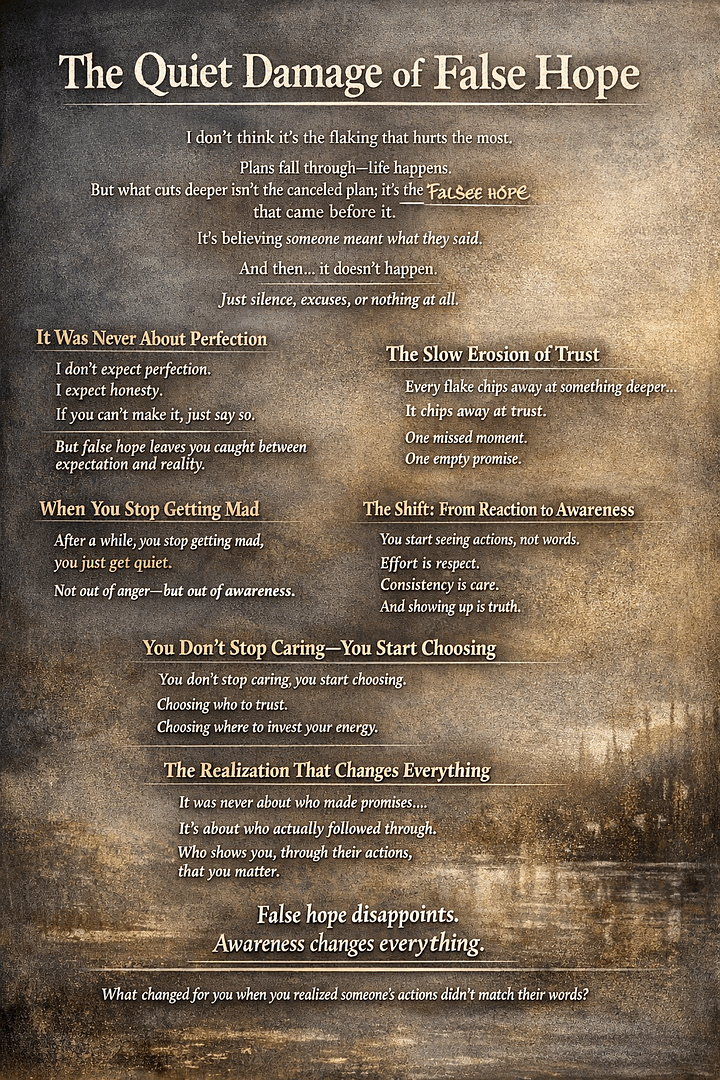
    I don’t think it’s the flaking that hurts the most.

    Plans fall through—life happens, people get overwhelmed, things don’t always go the way we expect. That’s part of life, and most of us understand that. We make room for it. We give grace. We try to be patient.

    But what cuts deeper isn’t the canceled plan or the missed moment.

    It’s the false hope that came before it.

    It’s believing someone meant what they said.

    It’s that moment when they look you in the eye—or send that message—and say, “Yeah, I’ll be there,” or “Let’s do this.” And you take them at their word. Not because you’re naïve, but because you choose to believe in people. You choose to trust.

    So you start to look forward to it.

    You rearrange your schedule. You turn down other plans. You mentally prepare. Maybe you even feel a little excitement building—because connection matters to you. Showing up matters to you.

    And then… it doesn’t happen.

    No real explanation.
    No accountability.
    No honesty.

    Just silence, last-minute excuses, or worse—nothing at all.

    That’s the part that lingers.

    Because it’s not just about the plan that fell through. It’s about the emotional investment that came with it. It’s about realizing that while you were being intentional, someone else was being careless.

    And that realization doesn’t just sting—it settles.

    It Was Never About Perfection

    Most people aren’t expecting perfection.

    We don’t expect people to always get it right. We don’t expect life to run on schedule or everything to go smoothly. What we do expect—what we need in order to feel respected—is honesty.

    Simple, direct honesty.

    If you can’t make it, say that.
    If you’re not sure, say that.
    If you don’t want to show up, just be real about it.

    Because there’s something grounding about truth—even when it disappoints you. Truth gives you clarity. It allows you to adjust, to move forward without confusion.

    But false hope?

    That leaves you hanging in a space between expectation and reality. And that space is where doubt begins to grow.

    The Slow Erosion of Trust

    Every time someone flakes, it might seem small on the surface.

    “It’s just one time.”
    “It’s not a big deal.”
    “They probably didn’t mean anything by it.”

    But over time, those moments add up.

    And what they begin to chip away at isn’t your schedule—it’s your trust.

    Trust doesn’t break loudly most of the time. It doesn’t always come with a confrontation or a clear ending. More often, it fades quietly.

    One missed moment.
    One empty promise.
    One unanswered message.

    Until eventually, something inside you shifts.

    You stop expecting consistency from certain people.
    You stop believing their words carry weight.
    You stop giving them the same access to your time and energy.

    Not out of anger—but out of awareness.

    When You Stop Getting Mad

    At first, it frustrates you.

    You question it. You replay conversations. You try to understand why someone would say something they didn’t intend to follow through on. You might even blame yourself—wondering if you expected too much.

    But then something changes.

    You stop reacting the way you used to.

    You don’t argue.
    You don’t chase explanations.
    You don’t keep asking, “Are you still coming?”

    Instead…

    you get quiet.

    And that silence isn’t weakness.

    It’s recognition.

    It’s the moment you begin to understand that not everyone values your time the way you do. Not everyone communicates with the same level of intention. Not everyone shows up—not just physically, but emotionally.

    And once you see that clearly, it becomes harder to ignore.

    The Shift: From Reaction to Awareness

    That quiet phase is where growth happens.

    Because instead of reacting emotionally, you start observing patterns. You begin to separate words from actions. You stop holding onto potential and start paying attention to consistency.

    You learn that:

    Effort is a form of respect
    Consistency is a form of care
    Showing up is a form of truth

    And when those things are missing, no amount of excuses can replace them.

    So you adjust.

    You don’t give the same energy to everyone.
    You don’t overextend yourself for people who underdeliver.
    You don’t build expectations on words alone anymore.

    You start protecting your time like it matters—because it does.

    You start protecting your peace like it matters—because it does.

    You Don’t Stop Caring—You Start Choosing

    One of the biggest misconceptions is that when someone gets quiet, it means they’ve stopped caring.

    But that’s not always true.

    Sometimes, it means they’ve started choosing.

    Choosing where to invest their energy.
    Choosing who to trust.
    Choosing what they allow into their space.

    You don’t stop valuing connection—you just become more intentional about it.

    You don’t shut people out—you just stop chasing people who aren’t meeting you halfway.

    Because you’ve learned something important:

    Not everyone who says they’ll be there actually will be.
    But the ones who truly care? They won’t have to convince you.

    The Realization That Changes Everything

    At some point, it clicks.

    You realize it was never about how many people made promises.

    It was about who actually followed through.

    Who checked in.
    Who showed up.
    Who made the effort without needing reminders or pressure.

    And once you see that clearly, everything shifts.

    You stop holding onto false hope.
    You stop waiting on people who don’t value your time.
    You stop confusing words with commitment.

    And instead…

    you start building your life around the people who show you—consistently—that you matter.

    Final Thought

    False hope doesn’t just disappoint—it reshapes how you trust.

    But awareness?

    That reshapes how you choose.

    And in the end, that quiet understanding—the one that comes after all the frustration fades—is what protects your heart moving forward.

    Because now you know:

    It’s not about who says they care.

    It’s about who proves it—without you having to question it.

    Read More Health & Wellness

  • 🥪 National Make Lunch Count Day: Turning a Simple Meal into a Meaningful Moment

    Advertisements

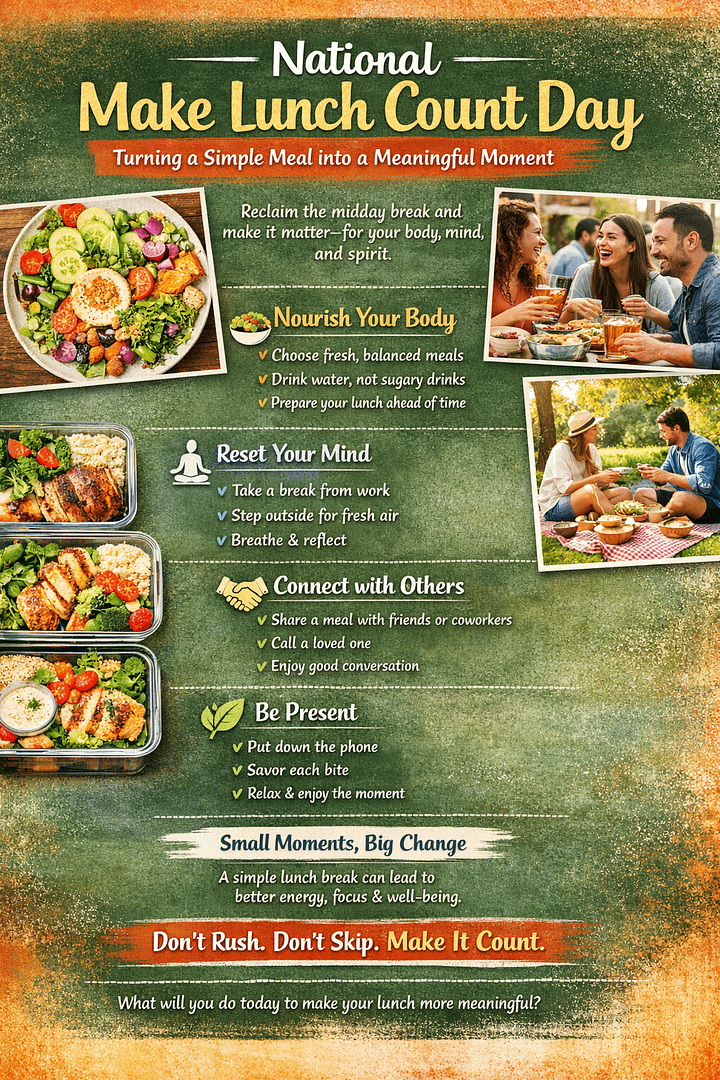
    In a world that constantly demands more of our time, energy, and attention, lunch often becomes one of the first things we sacrifice. We eat quickly, eat poorly, or sometimes don’t eat at all. But National Make Lunch Count Day challenges that habit. It calls us to pause, to be intentional, and to recognize that even something as simple as lunch can shape the entire course of our day—and our well-being.

    This isn’t just about food.
    It’s about how you treat yourself in the middle of life’s demands.

    🍽️ The Forgotten Break in a Busy World

    Think about your typical day. Mornings are rushed. Evenings are full. And right in the middle sits lunch—a moment that could restore you, yet is often ignored.

    Too many people:

    Eat at their desk without looking up
    Grab fast food out of convenience, not nourishment
    Skip meals entirely due to stress or workload

    Over time, these habits take a toll—not just physically, but emotionally and mentally. When you neglect your midday break, you’re telling yourself that everything else matters more than your own care.

    National Make Lunch Count Day is about changing that mindset.
    It’s about reclaiming that moment and using it with purpose.

    🥗 Nourish Your Body with Intention

    Food is fuel—but it’s also medicine. The choices you make at lunch can either carry you through the rest of the day with steady energy or leave you feeling sluggish and drained.

    Making lunch count doesn’t mean perfection. It means awareness.

    Consider:

    Choosing whole, fresh ingredients over processed options
    Including a balance of protein, healthy fats, and fiber
    Avoiding heavy, sugar-loaded meals that lead to crashes

    Even small changes matter:

    Adding a handful of greens
    Swapping soda for water
    Preparing your lunch ahead of time instead of relying on convenience

    These simple decisions add up. Over time, they become habits—and those habits become a healthier, stronger version of you.

    🧠 A Reset for Your Mind and Spirit

    Your mind needs rest just as much as your body needs food.

    Lunch is more than a physical break—it’s a mental reset. Stepping away, even for 20–30 minutes, can improve your focus, reduce stress, and help you return to your day with clarity.

    Instead of multitasking during lunch, try:

    Sitting somewhere quiet
    Taking a short walk outdoors
    Practicing gratitude or reflection
    Simply breathing and being still

    In a world that glorifies constant productivity, choosing to pause is powerful. It’s not laziness—it’s wisdom.

    🤝 The Power of Connection

    Some of life’s best conversations happen over a meal.

    Lunch can be a time to reconnect—with coworkers, friends, or family. It can be a moment to laugh, share stories, and strengthen relationships that often get lost in the busyness of life.

    Even a simple message or phone call during lunch can remind someone they matter—and remind you that you’re not alone.

    And if you’re eating by yourself, that doesn’t mean you’re disconnected. It can be a time to reconnect with yourself—to check in emotionally, mentally, and spiritually.

    🌿 Presence Over Pressure

    One of the biggest reasons lunch loses its value is distraction. Phones, emails, notifications—they all pull you away from the moment.

    Making lunch count means choosing presence over pressure.

    Slow down.
    Taste your food.
    Notice your surroundings.

    When you’re present, even a simple sandwich becomes more than just a meal—it becomes a moment of peace in a busy world.

    ⏳ Small Moments Create Big Change

    It’s easy to think that meaningful change requires big actions. But often, it’s the small, consistent moments that shape our lives.

    Lunch is one of those moments.

    A better lunch today leads to:

    Better energy this afternoon
    Better focus on your goals
    Better habits over time

    And eventually, a better quality of life.

    💬 Final Thoughts

    National Make Lunch Count Day is more than a reminder—it’s an invitation.

    An invitation to slow down.
    An invitation to take care of yourself.
    An invitation to be intentional in the middle of your day.

    Because your life isn’t just made up of big milestones—
    it’s made up of small, everyday moments like this one.

    So today, don’t rush through lunch.
    Don’t ignore it.
    Don’t treat it as unimportant.

    Sit down.
    Take a breath.
    And make it count.

    Read More Holidays & National Days

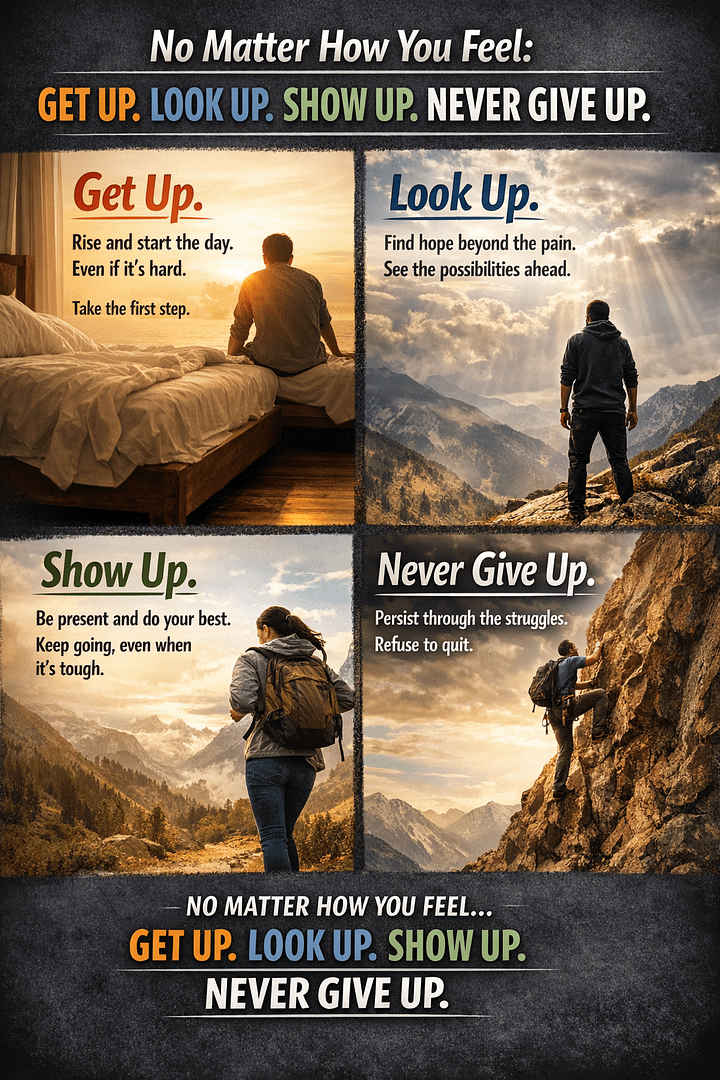
  • No Matter How You Feel: Get Up. Look Up. Show Up. Never Give Up.

    Advertisements

    There are moments in life when everything inside you says stop.
    Stop trying. Stop caring. Stop pushing forward.

    It’s in those quiet, heavy moments—when the world keeps moving but your heart feels stuck—that this message matters most:

    Get up.
    Look up.
    Show up.
    Never give up.

    These words are simple, but they carry a kind of strength that doesn’t shout—it endures. They are not about perfection. They are about persistence. Not about feeling strong, but choosing to keep going even when you feel anything but.

    Get Up: The First Victory of the Day

    Getting up is often the hardest part.

    Not physically—but emotionally.

    It’s waking up to another day when your heart still aches. It’s facing responsibilities when your mind is tired. It’s stepping into a world that doesn’t pause for your pain.

    But getting up is powerful.

    It is the first decision that shifts everything.
    It is the moment you refuse to let your circumstances define your entire day.

    Some days, getting up will feel like a small act. But in reality, it’s a declaration:

    I’m not done.

    Even if all you do is take one step forward, that step matters. Because momentum doesn’t begin with leaps—it begins with movement.

    Look Up: Changing Your Perspective

    When life gets heavy, your vision narrows. You begin to see only what’s wrong, what’s missing, what hurts.

    Looking up is about breaking that pattern.

    It’s about lifting your eyes—whether toward faith, hope, purpose, or simply the possibility that things can change. It’s choosing not to stay locked into the weight of the present moment.

    Looking up doesn’t erase your struggles.
    It gives you the strength to rise above them.

    It reminds you that:

    This moment is not your entire story
    Pain is real, but it is not permanent
    There is still something ahead worth moving toward

    Sometimes, looking up is a prayer.
    Sometimes, it’s a quiet belief.
    Sometimes, it’s just refusing to give in to despair.

    But every time you do it, you create space for hope.

    Show Up: The Power of Presence

    You don’t need to have it all figured out to show up.

    You don’t need to feel ready, confident, or strong.

    You just need to be there.

    Showing up is one of the most underrated forms of strength. It’s easy to disappear when life gets hard—to withdraw, to shut down, to isolate. But choosing to show up—especially when you don’t feel like it—is what builds resilience.

    Show up for:

    Your responsibilities
    Your purpose
    Your family and those who care about you
    And most importantly, yourself

    Some days, showing up means giving your best effort.
    Other days, it simply means not giving up.

    And that’s enough.

    Because consistency—not perfection—is what creates change over time.

    Never Give Up: The Decision That Changes Everything

    There will be moments when quitting feels easier.

    When the road feels too long.
    When the pain feels too deep.
    When the progress feels invisible.

    But what you don’t see in those moments is how close you might be to a breakthrough.

    Giving up ends the story.
    Continuing gives it a chance to change.

    Never giving up doesn’t mean you never struggle. It doesn’t mean you don’t feel weak, tired, or discouraged.

    It means that despite all of that—you keep going.

    It means:

    You keep trying, even when it’s hard
    You keep believing, even when doubt creeps in
    You keep moving, even when progress feels slow

    Because strength is not about never falling—it’s about refusing to stay down.

    When Feelings Try to Take Control

    Feelings are powerful.

    They can convince you that you’re not strong enough. That things won’t get better. That it’s not worth the effort.

    But feelings are not facts.

    They change. They shift. They rise and fall like waves.

    If you build your life based only on how you feel in a moment, you’ll always be at the mercy of those waves.

    But when you choose discipline over emotion—when you decide to act regardless of how you feel—you take back control.

    You remind yourself:

    I may feel weak, but I am not defeated.
    I may feel tired, but I can still move forward.
    I may feel lost, but I am not without direction.

    The Quiet Strength of Endurance

    Not all strength is loud.

    Sometimes strength looks like:

    Getting through the day without giving up
    Holding yourself together when everything feels like it’s falling apart
    Continuing to try when no one else sees your effort

    Endurance is not glamorous—but it is powerful.

    It builds character.
    It shapes resilience.
    It creates a foundation that cannot be easily broken.

    And over time, that quiet strength becomes unshakable.

    The Ripple Effect of Showing Up

    When you live by this mindset, something incredible happens.

    Your actions begin to influence more than just your own life.

    You inspire others—often without even realizing it.

    Someone sees you keep going when it’s hard, and it gives them the courage to do the same. Someone watches your persistence and begins to believe that maybe they can push through too.

    Your decision to not give up becomes a light for someone else.

    Final Reflection

    No matter how you feel today—whether you’re full of energy or barely holding on—these four steps remain the same:

    Get up.
    Look up.
    Show up.
    Never give up.

    You don’t have to conquer everything at once.
    You don’t need all the answers.
    You don’t have to feel strong.

    You just have to take the next step.

    Because every step forward—no matter how small—is proof that you are still fighting, still believing, and still moving toward something better.

    And that… is more powerful than you realize.

    Read More Of Inspiration & Motivation

  • Good Deeds Day: The Power of Small Acts to Change the World

    Advertisements

    Good Deeds Day is more than just a date on the calendar—it is a global movement built on the belief that kindness has the power to transform lives. Celebrated by millions of people across the world, this day serves as a reminder that no act of goodness is ever too small to matter.

    In a world that often feels fast-paced and disconnected, Good Deeds Day invites us to slow down, look around, and choose compassion. It reminds us that behind every face is a story, and sometimes all it takes is one kind gesture to change the direction of someone’s day—or even their life.

    The Heart Behind Good Deeds Day

    At its core, Good Deeds Day is about intention. It’s about making a conscious decision to bring light into someone else’s world. It’s not about recognition, applause, or reward—it’s about giving from a place of sincerity.

    A good deed doesn’t have to be grand or expensive. Often, the most meaningful acts are the simplest:

    A smile offered to someone who feels invisible
    A listening ear for someone who needs to be heard
    A message that says, “I’m thinking of you”
    Helping someone carry a burden—physically or emotionally

    These moments, though brief, have a lasting impact. They remind people that they are seen, valued, and not alone.

    The Ripple Effect of Kindness

    Kindness doesn’t stop with one person—it spreads.

    When someone experiences a good deed, it often inspires them to pass that kindness on to someone else. This creates a ripple effect that can travel far beyond the original act. One moment of compassion can turn into dozens, even hundreds, of acts of goodness.

    Think of it like a stone dropped into still water. The ripples move outward, touching everything in their path. That’s what kindness does—it reaches places we may never see, impacting lives we may never know.

    Good Deeds in Everyday Life

    You don’t have to wait for Good Deeds Day to make a difference. Opportunities for kindness are everywhere, woven into the fabric of everyday life.

    You can:

    Pay for someone’s coffee without telling them
    Leave a generous tip for a hardworking server
    Volunteer your time at a local shelter
    Donate clothes or food to those in need
    Offer encouragement to someone going through a difficult time
    Forgive someone who has hurt you
    Simply be patient when it would be easier not to be

    Even in moments when life feels heavy, choosing kindness can be a powerful act—not just for others, but for yourself.

    The Healing Power of Doing Good

    There is something deeply healing about helping others.

    For those carrying grief, pain, or loss, doing a good deed can bring a sense of purpose and connection. It doesn’t erase the pain, but it can soften it. It can remind you that even in brokenness, there is still something beautiful you can give.

    Sometimes, the act of helping someone else becomes a quiet way of honoring someone you’ve lost. A way of continuing love in a world that still needs it.

    Kindness becomes a bridge—connecting what was, what is, and what still can be.

    When Kindness Feels Hard

    There are days when being kind feels difficult—when you’re tired, hurt, or disappointed by others. Days when the world feels cold, and your instinct is to pull back.

    But those are often the moments when kindness matters most.

    Choosing to do good, even when you don’t feel like it, is a powerful act of strength. It says that you will not let negativity define you. It says that your heart, no matter what it has been through, still chooses love.

    That doesn’t mean allowing yourself to be mistreated. It means setting boundaries when needed, while still holding onto your humanity.

    Building a Culture of Good Deeds

    Imagine if kindness became contagious in every community:

    Workplaces where people uplift instead of compete
    Neighborhoods where people look out for one another
    Schools where compassion is taught as strongly as academics
    Families where love is expressed openly and often

    This kind of world doesn’t start with large systems—it starts with individuals making small choices every day.

    When enough people choose kindness, culture begins to shift.

    The Quiet Good Deeds That Matter Most

    Some of the most powerful good deeds are the ones no one ever sees.

    The prayer you say for someone in silence
    The forgiveness you offer without being asked
    The decision to speak kindly instead of reacting in anger
    The strength it takes to show up for someone when you’re struggling yourself

    These quiet acts shape character. They define who you are when no one is watching.

    And often, they are the ones that carry the deepest meaning.

    A Legacy of Kindness

    At the end of life, people rarely remember the material things. They remember how someone made them feel. They remember the kindness, the compassion, the moments when someone showed up for them.

    Every good deed you do becomes part of your legacy.

    It becomes part of the story people tell about you.
    It becomes part of the difference you made in the world.

    You may never fully see the impact of your kindness—but that doesn’t mean it isn’t there.

    Final Thoughts

    Good Deeds Day is not just a celebration—it’s an invitation.

    An invitation to be more aware.
    An invitation to be more compassionate.
    An invitation to live with intention.

    Today, and every day, ask yourself:

    Who can I help?
    Who needs encouragement?
    Where can I bring a little more light?

    Because in the end, it’s not about how much you give—it’s about the heart behind it.

    And sometimes, the smallest act of kindness can become the biggest blessing in someone’s life.

    Read More Holidays & National Days

Exit mobile version