Author: Brett Murphy

  • National Supreme Sacrifice Day: Honoring the Ultimate Act of Selflessness

    National Supreme Sacrifice Day: Honoring the Ultimate Act of Selflessness

    Advertisements

    Every year, National Supreme Sacrifice Day stands as a solemn reminder of the profound courage and selflessness displayed by individuals who gave everything for others. It is not a day of celebration in the traditional sense—it is a day of reflection, remembrance, and deep respect for those whose final act was one of extraordinary bravery.

    The True Weight of Sacrifice

    The phrase “supreme sacrifice” is not used lightly. It represents the highest form of giving—when someone knowingly or instinctively places the lives, safety, or future of others above their own. It is the firefighter who runs into a burning building, the soldier who shields their fellow service members, the officer who stands firm in danger, or the stranger who dives into chaos to save a life.

    These moments are often defined by seconds. There is rarely time for deliberation, only instinct shaped by character, courage, and compassion. And yet, in those fleeting moments, lives are forever changed.

    What makes these acts even more powerful is that many of them go unnoticed by the world. Not every hero is remembered in history books, but every act of sacrifice leaves a ripple—touching families, communities, and generations.

    The Emotional Impact Left Behind

    While the word “sacrifice” often centers on the individual, its impact extends far beyond. Behind every act of supreme sacrifice are families, friends, and loved ones who must carry both pride and grief.

    There is a unique duality in their experience:

    Pride in knowing their loved one acted with courage and honor

    Pain in the absence left behind

    This day also belongs to them.

    It is a reminder to acknowledge not just the sacrifice itself, but the lives that continue in its shadow. Their strength, resilience, and ability to move forward become part of the legacy of that sacrifice.

    A History Rooted in Human Courage

    While National Supreme Sacrifice Day may not be as widely recognized as some national observances, its meaning is timeless. Across history, every nation and every culture has stories of individuals who chose others over themselves.

    From ancient warriors defending their people to modern-day heroes responding to emergencies, the essence of sacrifice has remained unchanged. Technology evolves, societies shift—but courage, at its core, remains constant.

    This day exists not to focus on one group or one moment in time, but to honor a universal truth: humanity is capable of incredible selflessness.

    Everyday Heroes Among Us

    One of the most powerful aspects of this observance is the realization that heroes are not always who we expect. They are not always decorated, trained, or recognized.

    They are:

    The passerby who pulls someone from a wreck

    The neighbor who steps in during a crisis

    The parent who sacrifices everything for their child

    The individual who stands up when everyone else steps back

    Supreme sacrifice does not always happen on battlefields—it happens in ordinary places, in ordinary moments, by ordinary people who choose to act in extraordinary ways.

    Why Remembrance Matters More Than Ever

    In a world driven by speed, distraction, and constant noise, taking time to remember can feel difficult—but it has never been more important.

    Remembrance does three critical things:

    1. It Preserves Legacy
    Without remembrance, stories fade. Honoring sacrifice ensures that these acts are never lost to time.

    2. It Grounds Us in Gratitude
    It reminds us that many of the freedoms and safety we experience today came at a cost.

    3. It Inspires Future Generations
    Stories of courage shape values. They remind us—and those who come after us—what it means to be human at our very best.

    Meaningful Ways to Observe the Day

    You don’t need a large platform or formal ceremony to honor National Supreme Sacrifice Day. What matters most is intention.

    Consider:

    Quiet Reflection

    Take a moment of silence. Turn off distractions. Simply reflect on the idea of sacrifice and what it means to you.

    Visit Places of Remembrance

    Memorials, cemeteries, and monuments provide a physical space to connect with the past and pay respect.

    Share Stories

    Talk about heroes—whether they are public figures or personal ones. Keeping their stories alive is one of the most powerful forms of honor.

    Support Those Left Behind

    Reach out to families of fallen heroes, veterans, or community members affected by loss. Even a small gesture of kindness can mean a great deal.

    Live With Purpose

    Perhaps the most meaningful way to honor sacrifice is to live a life that reflects its value—one rooted in empathy, courage, and service to others.

    The Quiet Strength of Humanity

    There is something profoundly moving about the idea that, in the face of fear, some people choose to act not for themselves, but for others. It speaks to a deeper truth about humanity—that beneath everything, there is an instinct to protect, to give, and to love beyond self-interest.

    National Supreme Sacrifice Day is not just about loss—it is about that quiet strength. The kind that doesn’t seek recognition, but changes the world nonetheless.

    Carrying the Legacy Forward

    The true power of this day lies in what happens after it passes.

    Do we remember only for a moment, or do we carry those values forward?

    Every act of kindness, every moment of courage, every choice to put others first becomes a continuation of that legacy. While not everyone will face a moment that calls for supreme sacrifice, everyone has the opportunity to live with the same spirit behind it.

    Final Reflection

    National Supreme Sacrifice Day is a reminder of the best of humanity, revealed in its most difficult moments.

    It asks us to remember not just how people died—but how they lived, how they chose, and what they stood for.

    Because in honoring their sacrifice, we are also asked a quiet question:

    How will we choose to live in return?

    Read More Holidays & National Days
  • National Awkward Moments Day: Embracing the Cringe That Connects Us

    Advertisements

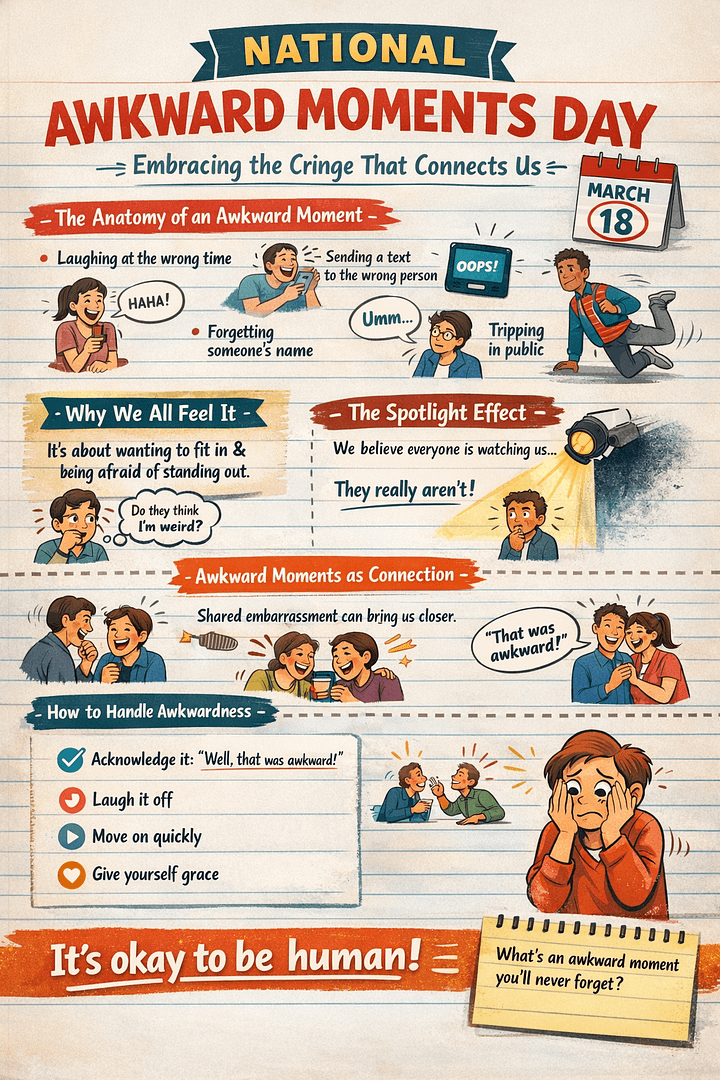
    Every year on March 18th, we celebrate something deeply human, wildly uncomfortable, and often unintentionally hilarious—National Awkward Moments Day. It’s a day that invites us to stop hiding from our most cringe-worthy memories and instead lean into them, laugh at them, and maybe even learn from them.

    Because the truth is, awkward moments aren’t rare accidents—they’re part of the shared experience of being alive.

    The Anatomy of an Awkward Moment

    An awkward moment usually arrives uninvited. It’s that sudden shift in energy when something doesn’t land right—when a joke falls flat, a handshake turns into a hug collision, or you confidently say something completely wrong.

    It’s:

    Laughing at the wrong time

    Forgetting someone’s name mid-conversation

    Sending a text to the wrong person

    Walking into a room and forgetting why you’re there

    Or worse… realizing everyone noticed

    What makes these moments powerful isn’t the mistake itself—it’s the awareness of it. That instant when you know something is off, and there’s no graceful exit.

    Why Awkwardness Feels So Intense

    Awkward moments hit hard because they tap into something deeper than embarrassment—they challenge our sense of belonging.

    Humans are wired for connection. We want to be accepted, understood, and liked. So when something awkward happens, it can feel like we’ve disrupted that connection, even if only for a second.

    Your brain reacts quickly:

    “Did I just ruin that interaction?”

    “Do they think I’m weird?”

    “Why did I say that?”

    And just like that, a five-second moment turns into a five-day mental replay.

    The “Spotlight Effect” Trap

    One of the biggest reasons awkward moments stick with us is something psychologists call the spotlight effect—the tendency to believe people are paying far more attention to us than they actually are.

    In reality? Most people:

    Didn’t notice

    Didn’t care

    Or forgot almost immediately

    Meanwhile, you’re still thinking about it years later.

    That’s the irony of awkwardness—we carry moments that no one else is holding onto.

    Awkwardness Across Life Stages

    Awkward moments evolve as we do. They don’t disappear—they just change form.

    As kids:
    It’s tripping in class, saying something “wrong,” or being called out in front of others.

    As teenagers:
    Awkwardness intensifies. Social pressure, identity, and self-awareness peak. Everything feels magnified—from how you talk to how you stand.

    As adults:
    It becomes more subtle but no less real:

    Workplace misunderstandings

    Social misreads

    Dating misfires

    Saying “you too” when the waiter says “enjoy your meal”

    The stakes feel different, but the feeling is the same.

    When Awkward Turns Into Anxiety

    For some, awkward moments aren’t just funny memories—they can trigger deeper anxiety.

    If you’ve ever avoided speaking up, meeting new people, or putting yourself out there because of fear of embarrassment, you’re not alone.

    Awkwardness can:

    Make you overanalyze conversations

    Cause you to replay interactions repeatedly

    Lead to self-doubt or withdrawal

    But here’s the important distinction: awkward moments are temporary—avoidance can become permanent.

    Growth lives on the other side of discomfort.

    The Hidden Gift of Awkward Moments

    As uncomfortable as they feel, awkward moments can actually be powerful teachers.

    They:

    Build humility

    Strengthen resilience

    Improve self-awareness

    Help you develop social intuition

    More importantly, they remind you that perfection isn’t required to connect with others.

    In fact, imperfection often makes you more relatable.

    Awkward Moments as Social Glue

    Think about the last time something awkward happened in a group—and everyone laughed.

    That shared moment likely:

    Broke tension

    Made people feel more comfortable

    Created a memory

    Awkwardness, when embraced, becomes a bridge instead of a barrier.

    It says, “Hey, I’m human too.”

    And that’s something everyone understands.

    Rewriting the Narrative

    What if awkward moments weren’t something to recover from—but something to accept?

    Instead of:

    “That was terrible.”
    Try: “That was human.”

    Instead of:

    “I embarrassed myself.”
    Try: “I had a moment.”

    This shift doesn’t erase the feeling—but it softens it. It gives you space to move forward without carrying unnecessary weight.

    How to Handle Awkward Moments in Real Time

    When awkwardness strikes, you don’t have to panic. Try this:

    1. Acknowledge it
    A simple “Well, that was awkward” can instantly diffuse tension.

    2. Laugh if you can
    Humor is one of the fastest ways to reset a moment.

    3. Don’t over-explain
    Most situations don’t need a long recovery speech.

    4. Move on quickly
    The faster you let it go, the less power it has.

    5. Give yourself grace
    You’re allowed to be imperfect.

    Celebrating the Cringe

    National Awkward Moments Day is more than just a quirky observance—it’s a reminder to stop taking ourselves so seriously.

    Today is a chance to:

    Share a story that once made you cringe

    Laugh at something you used to overthink

    Forgive yourself for a moment that still lingers

    Because those moments? They didn’t break you.
    They shaped you.

    Final Reflection

    Awkward moments are proof that you’re living, interacting, risking, and showing up. They’re not signs of failure—they’re signs of participation.

    And in a world where so many people hold back out of fear, there’s something quietly powerful about being willing to be a little awkward.

    So the next time it happens—and it will—remember:

    You’re not alone.
    You’re not broken.
    You’re just human.

    Read More Holidays & National Days
  • Traditions of St. Patrick’s Day: A Celebration of Culture, Faith, and Festivity

    Advertisements

    Every year on March 17, people across the globe come together to celebrate St. Patrick’s Day, a holiday that blends history, faith, culture, and community into one vibrant experience. What began as a solemn feast day honoring Saint Patrick has grown into a worldwide celebration of Irish identity—rich with traditions that continue to evolve while staying rooted in centuries of meaning.

    The Origins: From Sacred Observance to Global Celebration

    St. Patrick’s Day marks the death of Saint Patrick, the missionary credited with spreading Christianity throughout Ireland. For centuries, the day was observed primarily as a religious holiday. Families attended church, shared quiet meals, and reflected on faith.

    It wasn’t until Irish immigrants carried their traditions to countries like the United States that the celebration began to transform. In these new lands, St. Patrick’s Day became a powerful expression of identity—especially for communities seeking connection, pride, and belonging in unfamiliar places.

    The Evolution of Traditions
    Wearing Green: Identity, Rebellion, and Belonging

    While today it’s a fun and festive custom, wearing green has deeper historical roots. Originally, blue was associated with Saint Patrick, but green became a symbol of Irish nationalism during political struggles. Over time, it evolved into a universal sign of celebration.

    Now, green is everywhere—clothing, accessories, decorations, and even food. It’s not just a color; it’s a shared language of joy and identity.

    The Power of the Shamrock

    The humble shamrock carries both spiritual and cultural significance. Its connection to the teachings of Saint Patrick makes it a symbol of faith, while its presence in Irish folklore ties it to luck and protection. Today, it’s one of the most recognizable icons of the holiday worldwide.

    Parades: A Living Expression of Heritage

    Modern St. Patrick’s Day parades are grand, energetic, and deeply symbolic. Cities like Dublin host multi-day festivals celebrating Irish art, music, and culture. In the United States, cities such as New York City and Chicago transform into green-filled spectacles.

    These parades are more than entertainment—they are a tribute to resilience, immigration, and cultural pride. Generations march together, representing families, organizations, and shared history.

    Food Traditions: A Blend of Old and New

    Traditional Irish meals were simple and hearty, often centered around potatoes, bread, and meats. In Ireland, dishes like lamb stew and soda bread remain staples.

    In contrast, Irish-American traditions introduced corned beef and cabbage—a meal born out of adaptation and necessity. Though not originally Irish, it has become synonymous with the holiday in places like the United States.

    Food on this day is about more than taste—it’s about gathering, sharing, and remembering.

    Music, Dance, and the Soul of Ireland

    Irish culture is deeply rooted in storytelling, and music is one of its most powerful forms. On St. Patrick’s Day, traditional tunes fill homes, pubs, and streets. Instruments like fiddles and bodhráns create a rhythm that feels both ancient and alive.

    Dance also plays a key role. Performances inspired by productions like Riverdance showcase precision, discipline, and cultural pride. These performances connect generations and bring history to life in motion.

    Faith and Reflection in a Modern World

    Despite the global celebrations, many still honor the religious significance of the day. Church services remain an important tradition, particularly in Ireland, where the spiritual roots of the holiday are still deeply respected.

    For some, the day is a balance—celebration paired with reflection, joy grounded in gratitude.

    Murphy Traditions on St. Patrick’s Day 🍀

    For those who carry the Murphy name, St. Patrick’s Day often feels deeply personal. The surname Murphy—derived from Ó Murchadha, meaning “descendant of the sea warrior”—is one of the most widespread names in Ireland. With that history comes a strong sense of pride, identity, and connection.

    A Name That Carries History

    Murphy families often use this day to reflect on their lineage. Stories of ancestors who lived, struggled, and sometimes emigrated from Ireland are shared and preserved. It’s a day where history isn’t distant—it’s alive in conversation.

    Generations at the Table

    Food becomes a centerpiece for Murphy traditions. Families gather—sometimes across multiple generations—to share meals, laughter, and memories. Recipes may be passed down, slightly changed over time, but always carrying meaning.

    For many Murphys, the table represents more than nourishment—it represents continuity.

    The Murphy Toast

    A common tradition among Murphy families is raising a toast—not just to the holiday, but to the name itself. It’s a moment of pride, of remembrance, and of unity.

    Sometimes the toast is simple. Other times, it’s accompanied by stories, laughter, or even a few tears. Either way, it connects past and present in a meaningful way.

    Wearing Heritage with Pride

    While many wear green, Murphy families often take it a step further—custom shirts, family crests, or coordinated outfits that highlight their surname. It’s a visible way of honoring identity and celebrating together.

    Music, Laughter, and Storytelling

    If there’s one thing that defines Murphy gatherings, it’s the atmosphere. Music plays, stories are told, and laughter fills the room. Humor, resilience, and warmth—hallmarks of Irish culture—are on full display.

    It’s not about perfection. It’s about presence.

    Creating New Traditions

    Modern Murphy families continue to build on the past. Whether it’s traveling to Ireland, documenting family history, or simply starting new rituals with younger generations, the tradition evolves.

    Each year adds another layer to the story.

    A Celebration That Belongs to Everyone

    What makes St. Patrick’s Day so powerful is its inclusivity. You don’t have to be Irish—or a Murphy—to take part. The holiday has become a global symbol of joy, resilience, and connection.

    From small family gatherings to massive public celebrations, the spirit remains the same: come together, honor the past, and celebrate the present.

    More Than a Day—A Feeling

    At its core, St. Patrick’s Day is about identity and belonging. It’s about remembering where you come from, appreciating where you are, and sharing that journey with others.

    For Murphy families, it may carry an extra layer of meaning—but its message is universal.

    Connection. Pride. Celebration.

    Read More Holidays & National Days
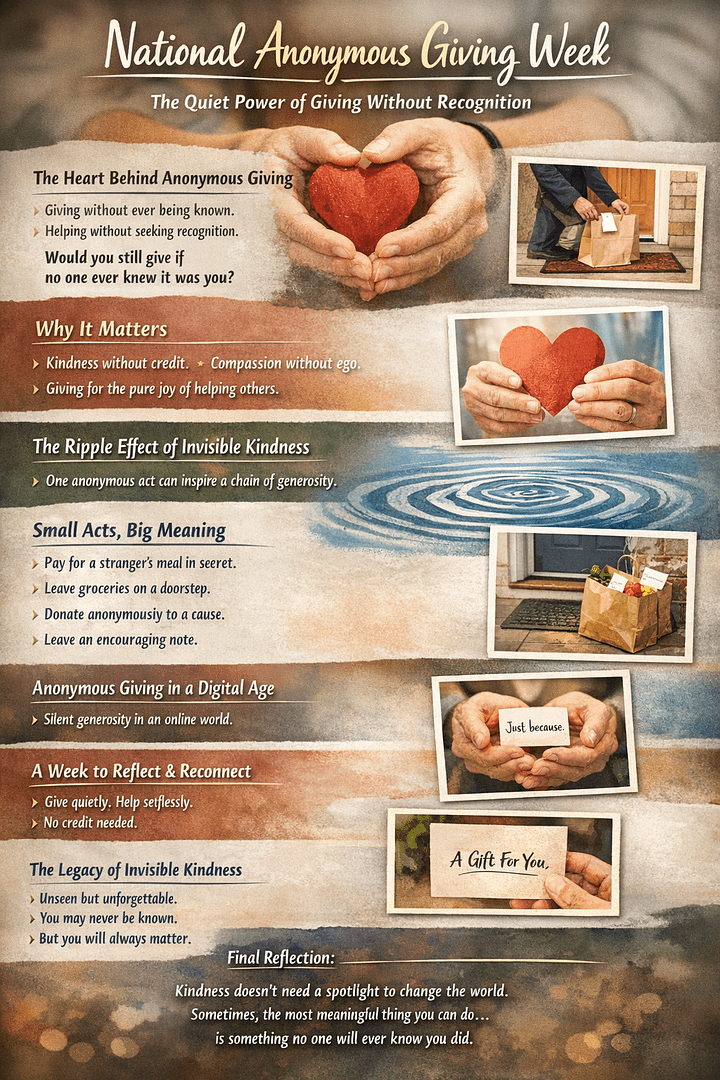
  • National Anonymous Giving Week: The Quiet Power of Giving Without Recognition

    Advertisements

    In a world that often celebrates visibility—likes, shares, recognition, and applause—there exists a quieter, deeper form of generosity: giving without ever being known. National Anonymous Giving Week shines a light on this powerful act, reminding us that some of the most meaningful kindness happens when no one is watching.

    The Heart Behind Anonymous Giving

    Anonymous giving is exactly what it sounds like—offering help, support, or resources without revealing your identity. There’s no expectation of gratitude, no public acknowledgment, and no reward beyond the act itself. It is generosity in its purest form.

    At its core, anonymous giving shifts the focus away from the giver and places it entirely on the impact. It asks a simple but profound question: Would you still give if no one ever knew it was you?

    For many, the answer becomes a journey inward—a reflection of values, empathy, and the desire to do good simply because it is right.

    Why It Matters in Today’s World

    We live in a time where kindness is often documented, shared, and sometimes even measured by engagement. While public acts of generosity can inspire others, they can also unintentionally blur the line between compassion and recognition.

    National Anonymous Giving Week re-centers that balance.

    It reminds us that the truest form of giving isn’t about being seen—it’s about seeing others. It strips away ego and replaces it with intention. When we give anonymously, we remove the “what do I get in return?” mindset and embrace a deeper purpose: helping someone simply because they need it.

    This kind of giving restores faith—not just for the person receiving help, but for anyone who hears their story. It becomes proof that goodness still exists, even in a noisy, attention-driven world.

    The Psychology of Selfless Giving

    There’s something transformative about giving without recognition. Studies in human behavior and emotional well-being often show that acts of kindness can increase happiness, reduce stress, and create a sense of purpose. But anonymous giving takes it a step further.

    Without external validation, the reward becomes internal.

    It fosters:

    Humility – because the act isn’t about you

    Empathy – because you focus deeply on someone else’s needs

    Authenticity – because your intentions are pure

    Emotional fulfillment – because the act itself is enough

    There’s a quiet peace in knowing you made a difference—and that the moment belongs entirely to the person who needed it.

    The Ripple Effect of Invisible Kindness

    Anonymous giving doesn’t end with one act—it spreads.

    Imagine someone struggling to pay their bills, only to discover that an unknown person covered it. That moment doesn’t just solve a problem—it restores hope. It changes how they see the world. And often, it inspires them to one day do the same for someone else.

    That’s how invisible kindness becomes visible impact.

    It moves quietly from one life to another, creating a chain reaction of compassion that doesn’t need names or recognition—only intention.

    Small Acts, Big Meaning

    One of the most beautiful aspects of anonymous giving is that it doesn’t require wealth, status, or grand gestures. It thrives in everyday moments.

    You might:

    Pay for the person behind you in line without saying a word

    Leave a generous tip with a simple “thank you” and no name

    Send a gift or groceries to someone going through a tough time

    Donate to a fundraiser anonymously

    Write a note of encouragement and leave it where someone will find it

    Cover school supplies for a child whose family is struggling

    These acts may seem small—but to someone else, they can mean everything.

    Anonymous Giving in a Digital Age

    Even in a world driven by technology, anonymous giving has found new ways to thrive. Online platforms allow people to donate, support causes, and help individuals without ever revealing their identity.

    But the challenge remains the same: resisting the urge to be recognized.

    In a culture where sharing is second nature, choosing not to post about a kind act becomes part of the giving itself. It becomes a quiet discipline—a reminder that not everything meaningful needs to be displayed.

    Sometimes, the most powerful moments are the ones that stay unseen.

    A Week to Reflect, Reset, and Reconnect

    National Anonymous Giving Week is more than a celebration—it’s an invitation.

    An invitation to slow down.
    To look around.
    To notice the needs that often go unseen.

    It’s a chance to reset how we think about generosity and reconnect with the deeper purpose behind it.

    This week, challenge yourself:

    Do something kind without telling anyone

    Help someone who cannot repay you

    Give in a way that leaves no trace of your identity

    Let the act stand on its own.

    The Legacy of Giving Without a Name

    The beauty of anonymous giving is that it doesn’t seek to be remembered—yet it never gets forgotten.

    Long after the moment passes, the impact remains. It lives in someone’s story. It becomes a turning point in someone’s life. It restores belief during a time when hope felt distant.

    You may never hear “thank you.”
    You may never see the outcome.
    You may never be known.

    But your kindness will echo in ways you may never fully understand.

    And in a world that often asks, “Who gets the credit?”—anonymous giving quietly answers, “It doesn’t matter.”

    Final Reflection

    At its core, National Anonymous Giving Week reminds us of a simple but powerful truth:
    Kindness doesn’t need a spotlight to change the world.

    Sometimes, the most meaningful thing you can do…
    is something no one will ever know you did.

    Read More Holidays & National Days
  • St. Patrick’s Day: A Celebration of Culture, Heritage, and Spirit

    Advertisements

    Every year on March 17, the world turns a little greener as millions gather to celebrate St. Patrick’s Day—a holiday that blends history, faith, folklore, and festivity into one unforgettable experience. What began as a religious observance in honor of a humble missionary has grown into a global celebration of Irish pride, identity, and connection.

    The Man Behind the Legacy

    At the heart of the holiday is Saint Patrick, the beloved patron saint of Ireland. Though often romanticized in legend, his real story is one of hardship, faith, and resilience.

    Born in Roman Britain in the late 4th century, Patrick was kidnapped at the age of sixteen and taken to Ireland as a slave. He spent years working in isolation, tending sheep and surviving harsh conditions. During this time, he turned deeply to faith, which would later define his life’s purpose.

    After escaping captivity, Patrick returned home—but something unexpected happened. He felt called back to Ireland, the very place of his suffering, this time as a missionary. His return wasn’t driven by revenge, but by compassion and conviction. He dedicated his life to spreading Christianity and connecting with the Irish people on a cultural level.

    Legend tells us he used the shamrock to explain the Holy Trinity—Father, Son, and Holy Spirit—making complex theology accessible through nature. Whether fact or folklore, this story remains a powerful symbol of how faith and culture can intertwine.

    The Evolution of a Holiday

    Originally, St. Patrick’s Day was a quiet, religious feast day observed primarily in Ireland. It was a time for reflection, prayer, and honoring Patrick’s contributions to Irish Christianity. For centuries, the celebration remained modest and deeply spiritual.

    However, everything changed with the Irish diaspora.

    As Irish immigrants spread across the world—particularly to the United States—they carried their traditions with them. In places like New York City, Irish communities began organizing parades as early as the 18th century. These events weren’t just celebrations—they were statements of identity, unity, and pride in the face of discrimination and hardship.

    Over time, cities like Chicago added their own flair, famously dyeing the Chicago River green—an iconic tradition that captures the playful spirit of the holiday.

    Today, St. Patrick’s Day is celebrated worldwide, from Dublin to Sydney, blending Irish customs with local culture in unique and vibrant ways.

    Symbols That Tell a Story

    St. Patrick’s Day is rich with imagery, each symbol carrying layers of meaning:

    The Color Green: Once associated with Irish nationalism and the lush landscapes of Ireland—often called the “Emerald Isle”—green has become the defining color of the holiday. Wearing it is both a celebration and a playful tradition.

    The Shamrock: More than just a plant, it represents heritage, faith, and storytelling. It’s a quiet reminder of Patrick’s teachings and Ireland’s deep spiritual roots.

    Leprechauns: Drawn from Irish folklore, these mischievous fairies are said to guard hidden pots of gold. While more whimsical than historical, they add a magical charm to the celebration.

    The Celtic Cross and Harp: Traditional Irish symbols that reflect the country’s artistic, religious, and cultural legacy.

    Music, Dance, and the Heartbeat of Ireland

    No St. Patrick’s Day celebration is complete without music. Traditional Irish instruments like fiddles, tin whistles, and bodhráns create rhythms that are both haunting and uplifting. Songs passed down through generations tell stories of love, loss, rebellion, and hope.

    Irish dance, particularly step dancing, adds a visual energy to the celebration. With precise footwork and upright posture, dancers bring history to life through movement—each step echoing centuries of tradition.

    In pubs and public squares, strangers become friends as music fills the air. It’s not uncommon for entire rooms to join in song, creating a shared moment that transcends language and background.

    Food, Drink, and Togetherness

    Food plays a central role in bringing people together on St. Patrick’s Day. While some dishes associated with the holiday—like corned beef and cabbage—are more Irish-American than traditionally Irish, they’ve become staples of the celebration.

    Other traditional foods include Irish stew, soda bread, and hearty meals that reflect Ireland’s agricultural roots. These dishes are simple, comforting, and meant to be shared.

    And of course, there’s the toast—raising a glass in honor of friendship, memory, and good fortune. Whether in a bustling pub or a quiet home, the act of gathering is what truly defines the day.

    A Celebration of Identity and Belonging

    What makes St. Patrick’s Day truly special is its inclusivity. You don’t need Irish ancestry to take part. The holiday has become a universal celebration of culture and connection—a day where everyone is invited to belong.

    For many, it’s also a day of remembrance. It honors the struggles and triumphs of Irish immigrants who built new lives far from home, carrying their traditions with them and shaping the cultures of the places they settled.

    It’s a reminder that identity is something to be celebrated, not hidden—and that our differences can bring us closer together.

    Beyond the Festivities

    While parades, green attire, and lively gatherings are the most visible parts of St. Patrick’s Day, its deeper meaning lies in resilience, faith, and transformation.

    The story of Saint Patrick is ultimately one of returning to a place of pain with purpose. It’s about finding strength in adversity and choosing compassion over bitterness.

    In many ways, that message still resonates today.

    A Global Tradition That Keeps Growing

    From small towns to major cities, St. Patrick’s Day continues to evolve. Modern celebrations include cultural festivals, educational events, and even global landmarks lighting up in green.

    Yet despite its growth, the heart of the holiday remains unchanged: connection, storytelling, and shared joy.

    Read More Holidays & National Days
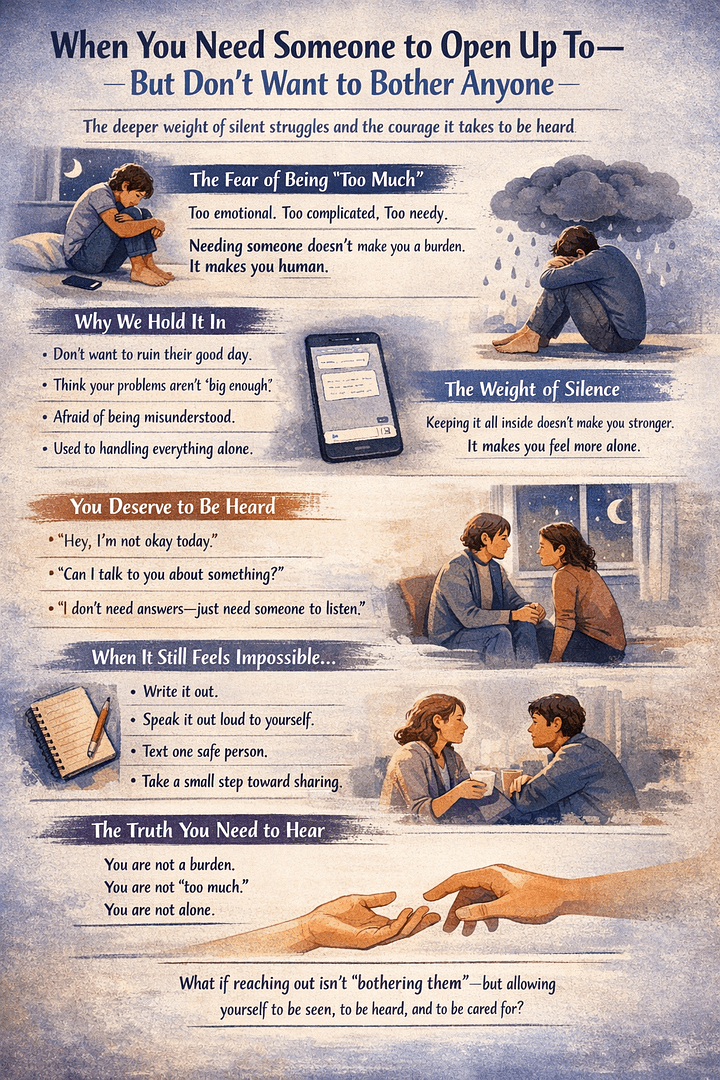
  • When You Need Someone to Open Up To—But Don’t Want to Bother Anyone

    Advertisements

    The deeper weight of silent struggles and the courage it takes to be heard

    There’s a specific kind of heaviness that settles in when you need someone—really need someone—but stop yourself from reaching out. It’s not loud or dramatic. It doesn’t always come with tears. Sometimes it’s just a quiet ache sitting in your chest while you go about your day, pretending everything is fine.

    You might be surrounded by people. You might even have conversations, laugh, respond, show up. But underneath it all is this constant thought:

    “I wish I could tell someone how I actually feel… but I don’t want to bother anyone.”

    So you don’t.

    And that silence becomes its own kind of burden.

    The Inner Conflict No One Sees

    What makes this feeling so exhausting is the constant internal push and pull.

    One part of you is overwhelmed—full of thoughts, emotions, questions, maybe even pain you don’t fully understand yourself. That part is asking for release, for connection, for someone to sit with you in it.

    But another part of you shuts it down just as quickly:

    They’re busy.

    They have their own problems.

    This isn’t important enough.

    I’ll just deal with it myself.

    You go back and forth, sometimes within seconds. You open a message, type something vulnerable… then delete it. You consider making a call… then decide against it. You tell yourself to wait until the “right time,” but that time rarely comes.

    So the words stay inside.

    And over time, they don’t just stay—they build.

    Where This Feeling Comes From

    This hesitation doesn’t come out of nowhere. It’s often rooted in experiences that taught you—directly or indirectly—that your feelings might be inconvenient.

    Maybe at some point in your life:

    You were told you were “too sensitive”

    Your emotions were minimized or ignored

    Someone reacted with impatience when you tried to open up

    You learned to be the “strong one” for everyone else

    You felt like you had to earn your place by not needing too much

    Even subtle moments can shape this belief. A sigh. A distracted response. A conversation that quickly shifted away from you. These things add up, and eventually, you start filtering yourself before anyone else gets the chance to.

    You don’t stop feeling—you just stop sharing.

    The Role You’ve Learned to Play

    For many people, this struggle is even deeper because they’ve become the listener in everyone else’s life.

    You’re the one people come to. The one who gives advice, who shows up, who checks in, who carries others when they’re falling apart. You know how to hold space for people—but you don’t always know how to ask for space in return.

    Not because you don’t deserve it.

    But because you’ve trained yourself not to need it.

    And when you’re used to being the strong one, asking for help can feel like breaking character.

    The Misunderstanding of “Being a Burden”

    Somewhere along the way, needing someone became confused with being a burden.

    But they are not the same thing.

    A burden is something forced, unwanted, or excessive.
    But opening up—honestly, gently, vulnerably—is an invitation. It’s trust.

    The people who care about you don’t measure your worth by how little you need them. They care because of who you are—not because of how quiet you can keep your struggles.

    In fact, many people feel closer to someone because they opened up, not in spite of it.

    Connection isn’t built on perfection. It’s built on honesty.

    The Cost of Keeping Everything Inside

    When you keep everything to yourself, it doesn’t just disappear.

    It shows up in other ways:

    Overthinking small things until they feel overwhelming

    Feeling emotionally distant, even when you’re around people

    Carrying a constant sense of tension or exhaustion

    Struggling to sleep because your mind won’t slow down

    Feeling unseen, even by people who care about you

    You start to feel like you’re living two lives—the one people see, and the one you’re silently managing on your own.

    And the longer you stay in that space, the harder it becomes to step out of it.

    What Opening Up Actually Looks Like

    Opening up doesn’t have to be a dramatic, all-at-once release.

    It can be simple. Imperfect. Even a little awkward.

    It might sound like:

    “Hey… can I talk to you about something that’s been on my mind?”

    “I don’t really know how to explain this, but I’ve been struggling a bit.”

    “I don’t need you to fix anything—I just don’t want to feel alone in it.”

    You don’t have to have the right words. You don’t have to explain everything perfectly. You just have to start.

    Because often, the hardest part isn’t being heard—it’s allowing yourself to be.

    When It Still Feels Too Hard

    Even knowing all of this, there are moments when reaching out feels impossible.

    And that’s okay.

    Start where you are.

    Write everything down without filtering it.
    Record your thoughts out loud just to hear them.
    Send a message you don’t over-edit.
    Choose one person who feels even slightly safe.

    Or even take a step toward connection in a different way—reading something that resonates, listening to a voice that understands, reminding yourself that you’re not the only one who feels this way.

    You don’t have to go from silence to full vulnerability overnight.

    You just have to take one small step toward not carrying it alone.

    The Truth You Might Need to Hear

    You are not a burden for having feelings.

    You are not “too much” for needing support.

    You are not weak for wanting someone to listen.

    And you don’t have to earn the right to be heard by suffering in silence first.

    The right people won’t see your honesty as an interruption.
    They’ll see it as trust—and they’ll meet you there.

    Final Reflection

    There will always be moments in life when things feel heavier than you can carry on your own. That doesn’t mean you’ve failed. It means you’re human.

    And being human was never meant to be a solo experience.

    So the next time that thought creeps in—“I don’t want to bother anyone”—pause and ask yourself something different:

    “What if I’m not bothering them… what if I’m giving someone a chance to be there for me?”

    Because sometimes, the connection you’re afraid to reach for…
    is the very thing that will remind you you’re not alone.

    Read More Health & Wellness

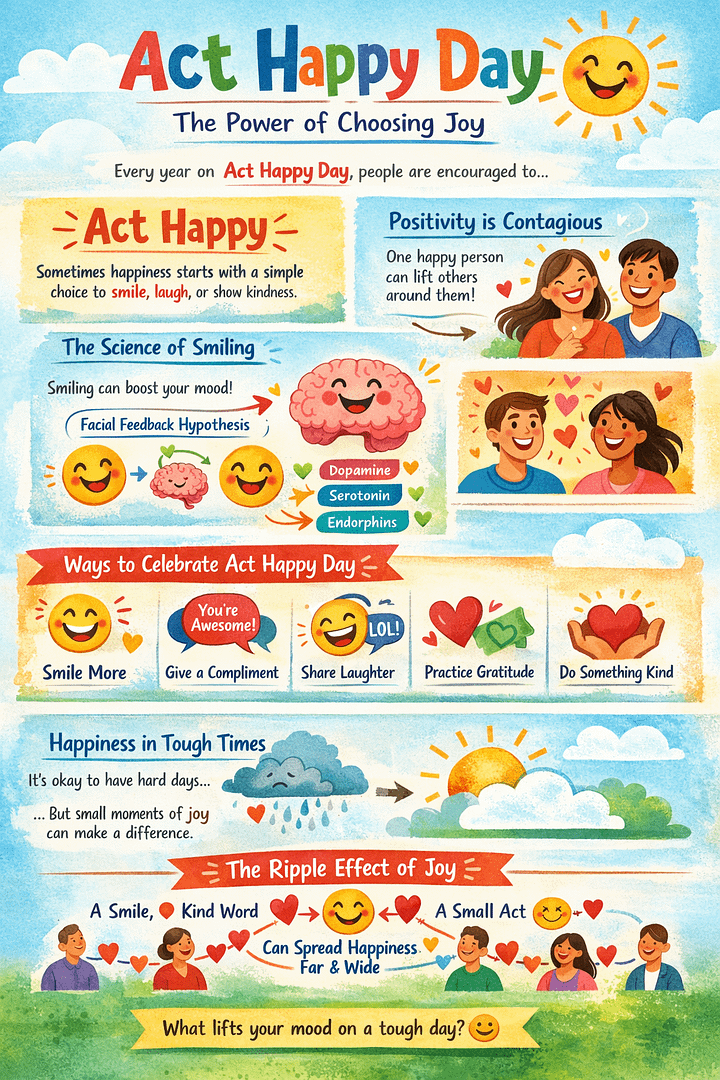
  • Act Happy Day: The Power of Choosing Joy

    Advertisements

    Every year on Act Happy Day, people are encouraged to try something surprisingly simple—act happy. At first glance, the idea may sound a little strange. How can someone act happy if they don’t actually feel happy? Yet the meaning behind this day goes far deeper than just putting on a smile.

    Act Happy Day is a reminder that our emotions and actions are more connected than we often realize. Sometimes happiness follows life’s good moments. Other times, happiness begins with a decision to change how we approach the day.

    In a world that can feel heavy with stress, responsibilities, and uncertainty, this lighthearted holiday encourages people to rediscover the power of positivity—even if it starts as an intentional effort.

    The Idea Behind Acting Happy

    Many people believe happiness is something that simply happens to them. We wait for good news, success, love, or a peaceful moment before allowing ourselves to feel joy. But Act Happy Day challenges that way of thinking.

    Instead of waiting for happiness to arrive, the day encourages people to practice it.

    Acting happy might mean smiling a little more, speaking kindly to others, laughing at something silly, or choosing gratitude instead of frustration. These small actions might seem insignificant, but they often have a surprising effect.

    When you behave in positive ways, your brain begins to respond. Mood can shift. Stress can ease. Perspective can change.

    What started as a simple action can slowly turn into a genuine emotional experience.

    The Science of Smiling

    One of the reasons Act Happy Day works is rooted in psychology and biology. Researchers have studied something called the facial feedback hypothesis, which suggests that our facial expressions influence our emotional state.

    In simple terms, when you smile—even if it begins as a forced smile—your brain releases chemicals like dopamine, serotonin, and endorphins. These chemicals are associated with feelings of happiness and relaxation.

    Your body begins to respond as if the happiness were real.

    It’s a fascinating example of how the mind and body constantly influence each other. Just as sadness can affect posture and energy levels, positive physical expressions can influence mood.

    This doesn’t mean a smile magically erases pain or struggles, but it does show that small positive actions can create meaningful emotional changes.

    The Power of Positive Energy

    Another reason acting happy can have such a strong effect is that emotions are often contagious. Humans naturally mirror the moods of the people around them.

    If someone enters a room frustrated or angry, that energy can spread quickly. But the same is true for positivity. A cheerful attitude, a warm greeting, or a simple laugh can change the entire atmosphere of a room.

    When one person chooses kindness or joy, others often respond the same way.

    This ripple effect is one of the most beautiful aspects of Act Happy Day. A single positive action can travel far beyond the moment it was created.

    Simple Ways to Celebrate Act Happy Day

    Celebrating Act Happy Day doesn’t require anything elaborate. In fact, the spirit of the day lies in the smallest gestures.

    Here are a few simple ways people embrace the holiday:

    Smile More Often

    A smile can instantly change the tone of a conversation. It signals openness, warmth, and positivity.

    Compliment Someone

    A sincere compliment can brighten someone’s entire day. It might be as simple as telling someone they did a great job or that you appreciate them.

    Share Laughter

    Watch something funny, tell a joke, or reminisce about a hilarious memory with a friend. Laughter has a powerful way of lifting spirits.

    Practice Gratitude

    Take a moment to think about the good things in your life—even the small ones. Gratitude can quickly shift perspective.

    Do Something Kind

    Helping someone else often creates happiness for both people involved. Whether it’s offering encouragement, lending a hand, or simply listening, kindness spreads joy.

    Take a Break From Negativity

    Spend a day stepping away from negative news, arguments online, or stressful conversations. Protecting your peace can help your mind reset.

    Happiness Doesn’t Mean Ignoring Reality

    It’s important to understand that Act Happy Day isn’t about pretending everything in life is perfect. Everyone experiences sadness, stress, grief, or loneliness at times. Those emotions are part of being human.

    Instead, the day is about remembering that moments of joy can still exist even during difficult seasons.

    Acting happy is not about denying pain—it’s about allowing yourself to experience light alongside the darkness.

    Sometimes a small moment of laughter or kindness can make a hard day feel just a little more manageable.

    Why the World Needs More Happiness

    Modern life often moves quickly. People are busy with work, responsibilities, financial pressures, and endless distractions. Stress can build quietly over time, leaving many people feeling overwhelmed.

    Days like Act Happy Day serve as gentle reminders to slow down and reconnect with something simple: joy.

    Happiness doesn’t always come from big accomplishments or dramatic life changes. Often it lives in the quiet moments—sharing a laugh, hearing a favorite song, watching a sunset, or receiving a message from someone who cares.

    When people intentionally seek out these moments, life begins to feel a little brighter.

    The Ripple Effect of Joy

    Perhaps the most powerful lesson of Act Happy Day is how far happiness can travel.

    One smile can encourage another.
    One act of kindness can inspire several more.
    One person choosing positivity can shift an entire environment.

    These ripples can move through families, workplaces, communities, and even strangers passing on the street.

    You may never fully know how much a small gesture affects someone else. But sometimes the smallest actions leave the biggest impact.

    A Simple Choice

    At its heart, Act Happy Day reminds us that happiness is not always something we must wait for. Sometimes it begins with a simple choice.

    A choice to smile.
    A choice to be kind.
    A choice to laugh.
    A choice to look for something good in the middle of an ordinary day.

    And sometimes, by acting happy—even just a little—we give ourselves permission to truly feel it.

    Read More Holidays & National Days
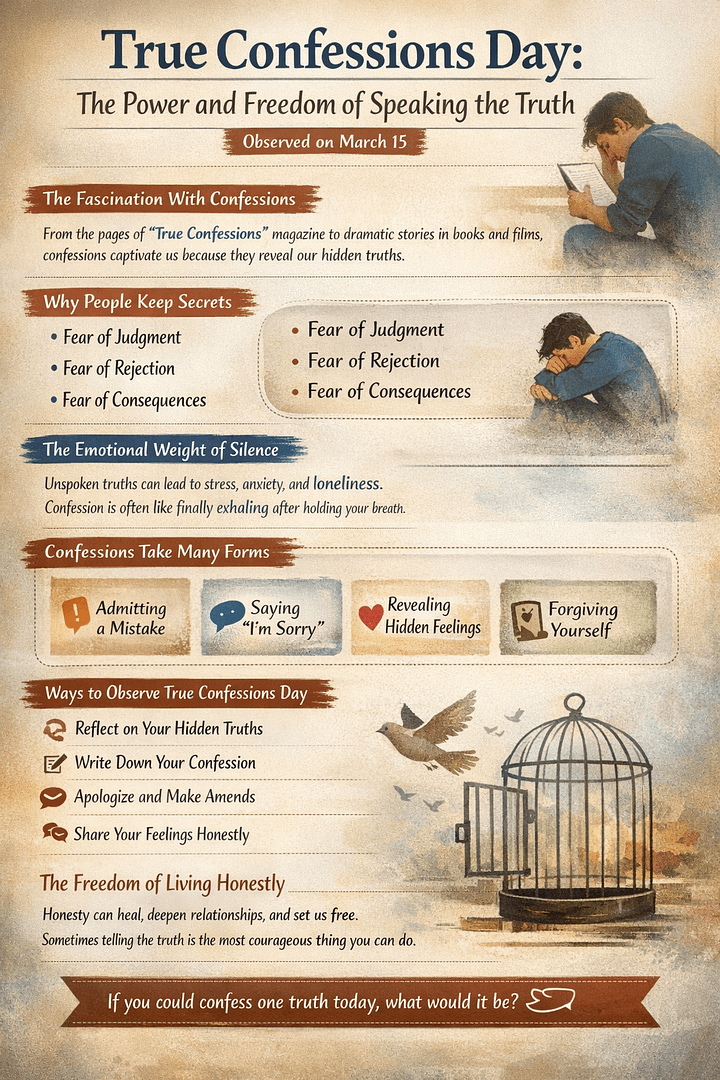
  • True Confessions Day: The Power and Freedom of Speaking the Truth

    Advertisements

    Every year on March 15, a little-known but deeply meaningful holiday invites people to confront something many of us struggle with—honesty. True Confessions Day is not about celebration in the traditional sense. There are no decorations, gifts, or parties. Instead, it is a day devoted to reflection, courage, and the possibility of emotional freedom.

    We all carry secrets. Some are small—thoughts we never shared or words we wish we had said differently. Others run deeper—regrets, hidden feelings, apologies left unspoken, or truths we feared might change everything. True Confessions Day reminds us that sometimes the most powerful thing a person can do is simply tell the truth.

    For many people, confession is not about guilt or shame. It is about release. It is about lifting the weight of silence that has been sitting on the heart for far too long.

    The Fascination With Confessions

    Human beings have always been drawn to confessions. There is something deeply compelling about hearing someone reveal a truth they have carried quietly for years. Confessions appear everywhere in our culture—literature, movies, television, and even social media.

    One cultural influence connected to the spirit of the holiday is True Confessions, a publication that began in the early 1900s. The magazine featured dramatic personal stories filled with love, betrayal, mistakes, redemption, and emotional revelations. Readers were fascinated because these stories reflected real human struggles.

    The appeal of confession is simple: when someone tells the truth about their life, others often recognize pieces of themselves in that story. It reminds us that we are not alone in our mistakes, fears, or complicated emotions.

    Why People Keep Secrets

    If honesty is so freeing, why do people hide the truth?

    The answer usually comes down to fear.

    People fear being judged.
    They fear losing someone they care about.
    They fear rejection, embarrassment, or consequences.

    Sometimes people also stay silent because they believe the moment to speak has already passed. A person might think, “It’s been too long. I should have said something years ago.”

    But the truth is that unspoken feelings rarely disappear. Instead, they linger quietly in the background of our lives. Over time, those unsaid words can grow heavier.

    Many people know the feeling of replaying a moment in their mind—wishing they had apologized, admitted their feelings, or told someone how much they mattered.

    The Emotional Weight of Silence

    Holding onto secrets can be exhausting.

    When people suppress their truth, it can lead to stress, anxiety, and emotional isolation. They may feel disconnected from others because part of their real self remains hidden.

    Psychologists often talk about the emotional relief that comes from honest expression. When people share something they have been holding inside, they frequently experience a sense of release—almost like finally exhaling after holding their breath for a long time.

    Confession can be healing because it allows people to stop pretending.

    Instead of carrying the burden alone, they allow someone else to see the real story.

    Confessions Come in Many Forms

    When people hear the word confession, they sometimes imagine dramatic revelations—like those seen in movies. But in reality, most confessions are simple, quiet, and deeply human.

    A confession might be:

    Admitting you made a mistake.

    Telling someone you forgive them.

    Saying “I’m sorry” after years of silence.

    Revealing feelings you’ve been afraid to express.

    Acknowledging something painful you’ve been denying.

    Sometimes the most important confession is not spoken to another person at all.

    Sometimes the hardest truth to admit is the one we finally say to ourselves.

    The Courage Behind Honesty

    Speaking the truth requires vulnerability, and vulnerability takes courage.

    When someone confesses something meaningful, they are taking a risk. They are choosing authenticity over comfort. They are allowing themselves to be seen without the protection of silence.

    Not every confession will lead to the outcome someone hopes for. Some truths may change relationships. Some may bring difficult conversations.

    But even when the outcome is uncertain, honesty has a powerful way of creating clarity. It removes the confusion that secrets create and replaces it with reality—something people can finally face and move forward from.

    Truth may not always be easy, but it is often freeing.

    Ways to Observe True Confessions Day

    You do not have to reveal your deepest secret to the world to participate in True Confessions Day. Instead, the day can be used as a moment for thoughtful honesty and personal reflection.

    Here are some meaningful ways to observe the day:

    Reflect on What You’ve Been Holding Inside

    Take a moment to ask yourself if there is something you’ve been carrying emotionally. Is there a truth that might bring peace if it were spoken?

    Write a Confession

    Writing can be a powerful outlet. Even if you never share it with anyone, putting your truth on paper can help you process it.

    Offer a Long-Overdue Apology

    Sometimes the most healing words a person can say are simply, “I’m sorry.”

    Tell Someone How You Really Feel

    Many people go through life without ever hearing how much they mean to someone. True Confessions Day can be a chance to change that.

    Forgive Yourself

    Not every confession needs an audience. Sometimes the most important truth is acknowledging your past and allowing yourself to move forward.

    The Freedom of Living Honestly

    The real message behind True Confessions Day is not about exposing secrets—it is about embracing authenticity.

    Life becomes lighter when people stop hiding parts of themselves. When honesty replaces silence, relationships can deepen, healing can begin, and individuals can grow into more genuine versions of themselves.

    Truth has a strange but powerful way of setting people free.

    And sometimes all it takes is one moment of courage—one honest conversation, one sincere apology, or one heartfelt admission—to change everything.

    Read More Holidays & National Days

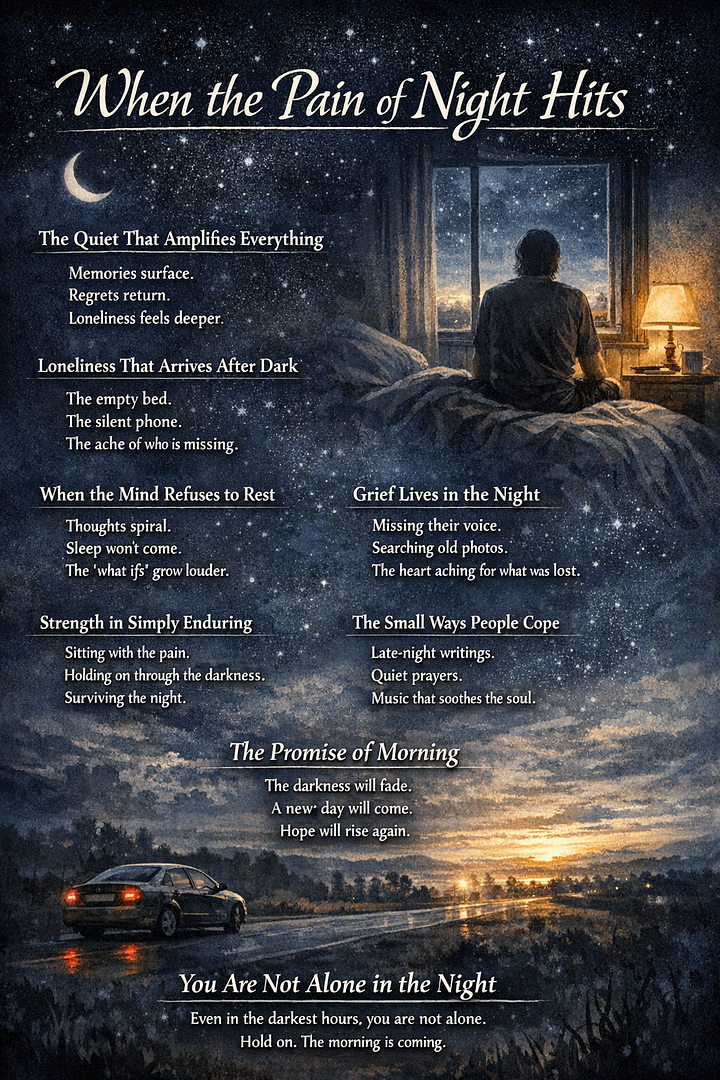
  • When the Pain of Night Hits

    Advertisements

    There is something about nighttime that can make pain feel deeper.

    During the day, life moves quickly. Responsibilities demand our attention. Phones ring, people talk, work needs to be done, and the noise of everyday life keeps our minds occupied. Even when we are hurting, the pace of the day gives us moments of distraction. It allows us to function, to push emotions aside long enough to get through what needs to be done.

    But night is different.

    When the sun sets and the world begins to quiet down, the distractions fade. Conversations end, streets empty, and the hum of daily activity slowly disappears. What remains is silence—and in that silence, emotions that were buried during the day often rise to the surface.

    For many people, the pain they have been holding inside all day finally shows itself once the night arrives.

    The Quiet That Amplifies Everything

    Nighttime has a unique way of magnifying thoughts and emotions. When everything around us becomes still, our minds begin to wander through places we sometimes try to avoid.

    Memories surface more vividly.

    You might think about someone you lost, replaying moments that once felt ordinary but now feel priceless. You might remember the sound of their voice, the way they laughed, or the conversations you wish you could have one more time.

    For others, the memories involve relationships that ended. The mind drifts back to happier moments, questioning where things went wrong. You revisit words that were said, words that were never spoken, and moments when everything could have gone differently.

    At night, the mind can become a storyteller, replaying scenes from the past over and over again.

    Sometimes it is comforting.

    But often, it hurts.

    The Loneliness That Arrives After Dark

    Loneliness often feels stronger at night.

    During the day, even if you feel alone inside, the world is filled with people. There are coworkers, strangers in stores, conversations in passing, and the simple awareness that life is happening all around you.

    But when night comes, the world grows quieter. Lights turn off in windows, phones stop buzzing, and social media feeds slow down. The outside world begins to rest.

    And suddenly, the emptiness feels louder.

    You might look around the room and feel the absence of someone who used to be there. A chair at the table, an empty side of the bed, or a quiet phone that once held conversations that meant everything.

    Loneliness at night is not always about being physically alone. Sometimes it is the emotional feeling of being disconnected from the person you wish was beside you.

    The person you want to talk to.

    The person you miss.

    The person who once made everything feel lighter.

    When the Mind Refuses to Rest

    One of the hardest parts about nighttime pain is how it interferes with sleep.

    When the body is tired but the mind is racing, rest can feel impossible. Thoughts move in circles, replaying past mistakes, unanswered questions, and fears about the future.

    “What if I had done things differently?”
    “Why did things turn out this way?”
    “Will things ever get better?”

    The ceiling becomes familiar as you stare into the darkness, hoping your mind will eventually quiet itself. But the more you try to force sleep, the more awake you feel.

    Hours pass slowly.

    And sometimes the night feels endless.

    Grief That Lives in the Night

    For those who are grieving, nighttime can be particularly difficult.

    Grief does not follow a schedule. It appears when it chooses, often catching us off guard. But night is when grief often finds the most space to speak.

    You might find yourself scrolling through old photos. Listening to songs that remind you of someone you lost. Re-reading messages you once took for granted.

    The quiet gives grief room to breathe.

    In those moments, the ache can feel overwhelming—not because the love is gone, but because it remains so strong while the person is no longer here.

    Grief is, in many ways, love that no longer has a place to land.

    And at night, that love often searches for somewhere to go.

    The Invisible Battles

    Many people fight battles at night that the outside world never sees.

    They may appear strong during the day. They may smile, laugh, work, and interact with others without anyone realizing the storm that waits for them once they are alone.

    But when the door closes and the lights dim, those hidden struggles can rise to the surface.

    Anxiety.
    Heartbreak.
    Regret.
    Fear of the future.
    Feelings of worthlessness or being unlovable.

    Night does not create these emotions, but it removes the distractions that normally keep them quiet.

    And for some, that silence can feel overwhelming.

    Strength in Simply Enduring

    One of the most overlooked forms of strength is endurance.

    When people think of strength, they often imagine dramatic moments—acts of bravery, bold decisions, or powerful words. But sometimes strength looks much quieter than that.

    Sometimes strength is simply surviving the night.

    It is allowing yourself to feel pain without letting it completely break you. It is sitting with difficult emotions and choosing to keep going even when the path forward feels uncertain.

    You may not feel strong in those moments. You may feel exhausted, vulnerable, or lost.

    But every night you make it through is proof that something inside you is still holding on.

    Even when it feels fragile.

    The Small Ways People Cope

    When the pain of night hits, people often search for small ways to make the darkness easier to carry.

    Some write their thoughts in journals, turning overwhelming emotions into words on a page. Others listen to music that understands their feelings better than conversation ever could.

    Some people watch movies or television simply to fill the silence. Others go for late-night drives, letting the motion of the road calm their racing thoughts.

    There are those who pray.
    Those who read.
    Those who cry quietly into pillows until the weight begins to ease.

    None of these actions erase pain completely. But they create small spaces of comfort inside the darkness.

    And sometimes, those small spaces are enough to get through another night.

    The Promise Hidden in Every Morning

    No matter how long a night feels, morning eventually arrives.

    It may come slowly, with the faint glow of early light pushing back the darkness. Or it may arrive suddenly, when the alarm clock rings and a new day demands your attention.

    The pain you carried through the night may still exist. Healing rarely happens instantly.

    But morning offers something important: perspective.

    It reminds you that the night did not last forever.

    It reminds you that time continues to move forward.

    And it reminds you that even when you felt completely alone in the darkness, you made it through.

    You Are Not Alone in the Night

    If you have ever laid awake while the world slept, carrying thoughts that felt too heavy for one heart to hold, know that you are not alone.

    Across cities, towns, and quiet homes around the world, there are countless people staring into the same darkness, fighting similar battles inside their own minds.

    Different stories.

    Different losses.

    Different struggles.

    But the same quiet hope that the pain will one day soften.

    Night can make pain feel overwhelming, but it can also reveal something powerful: the resilience of the human heart.

    Because even when the darkness feels endless, people continue to endure.

    They continue to breathe.

    They continue to hold on.

    And eventually, they continue to rise with the morning.

    A Father’s Guide to Surviving the Loss of a Child

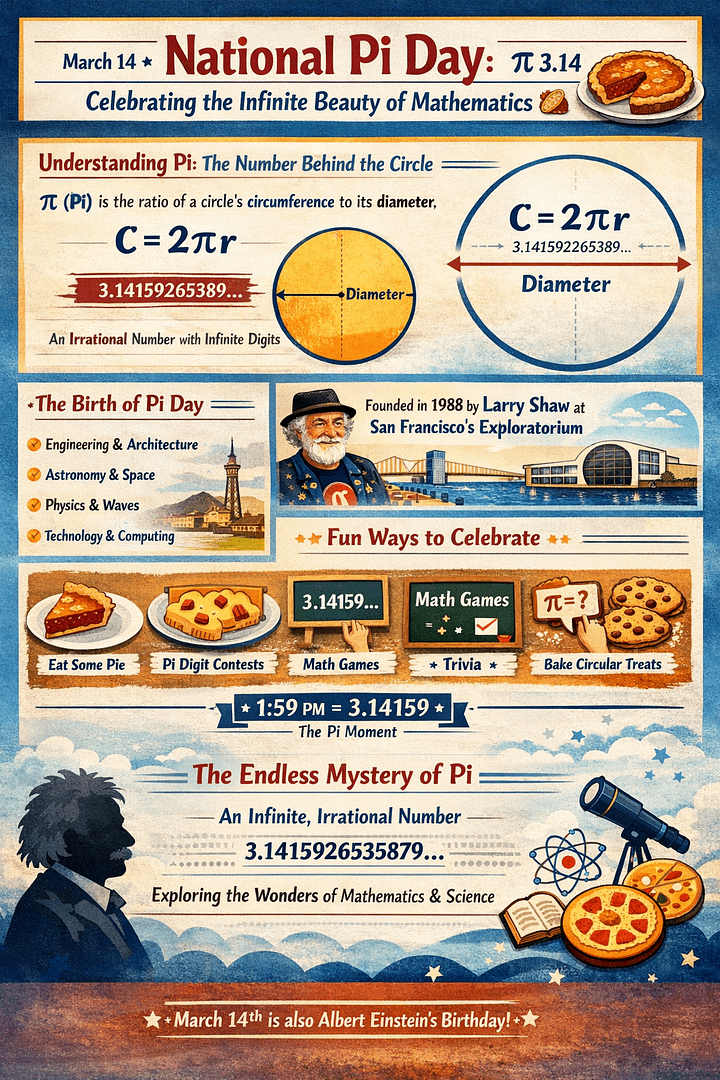
  • National Pi Day: Celebrating the Infinite Beauty of Mathematics

    Advertisements

    Every year on March 14, people across the globe celebrate Pi Day, a unique holiday dedicated to one of mathematics’ most fascinating numbers: Pi. The date—3/14—corresponds with the first three digits of Pi (3.14), making it the perfect day to honor a number that has intrigued mathematicians, scientists, and thinkers for thousands of years.

    What began as a playful celebration among math enthusiasts has grown into an international event that highlights the beauty of mathematics, the importance of scientific curiosity, and the joy of learning. From classrooms to science museums, Pi Day inspires people to explore the wonders hidden within numbers and patterns that shape our world.

    Understanding Pi: The Number Behind the Circle

    Pi, represented by the Greek letter π, is the ratio of a circle’s circumference to its diameter. No matter how large or small a circle is, this ratio always remains the same.

    This relationship is shown in the fundamental circle equation:

    C=2πr

    Here, C represents the circumference of the circle and r represents the radius. Pi connects these measurements, allowing mathematicians and scientists to calculate distances, areas, and curves involving circles and spheres.

    The decimal representation of Pi begins as:

    3.141592653589793238…

    What makes Pi extraordinary is that it is an irrational number, meaning its decimal digits continue infinitely without repeating in any predictable pattern. Despite centuries of study and modern supercomputers calculating trillions of digits, Pi continues endlessly.

    In many ways, Pi symbolizes the infinite curiosity of human knowledge—there is always more to discover.

    Ancient Origins of Pi

    Although Pi Day itself is modern, the study of Pi stretches back thousands of years. Ancient civilizations discovered that circles followed a consistent mathematical relationship long before modern notation existed.

    One of the earliest recorded approximations of Pi came from Archimedes, the brilliant Greek mathematician who lived in the third century BCE. Archimedes used geometric methods involving polygons to estimate Pi, calculating that its value was somewhere between 3.1408 and 3.1429, remarkably close to the value we know today.

    Other ancient cultures also explored the constant:

    The Babylonians approximated Pi as 3.125.

    Ancient Egyptians used a value close to 3.16 in their calculations.

    Chinese mathematicians later refined Pi to several decimal places.

    These discoveries demonstrate that the fascination with circles and their mathematical properties has existed for millennia.

    The Birth of Pi Day

    The celebration of Pi Day itself began in 1988 thanks to physicist Larry Shaw at the Exploratorium science museum in San Francisco.

    Shaw and his colleagues organized a lighthearted event where participants walked in circles and enjoyed slices of pie while discussing mathematics. The clever combination of science and humor quickly caught the attention of educators and students.

    Over time, the celebration spread far beyond the museum. Schools began hosting math competitions and classroom activities, while science enthusiasts embraced the holiday as a fun way to highlight the importance of mathematics.

    In 2009, the United States House of Representatives officially recognized March 14 as National Pi Day. The recognition helped solidify the holiday’s place in American culture and encouraged educational institutions to celebrate mathematics in engaging ways.

    Interestingly, March 14 is also the birthday of one of history’s most famous scientists, Albert Einstein, whose groundbreaking work revolutionized physics and our understanding of the universe.

    Why Pi Matters in the Real World

    While Pi might appear to be just another number in a math textbook, it is actually essential to countless fields of science and technology.

    Engineering and Architecture

    Engineers use Pi when designing structures that involve curves or circular shapes, such as bridges, tunnels, and domes. Accurate measurements ensure that these structures remain stable and safe.

    Astronomy

    Astronomers rely on Pi when calculating the motion of planets, orbits, and the shapes of galaxies. Without Pi, understanding the mechanics of our solar system would be far more difficult.

    Physics

    Many physical equations involving waves, motion, and energy include Pi. It appears in formulas describing everything from sound waves to the motion of pendulums.

    Technology and Computing

    Modern technology also uses Pi in algorithms, simulations, and digital signal processing. Even graphics engines that render curved shapes on computer screens depend on the mathematics involving Pi.

    Simply put, Pi is woven deeply into the fabric of science and engineering.

    Fun Ways People Celebrate Pi Day

    Part of the charm of Pi Day is that it combines education with creativity and fun. Around the world, celebrations often include a variety of activities:

    Eating pie:
    The classic Pi Day tradition is enjoying a slice of pie—apple, cherry, pumpkin, or any favorite flavor. The pun between “Pi” and “pie” has become an iconic part of the celebration.

    Math competitions:
    Schools and universities host challenges where students compete to solve mathematical problems or recite as many digits of Pi as possible.

    Memorization contests:
    Some enthusiasts dedicate themselves to memorizing thousands of digits of Pi. The current world records reach astonishing lengths.

    Educational events:
    Teachers use Pi Day as an opportunity to make math engaging, often through games, puzzles, and hands-on experiments.

    Circular foods:
    Pizza, cookies, pancakes, and donuts also appear at Pi Day gatherings, reinforcing the theme of circles.

    Some celebrations even occur at 1:59 PM, representing the sequence 3.14159, the first six digits of Pi.

    Pi in Popular Culture

    Beyond the classroom, Pi has found a place in popular culture as well. It appears in puzzles, books, and films that explore the mysteries of mathematics.

    One notable example is the film Pi, directed by Darren Aronofsky, which tells the story of a mathematician obsessed with discovering hidden patterns in numbers.

    Pi has also inspired art, music, and poetry, proving that mathematics can be both logical and deeply creative.

    The Endless Nature of Pi

    Perhaps the most fascinating aspect of Pi is its infinite nature. Unlike most numbers we use in daily life, Pi never truly ends. Its digits stretch on forever, without repetition.

    For mathematicians, this endless sequence represents a kind of intellectual frontier. Even with advanced technology, we continue exploring new digits and studying the patterns that might exist within them.

    Pi reminds us that even the simplest shapes—like a circle—can hold mysteries that challenge human understanding.

    More Than Just a Number

    At its heart, National Pi Day celebrates more than mathematics. It celebrates curiosity, learning, and the human desire to understand the world.

    Numbers like Pi remind us that patterns exist everywhere—in nature, science, art, and the universe itself. By studying these patterns, we uncover new knowledge and deepen our appreciation for the world around us.

    So whether you spend March 14 solving equations, teaching students about geometry, or simply enjoying a slice of pie, Pi Day offers a moment to celebrate the beauty of discovery.

    After all, Pi may be infinite—but so is our capacity to learn.

    Read More Holidays & National Days

Exit mobile version