Author: Brett Murphy

  • When a Loved One Passes Away

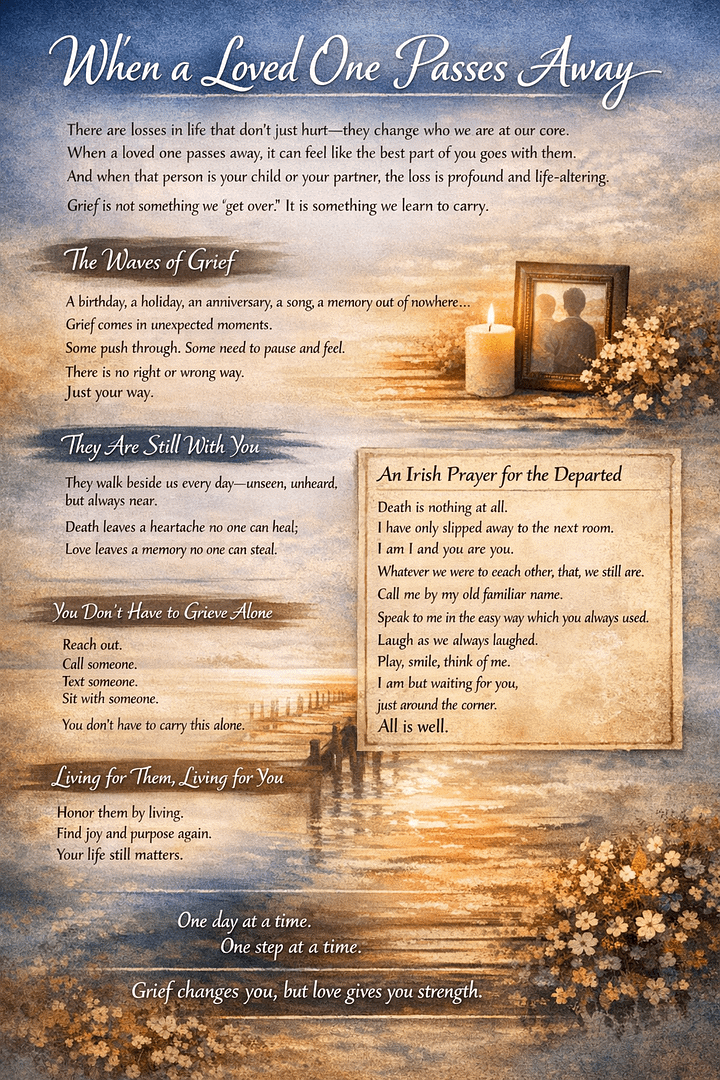
    When a Loved One Passes Away

    Advertisements

    There are losses in life that don’t just hurt—they change who we are at our core. When a loved one passes away, it can feel like the best part of you goes with them. And when that person is your child or your partner, the loss reaches into places within you that you didn’t even know existed. It doesn’t just break your heart—it reshapes your entire world.

    Because they weren’t just part of your life… they were part of you.

    Your routines, your thoughts, your plans, your identity—so much of it was tied to their presence. And when they are gone, you are left trying to understand who you are now, in a life that feels unfamiliar and incomplete.

    Grief is not something we “get over.” It is something we learn to carry, one breath at a time.

    The Weight of Loss

    In the beginning, everything feels heavy. The simplest tasks can feel overwhelming. Getting out of bed takes strength. Facing the day takes courage. There are moments when even breathing feels like work.

    You may find yourself replaying memories, conversations, or moments you wish you could relive. You may think about what you could have said differently, done differently, or held onto just a little longer.

    These thoughts are a natural part of grief.

    Because grief is love that no longer has a physical place to go.

    And that love doesn’t disappear—it searches for a new place to exist. Sometimes it becomes tears. Sometimes silence. Sometimes memories that flood your mind when you least expect it.

    There Is No Timeline for Grief

    One of the most important truths to understand is this: there is no timetable for grief.

    Some people begin to find a rhythm again in a few months. Others take years. Some carry a deep, ongoing grief that becomes part of their daily life forever.

    None of these paths are wrong.

    Grief is not something you measure. It is something you experience.

    It is deeply personal, shaped by your relationship, your memories, and the love you shared. No one else can define how long it should take, how it should look, or how you should feel.

    There will be days when you feel like you are making progress, and then suddenly, without warning, it feels like you are right back at the beginning.

    That is not failure.

    That is grief doing what grief does.

    The Waves That Come Without Warning

    Even when time has passed, grief does not simply disappear. It changes, but it remains.

    And sometimes, it returns in waves.

    A birthday. A holiday. An anniversary. A favorite song. A smell. A place you once shared. A random memory that appears out of nowhere.

    These moments can hit you just as hard as the day you lost them.

    One second you are functioning, moving through your day—and the next, you are overwhelmed by a feeling you cannot control.

    This is one of the most difficult parts of grief: the unpredictability.

    Some people can push through those moments and keep going. Others need to stop, sit, cry, and let it pass.

    Both responses are valid.

    There is no right or wrong way to survive those waves.

    There is only doing what you need to do to make it through the day.

    Learning to Live Without Them

    Perhaps the hardest part of grief is learning how to live without someone you never imagined living without.

    It is not about “moving on.” It is about moving forward—with them still in your heart.

    You begin to find ways to carry them with you:

    In the way you speak
    In the values they taught you
    In the memories you revisit
    In the love you continue to feel

    Over time, the pain does not necessarily disappear—but it softens. It becomes less sharp, less constant. It shifts from a wound into something quieter, something that lives alongside you instead of overwhelming you.

    You begin to smile at memories that once only made you cry.

    You begin to feel their presence not just in loss, but in love.

    They Are Still With You

    There is a quiet comfort in realizing that the people we love never truly leave us.

    They walk beside us every day—unseen, unheard, but always near.

    They are in the little things:

    The way you laugh
    The songs you still play
    The traditions you continue
    The lessons you carry forward

    Death leaves a heartache no one can heal, but love leaves a memory no one can steal.

    That love becomes part of you—woven into who you are, forever.

    An Irish Prayer for Comfort

    There is a beautiful Irish prayer that has brought comfort to many who are grieving. It reminds us that separation is not the end, but simply a pause:

    Death is nothing at all.
    I have only slipped away to the next room.
    I am I and you are you.
    Whatever we were to each other, that, we still are.
    Call me by my old familiar name.
    Speak to me in the easy way which you always used.
    Put no difference into your tone.
    Wear no forced air of solemnity or sorrow.
    Laugh as we always laughed
    at the little jokes we enjoyed together.
    Play, smile, think of me. Pray for me.
    Let my name be ever the household word that it always was.
    Let it be spoken without effect.
    Without the trace of a shadow on it.
    Life means all that it ever meant.
    It is the same as it ever was.
    There is absolute unbroken continuity.
    Why should I be out of mind because I am out of sight?
    I am but waiting for you,
    for an interval,
    somewhere very near,
    just around the corner.
    All is well.

    You Don’t Have to Do This Alone

    Grief can feel isolating. It can make you feel like no one truly understands what you are going through.

    But you do not have to carry it alone.

    Reach out.

    Call someone. Text someone. Sit with someone. Even if you don’t know what to say. Even if all you can do is be present.

    There is strength in allowing others to be there for you.

    Because while grief is personal, healing often happens in connection.

    Living for Them, and for Yourself

    The journey of grief never truly ends—but it evolves.

    And through that evolution, there is a quiet responsibility we carry: to live.

    Not just exist—but live.

    The people we love would not want us to stay stuck in our pain. They would not want us to walk this life alone or close ourselves off from the world.

    They would want us to wake up each day and keep going.

    To laugh again.
    To love again.
    To find meaning again.

    Not just for them—but for ourselves, and for the people who are still here.

    Because your life still matters.

    Even after loss.
    Even through pain.
    Even when it feels impossible.

    There is still purpose in your story.

    Final Thought

    Grief may take a part of you—but it does not take all of you.

    What remains is strength you didn’t know you had, love that will never fade, and a connection that even death cannot break.

    And in that space—between loss and love—you find a way forward.

    One day at a time. One step at a time.

    A Father’s Guide to Surviving the Loss of a Child

  • Dear Paul, My Son, My Hero

    Advertisements

    Dear Paul,

    I know you are looking down at me while I am writing this. Smiling and laughing that I am doing the one thing we both know that I rarely do. Opening up and letting my feelings out.

    In life and death, you are not just my son, you are also my hero.

    In life you led by example. You were a loving, caring, mature 21-year-old with an old soul. You cared about others and would help someone in any way you could. Not once did you ever say look what I did, you would say, Dad there was someone who needed help, and I helped them without letting others know so they wouldn’t be embarrassed. You would donate time, items, and other resources to help those in need. Just like your old man.

    You took care of me when I was having medical issues years ago. You would get up, make sure I took my medicine, cook breakfast, go to school, come home and make sure I had dinner and taking care of me all at the tender age of 15.

    I remember how you kept taking care of me all the way up until your death.

    It was just the two of us.

    You would never let me give up. You always knew what to say when things were not good or when you could tell I was not doing good. I miss those pep talk speeches.

    I remember there was times when you would use a speech from a movie and turn it to your own speech. Whatever I needed to hear, you had a knack to find out what was going on and knew what to say.

    I miss the meals you would cook. You always knew what meal would be good for us. Especially what meal would be good for me after a long day or a long night.

    I miss the conversations we would have about anything and everything. It was just not father-son conversations, but the best friends conversations that we would have.

    If it was not for you in life, I would not be here writing this letter to you.

    Thank you for taking care of me and pushing me to live and be better.

    In death, you are not just my son, my hero, but you are also my guardian angel.

    When I found out you had passed away, it broke me into a billion pieces. I could not talk, I could not move, I could not breath.

    I remember that the only thing I needed was you. I ended up going to the bar and numbing the pain of losing of you. I ended up back at home and was up all night and right before I slept for thirty minutes, the last thing I saw was you with wings.

    Ever since, you are the voice that guides me, the spirit that pushes me when I want to give up and the reason why I help people.

    When things get bad or I don’t know what to do, I look up for your guidance. Even in death, you know what to say to me.

    You know how much a pain in the rear you are and I know you are laughing and smiling right now. You know how much I do not like being pushed to do things. But if there is anyone who could get through to me, its you. Your guidance has helped me more than you know.

    I know it took me years to even think of living. Well, with your help, I am trying to live son. Not as much as you want for me, but at least I am trying.

    I know what you are saying to the other angels right now. You are saying,

    “You see how stubborn my old man is, he thinks he is living. He thinks that he tries something new a few times, asks someone out once or twice, writes some articles and helps people do what he needs to do is living. What he needs to do is fully open up to that person he opened up to once, stop hiding and live life, stop being scared of the unknown and get back up and fight to win like he did when I was there with him.”

    I know son. I felt that smack upside my head.

    I will do better. I will be better. I will lead by example. I will get that life you want for me.

    Thank you for taking care of me and pushing me to live and be better.

    Paul, I love you and I miss you every second. You always have been and will be forever my guardian angel.
    Forever my rock, forever my hero, forever my guardian angel, Forever my son.

    Paul, I miss you and I Love you. Till we meet again.

    A Father’s Guide to Surviving the Loss of a Child

  • When No One Supports You

    Advertisements

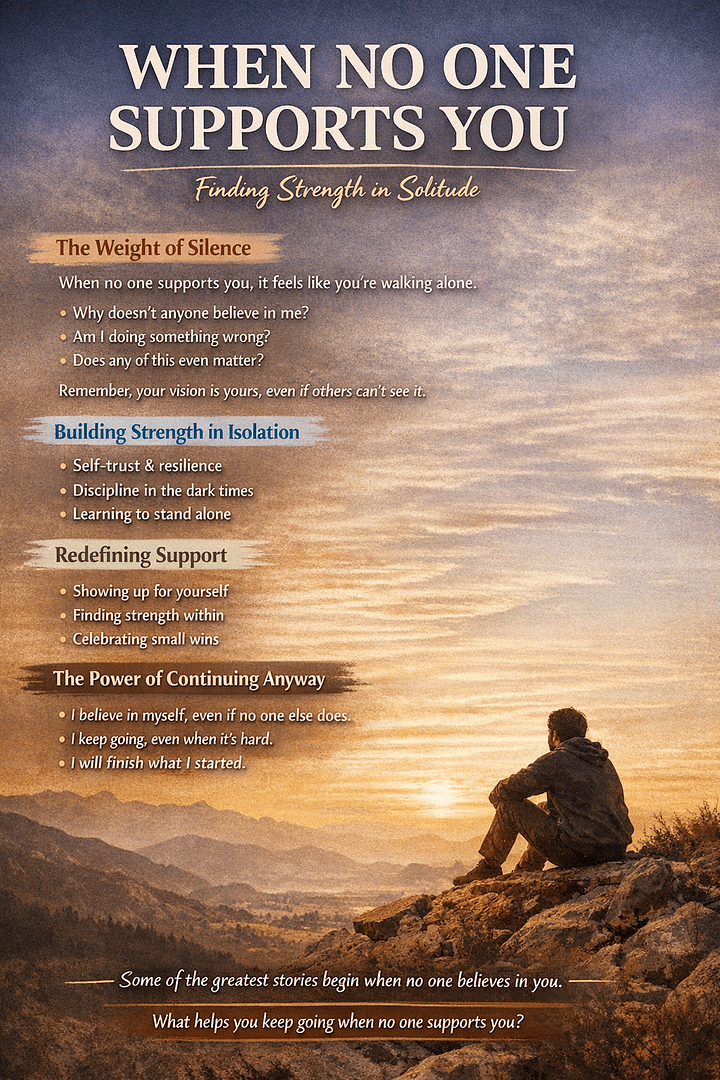
    There are seasons in life when the silence feels overwhelming—when your efforts go unnoticed, your struggles go unseen, and your victories are celebrated by no one but you. It’s in these moments that you may begin to question everything: your purpose, your direction, even your worth.

    When no one supports you, it can feel like you’re walking through life alone, carrying dreams that no one else believes in. It’s heavy. It’s isolating. And at times, it’s deeply discouraging.

    But there is a side to this experience that most people don’t talk about—a side that, while painful, has the power to shape you into someone unshakable.

    The Weight of Silence

    Support isn’t just about applause or praise. It’s about feeling seen, heard, and understood. When that’s missing, even the strongest person can feel invisible.

    You may find yourself wondering:

    Why doesn’t anyone believe in me?
    Am I doing something wrong?
    Does any of this even matter?

    These thoughts are natural. Humans are wired for connection. We seek encouragement because it reassures us that we’re not alone in what we’re doing.

    But the absence of support doesn’t mean the absence of purpose.

    Sometimes, people don’t support you because they can’t see what you see. Your vision is yours for a reason. It wasn’t given to them—it was given to you.

    The Hidden Reasons People Don’t Show Up

    It’s easy to take a lack of support personally, but the truth is, it’s often not about you at all.

    Some people don’t support you because:

    They don’t understand your goals
    They’re dealing with their own struggles
    They’re afraid of change or growth
    They’re uncomfortable seeing you step into something bigger

    And sometimes, the hardest truth to accept is this: not everyone is meant to walk your journey with you.

    That realization can hurt—but it can also free you.

    Building Strength in Isolation

    When support disappears, something else begins to grow—something deeper and more powerful than external validation.

    You begin to rely on yourself.

    At first, it feels unnatural. You look for reassurance that isn’t there. You hope someone will step in and tell you you’re on the right path.

    But over time, you start to develop:

    Self-trust — believing in your decisions without needing approval
    Discipline — continuing even when motivation fades
    Resilience — standing back up when no one is there to lift you

    This is where real strength is built—not in the spotlight, but in the shadows.

    The Loneliness That Teaches You

    Loneliness has a way of revealing things about yourself that you might never notice otherwise.

    It teaches you:

    Who you are when no one is watching
    What you truly want, without outside influence
    How to sit with your thoughts and face your fears

    It forces you to become your own source of comfort, your own encouragement, your own belief system.

    And while that process is painful, it’s also transformative.

    Because once you learn how to stand alone, you’re no longer dependent on others to keep you standing.

    Redefining What Support Means

    We often think support has to come from other people—but what if that’s not always true?

    What if support could look like:

    Showing up for yourself on the days you don’t feel like it
    Choosing to keep going, even when it’s hard
    Giving yourself credit for progress, no matter how small

    What if the most important support you’ll ever receive… comes from within?

    When you start to shift your perspective, everything changes. You stop waiting for validation and start creating your own.

    The Power of Continuing Anyway

    There is something incredibly powerful about continuing forward when no one is cheering for you.

    Every step you take becomes a statement:

    I believe in myself, even if no one else does.
    I’m not quitting, even when it would be easier to.
    I will finish what I started.

    That kind of determination builds a quiet confidence—one that doesn’t need recognition to exist.

    And over time, that confidence becomes unbreakable.

    When Support Finally Comes

    Ironically, there may come a time when people do start to notice.

    They may begin to support you, to praise you, to stand beside you.

    But by then, something inside you will have changed.

    You won’t need it the way you once did.

    Because you’ll already know:

    What you’re capable of
    How far you’ve come
    What it took to get there

    And the support you once longed for will simply become an addition—not a necessity.

    Final Reflection

    If you are in a season where no one supports you, don’t let that silence define your journey.

    Let it refine you.

    Let it build you into someone who doesn’t need permission to keep going. Someone who doesn’t rely on applause to feel worthy. Someone who understands that belief starts from within.

    Because the truth is—some of the greatest stories ever told…
    began in moments where no one believed in the person living them.

    And maybe, just maybe…

    This is the beginning of yours.

    Read More Health & Wellness

  • National Single Parent Day: Honoring Strength, Sacrifice, and Unbreakable Love

    Advertisements

    Every year on March 21st, National Single Parent Day shines a light on a group of individuals who quietly carry one of life’s heaviest responsibilities with incredible strength—single parents. This day is more than a date on the calendar; it’s a heartfelt recognition of resilience, sacrifice, and the kind of love that refuses to break, even under pressure.

    Single parents don’t just raise children—they build entire worlds for them, often while navigating life without a partner to share the weight.

    The Reality Behind the Role

    Single parenting is often misunderstood. From the outside, it may look like simply managing a household alone—but the truth goes far deeper.

    It’s waking up early to prepare for the day while mentally planning finances, schedules, and responsibilities. It’s working long hours, then coming home to switch roles instantly—from employee to caregiver, from provider to emotional support system.

    There’s no division of labor. No one to say, “I’ll handle this tonight.”
    Every responsibility rests on one set of shoulders.

    And yet, despite the pressure, single parents adapt. They evolve. They become stronger than they ever imagined possible.

    Wearing Every Hat

    A single parent doesn’t just fill one role—they fill them all:

    Provider
    Protector
    Teacher
    Cook
    Counselor
    Cheerleader
    Role model

    They manage finances, discipline, emotional growth, education, and daily survival—all while trying to maintain their own mental and physical health.

    There are moments when exhaustion takes over. Moments when silence fills the room after the kids are asleep, and the weight of everything settles in.

    But even in those quiet, heavy moments—they don’t quit.

    The Invisible Sacrifices

    Behind every stable home created by a single parent are countless sacrifices that often go unseen.

    They give up:

    Personal time
    Social lives
    Career opportunities
    Rest and sleep

    Sometimes they skip meals so their child doesn’t have to. Sometimes they hide their struggles so their child can feel secure.

    And perhaps the greatest sacrifice of all—they carry their fears alone.

    But they continue forward, driven by one powerful force:
    love that refuses to fail.

    The Emotional Weight

    Single parenting is not just a physical challenge—it’s deeply emotional.

    There are nights filled with questions:

    “Am I doing this right?”
    “Is my child happy?”
    “Will they understand everything I’m sacrificing?”

    There’s loneliness in making decisions alone. There’s pressure in trying to be everything at once.

    But there is also something incredibly powerful—
    the bond between a single parent and their child.

    It is often stronger, deeper, and built on a foundation of trust, resilience, and unconditional love.

    The Strength You Don’t Always See

    Strength doesn’t always look like confidence or certainty.

    Sometimes, strength looks like:

    Getting out of bed when you feel overwhelmed
    Showing up for your child when you’re exhausted
    Smiling when everything feels uncertain
    Continuing forward when quitting feels easier

    Single parents embody a quiet strength—the kind that doesn’t seek recognition, but deserves it more than most.

    Celebrating Every Victory

    National Single Parent Day is about recognizing victories that others may overlook.

    Not just the big milestones—but the everyday wins:

    Making it through another difficult day
    Paying the bills on time
    Helping with homework after a long shift
    Creating moments of joy in the middle of struggle

    These victories build a life. They build a future.

    And they deserve to be celebrated.

    Breaking the Stigma

    For far too long, single parenthood has been surrounded by unfair judgment and misconceptions.

    But the truth is this:

    Single parents are not “lacking”—they are resilient.
    They are not “struggling”—they are persevering.
    They are not “alone”—they are leading with strength and love.

    It’s time to replace judgment with respect.
    To replace assumptions with understanding.

    Because raising a child alone is not a weakness—it’s a testament to courage.

    How We Can Show Support

    Supporting a single parent doesn’t require grand gestures. Often, it’s the small things that matter most:

    Offer encouragement without judgment
    Help with errands or childcare when possible
    Check in with a simple message
    Acknowledge their effort and resilience

    Sometimes, the most powerful thing you can say is:
    “I see you. And you’re doing an incredible job.”

    A Message to Every Single Parent

    If you are walking this path:

    You are not invisible.
    You are not failing.
    You are not alone.

    You are building something meaningful—day by day, moment by moment.

    Even when it feels like too much…
    Even when doubt creeps in…
    Even when no one else sees the effort you’re putting in…

    It matters. You matter.

    And one day, your child will understand the depth of everything you did for them.

    Final Thoughts

    National Single Parent Day is more than recognition—it’s a reminder.

    A reminder that strength doesn’t always come in loud, obvious forms.
    Sometimes, it’s found in quiet perseverance.
    In late nights.
    In early mornings.
    In sacrifices made without applause.

    Being a single parent means carrying the weight of two roles with one heart—
    and still finding a way to love without limits.

    And that is something truly extraordinary.

    Read More Holidays & National Days

  • Celebrating National French Bread Day

    Advertisements

    There’s something almost magical about the aroma of freshly baked French bread drifting through the air. It’s warm, inviting, and instantly comforting. On National French Bread Day, we celebrate more than just a loaf—we celebrate a tradition that has nourished generations, connected cultures, and turned simple ingredients into something unforgettable.

    The Rich History Behind French Bread

    French bread, particularly the world-famous baguette, is deeply rooted in the culinary heritage of France. While bread itself dates back thousands of years, French bakers elevated it into an art form.

    The baguette as we know it today became popular in the 19th and early 20th centuries. Some stories suggest its long, slender shape was designed for convenience—easy to carry, quick to bake, and perfect for daily consumption. Others link it to changes in labor laws that limited early morning work hours, encouraging bakers to create bread that could be prepared more efficiently.

    Regardless of its exact origin, one thing is certain: French bread quickly became a cultural symbol. In fact, the traditional French baguette has been recognized globally as a representation of craftsmanship and heritage, even earning cultural recognition in recent years.

    🥖 The Craft of French Bread Making

    At first glance, French bread seems simple. Just four ingredients:

    Flour
    Water
    Yeast
    Salt

    But behind that simplicity lies a deep level of skill and patience.

    French bakers rely on time-honored techniques such as:

    Long fermentation to develop flavor
    Precise kneading to build structure
    Careful scoring to control how the bread expands
    High-temperature baking to create that signature crisp crust

    The result? A loaf that crackles when you press it, with a golden exterior and a soft, airy crumb inside.

    In France, many bakers still follow strict guidelines to preserve authenticity. A traditional baguette, often called baguette de tradition, cannot contain additives or preservatives—only the essential ingredients and expert technique.

    🌍 French Bread Around the World

    While French bread originated in France, its influence has spread across the globe. Today, you can find variations of French-style bread in bakeries from small towns to major cities worldwide.

    In the United States, French bread has become a staple in many households—served alongside pasta dishes, used for sandwiches, or transformed into garlic bread. Each region adds its own twist, but the essence remains the same: simple, satisfying, and versatile.

    🍽️ Delicious Ways to Celebrate

    National French Bread Day is the perfect opportunity to enjoy this classic in creative and comforting ways.

    🧈 Keep It Classic

    Slice a fresh baguette and spread it with butter. The warmth of the bread melts the butter instantly—simple, rich, and timeless.

    🧄 Make Garlic Bread

    Add butter, garlic, and herbs, then toast until golden. It’s the perfect side for pasta or soup.

    🧀 Build a Charcuterie Board

    Pair French bread with cheeses, cured meats, fruits, and spreads for a beautiful and flavorful experience.

    🥪 Create Gourmet Sandwiches

    French bread makes an excellent base for sandwiches—crispy outside, soft enough inside to hold all your favorite fillings.

    🍲 Pair with Comfort Foods

    Dip it into soups, stews, or sauces. French bread has a way of making every meal feel heartier and more complete.

    🏡 Baking French Bread at Home

    There’s something deeply rewarding about baking your own French bread. While it may seem intimidating at first, the process is both therapeutic and fulfilling.

    You don’t need fancy ingredients—just time, patience, and a willingness to learn. As the dough rises and the crust turns golden in the oven, your kitchen transforms into something special.

    Even if your first loaf isn’t perfect, it will still carry something meaningful: the effort and care you put into it.

    ❤️ More Than Food—A Symbol of Connection

    French bread isn’t just about taste—it’s about experience. It’s the bread shared at dinner tables, passed between friends, and enjoyed during quiet moments of reflection.

    In many ways, it represents:

    Tradition passed down through generations
    Simplicity in a complicated world
    Connection between people and cultures

    Breaking bread together has long been a symbol of unity, and French bread embodies that idea beautifully.

    🥖 A Moment to Savor

    On National French Bread Day, take a moment to slow down. Tear off a piece, enjoy the texture, and appreciate the craftsmanship behind it.

    Because sometimes, the simplest things—like a loaf of bread—hold the deepest meaning.

    Read More Holidays & National Days

  • When You Need Someone to Care

    Advertisements

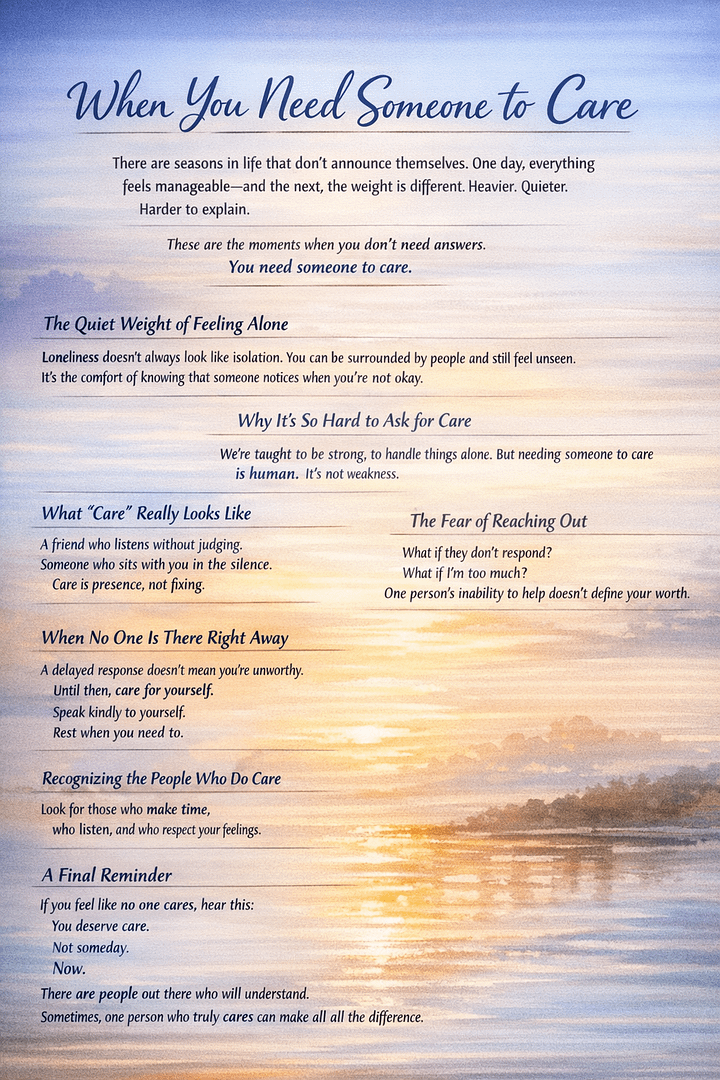
    There are seasons in life that don’t announce themselves. They don’t come with warning signs or clear beginnings. One day, everything feels manageable—and the next, the weight is different. Heavier. Quieter. Harder to explain.

    These are the moments when you don’t need answers.

    You need someone to care.

    Not someone to analyze your situation or tell you what you should have done differently. Not someone to rush you toward a solution. Just someone who sits with you in the middle of it all—without judgment, without impatience, without trying to turn your pain into something convenient.

    Because when you’re hurting, what you’re really searching for isn’t advice—it’s connection.

    The Quiet Weight of Feeling Alone

    Loneliness doesn’t always look like isolation. You can be surrounded by people—family, friends, coworkers—and still feel like no one truly sees you. You smile when you’re supposed to. You respond when spoken to. You go through the motions.

    But inside, something is missing.

    It’s the feeling of being understood without having to explain every detail. It’s the comfort of knowing that someone notices when you’re not okay—even when you try to hide it.

    And when that’s missing, the silence becomes overwhelming.

    You start to question yourself:

    Am I asking for too much?
    Would anyone really understand?
    Is it even worth reaching out?

    So you don’t.

    You carry it quietly instead.

    Why It’s So Hard to Ask for Care

    From a young age, many of us are taught to be strong—to handle things on our own, to not “burden” others with our struggles. Strength becomes associated with silence. Independence becomes a shield.

    But over time, that shield turns into a barrier.

    You begin to believe that your needs are inconvenient. That your emotions are something to manage privately. That asking for care somehow makes you less capable, less resilient, less… enough.

    The truth is, it doesn’t.

    Needing someone to care is not a flaw in your character—it’s part of being human. We are wired for connection. We are meant to be seen, heard, and supported. Denying that need doesn’t make it disappear; it just makes the weight harder to carry.

    What “Care” Really Looks Like

    Care isn’t always grand or dramatic. In fact, the most meaningful forms of care are often the simplest.

    It’s the friend who checks in without being asked.
    The person who listens without interrupting.
    The one who sits beside you in silence because words aren’t necessary.

    Care is consistency.

    It’s someone remembering the little things—your struggles, your fears, the things you don’t always say out loud. It’s someone choosing to stay, even when things aren’t easy or convenient.

    And sometimes, care is just presence.

    No fixing. No solving. Just being there.

    The Fear of Reaching Out

    Even when you know you need someone, reaching out can feel like the hardest step. It requires vulnerability—the willingness to be seen in a moment when you don’t feel your strongest.

    There’s always that fear:

    What if they don’t respond?
    What if they don’t understand?
    What if I’m too much?

    Those fears are real. And sometimes, they’re shaped by past experiences—times when you did open up and didn’t receive the care you needed.

    But here’s something important to remember:

    One person’s inability to show up does not define your worth.

    It doesn’t mean you’re too much.
    It doesn’t mean your feelings are invalid.
    It simply means that person wasn’t the right one to hold that moment with you.

    And that’s okay.

    Because the right people—the ones who truly care—will meet you where you are, not where it’s convenient for them.

    When No One Is There Right Away

    There are moments when you reach out, and the response isn’t immediate. Maybe people are busy. Maybe they don’t realize how serious things feel for you. Maybe they just don’t know how to respond.

    In those moments, it’s easy to fall deeper into the belief that you’re alone.

    But a delayed response is not the same as a lack of care.

    Sometimes, it just means the connection you need hasn’t happened yet.

    And while you wait, there’s something powerful you can do—something that often gets overlooked:

    You can care for yourself.

    Not in a cliché, surface-level way. But in a real, intentional way.

    Talk to yourself with the same kindness you wish someone else would offer.
    Give yourself permission to feel without judgment.
    Rest when you need to, even if the world keeps moving.

    Self-care doesn’t replace human connection—but it helps you stay grounded until that connection arrives.

    Recognizing the People Who Do Care

    Sometimes, care is already present in your life—you just haven’t recognized it in the way you expected.

    It might not come from the person you thought it would. It might not look the way you imagined. But it’s there.

    Look for the ones who:

    Make time, even in small ways
    Listen more than they speak
    Show consistency, not just intensity
    Respect your feelings without trying to minimize them

    Those are the people who care.

    And when you find them, hold onto them—not out of fear, but out of appreciation. Because genuine care is rare, and it deserves to be valued.

    Becoming Someone Who Cares—Even for Yourself

    One of the most transformative realizations is this:

    The care you’re searching for in others can also grow within you.

    When you’ve experienced what it feels like to need someone—to truly need someone—you develop a deeper understanding of what care means. And that understanding allows you to show up, not only for others, but for yourself.

    You learn to listen more deeply.
    To be more patient.
    To offer presence instead of solutions.

    And over time, you become the kind of person who doesn’t let others feel as alone as you once did.

    A Final Reminder

    If you’re in a place right now where you feel like no one cares, hear this:

    That feeling is real—but it is not permanent.

    There are people in this world who will understand you.
    People who will listen without judgment.
    People who will care in the way you’ve been needing.

    You may not have found them yet. Or maybe they’re closer than you think.

    But they exist.

    And until you find them, don’t silence your needs. Don’t convince yourself that you have to carry everything alone. Don’t shrink who you are just to make your pain more acceptable.

    You deserve care.

    Not someday. Not when you’re “better.” Not when things are easier.

    Now.

    Because sometimes, all it takes is one person to care—to truly care—and suddenly, the weight you’ve been carrying doesn’t feel quite so heavy anymore.

    And that one person could be closer than you think.

    Read More Health & Wellness

  • Honoring the Life and Legacy of Chuck Norris

    Advertisements

    There are icons, there are legends—and then there are those rare individuals whose lives become a blueprint for strength, discipline, and purpose. Chuck Norris was one of those individuals. His passing is not simply the loss of a cultural figure; it is the closing of a chapter that helped define what resilience and integrity look like in modern times.

    For decades, he stood as a symbol of unwavering strength. Not just the kind displayed in action scenes or martial arts competitions—but the kind built quietly, through hardship, conviction, and consistency. To honor his life is to look beyond the myth and into the man who shaped it.

    A Beginning Forged in Adversity

    Long before the world knew his name, Chuck Norris was simply Carlos Ray Norris—a young man navigating a difficult upbringing. Born in 1940, his early years were marked by instability and struggle. These were not the conditions that typically produce icons, but they were exactly what forged his character.

    Adversity did not defeat him. It defined him.

    His life took a transformative turn when he joined the United States Air Force. While stationed overseas, he discovered martial arts. What began as a curiosity quickly became a calling. In martial arts, Norris found structure, discipline, and a path forward.

    He immersed himself completely, training relentlessly. Over time, he rose through the ranks to become a world champion in karate. But more importantly, he developed a philosophy—one rooted in respect, perseverance, and self-mastery.

    It wasn’t about being the strongest in the room. It was about being the most disciplined.

    The Rise of a New Kind of Action Hero

    Chuck Norris didn’t just step into Hollywood—he brought something entirely new with him.

    At a time when action stars were often defined by spectacle, Norris brought authenticity. His movements weren’t choreographed illusions; they were grounded in real skill. His presence wasn’t manufactured—it was earned.

    One of his most iconic moments came in Way of the Dragon, where he faced off against Bruce Lee in a battle that remains legendary. That scene wasn’t just a cinematic highlight—it was a meeting of two philosophies, two masters, and two legacies.

    From there, Norris built a career that would make him a household name. Films like Missing in Action and Delta Force showcased his no-nonsense approach to heroism. But it was Walker, Texas Ranger that cemented his place in American culture.

    As Cordell Walker, Norris represented something audiences deeply craved: a hero who stood for justice without compromise. He wasn’t cynical. He wasn’t morally conflicted. He was steady, principled, and unshakable.

    In a world growing more complex, Chuck Norris remained clear.

    Beyond the Screen: A Life of Purpose

    What truly set Chuck Norris apart was not his success—but what he chose to do with it.

    Behind the fame was a man deeply committed to faith, family, and service. He understood that influence carries responsibility, and he embraced that responsibility fully.

    Through his organization, Kickstart Kids, Norris worked tirelessly to mentor young people. Using martial arts as a foundation, the program taught discipline, respect, and confidence to students who needed it most.

    He believed that strength wasn’t just physical—it was moral, emotional, and spiritual.

    Norris also became a voice for values that often feel overlooked in modern society. Through books, interviews, and public speaking, he emphasized the importance of integrity, perseverance, and accountability.

    He didn’t just play a hero. He lived like one.

    The Myth, the Humor, and the Man

    Few public figures ever reach the level of cultural transcendence that Chuck Norris achieved.

    The “Chuck Norris facts” phenomenon turned him into something larger than life—an unstoppable force capable of the impossible. While humorous, these exaggerated tales carried a deeper truth: people saw in him a symbol of ultimate strength.

    But what made those jokes endure wasn’t just their humor—it was their foundation. They worked because Chuck Norris already felt larger than life.

    And yet, beneath the myth was a man of humility.

    He never chased the legend. He simply lived his values—and the legend followed.

    A World in Mourning

    With the passing of Chuck Norris, the world pauses.

    For some, it is the loss of a childhood hero. For others, it is the loss of a role model. For many, it is the loss of a symbol—a reminder of what it means to stand strong in a world that often demands compromise.

    His absence is deeply felt because his presence was so impactful.

    He represented a kind of strength that feels increasingly rare: quiet, steady, and rooted in principle. Not loud. Not boastful. Just unshakable.

    And while his physical presence may be gone, the imprint he leaves behind is undeniable.

    The Enduring Legacy of Strength

    Legacies are not measured in years—they are measured in impact. And Chuck Norris’ impact is immeasurable.

    His life continues to ripple outward:

    In every person who chooses discipline over distraction

    In every young student who finds confidence through structure and guidance

    In every act of courage that stands firm in the face of pressure

    In every reminder that true strength begins within

    He showed the world that resilience is built, not given. That character matters more than recognition. That the strongest people are often the quietest ones in the room.

    Final Reflection: Carrying the Torch

    To honor Chuck Norris is to do more than remember him—it is to carry forward what he stood for.

    It is to live with intention.
    To act with integrity.
    To stand firm when it would be easier to fold.
    To build strength not just in body, but in spirit.

    His life was a testament to what is possible when discipline meets purpose. And though he has passed, the principles he embodied remain within reach for all of us.

    Legends never truly leave. They live on in the choices we make, the values we uphold, and the strength we choose to build within ourselves.

    Chuck Norris may be gone—but what he stood for will never fade.

    Read More History & Culture

  • When It’s Time to Let Go

    Advertisements

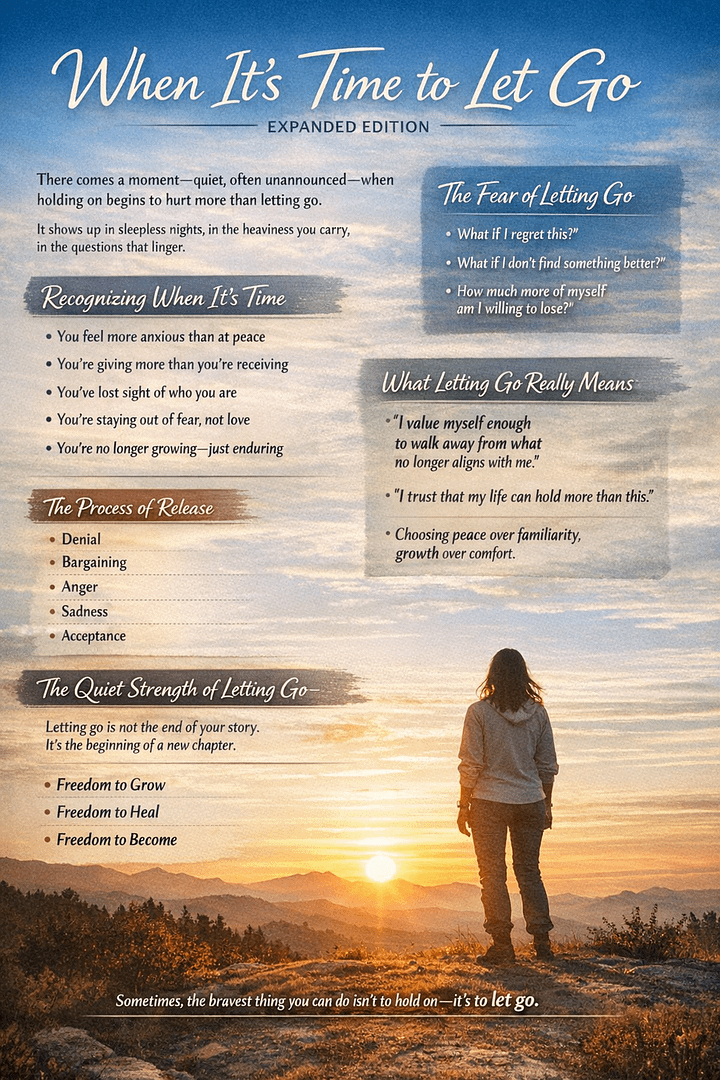
    There comes a moment—quiet, often unannounced—when holding on begins to hurt more than letting go. It doesn’t arrive with a loud declaration or a clear signpost. Instead, it seeps into your life slowly. It shows up in sleepless nights, in overthinking conversations, in the way your energy feels constantly drained. It lives in the silence after everything has been said, and in the tension of things left unsaid.

    Letting go is one of the most difficult emotional experiences we face—not because we don’t understand how, but because we don’t want to accept why. We hold on out of love, loyalty, history, and hope. Especially hope.

    Hope can be beautiful, but it can also keep us stuck in places we’ve outgrown.

    We hold on to people who no longer meet us where we stand. We hold on to relationships that once felt like home but now feel like obligation. We hold on to dreams we built in a different version of ourselves—dreams that no longer align with who we’re becoming.

    And still, we stay.

    We tell ourselves:
    “Maybe things will change.”
    “Maybe I just need to try harder.”
    “Maybe this is just a rough season.”

    But deep down, there’s a voice—quiet but persistent—that whispers the truth. And the truth is this: not everything is meant to stay.

    Some connections are meant to teach you, not keep you. Some experiences are meant to shape you, not define your forever.

    The Weight of Holding On

    Holding on can feel like strength. It can feel like commitment, resilience, even love. But there is a line where holding on stops being strength and starts becoming self-abandonment.

    You begin to lose pieces of yourself:

    Your peace

    Your confidence

    Your sense of direction

    Your emotional stability

    You start making excuses for things you once said you would never tolerate. You silence your own needs to keep something—or someone—intact. You shrink to fit into spaces that no longer have room for your growth.

    And the hardest part? You remember what it used to be. You remember the laughter, the connection, the potential. You’re not just holding on to what is—you’re holding on to what was.

    That’s what makes letting go so painful. You’re not just releasing a person, a situation, or a dream—you’re releasing the version of yourself that existed within it.

    Recognizing When It’s Time

    Letting go doesn’t come with a clear instruction manual, but there are signs—subtle at first, then undeniable:

    You feel more anxious than at peace

    You’re constantly overthinking instead of feeling secure

    You’re giving more than you’re receiving, and it’s no longer sustainable

    You feel emotionally exhausted, even when nothing “major” has happened

    You’ve lost sight of who you are outside of the situation

    You stay because you’re afraid of what life looks like without it

    Perhaps the clearest sign is this: you’re no longer growing—you’re just enduring.

    Growth feels expansive, even when it’s hard. Endurance feels heavy, even when it’s familiar.

    The Fear of Letting Go

    Letting go forces you to confront uncertainty. And uncertainty is uncomfortable. It asks you to step into the unknown without guarantees.

    You might ask yourself:

    What if I regret this?

    What if I don’t find something better?

    What if this was my chance?

    These fears are real, and they deserve to be acknowledged—not dismissed. But they shouldn’t be the reason you stay in something that’s slowly breaking you.

    Because there’s another set of questions you need to ask:

    What happens if I stay?

    How much more of myself am I willing to lose?

    Is this the life I truly want?

    Sometimes, staying is the greater risk.

    What Letting Go Really Means

    Letting go is often misunderstood. It’s not about erasing the past or pretending something didn’t matter. It’s not about anger or resentment. And it’s definitely not about weakness.

    Letting go is an act of self-respect.

    It’s saying:
    “I acknowledge what this was, but I also recognize what it has become.”
    “I value myself enough to walk away from what no longer aligns with me.”
    “I trust that my life can hold more than this.”

    It’s choosing peace over familiarity. Growth over comfort. Truth over illusion.

    And sometimes, it’s choosing yourself for the first time in a long time.

    The Process of Release

    Letting go isn’t a single decision—it’s a process. A layered, emotional journey that unfolds over time.

    You might cycle through:

    Denial (“It’s not that bad”)

    Bargaining (“If I just try harder…”)

    Anger (“Why did this happen?”)

    Sadness (“I didn’t want it to end like this”)

    Acceptance (“This is what needs to happen”)

    These stages don’t come in order, and they don’t follow a timeline. Some days you’ll feel strong. Other days, you’ll feel like you’re starting over.

    That’s okay.

    Healing is not linear. Letting go is not perfect.

    What matters is that you keep choosing forward.

    Rebuilding After Letting Go

    After you let go, there is a space that feels unfamiliar. At first, it might feel like emptiness. But it’s not emptiness—it’s openness.

    It’s space that was once filled with stress, confusion, or emotional weight.

    Now, it’s yours.

    This is where rebuilding begins:

    Rediscovering who you are

    Reconnecting with what brings you joy

    Setting new boundaries

    Learning to trust yourself again

    You begin to realize that your identity was never meant to be tied to one person, one outcome, or one chapter of your life.

    You are bigger than what you had to release.

    The Quiet Strength of Letting Go

    Letting go is not loud. It doesn’t always come with closure or a clear ending. Sometimes, it’s simply a quiet decision you make within yourself:

    “I’m done carrying this.”

    And that decision changes everything.

    Over time, the weight lifts. The overthinking fades. The emotional noise quiets. And what replaces it isn’t just relief—it’s clarity.

    You start to see things as they truly were, not just as you hoped they would be.

    And with that clarity comes peace.

    Closing Thoughts

    Letting go will always carry a sense of loss. That’s the price of caring deeply. But it also carries something else—something powerful:

    Freedom.

    Freedom to grow.
    Freedom to heal.
    Freedom to step into a life that feels aligned, genuine, and whole.

    Sometimes, the bravest thing you can do isn’t to keep holding on.

    It’s to release—with grace, with gratitude, and with the quiet belief that what’s meant for you will never require you to lose yourself to keep it.

    Read More Of Inspiration & Motivation

  • National Let’s Laugh Day – A Celebration of Joy, Healing, and Human Connection

    Advertisements

    In a world that often feels heavy with responsibility, stress, and constant motion, National Let’s Laugh Day, observed each year on March 19, invites us to rediscover something simple yet powerful—laughter. It’s not just about telling jokes or watching something funny; it’s about reconnecting with a part of ourselves that often gets buried under pressure, routine, and worry.

    Laughter is one of the most natural expressions of being human. Before we learn language, before we understand the world, we laugh. It’s instinctive. It’s pure. And somewhere along the way, many of us forget just how essential it is.

    This day exists to remind us.

    The Science Behind a Smile

    Laughter might feel effortless, but what it does inside the body is remarkable. When you laugh, your brain releases endorphins—chemicals that promote a sense of happiness and well-being. At the same time, levels of stress hormones like cortisol begin to drop.

    Your body physically responds:

    Your heart rate increases, then settles into a calmer rhythm

    Your muscles relax, relieving built-up tension

    Your lungs expand as you take in more oxygen

    Your immune system gets a subtle but meaningful boost

    Even a short burst of laughter can create a ripple effect that lasts far beyond the moment itself. It’s like hitting a reset button for your mind and body.

    Emotional Healing Through Laughter

    Life can be overwhelming. There are days when the weight feels too heavy—when silence replaces joy, and exhaustion replaces hope. In those moments, laughter might feel distant or even inappropriate.

    But laughter doesn’t dismiss pain—it coexists with it.

    Sometimes, laughter is what cracks through the darkness. It doesn’t erase hardship, but it softens it. It reminds us that even in difficult times, there are still pieces of light to hold onto.

    There’s a quiet strength in being able to laugh when things aren’t perfect. It’s not denial—it’s resilience.

    Laughter as a Shared Language

    One of the most beautiful things about laughter is that it doesn’t require translation. Across cultures, backgrounds, and experiences, laughter connects people instantly.

    Think about the last time you laughed with someone:

    Maybe it was over something completely unexpected

    Maybe it was a shared memory that never gets old

    Maybe it was a moment so simple it caught you off guard

    Those moments matter. They build trust. They create connection. They remind us that we’re not as alone as we sometimes feel.

    Laughter has a way of breaking down walls that words can’t reach.

    Why We Sometimes Forget to Laugh

    As we grow older, life becomes more structured—and often more serious. Responsibilities increase. Expectations rise. We begin to associate maturity with restraint, professionalism, and control.

    Somewhere along the way, laughter becomes something we schedule instead of something we live.

    We tell ourselves:
    “I’ll relax later.”
    “I’ll laugh when things calm down.”
    “I don’t have time right now.”

    But the truth is—life rarely “calms down” on its own. If we don’t make space for joy, it slowly disappears from our daily lives.

    National Let’s Laugh Day challenges that mindset. It reminds us that joy isn’t a reward for finishing life’s responsibilities—it’s fuel that helps us keep going.

    Simple, Meaningful Ways to Celebrate

    Celebrating this day doesn’t require anything elaborate. It’s about intention—choosing to invite laughter back into your day.

    Here are a few ways to do that:

    Reconnect with What Makes You Laugh

    Watch a movie or show that always makes you smile. Revisit a comedian, a sitcom, or even a silly video that never fails to lift your mood.

    Share Laughter with Others

    Send a funny message to a friend. Call someone who always makes you laugh. Sometimes, all it takes is one shared moment to brighten both of your days.

    Let Go of Perfection

    Allow yourself to be a little silly. Laugh at your own mistakes. Embrace the awkward, imperfect moments—they often turn into the best stories.

    Spend Time with Lighthearted People

    Energy is contagious. Being around people who laugh easily can help you rediscover that part of yourself.

    Create the Moment

    Don’t wait for laughter to happen—create it. Play a game, tell a joke, or simply choose to approach the day with a lighter perspective.

    Laughter in Difficult Times

    It’s important to acknowledge that not every day feels like a day to laugh. Some people are carrying grief, stress, or silent battles that make joy feel out of reach.

    And that’s okay.

    National Let’s Laugh Day isn’t about forcing happiness—it’s about making space for even the smallest moments of relief. Sometimes laughter isn’t loud or uncontrollable. Sometimes it’s just a small smile, a quiet chuckle, or a moment of lightness in an otherwise heavy day.

    That still counts.

    In fact, those moments might matter the most.

    The Ripple Effect of Joy

    Laughter doesn’t just affect you—it spreads. One genuine laugh can shift the mood of a room. It can ease tension, build connection, and create a chain reaction of positivity.

    Think about how powerful that is.

    A single moment of laughter can:

    Change someone’s day

    Strengthen a relationship

    Break through emotional distance

    Remind someone they’re not alone

    In a world that often feels divided or disconnected, laughter is one of the simplest ways to bring people back together.

    A Gentle Reminder for Today

    You don’t have to have everything figured out to laugh.
    You don’t need a perfect life to feel joy.
    And you don’t need a reason to smile.

    Today is simply a reminder:

    Pause.
    Breathe.
    Find something—anything—that makes you laugh.

    Let yourself feel that moment fully, without guilt or hesitation.

    Final Thought

    Laughter may not fix everything, but it changes how we experience everything. It lightens the load, softens the edges, and reminds us of the beauty still present in everyday life.

    So on this National Let’s Laugh Day, give yourself permission to laugh freely, love deeply, and live a little lighter.

    Because sometimes, the most powerful thing you can do…
    is simply laugh.

    Read More Holidays & National Days

  • When You Want to Quit and Disappear

    Advertisements

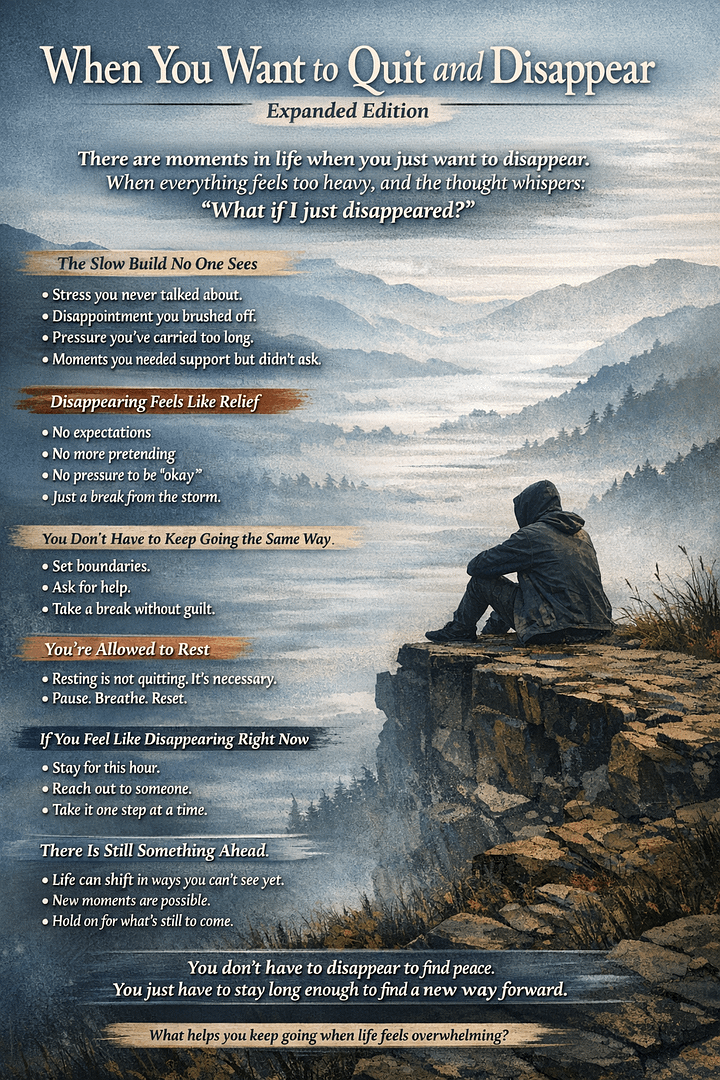
    There are moments in life that don’t arrive with warning. They don’t knock politely or give you time to prepare. They settle in quietly—heavy, suffocating, and relentless—until everything starts to feel harder than it should.

    And in those moments, a thought can creep in so softly you almost don’t notice it at first:

    “What if I just disappeared?”

    Not always in a literal sense. Not always about leaving the world entirely. Sometimes it’s about stepping away from everything that feels overwhelming—responsibilities, expectations, relationships, even your own identity. It’s the urge to go silent, to stop trying, to fade into a place where nothing is asked of you anymore.

    It’s a thought rooted not in weakness, but in exhaustion.

    The Slow Build No One Sees

    People rarely wake up one day and suddenly decide they want to quit everything. More often, it’s the result of a long, invisible build-up.

    It’s the stress you never talked about.
    The disappointment you brushed off.
    The pressure you kept telling yourself you could handle.
    The moments you needed support but convinced yourself not to ask.

    You keep going because that’s what you’ve always done. You show up, you push through, you carry more than you should—and you tell yourself it’s temporary.

    Until it isn’t.

    Until one day, even the smallest task feels heavy. Even the simplest decision feels overwhelming. Even getting out of bed feels like more effort than you have to give.

    That’s when the thought shows up:

    “I can’t do this anymore.”

    Disappearing Feels Like Relief

    There’s a strange comfort in the idea of disappearing.

    No expectations.
    No pressure to perform.
    No need to explain yourself.
    No more pretending you’re okay when you’re not.

    It feels like a way to finally rest.

    But what makes it dangerous is how convincing it can be. It doesn’t feel like giving up—it feels like choosing peace. It feels like taking control.

    And when you’ve been overwhelmed for so long, that kind of “peace” is incredibly tempting.

    The Truth Beneath the Feeling

    Underneath the urge to quit is something deeper—something more honest.

    You’re not tired of life.
    You’re tired of how life feels right now.

    You’re tired of:

    Carrying more than your share

    Feeling unseen or unappreciated

    Trying and still falling short

    Giving energy you don’t have

    Fighting battles that don’t seem to end

    When you strip it down, the desire to disappear is often a desire for relief, not escape.

    And that distinction matters more than it seems.

    Because if what you really need is relief… then there are ways to find it that don’t require losing yourself.

    The Danger of Silence

    One of the first things people do when they feel like this is pull away.

    They stop answering messages.
    They cancel plans.
    They avoid conversations.
    They go quiet.

    At first, it feels safer that way. You don’t have to explain what you’re going through. You don’t have to pretend. You don’t have to deal with anyone else’s expectations.

    But over time, that silence can become its own kind of trap.

    Because the longer you stay in it, the louder your thoughts become. Doubt grows. Isolation deepens. And what started as a way to protect yourself slowly begins to hurt you.

    Humans aren’t built to carry everything alone—even if we try to convince ourselves we are.

    You Don’t Have to Keep Going the Same Way

    Sometimes, when people feel like quitting, it’s because they believe there are only two options:

    Keep going exactly as things are

    Walk away from everything completely

    But there’s a third option that doesn’t get enough attention:

    Change how you’re going.

    You can:

    Set boundaries where you never had them

    Say no without explaining yourself

    Take breaks without guilt

    Ask for help without feeling weak

    Let go of things that are draining you

    You don’t have to destroy your life to rebuild your peace.

    Redefining Strength

    We often think strength means pushing through no matter what. Never stopping. Never breaking. Never letting anyone see us struggle.

    But real strength is more honest than that.

    Sometimes strength is admitting:

    “I’m not okay.”

    “I need a break.”

    “I can’t carry this alone anymore.”

    Sometimes strength is choosing to stay when disappearing would be easier.

    And sometimes, strength is letting go of the idea that you have to be strong all the time.

    The Power of Small Anchors

    When everything feels overwhelming, thinking about the future can make things worse. It feels too big, too uncertain, too far away.

    That’s why it helps to focus on small anchors—tiny things that keep you grounded in the present.

    It might be:

    A song that calms you

    A walk outside

    A conversation with someone you trust

    Writing your thoughts out instead of holding them in

    Even just getting through the next hour

    These aren’t solutions to everything. But they’re lifelines in moments when you feel like drifting away.

    And sometimes, lifelines are enough to get you through the storm.

    You’re Allowed to Rest

    One of the biggest misconceptions is that rest has to be earned.

    That you have to reach a breaking point before you’re “allowed” to slow down.

    But rest isn’t a reward—it’s a necessity.

    You don’t have to prove how exhausted you are before you take care of yourself. You don’t have to wait until everything falls apart before you give yourself permission to breathe.

    Resting doesn’t mean you’re quitting.

    It means you’re choosing to continue in a healthier way.

    If You Feel Like Disappearing Right Now

    If this isn’t just an idea, but something you’re feeling deeply in this moment, don’t try to fix everything at once.

    Just focus on staying.

    Stay for this hour.
    Stay for this conversation.
    Stay for one more day.

    Reach out—even if it’s uncomfortable. Even if you don’t know what to say. You don’t need perfect words. You just need a connection.

    And if reaching out feels like too much right now, start smaller. Sit with yourself. Breathe. Let the feeling pass through instead of fighting it.

    Feelings, even the heavy ones, are temporary.

    You are not.

    There Is Still Something Ahead

    It might not feel like it right now. It might feel like everything is stuck, like nothing is changing, like you’re just going through the motions.

    But life has a way of shifting when you least expect it.

    New opportunities.
    New people.
    New moments that remind you why you stayed.

    You don’t have to believe in a perfect future. You just have to leave enough room for the possibility that things can change.

    Because they can.

    Final Thought

    Wanting to quit doesn’t make you weak. Wanting to disappear doesn’t make you broken.

    It makes you human.

    It means you’ve been carrying something heavy for too long without enough support.

    But you don’t have to carry it the same way anymore.

    You don’t have to disappear to find peace.

    You just have to stay long enough to discover a different way forward.

    Read More Health & Wellness

Exit mobile version