
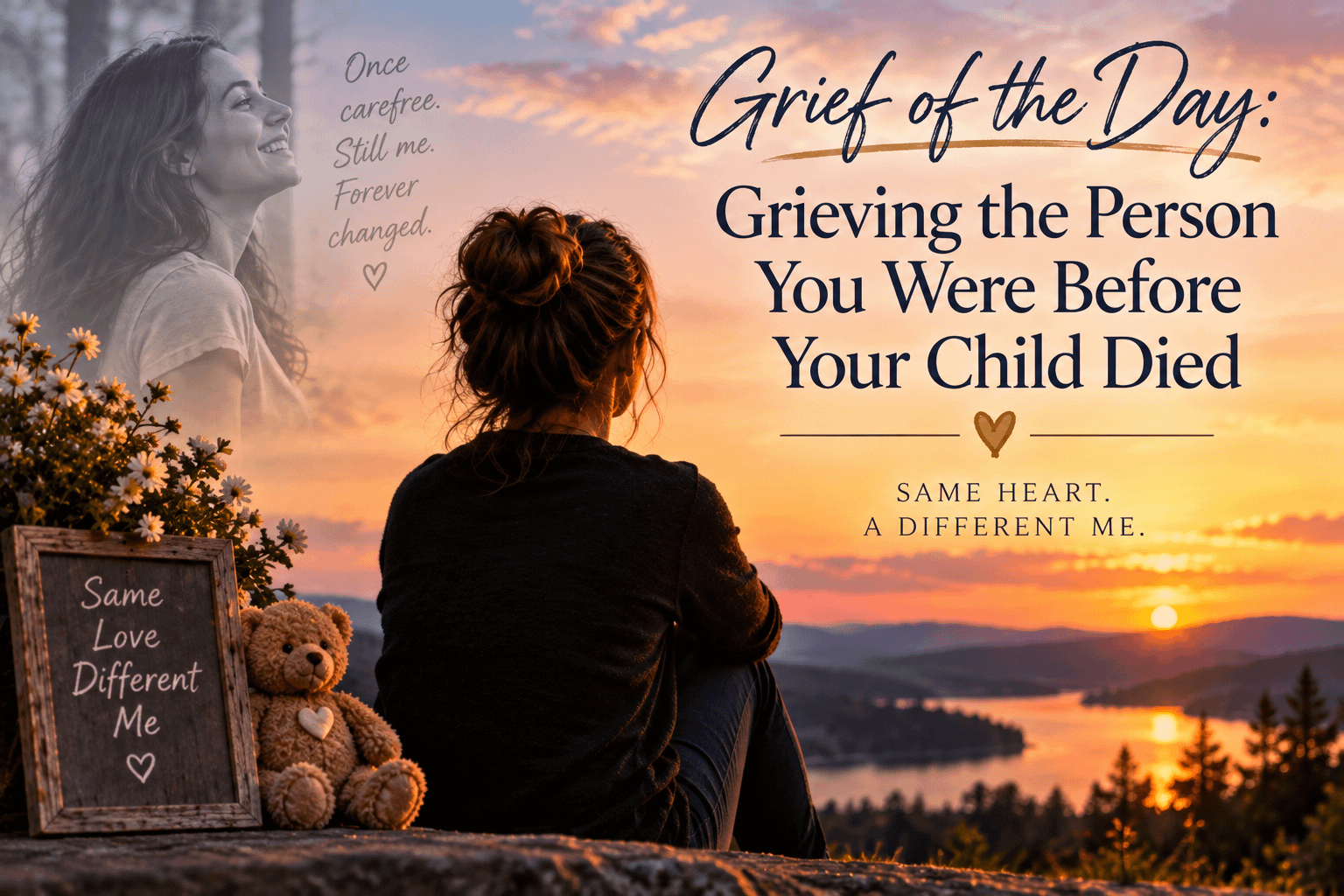
When your child dies, you grieve your child.
You grieve their voice.
Their smile.
Their laugh.
Their presence.
You grieve the conversations you can no longer have, the memories you can no longer make, and the future you believed you would share.
But there is another loss that isn’t talked about nearly enough.
You may also grieve the person you were before your child died.
There was a version of you who existed before that day.
A version who didn’t know this kind of pain.
A version who could hear the phone ring without fearing terrible news.
A version who could make plans for the future without wondering how quickly everything could disappear.
A version who could laugh without occasionally feeling guilty about it.
A version who believed certain tragedies happened to other people.
Then your child died.
And that person changed.
You didn’t ask to become someone different.
You didn’t choose this transformation.
But grief entered your life and divided your story into two parts:
Before my child died.
And:
After my child died.
Sometimes you miss your child more than words could ever explain.
And sometimes, quietly, you miss yourself too.
There Was a Version of You Who Didn’t Know This Pain
Before losing a child, you may have understood that terrible things happened in the world.
You saw stories on the news.
You heard about tragedies.
Maybe you knew other parents who had lost children.
You felt sympathy for them.
You may even have tried to imagine what they were experiencing.
But imagining child loss and living through it are completely different things.
Before your loss, there was still a certain innocence inside you.
You could assume tomorrow would arrive.
You could make plans months or years ahead.
You could say goodbye to someone without wondering whether it might be the final goodbye.
You could watch your child walk out the door without understanding just how precious an ordinary goodbye could become.
Then everything changed.
Once you have experienced the death of your child, you know something you can never unknow:
Life can change in a moment.
That knowledge becomes part of you.
You May Miss How Carefree You Used to Be
Maybe you used to laugh more easily.
Maybe you didn’t overthink every phone call.
Maybe you didn’t worry when someone was late.
Maybe you didn’t think about death as often.
Maybe birthdays were simply birthdays.
Holidays were simply holidays.
Songs were simply songs.
Photographs were simply photographs.
Dates on the calendar didn’t carry the weight they carry now.
Then grief changed the meaning of ordinary things.
A birthday can become a reminder of the age your child should be.
A holiday can make you notice the empty place at the table.
A photograph can make you smile for five seconds and cry for twenty minutes.
A song can take you back years in seconds.
A familiar road can bring back memories you weren’t expecting.
You may occasionally look at the person you were before all of this and think:
I miss being that person.
There is nothing wrong with admitting that.
Missing who you used to be does not mean you aren’t grateful for who you are becoming.
It simply means you recognize how much loss changed you.
Child Loss Changes the Way You See Time
Before your child died, time may have seemed almost unlimited.
There would always be another birthday.
Another Christmas.
Another dinner.
Another conversation.
Another photograph.
Another chance to say what you wanted to say.
Another opportunity to make things right.
Another ordinary Tuesday.
Grief teaches you otherwise.
You begin understanding how temporary everything can be.
You may find yourself appreciating small moments more deeply because you now understand how valuable they are.
But that awareness comes at a terrible price.
You learned how precious time is because someone you desperately wanted more time with is gone.
That realization can change how you live.
You may say “I love you” more often.
You may forgive sooner.
You may stop worrying about things that once seemed important.
You may take more photographs.
You may treasure ordinary conversations.
You may hug people a little longer.
Those changes are part of the person grief has made you.
You May Not Recognize Yourself Anymore
One of the strangest experiences after a devastating loss is looking at yourself and feeling disconnected from the person staring back.
You look the same.
Maybe older.
Maybe more tired.
But inside, everything feels different.
Things that once excited you may no longer matter.
Things that once bothered you may suddenly seem insignificant.
Your priorities may change.
Your friendships may change.
Your beliefs may be challenged.
Your goals may change.
Even your personality may feel different.
You may become quieter.
More emotional.
More guarded.
More compassionate.
More impatient with meaningless drama.
More aware of other people’s hidden pain.
Grief doesn’t ask permission before changing you.
It simply does.
And part of healing can involve learning who this new version of you is.
You Don’t Have to Become the Person You Were Before
People sometimes talk about healing as though the goal is to “get back to normal.”
But what if normal no longer exists?
What if the person you were before your child died cannot completely return?
That doesn’t mean you are failing.
Maybe healing isn’t about becoming who you used to be.
Maybe healing is about learning to live as the person you are now.
You carry experiences the old version of you never carried.
You know pain that person never knew.
You have survived days that person never imagined.
You have cried tears that person never expected to cry.
You have learned things about love, grief, strength, loneliness, compassion, and survival that you never wanted to learn.
You cannot simply erase all of that and return to who you were.
But you can decide who you want to become.
Some Parts of the Old You Are Still There
Grief changes you, but it doesn’t necessarily erase everything that existed before.
The person you were is still part of you.
Maybe your sense of humor is still there.
Maybe your kindness is still there.
Maybe your love for helping others is still there.
Maybe your dreams are still somewhere beneath the grief.
Maybe your curiosity is still there.
Maybe your ability to love is still there.
Those parts may have become quieter for a while.
Grief can cover them.
Pain can make them difficult to recognize.
But slowly, pieces of yourself can return.
You may laugh and suddenly realize:
That sounded like the old me.
You may become excited about something.
You may start planning again.
You may rediscover something you once enjoyed.
And for a moment, you feel familiar to yourself.
Don’t be afraid of those moments.
They don’t mean you’re leaving your child behind.
They mean part of you is waking up again.
The New You Can Carry the Old You Forward
You don’t have to choose between who you were and who you are becoming.
Both versions can exist within you.
The old you knew your child.
The old you created memories with them.
The old you heard their voice, saw their smile, celebrated birthdays, shared ordinary days, and experienced moments you would give anything to experience again.
That version of you holds something incredibly precious:
memories.
The person you are now carries those memories forward.
You are the bridge between the life you had and the life you still have.
That can be incredibly painful.
But it can also become meaningful.
You May Become More Compassionate Toward Other People’s Pain
One thing grief often changes is how you see other people.
Before your loss, you may have looked at someone and assumed they were okay because they looked okay.
Now you know better.
You know someone can smile while grieving.
Someone can laugh while hurting.
Someone can work while barely holding themselves together.
Someone can answer “I’m fine” while carrying enormous pain.
Someone can sit beside you while fighting a battle you know nothing about.
Grief teaches you that appearances tell very little about what someone is carrying.
That knowledge can make you gentler.
More patient.
More willing to listen.
More likely to check on someone.
More willing to sit beside someone without trying to fix them.
You know what it means to hurt.
And because of that, you may become someone who recognizes hurt in others.
That is one of the ways pain can become compassion.
You May Stop Caring About Things That Once Seemed Important
Child loss has a way of changing perspective.
Arguments that once seemed enormous can feel meaningless.
Drama can become exhausting.
Holding grudges can feel like wasted time.
You may become less interested in impressing people.
Less interested in pretending.
Less willing to spend time around people who constantly bring negativity into your life.
Because after losing someone you love, you understand something deeply:
Time matters.
You begin asking different questions.
Who matters to me?
How do I want to spend the time I have?
What kind of person do I want to be?
What would my child want for me?
What do I want my life to stand for?
These questions can slowly reshape you.
There May Be Parts of the New You That You’re Proud Of
This can be difficult to admit because nobody would ever choose the circumstances that created this version of you.
You would give anything to have your child back.
Nothing about personal growth makes the loss worth it.
Nothing makes the tragedy necessary.
Nothing makes you grateful that it happened.
But you can still recognize the strength you’ve developed afterward.
Maybe you’re more compassionate now.
Maybe you’re more honest about what matters.
Maybe you’re helping other grieving parents.
Maybe you’re telling your child’s story.
Maybe you’re raising awareness.
Maybe you’re supporting people who feel forgotten.
Maybe you’re living differently because your child taught you something about love.
You didn’t choose the pain.
But you can choose what you do with the life you still have.
Your Child Is Part of Who You Were—and Who You Are Becoming
One of the fears parents can have when they begin rebuilding their lives is that moving forward somehow means moving away from their child.
But your child is already part of you.
They helped shape who you are.
Their personality influenced you.
Their love influenced you.
The memories you shared influenced you.
The lessons they taught you influenced you.
Even the little things became part of your story.
You don’t have to remain exactly the person you were when they were alive to continue loving them.
You can grow.
You can change.
You can discover new dreams.
You can meet new people.
You can laugh again.
You can travel.
You can love.
You can create.
You can find purpose.
You can build a different future.
And your child can remain part of all of it.
You Are Allowed to Miss Yourself
There may be nights when you’re looking through old photographs and something catches your attention.
Not only your child.
You.
You notice your smile.
You notice how happy you looked.
You remember what life felt like then.
And suddenly you aren’t only grieving the person standing beside you.
You’re grieving the person you were in that photograph.
You may think:
I wish I could go back.
Not because everything was perfect.
But because your child was there.
Because you didn’t know what was coming.
Because for that moment, life still contained something you would later lose.
It is okay to grieve that version of yourself.
You lost something too.
Your sense of certainty.
Your innocence about life.
The future you imagined.
Parts of your identity.
The way you once understood the world.
Those are real losses.
Don’t Judge Who You’ve Become
You may not have the same energy anymore.
You may not trust as easily.
You may need more time alone.
You may become emotional unexpectedly.
You may have days when you don’t want to talk.
You may struggle around certain dates.
You may avoid certain places.
You may need boundaries you never needed before.
You may value completely different things.
Give yourself grace.
You survived something that changed your entire understanding of life.
You are still learning how to live with that.
You Can Become Someone Your Child Would Be Proud Of
Perhaps the goal isn’t to become the person you were before your child died.
Perhaps the goal is to become someone who carries the best parts of that person forward while allowing grief to teach you what truly matters.
Someone who loves deeply.
Someone who says what needs to be said.
Someone who helps when they can.
Someone who understands pain.
Someone who doesn’t take tomorrow for granted.
Someone who tells their child’s stories.
Someone who keeps their memory alive.
Someone who gets knocked down and eventually finds the courage to stand again.
Someone who continues living even when living became incredibly difficult.
You don’t have to accomplish something extraordinary.
Sometimes honoring your child means simply continuing.
Getting up.
Trying again.
Helping someone.
Sharing a memory.
Laughing when laughter comes.
Crying when tears come.
And refusing to believe that your life stopped having value when your child’s life ended.
Grief of the Day Reminder
If you miss the person you were before your child died, you are allowed to grieve that person too.
You don’t have to pretend loss didn’t change you.
It did.
You may never see life exactly the same way again.
You may never take ordinary moments for granted the way you once did.
Certain dates may always mean something different.
Certain songs may always bring memories.
Certain photographs may always stop you in your tracks.
And there may always be moments when you wish you could return to the person you were before you knew this kind of heartbreak.
But don’t overlook the person standing here today.
That person has survived.
That person has carried unimaginable love and unimaginable loss.
That person has made it through days they once believed were impossible.
That person has learned how to wake up in a world where someone important is missing.
That person has continued loving a child they can no longer physically hold.
You may not be who you were before.
Maybe you were never supposed to pretend you could be.
Your story has changed.
Your heart has changed.
Your priorities have changed.
Your understanding of life has changed.
But changed does not mean finished.
There are still chapters ahead.
There are still people you can help.
There are still memories you can make.
There are still reasons to laugh.
There are still places to go.
There is still love to give.
There is still purpose to discover.
And there is still a child whose life will forever be woven into yours.
You can miss the person you used to be while learning to respect the person you have become.
You can grieve your old life while building a new one.
You can carry yesterday while still walking toward tomorrow.
And perhaps one day, when you look at the person you have become, you will recognize something familiar.
Not the exact person you were before.
Something deeper.
The love you always had.
The love your child knew.
The love that survived even when your world changed.
You aren’t leaving the old you behind.
You are carrying that person forward—along with every memory, every lesson, every laugh, every tear, and every ounce of love your child placed inside your heart.
When you look at who you were before your loss and who you are today, what part of yourself do you miss most—and what part of the person you’ve become are you most proud of?
Leave a ReplyCancel reply