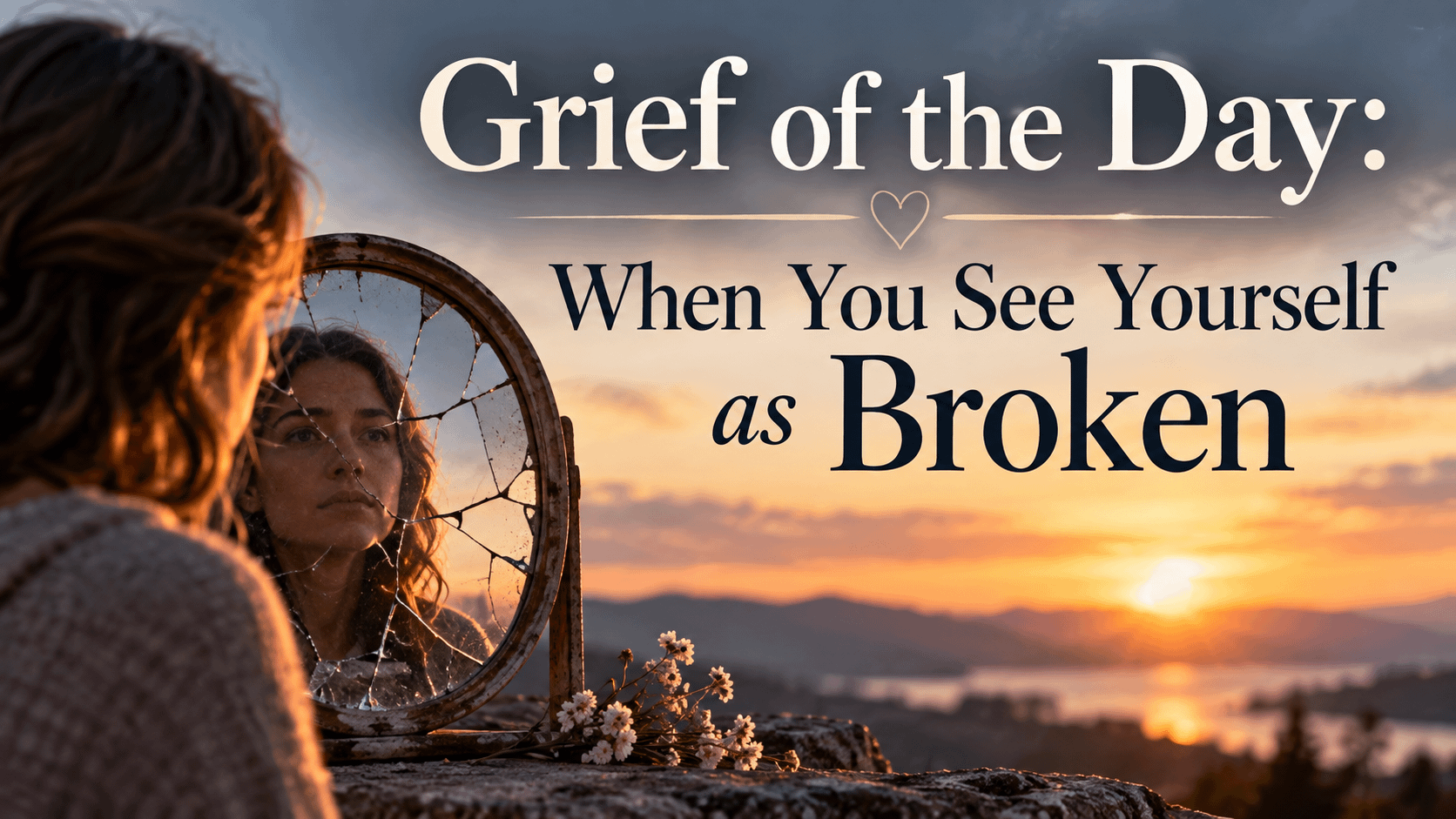
There are moments in grief when you do not recognize the person staring back at you in the mirror.
You remember who you used to be.
You remember laughing without feeling guilty afterward. You remember waking up without grief being one of your first thoughts. You remember making plans for the future and actually believing that future was going to happen.
Then loss entered your life.
And somewhere along the way, you started seeing yourself differently.
You stopped seeing someone who was hurting and started seeing someone who was broken.
That word can become incredibly powerful.
Broken.
It can begin to describe everything.
Your heart feels broken.
Your dreams feel broken.
Your family feels broken.
Your plans feel broken.
Your faith may even feel broken.
Eventually, you start looking at yourself and thinking:
Maybe I am broken too.
But there is something important I have learned about grief: feeling broken and being beyond healing are not the same thing.
You can carry shattered pieces of your old life and still build something meaningful with the life that remains.
Grief Changes the Way You See Yourself
Losing someone you deeply love does more than create sadness.
It can change your identity.
Before loss, you may have known exactly who you were. You had responsibilities, relationships, routines, dreams, and expectations.
Then suddenly everything changed.
You may still have the same name.
You may still live in the same house.
You may still drive the same roads, shop at the same stores, and interact with many of the same people.
But inside, you know something is different.
The person you were before the loss does not completely exist anymore.
That realization can be frightening.
Sometimes you desperately want your old self back.
You want the version of yourself who could laugh freely.
The version who trusted life.
The version who believed tomorrow would probably be okay.
The version who did not understand how quickly everything could change.
But grief teaches you something you never wanted to learn:
Some experiences change you permanently.
That does not mean your life is permanently ruined.
It means you are becoming someone different.
When “Broken” Becomes Your Identity
There is a difference between saying:
“My heart is broken.”
and saying:
“I am broken.”
One describes pain.
The other describes identity.
That distinction matters.
When grief lasts months or years, it can become difficult to separate yourself from your suffering.
You may begin believing you are the sadness.
You are the loneliness.
You are the depression.
You are the person whose loved one died.
You are the person everyone feels sorry for.
You are the person who cannot get over what happened.
You are the person who is never going to be happy again.
But grief is something you carry.
It is not everything you are.
Your loss will always be part of your story, but it does not have to become the only chapter anyone—including you—is allowed to read.
You May Never Be the Person You Were Before
People sometimes talk about healing as though the ultimate goal is returning to normal.
I do not think grief always works that way.
Sometimes there is no going back.
There is only going forward.
And accepting that can actually be freeing.
You do not have to spend the rest of your life trying to become the person you were before your world changed.
That person belonged to another chapter of your life.
You can honor that version of yourself while slowly discovering who you are becoming now.
Maybe you are more compassionate because you understand suffering.
Maybe you notice lonely people more quickly.
Maybe you check on someone when everyone else assumes they are fine.
Maybe you understand the importance of saying “I love you.”
Maybe you appreciate ordinary moments differently.
Maybe you have learned that tomorrow is never guaranteed.
These lessons came at a terrible price.
You never would have chosen them.
But they can still become part of who you are.
Healing Does Not Mean Putting Every Piece Back
Imagine dropping a piece of pottery.
It hits the ground and breaks.
You could spend forever trying to make every fragment fit exactly as it did before.
But even if you managed to rebuild it, the cracks would remain.
Grief can feel like that.
We sometimes believe healing means hiding every crack.
Pretending everything is okay.
Smiling when we want to cry.
Telling people we are doing great because we are tired of explaining ourselves.
But perhaps healing is not about hiding the cracks.
Perhaps it is learning that the cracks are part of your story.
They show where life hurt you.
They show where you survived something you once believed would destroy you.
You do not have to be ashamed of them.
There Will Be Days When You Feel Broken Again
Healing is not a straight line.
You can have a good week and suddenly fall apart.
You can laugh all afternoon and cry that evening.
You can believe you are finally making progress and then hear a song that brings everything rushing back.
A birthday arrives.
An anniversary approaches.
You see an old photograph.
You smell something familiar.
You drive past somewhere connected to them.
And suddenly the distance between yesterday and today disappears.
You miss them with an intensity that surprises you.
In those moments, you might think:
I thought I was doing better.
You probably are.
A difficult day does not erase your progress.
Crying again does not mean you have returned to the beginning.
Missing someone deeply years later does not mean you failed at healing.
It means you loved someone who mattered.
Stop Measuring Yourself Against People Who Have Not Lived Your Loss
One of the easiest ways to feel broken is to compare yourself with everyone around you.
You watch people living normal lives.
They go to work.
They celebrate birthdays.
They travel.
They fall in love.
They complain about small problems.
They make plans years into the future.
Meanwhile, you might be proud of yourself simply for getting out of bed.
That comparison can make you wonder what is wrong with you.
But people carry different stories.
Someone who has never experienced your particular loss cannot be the measuring stick for your recovery.
There may be days when getting through the day is an accomplishment.
There may be times when answering a phone call feels difficult.
There may be mornings when taking a shower, eating something, and stepping outside requires genuine effort.
Give yourself credit for those victories.
Healing often happens through incredibly ordinary actions.
You Are Allowed to Need People
Seeing yourself as broken can make you withdraw.
You may think:
Nobody wants to deal with me.
I am too much.
People are tired of hearing about my grief.
I should handle this myself.
But isolation can make grief feel even heavier.
You do not have to tell everyone everything.
You do not need dozens of people around you.
Sometimes you simply need one person who is willing to sit beside you without trying to fix you.
Someone who lets you talk about the person you miss.
Someone who does not change the subject when you say their name.
Someone who understands that grief does not follow a calendar.
Someone who can listen when you say:
“Today is hard.”
There is strength in allowing yourself to be supported.
Your Scars Are Not Evidence of Failure
We often think scars represent damage.
But scars also represent survival.
They exist because something wounded you and your body attempted to heal.
Emotional scars can be similar.
There are things grief may leave inside you forever.
Certain dates may always hurt.
Certain songs may always make your chest tighten.
Certain photographs may always bring tears.
Certain memories may always make you wish you could go backward in time.
Those reactions do not make you weak.
They show that someone mattered enough to leave an imprint on your life.
Love leaves marks.
So does loss.
You Can Be Hurting and Still Be Healing
These two things can exist together.
You can miss someone and still enjoy today.
You can cry and still be healing.
You can have difficult days and still be making progress.
You can feel lonely and still be learning how to live again.
You can carry grief and still experience joy.
For a long time, happiness after loss can feel like betrayal.
You might feel guilty for laughing.
You might feel guilty for traveling.
You might feel guilty for falling in love again.
You might even feel guilty simply because you are still alive.
But continuing to live does not erase the person you lost.
Your happiness does not diminish your love for them.
Your future does not cancel your past.
There is room for both.
Speak to Yourself With Compassion
Think about how you would speak to someone you loved who had experienced a devastating loss.
Would you tell them they were pathetic?
Would you tell them they should be over it?
Would you tell them they were weak because they cried?
Would you tell them they were broken beyond repair?
Probably not.
You would likely show them compassion.
Try offering some of that same compassion to yourself.
Instead of:
“What is wrong with me?”
Try:
“I am having a difficult day.”
Instead of:
“I should be over this.”
Try:
“I am still learning how to carry this.”
Instead of:
“I am broken.”
Try:
“I have been deeply hurt, and I am still here.”
Words matter.
Especially the words you repeat to yourself when nobody else is listening.
Maybe You Are Rebuilding
There is another way to look at yourself.
Instead of broken, perhaps you are rebuilding.
Rebuilding does not happen quickly.
It happens piece by piece.
You begin taking care of yourself again.
You reconnect with someone.
You discover something that makes you smile.
You find purpose in helping another grieving person.
You start making plans.
You allow yourself to dream again.
Maybe you fall in love.
Maybe you travel somewhere new.
Maybe you discover a purpose you never expected.
None of those things erase what happened.
They simply prove that loss did not take everything from you.
There is still life inside you.
You Are More Than the Worst Thing That Happened to You
This may be one of the hardest things to believe when grief becomes part of your identity.
You are more than your tragedy.
You are more than the worst phone call you ever received.
You are more than the funeral.
You are more than the empty bedroom.
You are more than the photographs.
You are more than the anniversaries.
You are more than the nights you cried until you could not cry anymore.
You are still a person capable of kindness.
Capable of loving.
Capable of helping someone.
Capable of creating something.
Capable of finding meaning.
Capable of experiencing moments of happiness again.
Your grief is part of you.
But it is not all of you.
When You Look in the Mirror
The next time you look at yourself and think, “I am broken,” look a little longer.
Look at the person who survived every terrible day so far.
Look at the person who got out of bed when there seemed to be no reason to.
Look at the person who continued breathing through moments when grief felt unbearable.
Look at the person who learned how to carry an absence that cannot be filled.
You may see cracks.
You may see exhaustion.
You may see sadness in your own eyes.
But there is something else there too.
You are still here.
That matters.
You do not need to have everything figured out today.
You do not need to pretend you are okay.
You do not need to prove anything to anyone.
You simply need to keep giving yourself permission to take another step.
And then another.
Some days those steps will be enormous.
Other days they will barely move you forward.
Both count.
Because maybe you are not a broken person waiting to be repaired.
Maybe you are a grieving person learning how to live with a heart that has been changed forever.
And perhaps healing is not becoming who you used to be.
Perhaps healing is slowly discovering that even with the cracks, scars, memories, tears, and missing pieces, your life can still hold love, purpose, meaning, and moments worth living for.
So when the thought comes again—
“I am broken.”
Try answering it differently:
“I have been brokenhearted. I have been wounded. I have been changed. But I am still here, and my story is not finished.”
When grief makes you see yourself as broken, what would change if you began seeing yourself instead as someone who is still rebuilding?