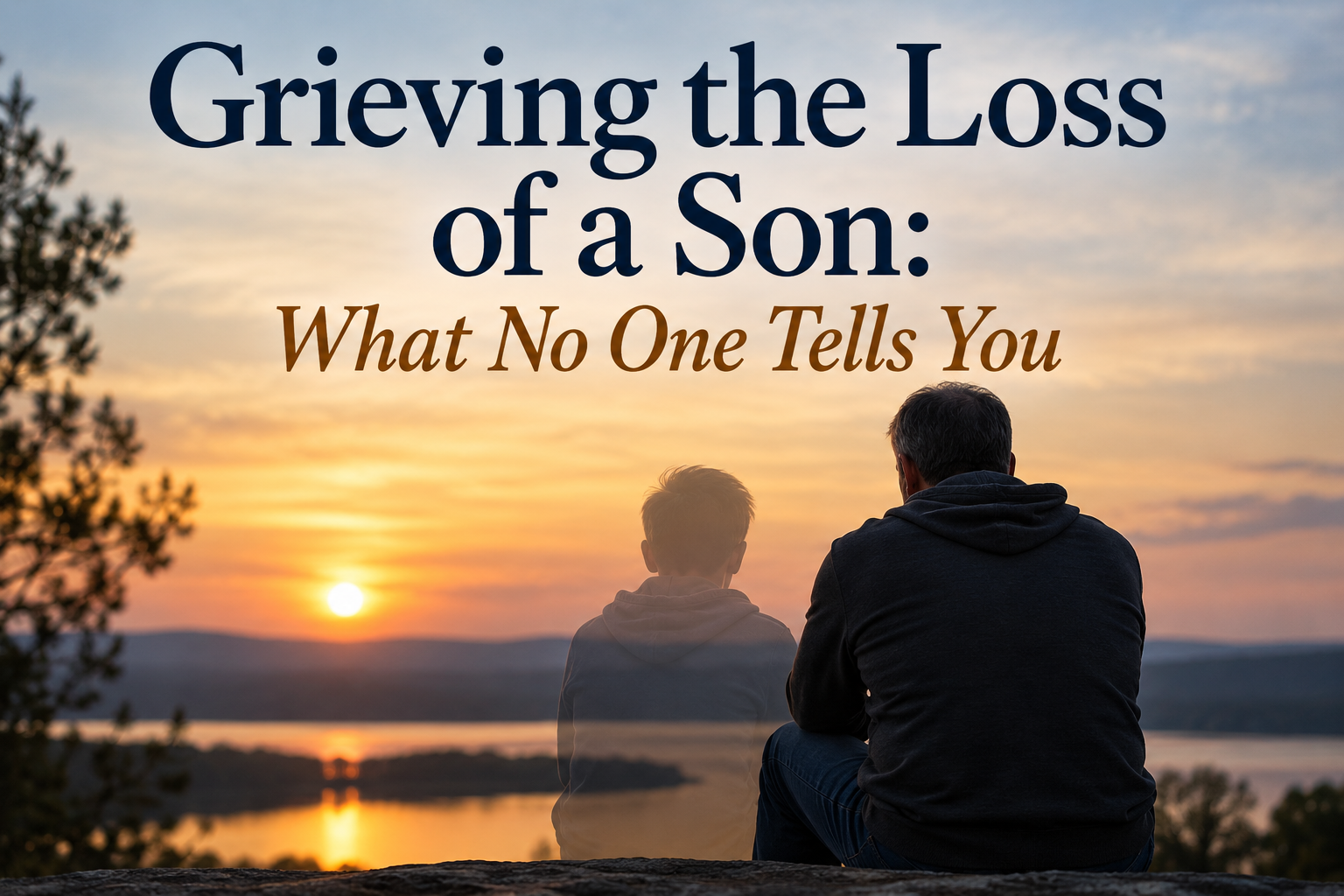
There are losses in life that hurt deeply, and then there are losses that completely change the person you are.
Losing a son is one of those losses.
When your son dies, you don’t simply lose someone you love. You lose a part of your identity, your future, your daily life, and the person you thought you would be for the rest of your life.
You are still his father.
But suddenly, you are a father who cannot call his son.
You cannot hear his voice.
You cannot ask how his day went.
You cannot watch him grow older.
You cannot make new memories together.
And somehow, while your entire world has been shattered, the rest of the world continues moving as though nothing happened.
That may be one of the hardest realities of grieving a son.
People can tell you that grief takes time. They can tell you to remember the good memories. They can tell you your son would want you to be happy.
Some of those words may come from genuine love.
But there are parts of losing a son that people rarely talk about.
These are some of the things no one tells you about grieving the loss of a son.
You Don’t Just Lose Your Son — You Lose the Future You Imagined
When a son dies, parents don’t only grieve the life that ended.
They grieve everything that was supposed to happen next.
You may have imagined watching your son build his career, fall in love, get married, have children, travel, buy a home, or simply grow older.
Maybe you pictured birthdays decades into the future.
Maybe you wondered what he would look like at 30, 40, or 50.
Maybe you imagined sitting together when you were an old man, laughing about everything you had survived together.
Then suddenly, those imagined moments disappear.
This creates a strange form of grief because you find yourself mourning things that never actually happened.
You grieve birthdays that will never come.
You grieve conversations you will never have.
You grieve photographs that will never be taken.
You grieve the older version of your son you will never get to meet.
People may understand that you miss your son.
They don’t always understand that you also miss your future with him.
Being His Father Doesn’t End When He Dies
One of the strangest things about losing a child is that death changes the relationship without ending the love.
Your son is gone, but you are still his father.
That identity doesn’t disappear.
For years, perhaps decades, part of your life revolved around being his dad.
You worried about him.
You protected him.
You celebrated his accomplishments.
You tried to help when he struggled.
You wanted him to have a better life.
Then he dies, and suddenly there is nowhere for all that fatherly instinct to go.
You still want to protect him, but you can’t.
You still want to help him, but you can’t.
You still want to call him and make sure he’s okay.
That may be one of the most painful contradictions of child loss:
The relationship changes, but the love doesn’t.
A father’s love does not have an expiration date.
You don’t stop being your son’s father because he is no longer physically here.
Grief Can Become Harder After Everyone Else Goes Back to Normal
Immediately after a death, there may be phone calls, messages, food, flowers, visits, condolences, and people asking what they can do.
Then time passes.
People return to work.
Friends return to their routines.
The messages become less frequent.
Eventually, people may stop asking altogether.
But your son is still gone.
That is when grief can become incredibly lonely.
The world has moved forward, but part of you may still be standing in the same place.
There is no timetable that says a father should be finished grieving his son after six months, one year, three years, five years, or twenty years.
You learn how to carry the loss differently.
That isn’t the same as leaving it behind.
Small Things Can Hurt More Than the Big Things
You expect birthdays to hurt.
You expect the anniversary of your son’s death to hurt.
You expect holidays to be difficult.
What you may not expect is being devastated by something completely ordinary.
A song comes on.
You see someone who resembles him.
You hear someone say his name.
You find one of his belongings.
You see his favorite food.
You come across an old photograph.
You instinctively think, I need to tell him about this.
And then reality hits again.
He’s gone.
Grief does not always announce itself.
Sometimes it walks quietly into an ordinary Tuesday afternoon and knocks the air out of you.
Years later, that can still happen.
It doesn’t mean you are moving backward.
It means your son mattered.
You May Miss Things You Never Thought You Would Miss
When someone is alive, you don’t realize how precious ordinary things are.
You might miss the sound of your son walking through the house.
His laugh.
His voice from another room.
The way he said your name.
His text messages.
His habits.
His jokes.
Even things that once annoyed you can become memories you would give anything to experience again.
You begin to understand that some of life’s greatest moments weren’t actually the big celebrations.
They were the ordinary moments you assumed would happen again tomorrow.
Your Phone Can Become a Source of Grief
Technology creates an entirely new layer of mourning.
Your son’s name may still be in your contacts.
Old text conversations may remain on your phone.
Voicemails may suddenly become priceless.
Photos you barely noticed when they were taken become treasures.
Social media memories can appear without warning.
You may stare at his phone number knowing you can never call it again.
You may reread messages just to remember what it felt like when your son was on the other side of the conversation.
These digital pieces of someone’s life can provide comfort and heartbreak at the same time.
They are reminders that he was here.
He lived.
He spoke.
He laughed.
He loved.
He mattered.
Fathers Often Learn to Hide Their Grief
Men are frequently taught to be strong during tragedy.
Take care of the family.
Handle the arrangements.
Make decisions.
Be there for everyone else.
Don’t fall apart.
For grieving fathers, that expectation can create enormous loneliness.
People may ask how the mother is doing while assuming the father is managing.
But fathers grieve too.
A father can be completely devastated while appearing calm on the outside.
He can go to work.
Answer questions.
Pay bills.
Talk to people.
Even laugh occasionally.
And still feel like his entire world has collapsed.
Strength isn’t the absence of grief.
Sometimes strength is simply getting through another day while carrying something unimaginably heavy.
You May Question Everything
Child loss can shake the foundations of your life.
You may question fairness.
You may question your purpose.
You may question decisions you made years earlier.
You may even question your faith.
For someone who believes in God, grief can create complicated emotions.
You can believe and still be angry.
You can have faith and still ask why.
You can pray and still feel completely lost.
Faith and grief do not have to be enemies.
Sometimes faith during grief isn’t confidently understanding God’s plan.
Sometimes it is simply whispering:
“God, I don’t understand any of this, but please help me survive today.”
That may be all you have.
And sometimes that is enough for one more day.
Guilt Can Become One of Grief’s Cruelest Companions
Many parents replay the past after losing a child.
What if I had done something differently?
What if I had called?
What if I had noticed something?
What if I had been there?
What if I had said something different the last time we spoke?
The mind desperately searches for a version of the story where the ending changes.
Unfortunately, grief doesn’t give us access to another timeline.
We only have the life that actually happened.
You may spend years thinking about things you wish you had done differently.
But don’t allow the final chapter of your son’s life to erase all the chapters that came before it.
Your relationship was bigger than one moment.
It was built through thousands of moments of love, frustration, laughter, worry, arguments, forgiveness, conversations, and memories.
Remember the whole story.
Happiness Can Make You Feel Guilty
One day something unexpected may happen.
You laugh.
Really laugh.
And for a second, you feel normal.
Then guilt arrives.
How can I laugh when my son is dead?
Later, you may enjoy a meal, take a trip, meet someone new, celebrate an accomplishment, or experience something beautiful.
Again, guilt may whisper that enjoying life somehow means leaving your son behind.
It doesn’t.
Your suffering is not proof of your love.
You do not have to remain miserable forever to demonstrate how much your son meant to you.
There is room in your heart for both.
You can miss your son desperately and still laugh.
You can carry grief and experience joy.
You can wish he were standing beside you while still appreciating the life that remains in front of you.
Moving Forward Does Not Mean Moving On
The phrase “move on” can feel almost insulting after losing a child.
How do you move on from your son?
You don’t.
But you can eventually move forward.
There is an important difference.
Moving on suggests leaving something behind.
Moving forward means carrying your son’s memory with you while continuing to live.
Your son becomes part of the person you are becoming.
His life influences how you treat people.
His memory influences what matters to you.
His love can become part of the reason you continue.
You aren’t walking away from him.
You are learning how to walk while carrying him differently.
People May Avoid Saying Your Son’s Name
Some people worry that mentioning your son will upset you.
They may avoid his name because they don’t want to remind you of your loss.
What they may not understand is that you don’t need reminding.
You already remember.
Every day.
Hearing your son’s name can actually be comforting.
It means someone else remembers that he existed.
Parents who have lost children often fear something deeper than sadness.
They fear their child being forgotten.
Say his name.
Tell his stories.
Share his photographs.
Talk about the ridiculous things he did.
Talk about the things that made you proud.
Death ended his physical life.
It doesn’t have to erase his story.
Grief Changes Your Relationships
Some people you expected to support you may disappear.
Others may surprise you.
Grief has a way of revealing relationships.
Some people are uncomfortable with pain they cannot fix.
Some don’t know what to say.
Some expect you to become your “old self” again.
But after losing your son, the old version of you may no longer exist.
That doesn’t necessarily mean the person you become is worse.
Just different.
You may have less patience for meaningless arguments.
You may value time differently.
You may become more compassionate toward people who are suffering.
You may stop caring about things that once seemed important.
Loss changes your perspective because you have learned, in the hardest possible way, how quickly life can change.
The Second Year Can Sometimes Be Harder
People often focus heavily on the first year.
The first birthday.
The first Thanksgiving.
The first Christmas.
The first anniversary.
But grief doesn’t magically improve when the calendar reaches year two.
For some parents, the second year can be unexpectedly difficult.
During the first year, you may still be in shock.
Later, the permanence of the loss can become clearer.
Your mind begins understanding something your heart still refuses to accept:
He’s really not coming back.
That realization can be devastating.
There is nothing wrong with you if grief remains powerful years later.
There is no deadline.
You Can Survive Something You Thought Would Destroy You
There may have been a time when you thought:
If anything ever happened to my child, I couldn’t survive it.
Then the unthinkable happened.
And somehow you’re still here.
Maybe you don’t feel strong.
Maybe some days simply getting out of bed takes everything you have.
But you are here.
Survival after losing a son isn’t always inspirational.
Sometimes survival looks messy.
Sometimes it means crying in the shower.
Sometimes it means sitting alone remembering him.
Sometimes it means getting through the next hour instead of thinking about the next year.
But every day you continue is another day you have carried something you once believed was impossible to carry.
Your Son Can Still Influence the World
One of the most meaningful ways I have found to think about loss is realizing that someone’s impact doesn’t necessarily end when their life ends.
The love your son gave you changed you.
And when you give that love to someone else, part of his influence continues.
Maybe you help another grieving parent.
Maybe you become more compassionate.
Maybe you tell his story.
Maybe you support something he cared about.
Maybe you simply become kinder because you understand how much hidden pain people can carry.
Those actions matter.
Your son’s life mattered.
And the love between a father and son can continue creating something meaningful even after death.
Healing Doesn’t Mean Forgetting
You may hear people talk about healing.
That word can be difficult because it sounds as though grief is an injury that eventually disappears.
Child loss isn’t quite like that.
Perhaps healing is better understood as learning how to live with the scar.
The scar remains because the love remains.
Over time, you may learn how to carry grief without allowing it to consume every moment.
You may smile when remembering your son instead of crying every time.
Then another day, you may cry again.
Both are okay.
Healing and hurting can exist together.
There Is No Correct Way to Grieve Your Son
Some fathers cry often.
Some rarely cry.
Some need to talk.
Some need silence.
Some visit the cemetery.
Some cannot.
Some keep their son’s room untouched.
Others eventually change it.
Some find comfort in photographs.
Others find photographs painful.
Some become deeply involved in grief communities.
Others grieve privately.
There isn’t one correct path.
Your relationship with your son was unique.
Your grief will be unique too.
Give yourself permission to grieve in the way you need to.
What No One Tells You Most of All
Perhaps the biggest thing nobody tells you is this:
You will never completely stop missing your son.
And you don’t have to.
The goal isn’t to reach a day when he no longer matters.
The goal isn’t to erase the sadness.
The goal isn’t to forget.
The goal is to slowly build a life large enough to hold both the grief and the love.
Because underneath all of this pain is something incredibly powerful.
Love.
You hurt because you loved your son.
You miss him because his presence mattered.
You grieve because the relationship was real.
Death can take away someone’s physical presence.
It cannot rewrite the years you shared.
It cannot erase the memories.
And it cannot change one fundamental truth:
He will always be your son, and you will always be his father.
Keep Saying His Name
If you’ve lost a son, there may be days when simply continuing feels impossible.
On those days, don’t worry about the rest of your life.
Get through today.
If today feels too large, get through this hour.
Remember him.
Talk about him.
Write about him.
Look at his pictures.
Tell his stories.
Say his name.
And when you’re able, keep living.
Not because you’ve stopped grieving.
Not because you’ve moved on.
Not because you’ve forgotten him.
But because the love you shared deserves to continue shaping the life you still have.
Your son’s story did not become meaningless when he died.
And neither did yours.
You are still here.
You are still his father.
You are still carrying his love.
And sometimes, carrying that love forward is the bravest thing a grieving father can do.
If you have lost a son, what is one thing you wish other people understood about your grief?



Leave a Reply