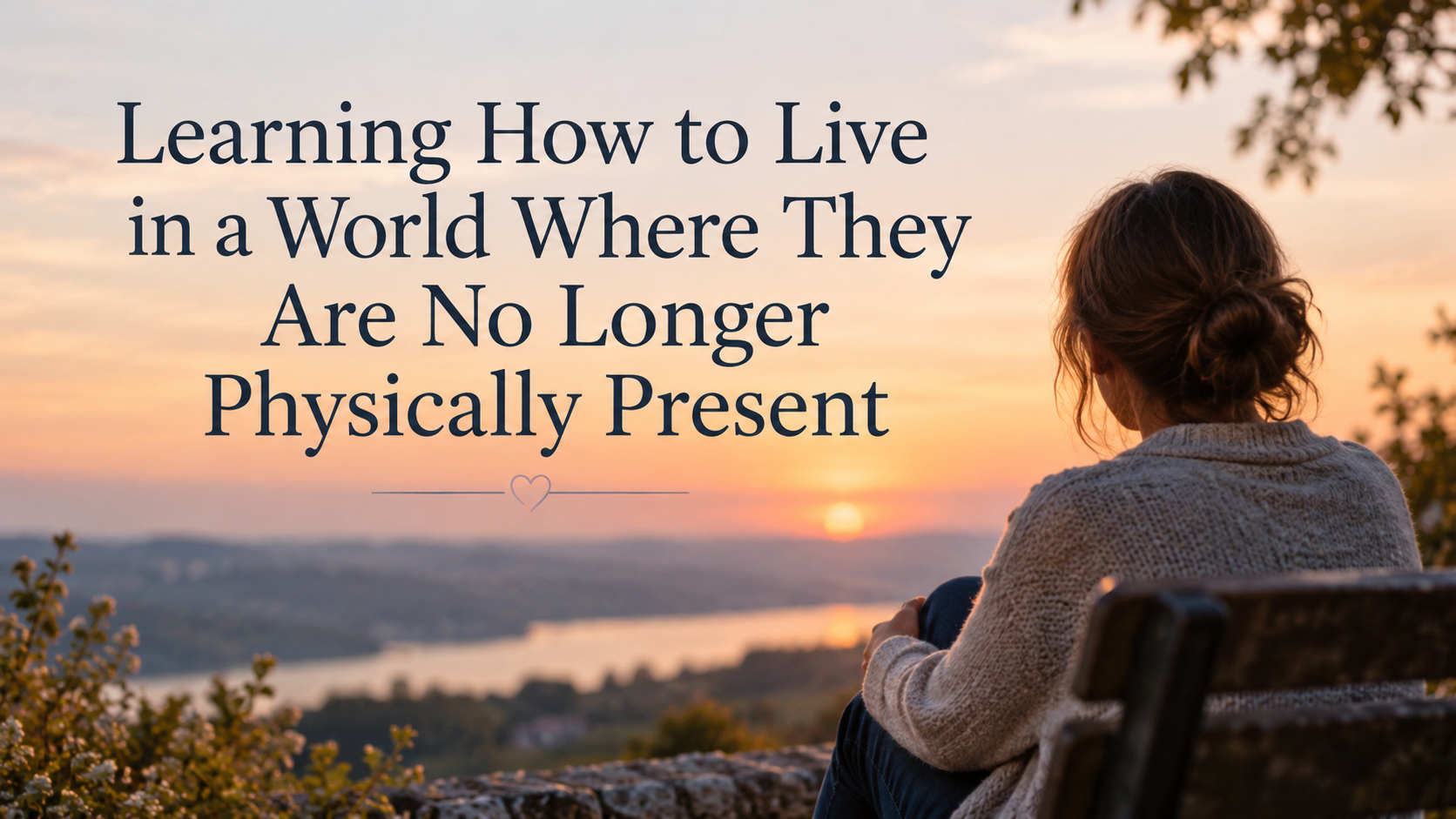
There is a kind of pain that comes from losing someone you love that words will never fully explain. It is not simply the sadness of missing them. It is the overwhelming realization that you must somehow continue living in a world where they are no longer physically present.
The world looks the same, but nothing feels the same.
The sun still rises. People still go to work. Families gather around dinner tables. Holidays come and go. Life continues moving forward, seemingly unaware that your entire world has changed.
But for you, something is missing from every single day.
There is a voice you can no longer hear, a face you can no longer see in person, a hand you can no longer hold, and a presence you would give anything to experience just one more time.
And somehow, you are expected to learn how to live with that absence.
The truth is that learning to live without someone’s physical presence does not mean learning to live without loving them. It means discovering how to carry that love through a life that looks nothing like the one you imagined.
When the World Continues but Your Heart Stands Still
One of the hardest parts of grief is watching the world continue as though nothing has happened.
People laugh. They make plans. They celebrate birthdays, weddings, graduations, and holidays. They talk about tomorrow without thinking twice about who will be there.
Meanwhile, you are trying to understand how tomorrow can even exist without someone who was supposed to be part of it.
You may find yourself looking at an empty chair, staring at an old photograph, or reaching for your phone before remembering there is no longer anyone on the other end to answer.
These moments can bring a wave of grief so powerful that it feels as though the loss has happened all over again.
And perhaps one of the most painful realizations is that the world did not stop when yours fell apart.
But grief does not follow the world’s schedule.
You may need more time than others understand. You may still struggle years after people assume you should have adjusted. You may have days when simply getting out of bed feels like an accomplishment.
That does not mean you are failing at life.
It means you are learning to live with an absence that matters deeply.
The Pain of All the Moments That Will Never Happen
When someone dies, we grieve more than the moments we shared with them.
We also grieve the future we believed we would have.
We grieve the conversations that will never take place, the milestones they will never physically attend, and the memories we will never have the opportunity to create together.
For a parent who has lost a child, this pain can be especially devastating.
A parent is not supposed to imagine a future without their child. They imagine watching their child grow older, accomplish dreams, experience love, and discover everything life has to offer.
When that future disappears, the grief extends far beyond the day of their death.
It reaches into every tomorrow.
You may wonder what your child would look like today, what kind of person they would have become, or what they would think about the person you are becoming.
You may imagine conversations you wish you could have or moments you wish they could witness.
There is no simple way to make peace with a future that was taken away.
But you can slowly learn to recognize that the love you have for them still belongs in the future you are living.
Their physical journey may have ended, but the influence of their life continues through yours.
Learning to Accept What Your Heart Cannot Understand
Acceptance is one of the most misunderstood parts of grief.
People sometimes speak about acceptance as though it means reaching a point where the loss no longer hurts.
But accepting someone’s death does not mean believing it was fair, finding a reason for it, or becoming comfortable with their absence.
Sometimes acceptance simply means acknowledging a reality you desperately wish were different.
It means waking up each morning knowing they are not coming home, even though a part of your heart may still long for that impossible moment.
It means learning to make decisions without being able to ask for their advice.
It means celebrating meaningful occasions while feeling the weight of the person who should be there.
And it means understanding that you can acknowledge the reality of their death while continuing to love and miss them.
You do not have to approve of what happened to begin living again.
You do not have to stop wishing things were different.
Acceptance is not the end of love or longing. It is learning how to live alongside a truth you never wanted to face.
Finding Them in the Little Things
As time passes, you may begin noticing how deeply someone’s presence remains woven into your everyday life.
A familiar song might bring back a memory.
A favorite meal might remind you of a conversation.
A particular place might make you smile before the sadness arrives.
You may hear a familiar expression and immediately remember the way they used to say it.
Sometimes these reminders hurt. Other times they bring unexpected comfort.
Both reactions are natural.
There may come a day when you can remember something funny they did and laugh without immediately feeling guilty.
There may be moments when a memory brings warmth instead of only tears.
And there may still be days when the smallest reminder breaks your heart.
None of these experiences cancels out the others.
The memories you carry are evidence of a relationship that mattered.
You are allowed to hold on to those memories, speak their name, tell their stories, and keep their place in your life.
Their absence does not require you to erase their presence from your heart.
The Loneliness of Missing Someone No One Can Replace
One of the loneliest parts of grief is realizing that no matter how many people surround you, the one person you desperately want is still missing.
You can sit in a crowded room and feel completely alone.
You can attend family gatherings and feel the absence of the person who should be sitting beside you.
You can receive kindness, support, and encouragement while still wishing for the comfort of one particular voice.
This loneliness is not always about having nobody around.
Sometimes it is about missing somebody specific.
And that person cannot simply be replaced.
Friends may encourage you to meet new people, develop hobbies, or stay busy. Those things can be helpful, but they cannot fill every space left behind by someone you loved.
You may build new relationships and create new memories, but that does not mean the old ones become less important.
Love is not a position that someone else can simply take over.
Every meaningful relationship has its own place in our lives.
And when someone dies, that place may remain uniquely theirs.
Giving Yourself Permission to Experience Happiness Again
For many grieving people, happiness can bring unexpected guilt.
You might laugh at something and suddenly wonder whether you should be laughing.
You might enjoy a beautiful day and feel guilty because the person you love is no longer here to experience it.
You might begin looking forward to something, only to feel as though you are leaving them behind.
These feelings can be particularly difficult for parents grieving a child.
When your child is no longer physically present, moving forward can sometimes feel like moving away from them.
But living does not mean forgetting.
Smiling does not mean you miss them less.
Finding happiness does not mean their death has become acceptable.
You can experience moments of joy while still carrying tremendous sorrow.
You can build a meaningful life while wishing with all your heart that they were still part of it.
You can laugh today and cry tomorrow without either emotion making the other less real.
You are not betraying their memory by allowing yourself to experience life.
You are continuing a life that has been forever shaped by loving them.
Learning to Carry Love Differently
When someone is physically present, love often expresses itself through everyday actions.
We call them, hug them, spend time together, share meals, celebrate accomplishments, and support them through difficult moments.
After death, those familiar ways of expressing love are no longer available.
But the love itself does not have to disappear.
It can take different forms.
You might honor their birthday, continue a tradition they enjoyed, support a cause that mattered to them, or help someone going through a difficult experience.
You might write letters to them, speak their name aloud, or share stories so others can understand who they were.
You might find comfort in prayer, quiet reflection, or visiting a place that holds special memories.
Some people create memorials. Others find meaning in acts of kindness.
There is no single correct way to maintain a connection with someone who has died.
What matters is finding ways that feel meaningful to you.
You are not required to put their memory away in order to move forward.
Sometimes carrying their memory is what gives you the strength to take another step.
When Grief Returns Without Warning
Even after years have passed, grief can arrive unexpectedly.
You may be having a relatively peaceful day when a song, photograph, smell, or passing thought brings everything rushing back.
Suddenly, the absence feels as painful as it did in the beginning.
You may wonder why you are still struggling or why certain memories continue to affect you so deeply.
But grief is not a straight road with a clear finish line.
There may be long periods when life feels manageable, followed by moments when the sadness becomes overwhelming again.
Anniversaries, birthdays, holidays, and major life changes can bring renewed grief.
Sometimes there is no obvious reason at all.
When these moments happen, try not to judge yourself.
Allow yourself to feel what you feel.
Cry if you need to. Rest if you are exhausted. Reach out to someone who understands if you need support.
And remember that experiencing grief again does not erase the progress you have made.
You are not starting over every time you miss them.
You are continuing to navigate a life in which their absence will always matter.
Building a Life That Still Honors Them
One of the most difficult questions after losing someone is, “How am I supposed to keep living without them?”
There may not be an answer that immediately makes sense.
In the beginning, survival may be all you can manage.
Getting through the morning, eating a meal, taking a shower, or making it through another night may require tremendous effort.
Over time, you may begin discovering small reasons to keep going.
Perhaps you want to honor their memory.
Perhaps you want to help someone else who understands this kind of pain.
Perhaps you want to continue something meaningful that you shared together.
Or perhaps you simply want to see what tomorrow might bring.
Your reason does not have to be extraordinary.
And you do not have to transform your grief into a mission or accomplishment to prove that their life mattered.
Their life already mattered.
Your love already mattered.
Sometimes honoring someone means doing something meaningful in their name.
Other times it means allowing yourself to live an ordinary day, even when you miss them.
Both can be acts of love.
You Are Still Connected to the Person You Were Before the Loss
Grief changes people.
It can change how you see the world, what you value, whom you trust, and what you believe matters most.
You may no longer recognize the person you were before your loved one died.
You may feel less interested in things that once excited you or more sensitive to situations that previously seemed unimportant.
You may find yourself questioning your identity and your purpose.
For parents who have lost a child, this struggle can reach into the very meaning of being a mother or father.
But death does not erase parenthood.
A father remains a father even when his child is no longer physically here.
A mother remains a mother even when she can no longer hold her child.
The relationship has changed in ways no parent should have to experience, but the love and the meaning of that relationship remain.
You do not have to become the person you were before the loss.
You can discover who you are now while continuing to honor the person you have always been.
Taking Life One Day at a Time
Learning to live in a world without someone you love can feel impossible when you think about all the years ahead.
The thought of another birthday, another Christmas, another anniversary, or another ordinary Tuesday without them can be overwhelming.
Sometimes the future is simply too much to carry all at once.
That is when taking life one day at a time becomes more than a comforting phrase.
It becomes a way of surviving.
You do not have to figure out the rest of your life today.
You do not have to know how you will handle every holiday or milestone.
You do not have to understand how you will feel five or ten years from now.
You only need to focus on the part of life directly in front of you.
Some days that may mean making plans and finding reasons to smile.
Other days it may mean resting, crying, and giving yourself permission to struggle.
Both kinds of days belong to the process of living with loss.
And on the days when even one day feels too overwhelming, you can take things one hour or one moment at a time.
Their Physical Presence Is Gone, but Their Life Still Matters
Perhaps one of the most important things to understand about grief is that someone’s death does not erase the significance of their life.
The years you shared still happened.
The love you experienced was real.
The memories you created remain part of your story.
The lessons they taught you, the laughter you shared, and the ways they changed your life continue to have meaning.
There will never be another person exactly like them.
And you do not have to pretend otherwise.
You can continue speaking about them.
You can remember the sound of their laughter.
You can tell people what made them special.
You can acknowledge the tremendous sadness of their absence while remaining grateful for the love you shared.
Their story does not have to disappear simply because their physical life has ended.
It continues through the people who remember them and the ways their lives touched others.
Final Thoughts: Learning to Live Without Leaving Them Behind
Learning how to live in a world where someone you love is no longer physically present may be one of the hardest journeys you will ever face.
There is no instruction manual that can prepare you for the empty spaces, the unanswered questions, or the ordinary moments when their absence becomes almost unbearable.
There is no perfect timeline for adjusting to a reality you never wanted.
And there is no requirement that you eventually reach a place where you no longer miss them.
You may carry that longing for the rest of your life.
But you may also discover that your heart has room for both grief and hope.
You may find yourself smiling at memories that once brought only tears.
You may discover new friendships, new experiences, and new reasons to get out of bed.
You may slowly learn that continuing to live does not mean abandoning the person you love.
It means carrying their memory into the days they cannot physically share with you.
And perhaps that is one of the most meaningful ways love continues after death.
Not because the pain disappears.
Not because life returns to what it once was.
But because the love remains part of who you are.
You will always wish they were here. You will always wonder what life would look like if they had stayed. And there may always be moments when you would give anything for one more conversation, one more embrace, or one more ordinary day together.
But you are still here.
Your story is still unfolding.
And even though you must now walk through a world where they are no longer physically beside you, you can carry everything their love meant to you into whatever comes next.
You do not have to leave them behind to keep moving forward.
You can miss them, love them, remember them, honor them, and continue living.
Because learning to live without their physical presence is not about learning to love them less.
It is about learning how to keep living with all the love that remains.
And for those of us who have lost someone who meant everything, that love will always be part of our story.
What has been the hardest part of learning to live in a world where your loved one is no longer physically present, and what helps you feel connected to them today?


Leave a Reply