
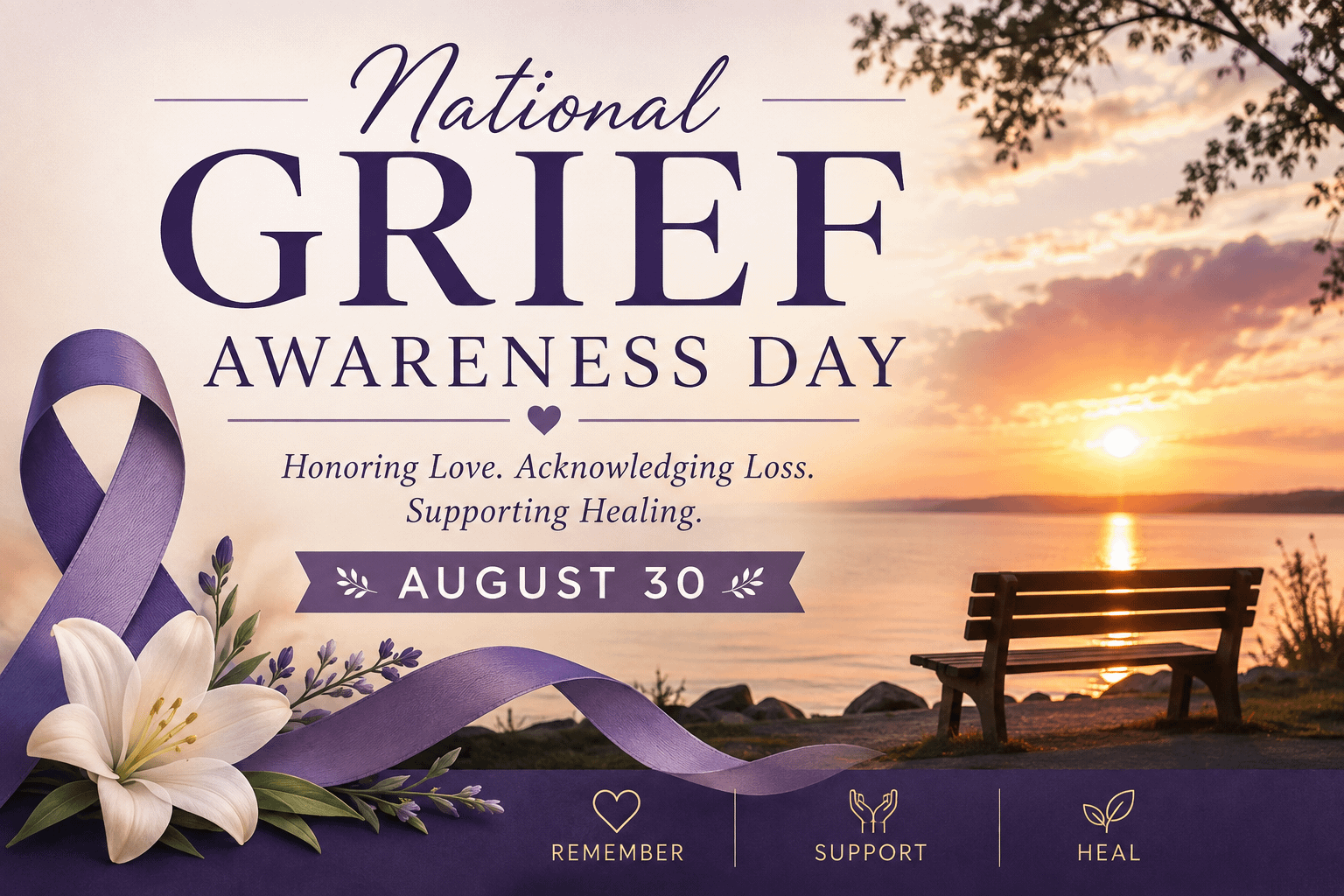
Every year on August 30, National Grief Awareness Day encourages us to recognize one of the most universal—and deeply personal—human experiences: grief.
Nearly everyone will encounter grief at some point in life, yet it remains something many people find difficult to discuss openly. We often know what to say when someone celebrates a birthday, gets married, welcomes a child, receives a promotion, or reaches an important milestone. When someone experiences a devastating loss, however, words can suddenly become much harder to find.
Sometimes people become uncomfortable around grief because they don’t know what to say.
Sometimes they avoid mentioning the person who died because they worry they will make the grieving person sad.
Sometimes they assume enough time has passed and the grieving person should be doing better.
National Grief Awareness Day challenges those assumptions.
It reminds us that grief does not have an expiration date.
It reminds us that people experience loss differently.
And perhaps most importantly, it reminds grieving people that they should never feel ashamed for continuing to miss someone they deeply loved.
Grief isn’t something that can simply be switched off.
When someone becomes part of your heart, their absence can remain meaningful for the rest of your life.
National Grief Awareness Day gives us permission to talk about that reality.
What Is National Grief Awareness Day?
National Grief Awareness Day is observed annually on August 30.
The observance was founded in 2014 by grief-awareness advocate Angie Cartwright to increase understanding surrounding grief and encourage greater support for people experiencing loss.
The purpose extends beyond simply recognizing that grief exists.
National Grief Awareness Day encourages society to become more comfortable talking about death, loss, remembrance, mourning, and emotional healing.
It also helps challenge one of the most persistent myths surrounding grief:
There is a correct way to grieve.
There isn’t.
Some people cry openly.
Others rarely cry around anyone.
Some want to talk about the person they lost every day.
Others find those conversations overwhelming, especially early in their grief.
Some immediately surround themselves with friends and relatives.
Others need periods of solitude.
Some return to work quickly because routine helps them cope.
Others struggle to concentrate on even basic responsibilities.
One response isn’t necessarily healthier or more loving than another.
Grief is deeply individual because relationships are deeply individual.
Understanding What Grief Really Is
Grief is often described simply as sadness following someone’s death.
But grief is much more complicated than sadness.
It can involve sadness, anger, confusion, guilt, loneliness, fear, exhaustion, numbness, anxiety, relief, gratitude, regret, love, disbelief, and countless other emotions.
Sometimes several of those emotions appear during the same day.
There can even be moments of laughter.
That doesn’t mean someone has stopped grieving.
Human emotions are complicated enough to allow joy and sorrow to exist simultaneously.
A grieving person can laugh at dinner and cry on the drive home.
They can enjoy someone’s wedding while wishing another person were standing beside them.
They can have an incredible vacation and still experience a sudden moment when they desperately miss the person they lost.
Grief isn’t always visible.
And that is one reason awareness matters.
There Is No Timeline for Grief
One of the most important messages of National Grief Awareness Day is that grief does not operate according to a schedule.
There is no universal point when someone should be “over it.”
A few weeks isn’t enough.
A few months isn’t necessarily enough.
A year doesn’t automatically change everything.
Even decades later, certain memories may carry powerful emotions.
The intensity and frequency of grief often change over time, but love and remembrance can remain.
Someone might go weeks or months feeling relatively stable and suddenly hear a song that brings everything rushing back.
A photograph can do it.
A familiar scent can do it.
Driving past a restaurant can do it.
Watching an old television show can do it.
Finding an old voicemail can do it.
Seeing someone’s favorite food in the grocery store can do it.
Sometimes the smallest things create the biggest waves.
That doesn’t mean healing has failed.
It means memory is powerful.
Grief Doesn’t Always Move in a Straight Line
People sometimes imagine grief as a road.
You begin devastated, gradually improve, and eventually reach the end.
Real grief rarely works that neatly.
There can be good days followed by terrible ones.
There can be months of progress followed by an anniversary that feels almost unbearable.
There can be moments when you believe you’re finally adjusting, followed by an unexpected reminder that makes the loss feel painfully fresh.
Healing can look like:
two steps forward, one step backward, three steps forward, another difficult day, and then continuing again.
The difficult days don’t erase the progress.
They are part of the journey.
The Difference Between Moving Forward and Moving On
The phrase “move on” can be incredibly painful for someone who has experienced a significant loss.
Moving on can sound like leaving someone behind.
For many grieving people, that isn’t what they want.
They want to continue living while carrying their loved one’s memory with them.
A better idea may be moving forward.
Moving forward doesn’t mean forgetting.
It doesn’t mean the relationship suddenly becomes unimportant.
It doesn’t mean photographs have to disappear.
It doesn’t mean traditions must end.
It doesn’t mean someone’s name should stop being spoken.
Moving forward means gradually learning how to participate in life again while acknowledging that someone important will always be missing.
You can move forward with their memory, not away from it.
Grief Is Love With Nowhere Familiar to Go
Part of what makes grief so powerful is that love doesn’t automatically disappear when someone dies.
You may still instinctively want to call them.
You may still think about something you want to tell them.
You may still see something funny and immediately imagine their reaction.
For a brief second, your mind may follow the old routine.
Then reality returns.
That is one of grief’s cruelest moments.
The relationship has changed, but the love remains.
That love may eventually find new expressions through remembrance, storytelling, traditions, charitable acts, family gatherings, creative projects, or helping other people.
Grief changes.
Love continues.
Grieving the Future That Never Happened
Grief isn’t limited to memories from the past.
Sometimes people grieve the future just as deeply.
When someone dies, countless imagined moments disappear with them.
A parent may imagine graduations, careers, weddings, grandchildren, vacations, birthdays, holidays, and ordinary Sunday dinners that will never happen.
A spouse may mourn retirement plans.
A child may mourn conversations they expected to have with a parent later in life.
A sibling may mourn growing old together.
This is sometimes called secondary loss—the many additional losses that follow the primary loss.
You’re not only grieving the person.
You may also be grieving everything you expected to experience together.
When Everyone Else Returns to Normal
One of the loneliest periods of grief can begin after the initial wave of support disappears.
Immediately after someone dies, there may be phone calls, messages, flowers, meals, visits, cards, and offers of help.
Then the funeral ends.
Days pass.
Weeks pass.
People return to work.
Families resume their routines.
Life moves forward.
For the grieving person, however, the reality of the loss may only be beginning to settle in.
The house may feel different.
The phone may be quieter.
There may be fewer people checking in.
That’s why grief support shouldn’t disappear after the funeral.
Sometimes the person needs support even more several months later.
The Empty Chair
Grief often becomes particularly noticeable during celebrations.
There can be an invisible presence at the dinner table:
the empty chair.
Thanksgiving arrives.
Christmas arrives.
Birthdays arrive.
Weddings happen.
Graduations happen.
Family reunions happen.
People laugh, eat, exchange gifts, take photographs, and create new memories.
And somewhere inside the celebration is the awareness that someone is missing.
That doesn’t mean the grieving person isn’t grateful for everyone who is there.
It means they can appreciate the people present while simultaneously missing the person who isn’t.
Both emotions can exist together.
Remembering Grieving Parents
Few losses challenge the expected order of life as profoundly as the death of a child.
Parents naturally imagine watching their children grow older.
They imagine birthdays, graduations, careers, relationships, weddings, families, holidays, and countless ordinary moments.
When a child dies, parents may grieve both the life their child lived and the future their child should have experienced.
There may forever be questions beginning with:
“What would they be doing today?”
What would their career have become?
Where would they live?
Would they be married?
Would they have children?
What would they look like now?
These questions can continue years after the death.
A parent’s grief doesn’t disappear simply because time passes.
The relationship continues through memory, love, storytelling, traditions, photographs, and the impact the child had on their parent’s life.
Say Their Name
One of the greatest gifts you can give someone who is grieving is surprisingly simple:
Say the name of the person they lost.
People sometimes avoid doing this because they’re afraid it will make the grieving person sad.
But mentioning someone’s name doesn’t create the grief.
The grief is already there.
For many people, hearing someone else remember their loved one can be comforting.
It says:
They mattered.
They are remembered.
Their life hasn’t been forgotten.
Ask about them.
Share memories.
Tell stories.
Remember birthdays.
Remember anniversaries.
A person’s life should not become a forbidden subject simply because they died.
The Power of Stories
Stories keep people present in powerful ways.
Tell the funny stories.
Tell the embarrassing stories.
Tell the stories about their kindness.
Talk about the things they loved.
Talk about their favorite foods.
Their favorite songs.
Their personality.
Their habits.
Their jokes.
Their dreams.
Their accomplishments.
Their imperfections.
Their life was more than the moment it ended.
Remembering the complete person can be an important part of grief.
When a Photograph Becomes Priceless
Before loss, photographs can feel ordinary.
After loss, they can become treasures.
A random picture taken during dinner may suddenly mean everything.
A blurry photograph might become someone’s favorite because it captures a smile they desperately miss.
Old videos become opportunities to hear someone’s voice again.
Voicemails become priceless.
Text-message conversations become pieces of history.
Objects that once seemed ordinary—a shirt, handwritten note, coffee mug, birthday card, recipe, hat, book, or piece of jewelry—can carry enormous emotional meaning.
Grief changes the value of things.
Their monetary value may be insignificant.
Their emotional value can become immeasurable.
Grief Can Change Friendships
Loss can reveal unexpected truths about relationships.
Some people you expected to remain close may disappear because they don’t know how to handle grief.
Others may surprise you by staying beside you through incredibly difficult moments.
Some friendships grow stronger.
Others fade.
New friendships sometimes develop with people who understand loss in ways others cannot.
This can be another painful secondary loss.
The grieving person may already be coping with someone’s death while simultaneously experiencing changes in friendships, routines, identity, and community.
Understanding this can help us become more patient and compassionate.
Grief Can Change Who You Are
Significant loss can change a person’s priorities.
Things that once seemed incredibly important may suddenly feel meaningless.
Small moments may become more valuable.
Relationships may become more important.
Time may feel more precious.
Some people become quieter.
Some become more compassionate.
Some develop a stronger desire to help others.
Some begin pursuing dreams they previously postponed.
Others simply learn to appreciate ordinary days differently.
Loss can divide life into two distinct periods:
before and after.
The goal isn’t necessarily to become the exact person you were before the loss.
Sometimes healing means discovering who you are now.
Supporting Someone Who Is Grieving
You don’t need special training to show compassion to someone experiencing grief.
You need willingness.
Listen.
Be patient.
Show up.
Don’t rush their emotions.
Don’t compare their grief to someone else’s.
Don’t pressure them to stop talking about the person they lost.
Remember important dates.
Send a message months later.
Invite them somewhere while giving them permission to decline.
Offer specific assistance rather than simply saying, “Let me know if you need anything.”
Sometimes practical kindness can mean a great deal:
bringing dinner, helping with errands, sitting quietly together, making a phone call, walking the dog, helping around the house, or simply having coffee.
You don’t need to fix their grief.
You couldn’t even if you tried.
You can simply make sure they aren’t completely alone in it.
What Not to Say
People usually mean well when they offer comforting words, but certain phrases can unintentionally minimize someone’s pain.
Avoid telling someone:
“Everything happens for a reason.”
“They’re in a better place.”
“You have to stay strong.”
“At least you still have…”
“You need to move on.”
“It’s been a long time.”
“I know exactly how you feel.”
Even if some of these statements reflect personal beliefs, they may not provide comfort at that particular moment.
Often simpler words are more meaningful:
“I’m thinking about you.”
“I miss them too.”
“I remember when…”
“I’m here if you want to talk.”
“You don’t have to pretend you’re okay with me.”
Compassion doesn’t require perfect words.
Presence is often enough.
The Courage to Experience Happiness Again
Grief can create guilt when happiness begins returning.
A grieving person may laugh and suddenly think:
How can I laugh when they’re gone?
They may take a vacation and feel guilty for enjoying themselves.
They may fall in love again and wonder whether they’re betraying someone.
They may celebrate a milestone and feel uncomfortable experiencing happiness.
But joy doesn’t erase love.
Laughing doesn’t mean forgetting.
Living doesn’t mean abandoning the person who died.
Continuing your life can be one way of honoring the love and lessons they gave you.
You Can Carry Joy and Grief Together
Eventually many grieving people discover that life doesn’t have to be exclusively sad or exclusively happy.
It can be both.
You can miss someone terribly and have a wonderful day.
You can cry in the morning and laugh that afternoon.
You can honor the past while building a future.
You can feel grateful for your life while wishing desperately that someone were still part of it.
Human hearts are capable of carrying seemingly contradictory emotions.
That isn’t confusion.
That is grief.
Finding Meaning After Loss
Not every loss needs to produce a lesson.
No one should feel pressured to turn tragedy into something positive.
But some people eventually find meaning through the ways they choose to live afterward.
They may volunteer.
Start a scholarship.
Donate to charity.
Create a memorial.
Plant a tree.
Write.
Speak publicly.
Join a support group.
Help another grieving parent.
Share their experiences.
Advocate for awareness.
Or simply become kinder because they understand how much invisible pain people can carry.
Meaning doesn’t erase grief.
It can simply give love somewhere new to go.
How to Observe National Grief Awareness Day
There is no single correct way to recognize August 30.
You might:
- Reach out to someone who has experienced a loss.
- Share a favorite memory of someone who died.
- Say their name.
- Light a candle in remembrance.
- Visit a meaningful location.
- Look through photographs.
- Listen to their favorite music.
- Cook their favorite meal.
- Write them a letter.
- Donate to an organization in their memory.
- Support a grief-related charity or community.
- Learn more about how grief affects people differently.
- Give someone permission to talk without trying to solve their pain.
- Share grief-awareness information so others feel less alone.
And if you are grieving yourself, you don’t have to do anything publicly.
You can simply remember.
Sometimes that is enough.
Give Yourself Permission to Have Difficult Days
Grieving people often put enormous pressure on themselves.
They believe they should be stronger.
They should cry less.
They should be more productive.
They should have adjusted by now.
National Grief Awareness Day offers another message:
Give yourself grace.
Some days will be easier than others.
Some days getting through the day is enough.
You don’t have to prove your strength by pretending you aren’t hurting.
Strength and sadness can exist together.
Give Yourself Permission to Have Good Days Too
Just as you are allowed to have difficult days, you are also allowed to have good ones.
Enjoy them.
Laugh.
Travel.
Celebrate.
Fall in love.
Make friends.
Try something new.
Build new traditions.
Create new memories.
Dream again.
None of those things erase the person you lost.
Your future does not have to compete with your past.
There is room for both.
Grief Has No Expiration Date
Perhaps one of the most important lessons of National Grief Awareness Day is this:
There is no deadline for missing someone.
A year may pass.
Five years may pass.
Ten years may pass.
Twenty years may pass.
Love doesn’t consult a calendar.
Someone may become better at carrying grief, but that doesn’t mean they stop loving or remembering.
Certain dates may always matter.
Certain songs may always hurt.
Certain photographs may always bring tears.
Certain memories may always make you smile.
And that’s okay.
Their Life Was Bigger Than Their Death
When someone dies, it can sometimes feel as though the tragedy becomes the defining part of their story.
But their life was bigger than the day they died.
Remember how they lived.
Remember what made them laugh.
Remember the things they loved.
Remember their kindness.
Remember their stubbornness.
Remember their humor.
Remember the ordinary moments.
Remember the adventures.
Remember the conversations.
Remember the person.
A life should be remembered for everything that happened between the beginning and the end.
Turning Awareness Into Compassion
National Grief Awareness Day shouldn’t only be about sharing a message on August 30.
Its lessons can influence how we treat grieving people throughout the year.
Remember the widow six months later.
Remember the grieving father years later.
Remember the mother on her child’s birthday.
Remember the person approaching the anniversary of a sibling’s death.
Remember the friend spending their first Christmas without someone they loved.
Check in.
Send the message.
Make the phone call.
Speak the name.
Sometimes a few minutes of compassion can make an incredibly lonely day feel a little less lonely.
For Anyone Grieving Today
If National Grief Awareness Day brings someone to your mind, allow yourself to remember them.
Remember their voice.
Their smile.
Their personality.
Their laugh.
Their kindness.
Their quirks.
Their favorite things.
The ordinary moments you never realized would someday become extraordinary memories.
You don’t have to stop loving someone because they died.
You don’t have to erase their memory to continue living.
And you don’t have to choose between remembering them and building a future.
You can do both.
You can carry their memory into whatever comes next.
Final Thoughts: Love Continues
National Grief Awareness Day on August 30 is ultimately about more than grief.
It is about love.
Because behind profound grief is usually a relationship that mattered.
Someone existed.
Someone was loved.
Someone changed another person’s life.
And their absence matters because their presence mattered first.
Grief may change over time.
The tears may come less frequently.
The sharpest edges may soften.
New experiences may enter your life.
You may discover reasons to smile again.
You may build new relationships, create new memories, and begin dreaming about the future.
None of that requires forgetting the past.
The people we lose become woven into our stories.
We carry their lessons.
We carry their memories.
We carry the ways they changed us.
We carry their love.
So this National Grief Awareness Day, remember those who are grieving.
Reach out to someone who may be hurting quietly.
Speak the names of those who are deeply missed.
Listen without judgment.
Offer compassion without deadlines.
And remember:
Grief is not a sign that someone has failed to move forward.
Sometimes grief is simply love continuing after loss.
And although life may never return to exactly what it was before, it can slowly become meaningful again—not because the person who died has been forgotten, but because their love becomes part of the strength we carry into tomorrow.
Leave a ReplyCancel reply