Category: Grief & Child Loss

  • What Happens to a Father’s Heart When He Loses a Child?

    What Happens to a Father’s Heart When He Loses a Child?

    Advertisements

    There are pains in life that words struggle to describe. Losing a job, ending a marriage, facing illness, or saying goodbye to loved ones all leave scars. But for many fathers, there is one wound that stands above all others—the loss of a child.

    When a father loses a child, something profound happens deep within his heart. It is not simply sadness. It is not merely grief. It is the shattering of a future, the breaking of dreams, and the loss of a piece of himself that can never be replaced.

    The world often sees fathers as strong, steady, and resilient. Society teaches men to protect, provide, and remain composed through hardship. Yet when a child dies, even the strongest father finds himself facing a pain that no amount of strength can prevent.

    A Piece of His Heart Leaves With Them

    Many fathers describe losing a child as feeling like a piece of their heart has been torn away.

    From the moment a child is born, a father’s life becomes connected to theirs. Every smile, every accomplishment, every struggle becomes part of his own journey. He watches them grow, dreams about their future, and imagines milestones yet to come.

    When that child dies, those dreams die too.

    The graduation that will never happen.

    The wedding he will never attend.

    The grandchildren he may never hold.

    The phone calls that will never come.

    The future he imagined disappears in an instant.

    What remains is a deep ache that settles into the heart and stays there.

    The Heart Becomes Heavy

    Many grieving fathers carry an invisible weight.

    They may continue working.

    They may continue paying bills.

    They may continue smiling for others.

    But inside, their hearts feel heavy every single day.

    Simple things become difficult.

    Getting out of bed requires effort.

    Conversations feel exhausting.

    Activities once enjoyed lose their meaning.

    The world keeps moving forward while the father feels frozen in the moment everything changed.

    People often assume that because a father is functioning, he must be healing. In reality, many fathers are simply surviving.

    The Protector Feels Helpless

    One of the deepest wounds a father experiences after losing a child comes from feeling unable to protect them.

    Fathers naturally want to shield their children from harm. Whether their child is five years old or fifty, that instinct never truly disappears.

    When a child dies, many fathers wrestle with questions that have no answers:

    “Could I have done something differently?”

    “Should I have seen the warning signs?”

    “Why wasn’t I able to save them?”

    Even when the death was completely beyond their control, fathers often carry guilt.

    Their minds replay events repeatedly, searching for a way they could have changed the outcome.

    This burden can become one of the most painful parts of grief.

    The Heart Learns a New Kind of Loneliness

    Child loss creates a loneliness unlike any other.

    Friends may offer support initially, but life eventually moves on for everyone else.

    The father remains.

    Birthdays still arrive.

    Holidays still come.

    Memories still surface unexpectedly.

    Meanwhile, fewer people mention the child’s name.

    Many fathers begin to feel isolated in their grief.

    Some stop talking about their pain because they fear burdening others.

    Some withdraw because they feel no one truly understands.

    Others suffer quietly because society often expects men to remain strong.

    The result is a loneliness that settles deep into the heart.

    Love Doesn’t End When Life Ends

    One of the greatest misconceptions about grief is that it eventually disappears.

    For a father, grief does not end because love does not end.

    The child may no longer be physically present, but the bond remains.

    A father still thinks about them.

    He still misses them.

    He still loves them.

    That love continues every day.

    In many ways, grief is simply love that no longer has a place to go.

    The heart continues reaching for someone it can no longer touch.

    The Heart Is Forever Changed

    A father who loses a child never returns to the person he was before.

    The experience changes him.

    Some fathers become quieter.

    Some become more compassionate.

    Some develop a deeper appreciation for life.

    Others struggle for years with depression, anxiety, or feelings of emptiness.

    The loss becomes part of who they are.

    While healing may occur, healing does not mean forgetting.

    Healing means learning how to carry the loss while continuing to live.

    It means finding ways to honor the child while moving forward.

    It means discovering that joy and sorrow can exist together.

    Hope Can Still Exist

    Although a father’s heart is forever changed by child loss, it is not beyond hope.

    Over time, many fathers discover that while the pain never completely disappears, it becomes something they can carry.

    They find strength they never knew they possessed.

    They begin helping others who are hurting.

    They honor their child’s memory through acts of kindness, service, faith, or advocacy.

    They learn that moving forward does not mean leaving their child behind.

    Their child remains part of every step they take.

    Final Thoughts

    What happens to a father’s heart when he loses a child?

    It breaks.

    It aches.

    It carries burdens few people can see.

    It learns the depth of sorrow and the depth of love at the same time.

    Yet despite the heartbreak, a father’s love endures.

    The child remains woven into his heart forever.

    And though life may never look the way he imagined, he can continue living in a way that honors the child he loves and misses every single day.

    Because even death cannot erase the bond between a father and his child. That love remains—strong, enduring, and eternal.

    A Father’s Guide to Surviving the Loss of a Child

  • How Does a Father Survive After His Son Dies?

    Advertisements

    Living Through the Unthinkable Loss

    There is no pain quite like the death of a son.

    For a father, the loss can feel like the end of everything he once knew. Dreams vanish. Plans disappear. The future that seemed certain suddenly becomes a blank page filled with questions that may never have answers.

    Many fathers ask themselves:

    “How do I survive this?”

    The truth is that surviving the death of a son is not something a father accomplishes overnight. It is not a journey measured in days or weeks. It is a lifelong process of learning how to carry a loss that never fully leaves.

    The death of a son changes a father forever.

    But while life may never be the same, survival is possible. Healing is possible. Purpose is possible.

    And hope is possible.

    The First Days Feel Impossible

    When a father first learns his son has died, the world often stops making sense.

    The mind struggles to process the reality.

    You may find yourself:

    • Waiting for him to walk through the door.
    • Replaying the last conversation.
    • Checking your phone expecting a text.
    • Waking up hoping it was all a nightmare.

    Shock serves as the mind’s protection against overwhelming pain.

    Many fathers describe feeling numb during those first days and weeks. Others feel consumed by anger, guilt, confusion, or despair.

    There is no right way to react.

    Grief affects every father differently.

    The important thing to understand is that whatever you are feeling is a normal response to an abnormal tragedy.

    A Father Often Feels He Failed

    One of the heaviest burdens fathers carry after losing a son is guilt.

    Even when the death was completely beyond their control, many fathers still ask:

    • “What could I have done differently?”
    • “Why didn’t I see it coming?”
    • “Why wasn’t it me instead?”
    • “Was I a good enough father?”

    A father’s instinct is to protect his children.

    When a son dies, that instinct collides with reality.

    The result can be crushing self-blame.

    But surviving means learning an important truth:

    You did not cause every storm your son faced.

    You loved him.

    You protected him when you could.

    You did the best you knew how to do.

    And that matters.

    Many Fathers Grieve in Silence

    Society often teaches men to be strong.

    To hold it together.

    To stay busy.

    To avoid tears.

    Unfortunately, these expectations can leave grieving fathers isolated.

    Many fathers suffer silently because they fear:

    • Being judged.
    • Appearing weak.
    • Burdening others.
    • Losing control emotionally.

    Yet silence often deepens suffering.

    Survival begins when fathers allow themselves permission to grieve openly.

    That may mean:

    • Talking to a trusted friend.
    • Joining a grief support group.
    • Meeting with a counselor.
    • Writing in a journal.
    • Praying honestly to God.

    Pain buried alive does not disappear.

    It waits.

    Healing begins when grief is acknowledged instead of hidden.

    The Loneliness Can Be Overwhelming

    One of the hardest parts of losing a son is realizing that life continues for everyone else.

    People return to work.

    Friends move forward.

    The world keeps spinning.

    Meanwhile, a father may feel frozen in time.

    Birthdays become painful reminders.

    Holidays become difficult.

    Father’s Day can feel unbearable.

    Even years later, loneliness can arrive unexpectedly.

    A song.

    A photograph.

    A familiar place.

    A memory.

    Survival often means accepting that grief will revisit you throughout life.

    That does not mean you are failing.

    It means you loved deeply.

    Faith Becomes a Lifeline for Many Fathers

    Many grieving fathers wrestle with faith after losing a son.

    Questions arise:

    • Why would God allow this?
    • Why my child?
    • Why didn’t God stop it?

    These questions are natural.

    Throughout Scripture, faithful people cried out to God in their pain.

    Even in moments of doubt, many fathers discover that faith provides something grief cannot destroy:

    Hope.

    Faith reminds us that death does not have the final word.

    It reminds us that love continues.

    It reminds us that God remains near to the brokenhearted.

    A father may not receive all the answers he wants, but he can find strength for the next step.

    Sometimes surviving means trusting God one day at a time.

    Sometimes it means trusting Him one breath at a time.

    Your Son’s Life Still Matters

    One of the greatest fears after losing a child is that the world will forget them.

    A father never does.

    The love remains.

    The memories remain.

    The impact remains.

    Many fathers survive by finding ways to honor their son’s legacy.

    Some:

    • Create scholarships.
    • Volunteer in their son’s memory.
    • Support charities.
    • Share stories.
    • Celebrate birthdays.
    • Help other grieving parents.

    These acts do not erase pain.

    But they transform grief into purpose.

    Your son’s life mattered.

    And it still matters today.

    You Learn to Carry the Pain

    Many fathers begin their grief journey hoping the pain will eventually disappear.

    Most discover something different.

    The pain changes.

    It softens.

    It becomes less constant.

    But it never completely leaves.

    Instead of “getting over” the loss, fathers learn to carry it.

    The grief becomes part of their story.

    Not the entire story.

    Just one chapter.

    A significant chapter.

    A painful chapter.

    But not the final chapter.

    Living Again Is Not Betrayal

    Many fathers feel guilty when they begin experiencing moments of happiness again.

    A smile feels wrong.

    A laugh feels wrong.

    Enjoying life feels wrong.

    But your son would not want your entire future buried beside him.

    Living again is not forgetting.

    Finding joy is not betrayal.

    Loving others is not betrayal.

    Building a future is not betrayal.

    Your son will always be part of your heart.

    Nothing can change that.

    Choosing to live fully honors the love you shared.

    What Survival Really Looks Like

    Surviving the death of a son does not mean becoming the man you were before.

    That man is gone.

    Grief changes you.

    Survival means becoming someone new.

    A man who carries both sorrow and love.

    A man who remembers while moving forward.

    A man who still hurts but continues walking.

    A man who honors his son by refusing to let grief have the final word.

    There will be difficult days.

    There will be tears.

    There will be moments when the loss feels fresh all over again.

    But there will also be moments of peace.

    Moments of gratitude.

    Moments of purpose.

    And eventually, moments of hope.

    A Final Word to Every Grieving Father

    If you are reading this after losing your son, know this:

    You are not alone.

    The pain you carry is real.

    The tears you shed are evidence of love.

    The emptiness you feel is a reflection of how much your son meant to you.

    You do not have to have all the answers today.

    You do not have to be strong every moment.

    You only need to take the next step.

    Then the next one.

    And then the next.

    Survival is not about forgetting your son.

    It is about learning how to carry his memory forward while continuing to live.

    Your son’s story is part of you forever.

    And because of that, his love will continue walking beside you for the rest of your life.

    A Father’s Guide to Surviving the Loss of a Child

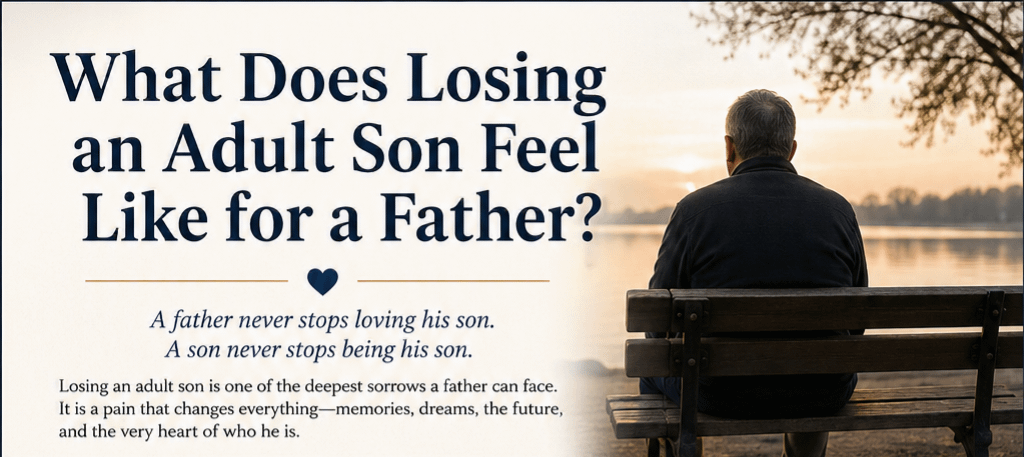
  • What Does Losing an Adult Son Feel Like for a Father?

    Advertisements

    A Pain Few Can Truly Understand

    There are some losses in life that change a person forever. Losing an adult son is one of them.

    Many people assume that when a child reaches adulthood, the parent-child bond somehow becomes less intense. They imagine that because a son has grown up, moved out, started a career, married, or built a life of his own, the loss is somehow easier to bear. Fathers who have lived through this tragedy know the truth.

    A son never stops being your son.

    Whether he is five years old, twenty-five, or fifty-five, he remains a part of your heart. The love a father has for his son does not diminish with age. In many ways, it grows stronger as the years pass and shared experiences deepen the relationship.

    When an adult son dies, a father loses far more than a child. He loses a lifelong companion, a source of pride, a keeper of family memories, and a future that he expected to share.

    The pain is profound, life-altering, and often difficult to describe to those who have never experienced it.

    Losing a Piece of Yourself

    Many fathers describe the loss of a son as feeling like part of themselves has died.

    A son often carries a father’s values, traditions, lessons, and dreams into the next generation. Fathers see pieces of themselves reflected in their sons—their smile, their personality, their strengths, and sometimes even their flaws.

    When that son is suddenly gone, it can feel as though a part of the father’s own identity has been ripped away.

    Simple questions become difficult.

    Who am I now?

    What happens to all the plans we had?

    Why am I still here when my son is not?

    The loss creates a wound that reaches beyond grief. It touches the very core of a father’s sense of self.

    The Weight of Memories

    After losing an adult son, memories become both a blessing and a burden.

    A father may find himself replaying moments from every stage of his son’s life.

    The first time he held him.

    The first steps.

    Little League games.

    School graduations.

    Family vacations.

    Conversations in the kitchen.

    Holiday gatherings.

    The day his son became a man.

    Memories arrive unexpectedly. A familiar song, a photograph, a scent, or even a passing comment can transport a father back in time.

    For a few brief moments, he feels close to his son again.

    Then reality returns.

    The memory that once brought joy now brings tears because it reminds him of what has been lost.

    The Future That Disappeared

    One of the hardest aspects of losing an adult son is grieving the future.

    Most people focus on the memories of the past, but fathers often mourn the experiences that will never happen.

    The wedding he may never see.

    The grandchildren he may never hold.

    The family gatherings that will always have an empty chair.

    The phone calls that will never come.

    The birthdays that will never be celebrated together.

    The future becomes a landscape filled with unanswered questions and unfinished dreams.

    A father not only loses the son he knew; he loses the man his son was still becoming.

    The Guilt Fathers Carry

    Even when a son’s death was completely beyond anyone’s control, many fathers carry immense guilt.

    Fathers are protectors by nature.

    From the moment their child is born, they feel responsible for keeping him safe.

    When tragedy strikes, fathers often ask questions that have no answers.

    Could I have done something differently?

    Did I miss warning signs?

    Should I have called more often?

    Did he know how much I loved him?

    Could I have protected him somehow?

    These questions can haunt a father for years.

    The rational mind may understand that nothing could have changed the outcome, yet the heart continues searching for a way to make sense of the unimaginable.

    Grieving in Silence

    One of the most overlooked aspects of child loss is how many fathers grieve alone.

    Society often teaches men to be strong, composed, and emotionally controlled.

    After the death of a son, many fathers feel pressure to hold everything together for everyone else.

    They support their spouse.

    They comfort relatives.

    They handle arrangements.

    They take care of practical matters.

    Meanwhile, their own grief remains hidden.

    Many fathers cry behind closed doors.

    Some cry while driving alone.

    Some sit awake at night staring into darkness.

    Others bury themselves in work because it feels easier than confronting the pain.

    Their grief is every bit as intense as anyone else’s, but much of it remains unseen.

    The Loneliness Nobody Talks About

    The loneliness that follows the loss of an adult son can be overwhelming.

    Friends often rally around the family in the days and weeks after the death. Phone calls come in. Meals are delivered. Sympathy cards arrive.

    Then gradually life moves on.

    For everyone else.

    Not for the father.

    Months later, people may stop asking how he is doing.

    Years later, many assume he has healed.

    What they fail to realize is that a father’s grief does not operate on a timetable.

    His son is still gone.

    Every day.

    The loneliness becomes especially difficult when it feels like nobody remembers the person he misses every single moment.

    The Pain of Ordinary Days

    People often expect grief to hit hardest on anniversaries, birthdays, and holidays.

    Those days are certainly difficult.

    But many fathers discover that ordinary days can hurt just as much.

    Walking past his son’s favorite restaurant.

    Seeing a vehicle similar to the one his son drove.

    Hearing someone laugh in a way that sounds familiar.

    Watching another father and son spend time together.

    These seemingly small moments can trigger powerful waves of grief.

    The world keeps offering reminders of the person who should still be here.

    How Loss Changes a Father

    The death of a son changes a father forever.

    Many grieving fathers describe feeling older overnight.

    Some lose interest in activities they once enjoyed.

    Others struggle with concentration, sleep, motivation, and relationships.

    Many develop a deeper understanding of suffering and compassion.

    They become more sensitive to the pain of others because they know what it means to carry heartbreak every day.

    Some fathers become quieter.

    Others become more reflective.

    Many begin asking deeper questions about life, purpose, faith, and eternity.

    The experience reshapes them in ways they never expected.

    Faith, Questions, and Spiritual Struggles

    For fathers who have faith, losing a son often creates a complicated spiritual journey.

    Some find comfort in their beliefs.

    Others wrestle with difficult questions.

    Why did this happen?

    Why my son?

    Why now?

    Where was God?

    Can I trust Him again?

    These questions are normal.

    Faith after child loss is rarely simple.

    Many fathers discover that faith is not the absence of questions. Instead, it becomes the willingness to continue seeking God even when answers never come.

    Over time, some fathers find peace in believing that death is not the end of the relationship.

    The love remains.

    The bond remains.

    And the hope of reunion becomes a source of strength.

    Learning to Carry the Grief

    Contrary to popular belief, grieving fathers do not “get over” losing a son.

    Instead, they learn how to carry the grief.

    The pain never fully disappears.

    It changes.

    In the beginning, grief feels impossible to survive.

    Every breath hurts.

    Every day feels unbearable.

    Over time, fathers gradually learn how to live alongside the loss.

    There are still tears.

    There are still difficult days.

    There are still moments when grief appears unexpectedly.

    But they develop the strength to continue moving forward while carrying their son’s memory with them.

    Healing does not mean forgetting.

    Healing means learning how to love and remember while continuing to live.

    Honoring a Son’s Legacy

    Many fathers eventually discover that one of the most meaningful ways to cope is by honoring their son’s legacy.

    Some volunteer.

    Some support other grieving parents.

    Some create scholarships or memorials.

    Some share their son’s story whenever they have the opportunity.

    Others simply strive to live in a way that would make their son proud.

    Every act of remembrance becomes a way of keeping the connection alive.

    Love does not end when life ends.

    A Letter to Every Father Who Has Lost an Adult Son

    If you are a father who has lost an adult son, know this:

    Your grief is valid.

    Your tears are valid.

    Your questions are valid.

    The depth of your pain reflects the depth of your love.

    You are not weak because you struggle.

    You are not failing because you still cry.

    You are not broken because part of you feels missing.

    You loved your son deeply, and that love did not end when his life ended.

    There will always be a place in your heart that belongs to him.

    Nothing can take that away.

    Though the road ahead may feel impossible at times, you do not walk it alone.

    Countless fathers carry this same invisible burden.

    And while the pain may never completely disappear, neither will the love.

    Your son mattered.

    His life mattered.

    His story matters.

    And the love between a father and his son is stronger than death itself.

    A Father’s Guide to Surviving the Loss of a Child

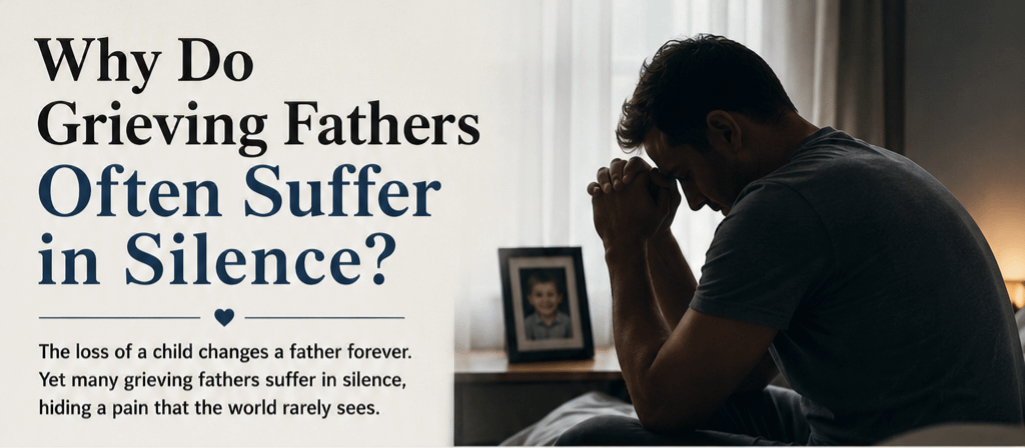
  • Why Do Grieving Fathers Often Suffer in Silence?

    Advertisements

    The Hidden Side of Child Loss

    The loss of a child is one of the most devastating experiences a person can endure. It shatters dreams, changes identities, and leaves a wound that never fully heals. While both mothers and fathers experience profound grief, society often pays less attention to the pain fathers carry.

    Many grieving fathers suffer in silence. They continue working, taking care of responsibilities, and appearing strong on the outside while privately carrying unimaginable heartbreak. Their tears are often unseen, their struggles unheard, and their grief misunderstood.

    The silence is not because fathers love less. It is often because they feel they have no choice.

    Society Teaches Men to Be Strong

    From a young age, many boys are taught messages such as:

    • Be tough.
    • Don’t cry.
    • Handle your problems.
    • Stay strong for others.

    While resilience can be a valuable trait, these messages often become harmful when a father experiences the death of a child.

    Many grieving fathers feel pressure to suppress their emotions because they believe showing pain is a sign of weakness. Instead of expressing their grief openly, they bury it deep inside.

    The result is not less pain.

    The result is hidden pain.

    A father may appear calm while internally struggling with overwhelming sadness, guilt, anger, confusion, and despair.

    Fathers Often Feel Responsible

    One of the most common emotions grieving fathers experience is guilt.

    They may ask themselves:

    • Could I have prevented this?
    • What should I have done differently?
    • Why wasn’t I there?
    • Why couldn’t I protect my child?

    Even when the loss was completely beyond their control, many fathers carry an enormous burden of responsibility.

    Fathers are often viewed as protectors. When a child dies, some fathers feel they have failed in the very role they were meant to fulfill.

    This guilt can become so heavy that they stop talking about it altogether.

    They Feel They Must Protect Their Family

    Many grieving fathers instinctively shift into protector mode after a loss.

    Instead of focusing on their own pain, they focus on:

    • Supporting their spouse.
    • Caring for surviving children.
    • Managing finances.
    • Handling funeral arrangements.
    • Returning to work.

    They become the person everyone leans on.

    Unfortunately, when everyone depends on the father for strength, few people stop to ask how he is doing.

    The father becomes the support system while having no support system himself.

    Over time, this can create intense loneliness.

    People Check on Mothers More Often

    After a child dies, support often naturally flows toward the mother.

    Friends and family may call, send cards, offer hugs, and ask how she is coping.

    This support is important and deserved.

    However, fathers are frequently overlooked.

    People may assume:

    • Dad is handling it.
    • He’s staying busy.
    • He’s the strong one.
    • He doesn’t want to talk.

    As a result, fathers may receive significantly less emotional support.

    The silence around their grief can make them feel invisible.

    Fathers and Mothers Often Grieve Differently

    Another reason fathers suffer in silence is that their grief may look different than a mother’s.

    Many mothers process grief through conversation, emotional expression, and sharing memories.

    Many fathers process grief through action.

    They may:

    • Work longer hours.
    • Take on projects.
    • Exercise excessively.
    • Stay constantly busy.
    • Focus on helping others.

    These activities are not necessarily avoidance. Sometimes they are simply how fathers cope.

    The problem occurs when others mistake these behaviors for healing.

    Just because a father is functioning does not mean he is okay.

    Many grieving fathers are surviving, not healing.

    Fear of Breaking Down

    Some fathers remain silent because they fear what might happen if they allow themselves to fully feel their grief.

    They worry:

    • If I start crying, I won’t stop.
    • If I let myself feel this pain, it will destroy me.
    • If I fall apart, who will hold everyone else together?

    This fear causes many fathers to build emotional walls.

    Unfortunately, grief does not disappear behind those walls.

    It waits.

    Often it resurfaces later through depression, anxiety, anger, physical illness, sleep problems, or emotional exhaustion.

    The Workplace Offers Little Space for Grief

    Many fathers return to work quickly after losing a child.

    Financial responsibilities often leave them little choice.

    Within days or weeks, they may find themselves back at their jobs while still in shock.

    Coworkers may avoid the subject entirely.

    Others may offer brief condolences before expecting normal productivity.

    Meanwhile, the father is trying to function while carrying unimaginable pain.

    Work can become another place where grief remains hidden.

    Men Often Lack Emotional Support Networks

    Many women maintain close friendships where emotional conversations are common.

    Many men do not.

    A grieving father may have plenty of acquaintances but very few people he feels comfortable calling at midnight when the pain becomes overwhelming.

    Without trusted outlets, grief becomes isolated.

    The father suffers alone even when surrounded by people.

    The Pain Never Leaves

    One of the greatest misconceptions about grief is that it eventually disappears.

    For grieving fathers, the loss remains part of them forever.

    Years later, a song, a photograph, a birthday, or an empty chair can bring the pain rushing back.

    Many fathers continue carrying conversations with their child in their hearts.

    They continue wondering what their child would look like today, what milestones they would have reached, and what life would have been like.

    The grief changes over time, but the love remains.

    And where love remains, grief often follows.

    Why Fathers Need Permission to Speak

    Grieving fathers need something many have never been given:

    Permission.

    Permission to cry.

    Permission to talk.

    Permission to admit they are struggling.

    Permission to seek counseling.

    Permission to say they are not okay.

    Permission to grieve differently.

    Strength is not the absence of tears.

    Strength is having the courage to face pain honestly.

    The strongest thing a grieving father can do is acknowledge what he is carrying.

    A Message to Every Grieving Father

    If you are grieving the loss of a child, know this:

    Your pain matters.

    Your tears matter.

    Your story matters.

    You do not have to carry this burden alone.

    You are not weak because you miss your child.

    You are not weak because you cry.

    You are not weak because some days feel impossible.

    You are a father whose love continues beyond loss.

    The world may not always see your grief, but it is real.

    And so is your love.

    Your child mattered.

    Your child still matters.

    And your grief is simply the evidence of a love that death could never take away.

    Final Thoughts

    Grieving fathers often suffer in silence because society expects strength, responsibility, and emotional control. They feel pressure to protect others while privately carrying unimaginable pain.

    Yet healing begins when silence is broken.

    When fathers are given permission to share their stories, express their emotions, and seek support, they discover something important:

    They are not alone.

    Behind every grieving father is a heart that loved deeply, still loves deeply, and always will.

    That love deserves to be heard.

    A Father’s Guide to Surviving the Loss of a Child

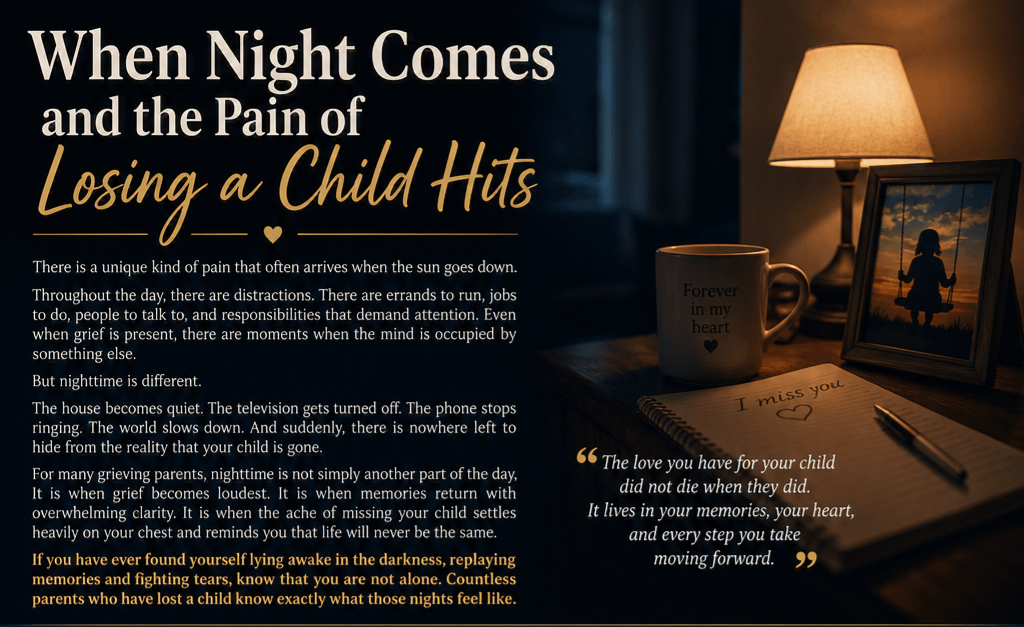
  • When Night Comes and the Pain of Losing a Child Hits

    Advertisements

    There is a unique kind of pain that often arrives when the sun goes down.

    Throughout the day, there are distractions. There are errands to run, jobs to do, people to talk to, and responsibilities that demand attention. Even when grief is present, there are moments when the mind is occupied by something else.

    But nighttime is different.

    The house becomes quiet.

    The television gets turned off.

    The phone stops ringing.

    The world slows down.

    And suddenly, there is nowhere left to hide from the reality that your child is gone.

    For many grieving parents, nighttime is not simply another part of the day. It is when grief becomes loudest. It is when memories return with overwhelming clarity. It is when the ache of missing your child settles heavily on your chest and reminds you that life will never be the same.

    If you have ever found yourself lying awake in the darkness, replaying memories and fighting tears, know that you are not alone. Countless parents who have lost a child know exactly what those nights feel like.

    The Day Can Distract You, But Night Forces You to Feel

    Many grieving parents become experts at surviving the daytime.

    They go to work.

    They attend family gatherings.

    They smile when expected.

    They complete daily tasks.

    From the outside, they may appear to be coping well.

    But grief does not disappear simply because a parent is functioning.

    Often, grief waits patiently beneath the surface until the quiet moments arrive.

    Night removes the distractions.

    The responsibilities fade.

    The noise disappears.

    And what remains is a heart carrying an unimaginable loss.

    This is why many bereaved parents say they are strongest during the day and most vulnerable at night.

    The pain that was pushed aside throughout the day finally has room to emerge.

    The Empty Bedroom Never Stops Hurting

    One of the hardest realities of losing a child is seeing the physical reminders they left behind.

    At night, those reminders seem more noticeable.

    The empty bedroom.

    The favorite chair.

    The sports trophies.

    The photographs hanging on the wall.

    The clothes that still carry memories.

    Many parents find themselves standing in their child’s room late at night, remembering a time when that room was full of life.

    They remember hearing laughter from behind the door.

    They remember bedtime conversations.

    They remember hearing footsteps down the hallway.

    Now there is silence.

    A silence that can feel almost unbearable.

    The room remains.

    The memories remain.

    But the child is gone.

    That reality can hit with extraordinary force during the quiet hours of the night.

    When Memories Refuse to Let You Sleep

    Nighttime often becomes a theater of memories.

    The mind begins replaying moments from years ago.

    A first day of school.

    A birthday party.

    A family vacation.

    A graduation.

    A holiday dinner.

    A simple afternoon spent laughing together.

    Some memories bring smiles.

    Others bring tears.

    Many bring both.

    Parents often discover that the moments they miss most are not always the major milestones.

    Sometimes they miss the ordinary things.

    The sound of their child’s voice saying “Dad.”

    The random text messages.

    The late-night conversations.

    The arguments they would gladly have again.

    The everyday moments that once seemed insignificant suddenly become priceless treasures.

    When night comes, those memories can flood the mind and make sleep impossible.

    The Questions That Keep You Awake

    Many grieving parents spend countless nights wrestling with questions.

    Why did this happen?

    Why my child?

    Why couldn’t it have been different?

    Could I have done something more?

    Did I miss something important?

    Could I have prevented it?

    These questions are part of grief.

    They arise because parents are protectors by nature.

    From the moment a child is born, a parent feels responsible for their safety and well-being.

    When a child dies, that instinct does not disappear.

    Instead, it often turns inward.

    Parents replay events repeatedly, searching for answers.

    Searching for explanations.

    Searching for something that will make sense of the tragedy.

    Unfortunately, some losses simply do not make sense.

    No explanation feels sufficient.

    No answer removes the pain.

    No amount of questioning changes what happened.

    Learning to live with unanswered questions is one of the most difficult parts of grieving a child.

    The Loneliness Few People Understand

    Nighttime often magnifies loneliness.

    Friends may care deeply, but most eventually return to their own lives.

    Family members may offer support, but they cannot carry your grief for you.

    The world keeps moving.

    Meanwhile, a grieving parent may feel completely frozen in time.

    Many fathers especially experience profound isolation.

    Society often expects men to stay strong.

    To remain composed.

    To hide their emotions.

    To continue functioning no matter how much pain they carry.

    As a result, many grieving fathers cry alone.

    They break down after everyone else has gone to sleep.

    They sit in dark rooms carrying burdens they rarely discuss.

    They suffer silently because they fear becoming a burden to others.

    Nighttime can become the place where all those hidden emotions finally emerge.

    Missing Them Never Gets Old

    People sometimes assume grief fades after enough time passes.

    Bereaved parents know differently.

    The intensity may change.

    The frequency may change.

    But the love remains.

    And because the love remains, the missing remains.

    Years later, parents still wonder what their child would look like today.

    They imagine birthdays that never happened.

    They wonder about careers, marriages, grandchildren, and futures that were stolen.

    Every milestone becomes a reminder.

    Every holiday carries an empty chair.

    Every family gathering contains someone missing.

    Nighttime often becomes the place where those thoughts surface.

    A parent may find themselves staring at the ceiling imagining what life would have been if their child were still here.

    That longing never completely disappears.

    Because love never completely disappears.

    The Tears That Come After Dark

    Many grieving parents discover they can hold themselves together all day only to fall apart at night.

    The tears arrive unexpectedly.

    A photograph triggers a memory.

    A song plays on the radio.

    A birthday approaches.

    An anniversary passes.

    Or perhaps there is no obvious trigger at all.

    The tears simply come.

    And when they do, it is important to remember something.

    Tears are not weakness.

    They are love expressed through grief.

    Every tear represents a relationship that mattered.

    Every tear reflects a heart that refuses to forget.

    Every tear is evidence of a bond that death could not destroy.

    The Physical Weight of Nighttime Grief

    Grief is not only emotional.

    It is physical.

    Many bereaved parents experience:

    • Difficulty sleeping
    • Anxiety at bedtime
    • Racing thoughts
    • Chest tightness
    • Exhaustion
    • Headaches
    • Muscle tension
    • Restlessness
    • Panic attacks

    Nighttime often intensifies these symptoms.

    The body remembers trauma.

    The nervous system remains on alert.

    Sleep becomes difficult because the mind refuses to quiet itself.

    Many parents find themselves awake long after everyone else has fallen asleep, trapped in cycles of memories and emotions.

    This is a common experience among grieving parents.

    It does not mean something is wrong with you.

    It means your heart is carrying something extraordinarily heavy.

    Finding God in the Darkness

    Some of the most honest prayers ever spoken happen in the middle of the night.

    Not polished prayers.

    Not rehearsed prayers.

    Just broken hearts crying out to God.

    Many grieving parents have sat in darkness asking questions through tears.

    Some have been angry.

    Some have been confused.

    Some have felt abandoned.

    Others have simply begged for enough strength to survive another day.

    The Bible is filled with people who cried out to God during seasons of suffering.

    God is not frightened by our grief.

    He is not offended by our questions.

    He is not distant from our pain.

    While faith does not remove grief, it can provide comfort in the midst of it.

    It can remind us that our children are known by God.

    It can remind us that death does not have the final word.

    It can remind us that love is stronger than the grave.

    What To Do When the Night Feels Unbearable

    If tonight is one of those difficult nights, consider giving yourself permission to do what you need.

    Look through photographs.

    Write a letter to your child.

    Say their name out loud.

    Pray.

    Journal.

    Listen to calming music.

    Read Scripture.

    Talk to someone you trust.

    Or simply sit quietly and allow yourself to feel.

    There is no right or wrong way to survive these nights.

    The goal is not to eliminate grief.

    The goal is to make it through the night.

    One hour at a time.

    One breath at a time.

    One step at a time.

    To Every Parent Lying Awake Tonight

    If you are reading this while carrying the pain of losing a child, know this:

    Your grief is a reflection of your love.

    You are not weak because you cry.

    You are not broken because you struggle.

    You are not failing because you still miss them years later.

    You are a parent.

    And parents never stop loving their children.

    Not after birthdays pass.

    Not after years go by.

    Not even after death.

    The nights may still hurt.

    The memories may still bring tears.

    The longing may still feel overwhelming.

    But your child’s life mattered.

    Their story mattered.

    Their love mattered.

    And the love you carry for them continues to live within you every single day.

    Final Thoughts

    When night comes and the pain of losing a child hits, it can feel as though the entire weight of the world has settled upon your heart.

    The silence becomes louder.

    The memories become stronger.

    The loneliness becomes deeper.

    But so does the love.

    And that love is the reason your child will never truly be forgotten.

    Though grief may visit in the darkness, love remains.

    It remains in every memory.

    It remains in every tear.

    It remains in every story you tell.

    And it remains in the unbreakable bond between a parent and child—a bond that even death cannot erase.

    A Father’s Guide to Surviving the Loss of a Child

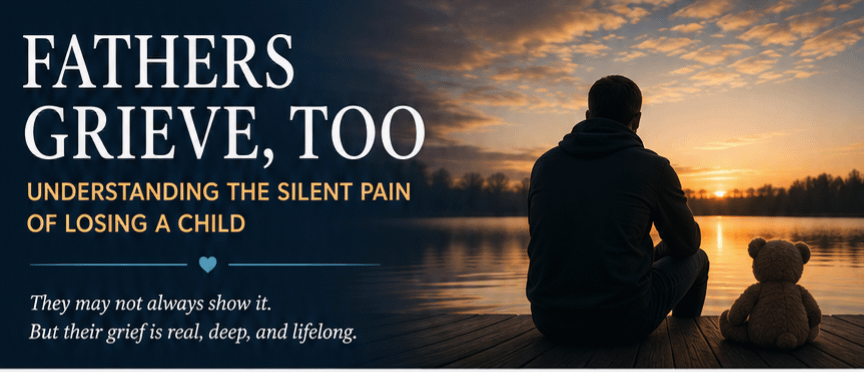
  • Fathers Grieve, Too: Understanding the Silent Pain of Losing a Child

    Advertisements

    Introduction

    There is no pain quite like the death of a child.

    It goes against everything we believe life should be. Parents expect to grow old and watch their children build lives of their own. They imagine graduations, careers, weddings, grandchildren, and countless milestones. When a child dies, those dreams die too.

    For fathers, this loss often carries an additional burden. Society has traditionally viewed men as protectors, providers, and problem-solvers. Men are taught to be strong during crises and to hold themselves together when others fall apart. Yet losing a child creates a wound that no amount of strength can prevent and no amount of determination can fix.

    Despite this reality, grieving fathers are frequently overlooked. Their pain is often hidden behind stoic expressions, busy schedules, and a determination to keep functioning. Many people assume that because a father is not openly crying, he is coping better than everyone else.

    Nothing could be further from the truth.

    Fathers grieve deeply. They hurt profoundly. They cry, even if the tears never leave their eyes. They carry heartbreak, guilt, fear, and loneliness while trying to continue living in a world that suddenly feels unfamiliar.

    This is the story of grieving fathers—the struggles they face, the emotions they carry, and the hope that can still be found after unimaginable loss.


    When a Child Dies, Part of a Father Dies Too

    The death of a child is not simply the loss of a loved one.

    For many fathers, it feels as though a part of themselves has died as well.

    A father invests years of his life protecting, teaching, guiding, and loving his child. His identity becomes intertwined with his role as a dad. When that child dies, the father often feels as though he has lost a piece of who he is.

    Simple questions become difficult.

    Who am I now?

    What is my purpose?

    How do I continue living when the person I loved so deeply is gone?

    Many fathers describe the experience as feeling disconnected from the world around them. Things that once seemed important suddenly feel meaningless. Conversations become harder. Joy feels distant.

    The man who existed before his child’s death is gone.

    The challenge becomes learning how to live as the person grief has forced him to become.


    The Expectations Placed on Men

    From childhood, boys receive messages about how men should behave.

    “Be tough.”

    “Don’t cry.”

    “Shake it off.”

    “Be a man.”

    These messages often become deeply rooted beliefs.

    As a result, many fathers feel pressure to suppress their emotions after losing a child. They believe they must remain strong for their spouse, their surviving children, and everyone else around them.

    They become caretakers while desperately needing care themselves.

    Many grieving fathers hear comments such as:

    • “You need to stay strong.”
    • “Your wife needs you.”
    • “Your family is counting on you.”
    • “You have to keep moving forward.”

    While these comments are often well-intentioned, they can unintentionally send the message that a father’s grief matters less than everyone else’s.

    The reality is that strength is not the absence of emotion.

    True strength is allowing yourself to feel the pain and continuing to move forward anyway.


    The Many Faces of Grief

    Grief affects every father differently.

    Some cry openly.

    Others never shed a tear.

    Some talk about their child constantly.

    Others become quiet and withdrawn.

    Neither response is right or wrong.

    A grieving father may experience:

    • Anger
    • Depression
    • Loneliness
    • Anxiety
    • Fear
    • Confusion
    • Hopelessness
    • Numbness
    • Panic
    • Guilt
    • Emotional exhaustion

    Many fathers find themselves overwhelmed by emotions they have never experienced before.

    One moment they may feel relatively stable.

    The next, a photograph, song, memory, or familiar place can bring them to tears.

    Grief does not follow a schedule.

    It arrives unexpectedly and often stays longer than anyone expects.


    The Guilt That Haunts Fathers

    Perhaps no emotion is more common among grieving fathers than guilt.

    Even when a child’s death was completely beyond their control, fathers often question themselves endlessly.

    What if I had done something differently?

    What if I had called?

    What if I had stayed?

    What if I had noticed something sooner?

    What if I had protected them better?

    These questions become relentless.

    A father’s natural instinct is to protect his child. When that child dies, many fathers feel they have failed at the most important job they were ever given.

    The truth is that tragedy is not always preventable.

    Accidents happen.

    Illnesses happen.

    Life can be unfair.

    Yet knowing this intellectually does not always ease the guilt carried in a father’s heart.

    Learning to forgive yourself may be one of the hardest parts of healing.


    The Loneliness No One Talks About

    One of the most painful aspects of child loss is isolation.

    In the beginning, support often arrives quickly.

    People call.

    They visit.

    They send messages.

    They attend the funeral.

    Then, slowly, life moves on for everyone else.

    But not for the father.

    Weeks become months.

    Months become years.

    The grief remains.

    Many fathers discover that fewer and fewer people ask about their child. Friends become uncomfortable discussing the loss. Some avoid the topic altogether.

    This can leave fathers feeling invisible.

    They desperately want someone to remember their child.

    To say their name.

    To acknowledge their existence.

    Instead, they often find themselves grieving alone.


    How Child Loss Affects Marriage

    The death of a child places enormous strain on a marriage.

    A husband and wife may grieve very differently.

    One may need to talk frequently.

    The other may process grief privately.

    One may seek support groups.

    The other may avoid discussing the loss altogether.

    These differences can create misunderstandings.

    A spouse may mistakenly believe the other person does not care as deeply.

    The reality is that both are hurting.

    They are simply grieving in different ways.

    Successful couples learn to respect each other’s grieving styles while finding ways to support one another through the pain.


    The Physical Effects of Grief

    Grief is not only emotional.

    It affects the body as well.

    Many fathers experience:

    • Difficulty sleeping
    • Fatigue
    • Headaches
    • Muscle tension
    • Digestive issues
    • Loss of appetite
    • Weight changes
    • Panic attacks
    • Increased blood pressure
    • Memory problems

    Some fathers are surprised by how physically painful grief can be.

    The body carries sorrow just as much as the heart does.

    This is why self-care becomes so important.

    Eating properly, exercising, resting, and seeking medical support when necessary are not luxuries.

    They are essential parts of surviving grief.


    The Fear of Living Again

    Many fathers struggle with an unexpected fear.

    The fear of healing.

    Part of them worries that feeling better somehow means loving their child less.

    They fear that laughter is a betrayal.

    That happiness means forgetting.

    That moving forward means leaving their child behind.

    But healing does not mean forgetting.

    It means learning how to carry love and grief together.

    A father’s relationship with his child does not end when death occurs.

    The relationship changes.

    The love remains.

    The memories remain.

    The bond remains.

    Healing allows fathers to honor that bond while continuing to live.


    Finding Purpose After Loss

    One of the most powerful steps in healing is discovering purpose.

    Many fathers honor their children by:

    • Helping others
    • Volunteering
    • Supporting charities
    • Advocating for causes
    • Creating memorial projects
    • Sharing their stories
    • Supporting other grieving parents

    Purpose does not remove pain.

    But it can transform suffering into something meaningful.

    Many fathers find that helping others becomes a way to keep their child’s memory alive.

    Their child’s life continues making a difference through the lives they touch.


    What Grieving Fathers Need Most

    Grieving fathers do not need people to fix their pain.

    They need people willing to walk beside them through it.

    They need:

    • Understanding
    • Compassion
    • Patience
    • Honest conversations
    • Permission to feel
    • Safe places to talk
    • Continued support long after the funeral

    Most importantly, they need to know they are not alone.


    A Letter to Every Grieving Father

    If you are reading this as a father who has lost a child, know this:

    Your grief is real.

    Your tears are real.

    Your heartbreak is real.

    You do not have to prove how much you loved your child.

    You do not have to hide your pain.

    You do not have to carry this burden alone.

    The world may not always understand what you are going through, but there are others walking this road beside you.

    You may never be the person you were before your child died.

    But that does not mean your life is over.

    There is still purpose ahead.

    There is still love ahead.

    There is still hope ahead.

    And while the pain may never completely disappear, neither will the love you have for your child.

    That love remains forever.

    Death may separate you physically, but it can never erase the bond between a father and his child.

    That bond is eternal.

    And so is love.

    Conclusion

    Fathers grieve too.

    They grieve deeply, often quietly, and frequently alone.

    Behind the strong exterior many fathers present to the world is a heart carrying unimaginable pain. Recognizing their grief, supporting their healing, and giving them permission to express their emotions can make a tremendous difference.

    For every father mourning the loss of a child, may you find comfort in knowing that your grief matters, your child matters, and your story matters.

    You are not alone.

    A Father’s Guide to Surviving the Loss of a Child

  • To the Fathers Whose Child Has Passed

    Advertisements

    There are losses in life that change us forever.

    The death of a parent is painful. The end of a marriage can be devastating. Losing a close friend leaves a void that can never fully be filled.

    But there is something uniquely devastating about the death of a child.

    It goes against the natural order of life. Parents are not supposed to outlive their children. Fathers are supposed to protect them, guide them, watch them grow, and eventually watch them build lives of their own.

    When a child dies, those dreams die too.

    The future you imagined disappears in an instant.

    To every father who has experienced this loss, this article is for you.

    Not because I have all the answers.

    But because I understand the pain.


    The Day Your World Changed Forever

    Every father remembers the moment.

    The phone call.

    The knock on the door.

    The words spoken by a doctor, police officer, or family member.

    The moment life divided itself into two chapters:

    Before your child died.

    After your child died.

    Nothing feels real at first.

    Your mind struggles to accept what your heart knows is true.

    You may find yourself waiting for them to walk through the door.

    You may still reach for your phone to call them.

    You may wake up for a split second believing it was all a nightmare.

    The shock can last for weeks, months, or even years.

    The world continues moving while yours feels frozen.


    Fathers Grieve Differently

    One of the greatest misconceptions about grief is that everyone grieves the same way.

    They do not.

    Many fathers grieve silently.

    We were raised to be strong.

    To handle problems.

    To protect our families.

    To keep moving forward.

    As a result, many fathers suppress their emotions.

    They throw themselves into work.

    They stay busy.

    They focus on helping everyone else.

    Meanwhile, their own hearts are breaking.

    People often ask mothers how they are doing after the loss of a child.

    Fathers are frequently overlooked.

    Many people assume that because a father is functioning, he must be okay.

    Nothing could be further from the truth.

    The strongest-looking man in the room may be carrying unbearable pain.


    The Guilt That Many Fathers Carry

    One of the heaviest burdens fathers carry after losing a child is guilt.

    You begin replaying every memory.

    Every decision.

    Every conversation.

    You ask yourself questions that may never have answers.

    “What if I had called?”

    “What if I had stopped them from going?”

    “What if I had seen the signs?”

    “What if I had done something differently?”

    The mind desperately searches for a way to regain control over something that could not be controlled.

    The reality is that most fathers did the best they could with the information they had at the time.

    But grief rarely listens to logic.

    It whispers accusations.

    It creates doubts.

    It magnifies regrets.

    Learning to release guilt is one of the hardest parts of healing.


    The Loneliness Nobody Talks About

    Perhaps the most surprising part of child loss is the loneliness.

    At first, people show up.

    They bring food.

    They send cards.

    They offer support.

    Then life moves on.

    The phone stops ringing.

    The messages become less frequent.

    The visits become rare.

    But your grief remains.

    Many fathers feel isolated because they don’t know where to express their pain.

    Society often provides fewer emotional outlets for men.

    As a result, fathers suffer in silence.

    You may find yourself sitting alone late at night looking through old photos.

    You may replay videos just to hear your child’s voice.

    You may find yourself crying in places where nobody can see.

    This loneliness can be overwhelming.

    But it is important to remember that you are not alone.

    Thousands of fathers are carrying the same invisible burden.


    When Your Child Was Also Your Best Friend

    Some fathers lose more than a child.

    They lose their best friend.

    The person they talked to every day.

    The person who made them laugh.

    The person who understood them.

    When your child was deeply involved in your daily life, the silence afterward can feel unbearable.

    Every routine changes.

    Every holiday feels different.

    Every milestone reminds you of who is missing.

    The absence is everywhere.

    And yet, so are the memories.


    Special Days Hurt the Most

    Birthdays.

    Father’s Day.

    Christmas.

    Graduations.

    Weddings.

    The first year after losing a child is often filled with painful “firsts.”

    The first birthday without them.

    The first holiday.

    The first anniversary of their death.

    Many fathers find these dates especially difficult because they force us to confront the reality of our loss all over again.

    The pain never fully disappears.

    We simply learn how to carry it.


    The Impact on Mental and Physical Health

    Grief affects far more than emotions.

    Many fathers experience:

    • Anxiety
    • Depression
    • Insomnia
    • Panic attacks
    • Weight gain or weight loss
    • Chronic fatigue
    • Difficulty concentrating
    • Increased health problems

    Some turn to alcohol.

    Others isolate themselves.

    Some become angry.

    Others become numb.

    Grief impacts the entire body.

    This is why taking care of yourself is not selfish.

    It is necessary.

    Your child would want you to survive this.

    Even when survival feels impossible.


    Faith After Losing a Child

    Many grieving fathers wrestle with faith.

    Some become angry with God.

    Some question everything they once believed.

    Others cling to faith more tightly than ever before.

    There is no right way to navigate spiritual grief.

    Faith does not remove pain.

    It simply gives us something to hold onto when the pain becomes overwhelming.

    For many fathers, faith becomes the bridge between heartbreak and hope.

    The belief that death is not the end.

    The belief that love survives.

    The belief that we will see our children again.

    These beliefs can provide comfort during the darkest moments.


    How to Honor Your Child’s Legacy

    One of the most powerful steps in healing is finding ways to honor your child’s memory.

    You can:

    • Share stories about them.
    • Support causes they cared about.
    • Create scholarships.
    • Volunteer.
    • Write about your experience.
    • Help other grieving parents.
    • Continue traditions they loved.

    The goal is not to move on from your child.

    The goal is to move forward with your child in your heart.

    Their life mattered.

    Their story matters.

    Their impact continues.


    Learning How to Live Again

    This may be the hardest lesson of all.

    Eventually, there comes a moment when you realize your child would not want your entire life to end because theirs did.

    That realization often creates guilt.

    You may feel guilty for laughing.

    Guilty for smiling.

    Guilty for finding happiness.

    Guilty for enjoying life.

    But healing is not betrayal.

    Healing is not forgetting.

    Healing is carrying both grief and gratitude at the same time.

    You can miss your child every day and still choose to live.

    You can cry and still laugh.

    You can grieve and still find purpose.

    Both things can be true.


    To Every Grieving Father Reading This

    I know there are days when you feel broken.

    I know there are nights when the silence feels unbearable.

    I know there are moments when you wonder how you can possibly keep going.

    But you have survived every day since your child passed.

    You have carried a weight that many people cannot imagine.

    You have continued walking through a storm that never fully ends.

    That takes courage.

    Your child’s life mattered.

    Your love for them matters.

    Your grief matters.

    And your life still matters.

    The road ahead may never be easy.

    The pain may never completely disappear.

    But neither will the love.

    Love is stronger than death.

    Love is stronger than time.

    Love is the reason your child remains part of you today.

    So keep going, Dad.

    One day at a time.

    One memory at a time.

    One step at a time.

    Carry their love.

    Carry their legacy.

    Carry their light.

    And when the world feels dark, remember this:

    You are not walking this path alone.

    A Father’s Guide to Surviving the Loss of a Child

  • The Physical Symptoms of Grief After Losing a Child

    Advertisements

    Losing a child is often described as the most devastating loss a person can experience. While most people understand that grief affects emotions, many are surprised to discover how deeply it affects the body as well. The death of a child is not just a heartbreak—it is a full-body experience that can leave grieving parents physically exhausted, sick, and struggling to function.

    When my son passed away, I expected the sadness. I expected the tears and the loneliness. What I did not expect was how much grief would affect my physical health. My body seemed to carry the weight of my loss in ways I never imagined. Some days I felt like I had run a marathon without taking a single step.

    If you have lost a child and are experiencing physical symptoms, you are not alone. What you are feeling is real, and it is a common part of the grieving process.

    Grief Changes the Body

    When a child dies, the mind and body enter a state of shock. The brain struggles to process what has happened because the loss feels unnatural. Parents are not supposed to bury their children. Because the loss goes against every expectation of life, the body responds as though it has experienced a major trauma.

    The stress hormones cortisol and adrenaline flood the system. Heart rate increases. Sleep becomes disrupted. Appetite changes. The immune system weakens. Over time, this prolonged state of stress can create a wide range of physical symptoms.

    Grief is not “just in your head.” It affects every part of your body.

    Extreme Fatigue

    One of the most common symptoms after losing a child is overwhelming exhaustion.

    Many grieving parents report feeling tired all the time. Even after sleeping for hours, they wake up exhausted. Simple tasks like taking a shower, cooking a meal, or running errands can feel impossible.

    This fatigue happens because grief requires enormous emotional energy. The brain is constantly processing memories, emotions, questions, regrets, fears, and pain. Even when you are resting, your mind is working overtime.

    Many bereaved parents describe feeling physically drained for months or even years after their loss.

    Sleep Problems

    Sleep often becomes one of the first casualties of grief.

    Some parents cannot fall asleep because their minds race with thoughts of their child. Others wake repeatedly during the night. Some experience vivid dreams or nightmares.

    For many grieving parents, bedtime is the hardest part of the day because the silence allows grief to become louder.

    Lack of sleep creates additional problems, including:

    • Increased anxiety
    • Difficulty concentrating
    • Memory issues
    • Irritability
    • Weakened immune function
    • Depression

    The combination of grief and sleep deprivation can make everyday life feel overwhelming.

    Chest Pain and Heart Symptoms

    Many bereaved parents experience chest tightness, heart palpitations, or even pain that feels similar to a heart attack.

    Doctors sometimes refer to this as “broken heart syndrome” or stress-induced cardiomyopathy. While not everyone experiences this condition, intense emotional stress can affect heart function.

    Even without a medical condition, grief often creates sensations such as:

    • Tightness in the chest
    • Rapid heartbeat
    • Shortness of breath
    • Pressure in the chest
    • Feelings of heaviness

    These symptoms can be frightening. Any severe or persistent chest pain should always be evaluated by a medical professional.

    Changes in Appetite

    Grief affects eating habits in different ways.

    Some parents lose their appetite completely. Food may taste bland or unappealing. They may go hours—or even days—without eating properly.

    Others turn to food for comfort and find themselves overeating to cope with emotional pain.

    Both responses are common.

    Weight loss and weight gain frequently occur during the grieving process because the body’s normal routines have been disrupted.

    Digestive Problems

    The stomach and intestines are closely connected to emotional health.

    After losing a child, many parents experience:

    • Nausea
    • Stomach cramps
    • Diarrhea
    • Constipation
    • Acid reflux
    • Loss of appetite
    • Digestive discomfort

    Stress hormones can significantly affect the digestive system, creating symptoms that feel very real and very uncomfortable.

    Many grieving parents find that their stomach becomes especially sensitive during periods when grief intensifies.

    Weakened Immune System

    Grief can lower the body’s ability to fight illness.

    Many bereaved parents notice they get sick more frequently after the death of a child. Colds seem to last longer. Minor illnesses feel more severe. Recovery takes more time.

    This happens because prolonged emotional stress places a heavy burden on the immune system.

    Your body is trying to survive a profound trauma while also maintaining normal physical functions. That combination can leave you more vulnerable to illness.

    Body Aches and Physical Pain

    Grief can literally hurt.

    Many parents report:

    • Muscle aches
    • Joint pain
    • Headaches
    • Neck tension
    • Back pain
    • Shoulder pain

    The body often stores stress in muscles, leading to chronic tension and discomfort.

    Some grieving parents feel as though they are carrying a physical weight everywhere they go. In many ways, they are. The emotional burden of losing a child often manifests as physical pain.

    Difficulty Concentrating

    While often viewed as a mental symptom, concentration problems can feel very physical.

    Grieving parents frequently describe:

    • Brain fog
    • Forgetfulness
    • Trouble focusing
    • Difficulty making decisions
    • Mental exhaustion

    You may find yourself rereading the same paragraph multiple times or forgetting why you entered a room.

    This is normal.

    Your brain is devoting tremendous resources to processing grief, leaving less energy available for everyday tasks.

    Anxiety and Panic Attacks

    The death of a child changes a parent’s sense of safety.

    Many grieving parents develop symptoms of anxiety, including:

    • Rapid heartbeat
    • Sweating
    • Shaking
    • Dizziness
    • Shortness of breath
    • Panic attacks

    After experiencing the unimaginable, the world often feels unpredictable and dangerous.

    Parents may become hyperaware of potential threats, worrying constantly about the people they love.

    The Return of Grief Symptoms

    One of the most surprising aspects of grief is that physical symptoms can return months or years later.

    Birthdays.

    Holidays.

    The anniversary of your child’s death.

    Father’s Day.

    Mother’s Day.

    Graduations.

    Weddings.

    Certain songs.

    Certain smells.

    These triggers can reactivate grief and bring back physical symptoms you thought had disappeared.

    This does not mean you are moving backward.

    It means your love for your child remains deeply connected to your life.

    Taking Care of Your Body While Grieving

    No amount of self-care will erase the pain of losing a child. However, caring for your physical health can help you survive the difficult days.

    Consider:

    • Drinking enough water.
    • Eating regular meals, even when you don’t feel hungry.
    • Taking short walks.
    • Maintaining a sleep routine.
    • Speaking with your doctor about ongoing symptoms.
    • Seeking grief counseling or support groups.
    • Allowing yourself to rest without guilt.

    Your body is carrying a tremendous burden. Treat it with the same compassion you would offer someone else who was suffering.

    Healing Does Not Mean Forgetting

    The physical symptoms of grief can be frightening. They can make you wonder if something is wrong with you.

    There isn’t.

    You are grieving the loss of someone you love beyond words.

    Your body is responding to one of life’s greatest traumas.

    Over time, the intensity of these symptoms may lessen. The pain may become more manageable. But the love you have for your child will remain.

    I have learned that grief does not disappear. Instead, we learn how to carry it. Some days the weight feels lighter. Some days it feels unbearable. Yet through it all, our children remain part of us.

    Their love continues to live in our hearts, our memories, and even in the way we keep moving forward.

    Because when a child dies, the relationship does not end.

    And neither does a parent’s love.

    A Father’s Guide to Surviving the Loss of a Child

  • Grief Does Not End When the Funeral Is Over: The Importance of Continued Support

    Advertisements

    When someone we love dies, the world seems to pause. Family and friends gather. Flowers arrive. Cards fill the mailbox. Meals are delivered. People offer hugs, prayers, and words of comfort. During those first days and weeks after a loss, grieving individuals are often surrounded by support.

    But eventually, the funeral ends.

    The visitors go home. The sympathy cards stop arriving. Life resumes for everyone else.

    For the grieving person, however, life is never quite the same again.

    One of the greatest misunderstandings about grief is the belief that it follows a predictable timeline. Society often expects people to move through their grief, find closure, and return to normal after a certain period of time. Yet anyone who has experienced a profound loss knows the truth: grief does not end when the funeral is over.

    In many ways, that is when the real journey begins.

    The Silence After the Crowd Leaves

    The days immediately following a death are often filled with activity. There are funeral arrangements to make, family members to notify, paperwork to complete, and countless decisions that must be made despite overwhelming emotional pain.

    During this time, grieving individuals are often operating on pure survival.

    Then, suddenly, everything becomes quiet.

    The funeral is over. The casseroles stop arriving. The phone stops ringing as often. People return to work, school, and their normal routines.

    The grieving person is left alone with the reality of their loss.

    The house feels emptier.

    The silence feels louder.

    The absence becomes impossible to ignore.

    This is often when grief truly begins to settle into everyday life.

    Many bereaved people describe feeling abandoned during this stage—not because their friends and family don’t care, but because the support that was so abundant at first slowly fades away while their pain remains.

    Grief Has No Expiration Date

    One of the most painful experiences for grieving individuals is feeling pressure to “move on.”

    People may ask:

    • “Are you doing better now?”
    • “Have you found closure?”
    • “It’s been a year already.”
    • “You need to focus on the future.”

    While usually well-intentioned, these comments reveal a misunderstanding of grief.

    Love does not disappear because time passes.

    A mother never stops being a mother because her child died.

    A father never stops missing his son.

    A spouse never forgets the person they built a life with.

    A sibling never stops carrying memories of the brother or sister they lost.

    The relationship continues even though the person is gone.

    Healthy grieving is not about forgetting. It is about learning how to live with the absence while still carrying the love.

    Years may pass, but grief often remains present in different ways.

    The intensity may lessen. The tears may become less frequent. The crushing weight may become more manageable.

    But the loss remains.

    And so does the love.

    The Grief That Others Don’t See

    Many grieving people become experts at hiding their pain.

    They smile when they are hurting.

    They attend social events while feeling broken inside.

    They go to work, pay bills, and fulfill responsibilities while carrying emotional wounds that few people notice.

    Because they appear functional, others assume they have healed.

    What many don’t realize is that grief often becomes an invisible burden.

    A bereaved parent may quietly cry in their car after seeing a child who reminds them of their son or daughter.

    A widow may smile through family gatherings while privately aching for the spouse who should be sitting beside her.

    A grieving father may spend Father’s Day pretending he is okay while feeling shattered inside.

    The pain becomes less visible but no less real.

    This is why continued support matters so much.

    Sometimes the people who seem strongest are the ones who need support the most.

    The Special Pain of Significant Dates

    Grief has a way of intensifying around certain dates.

    Birthdays.

    Anniversaries.

    Holidays.

    Graduations.

    Weddings.

    Mother’s Day.

    Father’s Day.

    Christmas.

    These occasions serve as painful reminders of who is missing.

    While others celebrate, grieving individuals often find themselves reflecting on memories and wondering what should have been.

    A parent may calculate how old their child would be today.

    A spouse may imagine what another anniversary together would have looked like.

    A sibling may wonder what life would have been like if their brother or sister were still here.

    These dates can trigger powerful waves of sadness even decades after a loss.

    One simple message that says, “I’m thinking about you today,” can provide tremendous comfort during these difficult moments.

    Why Remembering Matters

    One fear shared by many grieving people is that their loved one will be forgotten.

    As years pass, fewer people mention their name.

    Fewer stories are told.

    Fewer memories are shared.

    The world moves forward.

    But for those left behind, remembering matters.

    One of the greatest gifts you can give a grieving person is acknowledging their loved one.

    Mention their name.

    Share a memory.

    Talk about something you remember.

    Tell a story that makes you smile.

    Far from causing pain, these moments often bring comfort.

    Most grieving people are already thinking about their loved one every day. Hearing others remember them reminds them that their loved one’s life mattered.

    It reassures them that the person they lost continues to be remembered.

    Small Acts of Kindness Make a Big Difference

    Many people avoid reaching out because they worry they won’t know what to say.

    The truth is that perfect words are not necessary.

    Simple acts of kindness often mean the most.

    A text message.

    A phone call.

    A handwritten card.

    An invitation to lunch.

    A cup of coffee together.

    A simple question:

    “How are you really doing?”

    These gestures communicate something powerful:

    “You are not alone.”

    Grief can be incredibly isolating. Continued support helps break through that isolation.

    Even brief moments of connection can provide hope during dark seasons.

    Supporting Bereaved Parents

    The loss of a child creates a unique kind of grief.

    Parents expect to watch their children grow, build lives, and create families of their own.

    When a child dies, those hopes and dreams die as well.

    For bereaved parents, grief often becomes a lifelong companion.

    Many parents continue to think about their child every day.

    They remember birthdays.

    They imagine milestones that were never reached.

    They wonder what their child would look like today.

    They carry both love and loss everywhere they go.

    One of the greatest gifts you can offer a bereaved parent is acknowledging that their child existed and continues to matter.

    Don’t be afraid to say their child’s name.

    Don’t be afraid to ask about them.

    Don’t assume that years have erased the pain.

    Support offered years later often means more than support offered during the first weeks after the loss.

    What Continued Support Looks Like

    Continued support doesn’t require grand gestures.

    It looks like consistency.

    It looks like remembering.

    It looks like showing up.

    You might:

    • Send a text on an anniversary.
    • Call on a birthday.
    • Invite them to dinner.
    • Listen without trying to fix their pain.
    • Share a memory of their loved one.
    • Check in during holidays.
    • Offer companionship during difficult seasons.

    The goal isn’t to remove grief.

    The goal is to ensure the grieving person doesn’t carry it alone.

    For Those Who Feel Forgotten

    If you are grieving and feel as though everyone else has moved on, please know this:

    Your grief is not a problem to solve.

    Your love is not something to get over.

    There is no deadline for missing someone.

    There is no expiration date on remembering.

    There is no timetable for healing.

    The tears that come years later do not mean you are failing.

    The difficult days do not mean you are moving backward.

    The longing you feel is simply evidence of a love that continues.

    You are not weak because you still miss them.

    You are human.

    And your grief deserves compassion.

    A Message to Friends and Family

    If someone you care about is grieving, remember that your support is needed long after the funeral ends.

    The first year is difficult.

    The second year can be even harder.

    Sometimes the support that arrives years later becomes the support they remember most.

    Don’t worry about having perfect words.

    Just show up.

    Send the text.

    Make the call.

    Remember the anniversary.

    Speak their loved one’s name.

    Your kindness may arrive at exactly the moment it is needed most.

    Final Thoughts

    Grief does not end when the funeral is over.

    It doesn’t disappear when the sympathy cards stop arriving.

    It doesn’t vanish because months or years have passed.

    Grief changes, evolves, and becomes woven into the fabric of a person’s life.

    That is why continued support matters.

    A simple message.

    A remembered birthday.

    A shared memory.

    A quiet act of kindness.

    These small gestures remind grieving hearts that they are not forgotten and that neither are the people they love.

    Because while death may end a life, it never ends love.

    And for those carrying grief, knowing that others still remember can make all the difference.

    A Father’s Guide to Surviving the Loss of a Child

  • The Love of a Father Does Not Stop at the Death of a Child

    Advertisements

    There are some relationships in life that death cannot break.

    The bond between a father and his child is one of them.

    When a child dies, many people struggle to understand what happens next. They see the funeral, the tears, the months and years that follow, and they assume that eventually the father learns to let go. They believe healing means moving on. They think that with enough time, the loss somehow becomes smaller.

    But every grieving father knows the truth.

    The love of a father does not stop at the death of a child.

    It does not end at the graveside. It does not disappear after the funeral flowers fade. It does not weaken because the calendar keeps turning. It remains as real and powerful as it was the day that child entered the world.

    A father never stops loving his child.

    And a child never stops being his child.

    The Day Everything Changed

    The day a child dies is often the day a father’s world is divided into two parts: before and after.

    Before, there were plans.

    There were birthdays to celebrate, milestones to witness, conversations yet to be had, and memories still waiting to be made.

    After, there is a silence that feels impossible to describe.

    The future you imagined vanishes in an instant.

    The dreams you carried for your child suddenly have nowhere to go.

    The chair at the dinner table sits empty.

    The phone stops ringing.

    The world continues moving while your own heart feels frozen in place.

    For many fathers, the most painful realization is that there is nothing they can do to fix it.

    Fathers spend much of their lives protecting their children. We teach them to ride bikes, drive cars, handle challenges, and face life’s obstacles. We want to solve their problems and shield them from harm.

    But death presents a problem no father can solve.

    And that helplessness can be crushing.

    Yet even in that devastation, one thing remains untouched.

    Love.

    Love Does Not Require Presence

    One of the hardest lessons grieving fathers learn is that love does not require physical presence.

    You do not stop loving someone because you can no longer see them.

    You do not stop loving someone because you can no longer hear their voice.

    You do not stop loving someone because they have died.

    In fact, many fathers discover that the love they feel becomes even more noticeable after loss.

    Every memory becomes precious.

    Every photograph becomes priceless.

    Every story becomes a treasure worth telling again and again.

    The relationship changes, but the love remains.

    I still think about my son every day.

    I still wonder what he would think about certain situations.

    I still imagine conversations we would have had.

    I still carry lessons he taught me.

    The physical connection may be gone, but the emotional and spiritual connection remains alive.

    That is the power of a father’s love.

    The Weight of Missing Them

    Missing a child is not something that eventually disappears.

    It changes shape.

    In the beginning, grief often feels like a tidal wave. Every moment is overwhelming. Every reminder triggers tears. Every day feels impossible.

    Over time, those waves may become less frequent, but they never completely stop.

    A birthday arrives.

    Father’s Day appears on the calendar.

    A graduation season comes around.

    A favorite song plays unexpectedly.

    A photograph appears while cleaning a drawer.

    Suddenly, the grief is there again.

    Not because healing has failed.

    Not because the father is weak.

    But because love still exists.

    The reason we miss our children so deeply is because we loved them so deeply.

    Grief is love with nowhere to go.

    The pain itself becomes evidence of the bond that remains.

    The Love That Becomes Legacy

    Many fathers find themselves asking an important question after losing a child:

    “What do I do with all this love?”

    The child is no longer physically present to receive it.

    The hugs cannot be given.

    The advice cannot be shared.

    The encouragement cannot be spoken directly.

    Yet the love still exists.

    For many grieving parents, that love transforms into legacy.

    Some create scholarships.

    Some volunteer.

    Some support charities.

    Some mentor young people.

    Some become advocates for causes related to their child’s life or death.

    Others simply try to become better human beings.

    Every act of kindness becomes a way of honoring the child they lost.

    Every person helped becomes another way their child’s influence continues in the world.

    Love that can no longer be given directly often finds new ways to serve others.

    My Son Still Inspires Me

    One of the most surprising parts of grief is realizing that your child continues to influence your life long after they are gone.

    My son taught me lessons that continue shaping me today.

    His kindness reminds me to be compassionate.

    His courage reminds me to keep going.

    His memory reminds me that life is precious.

    Some days when I feel tired, discouraged, or broken, I think about the man he believed I could become.

    I remember the love he had for me.

    I remember the pride he showed in me.

    And I find strength to take another step forward.

    Not because the pain is gone.

    But because the love remains.

    Many grieving fathers experience something similar.

    Their child becomes part of their inner compass.

    The influence never disappears.

    The lessons never leave.

    The love continues guiding them.

    The Fear of Forgetting

    One fear many bereaved fathers carry is the fear of forgetting.

    We worry about forgetting the sound of their voice.

    We worry about forgetting their laugh.

    We worry about forgetting small details that once seemed insignificant.

    The truth is that memory changes over time.

    Certain details may become harder to recall.

    But love preserves what matters most.

    You may not remember every conversation.

    You may not remember every date.

    You may not remember every moment.

    But you will always remember how they made you feel.

    You will remember the pride.

    You will remember the joy.

    You will remember the connection.

    You will remember the love.

    And that is what truly matters.

    A Father’s Heart Never Stops Being a Father’s Heart

    Society often expects fathers to be strong.

    We are taught to stay busy.

    We are taught to suppress emotion.

    We are taught to move forward quickly.

    Yet child loss teaches us something different.

    It teaches us that true strength is not pretending the pain doesn’t exist.

    True strength is carrying that pain while continuing to love.

    A father’s heart never stops being a father’s heart.

    Even after death.

    Even after years pass.

    Even when life changes.

    The role remains.

    The identity remains.

    The love remains.

    Faith and the Hope of Reunion

    For fathers who have faith, there is another source of comfort.

    Death is not viewed as the end of the story.

    It is viewed as a separation that will one day be healed.

    Scripture reminds us that this world is not our final home.

    It reminds us that God is close to the brokenhearted.

    It reminds us that those who trust in Him have hope beyond the grave.

    That hope does not remove grief.

    It does not eliminate sorrow.

    But it provides something powerful: the belief that goodbye is not forever.

    For many grieving fathers, that hope becomes an anchor during life’s darkest storms.

    Love Stronger Than Death

    Perhaps the greatest lesson a grieving father learns is this:

    Love is stronger than death.

    Death can take away future conversations.

    Death can take away physical presence.

    Death can take away plans and dreams.

    But it cannot take away love.

    Love survives.

    Love endures.

    Love remembers.

    Love honors.

    Love carries on.

    Every time a father shares a story about his child, love continues.

    Every time he helps someone in their memory, love continues.

    Every time he chooses to keep living despite the pain, love continues.

    The world may no longer see the child, but the father’s heart carries them every single day.

    Conclusion

    The death of a child is one of life’s greatest tragedies, but it cannot destroy the bond between a father and his son or daughter.

    That bond is built on years of sacrifice, devotion, memories, and unconditional love.

    It is a connection that reaches beyond what the eyes can see.

    The love of a father does not end when a child takes their last breath.

    It lives in memories.

    It lives in stories.

    It lives in acts of kindness.

    It lives in the determination to keep moving forward.

    It lives in the hope of reunion.

    And it lives forever in the heart of a father who will always love the child he lost.

    Because a father never stops being a father.

    And true love never dies.

    A Father’s Guide to Surviving the Loss of a Child

Exit mobile version