
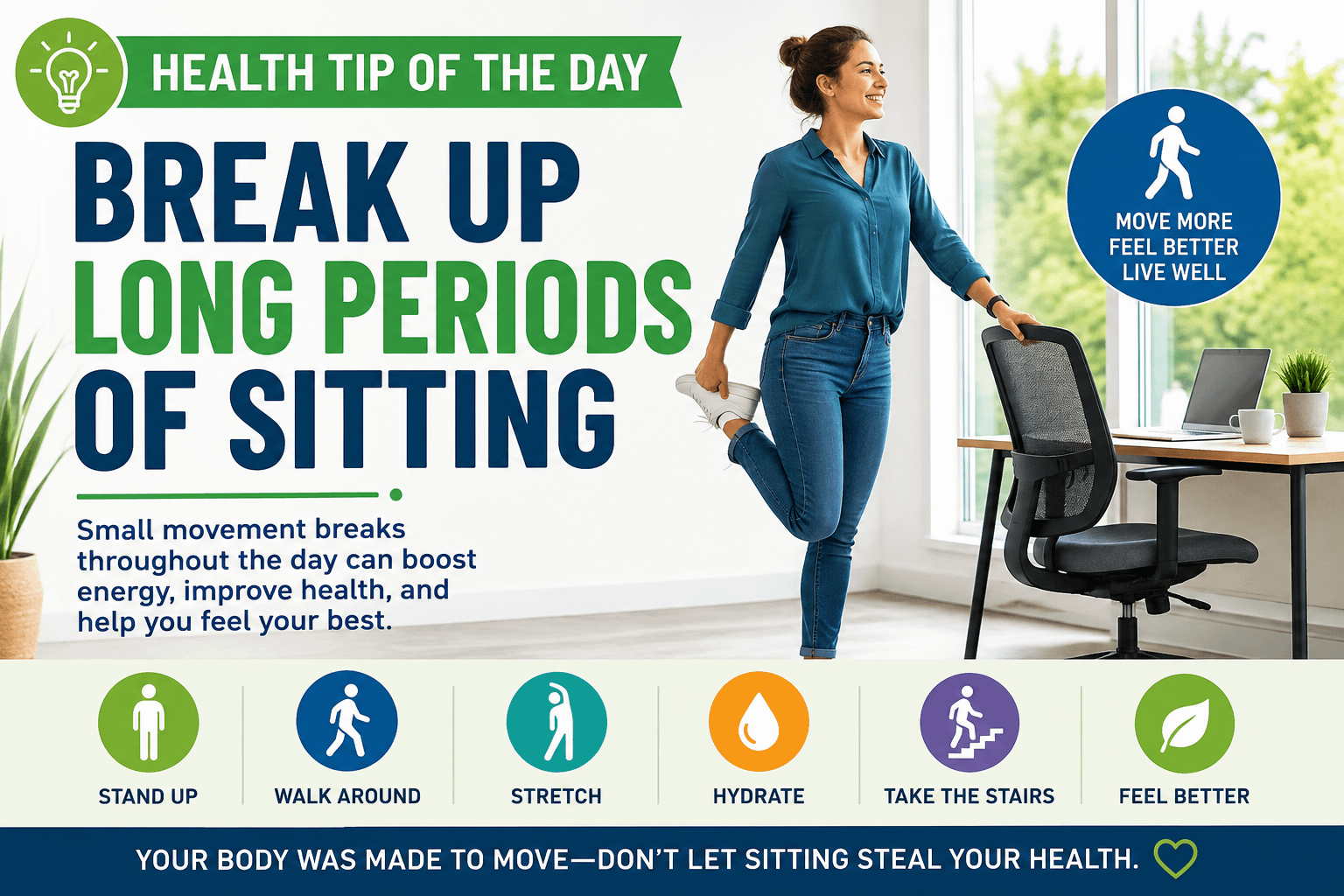
It is surprisingly easy to spend most of the day sitting.
You might sit while eating breakfast, driving to work, working at a desk, attending meetings, watching television, using your phone, playing video games, or relaxing at night. Even on a busy day, you can spend hours in a chair without realizing just how little you’ve moved.
That’s why today’s Health Tip of the Day focuses on a simple habit that can make your day more active:
Break Up Long Periods of Sitting
You don’t have to completely change your lifestyle overnight. You don’t need to turn every break into a workout, either.
The goal is much simpler.
Don’t stay in the same seated position for hours at a time when you’re able to move.
Stand up. Stretch. Walk around the room. Refill your water. Step outside. Complete a household chore. Take a short walk.
Small movement breaks throughout the day can help you build a lifestyle where physical activity becomes something you naturally incorporate into your routine.
We Sit More Than We Realize
Think about a typical day.
You wake up and sit down for breakfast.
You sit in your car during your commute.
You arrive at work and sit at your desk.
You sit during lunch.
You drive home.
You sit while eating dinner.
Then you sit on the couch watching television or scrolling through your phone.
Even someone who feels busy throughout the day can accumulate a lot of sitting time.
Technology has made many parts of life easier, but it has also removed many opportunities for everyday movement.
We can order food without leaving the couch. We can shop online without walking through a store. We can communicate with coworkers without leaving our desks. Entertainment is available instantly on our televisions, computers, tablets, and phones.
Convenience isn’t necessarily bad, but it means we sometimes have to intentionally create opportunities to move.
Your Body Was Made to Move
The human body isn’t designed to remain completely still all day.
Muscles, joints, bones, and the cardiovascular system all benefit from regular movement. Physical activity also plays an important role in maintaining overall health and independence.
That doesn’t mean you need to constantly exercise.
It simply means that movement should remain part of everyday life.
Walking across a parking lot is movement.
Cleaning your kitchen is movement.
Gardening is movement.
Taking the stairs is movement.
Walking the dog is movement.
Stretching after sitting at your desk is movement.
Playing with your children or grandchildren is movement.
Taking groceries into the house is movement.
All of these activities contribute to a more active day.
Exercise Is Important, but So Is Everyday Movement
A common misconception is that exercising once means you don’t need to think about movement during the rest of the day.
Imagine someone who exercises for 30 minutes in the morning but then spends most of the next ten hours sitting.
That workout is still valuable, but there are also many hours throughout the day where additional movement could be incorporated.
This is why it can be helpful to think about health in two ways:
Planned exercise and everyday movement.
Planned exercise might include walking, strength training, swimming, cycling, or another structured activity.
Everyday movement includes all the smaller physical activities that happen between workouts.
Both matter.
Instead of thinking, “I already exercised today,” consider asking:
“How can I continue moving throughout my day?”
Why Breaking Up Sitting Time Can Be Helpful
Long periods of sitting often mean your large muscles aren’t doing very much.
Getting up periodically changes that.
Even simple movement requires your muscles to become active again. Walking across the room, standing while talking on the phone, or stretching for a few minutes interrupts a long period of inactivity.
Movement breaks can also help you notice stiffness that develops after you’ve been sitting in one position for too long.
You may have experienced this yourself.
You spend a couple of hours working at the computer and finally stand up.
Your back feels tight.
Your hips feel stiff.
Your legs need a moment to adjust.
Your shoulders may be hunched forward from looking at the screen.
Sometimes the body simply appreciates a change of position.
Start With a Simple Movement Reminder
When you’re focused on something, time can disappear.
You might intend to work for 30 minutes and suddenly realize you’ve been sitting for two hours.
Setting a reminder can help.
Consider creating a reminder every 30 to 60 minutes during periods when you’re likely to remain seated.
When the reminder goes off, you don’t necessarily need to stop working for long.
Try taking a brief movement break.
Stand up.
Stretch.
Walk around.
Get some water.
Look away from the screen.
Then return to what you were doing.
If getting up every 30 to 60 minutes isn’t practical for your schedule or abilities, choose an interval that works for you. The important thing is avoiding unnecessary stretches of prolonged inactivity whenever possible.
The Two-Minute Movement Break
One useful approach is to make movement so easy that it becomes difficult to make excuses.
Tell yourself:
“I’m going to move for two minutes.”
Walk around your home.
Stand and stretch.
Walk down the hallway.
Put away a few dishes.
Take something to another room.
Step outside.
Walk around your workplace.
Two minutes may not sound impressive, but that isn’t the point.
The goal is to interrupt sitting.
And something interesting often happens once you start moving.
Two minutes sometimes becomes five.
Five minutes sometimes becomes ten.
The hardest part can simply be getting out of the chair.
Use Your Daily Routine as a Reminder
You don’t necessarily need alarms or fitness trackers to remember to move.
You can connect movement to things you already do every day.
This is sometimes called attaching a new habit to an existing routine.
For example:
After finishing your coffee: walk around for a few minutes.
After checking your email: stand and stretch.
After a meeting: take a short walk.
After lunch: walk for five minutes.
After dinner: walk around your neighborhood if you’re able.
During television commercials: get up from the couch.
Between episodes: walk around the house.
While talking on the phone: stand or pace.
When movement becomes connected to activities that already happen naturally, remembering it becomes easier.
Turn Television Time Into Movement Time
Television can easily turn into several hours of uninterrupted sitting.
You don’t have to stop watching your favorite shows.
Instead, use television as a movement reminder.
Between episodes, stand up.
During commercials, walk around the room.
Stretch while watching.
Fold laundry.
Put dishes away.
Walk in place if that is comfortable for you.
Do a simple household task.
Even if you spend most of the evening relaxing, breaking up that sitting time can help you add more movement to your day.
Take Advantage of Phone Calls
Phone calls can be another opportunity to move.
If you don’t need to look at a computer or take detailed notes during the conversation, consider standing.
You could also slowly walk around your home, office, backyard, or another safe area.
A 15-minute conversation could become a 15-minute period of gentle movement instead of another 15 minutes sitting in a chair.
Over the course of a week, those small choices can add up.
Walk After Meals When Appropriate
A short walk after eating can be another convenient way to incorporate movement into your day.
It doesn’t need to be a long or fast walk.
You might simply walk around the block, through your workplace, around your home, or outside for a few minutes.
The important part is developing the habit of moving.
Instead of immediately moving from the dinner table to the couch, consider taking a brief walk first.
It can become a peaceful daily ritual.
Create a More Active Workday
For many people, work is responsible for the largest amount of sitting.
Desk jobs can make movement particularly challenging because sitting is part of the job.
However, small changes can create opportunities to move.
Try standing during certain phone calls.
Walk to speak with a coworker when appropriate.
Take the stairs when practical.
Use part of your lunch break for a short walk.
Refill your water bottle instead of keeping several drinks at your desk.
Walk the longer route to the restroom.
Stand and stretch between tasks.
If you work from home, you may have even more flexibility.
You can walk around the house between meetings, step outside briefly, stretch in another room, or complete a small household task.
Use Movement to Break Up Screen Time
Sitting and screen time often go together.
Computers, smartphones, tablets, televisions, and gaming systems can keep us in the same position for hours.
Movement breaks can provide benefits beyond simply getting out of your chair.
They also give your mind an opportunity to disconnect from the screen.
Walk into another room.
Look outside.
Step into your yard.
Stretch.
Get some water.
Spend a couple of minutes away from your phone.
You may return feeling more refreshed and focused.
Movement Can Be a Mental Reset
Have you ever stared at a computer screen so long that you stopped being productive?
Sometimes continuing to sit there isn’t the answer.
Get up.
Walk around.
Stretch.
Take a few slow breaths.
Step outside for a moment.
Changing your environment and moving your body can provide a mental break.
You may return to your work with a clearer mind.
This is another reason movement breaks shouldn’t necessarily be viewed as wasted time.
Sometimes taking a short break can help you return with better concentration.
Make Your Environment Encourage Movement
Your surroundings can influence your habits.
If everything you need is within arm’s reach, you have very little reason to leave your chair.
You can intentionally create small reasons to move.
Keep your water somewhere that requires you to stand up to refill it.
Put the trash can slightly farther from your desk.
Walk documents to another area instead of letting them pile up.
Take the stairs when you’re comfortable doing so.
Park a little farther from an entrance when it is safe and appropriate.
None of these actions alone will transform your health.
But together they create a lifestyle that includes more movement.
Household Chores Count as Movement
Sometimes people believe physical activity only counts when they’re wearing workout clothes.
That isn’t true.
Everyday household activities can get you moving.
Vacuuming.
Sweeping.
Doing laundry.
Washing dishes.
Taking out the trash.
Cleaning the bathroom.
Organizing a closet.
Gardening.
Washing your car.
Putting groceries away.
These tasks may not replace structured exercise, but they can certainly help reduce the amount of time you spend sitting.
Instead of viewing chores only as work, consider them another opportunity to get your body moving.
Don’t Underestimate Short Walks
People sometimes avoid walking because they think a walk must be long to be worthwhile.
But shorter walks can be easier to fit into your day.
You might not have 30 uninterrupted minutes available.
But perhaps you have five minutes after breakfast.
Another five minutes during lunch.
Another ten minutes after dinner.
Instead of waiting for the perfect opportunity to exercise, use the opportunities already available.
Consistency is often easier when the goal feels manageable.
Start Where You Are
If you’ve spent years living a mostly sedentary lifestyle, don’t feel like you suddenly need to become extremely active tomorrow.
Start gradually.
Maybe today’s goal is simply standing more often.
Tomorrow, perhaps you add a short walk.
Next week, you might begin walking after dinner several nights.
Healthy habits are easier to maintain when they’re realistic.
Trying to completely transform your lifestyle overnight can feel overwhelming.
Small improvements are easier to repeat.
And repeatable habits are often the ones that last.
Movement Looks Different for Everyone
Not everyone has the same physical abilities.
Someone may be able to walk several miles comfortably, while another person may have difficulty standing for extended periods.
Movement should be appropriate for your body, circumstances, and abilities.
For some people, a movement break might involve walking around the building.
For others, it could mean standing briefly with support.
Someone else may benefit from gentle seated movements or stretches.
The goal isn’t to compare yourself with anyone else.
The goal is to find safe ways to avoid unnecessary inactivity within your own abilities.
If you have a medical condition, significant pain, balance concerns, or mobility limitations, consider discussing appropriate physical activity with a qualified healthcare professional.
Don’t Chase Perfection
You will have days when you sit longer than you intended.
That’s okay.
Maybe work becomes unusually busy.
Maybe you’re traveling.
Maybe you’re exhausted.
Maybe you’re watching a movie and forget to get up.
One long period of sitting doesn’t mean you’ve failed.
Healthy living isn’t about being perfect.
It is about noticing your habits and making better choices more often.
When you realize you’ve been sitting for a long time, don’t criticize yourself.
Simply use that realization as your cue:
Time to move.
Make Movement Something You Enjoy
Movement doesn’t always have to feel like a chore.
Find activities you enjoy.
Walk while listening to your favorite music.
Take your dog outside.
Walk with a family member.
Spend time gardening.
Dance around your home.
Explore a local park.
Play with your children.
Walk while listening to a podcast.
The more enjoyable movement feels, the easier it becomes to repeat.
Small Choices Add Up Over Time
One movement break probably won’t feel significant.
Neither will one short walk.
But health isn’t determined by one moment.
It is influenced by patterns.
Imagine standing and moving for a few minutes several times throughout your day.
Then imagine doing that most days of the week.
Then most weeks of the year.
Those tiny decisions begin forming a completely different pattern from sitting uninterrupted for hours every day.
That is the power of small habits.
A Simple Daily Movement Plan
You don’t need an elaborate fitness schedule to start reducing prolonged sitting.
Try something simple:
Morning: Move around after breakfast instead of immediately sitting down.
Midmorning: Stand and stretch after a period of work.
Lunch: Take a short walk if you’re able.
Afternoon: Walk around or stretch between tasks.
Dinner: Consider a short walk afterward.
Evening: Get up periodically while watching television or using your phone.
That’s it.
You’re simply creating multiple opportunities for movement throughout your day.
Today’s Health Challenge
For the rest of today, become aware of your sitting time.
You don’t need to obsess over numbers.
Just pay attention.
Whenever you realize you’ve been sitting for a long period, ask:
“Can I move for a few minutes right now?”
If you can, do it.
Stand.
Stretch.
Walk.
Get water.
Step outside.
Do a chore.
Walk down the hallway.
Move in whatever safe and comfortable way works for you.
Then continue with your day.
Try repeating that habit tomorrow.
And the next day.
Eventually, you may not need to remind yourself nearly as often because movement has simply become part of your routine.
Final Thoughts: Your Body Needs Regular Movement
Improving your health doesn’t always begin with a dramatic transformation.
Sometimes it begins with standing up.
We often focus on major health goals: losing weight, joining a gym, running a race, changing our entire diet, or beginning an intense exercise program.
Those goals can be worthwhile, but don’t overlook the smaller decisions happening every day.
How long have you been sitting?
Could you stand for a few minutes?
Could you walk around the room?
Could you take a short walk?
Could you stretch?
Could you complete a task that requires you to move?
Those choices may seem small, but they’re part of creating a more active lifestyle.
Your body doesn’t only benefit from movement during scheduled workouts.
It benefits from having regular opportunities to move throughout the day.
So the next time you notice you’ve been sitting for an extended period, use it as your reminder.
Get up.
Move around.
Stretch your legs.
Give your body a break from the chair.
Health Tip of the Day
Break up long periods of sitting.
You don’t have to spend your entire day exercising. Simply look for realistic opportunities to stand, walk, stretch, and move.
A few minutes of movement may seem small, but repeated throughout your day, those small choices can become a healthier way of living.
Leave a ReplyCancel reply