
Life moves quickly. Between work, responsibilities, errands, family, appointments, and everything else demanding our attention, even something as basic as eating can become rushed.
Breakfast may be eaten while getting ready for the day. Lunch might happen at a desk while answering messages. Dinner may be enjoyed in front of the television while scrolling through a phone. Snacks can disappear almost without us realizing we’ve eaten them.
When eating becomes automatic, we may stop paying attention to one of the most important parts of the experience: what our body is telling us.
That’s why today’s health tip is surprisingly simple:
Slow down and pay attention when you eat.
Mindful eating isn’t a strict diet. It doesn’t require expensive foods, complicated meal plans, or counting every calorie. It’s about becoming more aware of your food, your hunger, your fullness, and the experience of eating.
Something as simple as slowing down may help you enjoy meals more, recognize when you’re satisfied, and develop a healthier relationship with food.
What Does It Mean to Eat Mindfully?
Mindful eating means intentionally paying attention while you’re eating rather than allowing the meal to happen completely on autopilot.
Think about the difference between these two situations.
You sit in front of the television with a bag of chips. You’re watching something interesting and reaching into the bag without really thinking about it. Suddenly, you look down and realize you’ve eaten much more than you intended.
Now imagine putting a reasonable portion of those chips into a bowl, sitting down, and actually paying attention to them.
You notice the crunch.
You notice the saltiness.
You notice the flavor.
You notice when the initial hunger or craving begins disappearing.
The food hasn’t changed.
Your awareness has.
That’s the foundation of mindful eating.
Why Do We Eat So Quickly?
Many of us have developed the habit of eating quickly without realizing it.
Maybe you learned to eat fast because lunch breaks were short.
Maybe mornings are always rushed.
Maybe you’ve spent years eating meals while working.
Perhaps you’re used to watching television during dinner.
Or maybe eating quickly has simply become your normal pace.
Modern life often encourages speed.
We want faster internet, faster deliveries, faster service, faster transportation, and faster results.
Unfortunately, that mentality can carry over to meals.
Instead of sitting down and experiencing food, we sometimes treat eating like another item on our to-do list:
Eat. Finish. Move on.
But meals don’t always need to be rushed.
Sometimes slowing down is one of the simplest ways to become more aware of your eating habits.
Your Body Needs Time to Communicate
Hunger and fullness aren’t simply switches that instantly turn on and off.
Your digestive system and brain communicate throughout a meal through physical sensations and hormonal signals.
As you eat, your body gradually begins recognizing that food has arrived and your energy needs are being met.
If you’re eating extremely quickly, however, you may consume a significant amount of food before you fully notice that you’re becoming satisfied.
That’s why slowing down can be helpful.
It creates more opportunity for you to notice the transition from:
Hungry → Less hungry → Comfortable → Satisfied
instead of going directly from:
Hungry → Stuffed.
The goal doesn’t have to be stopping at some perfect moment.
It’s simply becoming better at noticing what your body is communicating.
Learn to Recognize Comfortable Fullness
Many people don’t stop eating when they’re satisfied.
They stop when the plate is empty.
Those aren’t necessarily the same thing.
You may have been taught growing up that you should always finish everything on your plate. That lesson often comes from good intentions, but as adults, it can make it harder to listen to internal hunger and fullness cues.
Mindful eating gives you permission to check in with yourself.
Halfway through your meal, ask:
“Am I still hungry?”
Then ask:
“How would I feel if I stopped eating right now?”
Maybe you’re still hungry.
Continue eating.
Maybe you’re beginning to feel comfortable.
Slow down.
Maybe you’re already satisfied.
You don’t necessarily have to continue simply because food remains on the plate.
Leftovers can become tomorrow’s lunch.
Eating Slowly Can Help You Enjoy Food More
One overlooked benefit of mindful eating is simple:
Food can taste better when you actually pay attention to it.
Think about your favorite meal.
Maybe it’s steak and potatoes.
Perhaps it’s homemade pasta.
Maybe it’s pizza.
Or tacos.
Or grilled chicken.
Or a warm bowl of soup on a cold evening.
Whatever your favorite food happens to be, part of the enjoyment comes from experiencing it.
The aroma.
The temperature.
The seasoning.
The texture.
The first bite.
The combination of ingredients.
If you finish the entire meal in a few minutes while distracted by your phone, you’ve missed much of the experience.
Slowing down allows you to enjoy what you’re eating rather than simply consuming it.
Try Putting Your Fork Down
One of the easiest strategies for eating more slowly doesn’t require counting bites or watching a timer.
Simply put your fork or spoon down occasionally.
Take a bite.
Chew.
Taste your food.
Swallow.
Take a short pause.
Then pick your utensil back up.
You don’t have to do this after every single bite.
The idea is simply to break the habit of preparing your next bite while you’re still chewing the previous one.
That small pause can naturally slow your eating pace.
Chew Your Food Instead of Racing Through It
Another simple mindful-eating practice is paying attention to chewing.
You don’t need to follow a rigid rule such as chewing every bite exactly 20 or 30 times.
Different foods naturally require different amounts of chewing.
Instead, focus on chewing thoroughly enough to experience the food.
Notice how its texture changes.
Notice how the flavors develop.
Then swallow before immediately reaching for another bite.
It sounds incredibly basic.
That’s because it is.
Healthy habits don’t always have to be complicated.
Take Smaller Bites
Large bites naturally encourage faster eating.
Try slightly smaller bites instead.
This can help extend your meal without dramatically changing what you’re eating.
Smaller bites also give you more opportunities to experience your food.
Instead of trying to finish dinner as quickly as possible, think about enjoying the meal one bite at a time.
Remove Some Distractions
One of the biggest challenges to mindful eating is distracted eating.
Television.
Phones.
Social media.
Emails.
Videos.
Work.
Games.
All of these can pull attention away from your meal.
You don’t need to eat every meal alone in complete silence.
That’s not realistic for most people.
Conversation around the dinner table can actually be one of the enjoyable parts of eating.
The goal is simply to reduce distractions that cause you to stop noticing your food entirely.
Try putting your phone somewhere you can’t easily reach during dinner.
Turn off the television occasionally.
Close the laptop.
Give your meal your attention.
Even doing this for the first 10 minutes can be a good place to start.
The 10-Minute Mindful Eating Challenge
Try this experiment with your next meal.
For the first 10 minutes, don’t look at your phone.
Don’t watch television.
Don’t answer emails.
Don’t scroll social media.
Just eat.
During those 10 minutes:
Notice the smell of your food.
Take smaller bites.
Chew slowly.
Put your utensil down occasionally.
Take a sip of water.
Notice the flavors.
Pay attention to your hunger.
You may discover that the meal feels very different when you’re actually present for it.
Understand Physical Hunger
Mindful eating can also help you become more familiar with what physical hunger feels like.
Physical hunger may develop gradually and can include sensations such as an empty feeling in your stomach, stomach growling, lower energy, or difficulty concentrating.
But hunger isn’t the only reason people eat.
Sometimes we eat because we’re bored.
Sometimes we’re stressed.
Sometimes we’re lonely.
Sometimes we’re celebrating.
Sometimes we’re tired.
Sometimes we’re watching a movie and automatically associate the experience with snacking.
Sometimes the food simply looks good.
None of this means you’ve done something wrong.
Food is part of human life and enjoyment.
Mindfulness simply gives you the opportunity to recognize what’s happening.
Ask Yourself Why You’re Eating
Before grabbing a snack, try asking:
“Why do I want to eat right now?”
Maybe the answer is:
“Because I’m hungry.”
Great.
Eat.
But maybe the answer is:
“I’m bored.”
Or:
“I’ve had a stressful day.”
Or:
“I saw the cookies sitting there.”
Recognizing the reason doesn’t mean you’re forbidden from eating.
Instead, it gives you a choice.
You may decide you still want the cookie.
Enjoy it.
Or you may realize you weren’t actually hungry and decide to do something else.
Either way, the decision becomes intentional rather than automatic.
Emotional Eating Happens
Food and emotions have always been connected.
Birthday cake.
Holiday dinners.
Comfort food.
Family recipes.
Celebration meals.
Ice cream after a difficult day.
These connections are normal.
Mindful eating isn’t about eliminating emotion from food.
It’s about recognizing when emotions are driving your eating decisions.
If you’re stressed and craving something, you can acknowledge:
“I’m stressed right now, and I want something comforting.”
That awareness alone can be powerful.
You might still choose to eat.
Or you might choose another comforting activity such as taking a walk, listening to music, calling someone, taking a shower, reading, praying, journaling, or simply resting.
The important thing is having a choice.
Don’t Label Every Food “Good” or “Bad”
Mindful eating can also encourage a more balanced way of thinking about food.
Some foods provide more nutrients than others.
Some foods are better suited for everyday meals.
Others are better enjoyed occasionally.
But constantly labeling yourself as “good” because you ate a salad or “bad” because you ate dessert can create unnecessary guilt around food.
One meal doesn’t define your health.
One dessert doesn’t ruin everything.
One salad doesn’t automatically make your entire diet healthy either.
Your overall eating pattern matters much more than one individual food choice.
Mindful eating focuses on awareness and balance rather than guilt.
Enjoy Your Favorite Foods Without Rushing
Ironically, slowing down can make treats more enjoyable.
Imagine having a slice of chocolate cake.
If you eat it quickly while distracted, the experience may be over in two minutes.
But if you take smaller bites and actually taste the chocolate, frosting, texture, and sweetness, you may get more enjoyment from the experience.
Mindful eating isn’t about removing pleasure from food.
It’s about experiencing that pleasure more intentionally.
Pause Halfway Through Your Meal
Here’s another easy habit.
When you’re approximately halfway through your meal, stop for a moment.
Take a drink of water.
Then ask yourself:
“How hungry am I now?”
Don’t worry about finding the perfect answer.
Just notice.
Are you still very hungry?
Keep eating.
Are you beginning to feel satisfied?
Slow down.
Are you comfortably full?
Maybe you’ve had enough.
This simple check-in can gradually help you become more aware of your body’s signals.
Stop Eating on Autopilot
One of the biggest ideas behind mindful eating is breaking automatic behaviors.
Think about situations where eating happens almost automatically:
Movie = popcorn.
Driving = snacks.
Watching sports = chips.
Stressful day = comfort food.
Late night television = something sweet.
None of these habits are automatically harmful.
But it’s useful to recognize them.
The next time you automatically reach for something, pause for five seconds.
Ask:
“Do I actually want this right now?”
If the answer is yes, enjoy it.
If the answer is no, you’ve interrupted the automatic habit.
That tiny pause can become a powerful tool.
Make Your Meal an Experience
Presentation isn’t only for restaurants.
Even simple food can feel more satisfying when you make the meal intentional.
Instead of eating directly from containers or packages, consider putting food on a plate.
Sit somewhere comfortable.
Pour your drink into a glass.
Take a moment to look at the meal before beginning.
It doesn’t have to be fancy.
You’re simply reminding yourself:
This is a meal. I’m going to take a few minutes and enjoy it.
Eating With Other People Can Naturally Slow You Down
Meals with family or friends often create natural pauses.
You eat.
Someone talks.
You listen.
You respond.
Then you take another bite.
Conversation can help transform eating from a rushed activity into a social experience.
When possible, use meals as opportunities to connect.
Ask about someone’s day.
Share something funny.
Talk about plans.
Enjoy the company.
Healthy living isn’t only about nutrients and exercise.
Relationships and connection matter too.
Give Yourself Enough Time to Eat
Sometimes eating quickly happens because we simply haven’t given ourselves enough time.
If you routinely allow only five minutes for breakfast, you’re probably going to eat quickly.
When possible, build a little more time into meals.
Even an additional five or 10 minutes can make a difference in how rushed the experience feels.
You don’t need an hour-long lunch every day.
Just try not to make every meal a race.
Start With One Meal a Day
Trying to eat mindfully at every meal immediately can feel overwhelming.
Instead, choose one.
Maybe breakfast works best.
Maybe lunch.
Maybe dinner.
Pick the meal where you have the most control over your environment.
For that one meal, practice slowing down.
Once the habit becomes easier, you can bring the same awareness to other meals.
Healthy habits are often easier to maintain when they’re built gradually.
Mindful Eating When Dining Out
Restaurant meals can also be opportunities to practice mindful eating.
Restaurant portions may sometimes be larger than what you’d normally serve yourself at home.
You don’t automatically have to finish everything.
Eat slowly.
Enjoy the conversation.
Pause periodically.
Notice how you feel.
If you’re satisfied before finishing, you can save the remainder for later when practical.
Again, the goal isn’t restriction.
The goal is awareness.
Mindful Eating Doesn’t Mean Perfect Eating
Some days you’ll eat slowly.
Other days you’ll finish lunch in five minutes because you’re busy.
Sometimes you’ll pay attention to your hunger.
Sometimes you’ll realize you’ve eaten an entire bowl of snacks while watching television.
That’s life.
Mindful eating isn’t a test you either pass or fail.
It’s a skill.
And like most skills, it improves with practice.
Every meal gives you another opportunity.
Try a Hunger and Fullness Check
Before eating, pause and ask yourself how hungry you feel.
You don’t need a complicated system.
You could simply think:
Not hungry
A little hungry
Hungry
Very hungry
Then check again during the meal.
Later, notice how you feel afterward.
Are you comfortably satisfied?
Still hungry?
Uncomfortably full?
Over time, you may begin noticing patterns that weren’t obvious before.
Avoid Waiting Until You’re Extremely Hungry
When you’re extremely hungry, slowing down can become much harder.
You may naturally want to eat very quickly.
Regular, balanced meals and appropriate snacks can help some people avoid reaching that point.
This is another reason paying attention to hunger throughout the day can be useful.
Rather than ignoring hunger until you’re ravenous, recognize it earlier.
Water Can Be Part of the Pause
Keeping water with your meal can create natural breaks.
Take a few bites.
Pause.
Have some water.
Continue eating.
You don’t need to drink excessive amounts or force yourself to drink when you aren’t thirsty.
It’s simply another way to create a slower rhythm during your meal while supporting normal hydration.
Pay Attention to How Food Makes You Feel
Mindfulness doesn’t have to stop when the meal ends.
Notice how you feel afterward.
Do you feel energized?
Comfortably satisfied?
Sluggish?
Still hungry?
Uncomfortably full?
Are there certain meals that keep you satisfied longer?
Do certain combinations leave you hungry again quickly?
Your body’s responses can provide useful information about your individual eating patterns.
Mindful Eating and Portion Awareness
One reason mindful eating can be useful is that it encourages you to respond to your body rather than relying entirely on external cues.
External cues might include:
The size of the package.
The amount served at a restaurant.
The size of your plate.
Someone else continuing to eat.
Food remaining on the table.
Mindful eating shifts some attention back toward internal cues.
How hungry am I?
Am I enjoying this?
Am I satisfied?
Do I actually want another serving?
That doesn’t mean ignoring nutrition or reasonable portions. It simply adds another important source of information: your own body’s signals.
Five Simple Ways to Eat More Slowly Today
You don’t have to completely redesign your eating habits.
Start small.
1. Put your phone away.
Give at least part of your meal your full attention.
2. Take smaller bites.
There’s no prize for finishing first.
3. Put your utensil down occasionally.
Create a natural pause between bites.
4. Check your hunger halfway through.
Ask whether you’re still hungry or beginning to feel satisfied.
5. Taste your food.
Pay attention to flavor, temperature, texture, and aroma.
These small actions can gradually change how you experience meals.
Turn Eating Into a Moment of Gratitude
Mindful eating can also be an opportunity for gratitude.
Before beginning your meal, take a moment to appreciate it.
Think about everything that had to happen for that food to reach your plate.
Someone grew it.
Someone harvested it.
Someone transported it.
Someone stocked it.
Someone prepared it.
Perhaps you prepared it yourself.
Maybe someone you love cooked it for you.
For people of faith, mealtime can also be a natural moment to thank God for the food and provision of another day.
Gratitude creates another reason to slow down.
Your Relationship With Food Matters
Health isn’t only about finding the perfect combination of calories, protein, carbohydrates, and fats.
Your relationship with food matters too.
Meals shouldn’t constantly feel like battles between guilt and restriction.
Food nourishes us.
Food brings people together.
Food is part of celebrations.
Food connects us with cultures and traditions.
Food can create memories.
Mindful eating allows room for both nutrition and enjoyment.
The goal is not to fear food.
The goal is to become more intentional about how you eat it.
Don’t Expect Overnight Changes
If you’ve spent decades eating quickly, you probably aren’t going to completely change the habit tomorrow.
That’s okay.
Start by noticing.
Maybe today you realize you eat lunch incredibly quickly.
Tomorrow you decide to slow down for the first five minutes.
A few days later, you start putting your phone away.
Eventually, you begin noticing fullness earlier.
Small changes build on one another.
You don’t have to transform everything at once.
A Simple Mindful Eating Routine
Try this routine with one meal today.
Before the Meal
Pause for a few seconds.
Ask yourself:
“How hungry am I?”
Look at your food.
Notice the smell.
Take a moment of gratitude.
During the Meal
Take smaller bites.
Chew thoroughly.
Taste your food.
Put your utensil down occasionally.
Take natural pauses.
Drink water when you’re thirsty.
Halfway Through
Stop briefly.
Ask:
“Am I still hungry?”
“Am I beginning to feel satisfied?”
Then continue based on what your body is telling you.
After the Meal
Notice how you feel.
Don’t judge yourself.
Simply observe.
That’s mindfulness.
Healthy Habits Don’t Have to Be Extreme
Health advice often focuses on major changes.
Lose a large amount of weight.
Completely change your diet.
Exercise every day.
Eliminate certain foods.
Track everything.
But sustainable health can also be built through much smaller habits.
Drinking more water.
Adding vegetables to dinner.
Taking a short walk.
Getting enough sleep.
Choosing nutritious snacks.
Eating slowly.
These habits may seem small individually, but consistent small decisions can add up over time.
Give Yourself Permission to Slow Down
Meals are one of the few activities we do every single day.
Instead of treating every meal as something that needs to be completed as quickly as possible, allow yourself to experience it.
Sit down.
Put the phone away.
Take the first bite.
Taste it.
Have a conversation.
Pause.
Listen to your body.
Enjoy your food.
You may discover that slowing down isn’t only beneficial for your eating habits.
It can also provide a few peaceful minutes during an otherwise busy day.
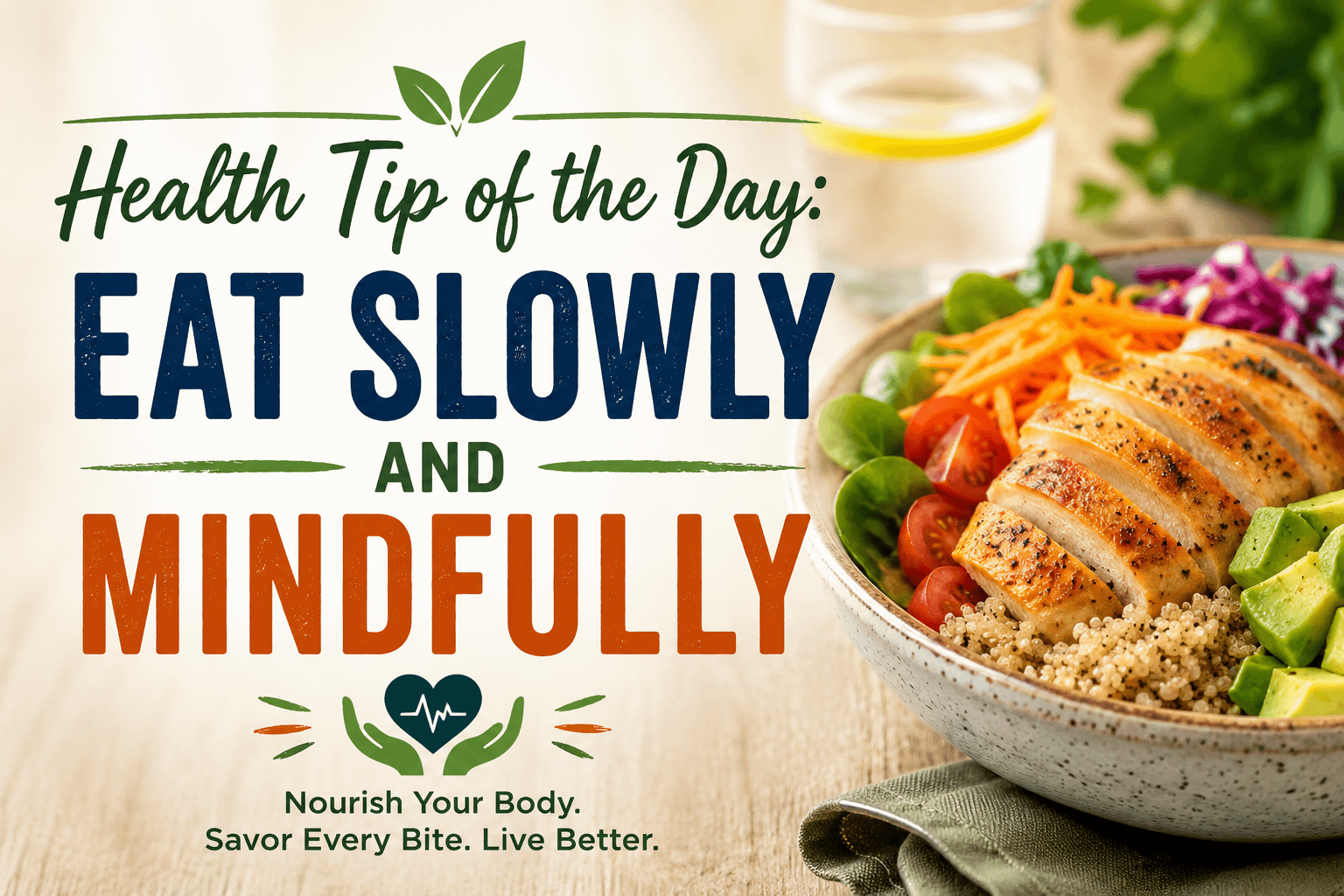
Health Tip of the Day
Eat slowly and mindfully.
Pay attention to your hunger before you begin eating. Take smaller bites, chew thoroughly, reduce distractions when possible, and give your body time to recognize when you’re becoming satisfied.
Don’t worry about doing it perfectly.
Start with one meal.
Then one snack.
Then another meal.
The goal isn’t to create another complicated health rule.
The goal is simply to become more present.
Because healthier eating isn’t always about changing what’s on your plate.
Sometimes it’s about changing how you experience what’s already there.
Today’s Healthy Challenge
Choose one meal today and make it a mindful meal.
Put your phone away for at least the first 10 minutes.
Take smaller bites.
Slow down.
Taste your food.
Pause halfway through.
Ask yourself whether you’re still hungry.
And most importantly, enjoy the experience.
Your next healthier habit may not require eating less, counting more, or following another complicated rule. It may simply begin by slowing down.
Leave a ReplyCancel reply