
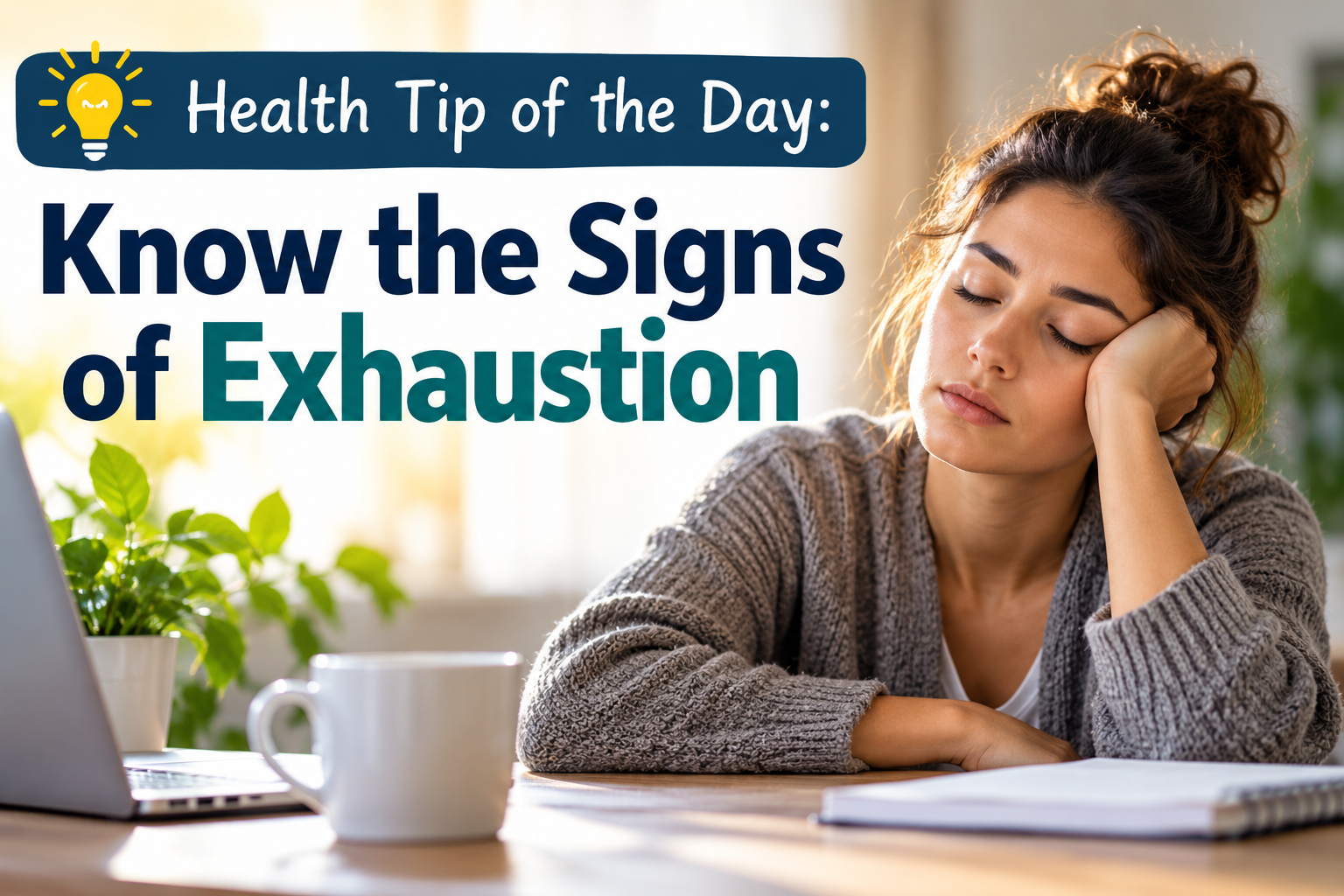
Everyone gets tired. You may have a long day at work, stay up too late, spend hours taking care of responsibilities, or simply have a day when your energy is lower than usual. Most of the time, a good night’s sleep and some rest help you recover.
Exhaustion can be different.
When you become physically, mentally, or emotionally exhausted, your body may start sending warning signs that you need more than another cup of coffee or a few extra minutes on the couch. Exhaustion can affect your concentration, mood, motivation, physical strength, sleep, and ability to handle everyday responsibilities.
One of the most important health habits you can develop is learning to recognize these signals before you reach the point where you feel completely drained.
Today’s health tip is simple:
Know the signs of exhaustion and give your body and mind the recovery they need.
Tiredness and Exhaustion Aren’t Always the Same
Feeling tired occasionally is normal.
Maybe you didn’t sleep well last night. Perhaps you had an unusually busy day. You might have exercised harder than usual or spent several hours dealing with stressful situations.
Ordinary tiredness will often improve after adequate sleep, food, hydration, and downtime.
Exhaustion may feel deeper.
You may wake up tired even after sleeping. Tasks that normally seem easy can suddenly require much more effort. Your patience may disappear quickly. Concentrating can become difficult, and you might find yourself wanting to withdraw from activities or people.
When those feelings continue, they deserve your attention.
Your body has ways of telling you when something isn’t right.
The challenge is learning to listen.
1. You Feel Tired All the Time
One of the most obvious signs of exhaustion is persistent fatigue.
You aren’t simply tired at bedtime.
You may feel tired when you wake up, tired throughout the afternoon, and tired again in the evening.
You might find yourself saying:
“I don’t know why I’m so tired.”
If adequate rest doesn’t seem to restore your energy, don’t automatically assume you need to push yourself harder.
Persistent fatigue can have many causes, ranging from lifestyle factors and inadequate sleep to medications and medical conditions. If it continues despite reasonable rest and self-care, consider discussing it with a healthcare professional.
2. You’re Having Trouble Concentrating
Exhaustion doesn’t only affect your muscles.
It can affect your thinking.
When you’re extremely tired, you may have difficulty focusing on conversations, reading, work, or other tasks. You may walk into a room and forget why you went there. Decisions that normally take a few seconds can suddenly feel overwhelming.
Some people describe this as brain fog.
Your brain needs adequate rest just as much as the rest of your body does.
If you’ve been pushing yourself without enough recovery, difficulty concentrating can be a signal that you need to slow down.
3. You’re Becoming More Irritable
Have you noticed yourself becoming frustrated over things that normally wouldn’t bother you?
Maybe you’re snapping at people.
Perhaps small inconveniences feel enormous.
You might have less patience with coworkers, family members, friends, traffic, technology, or everyday responsibilities.
Sometimes the problem isn’t necessarily the situation.
You may simply be exhausted.
Sleep deprivation and fatigue can make emotional regulation more difficult. When your mental resources are depleted, dealing with another problem can feel much harder.
Recognizing this can help you respond differently.
Instead of immediately thinking, “Why am I so angry?” consider asking:
“Am I exhausted?”
4. You’re Losing Motivation
Exhaustion can make even simple tasks feel enormous.
Laundry sits untouched.
Messages go unanswered.
Exercise gets postponed.
You don’t want to cook.
You don’t want to clean.
You don’t want to go anywhere.
You may even lose interest in hobbies and activities you normally enjoy.
Sometimes your mind and body are simply telling you that you’ve been running on empty for too long.
However, persistent loss of interest or motivation can also occur with depression and other health concerns. If it lasts, worsens, or begins interfering significantly with your life, consider reaching out to a qualified healthcare professional.
5. You’re Experiencing Headaches or Physical Tension
Stress and exhaustion can show up physically.
You might notice tension in your:
- Neck
- Shoulders
- Back
- Jaw
- Head
Headaches may become more frequent.
Muscles may feel tight or sore.
You might realize you’ve been clenching your jaw or keeping your shoulders tense without even noticing it.
Rest, hydration, gentle movement, stretching, and reducing stress may help in some situations.
But don’t automatically assume new, severe, persistent, or unusual pain is caused by exhaustion. New or concerning symptoms should be medically evaluated.
6. Your Sleep Is Getting Worse
It seems strange that someone who is exhausted could have trouble sleeping, but it happens.
You can feel completely drained while your mind continues racing.
You lie down and suddenly think about everything that happened today.
Then tomorrow.
Then next week.
Then something that happened five years ago.
Before you know it, you’re staring at the clock wondering why you can’t fall asleep.
Poor sleep can then contribute to greater fatigue the following day, creating a frustrating cycle:
Stress → poor sleep → exhaustion → more stress → poorer sleep.
Breaking that cycle may require intentionally creating time to unwind.
Try reducing stimulation before bedtime, maintaining a reasonably consistent sleep schedule, and creating a calm environment that encourages rest.
7. You’re Relying Heavily on Caffeine
Coffee isn’t automatically a problem.
For many people, moderate amounts of caffeine are part of their normal routine.
But pay attention to why you’re reaching for it.
If you constantly need caffeine or other stimulants simply to function throughout the day, your body may be telling you something.
Caffeine can temporarily increase alertness, but it doesn’t replace sleep.
Using more caffeine later in the day can also interfere with sleep for some people, potentially creating another cycle:
You’re exhausted → you consume more caffeine → you have trouble sleeping → you’re even more tired tomorrow.
Instead of only asking, “How can I get more energy?”
Also ask:
“Why don’t I have enough energy?”
8. You’re Making More Mistakes
Exhaustion can affect reaction time, judgment, attention, and memory.
You might forget appointments.
You may overlook something obvious.
You might make mistakes at work that you normally wouldn’t make.
You could miss a turn while driving or realize that you aren’t paying close attention to the road.
This is especially important when driving or operating machinery.
Severe sleepiness and driving are a dangerous combination.
If you’re struggling to stay awake, don’t try to prove that you can push through it. Find a safe alternative rather than continuing to drive while dangerously sleepy.
9. You’re Withdrawing From Everyone
When you’re exhausted, social interaction can start feeling like another responsibility.
You may stop answering calls.
You may decline invitations.
You may spend more time alone because you simply don’t have the energy to interact.
Sometimes temporary solitude is exactly what you need.
There is nothing wrong with taking some quiet time.
But if isolation becomes persistent or accompanies sadness, hopelessness, anxiety, or loss of interest in things you normally enjoy, consider talking with someone you trust or seeking professional support.
10. Your Body Feels Heavy
Sometimes exhaustion is difficult to describe.
You simply feel heavy.
Getting out of bed takes effort.
Walking across the room feels harder.
Your arms and legs may feel unusually tired.
Even thinking about everything you need to accomplish can make you want to sit back down.
That doesn’t mean you’re lazy.
Your body may be asking for recovery.
Give yourself permission to recognize the difference between avoiding responsibilities and genuinely needing rest.
Stop Treating Rest Like a Reward
One reason people become exhausted is because we’ve developed the idea that rest must be earned.
Finish everything first.
Answer every message.
Complete every task.
Help everyone.
Clean everything.
Work another hour.
Then you can rest.
The problem is that there will almost always be another responsibility waiting.
Rest isn’t something humans earn after completing every possible task.
Rest is part of taking care of your health.
You wouldn’t expect your phone to continue operating indefinitely without charging it.
Your body isn’t much different.
Eventually, you need to recharge.
Learn to Say No
Sometimes exhaustion comes from carrying too much.
We say yes because we don’t want to disappoint people.
Yes, I’ll help.
Yes, I’ll go.
Yes, I’ll handle it.
Yes, I’ll stay late.
Yes, I’ll take care of that too.
Eventually, all those yeses can leave you with nothing left for yourself.
Learning to say no doesn’t mean you don’t care about other people.
Sometimes saying no simply means recognizing your limits.
You cannot continuously give energy you don’t have.
Take Small Breaks Before You Reach Your Breaking Point
You don’t have to wait until you’re completely exhausted before resting.
Small periods of recovery throughout the day can help.
Step outside.
Stretch.
Drink some water.
Eat something nourishing if you’ve skipped a meal.
Close your eyes for a few minutes.
Take a short walk if you’re able.
Put your phone down.
Sit somewhere quiet.
Take a few slow breaths.
Even a short pause can remind you that you don’t have to operate at maximum speed every moment of the day.
Give Sleep the Importance It Deserves
Adults generally need at least seven hours of sleep per night, although individual needs vary.
Sleep isn’t wasted time.
While you sleep, your body and brain are carrying out important processes related to memory, immune function, metabolism, emotional regulation, and physical recovery.
Consistently sacrificing sleep to gain a few additional waking hours can eventually work against you.
You may have more hours awake but less energy, concentration, patience, and productivity during those hours.
Protecting your sleep is an investment in tomorrow.
When Exhaustion Shouldn’t Be Ignored
Not every case of persistent exhaustion can be solved with a weekend of rest.
Ongoing fatigue can sometimes be associated with sleep disorders, anemia, thyroid problems, infections, medication effects, depression, anxiety, nutritional deficiencies, heart or lung conditions, and many other medical issues.
If you’re constantly exhausted despite getting adequate sleep and taking reasonable care of yourself, talk with a healthcare professional.
You should also seek prompt medical attention for severe or sudden symptoms, especially exhaustion accompanied by symptoms such as chest pain, significant difficulty breathing, fainting, confusion, new weakness, or another serious or rapidly worsening symptom.
It is better to investigate an unexplained change in your health than repeatedly assume you simply need to “tough it out.”
Listen Before Your Body Has to Shout
Your body often gives you smaller warning signs before something becomes impossible to ignore.
You feel tired.
You become irritable.
Your concentration slips.
You stop enjoying things.
You aren’t sleeping properly.
Everything feels harder.
You tell yourself:
“I’ll rest later.”
Later becomes tomorrow.
Tomorrow becomes next week.
And eventually your body may force you to stop.
Pay attention earlier.
There is strength in knowing when to keep going, but there is also wisdom in knowing when you need recovery.
Today’s Health Tip
Know the signs of exhaustion.
Pay attention when your body feels unusually drained.
Notice changes in your mood.
Recognize when your concentration is disappearing.
Protect your sleep.
Drink enough fluids.
Eat regularly and aim for nutritious foods.
Take breaks.
Set boundaries.
Ask for help when you need it.
And if persistent exhaustion doesn’t improve or doesn’t have an obvious explanation, talk with a healthcare professional.
You only get one body.
Taking care of it isn’t weakness.
It’s responsibility.
Sometimes one of the healthiest things you can say is:
“I’ve done enough for today. I need to rest.”
A Question to Think About
When was the last time you allowed yourself to truly rest without feeling guilty about it?
Maybe today is the day to listen to what your body has been trying to tell you.





Leave a ReplyCancel reply