
It is easy to focus on what is missing.
We notice the things that went wrong, the plans that did not work out, the bills that need to be paid, the problems waiting for solutions, and the goals we have not reached yet. We can spend so much time thinking about what we wish were different that we overlook the good things already surrounding us.
That is where gratitude can make a difference.
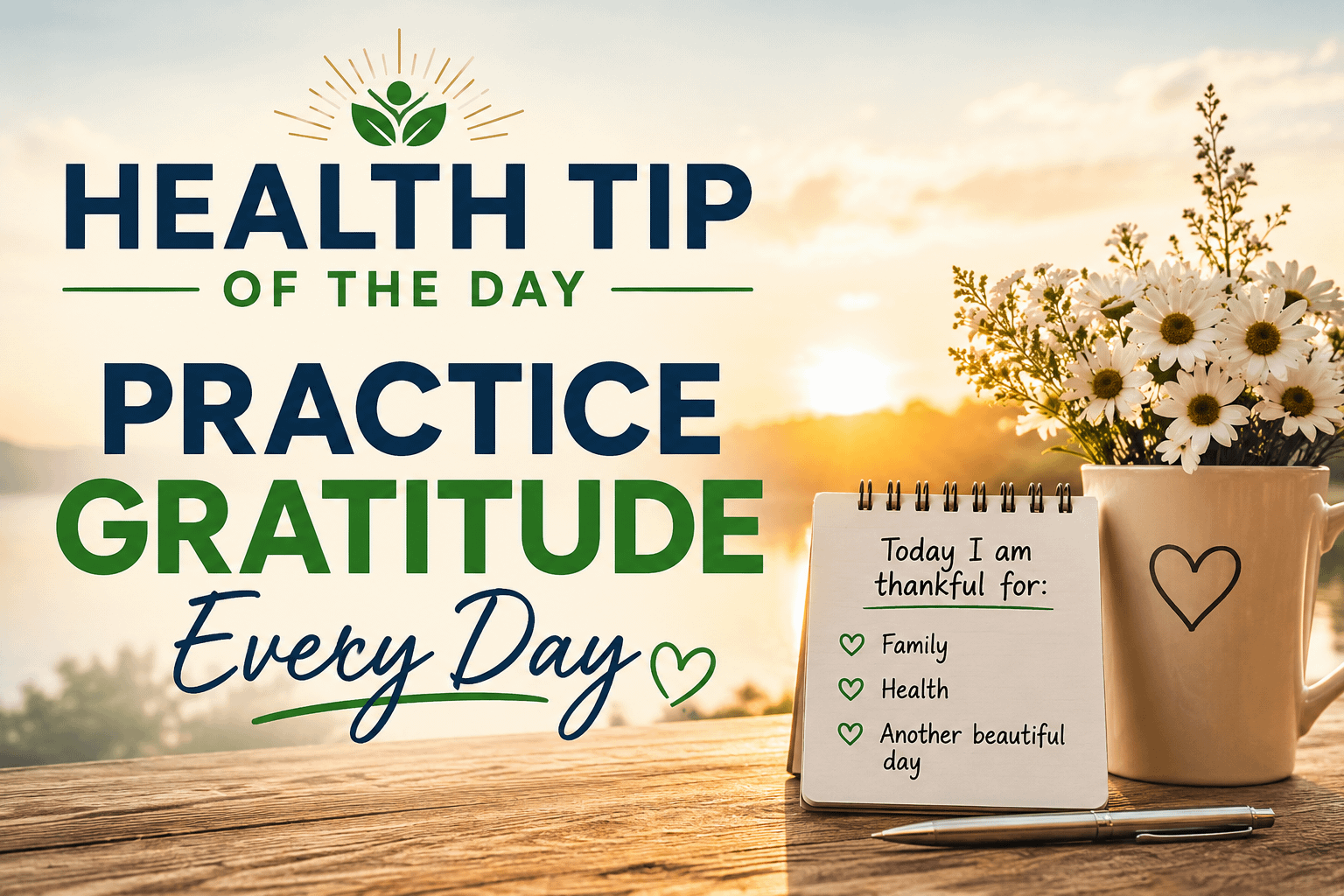
Health Tip of the Day: Practice Gratitude Every Day.
Gratitude does not require pretending that everything in your life is perfect. It does not mean ignoring pain, disappointment, stress, grief, or uncertainty. Instead, gratitude is the intentional practice of recognizing the good that exists alongside life’s difficulties.
Sometimes that good is something significant—a loving relationship, a new opportunity, a major accomplishment, or a beautiful experience.
Other times, it is remarkably simple.
A hot cup of coffee.
A comfortable bed.
A conversation with someone you care about.
A beautiful sunset.
A favorite song.
A quiet moment.
A good meal.
A laugh you did not expect.
Another morning to wake up and try again.
When you intentionally begin noticing these moments, gratitude can become more than an occasional feeling. It can become a daily habit that supports your emotional well-being, relationships, perspective, and overall quality of life.
Gratitude Is More Than Saying “Thank You”
Most of us learn to say “thank you” when we are children. Someone gives us something, helps us, or does something kind, and we are taught to acknowledge it.
That is an important form of gratitude, but practicing gratitude goes much deeper.
Gratitude is about developing awareness.
It means slowing down enough to recognize the people, experiences, opportunities, comforts, and small joys that might otherwise pass unnoticed.
Think about how many ordinary things you experience every day without giving them much thought.
Running water.
Electricity.
A warm shower.
Transportation.
Food in the refrigerator.
A phone call from someone who cares about you.
The ability to hear music.
The ability to see the sky.
The smell of breakfast cooking.
The feeling of fresh air.
These things may seem ordinary because we experience them regularly. But when we intentionally notice them, ordinary moments can become reminders that life contains more goodness than we sometimes realize.
Why Our Minds Often Notice the Negative First
Human beings naturally pay attention to potential problems.
If ten things go well during your day and one thing goes badly, which one are you most likely to think about when you are lying in bed that night?
For many people, it is the negative experience.
Maybe someone made a rude comment.
Perhaps you made a mistake at work.
Maybe traffic was terrible.
Perhaps you received disappointing news.
Suddenly, that single frustrating moment begins dominating your thoughts while the many positive or neutral experiences disappear into the background.
Practicing gratitude encourages you to deliberately notice what your mind might otherwise overlook.
Instead of allowing one difficult moment to define your entire day, you can recognize the complete picture.
You might say:
“Today was stressful, but I had a great conversation with a friend.”
“I am dealing with uncertainty, but I am thankful for the people supporting me.”
“I did not accomplish everything I wanted today, but I made progress.”
“This season of life is difficult, but something still made me smile today.”
Gratitude does not erase the difficult part of those statements.
It simply prevents difficulty from becoming the only thing you see.
Gratitude Can Help Change Your Perspective
Imagine looking through a camera.
Whatever you point the camera toward becomes the picture.
Life works similarly.
There may be hundreds of things happening around you at any given moment, but your attention determines what receives the greatest focus.
If your attention constantly searches for problems, disappointments, comparisons, and frustrations, your world may begin feeling overwhelmingly negative.
Gratitude encourages you to intentionally redirect some of that attention.
You begin asking different questions.
Instead of:
“What went wrong today?”
You might ask:
“What went right today?”
Instead of:
“What don’t I have?”
Ask:
“What do I already have that I appreciate?”
Instead of:
“Why isn’t my life better?”
Ask:
“What is something good about my life right now?”
These questions do not magically solve problems.
They do something equally important: they remind you that your problems are not the entirety of your life.
Start Your Morning With Gratitude
The first few minutes of your morning can influence the tone of your day.
Many people wake up and immediately reach for their phones.
Within minutes, they may be reading emails, checking social media, looking at news stories, thinking about work, or mentally reviewing everything they need to accomplish.
Before the day has even started, stress has already entered the room.
Try creating a different morning habit.
Before checking your phone, identify three things you are thankful for.
They do not have to be profound.
You might think:
“I’m thankful I slept well.”
“I’m thankful for another morning.”
“I’m thankful for the coffee I’m about to drink.”
“I’m thankful for my family.”
“I’m thankful I have work today.”
“I’m thankful for the roof over my head.”
“I’m thankful the sun is shining.”
“I’m thankful for someone who checked on me yesterday.”
Starting your morning this way encourages your mind to begin the day by recognizing something positive before outside distractions demand your attention.
Keep a Gratitude Journal
One of the simplest ways to develop a gratitude habit is to write things down.
You do not need an expensive journal or complicated system.
A notebook works.
A notes app on your phone works.
Even a piece of paper beside your bed works.
Each evening, write down three things you appreciated about your day.
For example:
- I had a delicious lunch.
- Someone made me laugh.
- The weather was beautiful during my walk.
Some days your list may include major events.
Other days it might contain extremely ordinary things.
That is perfectly fine.
The purpose is not to create an impressive list.
The purpose is to train yourself to notice.
After practicing this regularly, you may discover something interesting: you start looking for things to appreciate throughout the day because you know you will be writing them down later.
A beautiful moment happens and you think, “That’s going in my gratitude journal tonight.”
That shift in awareness can be powerful.
Appreciate the Small Things
We sometimes convince ourselves that happiness will arrive after something major happens.
When I get the promotion.
When I make more money.
When I lose the weight.
When I buy the house.
When I take the vacation.
When I reach my goal.
Goals are valuable, but life cannot consist entirely of waiting for the next major accomplishment.
Much of life happens between the milestones.
Gratitude helps you appreciate those ordinary spaces.
The smell of dinner cooking.
Your favorite chair.
A cool breeze through an open window.
A funny message from a friend.
Your pet greeting you when you walk through the door.
Finding your favorite song on the radio.
Watching the sunrise.
Sitting outside with a cup of coffee.
Hearing someone you love laugh.
These moments might never become major memories, but collectively they make up a tremendous portion of our lives.
Do not become so focused on extraordinary experiences that you forget to appreciate ordinary happiness.
Tell People You Appreciate Them
Gratitude becomes even more meaningful when it is shared.
Think about someone who has made a positive difference in your life.
When was the last time you told them?
You do not need to wait for a birthday, holiday, anniversary, or special occasion.
Send a text.
Make a phone call.
Write a note.
Tell them in person.
You could simply say:
“Thank you for always being there.”
“I appreciate everything you do.”
“I’m grateful you’re part of my life.”
“You probably don’t realize how much your support means to me.”
“I’m thankful for our friendship.”
“I just wanted you to know I appreciate you.”
These simple words can strengthen relationships while reminding both people that their connection matters.
Do not assume people know how much they mean to you.
Tell them.
Gratitude Does Not Mean Ignoring Difficult Emotions
One misunderstanding about gratitude is the idea that you should always be positive.
That is not realistic.
There will be days when you are angry.
There will be disappointments.
There will be fear.
There will be loneliness.
There will be grief.
There will be days when finding something to appreciate feels incredibly difficult.
Gratitude does not require denying those emotions.
You can be thankful and sad at the same time.
You can appreciate something while grieving something else.
You can recognize blessings while still wishing circumstances were different.
You can have hope while admitting that today hurts.
Human emotions are complicated enough to hold more than one truth simultaneously.
Sometimes gratitude during difficult seasons is incredibly simple.
“I’m thankful I made it through today.”
“I’m thankful someone called me.”
“I’m thankful I had enough strength to get out of bed.”
“I’m thankful for the memories I still carry.”
“I’m thankful tomorrow gives me another opportunity.”
On difficult days, gratitude does not have to be big.
Sometimes noticing one small thing is enough.
Stop Comparing Your Life to Everyone Else’s
Comparison can quickly steal gratitude.
Social media makes this especially easy.
You see someone’s vacation.
Their new house.
Their relationship.
Their promotion.
Their body transformation.
Their successful business.
Their seemingly perfect family.
Then you look at your own life and begin wondering why you are not where they are.
But you are comparing your complete life—including struggles, insecurities, setbacks, and ordinary days—to a small portion of someone else’s life.
Gratitude redirects your attention toward your own journey.
Instead of asking why someone else has something you do not, consider what exists in your life that deserves appreciation.
Someone else’s success does not reduce the value of what you have.
You can celebrate other people while still appreciating your own progress.
Turn Complaints Into Gratitude When Possible
Everyone complains occasionally.
But sometimes complaints become automatic.
“I have to go to work.”
“I have to cook dinner.”
“I have to exercise.”
“I have to clean the house.”
“I have to drive the kids somewhere.”
Try occasionally replacing “I have to” with “I get to.”
“I get to work and earn an income.”
“I get to prepare food.”
“I get to move my body.”
“I get to take care of my home.”
“I get to spend time with my family.”
This does not mean every responsibility suddenly becomes enjoyable.
It simply changes the perspective.
Things we sometimes consider inconveniences may also represent opportunities or privileges we could easily overlook.
Create Gratitude Reminders
Building any new habit takes repetition.
If gratitude does not come naturally yet, create reminders.
Set a notification on your phone that says:
“What are you grateful for right now?”
Put a sticky note on your bathroom mirror.
Keep a gratitude journal beside your bed.
Make gratitude part of your morning coffee routine.
Ask your family at dinner:
“What was the best part of your day?”
Attach gratitude to something you already do regularly.
Eventually, the reminder may become unnecessary because noticing things to appreciate begins happening naturally.
End Your Day Looking for Something Good
Before falling asleep, take a moment to review your day.
Do not ask whether the entire day was good.
Ask whether there was something good within the day.
Maybe someone smiled at you.
Maybe you completed a task you had been avoiding.
Maybe you enjoyed dinner.
Maybe you heard from an old friend.
Maybe you watched a beautiful sunset.
Maybe you had a peaceful ten minutes to yourself.
Maybe you laughed.
Maybe you helped someone.
Maybe someone helped you.
Maybe nothing particularly exciting happened, and you are simply grateful for a quiet day.
Identify one moment worth appreciating.
Then let that be one of the final thoughts you carry into the night.
Try the Seven-Day Gratitude Challenge
If you want to make gratitude part of your routine, try practicing intentionally for one week.
Day 1: Write down three things you are grateful for.
Day 2: Thank someone who has helped you.
Day 3: Notice something beautiful in nature.
Day 4: Identify something about your health or body that you appreciate.
Day 5: Write down a happy memory.
Day 6: Appreciate something you normally take for granted.
Day 7: Reflect on the entire week and write down the best thing that happened.
At the end of seven days, ask yourself whether you noticed more positive moments than you normally would.
Then consider continuing the practice.
Gratitude Can Become a Way of Living
The goal is not to create a perfect gratitude routine.
You do not have to write ten things every morning.
You do not need a beautiful journal.
You do not have to force yourself to feel thankful every minute of every day.
Simply practice noticing.
Notice the person who holds the door for you.
Notice the meal in front of you.
Notice the person who asks how you are doing.
Notice the sunrise.
Notice the music.
Notice the laughter.
Notice the memories.
Notice the opportunities.
Notice your progress.
Notice the fact that you are still here, still learning, still growing, and still moving forward.
Life moves quickly. If we are not careful, we can spend so much time chasing what comes next that we forget to appreciate what is happening now.
Health Tip of the Day: Find Something to Be Thankful for Today
You do not need to wait until life is perfect to practice gratitude.
You can begin exactly where you are.
Take a moment today and identify three things you appreciate.
Maybe they are big.
Maybe they are small.
Maybe nobody else would understand why they matter to you.
That does not matter.
They are yours to appreciate.
Then tomorrow, do it again.
Over time, gratitude can become a habit of noticing the good that was always there but was sometimes overshadowed by everything demanding your attention.
You will still have difficult days.
Problems will still happen.
Life will still bring unexpected challenges.
But gratitude gives you another place to look.
It reminds you that even during imperfect seasons, there can still be something worth appreciating.
Sometimes happiness is not found by getting everything we want.
Sometimes it begins by recognizing the value of what we already have.
What are three things you are grateful for today?
Leave a ReplyCancel reply