
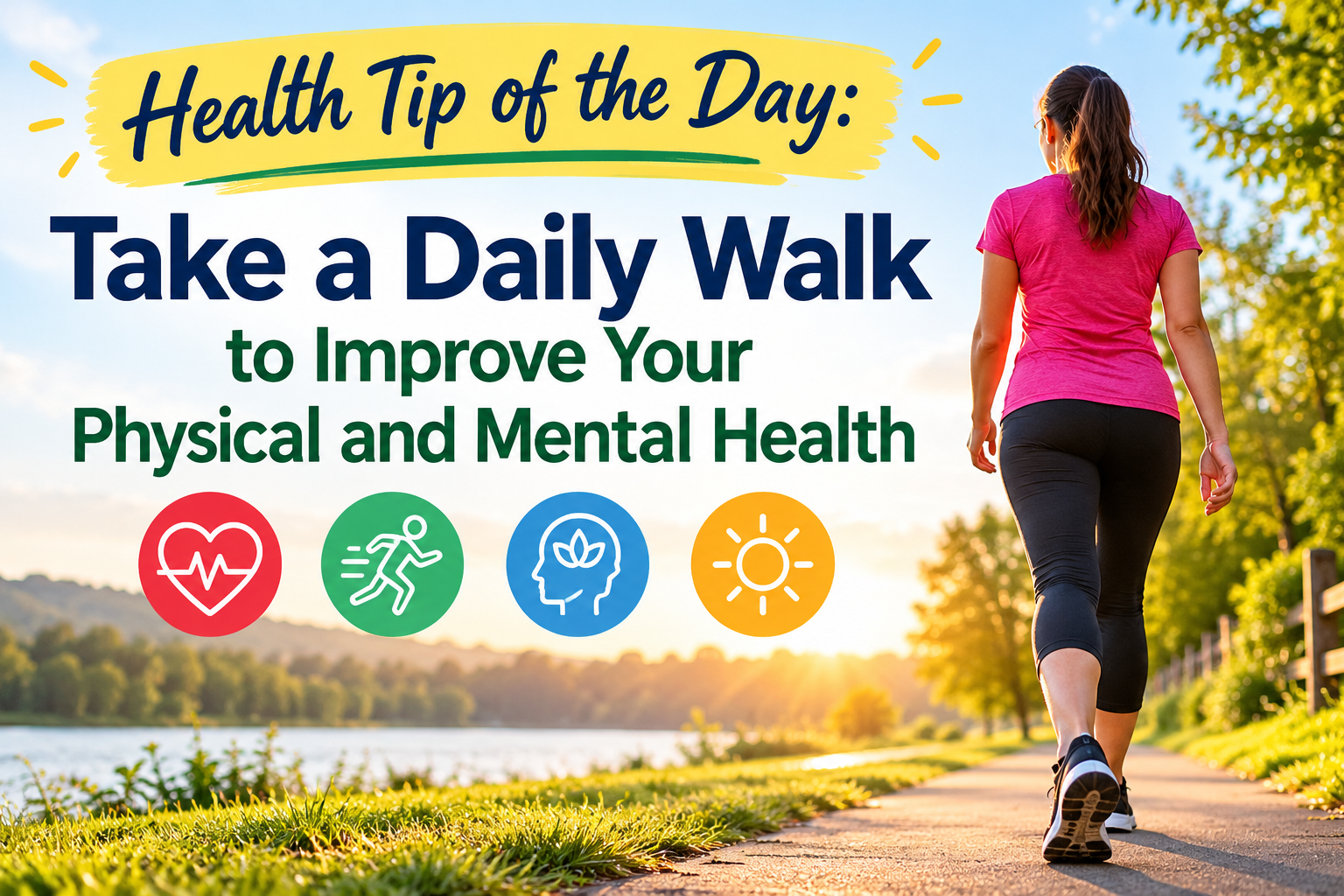
Improving your health does not always require an expensive gym membership, complicated workout routine, or dramatic lifestyle transformation. Sometimes one of the most effective changes you can make is also one of the simplest:
Walk more.
A daily walk may seem too basic to make much of a difference, but regular walking can become an important part of taking care of both your physical and mental well-being. It gets your body moving, gives you an opportunity to spend time outside, and can provide a break from the stress and distractions of everyday life.
You do not have to walk several miles or maintain an intense pace to begin benefiting from the habit. What matters most is finding an amount of movement that works for your current abilities and consistently building from there.
Today’s health tip is simple:
Make walking part of your daily routine—even if you have to start small.
Why Walking Is Such a Powerful Health Habit
Walking is something many of us take for granted. Because it feels like such an ordinary activity, we may not think of it as exercise.
But it absolutely counts as physical activity.
When you walk, your muscles are working, your heart rate can increase, your joints are moving, and your body is using energy. A brisk walk can provide moderate-intensity aerobic activity, while a slower walk can still help someone become more active than they were before.
Walking also has a major advantage over many other forms of exercise: it is accessible.
You don’t necessarily need special equipment.
You don’t have to learn complicated movements.
You don’t need to compete with anyone.
For many people, all it takes is a comfortable pair of shoes and somewhere safe to walk.
That simplicity makes walking easier to turn into a long-term habit.
Walking Can Support Your Heart Health
Your heart is a muscle, and regular physical activity helps support cardiovascular health.
Walking regularly can be one way to incorporate more aerobic activity into your life. As your fitness improves, you may be able to gradually increase your walking pace, distance, or duration.
The goal doesn’t have to be exhausting yourself.
A walk that gets you moving and slightly increases your breathing can be worthwhile.
Consistency is more important than trying to prove how hard you can exercise on a single day.
Think about your health over months and years rather than one workout.
A 20-minute walk may not feel life-changing today. But repeatedly choosing to move your body instead of remaining sedentary can add up.
Walking Can Help With Weight Management
Walking also uses energy, making it one useful component of a healthy weight-management strategy.
However, it is important to keep expectations realistic.
One walk will not suddenly cause significant weight loss. Walking works best as part of an overall healthy lifestyle that may include nutritious food choices, adequate sleep, appropriate portion sizes, hydration, and other forms of physical activity.
The advantage of walking is that it can often be repeated consistently.
Instead of attempting an extremely difficult exercise program that you abandon after a week, you may be better served by establishing a manageable routine that you can maintain.
Start with what you can realistically do.
Then build.
Walking Can Improve Your Mood
The benefits of a walk aren’t limited to physical health.
Walking can also provide an opportunity to mentally reset.
Our days can become filled with notifications, responsibilities, work, appointments, social media, television, and constant stimulation. Sometimes our minds rarely get a quiet moment.
Going for a walk can interrupt that cycle.
You can put your phone away and pay attention to the world around you.
Notice the sky.
Listen to the birds.
Feel the breeze.
Watch the trees.
Take a few deeper breaths.
Give yourself permission to simply walk.
Physical activity can also support mental well-being and may help reduce stress and improve mood.
Walking is not a replacement for professional mental-health treatment when it is needed, but it can be one healthy tool in a larger self-care plan that takes advantage of the mental health benefits of exercise.
You Don’t Have to Walk for an Hour
One reason people avoid exercise is the belief that it doesn’t count unless they do a large amount of it.
They think:
“I don’t have an hour.”
“I can’t walk three miles.”
“I’m too out of shape.”
“I get tired too quickly.”
Those thoughts can prevent someone from doing anything at all.
Instead of focusing on what you cannot do yet, start with what you can do today.
Maybe that’s five minutes.
Walk for five minutes.
If that feels comfortable after a while, try seven minutes.
Then ten.
Then fifteen.
Your starting point doesn’t determine where you will eventually end up.
Progress can happen gradually.
Break Your Walking Into Smaller Sessions
You also don’t necessarily have to complete all of your walking at once.
If a long walk is difficult to fit into your schedule, try shorter walks throughout your day.
You might take a short walk in the morning, another after lunch, and another in the evening.
This can make movement feel much more manageable.
Look for small opportunities to move.
Park slightly farther from the entrance when appropriate.
Walk around during a break.
Take a few laps around your building.
Walk around the block after dinner.
Take the stairs when they are appropriate for your abilities.
Small choices can accumulate.
Make Walking Something You Enjoy
Exercise is easier to maintain when you don’t hate doing it.
Find ways to make walking enjoyable.
Listen to music.
Listen to a podcast.
Walk somewhere with beautiful scenery.
Walk with your spouse, partner, family member, neighbor, or friend.
Take your dog.
Use the time to pray.
Use it to think.
Or leave your headphones at home and enjoy some quiet.
You can also change your routes so that walking doesn’t become boring.
Visit a local park.
Walk near the water.
Explore a neighborhood.
Walk through a shopping center when the weather is bad.
The best walking routine is one you will actually continue doing.
Use Walking as Time Away From Your Screen
Many of us spend hours every day staring at screens.
Phones.
Computers.
Televisions.
Tablets.
Sometimes we move from one screen to another without realizing how much of the day we have spent sitting.
A daily walk creates a natural opportunity to disconnect.
Try taking at least some walks without constantly checking your phone.
Allow your brain to experience a little less stimulation.
You might be surprised how refreshing 15 or 20 minutes away from notifications can feel.
Walking After Meals Can Be a Useful Routine
One easy way to remember to walk is to connect it to something you already do every day.
Meals can provide that trigger.
For example, you might decide:
After dinner, I take a walk.
Instead of relying on motivation, the walk becomes connected to your routine.
Dinner ends.
Shoes go on.
You walk.
Habit-building often becomes easier when a new behavior is attached to an established behavior.
The same strategy could work after breakfast or lunch.
Choose whatever fits your schedule.
Don’t Worry About Being the Fastest Person
Exercise is not a competition.
You don’t need to compare your walking speed with someone else’s.
Someone may walk a mile much faster than you.
That doesn’t mean your walk is worthless.
Someone else may be able to walk five miles while you can currently manage half a mile.
That doesn’t erase your progress.
Your health journey belongs to you.
Focus on improving from your own starting point.
If you walked ten minutes last week and can comfortably walk twelve minutes now, that is progress.
Celebrate improvement without turning your health into a competition.
Set a Realistic Goal
Goals can help you remain consistent, but they should be realistic.
Instead of saying:
“I’m going to walk five miles every single day starting tomorrow.”
Try:
“I’m going to take a 15-minute walk five days this week.”
Once that becomes comfortable, you can increase the goal.
The key is creating a target that challenges you without being so difficult that you immediately become discouraged.
Keep Track of Your Progress
Consider keeping a simple record of your walks.
You could track:
- How many days you walked
- How long you walked
- Your approximate distance
- How you felt before and afterward
- Improvements in stamina over time
Tracking isn’t about becoming obsessed with numbers.
It is about seeing progress that might otherwise be easy to overlook.
You may not notice day-to-day changes, but after several weeks you might realize that a walk that once left you exhausted has become much easier.
That can be incredibly motivating.
Some Days Will Be Harder Than Others
Consistency does not mean perfection.
There will be days when you’re tired.
There will be days when the weather is terrible.
There will be days when you’re busy.
There may be days when your body needs rest.
Missing one walk doesn’t mean you’ve failed.
Simply return to the habit when you can.
One missed day doesn’t destroy your progress any more than one healthy meal creates perfect health.
What matters is the overall pattern.
Listen to Your Body
While walking is generally accessible, everyone’s health situation is different.
Pay attention to pain, dizziness, unusual shortness of breath, chest discomfort, or other concerning symptoms.
Don’t push through serious symptoms simply because you are determined to finish a walk.
People with medical conditions, significant mobility limitations, recent injuries, or concerns about starting exercise should consider discussing an appropriate activity plan with a qualified healthcare professional.
There’s nothing wrong with adapting exercise to your abilities.
Using a mobility aid doesn’t make the movement less meaningful.
Walking slowly doesn’t make it less meaningful.
Taking breaks doesn’t make it less meaningful.
Your goal is to support your health—not punish your body.
Start Where You Are
This may be the most important part of today’s health tip.
You don’t have to wait until you’re healthier to start taking care of your health.
Start where you are.
If you can walk for thirty minutes, walk for thirty.
If you can walk for ten, start with ten.
If five minutes is challenging, start with five.
The person who consistently walks five minutes can eventually become the person who walks ten.
The person who walks ten may eventually walk twenty.
You build from your current ability.
There is no shame in starting small.
Turn Walking Into a Lifestyle
Eventually, the goal is for movement to stop feeling like something unusual you have to force yourself to do.
It simply becomes part of your life.
You wake up.
You eat.
You work.
You handle your responsibilities.
And somewhere in that routine, you move your body.
Some days that might be a dedicated walk.
Other days it might involve gardening, shopping, cleaning, hiking, playing with your children or grandchildren, or doing another activity you enjoy.
Movement doesn’t have to happen exclusively inside a gym.
Your everyday life can become more active.
Today’s Health Challenge
Give yourself one simple challenge today:
Take a walk.
Don’t worry about setting a record.
Don’t worry about reaching a certain number of steps.
Don’t worry about what anyone else is doing.
Choose a safe location and walk for an amount of time appropriate for you.
Even if it is only five or ten minutes, you’ve made a positive choice.
Then try again tomorrow.
Small healthy decisions become powerful when they’re repeated.
Final Thoughts
Better health is rarely created by one dramatic decision.
It is usually built through hundreds of small decisions repeated over time.
Choosing water instead of another sugary drink.
Getting enough sleep.
Eating more nutritious foods.
Going to medical appointments.
Managing stress.
Taking medications as prescribed.
Moving your body.
Taking a walk.
None of those decisions may seem extraordinary on their own.
Together, they can become a healthier lifestyle.
You don’t have to completely transform yourself today.
Just make one healthy choice.
Then make another tomorrow.
If you’re looking for somewhere to begin, put on a comfortable pair of shoes, step outside, and walk.
Your journey toward better health can begin one step at a time.
How could you add a few more minutes of walking or movement to your daily routine this week?
This article is for general educational purposes and is not a substitute for individualized medical advice. If you have health conditions, mobility concerns, or symptoms that make exercise difficult, talk with a qualified healthcare professional about what level of activity is appropriate for you.



Leave a ReplyCancel reply