
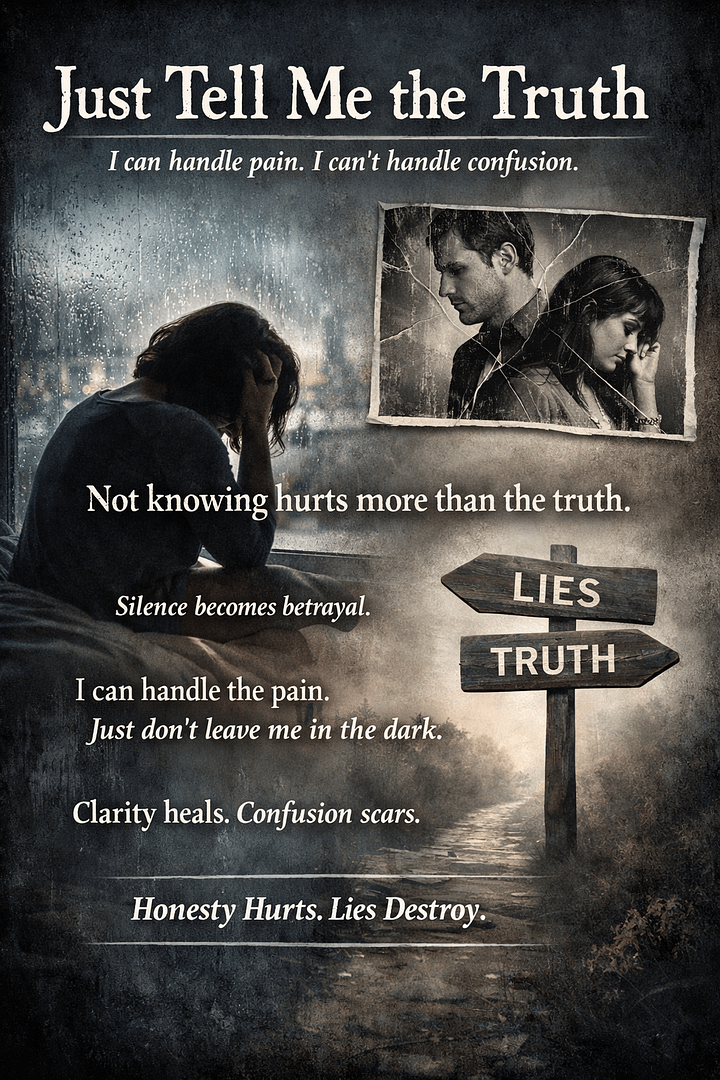
There’s a sentence people say when they’re bracing for impact.
“Just tell me the truth.”
It sounds simple. Direct. Brave, even. But underneath it is something raw:
I can handle pain. I can’t handle confusion.
I can survive hurt. I can’t survive guessing.
Because the space between suspicion and certainty is where the mind does its worst work.
The Weight of Not Knowing
Humans are wired to search for answers. When something feels off — a shift in tone, a distance that wasn’t there before, a story that doesn’t quite line up — the mind starts filling in blanks.
And it rarely fills them with comfort.
Silence becomes betrayal.
Delay becomes rejection.
“Maybe” becomes “definitely.”
Not knowing stretches pain out like a slow ache. Truth, even when it stings, is clean. It has edges. You can wrap your hands around it and say, “Okay. This is real. Now I deal with it.”
But uncertainty? That’s fog. You walk into it and lose your sense of direction.
Why Truth Feels So Hard to Give
People avoid honesty for reasons that feel noble in the moment:
-
“I don’t want to hurt them.”
-
“It’s easier to let this fade.”
-
“They’ll take it badly.”
But withholding truth rarely protects anyone. It only delays the impact while deepening the wound. When the truth finally surfaces — and it always does — it carries an extra sting:
Not only did this happen…
You let me stand in the dark while it was happening.
That’s the part people struggle to forgive.
The Courage on Both Sides
Asking for the truth takes courage. You are essentially saying:
“I’m willing to hear something that might change how I see you, us, or my future. But I’d rather face reality than live in illusion.”
That’s strength, not weakness.
Giving the truth takes courage too. It means choosing discomfort now over damage later. It means respecting someone enough to let them make decisions based on reality, not hope built on half-information.
Truth says: I value you enough not to manipulate your perception.
Pain Heals Faster Than Confusion
Heartbreak with clarity eventually settles. You grieve. You process. You rebuild.
But heartbreak tangled with lies or avoidance? That lingers. You replay conversations. You question your judgment. You lose trust not just in others, but in yourself.
Clarity may hurt sharply, but it heals cleanly.
Confusion wounds quietly and leaves scars that resurface in every future connection.
What “Just Tell Me the Truth” Really Means
It means:
Don’t soften it so much that it stops being real.
Don’t disappear instead of speaking.
Don’t make me decode your silence.
It means:
“I respect myself enough to face the truth. Please respect me enough to give it.”
Honesty doesn’t guarantee the relationship survives.
But it guarantees dignity does.
And sometimes, dignity is what carries us through when everything else falls apart.
Leave a ReplyCancel reply