
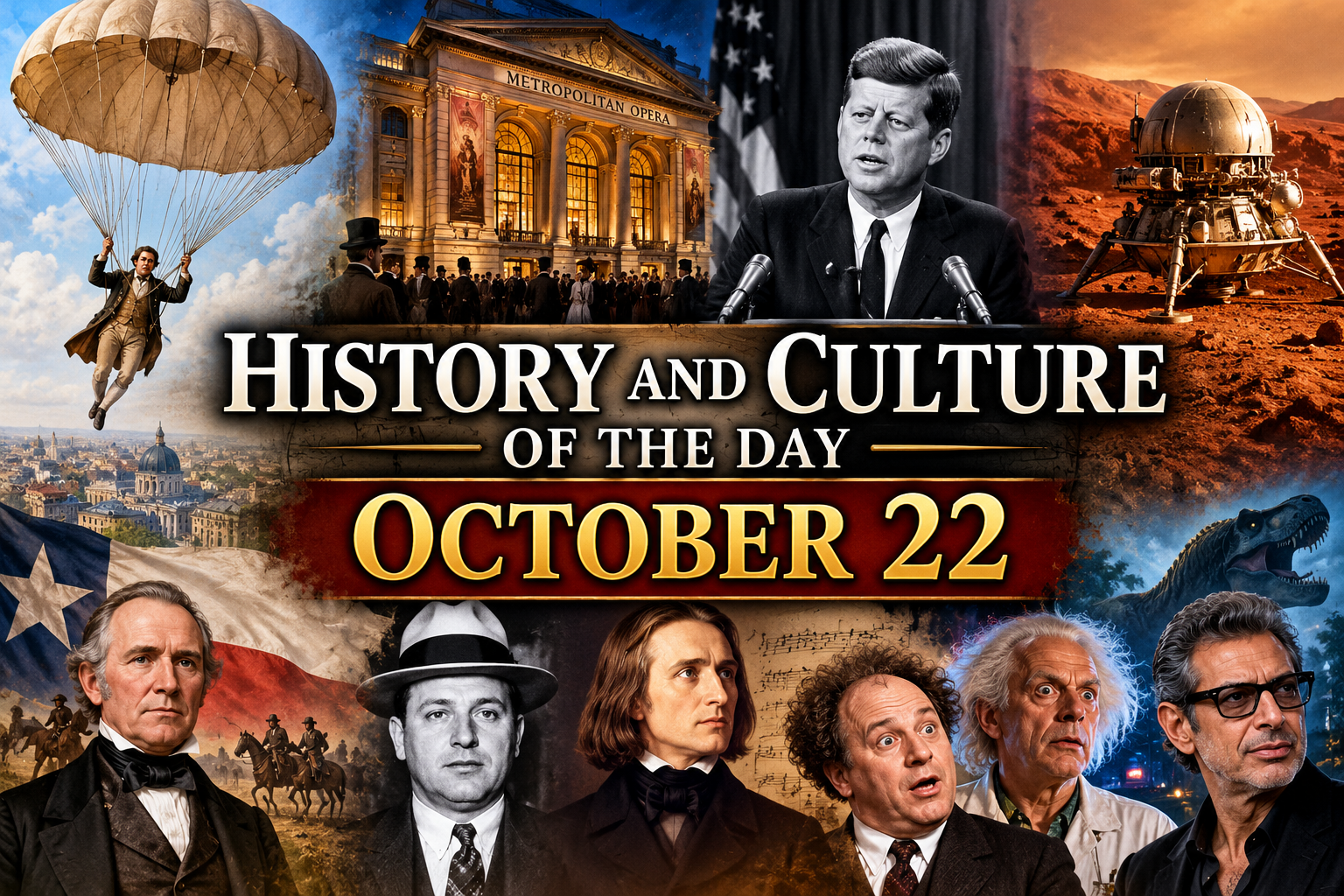
Every date on the calendar carries stories from the past, and October 22 is no exception. Across centuries, this day has witnessed moments involving exploration, science, war, politics, entertainment, technology, and popular culture.
Some events associated with October 22 changed the direction of nations. Others transformed everyday life. The day is also connected to people whose work influenced music, art, politics, sports, and entertainment.
Looking back at October 22 reminds us that history is not simply a collection of dates. It is the continuing story of people—their discoveries, conflicts, creativity, mistakes, courage, and determination.
Here is a look at some of the history and culture connected to October 22.
1797 — André-Jacques Garnerin Makes a Historic Parachute Descent
One of the most fascinating events associated with October 22 occurred in 1797, when Frenchman André-Jacques Garnerin made an early successful parachute descent.
Garnerin had been experimenting with the idea of descending safely from the sky using a parachute. On October 22, he ascended above Paris in a balloon and then separated from it, descending beneath a parachute.
The ride was reportedly anything but smooth. His parachute oscillated dramatically as he descended, but Garnerin survived.
His achievement became an important milestone in aviation history.
Today, parachutes are associated with everything from military operations and emergency aviation equipment to recreational skydiving. In the late 18th century, however, safely descending from the sky seemed almost unbelievable.
Garnerin helped demonstrate that it could be done.
His accomplishment also represents something that appears repeatedly throughout human history: people are willing to risk failure—and sometimes their lives—to discover what is possible.
1836 — Sam Houston Becomes President of the Republic of Texas
October 22, 1836, marked an important moment in the history of Texas when Sam Houston was inaugurated as the first elected president of the Republic of Texas.
Texas had declared independence from Mexico earlier that year.
Houston had already become a central figure in the Texas Revolution, particularly following the Battle of San Jacinto in April 1836. His forces defeated the Mexican army led by General Antonio López de Santa Anna in a decisive engagement that helped secure Texas independence.
The Republic of Texas would exist as an independent nation for nearly a decade before Texas joined the United States in 1845.
Houston’s political career continued long after his first presidency. He would eventually serve as a U.S. senator and governor of Texas.
His legacy remains complicated, reflecting the political conflicts, expansion, slavery, Indigenous displacement, and national struggles of 19th-century America.
The history of Texas cannot be separated from the broader story of how the United States expanded westward and how that expansion affected the people already living throughout the region.
1883 — The Metropolitan Opera House Opens in New York City
Culture took center stage on October 22, 1883, when the original Metropolitan Opera House opened in New York City.
The opening performance was Charles Gounod’s Faust.
Opera had already become an important part of European cultural life, and wealthy Americans increasingly wanted New York to have cultural institutions comparable to those found in major European cities.
The Metropolitan Opera eventually became one of the world’s most famous opera organizations.
Its original building stood on Broadway before the Metropolitan Opera moved to its present home at Lincoln Center in the 1960s.
The Met’s history reflects the development of New York City as an international center of music, theater, art, and culture.
Over generations, countless singers, conductors, musicians, designers, and performers have contributed to its legacy.
October 22 therefore holds a special place in American performing-arts history.
1934 — Pretty Boy Floyd Is Killed
October 22, 1934, marked the end of the life of one of America’s most famous Depression-era outlaws.
Charles Arthur Floyd, better known as “Pretty Boy Floyd,” was killed following a confrontation with law enforcement officers in Ohio.
Floyd had become notorious for bank robberies and other crimes during a period when figures such as John Dillinger, Bonnie Parker, Clyde Barrow, and Baby Face Nelson captured national attention.
The Great Depression created an unusual cultural environment surrounding bank robbers.
Banks were widely resented by many Americans who had lost homes, farms, savings, and businesses during the economic crisis. As a result, some criminals were transformed in popular culture into rebellious folk figures.
That romantic image often ignored the violence and suffering connected to their crimes.
Pretty Boy Floyd became part of that mythology.
His story later appeared in songs, books, movies, and folklore, demonstrating how historical figures can sometimes become very different characters in popular memory.
1962 — President Kennedy Addresses the Nation During the Cuban Missile Crisis
One of the most serious moments of the Cold War occurred on October 22, 1962.
President John F. Kennedy addressed the American people on television and revealed that the Soviet Union had placed nuclear missiles in Cuba.
The discovery triggered the Cuban Missile Crisis.
Cuba lies only about 90 miles from Florida, making the presence of Soviet nuclear weapons there particularly alarming to the United States.
Kennedy announced a naval “quarantine” around Cuba intended to prevent additional offensive military equipment from reaching the island.
For several tense days, the United States and Soviet Union confronted one another while the world feared that the crisis might escalate into nuclear war.
Imagine watching television that evening in 1962.
Families across America listened as their president discussed Soviet missiles capable of striking targets in the Western Hemisphere.
The possibility of nuclear war no longer seemed distant or theoretical.
It felt frighteningly real.
The World Comes Close to Nuclear War
The Cuban Missile Crisis is now remembered as one of the most dangerous confrontations in modern history.
The United States and Soviet Union had enormous nuclear arsenals, and a direct military confrontation could have resulted in catastrophic consequences.
Behind the scenes, intense negotiations took place.
Soviet leader Nikita Khrushchev ultimately agreed to remove the missiles from Cuba. The United States publicly pledged not to invade Cuba, while a separate understanding involved the later removal of American Jupiter missiles from Turkey.
The crisis demonstrated the extraordinary dangers of nuclear brinkmanship.
It also encouraged both superpowers to develop better methods of direct communication.
A direct communications link between Washington and Moscow—the famous Cold War “hotline”—was established the following year.
October 22 therefore represents more than a presidential speech.
It marks a moment when millions of people suddenly understood just how close international rivalry could bring humanity to disaster.
1964 — Jean-Paul Sartre Declines the Nobel Prize
October 22 also holds an unusual place in literary history.
In 1964, French philosopher and writer Jean-Paul Sartre was awarded the Nobel Prize in Literature.
Sartre declined it.
He had long resisted official honors and argued that writers should maintain their independence from institutions.
Rejecting one of the world’s most prestigious awards attracted enormous international attention.
Sartre was a major figure in existentialist philosophy and 20th-century intellectual life. His writing explored freedom, responsibility, human existence, politics, and the difficult choices people make.
His decision to reject the Nobel Prize became nearly as famous as the award itself.
It raised an interesting cultural question:
What matters more—recognition from powerful institutions or remaining faithful to your personal principles?
People may disagree with Sartre’s philosophy or his decision, but his refusal remains one of the most unusual episodes in Nobel Prize history.
1975 — The Soviet Venera 9 Mission Reaches Venus
October 22, 1975, brought an extraordinary achievement in space exploration.
The Soviet spacecraft Venera 9 successfully transmitted images from the surface of Venus.
Venus had long fascinated astronomers.
From Earth, the planet is hidden beneath thick clouds. Before spacecraft reached it, scientists could only speculate about what existed underneath.
What they discovered was an extremely hostile world.
Venus has crushing atmospheric pressure and surface temperatures hot enough to destroy spacecraft that remain there for long periods.
Successfully landing a spacecraft and transmitting information from such an environment was a remarkable engineering accomplishment.
Venera 9 provided humanity with some of its earliest views from the surface of another planet.
Today, photographs and videos from robotic missions throughout the solar system can sometimes make space exploration seem almost routine.
It isn’t.
Every successful planetary mission represents years of engineering, mathematics, experimentation, persistence, and problem-solving.
Venera 9 helped expand humanity’s understanding of one of Earth’s closest planetary neighbors.
1981 — The United States National Debt Reaches a Historic Threshold
October 22, 1981, is associated with an important economic milestone: the United States national debt passed the $1 trillion mark.
At the time, one trillion dollars seemed almost unimaginable.
It represented a major psychological threshold in discussions about government spending, taxation, deficits, and fiscal responsibility.
The national debt has grown dramatically since then, but looking back at the 1981 milestone provides perspective on how government finances have changed over generations.
Debates surrounding the national debt continue today.
Americans disagree about spending priorities, taxes, entitlement programs, defense spending, economic growth, and the appropriate role of the federal government.
Those arguments are not new.
October 22, 1981, simply gave the debate a very memorable number.
October 22 in Music and Popular Culture
History is not created only in government buildings, battlefields, or laboratories.
Culture matters too.
Music, movies, television, literature, fashion, and entertainment tell us something about what people valued and enjoyed during different periods.
October 22 is the birthday of several well-known cultural figures.
Franz Liszt — Born October 22, 1811
Hungarian composer and pianist Franz Liszt was born on October 22, 1811.
Liszt became one of the most famous musicians of the 19th century.
His extraordinary ability as a pianist turned him into something resembling an early international music superstar.
Audiences were fascinated by his performances.
Liszt also composed a large body of music and helped influence generations of musicians.
Long before modern celebrity culture, recordings, radio, television, or social media, performers such as Liszt demonstrated the power a charismatic artist could have over an audience.
His influence remains part of classical music today.
Curly Howard — Born October 22, 1903
Comedy fans may recognize October 22 as the birthday of Curly Howard.
Born Jerome Lester Horwitz in 1903, Curly became one of the most recognizable members of The Three Stooges.
His exaggerated reactions, physical comedy, distinctive voice, and unforgettable expressions helped make the group enormously popular.
The Three Stooges became especially famous through short films featuring slapstick humor.
Generations later, their comedy continues to appear on television, streaming services, home video, and online clips.
Whether someone finds their chaotic humor hilarious or ridiculous, their influence on American comedy is difficult to ignore.
Christopher Lloyd — Born October 22, 1938
Actor Christopher Lloyd was born on October 22, 1938.
He has appeared in numerous television programs and films, but many people know him best as Dr. Emmett “Doc” Brown in the Back to the Future film series.
Doc Brown became one of the most recognizable characters in science-fiction comedy.
With his wild hair, energetic personality, DeLorean time machine, and unforgettable enthusiasm for scientific discovery, the character became permanently connected to 1980s popular culture.
Lloyd’s career also includes memorable roles in Taxi, Who Framed Roger Rabbit, The Addams Family, and many other productions.
His birthday gives October 22 another connection to entertainment history.
Jeff Goldblum — Born October 22, 1952
Actor Jeff Goldblum was born on October 22, 1952.
Goldblum became widely recognized for performances in movies including The Fly, Jurassic Park, The Lost World: Jurassic Park, and Independence Day.
His distinctive delivery and personality have made him one of Hollywood’s most recognizable actors.
His roles in Jurassic Park and Independence Day are particularly connected to the blockbuster movie culture of the 1990s.
Those films became cultural events and remain widely recognized decades later.
October 22 Shows How Different Forms of History Connect
One of the most interesting things about studying a single day in history is seeing how dramatically different events can share the same date.
October 22 connects us to early parachuting.
It takes us into the political history of Texas.
It brings us to the opening of one of America’s most famous cultural institutions.
It introduces us to Depression-era crime and folklore.
It places us in American living rooms during the Cuban Missile Crisis.
It takes us to the surface of Venus.
And it reminds us of musicians, comedians, writers, philosophers, and actors who helped shape culture.
These stories may appear unrelated, but together they demonstrate what history actually looks like.
History is not one continuous story moving neatly in a single direction.
Millions of stories are happening simultaneously.
While governments rise and fall, artists create.
While wars are fought, scientists experiment.
While politicians debate, musicians perform.
While one generation struggles through a crisis, another is being born that will eventually create something entirely new.
Why Studying History and Culture Still Matters
It can be easy to think of history as something finished.
It isn’t.
The world we live in today was shaped by decisions made years, decades, and centuries ago.
Technology builds upon earlier discoveries.
Political institutions develop through earlier conflicts and compromises.
Music and entertainment borrow from previous generations.
Social movements learn from earlier struggles.
Even our everyday language, traditions, foods, holidays, and customs carry pieces of the past.
Understanding history gives us perspective.
It reminds us that today’s problems did not appear from nowhere. It also shows that periods of uncertainty, conflict, and dramatic change have happened before.
History does not provide perfect instructions for the future.
But it gives us something incredibly valuable:
context.
Remembering October 22
October 22 has witnessed moments of danger, creativity, exploration, innovation, politics, and entertainment.
From André-Jacques Garnerin descending beneath an early parachute to the terrifying days of the Cuban Missile Crisis, the date demonstrates humanity’s ability to take extraordinary risks.
From the Metropolitan Opera to Franz Liszt, it reflects our desire to create and experience art.
From Venera 9 reaching Venus to the development of aviation, it demonstrates our endless curiosity about places beyond our immediate reach.
And through the actors, musicians, writers, and entertainers connected to the date, October 22 reminds us that culture becomes part of history too.
The past is not simply something behind us.
Its influence remains everywhere.
Every invention we use, every tradition we continue, every lesson society has learned, and every cultural work passed from one generation to another carries a piece of history forward.
That is why taking a few minutes each day to explore history can be worthwhile.
There is always another story waiting to be discovered.
What historical event from October 22 do you find the most fascinating—and why?




Leave a ReplyCancel reply